Hacker News new | ask | show | jobs
by hogepiyo 1236 days ago
It's difficult to take the author of the article being repudiated (Wingfield-Hayes) seriously when he has lived here for over 10 years and doesn't speak the language.

Any other person who lived in a country for a decade and can't converse in the language would be (rightfully imo) shamed for it.

Idk, say what you like about how journalists operate but living somewhere for a decade and not speaking the language doesn't sit right with me.

23 comments

> Any other person who lived in a country for a decade and can't converse in the language would be (rightfully imo) shamed for it.

I'm German, living in Berlin, and have wonderful friends who fit that description. They live full lives, and I couldn't care less about their German levels. They do enough good things with their time they put their energy into instead.

People should learn languages if they feel a reason to or if they enjoy it. Motivation probably makes it easier. Guilting people by default doesn't sit right with me.

I've lived in Germany myself (NRW). Idk, from my experience it's cool if you're in the young professional tech bubble but when you step outside of that it didn't feel good to me personally. Going out into smaller towns / cities to me at least it rapidly became evident that you're missing something.

Maybe I'm old fashioned or something. I still think there's something to be said for learning the local language (and c'mon if you've been there for 10 years, I'm sure you can pick it up).

This even goes without saying it's Japan where the level of english is far worse than that in Germany (where honestly the standard of English isn't anything like that you find in Sweden / Norway)

> I still think there's something to be said for learning the local language

Absolutely! I worked in South Korea myself for four years and did a year of Korean school in Berlin first to prepare, and then more tutoring and self-study in country. I wasn't particularly great at learning overall, but did get to survival levels of conversational and it definitely enhanced the experience and gave me a connection to last a lifetime.

It's still a lot of fun to watch a Korean show now and be able to pick up on it when the subtitles are bad and miss all the cultural nuances of word and grammar choices, etc.

I just think it's great when people discover that for themselves.

Especially as the guy was a journalist, he was supposed to go into "smaller towns / cities" and write about the people in there.

Surprised though that the BBC hasn't put that as a requirement before sending him to Japan for a 10-year stint. Afaik The Economist requires of their potential correspondents that they know Chinese before posting them to China, and this is why many of their Chaguan China-focused editorials are really interesting (for example in the latest one [1] the Economist journalist takes a train ride before the Chinese New Year and talks with Chinese people with whom he shares the ride)

[1] https://archive.is/85RX3

My wife and I lived almost eight years in Belgium. I learned enough French that I could get in trouble with cab drivers. And trust me, I really tried. But French is a language that just goes in one ear and out the other for me. Unlike Spanish or Italian.

My wife learned enough business French that she was able to survive, but never became fluent.

There are just some people who cannot learn the local language, no matter how hard you may want to force them to do so or how long they've been living in that country. And I think it's a huge mistake to try to force them, or to judge them poorly for being unable to warp their mind around something that is a fundamentally alien concept for them.

As a linguist, the evidence is simply that your wife (or whoever) simply did not get enough exposure to language she understood, at the level she was at. Unless someone has a true learning disability, the only way one doesn't learn the language is because they weren't able to get the right input. And I say that without any blame - for whatever reason it was, that is the cause.
My wife did much better than I did, even though she never became fully fluent.

I will agree that I didn't go to a full immersion language school. But we did arrange for multiple tutors, some on our own dime and some paid for by her employer or mine. And we interacted with the people in our neighborhood on a daily basis.

I found that those who were Flemish speakers would actively prefer to practice their English with me, while Francophones would usually switch to English grudgingly, once they discovered how bad my French was. There were a few Francophones who couldn't speak English at all, or who refused to switch, and interactions with them were very limited and not very productive.

I honestly tried to learn French, but none of it stuck.

In contrast, during those same years, my wife and I took three different vacations to Italy. Twice to Rome and once to Ischia and the Amalfi coast. And I swear to $DEITY that I learned and used more Italian in those four total weeks, than all the French I ever spoke over nearly eight years in Belgium. Something about Italian and Spanish is just far easier for me to pick up.

This reminds me of a recent experience of mine. I was raised bilingual Greek and English (English is my primary language). For my entire life I heard both of these languages and use them both the same. What I had never heard, until recently, was someone who learned Greek as an adult. I was so excited to speak to them because it was something completely new to me.

When they began speaking (Greek) it was like my brain shorted out. I was so excited for them but it took active mental effort to translate what they were saying. I began speaking to them in English and I nearly couldn't force myself to speak Greek.

This was not elitism or snobbery, it was like my brain decided the path of least resistance was English and I used it automatically. Very strange experience.

How about Flemish then? It's one of the closest languages to English, so did you have an easier time with that?
> I've lived in Germany myself (NRW). Idk, from my experience it's cool if you're in the young professional tech bubble

The GP talked about Berlin. Berlin is somewhat special as it attracts quite some foreigners. For me as a German-native it is sometimes weird if I go to a bar or something, outside tority, but "hip" areas and the bar staff only speaks limited to no German, so that the orders etc. have to be done in English.

There is quite a live you can life speaking only English. Of course once you leave the "hip" areas it becomes more limited.

I am with OP, if someone is living in a foreign country for around 10 years and still dont speak the local language, that is displaying a certain disregard for the country they decided to life in.

As others have replied, maybe that is less of an issue in a certain tech-related bubble, but...

I have seen foreigners working in customer service who dont speak the local language sufficiently. People like you maybe expect the customer to speak english such that these people can fullfill the job? I don't.

I don't think we should shame people for not speaking the language of the country they live in, however it's important to stress that you're really missing out when you don't speak the local language.

It will vary a lot by countries, because in some of them (i.e. northern european countries) everyone will be able to speak English so not only you have less incentive to learn the local language but it will be very difficult to practice because the local won't make the effort of speaking to you in their language until you're good enough (which you're not because you lack practice).

Speaking of Japan, as someone who lived there for a few years and reached a decent Japanese level, the English proficency of locals is not great so if you don't speak it you'll be stuck in your bubble of foreigners + Japanese people used to hang out with foreigners. I've seen a lot of foreigners not speaking Japanese after living several years in Japan, and most of them were wonderful people but they were like permanent visitors in the country they live which I thought was really too bad.

I think we should shame people for that: A nation is like a big family. You're essentially saying that you don't think that you should be able to talk to your own family in their language.
It’s not only that. It’s just more work communicating with someone in your non-native language. Especially in Japan where many people don’t speak English well. So you’re creating an additional burden on the people around you.

And that absolutely should be shamed, especially when you’re talking about a society like Japan that places high value on individuals acting in ways that make things easier for people around them and society at large.

I don't think this sentiment would go over so well if I expressed it to people here on the West Coast of the US. Not to mention that there are people that will send their kids to bilingual schools for (and this is conjecture) either lefty political points or potential socio-economic reasons (dual language or Chinese immersion).

I personally love learning languages and am that person that tries to learn a little bit and communicate wherever I go. I does seem to be a hot button issue here in the US. I think people have different expectations. You hear stories of immigrants from the early 20th century that would force their kids to only speak English so that they would get on well in society. It seems like a difficult topic here around heritage vs managing in a society, especially for kids.

Are your friends journalists whose job is literally to understand and translate what is happening around them?

There is a guy working for the BBC in Budapest, Hungary, who learned to speak Hungarian quite well in the past ~3 decades. That shows dedication and enthusiasm, because Hungarian is one of the most useless languages to learn (in terms of the number of people you can speak with). Compared to that, learning Japanese even on a basic level is a no brainer... if you happen to live there for a decade!

The US State Department classifies Japanese as a category IV language, "Super hard languages", languages which are exceptionally difficult for native English speakers. They estimate that you need 88 weeks, or 2200 class hours, to reach professional working level in it. That's if you're young, well-educated and very motivated.

By comparison, they estimate Romanian, Swedish and Spanish take 24-30 weeks, or 600-750 class hours.

Ten years is not much to just "pick up" Japanese, unless you're an exceptional linguistic talent.

That's including reading and writing skills, presumably. Spoken Japanese is not a hard language IMO. Reading and writing it without a dictionary on hand is much more difficult.
I can’t help but think that the interaction between you and parent is based on a misunderstanding. By “no brainer,” I think parent didn’t mean that Japanese is easier than Hungarian but that Japanese is much more useful than Hungarian in that you can speak it with around 10 times more people on Earth.
> They live full lives, and I couldn't care less about their German levels. They do enough good things with their time they put their energy into instead.

What an odd mindset. Anecdotally, prior generations of Europeans (and expatriates) valued being multilingual. Having a working knowledge of German, Italian, French, English was fun, valuable, and normal especially when doing business in diverse countries and with diverse peoples.

That generation even taught us that "When in Rome, do as the Romans do." I guess that principle is no longer a thing.

> Having a working knowledge of German, Italian, French, English was fun, valuable, and normal especially when doing business in diverse countries and with diverse peoples.

That's nice with all these very similar languages using latin alphabet and now try it with Chinese characters and tones in China or at least kanji/hiragana without tones in Japan. Characters are huge barrier when learning the language, because you don't see words to memorize everywhere you look, you see just bunch of strokes. I really wish Chinese switched completely to pinyin as Vietnamese did (and Chinese intended, but didn't finish), it would remove huge barrier in communication (and also tehcnologically wise, after all most of the Chinese already write pinyin anyway on smartphones/computers, which just transcribe their pinyin back to characters) and people would realize Chinese is actually very simple language, where you don't have tenses, plural, etc.

As someone speaking English/German and my other two mother languages I can still understand some Italian, French or Dutch (which is basically English mixed with German by drunk sailor), because of how similar these languages are, so picking up some of them would be very easy compared to Chinese/Japanese (well at least Japanese has much more loaned words from English than Chinese).

Do you actually speak Chinese or Japanese? Because either of those languages with phonetic characters would be a nightmare imo.

The characters actually make it easier to learn the language imo, and anyone who claims otherwise hasn't actually tried to learn seriously

Vietnam and Korea have mostly dispensed with Chinese characters and are doing fine
Strangely enough, the official languages there are Vietnamese and Korean respectively, not Chinese or Japanese.
> I really wish Chinese switched completely to pinyin

Perhaps Americans would take the first step and switch from imperial to metric, then we can discuss and tell everyone what to do.

Yes, they should, but not sure how is it relevant to what I WISHED for, I didn't tell anyone what to do and I'm clearly not an American.
> I really wish Chinese switched completely to pinyin

That's like wishing English would switch to IPA because English spelling is wildly inconsistent - which English would you choose? People who speak different dialects can still understand each other using written Chinese, whereas Pinyin is for Mandarin only.

almost everyone using smartphones and computers already use pinyin anyway when they are inputting Chinese characters, it's just redundant at this point, part of tradition without practical meaning
> almost everyone using smartphones and computers already use pinyin anyway when they are inputting Chinese characters

Cantonese speakers don't use Pinyin.

Prior generations of Europeans were also xenophobic as hell, to the point of going to war with each other. I really don't understand which idyllic past you refer to here.
Everybody has gone to war with eachother in every continent all the way through history.

If you go live in a country (long-term, which 10 years is), you should learn the language and not expect the locals to try to conform to your not-knowing the language... you're there, it's their country, their language, not vice-versa. How can you expect a country where people employed there don't know the local language to even work? Imagine a postman, a service worker, etc. not knowing german.. how is that going to work? When stuff like this happens, you get immiggrant ghettos and yes, in turn xenophobia, because people there cannot get normal jobs and expect the germans to adapt to them instead of vice-versa.

If I live in the country for 10 years, then it is my country too. Perhaps it is in my interest to learn the language, and perhaps it isn't. There are plenty of countries in the world where people get by perfectly fine without even having a unifying language.

Do you guys know how every language came to be? It was through the interaction of people from different cultures, and it is an ongoing process. Germany was not even a country not so long ago. I reject the normative notion that learning a language is central to being a positive member of a community.

> If I live in the country for 10 years, then it is my country too

Lol no. You’re not a sovereign individual. You’re part of a society, and every society is the product of people who have a culture that’s been cultivated over generations. Japan is a creation of the Japanese—the fruit of generations of Japanese people building a society according to their culture—not some foreigner who’s lived there for a fraction of a lifetime.

Yeah, sure, you're able to get by without learning anything in some places... but you are a foreigner who came to their country, and instead of you adapting to the local culture (..well language), you expect literally everyone around you to adapt to your culture (..language) and use a non-native language to interact with you.

Imagine a brit going to france, driving his car on the "wrong" side of the road and saying "it doesn't matter, people just drive around me, it's not an issue".

As you age and require more and more services from the state of those countries do you think that country should provide you with an interpreter? You might encounter government employees, healthcare professionals or elderly care that does not speak English.
And the new generations will increasingly become xenophobic again as arrogant foreginers with no will to learn local language move in.

It's a massive trend in Europe again and it will not end well for the expats.

Yes and then maybe expats will go contribute their skills elsewhere, in a clear loss to the arrogant locals who think speaking language X is more important than living peacefully and contributing to the social welfare that depends on a young workforce that Europe can no longer produce.
It will be a three-way loss. For the natives who lose out on services, for the expats who clearly actively chose being expats in a particular location over all other options available to them and finally for the natives where the expats relocate who have to suffer those assholes (in exchange for services).
Prior generations were more likely to remain in a specific geographical area (eg. central or western Europe) and so taking the time to learn these specific languages made sense. Learning other European languages as a European is also not that far of a leap (unless we're talking Hungarian or Finnish).

Modern generations are constantly on the move in a globalised world. It's not uncommon for that European to end up working in Asia nowadays, where their knowledge of other European languages is useless.

It is still a thing, however, not for hardcore leftists. They will be very fast in calling you a nazi or at least faschist if you utter sentences like that. I am guessing they dont want to see their utopia fail, so they ignore everything which would be evidence against their view of the world.

And its fucking sad, because I used to see myself as part of "them". However, this inability to reflect about ones own failings has totally alienated me.

But (I'm assuming) they're not journalists whose _job_ it is to _understand_ and report on events in Germany. So I think the OP's critique is valid in that context.

Edit: Also, you can get by perfectly without knowing the local language in some cities on the continent, such as Berlin (Stockholm, Copenhagen, Oslo would be others). That is not true of Tokyo unless you're staying in an expat bubble. I spent 6 years in Beijing, and you had the expats who didn't know Chinese and all lived in one section of the city where you could get by on English alone, but that section most definitely did not represent the rest of China or provide a deep understanding of the country and its people.

Berlin is full of people with attitudes like that (both local and foreign), and that's part of the reason why the city is in such a sorry state. It's funny, in addition to those expats who only speak American/British you get a ton of immigrants who speak neither English nor German in a way that any sort of meaningful conversation would be possible. But it doesn't matter because no one cares, not even the government. And then every other week in a moment of brief clarity, some of them wonder why nothing works, from mail delivery over construction to even just holding an election.

In summary: AchBerlin.jpg

>And then every other week in a moment of brief clarity, some of them wonder why nothing works, from mail delivery over construction to even just holding an election.

Berlin has plenty of issues. But I don't think the points you raised here are meaningfully connected with people's language skills.

It's not about skill, it's about willingness to learn the language. It's about people not caring to learn the language and choosing to not be able to communicate with the people around them (except for that small bubble of their friends and the wait staff they expect to adapt to them).

That willful ignorance to anything around you is typically not limited to learning the language, and I agree that it seems to be at the core of Berlin's identity. Berliners love it. I loathe it, and I'd prefer not to send money to Berlin each year so they can continue in their ways.

Amsterdam is like that, maybe just a bit less dysfunctional. I think it's a matter of respect and decency to learn the language of the country you live in.
That seems rather confused. The circle of English-speaking expats doesn't really intersect much with the circle of people responsible for local politics, all of whom speak German.

Blaming expats for the fact that Berlin's politicians are incompetent (which they are) makes no sense to me.

There is a good reason: not being antisocial to the people in the country you are visiting. Most Germans speak English, sure, but dealing with someone that doesn’t speak your native language is incrementally harder and your friend is externalizing that cost onto everyone he interacts with.
If one can't bother learning the language of the country in which they live, any opinion one might have on that country can be safely discarded.
This take is a bit basic.
It's not verbose but it seems pretty self-evident to me. In Europe most people speak only the local language and little English, if you don't speak the language you're not integrated.

Your local businesses won't speak English, your baker, the cab drivers, the people working the public transport, at your local convenience store, the government officials, the deliverymen, your child's school-teacher, other parents at school, 90% of the people you will cross path with on the street, most written and recorded information about local events...

> Your local businesses won't speak English, your baker, the cab drivers, the people working the public transport, at your local convenience store, the government officials, the deliverymen, your child's school-teacher, other parents at school, 90% of the people you will cross path with on the street, most written and recorded information about local events...

And why would I wanna speak with baker, cab driver, public transport workers, convenience store workers, deliverymen, etc.?

I don't speak to these people even back home, I just buy what I want in shop, put it on checkout and pay, only thing you need to learn is answer question about loyalty card or plastic bag and the way you wanna pay (by card), all you need to learn is two words "No" to plastic bag, show your loyalty card if you wanna use it and say "card" and show it so you can pay.

I can order taxi in the app, get in, say greeting and sit there until arrival.

Public transport workers are closed in their cabin and you should NOT speak to them.

Deliveryman will just call you he is on the way, if you are at home and to come downstairs and you just sign or pick up your package, sdo you just need to say "OK, I'm home" to phone.

Other parents in school not speaking English are honestly not worth speaking (similar with obese people since that shows a lot about them), because if you don't speak English it shows bigger ignorance than not being able to speak local obscure language as English speaking foreigner.

School teachers tend to be old, so yes, you could hit language barrier there and would have to deal with that with some English speaking parent.

90% people on the street won't speak English, but for sure majority of adults in productive age will at least in big cities where foreigners move (and in Scandinavia you could hit even that 90% probably).

Most written information online can be easily translated with built in translator.

Honestly only place where you need to speak local language is communication with gov officials since those often tend to be PITA/xenophobic projecting their own complexes since successful people won't work for gov, it's usually job for lazy people who don't mind lower pay and were most likely also lazy to learn English (but to be fair to them, many of them speak English as well).

> And why would I wanna speak with baker, cab driver, public transport workers, convenience store workers, deliverymen, etc.?

Yeah, why would you ever want to speak to people who aren't important. Fucking serfs, they should stay in their place and silently serve you.

I agree, that kind of person's opinion on the country around them can safely be ignored, because it's based on ignorance.

90% of people on the street won't speak English in big European cities, no. I'm sure you can find some cities where they do like Stockholm, but that's the exception not the rule.

The rest of the things you said only confirm you have no intention to integrate and to be a pleasant addition to the community you live in. Your comments about people who don't speak English, and your attitude towards local workers are pretty vile.

The way you write feels like English isn't your first language. Sorry if I'm wrong, French is my native language. But in case you had to learn English, you need to understand that you had the time, resources and intelligence to learn it to a very proficient degree. This isn't true for everyone. The parents you're calling obese and ignorant, they might be a bit like you in that they don't want to use their time to learn something they don't really have to and rather spend time with their children. Older folks usually had very poor English education at school if any and consumed zero English media, unlike a kid today with access to the Internet.

Also in many countries, teachers and hospital workers, amongst other professions, are government workers. You calling them usually lazy people is insulting and ignorant.

In many countries governments are only allowed to communicate in the official language.

So stuff like tax forms or whatever will not be available in any other languages. You'll have to get a translator yourself.

I suspect that most people who proclaim sentiments like that in this thread (of course, just learn Japanese!) do not speak a second language at a conversational level at all.

That people grossly underestimate how hard it is to learn languages, is why Duolingo is in business. And Berlitz, Pimsleur, and Rosetta Stone before them.

The guy didn't say he spoke _no_ Japanese. He said he spoke _little_ Japanese. And for an adult native English speaker, who probably could not get very good social immersion even if he wanted, that is not surprising. No, not even after 10 years.

Two of my friends were into Japanese culture in a big way when I was young in the 90s. Both watched a lot of anime, obviously. Both had excellent second language (English) grades and at least decent third language (French) grades, so it's safe to say both had above average talent for language acquisition. Both went to study Japanese at university. Both moved to Japan. Both struggled with the language.

Isn't it opposite? IMO English natives tend to think that English should be okay in everywhere. European multilingual may think "just learn Japanese" but it's harder compared to european language for europeans
I'm an American living in Norway, in a larger city (for Norway). It's hard to learn, because when I try my burgeoning Norwegian, they immediately switch to English. I don't blame them at all, but I see how someone speaking English could not learn Norwegian in 10 years and be very happy.
That's because you are visibly American. If you looked more like a southerner, you'd have much better, they wouldn't switch to English. On the other hand, they wouldn't even speak a Norwegian to you.
I don't think it's looks, it's accent. Often someone will start a conversation with me in Norwegian before I've spoken, then switch when I answer. Granted, My Norwegian is not great yet (A2/B1 level), but it still definitely makes it harder to practice and learn here.
You could answer their English in Norwegian, or even some other language, e.g. French. If you have started the conversation in Norwegian, they should not assume you can speak English anyway.
True, but politeness feels like continuing in English, because I have no idea if they care to struggle through a conversation with me, and asking people that 5 times through the course of every day starts to wear me down.
Yeah you have to get over the "politeness" hurdle if you want to seriously learn a language.

When I go to Spain, I will always try to speak Spanish and if they reply in English (which they often do because I make mistakes and/or have an accent), I just keep replying in Spanish. That may be seen as "rude" or inefficient by some (although others probably appreciate the effort), but it's really the only way you can keep making progress. (Of course, if it really gets too complicated you can still switch - but usually people switch way before they've reached the end of their skills.)

In my opinion there are lots of external factors to it. I’m also German and we probably both know that especially lots of years back we could’ve set things up differently in terms of integration (which to some degree included learning the language).
> I'm German, living in Berlin, and have wonderful friends who fit that description. They live full lives, and I couldn't care less about their German levels. They do enough good things with their time they put their energy into instead.

I know many people like that too (also in Berlin), and they usually get stressed out whenever they have to deal with their landlord, or any government agency, etc. In addition, there are still areas even in Berlin where the baker or shopkeeper will not speak English well enough. Finding doctors could also prove more difficult, and so on. And what if you have children at some point and they go to school? Unless you can afford some fancy private school, everything will be in German.

Sure, you can get by without German for a while - especially if you have friends who can deal with certain things for you. But you'll just really be very dependent on others and their goodwill instead of being in charge of your own life.

But they do speak English? You can live with that comfortably in Germany and in Berlin especially, probably much less so in many other countries.
Your wonderful friends are not reporting on German society back home. (An assumption I know)

I agree it is outrageous that the BBC correspondent could not speak Japanese

I agree with you in principle. In practice English is often all you need if you live in a big city. When I look at my country (Poland), I can see that a person can live in Warsaw (capital city) or any of the biggest 5 cities without knowing any Polish. Even having an appointment with english speaking doctor is not a problem. OTOH when you adventure outside of big cities you suddenly find yourself in a land where nobody can understand English very well (in that case it's better to chat with teens than adults, most pupils have B2-level English at school).

That being said I know a person that spend 3 years in Denmark and they do not even attempt to learn Danish. Their argument was that the language is very niche, and they are not sure for how long they will stay there. If I was in their place I would probably at least learn Danish to B2 level, just in case e.g. an accident to be able to call a police or an ambulance.

I think the real problem here is that learning a language is a lot of work and requires a lot of efford. If you live comfortably with English they why to put extra effort for something that will provide little or not benefit at all.

I got my hair cut by a Greek barber in Copenhagen. He had been there for 12 years and didn't know any Danish. Somebody came in speaking Danish and he said "I'm sorry but I don't speak Danish" and the rest was in English. For many English speakers it's their third or fourth language and the value of Danish is pretty limited - even for a Copenhagen resident. Obviously, that Greek barber would probably love to speak Danish but as an adult, even a decade of effort won't get him to the level any Danish person can speak English.
> but as an adult, even a decade of effort won't get him to the level any Danish person can speak English.

Children don't have any special ability to pick up languages, but they do have certain advantages: they aren't afraid to make mistakes, they are fully immersed in the language from the moment they wake up, they have no responsibilities like jobs and other adult stuff and they have people (parents, school, teachers, family) constantly talking to them at a level they can comprehend while gently pointing out their mistakes. If you put that barber in the same environment he will be fluent in no time.

I believe they do have an advantage, mental plasticity is higher in children (especially young children).
>Children don't have any special ability to pick up languages

They do. One example I recall from a neurology class is that the auditory cortex of a young child is able to differentiate more sounds than that of an adult. As a child ages, they lose the ability to distinguish sounds not common in their native language. The inability to distinguish the sounds also applies to the inability to tell the sounds apart when speaking it which decreases their ability to produce the correct sound. There is some research showing it is possible to relearn the ability to differentiate, but this requires training specifically in identifying sounds, not training in learning a language.

This doesn't mean fluency as an adult is impossible, and there are many actions that an adult could take to better align their learning environment to that of a child's which would improve their learning, but we should recognize there are some difference that cannot be replicated in adults.

You’re right that one might only need English to live in a given country.

But then how much insight has that person into how other people think (they can’t hold a conversation with the vast majority of non english speaking people), or access to local news and studies...

I think many Spanish speaking countries are in the same boat: not speaking the local language means you end up in a foreign friendly bubble with limited access to anything that didn’t get picked up by that english speaking sphere, which will often include the really interesting stuff.

As someone who moved to Spain I would not say that you can get by with only English. Outside of tourism barely anyone speaks it really.
> I agree with you in principle. In practice English is often all you need if you live in a big city

that might be true in Europe (not everywhere though) or in the US, it is certainly not true in Japan.

There is also a fatigue associated to speaking English for non native speakers that often leads to being identified as the "foreigner" and in practice you end up hanging out only with other English speaking "foreigners".

You also miss a lot about the local culture, because the language barrier forces you to only visit places where people speak English.

It is like living in Poland and never eat pierogi.

> When I look at my country (Poland), I can see that a person can live in Warsaw (capital city) or any of the biggest 5 cities without knowing any Polish

Poland is good (but not great) in that sense, a lot of people speak English, many of them don't speak it well enough to actually hold a meaningful conversation with a native speaker. I understand them as a non native speaker, but I also recognize many of the mistakes in the construction of the sentences they make (and that I make as well).

But that's not true in general, not even in rich and well educated Europe

See

https://cache.eupedia.com/images/content/English_speakers_Eu...

Now the real advantage of speaking some local language is knowing a lingua franca.

It's not uncommon here in Italy to witness a conversation between immigrants coming from wildly different backgrounds (say, for example, North Africa and Eastern Europe) happening in Italian. Their version of Italian, of course, but it's good enough to communicate and they also can practice the language they actually need to interact with Italians.

Of course it takes a lot of time to learn a new language, especially if the language doesn't even have the same alphabet you already know, but after 10 years I would expect to actually have learned at least the basics of it.

There's a difference between, say, a tech worker not making an effort to learn the language because they can get by in English, and someone whose actual job description is to understand the politics and culture of their host country not bothering to learn it. In the second case it looks like professional negligence.
English language is really a superpower. I speak a little Spanish and was chatting up with an Argentine couple in Thailand. They don't speak much English and were telling me stories of being stuck and lost and swindled while traveling abroad.

I've managed to travel to 30+ countries and never felt out of place because most places will somehow accommodate English speakers.

The only place I felt a little bit of language hostility was in Russia. Moscow was probably the least English-friendly major city I've ever been to - but that makes sense from a historical perspective.

I think there’s a very big distinction between the usefulness of English for travel vs living in a country. Sure, English is a great for tourism, but outside of that I would not say it’s as useful as a lot of English speakers like to say. As someone who moved to Spain, I would say it’s pretty much impossible to get by (living) here with only English.
I think you are correct about "need". However when I was in Japan, people were very patient and absolutely thrilled when I inflicted my limited and low quality Japanese on them. It made it an excellent environment to learn in.
>learn Danish to B2 level, just in case e.g. an accident to be able to call a police or an ambulance.

I don’t think Denmark is the best example here. English competency is _extremely_ high and Danish is quite a difficult language to grasp (as far as I know as an A2/B1 Swedish learner).

Danish is not difficult to grasp as it is mostly a mix of English and German words.

Pronunciation is a very difficult ballgame as Danish has sounds not in any of those languages. E.g. stød: https://en.wikipedia.org/wiki/Stød

It's about making the effort to assimilate with your host country. Embracing and empathising with their way of life which begins with learning their language.

I've always found it frustrating whenever I meet people who don't try to integrate with the country they're living in - both when I've lived at home and in foreign countries...

Some people are really bad at language, and depending on the context it’s probably fine to let them off the hook. I once participated in a French class in Paris with a guy whose wife was French, and he was utterly hopeless. I’m not sure he was ever going to develop the skill, even though he tried. Though I hope I’m wrong about that.

I think a journalist writing about a country is a special case though, that doesn’t get affordancee.

I don't really believe this. Of course some people have more of a tendency to be good at languages than others but I think the guy from you story probably didn't try hard enough or maybe had a completely wrong approach. There are many countries where virtually all people speak a foreign language which shows that it is possible for almost anybody to pick up another language.
I really dislike the “didn’t try hard enough” angle. He seemed to be trying, he really wanted to be able to settle in to a productive life with his wife there. It’s lacking in empathy to assume you have all the relevant facts to pass judgement.

Countries where people are multilingual from a young age clearly have some major differences to those where they are not, and even in those countries many people are not multilingual.

There is a theory that children have a "language acquisition device" that goes from muscular brawn to a flubby dough-boy with age in most people. IDK if that's accurate but there does seem to be something to it.

The countries where everybody is multi-lingual this almost assuredly happens in middle to early childhood.

It is true that the plasticity of children's brains is higher than that of adults. Research also suggests that in very early childhood, children have an exceptionally good ability to discern different sounds and the ability to learn how to make those sounds, although this ability is lost at some point.

However, I believe many people overestimate the advantage children have in learning a language. For example, a four-year-old can have a basic conversation and communicate their needs, but they are not yet able to have a complex conversation. Their vocabulary and pronunciation may not be fully developed yet.

It's important to note that this child has spent a significant portion of their life learning the language and is exposed to it daily, and likely has parents or others to practice their language skills with. Despite this, their language level is not yet perfect.

The point I am trying to make is that it takes a significant amount of time and effort to learn a language, and there is no shortcut or "hack." Most adults would likely do comparably well if they dedicated the same time and effort to learning a language as children do.

I think one of the problems is that many people know about this child super power and then give up. OTH, I live in Italy which is full of adult African immigrants, and they all speak Italian.

The fact is any adult can learn any language, they just either don’t have to or don’t want to. I’m not saying it’s easy or it’s the best decision for every situation, but it’s definitely possible. This is true even more so if it’s a popular language with a lot of resources to learn it, and you live in the country where practice is virtually free.

Yes, most people just assumes that learning a language is equaly easy for everyone.
Tbf to my original parent comment, a close friend fits the description of someone who wields English extremely well and is hopeless at foreign languages so I'm not completely unempathetic to people who struggle
So if you live in 4 countries over four decades in your adult life you will learn 4 new languages?

I don't think you must've lived more than one place abroad, or somewhere with good English. For example I speak 4 languages, understand another 2, but don't speak the language of the country I've lived in for the last 3.5 years, and I'm not even learning. At some point it's just absolutely not worth it and I'm just gonna occupy memory that will be more useful for work or life.

This is the most common take you hear from people that never lived abroad, only speak one language, or lived abroad in a single place where they learn their first ever new language. Then judge someone who'd be learning their 4th or 5th. It's absolutely not the same thing for a native english speaker to learn one single foreign language when they move once and compare it under the same light.

>So if you live in 4 countries over four decades in your adult life you will learn 4 new languages?

Well, first I would argue that you're a massive outlier to the norm. I don't think living in multiple countries for decades at a time each that don't share a language is at all common.

>This is the most common take you hear from people that never lived abroad, only speak one language, or lived abroad in a single place where they learn their first ever new language. Then judge someone who'd be learning their 4th or 5th. It's absolutely not the same thing for a native english speaker to learn one single foreign language when they move once and compare it under the same light.

I don't really see the need for the presumption. If you move around that much and speak that many languages, all the more power to you. I was just saying generally if you live somewhere for a decade you should (probably) be reasonably competent in the language, especially if you're a journalist attempting to write insightful articles aimed at broadening a foreign understanding of the place.

> I'm just gonna occupy memory that will be more useful for work or life.

Well said, though presumably if your work was _BBC Tokyo correspondent_, that would be a weird argument.

Why does the number of countries matter? You go to a foreign country for a week, and you learn a few phrases (please, thank you, where is the toilet, ...) before you enter, just in case someone there doesn't know english, because why should they, if they're not from england/usa/canada.

If you live there for 10 years, you should definitely be able to learn the language enough to do daily tasks in the native language there.

> So if you live in 4 countries over four decades in your adult life you will learn 4 new languages?

If those 4 countries have 4 different languages then yes…

I’ve spent most of my adult life in foreign countries, and I’ve never spent time in a country without starting to pick up the language. I speak 3 languages fluently, another 2 I can have a conversation in, and there’s a few more that I have a decent foundation of the basics with. I don’t even know how it’s possible to live in a country where everybody speaks another language without starting to pick it up rather quickly.

Unless… you’re intentionally refusing to or simply do not spend any time with the locals, which is something people should rightfully be judgemental about.

He’s a journalist though - his job is to talk to people and ask questions. Surely that’s got to be much easier if you can do it in their native language?
If you're living in each place for a long time then yeah, you should learn the language. If you're just a temp worker then it's nbd, but then you also shouldn't be writing articles about the culture you clearly can't integrate in and don't understand.
> So if you live in 4 countries over four decades in your adult life you will learn 4 new languages?

Yes.

But you can't claim in-depth knowledge of the country if you can't access primary sources. Which might be important to some jobs.
> So if you live in 4 countries over four decades in your adult life you will learn 4 new languages?

Yes, unless you go out of your way to avoid learning the language and sticking to English as much as possible.

English speakers are notorious for not bothering to learn local languages, eg:

    Migrants failing to assimilate, 200-year-study finds

    Migrants to Australia have displayed an inability to assimilate with local values and refuse to speak anything but their native tongue, a study covering the last 200 years has found.

    The study confirms a popularly-held belief in parts of the country that migrants simply refuse to fit in.

    Boat people from as far back as 1788 didn’t bother applying for passports or visas, were set on introducing their own laws, and, in many cases concealed criminal records, according to the damning report.
~ https://www.theshovel.com.au/2023/01/26/migrants-failing-to-...
This is about non English speakers not learning English. I’m missing some sarcasm?
It is referring to English colonisation of Australia a few hundred years ago. The English did not learn the indigenous languages there, and they brought English law with them. It also refers to the fact that a lot of convicts were sent to Australia.

Joke: An Englishman gets off the plane, and immigration asks him if he has any criminal convictions. He replies “I didn’t know you still needed one”.

Yeah, not sure if attitude of english speakers toward natives in Australia is something to be widely joked about or satirized.
Bit late for that now, don't you think?

    "There's nothing I would rather be
    Than to be an Aborigine
    And watch you take my precious land away.
    For nothing gives me greater joy
    Than to watch you fill each girl and boy
    With superficial, existential shit.

    Now you may think I'm cheeky
    But I'd be satisfied
    To rebuild your convict ships
    And sail them on the tide.

    I love the way you give me God
    And of course the mining board,
    For this of course I thank the Lord each day.
    I'm glad you say that land rights wrong.
    Then you should go where you belong
    And leave me to just keep on keeping on."
~ Jimmy Chi, Bran Nue Dae, 1990

[1] https://en.wikipedia.org/wiki/Bran_Nue_Dae

[2] https://www.youtube.com/watch?v=ZTiXSmQET2E

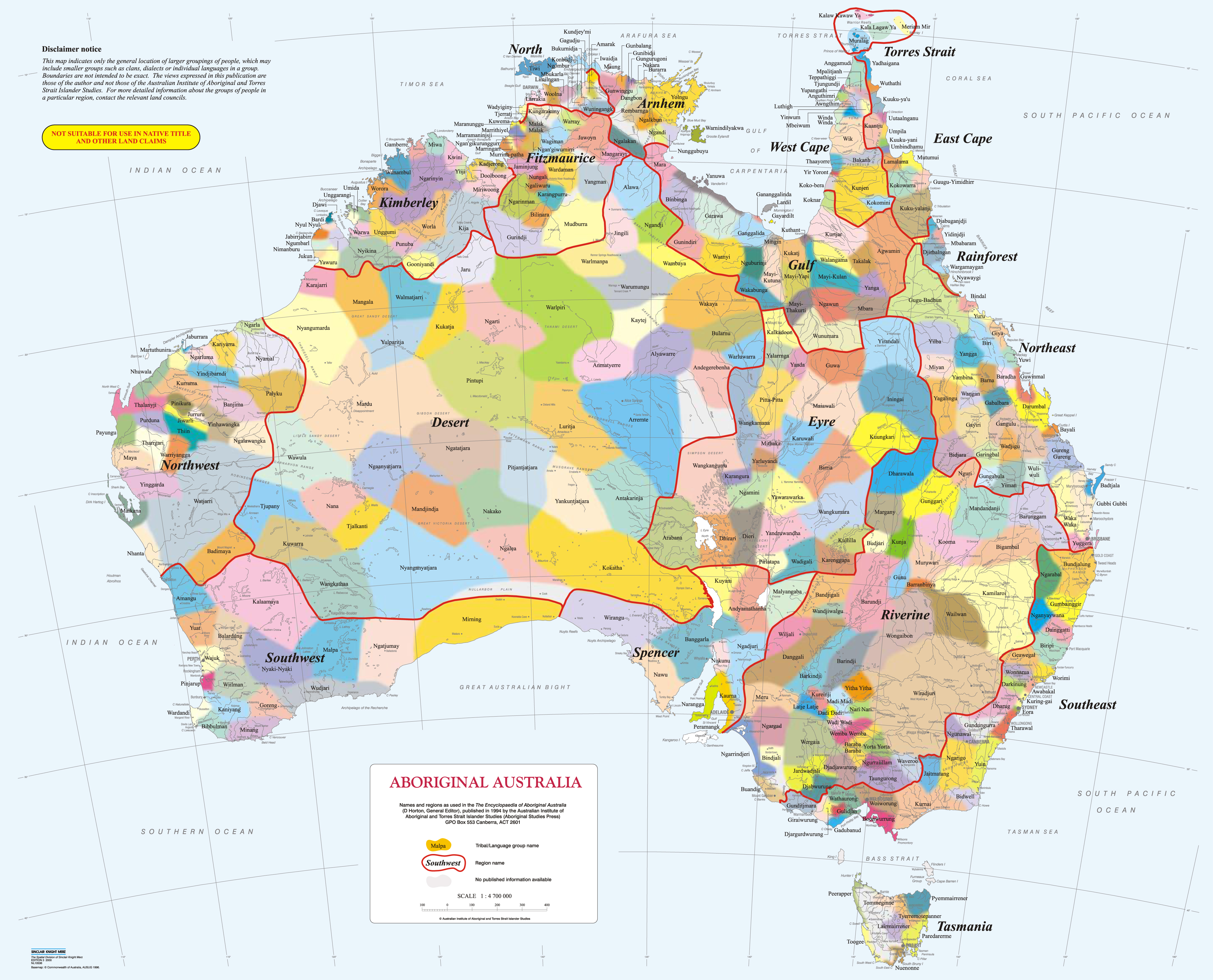
If you're curious here's a map [1] of the language groups that the English speaking immigrants mostly didn't bother to learn.

To their credit a rare few migrants picked up a couple - but today fewer than 30 original languages are still used.

[1] https://mgnsw.org.au/wp-content/uploads/2019/01/map_col_high...

theshovel.com.au is satire
I've lived abroad for over a decade and spent considerable effort learning the local language but I wouldn't shame someone for not doing the same. Learning a language as an adult is incredibly difficult and imo the benefits are limited unless you are learning the absolute basics (e.g. learning the 200 most common words) or you're able to get to a high level (which again is incredibly difficult to do).
But you don't need a lot more than those absolute basics to do day-to-day stuff in that foreign countries, and i despise people who cannot even learn that despite living there for years. If someone lived there for 5, 10, ... years, and cannot order beer, ask for a bag in a store or buy a bus ticket in the native language, that seems really disrespectful to the locals, who are expected to know and use a foreign language all the time to deal with them.
> Any other person who lived in a country for a decade and can't converse in the language would be (rightfully imo) shamed for it.

You haven't been to Sweden then.

I spent about half my year in Japan and half my year in Sweden and I speak both languages. It's always shocked me how many expats feel it's not necessary to speak the language but the justifications are totally different.

In Sweden they say "Everyone here speaks English anyway"

In Japan they say "All of my friends are expats anyway"

I think if people don't want to learn a language they will come up with any excuse.

> I spent about half my year in Japan and half my year in Sweden and I speak both languages.

Yeah, I really doubt that you can move to Japan with zero Japanese and in half year learn enough to hold normal conversation and be able to read/write Japanese, all that while working full time and not being immersed every day in Japanese language course.

It's perfectly possible to learn a language in 6 months if you spend a lot of your time conversing in it, avoiding English as much as possible. They also said "speak", not "write". It's possible and even natural to learn one and not the other.
Almost anything is possible, even time travel, it's just not very realistic under certain circumstances. In case of learning Japanese in 6 months while working full time in English speaking enviroment with 0 Japanese foundations to start with.
> Yeah, I really doubt that you can move to Japan with zero Japanese and in half year learn enough to hold normal conversation and be able to read/write Japanese, all that while working full time and not being immersed every day in Japanese language course.

If you're working full time in Japanese you could absolutely get conversational Japanese within half a year. Indeed I suspect that's the most practical way.

> If you're working full time in Japanese you could absolutely get conversational Japanese within half a year.

I fail to imagine scenario where Japanese company hire non-japanese speaker who will then be working full time in Japanese language to learn it.

Happens all the time with menial or physical jobs where they're desperate for labour - construction, fishing, forestry, that sort of thing. You can't get a work visa for that kind of job, but if you have a visa for other reasons (spouse, child of Japanese national, etc.) they'll take you.
Weird way to generalize the problem. The difficulty of learning Swedish is not the language itself, but because Swedes default to speaking English with you if they see you struggling. If you want to truly become fluent in Swedish you have to constantly ask them not to do that, and most expats get sick of it by the 10th or so time.

(First point) https://www.thelocal.se/20180817/the-signs-youve-mastered-th...

>I think if people don't want to learn a language they will come up with any excuse.

In a world where it was actually true that you don't have to learn the language wouldn't it appear that they always have an excuse not to? So how does your experience give evidence we're not in that world?

N1? You mastered 敬語 in 6 months?
I think they meant for the past x years, they've been spending half of it in Sweden, the other half in JApan, in chunks of 6 months.

edit: and you can be fluent in one or more languages without knowing how to read/write them.

I think he spent half a year every year
you spent half a year in japan and speak the language?
Or Finland, or the Netherlands, etc.

English is so widely spoken in these countries that many foreigners manage entirely without learning the local language.

It’s got to the point that in central Helsinki, you often can’t get service in Finnish in bars or restaurants.

> It’s got to the point that in central Helsinki, you often can’t get service in Finnish in bars or restaurants.

That would really suck if you were a native Finn and don't speak english, and the service worker in your own country doesn't speak your local language.

Yes, it is a common complaint in newspapers.

On one hand it's just part of a continuum of language transitions in a city that never was monolingual or even Finnish-dominated for most of its history. 110 years ago many neighborhoods in Helsinki were majority Swedish-speaking and the official language mandated for the government was Russian. A lot of people spoke all three languages. (I'm 42, was born in Helsinki, and I remember from my childhood shops in fancier neighborhoods where the service was in Swedish.)

On the other hand it's a real shame that it risks sending Finnish into a vicious circle of decreasing usage: the elites start speaking English and working in English, and Finnish once again becomes the insignificant language of country bumpkins.

Between 1860 and 1940, the nation collectively worked very hard to "uplift" Finnish into a real written language that is actively used in literature, science, audiovisual culture, and so on. People translated their family names and started speaking Finnish to their children. I can see that work being undone over the next century. (My own two children probably would have lost the language if we hadn't returned to Finland now; we were living abroad for years and they'd already started talking English between themselves.)

This is also starting to happen in Prague city center, though the real reason is those overpriced tourist traps are not frequented by locals so there is no need for staff to speak local language, it should be enough warning for you (as local) that you are in tourist trap.
I've been to prague every few years for decades now, and the whole city center has become just a giant tourist trap. Sadly the same is happening to many other old european capitals to the point where they all look and feel the same... some old buildings, a river and tourist traps and scams.
That's what happens in 4th most visited city in Europe, I can certainly relate to locals from Barcelona and Venice.
I live in ljubljana, and the same is happening here too...

Prague, bratislava, budapest, vienna,... it's all the same.. buildings are slightly different, landmarks slightly different, but the general feeling inside the "old town" centers is the same... pretty much same restaurants selling same overpriced food, same stores selling same made-in-china souvenirs and some obscure "locally made" stuff that's useless and way too expensive, same boat tours, same bike/scooter guides, same weird hidden supermarkets for the last few locals still living there... same tourists, same loud spanish girls, same japanese people with huge cameras, same groups following the same guides holding up same flags and umbrellas not to be lost in the crowd, same tourist cards, same corruption with guides (recommending shitty restaurants that pay the guides to steer tourists there)... it's kinda sad to me personally... tourism has destroyed so much sadly.

>It’s got to the point that in central Helsinki, you often can’t get service in Finnish in bars or restaurants.

I've only seen that at Fafa's, but that's part of their "international" branding.

Happens to me roughly 1/3 of the time in Kallio restaurants (not the oldschool grimy ones) and central fine dining spots.
Same for Norway.

If your Norwegian isn't good enough (even if it is just that one day or you are having a moment), folks quickly switch to English.

Some Norwegians have trouble understanding other Norwegians as well and wind up using English. Dialects vary greatly from the written language and they just sound... different. Children start learning when they enter school (6 years old) and I think half of the graffiti is in English.

I have no experience with Sweden, but The Netherlands would also be a counter-example.
Idk why this was downvoted?

There's not much pressure to learn Swedish because everyone here is fluent in English.

While doing my Swedish language course I met people that had lived here for 20 years and never learnt it

That is certainly true, but your experience is quite different if you speak Swedish or not. I definitely experienced a barrier when I mostly spoke English. I was working in an environment where everyone was speaking English, so it was harder to learn Swedish, however my relationship with swedes definitely improved after I tried to use more Swedish.
A lot of countries require a certain level of language knowledge to gain permanent residency. I can't imagine Sweden is too different than its western neighbor, where I have and still reside. I guess they realized that they aren't moving and need to have a plan when they retire? (I did read something in Norwegian immigration rules that it is possible if someone has lived for a significant amount of time, they can achieve permanent residency. Maybe there are stipulations. I don't know if the same thing is present in Sweden.)

It takes a bit a passion to keep on learning. I experience well enough, even though I still struggle with it. But living here, I do have a sense of FOMO though if I don't know what is happening where I live and having to be stuck translating everything or asking for summaries is extremely tedious.

I did think in the past that if universities require students to sit through local language lessons, in part to be prepared for other classes, what is the other part? My sense is that students have a lot of potential for local economies. The same "welfare" grant is rarely given by companies, where maintaining a workforce of contributing and skilled professionals could be equally as important. Yet, I found exactly one company in my own job searches that offer a stipend for a basic language course for a job that otherwise requires just English abilities. That actually sounds like an excellent job perk. This is really why people could sit 20 years without knowing more than a few phrases and can read signs. Maybe the cost of courses is not within a budget for something that is mostly optional for work life. But it is a damn shame anyway. For myself, I never took a course. I wish I did, but my language knowledge played a significant role in getting a lead developer position at a very good company (I kept saying in interviews that this is exactly something I want to improve :) )

Not only is there not much pressure, it's actually more difficult as Swedes are generally happy to speak English and will often switch as soon as your accent gives you away as a foreigner. After 15 years living here I am now fluent, it was a challenge though!
> Any other person who lived in a country for a decade and can't converse in the language would be (rightfully imo) shamed for it.

How many languages do you know?

I live in a country with 11 official languages; please come stay for half a decade.

And no one is expecting you to know all 11. But I'm sure on average most people know more than ONE. which country anyways, India?
> And no one is expecting you to know all 11.

TBH, there's only one you need to know in order to feel like a native - english.

> But I'm sure on average most people know more than ONE.

Guilty, unfortunately. The non-english one I know is pointless, useless and has too much emotional baggage attached to it to make me happy about speaking it.

> which country anyways, India?

South Africa.

India has double of that - 22 scheduled languages[0]

[0]: https://en.wikipedia.org/wiki/Languages_with_official_status...

Although he jokes about not speaking Japanese well in that tweet, I've seen him conversing in Japanese in some reports. I think he probably speaks Japanese well enough, but is lamenting that it's a hard language to get really good at.
Have you lived in country with completely different language with characters instead of simple <30 letters alphabet for 10+ years? It's very different for English speaker to learn Spanish or German and learn Chinese or Japanese, characters are VERY big barrier when learning, since even when Japanese learns German they just need to learn like 30 letters and they can read and write anything, while vice versa German must learn 500-1000 (Chinese) characters one by one at very least to be able to read some Chinese.

It's one thing to see everywhere words you can memorize when seeing it every single day in shops and online and very different thing when you see just bunch of strokes.

I lived in China for 5+ years and didn't learn the language because the characters are huge barrier. In a few weeks with Duolingo I learned more Spanish without ever visiting Spain than Chinese in few years living there. Same while travelling in Indonesia (where you are/were forced to learn Indonesian), I picked up comparable amount of phrases within few weeks as in China in few years. Of course I learned some basic Chinese characters at very beginning, so I can read at least menu in restaurants and bunch of phrases (how much does it cost, where is nnn,etc.), but I couldn't have any conversation at all with anyone not speaking English (or my mother tongues) and honestly I was not really interested in people who don't learn at least English as I had to learn as well since it's not my mother tongue. It probably helps I've found girlfriend (wife) who can be my translator if needed (which was not really needed even when dealing with paperwork most of the time).

But if author is journalist then I agree there should be set a higher bar for them, so they are able to research independently and make interviews with locals. It's one thing to be journalist covering the country and other thing just living your life working in English speaking enviroment without writing stories for thousands of people abroad.

> It's one thing to see everywhere words you can memorize when seeing it every single day in shops and online and very different thing when you see just bunch of strokes.

They become much, much easier to grasp once you notice they're nearly all composed of the same hundred or so radicals and you can break them down and memorise them that way.

> and honestly I was not really interested in people who don't learn at least English

That may be the real issue here. Mandarin has nearly as many speakers as English. Why should anyone be interested in people who don't "learn at least" Mandarin?

Going to China for that long and not trying to learn Mandarin is a misstep. Chinese is spoken by a lot of people, but spoken fluency isn't that high. Moreover, outside of the major cities, you will meet very few English speakers.

Where I lived, Shanghai, there was a western community that essentially interacted with each other in their enclaves and never developed any meaningful relationships outside maybe dating someone who was Chinese. In Shanghai at least you can get along just fine without learning the language, but you will miss out on so much because most people around you can't hold conversations in English.

> Going to China for that long and not trying to learn Mandarin is a misstep.

I went to China with intention to stay there one year to save some money and continue travelling. Then after less than a year I met my future wife.

> Where I lived, Shanghai, there was a western community that essentially interacted with each other in their enclaves and never developed any meaningful relationships outside maybe dating someone who was Chinese. In Shanghai at least you can get along just fine without learning the language, but you will miss out on so much because most people around you can't hold conversations in English.

I lived in Beijing and avoided foreigners outside work enviroment (well we had drinking lunch breaks and ocassionally drank even during dinner after work), didn't frequent bars/clubs for foreigners and first few years even avoided western food. In my first three apartments I had Chinese flatmates (no foreigners, always only me) and we had no problem to communicate in English. The problem in general are different hobbies and culture, not really the language, most of the westerners will have more to talk with other westerner even in broken English than with Chinese who is perfectly fluent in English, it's just fact and speaking Chinese won't change a thing about it.

I share a bit of that experience when trying to make Chinese friends. The first place I lived was with a family who had a son around my age. He was solely interested in practicing English but he had virtually no life outside of school.

I moved into a foreign students dorm and most of my classmates were Korean and Japanese, but I spoke to them in Chinese. The friend I hung out with the most was Korean and I didn't feel like there was a gap in hobbies. We had a group that would go out and play pool, drink soju, and sing KTV. I never had good opportunities to meet and hangout with other Chinese students. When people go to bars, they really don't go and socialize with others. Socializing is usually contained to the group you are in.

I think I'd say though there is still a big advantage in just being able to converse with taxi drivers, retail workers, etc. People are pretty chatty because westerners speaking Chinese is kind of novel. It is a great way to better understand what I consider a fairly misunderstood country.

I don't think understanding the country and not speaking the language are mutually exclusive. I've met my fair share of foreign students who studied Chinese at home, then stayed in China for a year to not overstay their honeymoon period and yet their understanding of China was completely shallow and they were clueless about China as much as they were when they came, because all their life was dorm parties and clubbing or shagging CN girls and enjoying their student bubble, while speaking local language. Meanwhile I worked for multiple companies over years, talked with plenty of Chinese coworkers whether they were interns or fulltime, dealt with apartment hunt seeing at least hundred of apartments in person, tons of various paperwork with various offices, dealth with hospitals because of wife's pregnancy and visited places that hardly seen any foreigners. You can still understand China even without speaking the language and not understand it while speaking the language.

But I agree western MSM is heavily biased against China and their "journalists" living in their foreign bubble are joke, especially if it's older unmarried men, where you can clearly see what they are doing with their spare time.

> That may be the real issue here. Mandarin has nearly as many speakers as English.

Completely different league, English has by magnitude more speakers than Chinese.

> Why should anyone be interested in people who don't "learn at least" Mandarin?

Because not learning any foreign language is quite sign of ignorant character, while English is foreign language in most of the world and most of the world English speakers are non natives including me who learned 2-3 foreign languages besides my mother tongue. But you are right Chinese not speaking any other language besides Chinese is less ignorant than me...

> Completely different league, English has by magnitude more speakers than Chinese.

That's an incredible claim. Got a reference for it? Wikipedia reckons 1.5bn English vs 1.1 bn Chinese.

Those numbers are native or second language. I bet the English numbers shoot way up vs Mandarin if you drop the bar to basic language skills or holding limited conversations.
It’s the one thing where I’m That Old White Man by now. My favorite is user groups meetups in Germany where there are one or two people who don’t speak German, and then request the talk to be held in English.

Imagine me attending a meetup in London as the only German and requesting to have the talk held in German. It would be ridiculous.

German is not lingua franca spoken by people all around world, so yes, this comparison is ridiculous comparing lanugage taught everywhere in world with niche language, which is less popular than Chinese as foreign language.
English is spoken by people all around the world, but not all people around the world speak English.

Also, those expats living an English life in Berlin etc. are doing themselves a huge disservice — you learn a language if and only if you are forced to hear and speak it. By attending meetups and softly forcing your language onto the group, you are never going to break out of your bubble.

It’s a lose-lose situation for everyone involved, really. The German speaker is limited in what she or he can express, the German audience is limited in what they can understand, the English audience doesn’t progress in learning the language of their new home country.

> It’s a lose-lose situation for everyone involved, really. The German speaker is limited in what she or he can express, the German audience is limited in what they can understand, the English audience doesn’t progress in learning the language of their new home country.

Maybe, but by not learning German they expats miss out on access to about 40 million Germans/Austrians/Swiss who don't also speak English (and they are likely not the smartest ones either). By not learning English, the locals block themselves out of a vast amount of knowledge and resources contributed by over 1 billion people.

Expats miss out on local job opportunities that need German speakers.

I am not in Germany, but the point applies to other countries. I missed out on extremely good opportunities a few years ago because I didn't speak the local language well (like opps that would have gotten me an easy 20-30% raises. I was constantly having to say no to recruiters because of that one detail, that I was not good enough at the time. I did get good and I did get a good opportunity and I hope in the future that I don't see it any other way that the investment of putting my head into something like that will have a great return in the future.

So I take it you took it upon yourself to learn Mandarin and perhaps also Spanish?
With Spanish and English you can communicate from Canada to Patagonia except for Brazil (and the Brazilians will understand an 80% of spoken Spanish and a 90% of written one because of Romance similarities), among UK, Spain and Scandinavia. Also a good part of France, Portugal and lots of Southern Italians will understand you in Spanish too.
No, but I don’t engage in Mandarin or Spanish communities.

I do engage in English-speaking communities, and I do so using English.

You are working with assumption people don't live in their bubbles even when living in home country speaking mother tongue and that not breaking bubble is something bad. Many people voluntarily choose to live in bubbles which overlap with other bubbles.

For instance I live in bubble where in general I avoid having conversation with obese people, since these people have complete lack of self control. It would be also quite odd to me to have (deep) conversation with person not speaking English (even if we both talk to each other in different language), since that shows ignorance to learn basic necessity to exist in present world and lack of education and world views (I mean how the heck can you learn anything about the world not speaking English just from limited local sources). I'd probably for various reasons avoid talking to people with dreadlocks and/or large amount of tattoos. You may think I am doing disservice to myself by living in bubble without talking to all these people, but I am fine with that and have my reasons for that.

How do you know it's disservice, if they are happy with their choice, you know better than them what's good for them?

Only thing I agree with you it's forcing 90% of local language speaking group to speak English because of just few people who don't wanna learn language, this will get tiresome pretty quickly, so they better find group with larger percentage of local language non-speakers or just make smaller groups or talk one on one (personally I prefer this option than some big group conversations even in my mother tongue, because there you end up fighting for word).

> since that shows ignorance to learn basic necessity to exist in present world and lack of education and world views (I mean how the heck can you learn anything about the world not speaking English just from limited local sources).

My parents' generation learned Latin and French instead of English, and there's an argument to be made that you also can't really understand a lot of the world without at least some passing familiarity with both of these languages. In the GDR, people used to learn Russian, for obvious reasons, and that's not so long ago - many of these people are still in the workforce.

That's not really an excuse, my retired father learned Latin, German (to the level he was translator) and Russian and he still late in his age learned also at least basic English.

Meanwhile my ignorant low educated mother learned just very basic German needed in shop to be able to communicate with German speaking customers.

I can cut you some slack if you are above 50 and know at least some other languages, but honestly you should still know at least very basic English even without formal education. I also learned at least very basic Spanish without any formal education. There is no excuse for anyone below 50 to not speak English even if they speak Latin or German.

There was a time when German was the language of science and widely studied in many countries. (Japanese has disproportionately many loanwords from German, for example).
Tragically, it was in no small part the fault of the Nazis that led to the decline of German for science. A huge number of German scientists emigrated to the US in the 1930s.
I'd give it a go if you want to speak German for a bit. However, the conversation is very likely to be skewed towards talking about Kraftwerk, Nue! and careers of Eric Zabel, Jens Voigt and Andre Greipel.

(To be perfectly frank, even if you're speaking in English the conversation is going to be skewed towards Kraftwerk, Nue! and careers of Eric Zabel, Jens Voigt and Andre Greipel. Sorry about that.)

Joking aside, I don't think I've ever met a local that didn't appreciate my attempts to start a conversation in their language even if we eventually switch to English.

I upvoted you because I appreciate the sentiment a lot.

As a non-native speaker in my country, if I seek to participate in meetups, etc. with the expectation that the language used will be the local one, I would prefer not to switch to English. I deliberately go to tech meetups partly for that purpose. It's fine to switch to English if the presentation is specifically in English, but I do not want the audience to accommodate to my lacking; I'd rather be clueless than be accommodated.

Japanese is rated as either the #1 or #2 hardest language for a native English speaker to learn (and the reverse is true which explains why you often run into people with little or no English there as opposed to in, say, Western Europe, where many people are practically natively fluent in English). People can and do learn Japanese, but it isn't something that one can easily learn in their spare time the way English speakers can learn French or Spanish.
I hear this frequently, but disagree strongly, at least regarding the spoken language. As a native English speaker who learned Japanese easily to the "could get by as a tourist" level with two semesters of college classes and minimal self study, I find French much harder (and I took 4 years during high school).

Unlike many southeastern Asiatic languages, Japanese doesn't have any sounds that the average English speaker doesn't already know how to make (possible exception in the 'l' sound, but, if you can roll your 'r's, it's the same tongue position). There are no articles, only two tenses, relatively normal conjugations (though adjective conjugation is odd relative to English), no declension, and sentence structure has strong hints of Latin. The simple-polite forms of verbs are sufficient for daily use. Pitch accent and ga vs. wa are hard to pick up without immersion, but neither are necessary to be understood.

The written language is a different story. Lots of memorization. The hiragana and katakana come quickly, but there are a lot of kanji. Probably not needed for tourists (particularly in the day of image translation on phones), but still a factor. Arguably still easier than Mandarin in that regard, though.

Additionally, there are an overabundance of resources for Japanese learners. The economic potential of American occupation under MacArthur and the subsequent boom years, the enduring popularity of Zen Buddhism, and the rise of anime's popularity in the West have likely all contributed to Japanese being one of the best-supported Asiatic languages in academia and self-study courses. Its support in the USA is exceeded (in my estimation) only by Mandarin due to the large immigrant population and ongoing trends in trade.

In short, I'm sure the number of native English speakers who can "get by" in Tokyo eclipses the total number of native English speakers with basic Lao, Thai, Khmer, Vietnamese, and probably even Mandarin skills.

Just one datum.

Written Japanese is a difficult language for native Japanese people. One would be in high school before one has learned enough Kanji to read a typical daily newspaper.
Seems pretty weird to me as well.

I don't understand how you could love a country enough to live and work there for a decade but not try to learn its language.

Let me introduce you to wild idea that language is just tool and has nothing to do really with the country/culture. I may loved China (at least first few years) where I lived for years without loving their politicians and learning language (beyond few useful phrase and numbers), same goes actually for many countries I travelled.

My kid is citizen of country A, was born in country B and lives in country C speaking languages B, C and D without actually speaking language of his citizenship country, because it's just language, you are not defined by your passport or mother language. I'm from country A, his mother from C and I speak to kid in B and D. The world is not black and white.

That idea is insane, it's well established that language shapes thought. Ask any multilingual person and they'll tell you their personality changes from language to language. I'm glad your kid speaks a bunch of languages, but if they don't learn A they'll never be able to fully culturally connect with country A either.
> it's well established that language shapes thought

I don't think is necessarily true. There is empirical evidence for linguistic relativity, but my intuition is this is often culture getting encoded in the language and then passed on. However, the way the language is used can change.

Most of the world's languages are spoken by a limited number of cultural groups, so if you analyze language L only spoken by group G, then you will find the way people of G use L is quite similar.

But if you look at languages with native speakers of diverse culture backgrounds, you will find the way they use the same language is quite different and often a reflection of their culture, not the other way. Like the way native English speakers from Wyoming speak versus native English speakers from Dehli, or a native Spanish speaker from Bolivia versus one from Northern Spain.

> Ask any multilingual person and they'll tell you their personality changes from language to language

I experience this too to a mild degree. My intuition is that it is the context in which the languages are used.

> if they don't learn A they'll never be able to fully culturally connect with country A either.

That's true, but at the end of the day a parent has to make a decision. It is tough to juggle lots of languages with kids and have time to do other things. Many kids will reject home languages if they don't get to use it outside of a single parent.

> Ask any multilingual person and they'll tell you their personality changes from language to language.

I disagree with this, I'm same person whether I communicate in English or my mother tongue, you could ask what people speaking English think of me, people speaking my mother tongue think of me and you would get pretty consistent decription.

> if they don't learn A they'll never be able to fully culturally connect with country A either.

I'm fine with that since A) they are not living there anyway, B) language of country B is actually very similar to country A, so much that people from these countries can talk to each other in their own local languages, C) I don't have really high opinion about culture of any of these countries or some "country culture" per se.

I am beyond some stupid lines on map or languages, although it may be difficult to comprehend for children when their school books are intended for kids born here, so they read there nonsense such as "Our mother country is A" and I have to correct it at home, that this is not our mother country, this is country where we live.

As mixed race/country kids living in country of neither of their parents it will be a bit confusing, but not necessarily bad, at least they won't be tied by concept of single home and some single country, which I find limiting when I look at others being proud about country they were born in as if it were some of their accomplishments. I have same attitude about people being happy about some athlete from same country winning some medal as if country had anything to do with that, great for the athlete, but it has nothing to do with you.

> Let me introduce you to wild idea that language is just tool and has nothing to do really with the country/culture

This is a wild idea because it's false. It's hard to be a part of any culture if you don't speak the language. All you've said is that knowing a language doesn't make you part of a culture, which nobody would disagree with in the first place

We are talking here about country and country's culture. What you say works for homogenous societies, but there are plenty of countries with multiple official languages where none of the citizens would be part of their country culture then, look at Switzerland, Belgium, US, etc., these countries don't really have single country culture defined by one common language, but at same time I'm sure all these people living there share similar country culture despite some of them being able to talk to each other.

If you say "any culture" then sure you can be always part of some (sub)culture if you narrow it down, it just matter how much you are going to narrow it, in the end you can be part of culture of foreigners living in specific country.

> Switzerland

Have you ever lived in Switzerland? Because I grew up there and if there's ever a group of people who don't accept you if you don't speak their dialect it's the Swiss Germans.

Swiss languages are regionally segregated, meaning that if you want to settle in to Zurich, you'll need to speak German (and at least understand Swiss German), if you want to live in Geneva you'll have to know French and you won't get anywhere in Lugano without knowing Italian.

I would be very surprised if in the case you all stayed in C, your kid wouldn't adopt at least some of the culture/ethnicity/values of C, which would be through the language of C (or possibly a C-derived subculture/creole).
sure, that's expected, but it won't be thanks to language, but because of the enviroment regardless of language
But language is part of the environment : the communication in the environment and understanding of the environment is mediated through language !
Ability to learn new languages (as an adult) follows normal distribution. Moreover, the further the new language is from one’s mother tongue the more difficult it is. Furthermore, people who excel in mother tongue (with enhanced writing and expressive abilities) often fall on the lower end of the spectrum with the ability to learn new languages. Shaming people over that is quite … shameful.
Whenever I find a language hard to learn, I always remind myself that the vast majority of every population can speak their own language.

"Chinese is hard" -> 1.5B people figured it out.

More recently, on observing my niece and nephew, something we take for granted is how exhausting it is being a child. You are learning 247 non stop for best part of 2 decades. Can't understate how hardcore it is. No wonder why we adults have less stomach to learn a new language. The kind of immersive learning required for language acquisition is all encompassing, and really kind of needs to take over your life - especially one distant from your mother tongue.

I say all this while figuring out how I personally muster the motivation, routine and immersion to gain fluency in Mandarin by the end of this decade (a personal goal).

> "Chinese is hard" -> 1.5B people figured it out.

Yeah and at least 90% of them were immersed in it since birth at home. Learning mother language while growing is very different from learning foreign language as adult.

> Can't understate how hardcore it is.

No, it isn't for kids, my kids are trilingual without any issues and much effort, kids are like sponges absorbing new information/languages easily, if you start early.

Btw. you won't be fluent in Chinese without living in China.

> at least 90% of them were immersed in it since birth at home

Bullshit... Maybe at best half of Chinese have Mandarin as a home language - of which half again speak Xinan Mandarin at home which is barely intelligible to a Standard Mandarin (Beifanghua) speaker. So the majority of Chinese learned Mandarin as a second language.

And obviously the writing and ideograms is something that every one of them had to painstakingly memorise over 15 years of schooling...

> Btw. you won't be fluent in Chinese without living in China

I know plenty of people in Singapore and Taiwan who wouldn't even bother to make fun of your ignorance...

Mandarin is language taught in Chinese kindergartens/schools regardless of province, so yes while their parents may speak different dialect at home, they learn it from very early age.

And you know very well I meant that 90% of those Chinese language speakers are ethnic Chinese and not foreigners. So congrats you won Nitpicker of the month prize!

> I know plenty of people in Singapore and Taiwan who wouldn't even bother to make fun of your ignorance...

1. Maybe you should check on official name of "Taiwan". 2. I am talking to non-native Chinese speaker (not you), not sure how does that apply to ethnical Chinese wherever they live, whether it's Singapore, Taiwan or US. Even the person I addressed my message to agrees with me, so congrats once again on completely pointless nitpicking.

> And obviously the writing and ideograms is something that every one of them had to painstakingly memorise over 15 years of schooling...

Yeah I've always wondered what the implications of growing up learning an ideogram based language has on your development.

>No, it isn't for kids, my kids are trilingual without any issues and much effort, kids are like sponges absorbing new information/languages easily, if you start early.

My point isn't that it's hardcore for children to be trilingual. My point is that the way of life of a child is exhausting - learning 247. If you try it later in life, eg doing a masters/bootcamp/intensive hobbies you realise how hard work it is trying to learn.

Having met people who have replicated learning like a child in adulthood, I posit that some of it is that children don't have responsibilities and also don't have a choice in the matter. The upside is also considerably greater - learning to walk + communicate.

> Btw. you won't be fluent in Chinese without living in China

I have lived in China before so this is very apparent to me. When I was there, my brain was always processing the language in the background. Remembering new vocab, trying to recognise new characters. Thinking about how to express specific ideas. That is worth so much more than any class or course can teach - and time spend learning like that really compounds. A week in a country like china can be worth months of study for me. And that style of learning is also how I imagine children are - constantly processing consciously and unconsciously...

> Yeah and at least 90% of them were immersed in it since birth at home

And the guy from the article has been immersed in it since ten years ago. Thats long enough to learn enough to be able to do day-to-day tasks and not expect every local there to adapt to your lazyness of not learning the language.

In France it is virtually impossible to function of you do not speak good French.

In a company you will miss all the important things that are usually conveyed in casual French (this includes subtleties that change the meaning of a sentence).

Yes, people will speak English with you, usually fluently (and with plenty of errors), but this is not the language of choice for the off the record conversations.

Outside of work you will get by in supermarkets, but for more complicated shops your will have problems.

For the administration it is clear: without being fluent in French there is no way to do anything. Even if you are a native speaker you understand just half of it and hope for the best.

People in the street speak English [citation needed] but they will get tired after some time and then the English becomes unbearable.

Source: native French married to a foreigner who struggles to understand everything (not to mention the subtleties) after 15 years of active use of the language.

What if a country has two official languages (Canada) or three (Switzerland) or eleven (South Africa)?

Do you need to learn them all, as a foreigner? What about as a naturalized citizen? What about as a born citizen?

What if a country has adopted English as another official language (Hong Kong, Malaysia). Do you still need to learn the other languages?

Switzerland has four official languages (Romansh was added in 1996 and was a "national language" since 1938).

In any case, particularly in Canada and Switzerland the official languages tend to be far more geographically divided than the unofficial languages in those countries, or the many languages in South Africa or much of India, or even Chinese in Singapore, Spanish in the US, etc. It's usually clear which subset of languages, official or otherwise, are useful for the city/region in which you live.

You should definitely get off your high horse a bit, world is a bit bigger than your opinions. There are millions of very smart high earning expats all over the world that see no reason to learn local language well if its ie too hard for them, they practically never use it (ie at work its english, at home its XYZ and for basic chit chat you get by with few hundreds of basic words), or simply don't have time to learn due to ie parental responsibilities.

I applaud to every parent who rather spends time with their kids rather than studying language because 'you should'. Ideal is both of course, but that's not how reality usually looks like.

I only hope those expats are ready to pick up and move either back home or to another country because they can't find a job in English in their country. They might be fine though. However, I'm being serious and am not joking, because it was my own concern. I am probably ok though as a software developer, maybe, but the thought of picking up and leaving at this point is really tough. At the very least, securing my assets and collected pension is well worth the time I am putting in to learning a language. Hey - you even get brownie points when you can mutter something in the local language.

As an example, here in Norway, I have read of expats, specifically British expats, being denied various earned benefits because their residency permits have expired and/or they decided to return back to where they came from. The collected pensions were not afforded to them. IANAL definitely, so if this is ok or not in terms of EEA rulings is maybe another story, but this, even being pre-Brexit, was still worrisome to me. At the time, years ago, I was not a citizen here nor a citizen of the EU/EEA, so tying my wife and my benefits' fates to whatever employment we were able to attain is a bit concerning. Not being explicitly tied to employment and maintaining the full rights of every other citizen by being one myself is a relief. Of course, one of the requirements was reaching a certain language level (it was A2 when I got it, which I aimed for specifically, but the government has since decided to push it up to B1.)

Also, I don't have children, but I have had co-workers who do, who sought to learn enough to be involved their children's education and also really can't afford expensive international schools. I mean, we all make salaries that are average to our profession, citizens and non-citizens alike; I mean, if you want your children to only speak English, work in a English-speaking country.

Look, good for you if you refuse to learn the language of your society.... As long as you don't attempt to write opinion pieces about that society you have no hope of integrating or understanding.

That's what the article writer did.

Nobody said outright refusing, I specifically mentioned even with few hundreds of words you can get by in many societies (probably not Japan or ie China though). Its about priorities, one has very little free time and for some there are more important matters than talking a bit better to strangers. Many languages require multi-year frequent commitment, you can learn tons of other skills or sports instead.

You can certainly write opinions, that's what they are, internet is still mostly free for speech. Not sure why you feel as an authority on who can write what. Something about high horse again? Living somewhere you can get tons of positives and negatives of state, society etc. even if not understanding a word. Maybe not 100% picture, but enough to form an opinion and write about it

My country has no official language and the lingua franca of my neighborhood is not a language I speak. Shit just got weird because basically no one would not consider me part of this society and I sure as hell understand it roughly as well as anybody else in my hood.

Maybe America is just weird but you can come here and not learn English and if someone refuses your right to comment on our society they'll probably just be called a straight up racist.

Your country isn't the whole rest of the world. I thought that would be obvious for an average HNer?
I would think one would look at the original quote and see it says:

"私は日本語がかなり下手です" [0]

Not being good at something is not the same thing as having refused to learn it. From the authors response I honestly can't assess their level of Japanese well. I routinely have had people tell me they don't speak English well but then have a full conversation with them.

https://twitter.com/wingcommander1/status/161706014073333760...

It's fine to live somewhere for many years without learning the local language. Even learning a relatively "easy" language, like German for a native English speaker, takes about a year of full-time dedication. Not everyone has time for that.

It's definitely not ok, however, to act as if you're an expert about the local culture. There is so much you can't grasp unless you speak the native language. Talking to people is important, but equally important is consuming native media and the news.

Hayes said he didn't speak much Japanese. That he speaks any at all, is probably evidence that he tried.

People vastly underestimate how hard it is to learn languages. A few people seem to have the knack for it, but the large majority of us don't. Especially not when we get older. Japanese is also famously hard for native English speakers.

I don't get all the replies to this comment.

hogepiyo was saying someone who lived for a decade and cannot speak native language does not have enough credit for us to believe his/her comment on the entire country's changes. The fact that people do can live this way does not change this point.

You should visit sweden, we have a lot of people that have lived here for like 20+ years and don't speak the language.

Although, some parts of cities nowadays you don't need to as other languages like arabic is more common.

In the words of the great Cioran "One does not inhabit a country; one inhabits a language".
I'm finnish and work with a lot of international people, many of whom have lived here for decades. None of them speak Finnish, and I, and all the other Finns I know, would never expect them to speak it. It's not that big of a deal.
That's great, but you also wouldn't expect them to write a relevant critique of society and culture since they can't even read the local news paper much less understand the living mindset of people.

Everyone here keeps anectoding about their trip to other places when the issue is not daily living but writing an opinion piece about a society they don't understand enough to live in.

Yeah, I get your point. Of course their point of view about the culture and society is unique and important and absolutely worth listening to, but it is true they will certainly miss a lot of the cultural nyances for exactly the reasons you described.
Why? What's so important about that? Pleasing the locals?

Not a hypothetical question for me. I've lived in Germany for fourteen years. And while I can mumble my way through some basic conversations, I'm far from fluent in German. I'm sorry but I'm not interested in sacrificing an enormous portion of my time to such a project either. Seems to be quite common here with foreigners. It's very rare that I get angry/annoyed reactions from Germans on this. The opposite actually, there are quite a few Germans here that are attracted to the notion of living in Berlin partially because it is more international focused.

In the time that I've lived here, automated translations have gotten much better. Which helps with the inevitable bureaucratic stuff or interacting with people who only speak German. There is very little practical need for me to speak German beyond that. And otherwise, the business language in the companies I deal with is mostly English. I of course live in a bit of a bubble with lots of foreigners that have invaded Berlin. I've also lived in places like Finland. Finnish is much harder than most other languages to pick up. So, I never even pretended that learning was going to be a thing. This might not even be my last country.

Most countries smaller than Germany or the US tend to be a lot more pragmatic about people speaking their language. People appreciate it if you do and generally don't really feel threatened by non native speakers.

With some exceptions of course. This is a popular topic with populists/xenophobes worried about people stealing their jobs, women, and real estate, becoming marginalized in their own country. You get that in a lot of places. I tend to not have a lot of sympathy for such people though. The opposite actually. Those aren't their jobs. You need the right skills and typically for skilled labor there isn't a whole lot of unemployment. We foreigners show up because we are wanted and needed to do a job. Women aren't property and are perfectly capable of deciding for themselves whom they form relationships with. Fun fact in Finland, a dis-proportionally large part of the local women end up marrying foreigners. And the real estate value indeed goes up if smart people move in and start creating economical value. Economic growth is generally a good thing but indeed annoying for the locals.

I think there's going to be more migration due to technical progress with translations between languages and the removal of language barriers. And I think that is a good thing. While I like English (the only language other than Dutch that I mastered well enough to use it professionally), there are large parts of the worlds where people just don't speak English very well. We literally refer to some parts of the world as third world countries, which is very condescending. It means that they are poor. But the implication of course is also that they are somehow inferior and a bit retarded. And that there are second world countries as well that are slightly less inferior. Language has created this elite bubble that keeps it like that for some of these countries. Being able to go to such places and live there without first having to learn a language is very liberating and is probably also going to be great for e.g. trade relationships. I think that should be welcomed. English optional. Also in the US, which of course has plenty of migrant groups that don't speak that very well.