Hacker News new | ask | show | jobs
by CDSlice 1418 days ago
> If you want some games that really revolutionize what games can be, check out Celeste, Secret Little Haven, Baba Is You, and Glittermitten Grove. All of these games really challenge what games can be and experiment with radically different kinds of art.

I haven’t played most of these games but I have played a lot of Celeste and I don’t really see how it challenges what games can be or experiments with radically different kinds of art. Don’t get me wrong, it is an absolutely amazing game and one of the best platformers of all time with a sweet, well written story but at the end of the day it’s a 2D platformer. Yes the controls and art are much better than most but there is nothing in the gameplay fundamentally different than what the original Super Mario Bros had on the NES.

I’m also not really a fan of the snobbish tone of the article. Horizon Zero Dawn is certainly not revolutionary in terms of game design but nobody claimed it was. Genres exist for a reason and just because a game (or TV show, or movie, etc) conforms to the expectations of the genre doesn’t make it bad. Also as a side note, I really resent them calling Aloy a “waifu” since Horizon is one of the few games with a female protagonist that is both undeniably a woman while also not being made as a sex object. Metroid is famous for being one of the first games with a female protagonist but for the entire game Samus might as well be a guy, non-binary, or a robot since all you see is her armor. You only find out she is a woman after beating the game and discovering that based on how much of the game you completed the more clothes you can strip off of her until she is left just wearing her underwear. Tomb Raider on the other hand had an obviously female protagonist but one that was intended as a sex object for guys to ogle with her large breasts, skimpy clothes, and near complete lack of personality. Meanwhile Horizon presents Aloy as a strong protagonist who doesn’t need men to save her at every turn while also not being sexualized to such extremes that you feel like the real reason she exists is so that men have someone to ogle at while playing the game. The fact that Horizon (and The Last of Us series which presents its female protagonists similarly) get such extreme hatred from capital G Gamers because “they made them look like men!” should be evidence enough that this is revolutionary in its own way in the industry.

7 comments

Games that challenge the standards, therefore making them good art: Factorio. Papers please. Obra Dinn. Prison Architect. Even old-school Minecraft did amazing work challenging definitions. (Subnautica?) I haven't seen an artistically interesting AAA game in decades.
When have AAA games ever been the source of challenging standards? AAA implies a level of budget at which that much risk isn't taken. If you look back multiple decades, it was so much cheaper to make a game that the definition of AAA doesn't makes sense. Even first-party major publishers were at most "AA".

Doom challenged standards, but Doom could be made by 5 people crammed in a house. Metal Gear Solid. The Sims had more people credited for music than Programming, Design, and Graphics combined (21). Minecraft was one person for the most part.

Look at the credits list for Morrowind: https://en.uesp.net/wiki/Morrowind:Credits

And for Skyrim: https://www.mobygames.com/game/windows/elder-scrolls-v-skyri... At the time, development costs were estimated at $100M.

The latest Skyrim Anniversary Edition remaster will surely have a credits list dramatically longer than the 2011 release. AAA games are expensive now, and no one's going to invest tens of millions on the hope that billions of people across the world understand your cryptic commentary about nuclear weapons or whatever.

>> When have AAA games ever been the source of challenging standards?

SimCity. The original Civilization/Colonization. The Wing Commander series (privateer). Syndicate (1993). F-19/F-117. (The Janes sim series??) AAA doesn't mean high budget, just the highest budget games in the market at the time, those backed by market leaders.

This sounds like a redefining of AAA Games. When everyone's new at the gaming market - especially Sid Meiers and Will Wright were developing their early games, those were *absolutely* indie-tier.
Hard disagree. Back then, market leaders were small companies that had to take risks to differentiate, and where you could fundamentally still self-fund if you had enough savings to live for a couple of years. Now the quality of a top-tier game requires a huge team, a huge amount of funding, and guarantees to the source of that funding.
What about CoD4? I think CoD4 gave me more understanding to the reality of a war than a layman teenager needed back then.
Prison Architect though? It's not a bad game, but seems like ordinary entry in simulation/tycoon genre.
Except that it teaches you to care about prisoners. The "win" is to keep them happy. That makes the capital punishment sequence downright disturbing. It is also the only game I know of that was reported for violations of the Geneva convention. (Misuse of the red cross symbol.) That had to be worth some artistic credibility.
Taking an atypical narrative stance seems like a low bar, in and of itself, for defining challenging standards. I'm in agreement with parent that it's well executed, but to reach for a lazy description, it's basically "[..] with a twist". I'd be surprised if it's remembered as milestone. (Your last sentence sounds like classic PR fare and not noteworthy.)

This is reinforced by how it came to be. Basically Introversion spent too much time and money on a tech demo without any concept of turning it into a game [1]. Prison Architect took a safe, well-trodden paradigm that was easier to turn into a finished, profitable protect. Subversion was the sort of game that could have broken the mould if they'd ever figured it out. I remember being underwhelemed hearing about what their new project would be when they gave up on it.

[1] https://en.m.wikipedia.org/wiki/Subversion_(video_game)

I actually haven't played any of those games but I'm surprised the author(s?) didn't mention any of Daniel Mullins' games. Pony Island, The Hex, and Inscryption are all really interesting "meta" games in the same vain as The Stanley Parable. Inscryption being the one that I feel functions the best out of the three as both a commentary on games as well as actual gameplay.
Author of the article here. I haven't played those games so I can't really comment on them :)
Highly recommended. Definitely seems like they'd be in your wheelhouse.
I apparently have Pony Island in my Steam library. Gonna take a look at it after dinner I guess. Thanks for the suggestion!
I'll second this; while I haven't played them myself, I've watched playthroughs of all three of them, and they really do an amazing job of blurring the line between the player's character and the real-life person playing the game. Combined with having some hidden secrets being only unlockable by doing real-world things outside the game, it's hard for to decide whether he's basically created a new art form that transcends the game genre or just has gotten everyone who's played the game essentially to join a sort of AR/roleplaying game of which his video games are just some of the pieces.
> I’m also not really a fan of the snobbish tone of the article.

As someone who really enjoyed Horizon Zero Dawn, I agree. It was a fun romp with a lot of spectacle, and there's surely room for that in the world. Not everything has to push the boundaries of the art form.

I suppose it's true that basically no AAA publishers release anything that does push those boundaries, but that's unsurprising, since pushing boundaries isn't where the money is. For every Baba is You or Outer Wilds that takes off there are a thousand games that make next to nothing. It's similar with the visual arts or music; by challenging norms or experimenting with "radically different kinds of art" you're much likelier to end up with something that displeases almost everyone than you are to be the next Jackson Pollock or Ornette Coleman.

> I really resent them calling Aloy a “waifu”

Given the amount of hate Guerrilla got for not making Aloy ultra-sexy in Forbidden West, this was pretty unfortunate phrasing.

I think that one of the biggest things that Celeste has going for it is its movement mechanics. It's this brilliant system where you are given all of the powers you need at the beginning but aren't taught how to use them until completing the game (i think a lot of the mechanics are actually revealed in the B and C sides). This also gives Celeste some killer replay-ability - there's nothing better than going back to early stages and using learned movement tech to break intended solutions. I think I could be convinced to categorize that as a bit of a revolution of game design.

This is also something that Outer Wilds did really well imo.

It's just a tight platformer with a small twist in the movement mechanic, that's not "a revolution of game design".

Frankly, Outer Wilds plays like shit. The controls are extremely complicated and difficult to wrestle with. However, that really suits the exploratory nature of the game. However, in terms of game design, Outer Wilds is clearly _far_ more interesting and revolutionary than Celeste. Totally physics-based 3D platformer and space exploration game on a time loop is obviously far more mechanically interesting than a 2D platformer with a restricted mid-air dash...

I think there's a lot to be said about the restrictions you put on a system when it comes to design.

I like Outer Wilds! It's fun, I'm currently playing through it. However, Celeste is the more mechanically interesting game when you combine the intentionally limited movement and the forgiving nature of its levels. My 9yo is currently trying to work her way through it, yet gives up on harder Mario levels. Celeste made hard, 2D platforming accessible.

I just don't think 2D platforming with a basic restriction can really be considered revolutionary
To be clear - Outer Wilds is another design system where everything is unlocked at the beginning, but obfuscated from the player until they play through long enough to learn the mechanics. Same concept, just applied to various game mechanics, but not movement mechanics.
Out of those I've only played Baba Is You and it's a great game, and certainly pushing game design.

It's not too unlike other programming puzzle games from zachtronics or Tomorrow Corp, but its interface is a lot more abstracted and it feels like a different paradigm than those.

I haven't played Glittermitten Grove, but Frog Fractions is a great meld and full of surprising genre shifts. It's not revolutionary, but it certainly has its own feel.

I'd have added Return of the Obra Dinn and Papers Please to the list, though. Maybe instead of Celeste, like you said.

> I really resent them calling Aloy a “waifu” since Horizon is one of the few games with a female protagonist that is both undeniably a woman while also not being made as a sex object.

Maybe they hate human protagonists on games wholesale. I’m on anime side and has a personal hate against a broad spectrum across Disney/furry/cartoon. Due to this background I am easily triggered and might go on to a rant of similar scale if, for example, a graphic, visually homosexual werewolf character would become an AAA protagonist.

The author’s odd reaction to just a modern female protagonist seems to be on that kind of internal logic and magnitude.

I've found people who extole Stanley Parable are not just capital G Gamers but also capital G Gatekeepers. Their game curation aesthetics have all the tact of Superman's Braniac collecting planets.

Celeste is derivative of Donkey Kong Country. I agree that for an author who thinks derivation itself is stinky, using an overly reductive critical framework where every game is derivative of, I don't know, unaliving Donkey Kong at the arcades, it was odd to see Celeste as a counter example.

Most of game innovation the past decade has been in the monetization model, moreso than mechanics. The author looks down their nose at microtransactions so they have probably missed all the innovation even as it continues to cross pollinate with every aspect of the games industry. No wonder they think Stanley Parable is still a noteworthy observation in 2022.

Hi, author of the article here. Microtransactions are an active cancer on the gaming world and I abhor their prevalence in modern gaming. The _only_ time I find them okay is for when they are for _cosmetic purchases only_, and even then the games industry has done a terrible job of making sure that is the case. Sometimes I want to play a game to play a game and immerse myself into that game's world. I don't want to have people manipulate money out of my wallet and into their bank account.

Then again, I'm also someone who has been suckered into spending over USD$200 on Fortnite skins, so a lot of my rejection of microtransactions is rooted in the fact that I am vulnerable to their temptations and would rather they be anywhere but in the games that I play on a regular basis. Nintendo games are usually good about not trying to fleece you for cash in a game you paid full price for, so I play a lot of those.

Gaming as-you-define-it is surely dying and it took maybe 15 years for microtransactions to do it in.

However, more people play video games than ever before and more games are released per year than at any other time in human history. So what died exactly? Certainly not an industry. Only a business model has died. A game's business model has always been inextricably tied to its design, going back to arcades. So designs you like are dying.

This is why I classify your behavior as gatekeeping. All those happy gamers must be enjoying games wrong. The designs they like are not valid game designs because they aren't adherent to your design aesthetics.

Do you miss paying a fixed price for a fixed amount of content, never to be updated? Nothing about that is incompatible with microtransactions. In the old days we called them expansions. These days they're called battle passes.

Do you miss paying for access to a live game server? Those used to be called subscriptions. Now we've found a way to offer free subscriptions to any and all, subsidized by gamers who have the financial freedom to support their favorite games.

[edit: for politeness]

No I actually miss paying 60 dollars for a product, getting the entire product, using the product, and that being the end of it. The fact that you even begin to equate business success with how happy the games are making people is absolutely abhorrent and a terrible way to think of things.

Have you made free to play games? Anyone who has taken even a small look at it obviously KNOWS that it's not people with "financial freedom to support" who are putting money into these things. Stop kidding yourself.

$60 price point for games spans back nearly 2 decades. In today dollars those games would cost $90. If you would like developers to release games with source engine graphics, and charge $90 for them, then just say that.

Back then games had a huge problem with equitable access. You needed the equivalent of $90 disposable income in 2022 just to try a game sight unseen. Gamers were incredibly wealthy and privileged in those days.

The industry dealt with rampant piracy from those who wanted game experiences but couldn't afford them. Gamers relied on written reviews by a handful of curators to derisk purchases.

All the while the table stakes to develop a game were rising. The nature of the console games industry is a technology reset every decade which undermines economic efficiencies in development tools. Development costs were kept artificially low by poor working conditions for those in the industry. Poor job security and stolen wages.

I haven't yet mentioned that gamers' expectations for control schemes, camera behavior, animation fidelity, environmental realism, and much much more have only grown and contributed to table stakes.

I think you are putting the momentary happiness of a niche gaming cohort on a pedestal and it blinds you to what the industry has become and just how many it benefits.

Lastly your claim that whales are gambling degenerates or people with poor self control is FUD. This claim is itself part of the gatekeeping from capital G Gamers because it assumes people spending money on games in novel ways can't possibly be enjoying those games. Whales are wealthy people with loads of disposable income. The same people who fly private jets or hire famous musicians for private parties. And everything in between. Why should games miss out on monetization models benefiting other entertainment formats?

A much simpler explanation is that Gamers who had grown accustomed to being the Alphas in a hobby they self-identity with, are grappling with the economization of their hobby and being priced out of Alpha status. In effect, the games industry has sold out, man. A naive position that overlooks all the economic realities I outlined at the start.

You should take a look at Elden Ring. It's a massive open world that you pay $60 for once and then you have the whole game. It's also an amazing game that builds on top of the foundations of Dark Souls to give you a role playing game that has a unique sense of victory when you overcome what feels insurmountable. Highly recommend. I've been planning on writing something up about it once I beat it.

It's also notable that Elden Ring has been one of the most successful games of 2022, it managed to trend on gaming twitter for over a month and a half and still comes up on trending every once in a while.

Not wanting to be scammed is not gatekeeping, in the same sense that not wanting to be defrauded is not gatekeeping.

Also--you say that other gamers are happy with microtransaction-heavy games, but that begs the question: Is it because of microtransactions? Or is it because they are able to enjoy these games despite the microtransactions?

> Gaming as-you-define-it is surely dying and it took maybe 15 years for microtransactions to do it in.

But tons of non-microtransaction games are coming out all the time. I game lots and don't see any impending shortage of that kind of game. They're coming out at a higher rate than ever, as far as I can tell, and I've been PC gaming and console gaming since something like 1990. I can't keep up with 5% of them, total—as in, I don't think I'm even aware of the existence of a solid 95% of what's coming out, but I can see enough that I'm certain I'm missing a ton—and can't even manage to try all the AAA titles of that kind at the rate they come out, let alone the vast ocean of indie and hobbyist games.

If the whole pie's growing, it doesn't follow that growth of microtransaction games are cutting into the availability of non-microtransaction games. Both could be growing. If non-microtransaction games are dying, it sure looks like they decided to flourish to a degree they never have before, just before they die (which must still be some point in the future).

Whatever the truth of the rest of what you're pushing, this part doesn't pass the smell test, at all.

I fully agree, and the quoted blurb is an instance of sarcasm not transmitting over text.

There's nothing about microtransactions that makes premium games unreleasable. This is part of why I view the anti-MT stance as gatekeeping.

Gotcha, sorry for the misunderstanding.
> Gaming as-you-define-it is surely dying and it took maybe 15 years for microtransactions to do it in.

> [...] So designs you like are dying.

Yeah, this seems to be the case and this is really unfortunate. I'm keeping a close eye on the indie scene though, that seems to be where the real innovation is with exceptions from Nintendo and other AAA developers like From Software. Indie games are generally made with a lot more heart and soul anyways, which I personally prefer. Plus with indie/Nintendo games you generally buy the game once and then you don't buy anything again unless they make more content for it. It's perfect for my needs.

> The designs they like are not valid game designs because they aren't adherent to your design aesthetics.

I think there's room for nuance here between games they like for the game themselves (such as with Tetris Effect being a super well implemented version of Tetris with an added VR mode), games they like for the aesthetics of the games (such as games like Pokémon where a friend of mine tries to play the game to assemble a viable team of creatures they think look cool and doesn't care about anything else), or games that have suckered people in using manipulation tactics to give them just enough of a drip feed of dopamine that people end up thinking they like them (such as my subjective and personal experience with games like Fortnite, Genshin Impact and other gachapon games).

I'm not trying to say that people that like microtransactions aren't happy. I've seen people get financially ruined over goddamn FarmVille (remember when that was the big thing in gaming??) and other such games that I'm beginning to wonder if we as a society should tolerate this kind of outright manipulation. And if this means that as a player that I will have to pay a fixed amount of money for a fixed amount of content and that if I want more content I need to pay more, then that is what I will prefer and seek out. Hell, I already do this. I have at least 130 hours into Xenoblade Chronicles 2 and I bought the expansions for the game something like 20 hours into playing it because I genuinely liked the experience and wanted more. These things do exist in the modern day. I preordered Xenoblade Chronicles 3 and its expansions upon announcement (mostly because I liked Xenoblade 2 _that much_). IGN's review says it's a 150 hour game. Looks like I have my gaming diet for the next few months ironed out.

Besides, things never being updated after being released makes game preservation very easy. You can go play the day 1 unpatched Breath of the Wild game and it's mostly the same as the one we have with all the various bug fixes it got over the years. When you don't need to have live services attached to a game to play it, the ability to play the game doesn't rely on other people's servers that they can turn off at any point. If that happens with a live services game, the data on my disk is useless no matter how much I paid for it.

> Do you miss paying for access to a live game server?

I pay for the Nintendo Switch Online and PS Plus subscriptions because I do online gaming with friends on my Switch and my PlayStation. I don't have to miss it, because this is already the reality to me. Besides, if a game was genuinely enhanced in some way that was only possible with a subscription (outside of a "battle pass" which is just a FOMO gate for cosmetic items or real-world currency), I'd put my money where my mouth is. I haven't seen a game out there that offers such a thing though, so I haven't.

Maybe I really do come from a different generation of thinking about video games. It's quite sad if this means that "being almost 30 years old" means that I have a totally fundamentally different view on what I want out of video games compared to the vast majority of the market though. It'd be really sad if this was the case.

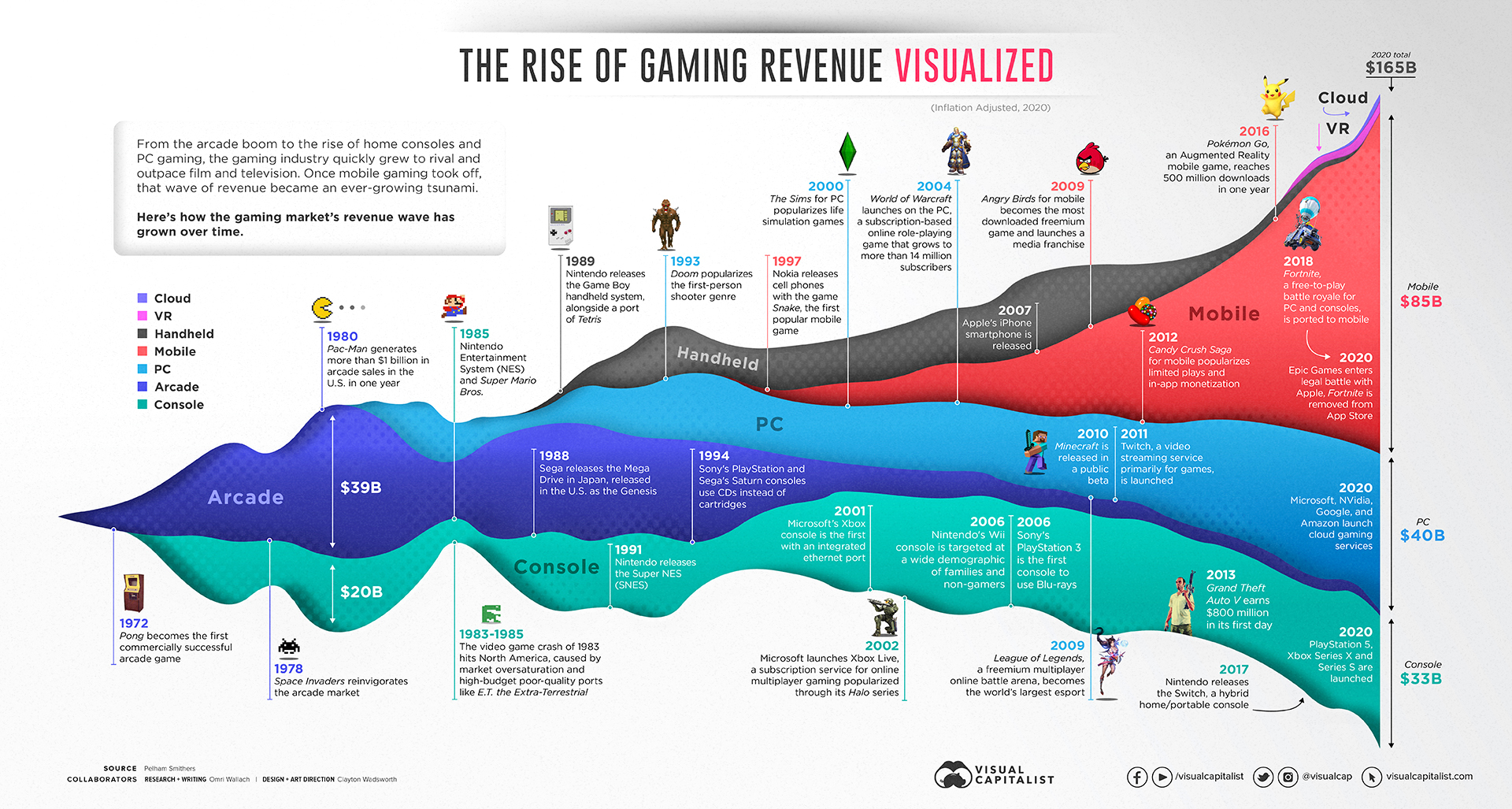
On your last point you may find this timeline of games industry market cap to be equal parts enlightening and horrifying.

https://www.visualcapitalist.com/wp-content/uploads/2020/11/...

During your lifetime consoles have been largely static and mobile gaming came out of nowhere and eclipsed every other form of gaming combined. But you're also old enough to have fraternized with those who rode the big console wave. 'Big' here is of course tiny compared to the mobile gaming wave. But it felt big at the time (and was.)

There are those who believe that games aren't how much money they make so they continue to ignore mobile gaming. Still, the timeline at least explains developers' behaviors.

> The author looks down their nose at microtransactions so they have probably missed all the innovation even as it continues to cross pollinate with every aspect of the games industry.

I've been doing some serious innovation in plumbing lately. Cut the drain pipe of an upstairs toilet so now it just drains into the room under it. If you hadn't been paying attention to letting-toilets-drain-into-occupied-rooms, you might not think there's much innovation going on in plumbing.

LOL... If looking down on "innovative monetization models" is gatekeeping, I am the largest gatekeeper there is.
Innovation in micro transactions is such a wild take. Absolutely awful for the games industry.
Maybe that's what the masses want. Even if there was a massive conspiracy by the industry, it's clear that free to play makes more money when done right

I hate it so I just play old and indie games most of the time.

Almost anything turns to shit as soon as the masses come.

The issue is that all the innovation is is hiring psychologists to mess with people's heads. Ask someone to pay 200$ to play fortnite and they'll balk at the idea, get them to pay 200$ in 5$ increments(not even, what you actually do is sell them 20$ of vbuck fun money to obfuscate and confuse how much things cost and sell them strangely priced things that can't add up to 20$ so you'll have just less money than you need for something at the end) and they'll get there eventually. The masses are up against teams of malevolent people trying to figure out how to rip them off without them realizing, what they want isn't a factor.