Hacker News new | ask | show | jobs
by Dem_Boys 923 days ago
I worked at McDonalds for 4 years. 2 as a kitchen worker. 2 as a shift manager. I've personally cleaned these machines too many times to count.

I've never heard one person tell "the truth" about this (at least in my personal experience).

Our ice cream machine was often down too but not because it was broken. Because we were short staffed and making ice cream is a HUGE time sink for employees. The manager would just tell the employees "no more ice cream" and they all knew what's up. They'd be very happy that they could focus on food and McCafe and thus not disappoint customers too much due to slow service.

Folks don't quite understand that McDonald's is consistently short staffed and the workers are often doing the work of 2-3 people just to try to get you fast and hot food.

11 comments

It's kinda wild how a franchise built around a milkshake machine now cannot bother with milkshakes.
To be fair, Wikipedia says McDonald’s is now 80 (!!!) years old, I expect many foundational aspects of the business have changed since then. But it is wild to see particular aspects of the evolution. I wonder how much was anticipated/planned, and how much “just happened”
i only go there for chicken sandwiches these days...
The company whose OG sign said "McDonald's Famous Hamburgers" the year they introduced "fast food" principles into their operations was actually built around shakes?
Ray Kroc (who is really responsible for the growth of the McDonald's franchise) was a milkshake machine salesman. I believe he was introduced to the McDonalds brothers when selling them a milkshake machine that could mix multiple individual milkshakes at once.

Edit: here's the "multimixer": http://www.sterlingmulti.com/multimixer_history.html

They did pretty much give up on the shakes not long after becoming a popular place. They were one of if not the first to switch from actual cow milk to chemical gelatin formulations.

So they really have always been struggling with the difficulties of quickly serving an ice cream product for their entire existence. That's a long time to have a thorn in your side and put up with it. 80 years according to the other comment.

They're undrinkable since the switch to paper straws anyway.
Your local franchisee or municipality has made this decision for you: McDonalds corporate and every franchisee in my area employs straws that do not disintegrate.
Had a stint myself and cleaned those Taylor shake machines, takes time as have to disassembler the entire chamber - lots of sharp blades and not many trusted to do it right. Let alone checking all the O-rings, which you often need spares and short of the one you need. Then inspections....so often find they would at least try to close the machine early to shorten the close, and often be down. Sometimes due to lack of milk for the machine and no they can't just pop down the local supermarket to get some - least not known that ever happen, nor risked as be job ending kinda things as cutting into that franchise supply grip.
One problem with your claims is this is pretty well documented as a uniquely McDonalds franchise problem at this point.

Competing fast-food franchises serve similar frozen dairy products, in a similar staffing environment, without their machines constantly being out of service.

This video covered the situation fairly well IIRC:

https://www.youtube.com/watch?v=SrDEtSlqJC4

You may be right! Just my experience working there for 4 years at 6 different stores.

This happened all the time at every store I worked at.

BTW Our machine would legit break too. Maybe once a year it would be down for a day.

The linked video makes a pretty strong case for it being a "show me the incentives and I'll show you the outcome" situation...
Also staff not keeping the ice cream machine full or ignoring the warnings on the screen or...all the other things. As long as people followed all the rules the machines they were bullet proof.
Exactly! Our ice cream machines were well made and always worked as they should. They'd be down for a couple hours a month to clean but that's it.

The machine would flash and beep when the ice cream mix was low so we were always eager to shut it up.

The intersection of minimum wage part time jobs with no benefits and motivated contentious workers is unfortunately fairly small.
This makes sense for daytime-rush "broken" ice cream machines; but almost all the reports I've seen about "broken" machines are about people coming into a dead store during the night-shift, when the employees would in theory have nothing better to do than make them an ice cream.
Your right about this occuring mostly at night.

The store looks dead but do you know if the night crew is caught up on their closing responsibilities? Doing dishes, stocking nuggest sauces, cleaning the grill, disassembling the fry hopper, organizing the stock room, etc...

If the store closes with none of these done the manager will blow their labor budget due to taking 3 hours to close and the employees will be pissed.

Your rebuttal is a good one and your somewhat right. Grabbing you an ice cream cone when there's no customers likely isn't a big deal. The manager usually cuts the ice cream while being overwhelmed (Ahh! 7 ice cream cones and we have 10 cars behind them. No more ice cream!) and never tells employees to start offering it again. Offering ice cream again would piss off the employees and also slow down the manager who's trying to hit labor and drive through times

> The store looks dead but do you know if the night crew is caught up on their closing responsibilities?

I mean, I've never worked in fast food myself, but that split of responsibilities assumes that the night shift are closing, no? There are a lot of 24-hour McDonald's locations, where no explicit "closing" ever happens.

I would assume that in a 24hr location, a lot of what would otherwise be "closing" responsibilities are either spread out as "clean as you go", turned into something done at shift-start/shift-end for each shift (and so made a lot quicker by only having 1/3rd the accumulated workload for each shift), or pushed to the dead-est period (which according to one Quora post is "in the middle of the graveyard shift, 3-6AM".)

You underestimate the creativity and laziness of night shift food workers. Once a daytime manager says "no ice cream", how far away is a night shift worker from just repeating that mantra?

Source: Was one, did that for other things all the time.

> " Sorry, we don't deliver to your area on Mondays "

It also needs to be cleaned (daily when I was crew), and that often means taking it apart early to get ahead of closing, or putting it together late because you didn’t have enough time to get to it before breakfast ended, or maybe just don’t put it back together at all because the person that usually did it was gone that day.
> the workers are often doing the work of 2-3 people

How is that possible?

When I worked there during our lunch rush, we would have a person dedicated to every task, fries, coffee, orders, bagging. When it came to the dinner rush, we would have half the staff or less then our lunch rush. So in a sense it is the work of 2 to 3 people. Also during overnight we would have only one person in the front, and one in the back. Once Uber eats came on the scene our workload increased 3x or more, but no extra staff was added! :-)

Edit: that’s not even mentioning when we would be short staffed, due to people not showing up / calling in, which happened every other day it felt like, and the shift wouldn’t be replaced.

Yes. Lunch rush is the baby of all McDonalds management. You'll rarely see an understaffed store then. Coincidentally this is the shift that most store managers work.

Night shift is where you'll see the cluster-fucks occur most and it's when the ice cream machine will be "down" the most in my experience

Lunch is like one $1200 hour, dinner is $4-600/hour, but occurs over many more hours. Lunch is definitely busier and better staffed, and the dinner crew usually needs to to start thinking about closing, so a few go off at 7 to start dish or clean the back room or whatever.
The customer load on a service business like McDonald's is going to vary chaotically from minute to minute. It's a difficult problem to have it match the staffing level, while staying in business.
> When it came to the dinner rush, we would have half the staff or less then our lunch rush. So in a sense it is the work of 2 to 3 people.

Is dinner as busy per hour as lunch?

I suspect this is a franchisee trying to improve profitability versus a company wide issue. I suspect it is highly variable. Also, sometimes sales are unexpectedly higher than normal.
We have comments from people who’ve worked there, which fit the general impression that the places tend to give.

I haven’t worked in fast food, but I’ve worked in retail, and it was my experience that the “nice” manager would schedule us, like… one extra person beyond the bare minimum.

Why do you suspect this, do you have any particular insight into these kinds of businesses beyond the rest of us?

Well, yes I do. I have owned four franchised businesses - all quick serve restaurant style - from two different national chains. Individual franchisees have significant leeway in how they schedule. Some, particularly marginal locations, will cut staffing to the bone. Others that are more confident in sales and doing well are able to schedule more than the bare minimum so that customers don’t wait as long and employees are happier.
Sales unexpectedly higher than normal happens, but that typically only lasts an hour and then you go clean the now very messy store, while if sales were normal you would have enough staff on hand to keep it clean as you go. Stores keep enough clean trays and the like around to handle the worst case extra busy, and the trash cans can go an hour without being emptied. Customers will pick the least dirty table.
Back in the early 2000s, I worked on a product that was the only profit center in a public company. While there were people who worked on overall technical architecture, it was only myself and one front end dev dedicated to the product. Other products that ran in the red had dozens of employees because they were the things that got touted to Wall Street, but we were the very boring thing that kept the company alive.

Back in high school I worked in fast food as a closer. One front end person, one backend person, one manager for dinner rush, late rush, clean up from the day both in the kitchen and the store, some basic prep for the next day (morning shift did main prep), and they kept pushing us to get our times down so that we could walk out the door as soon as the store closed rather than taking any time after closing for our cleanup, etc. Our labor cost per hour was likely around $17. The energy to run the ovens, refrigerators, etc was fairly consistent, while our labor cost for any extra time after closing was a variable cost that ate into their profit margin.

Doesn't matter what industry -- ask a doctor about their workload -- if management can squeeze labor costs, they will.

> if management can squeeze labor costs, they will.

Everybody squeezes costs, including you and I. Don't you shop for the lowest prices? I do. Customers of fast food are pretty price sensitive.

Of course, there's a great deal of price sensitivity especially on commodity products. But - perhaps implicit rather than explicit within my remarks - there's also mismanagement or questionable management. And, price is not always aligned with profit. That Arby's generated something like $1MM in yearly profit, in 1996 dollars. The extra $5.05 they would have paid me for the hour after closing to ensure the store was actually clean, prep was properly done, pans were cleaned etc, made exactly jack squat difference to their margin.

In the case of the tech company...let's just say they are all but forgotten, while other players came along with competent management and have formed new multi-billion dollar businesses.

Sure, there are a lot of incompetent employers. They usually go out of business. Businesses have a high failure rate, and it's pretty darn hard to make enough at it to put up with all the aggravation and work required to make it successful. Businessmen do not go into business to make a 3% return on capital, as anyone could buy a bond that pays 3%.

Bill Gates famously never went on vacation for something like the first two decades of Microsoft.

It would be nice to have fewer assumptions about others made on HN.
Stated assumptions are fine.
I'll counter you. How do you find competent, reliable people that show up to work consistently and work hard for $9.00 an hour?

You're doing the work of your buddies who called in. Your buddies called in because they're 17 and they're dad made them get this job. They hate it! This happens every damn day.

I think many of these jobs are starting at closer to $15/hr now, but perhaps your point still stands
Yeah I think you're right. I'm out of touch now.

I started working there ~10 years ago and my starting pay was $7.30/hr. I made $10/hr as a manager

I started at $4.25/hour, but got pushed up to $5 within a year. I feel old now.
What they mean is "the workers have 2-3x more work queued up than can be handled for satisfactory operations"

Quality of service will suffer.

What made it a time sink? How could it be made faster?
It's a relative time sink and the toughest logistical challenge in the whole store for workers due to soft serve melting so fast.

You must make the ice cream last. The car has to be at the window (or customer at the counter) when you start. This is the only item in the store that must be prepared like this so you must always have a free person to do this. McDonalds does't provide the labor budget to have "free people" standing around to get your ice cream when you need it. Making ice cream almost always hurt another area of the store in a small way.

Also making a soft serve ice cream cone is much harder than you think. Took me ~2 months to get it down. Dont even get me started on dipped cones.

Fun fact: This is why your mcflurry doesnt have candy at the bottom. Workers hate ice cream! They dont blend it with the machine, they'll just hand blend it to be quick.

The fix would be to take the burden off the the employees. Automate it just like they did drinks. Or increase the labor allowance to have the staff to handle ice cream. They'll probably never do that though.

This question makes me think that you believe the problem is an efficiency that can be solved rather than an intentional choice.

Ive worked at several restaurants as a waiter and food prep staff. The businesses have very thin margins and most costs are fixed except for…labor.

When it’s lunch rush, it feels like every atom of your being is pressed to the limit. Then when that’s done your manager has to come around and start assigning random cleaning and other tasks so people aren’t just hanging around.

When they schedule, they want to just *barely* handle the busiest time or otherwise it’s an inefficiency in the system.

Also to mention, restaurant staff aren’t the most…stable workforce in the world. So even if they do schedule to have some buffer, people will quit and call in sick on a dime.

I know what op is talking about when they say they do the work of 2-3 people and I believe them. The system is designed to squeeze that extra bit out of everyone.

If there was a magic mystery inefficiency they found, that would translate to decreasing staffing per shift, not increased breathing room for the individual workers. (IMHO)

We're specifically talking about the efficiency of making ice cream versus other foods. One that makes them change the menu when they're getting busy.

That specific problem can be solved.

And it would not enable any more decrease in staffing, because they're already not making the ice cream.

The question was not about trying to fix the general situation of being understaffed.

Thanks for clarifying. I read it as a general question rather than a specific one.
I've never worked at a McDonald's, but I have had to operate and maintain a soft-serve ice cream machine. I don't eat soft serve ice cream because I know how long it takes to clean these machines properly. I've seen what happens when they aren't. I don't trust that places like fast food joints that are understaffed, where the employees aren't motivated enough to do a thorough job, would take the time necessary to make sure those machines are clean.
In my experience the major time sinks happen when multiple McFlurrys were ordered. Mixing one takes about 15-30 seconds, and if too many are ordered at once the ice cream would start to come out slower.

When you’re backlogged with multiple people in line, multiple orders, and you’re a 1-3 person crew in the front, every second counts. Ice cream was the easiest thing to cut because of the stereotype that it was always broken so people didn’t question that it was “down”, and those precious seconds made my 17 year old life much easier.

Yeah I wondered this too. Watching them work, it certainly doesn’t look like they take more time than most McCafe drinks or making burgers.
It likely doesn't, but McCafe Drinks/Burgers are a staple. Coffee and Burgers are likely included in most of their orders, Ice Cream they get a few each hour.
If it’s only a few that’s no more of a backup than someone getting to order and going “uhhhhhhhhhh” or the people arguing with the cashier that something was wrong.
How long ago was this and have the machines changed over the years? Because this ice cream machine always broken seems like anew phenomenon compared to my tenure back around 97.

I was there for about a year IIRC, other than cleaning the machine "making ice cream" was dumping the premixed liquid into the top two compartments.

I don't think people would care if mcd says they are short staffed. I think people care due to mcd lying.
As a manager you can't tell the customers this. You'd lose your job if your store manager or any higher ups find out.

You lie to the customers and the workers cover for you (the shift manager) because they hate making ice cream.

Every retail/food service job is understaffed. You ask what people displaced by AI will do for a living? That. They'll do that. Because, actually, we do need people at PoS, if we're selling to other people. Hint hint as to why you should be supporting "unskilled" labor unions, high wages for those workers, and the destigmatizing of those types of jobs.
Displaced workers going into unskilled labor doesn't seem like an idealized "post-AI" situation. If anything, it might be something we should guard against. There's nothing wrong with honest work, but some would probably paint that scenario as dystopian, if you consider that many people think creative and autonomous work are important to human flourishing. If anything, I'd want AI to take over those rote jobs so people can focus on that type of creative work they tend to find more fulfilling.
I’m not sure if I’m capable of performing fulfilling work that would also have anything resembling of a demand.

Take creative work. The pre-AI market was already extremely competitive. Few artists can chase autonomy, the rest needs to sell out to some level - usually significant; not the human flourishing we wanted.

AI may disrupt this; still, my guess is that the pool of profitable creative workplaces remains unchanged, at best.

If an artist wants to make a living making art, the art has to be something people are willing to pay for.

If that's "selling out", then so be it. Why should society support the artist if his art has no value to anyone?

Note that our initial goal was different - not an artist who wants to make a living, but an artist who wants to perform fulfilling work.
Draw two circles, 1. fulfilling art 2. art that pays the bills. Create the art that is in the intersection.

Otherwise, you'll need another source of income in order to create fulfilling art.

There's lots of software I'd like to write. I've spent my time writing code that lies in the intersection.

Do you actually know any artists or musicians? Any of them that are successful? What you described wouldn't be "selling out," it'd be success. Selling out is the food service job they do to pay their rent, or the lessons they teach, etc. The person you were responding to was pointing out that it's not likely that there is a market for everyone's art, even if everyone was true to their own creative vision.
> Do you actually know any artists or musicians?

Yes, many among family and friends.

> What you described wouldn't be "selling out," it'd be success.

"Selling out" is a common epithet leveled at artists who became successful. Nirvana, for example, was often accused of selling out.

It’s almost like the idea of “making a living” is what needs disrupting the most. I didn’t ask to be here, and it’s kind of a shit deal for most folks the way things work now. “How many Einsteins” etc.

If the art I’m interested in making doesn’t fit into this “utilitarian” monetary income model, it means that I can only pursue art in my “spare time”, outside of a necessary job and (for lots of us) family obligations. I guess I could become an art star, or a viral sensation, but we all know how unlikely that is for any one person. There’s not much middle ground.

The thing that we have to acknowledge as a culture is that we don’t generally value art, or highly-specific research avenues, or much of anything that isn’t “productive” in the most myopic sense. That’s a cultural choice, and it’s a bad decision. It fits in well with our naked pursuit of short-term optimization at the expense of everything else though, so at least we’re consistent. Yay.

Look at the immensity of the music business, hollywood, books, furniture, buildings, landscaping, toys, the shape of my desk phone, and we pay plenty for it! I look around my office and see the work of artists in most everything in it.
The art that's being disrupted is "give me a picture of a guy riding a bike through our downtown in an impressionist style" (for a brochure or some marketing material). I'd call that artisanal more than creative - it certainly takes skill to produce something that meets those requirements of an acceptable degree of quality, but I don't there is much humanity loses out on having computers do that.

People simply romanticize that kind of work because of its loose association with highly-prestigious creative work. I don't think we lose out on Picassos if we lower the number of graphic designers or caricature artists.

That kind of artisanal work is something that artists can rely upon to fund their more creative ventures. And it is still creative, takes advantage of their illustration skills, etc.
I think that's largely true and most of us are trying to find a balance. Most modern jobs have some aspect of drudgery, or at least less palatable tasks, and we're trying to move the needle towards those tasks that we find fulfilling. But I'd argue some jobs are inherently less amenable to this, if you subscribe to the previously mentioned idea of fullment.
Whatever you'd like, you have to look at reality. It's clear that AI is coming for jobs that are about manipulating information before jobs that are about switching between manipulating objects and serving people.

Service jobs COULD be fulfilling. Spending a few hours a day helping your neighbors access the goods and services that they need is a part of community-building; people enjoy that kind of labor. The problem is the corporatization and "shareholder value"-centric bone-deep resource cuts that characterize most of these workplaces, where employees are forced to work under conditions that nominally prioritize profit over everything else (but are really also about, specifically: employee control, legal ass-covering, and union-busting).

If people got paid well for working limited and predictable hours where they could rely on coworkers to keep the labor load reasonable, I think these jobs would be more desirable. What better way to spend the value unlocked by AI automation?

A couple things:

1) as already stated elsewhere in this thread, automation has been coming for manual labor jobs for decades/centuries before AI has been coming for knowledge workers

2) I think "service" jobs is the wrong discriminator. There are lots of service jobs that are fulfilling. We're a social species and generally have the desire to contribute to our tribe. Service jobs often scratch that itch. Personal training, wedding planners, hairstylists, chef etc. are all service jobs that are fulfilling enough that people want to do those things even when they don't get paid. That should be confused with the rote, drudgery that is associated with jobs like assembly line work or fast food. I'd argue it's less about the pay (although that can't be ignored) and more about the work. Just look at the service job of attorney with its relatively high bar of entry and high pay, yet it still has pretty insane attrition rates. Even if the pay and status is good, people want a job that's fulfilling.

1) *Silicon-based manual automation (which is mere decades old and has hit a people-shaped wall)

2) You're conflating and categorizing jobs to benefit your argument, not as an accurate reflection of what I presented. Chef work is brutal, too. The main point seems to be that a mechanically unfulfilling job either needs to have fulfilling social contact (functioning as pressure relief, leverage, etc.), or high pay (i.e., an out). Most people would work a (safe) soul-deadening job for a year if they'd get 20 times the median wage out of it.

I think that “people shaped wall” is largely defined by that subsidization problem already mentioned elsewhere. If people were paid a non-subsidized wage I think that “silicon-based” automation would begin to take even more of a substantial amount of manual labor. But that “silicon-based” piece is a constraint that wasn’t part of my original point, so it seems you’re levying that for your own, different argument.

I’m only using the words you mentioned. You brought up service jobs, although you may have been using the term somewhat sloppily. Your explanation seems to bolster the point though. People will “put up with” a soulless job if it’s a means to an end. People don’t simply “put up” with a job that is inherently fulfilling. Circling back to the original point, AI forcing people into drudgery is probably not to the benefit of society, especially if there isn’t high pay.

It's not unskilled labor which will preserve, so much as it is labor that is difficult to automate. Plenty of skilled jobs, like being a therapist or surgeon, would also be difficult to automate.

McDonalds is also at the far end of the spectrum of "human service jobs that are less-skilled but difficult to automate". There is plenty of demand for higher quality versions - requiring a higher degree of skill and creativity - of the same general type, like fine-dining.

Truly creative (in the sense of it having a high degree of novelty and quality) work is not at risk of being automated any time soon. What is at risk of being automated is the category of "creative" work that requires some skills but is mostly assembly line. Category-defining or truly novel art almost by definition can't be produced by existing AI in any form, because AI can only remix the content it's seen already. "Generic rock song" or "clip-art like picture of a guy yelling at a computer" are at risk of going away, but I hardly think that means humanity will no longer flourish - producing that kind of stuff is romanticized as a cool, highish status thing to do, but functionally I don't really see it as any different or more worth preserving than obsolete skilled labor of the past like carriage-makers or human-computers.

I also think people tend to make the "Lump of Labor" fallacy when thinking about this stuff - economically speaking, if human workers are no longer needed to produce some high-value output, in the long run the excess labor/"talent" that gets freed from that task finds other value-producing tasks to do: https://en.wikipedia.org/wiki/Lump_of_labour_fallacy. Long-term unemployment and underemployment is completely a solvable economic problem; both can increase due to short term shocks like technological development and shifts in supply/demand, and in some cases underemployment is more a matter of "wrongly skilled", but long term they're both a matter of ensuring there is enough money, liquidity, and capital deployed to drive demand for marginal increases in both jobs and quality-of-jobs (without ruinous inflation).

I agree with some of what you said, but some of this comment seems overly intellectualized to the point of being out-of-touch.

Have you ever worked in fast food? What makes you think it can’t be automated? From my experience (admittedly decades ago), it’s ripe for automation. The work is largely rote and well controlled. The main edge cases (eg an order of salt free fries, or custom orders) are fairly easily managed without out-of-the-box thinking. The processes are well-defined and controlled. In fact, that’s a major contribution of franchise model: the entire process is already defined largely turn-key. IMO one of the reasons they aren’t automated already is because we essentially subsidize wages with social safety nets. This allows the human wage rate to stay below the cost of automation.

We also may disagree on the idea of creative work. By my estimation, creative is defined as not being rote. Maybe the discrepancy is whether you believe combining preexisting ideas is creative; to a large extent most would agree, but that doesn’t, for example, pass the PTOs definition of “non-obvious” so I think there’s some debate as to if it’s truly creative work.

I currently think the jobs that are least likely to be automated are non-rote manual labor, especially non-greenfield repair. Fixing a non-routine plumbing issue or installing a one-of-a-kind control system would just not be economical to automate.

AI will enter meat space long after it replaces knowledge workers
I tend to agree, but there are various degrees of "meat space." Rote manual work has been getting automated away for decades. Now AI is taking away rote (or adjacent) knowledge work. The question is whether a reasonable solution for those displace by AI in the knowledge sector is to go work in the rote manual labor space. That presupposes their labor rate is suppressed below that of automation.
Automation entered meat space centuries before it replaced knowledge work.
>Because, actually, we do need people at PoS, if we're selling to other people.

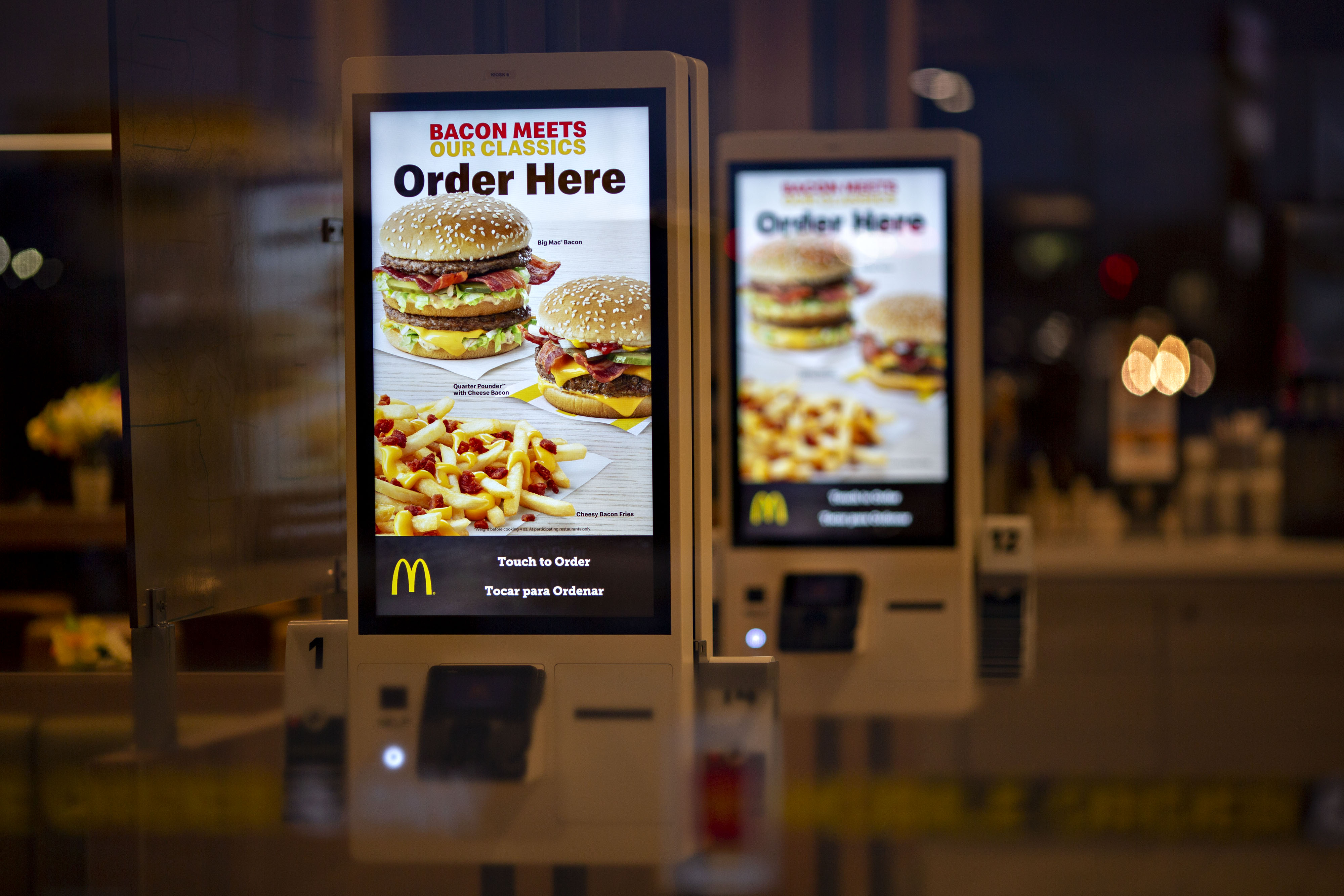
They haven't installed ordering machines[1] at your local mcdonalds yet?

[1] https://assets.bwbx.io/images/users/iqjWHBFdfxIU/ihydn_7eemN...

Those things never seem to work properly, at least in the UK. Receipt printers are always broken. Also was a study a few years back pre-COVID about them being covered in faeces particles.

I do prefer them to ordering at the counter due to pretty bad eyesight and having more time and I usually pay by card anyway but they're not the best things.

pre-COVID about them being covered in faeces particles.

Gross. But somehow I doubt the POS credit card reader would be any different. Those types of studies find grossness everywhere (feces on movie seats, urine in the bar peanuts etc)

Don't need to touch those unless you need to use chip and pin. 99% of card machines in the UK take contactless and mobile payments.
Fair point. Although the main implication is that a POS doesn’t negate the risk, it just has different risk vectors.
contactless support is still very spotty in the US, both from issuing banks and at merchants.
Yeah, I was going to ask. Last time I went to McDonalds, the lady at the counter directed me towards the order machines!
It was a ridiculous experience when I tried one recently.

I wanted a bag of ice, since they sell them cheaper than the Kwik-e-mart and I had some perishables I didn't want going bad on the way home.

Do I want to log in? No. Am I sure? But I could be earning bajillions of Rewards Points for my $1.75 purchase!

Now, where are bags of ice? It's not in an obvious category, there's no search, and finally, someone realizes I'm having trouble and looks herself, and then we finally find it at the bottom of the drinks menu, which has too many options to fit on the screen without scrolling randomly.

Now, I proceed to pay. Except I can't. I have a piece of crumpled paper issued by the central government I wish to exchange for my ice. But there's no note acceptor on the machine. The kiosk prints a receipt and I'm supposed to take it to the attended till to pay. Except there was nobody attending it. Again, try and flag down someone so I can finally complete my transaction.

Before, it was "Bag of ice, please." "$1.75", and I'm done in 1/4 the time. Of course, that was facilitated through labour, rather than $4000 worth of shiny touchscreen monitor and glorified Raspberry Pi.

This is so first world problem...

No 'note acceptor'? Thank god, that shit is slow, finicky and ugly. Just PayPass with your plastic card and have the order number in 5 seconds. No, 99 of times from 100 I don't need any paper receipt with an order number, so I don't even click on "print the receipt" button in the first place.

And lastly, I don't buy bags of ice, shovels and dildos at McD.

> Do I want to log in? No. Am I sure? But I could be earning bajillions of Rewards Points for my $1.75 purchase!

Now this is what should bring a slightly boiling cauldrons and pitchforks made from chinesium to those who thought and designed that shit up.

And service became even worse
Not to mention ordering via the app and collecting. QR code websites and tablet ordering machines are rapidly replacing humans taking your order across most restaurants, in the UK and Japan at least.
This is how I can tell neither of you have ever done gig delivery. I'll give you one guess as to how smoothly pick-up goes when there's no one at the cash register. We haven't gone full-automat yet, and I still need someone to actually hand me the order. Preferably, multiple someones, to service the multiple delivery drivers waiting for their pick-ups.
"Taking the order" means listening to their order, keying it in and taking payment. All of that is replaced by apps/kiosks, right? Of course somebody needs to pack it and send it to you.
Again, if you'd been in one of these establishments lately, you would know that all of those tasks are likely done by one person. Including the ones with kiosks (which are often broken or can't take special orders).
Not aimed at you, but the other commenters on your comment.

There is no such thing as unskilled labor. Put a fucking normie from the street into any of these 'unskilled' jobs and find out just how many skills are needed just to do something like customer service.

Looking down on those people is what will lead to another internal conflict. They'll be the ones you depend on when society goes to shit.

It is not a moral argument. It's a colloquialism that differentiates between different types of work. In part, those jobs are "unskilled" when they take less training to perform. It's not meant to demean the work or the worker.

A plumber or electrician is equally "skilled" work as a software developer, largely due to the extensive apprenticeship requirements.

If it can be taught to a teenager in a couple of days -- which is how many fast food employees get started -- it's not a "skill" in the context of https://en.wikipedia.org/wiki/Skill_(labor)
>If it can be taught to a teenager in a couple of days

Most can't. Hence the frustration you are likely to feel dealing with a teenager in his or her first week on the job.

Thank you. I wanted to put this in but couldn't figure out where it would fit.

In particular, the emotional and interpersonal regulation needed to do well at these jobs sometimes borders on superhuman. People stress over office politics, like it's not child's play compared to getting through an 8-hour shift dealing with the sick and irritable public that come into Wendy's or Walgreens with zero leverage over these people who hold your employment in their hands (not even being able to pass things off to a manager, since they're likely bouncing between different stores).

And every workplace has systems and policies that have to be learned. Smart and experienced people can analogize and cut some of the learning curve, but it's still measured in days and weeks, not hours.

Most jobs ever done by convicts as penal labor would be fundamentally unskilled, no? These are jobs with no expectation of unique talent or skill; with no lengthy on-the-job training; with no ability to fail at the job so badly that they would ever "fire" you. Jobs like "here's a pickaxe, start hitting rocks" or "sit here and pull down the stamper each time a license plate is in front of you" literally can't be done poorly — only done either efficiently or lazily.
If I was to do penal labor, I'd search all days for way do to it poorly.
The difference between unskilled, semi-skilled and skilled labour is usually based on how long it takes to learn how to do the job. It's not meant to be demeaning.
"Unskilled" just means that those type of jobs don't require any prior experience or qualifications. No need to interpret every word literally..
The local Starbucks has regular staff turnover. I've observed that it takes a new guy about 2 days to get up to speed on how to make the treats and run the cash register. Over time they'll get better and more efficient at it, but not that much.
> high wages for those workers

Part of the problem is that for some of these jobs, there is only so much money an employee is able to generate. And for some industries you can only get away with raising prices so much (fast food is relatively easy to raise prices).

I have friends in the grocery industry and they are so hard up for workers (even unionized/good-paying ones) and the margins are already so razor thin that they are looking at starting to close the store on certain days of the week.

So even in unskilled positions, you are going to need huge increases in labor productivity. Which means more customers per employee. So bigger fast food places, bigger stores, bigger farms, bigger hospitals, etc.

Australia has a real minimum wage almost twice that of the USA. Do they not have grocery stores there?

* https://stats.oecd.org/Index.aspx?DataSetCode=RMW

> Real hourly and annual minimum wages are statutory minimum wages converted into a common hourly and annual pay period for the 30 OECD countries and six non-member countries for which they are available. The resulting estimates are deflated by national Consumer Price Indices (CPI). The data are then converted into a common currency unit using either US $ current exchange rates or US $ Purchasing Power Parities (PPPs) for private consumption expenditures.

> So even in unskilled positions, you are going to need huge increases in labor productivity.

Or you could tax the excess profits that companies are earning from eliminating jobs through automation and AI, use that money to pay for healthcare and cover subsidies to bring the cost of food and other necessities down. Then the cost of labor goes down and you don't need to torture people for more productivity.

> Because, actually, we do need people at PoS, if we're selling to other people.

I don't know about that. I used to order from a kiosk at a Burger King in 2007 and skip the line.. At a fast food joint, point of sale is likely the easiest job to replace with a machine. My guess for the hardest to replace is cleaning..

He doesn't strictly refer to a cash register and the person behind it, but to the entire counter where someone has to put your order together. The cash register ringing part can be automated away easily, but the "putting all your ordered items onto a tray" part is not automatable in any economically feasible way in 2023, and will not be for the foreseeable future.
In my experience, "Point of Sale" as a term refers to the cash register and the actions around it, not the rest of the business such as delivering the food to the customer.
So it's going to be a dystopian Amazon job, where the fries and burgers come down in conveyor belts and you just put them into the right box. For 8 hours at a time.

Personally I'd prefer that job be automated because it's so mindless.

> You ask what people displaced by AI will do for a living? That. They'll do that.

And then the dystopia will be complete.

I worked at a big box retailer. I enjoyed helping people find solutions to their problems. I assume many chefs enjoy making good food and interacting with their regulars. Ask old-school diner workers or department store salespeople how they felt about their work, particularly when they were paid an actual living wage. The soul-crushing parts aren't inherent to those jobs, they're imposed by exploitative elites. Your dystopia is a "filthy rich f*ckwad" problem, not a "thank you, please come again" problem.
I'd argue that working in a fast food restaurant isn't in the same category as working in a diner or other actual restaurant, being a chef, or working for a big box retailer.

However, whether or not some people find those positions enjoyable isn't relevant to my point. If everyone has to work in those jobs, most people won't find that fulfilling or enjoyable because they're not suited to that sort of work. And when you add the fact that these are low-paying jobs, you have most people doing something they hate for very little pay, because (in this scenario) the work they are suited to do is unavailable. That's the beating heart of a dystopia right there.

(I put too much emphasis on the pay rate. I actually think the pay rate is of secondary importance for this point. A job you hate that pays very well will still make you unhappy.)

>I'd argue that working in a fast food restaurant isn't in the same category as working in a diner or other actual restaurant, being a chef, or working for a big box retailer.

I don't disagree. I'd like you to think critically about why.

>If everyone has to work in those jobs, most people won't find that fulfilling or enjoyable because they're not suited to that sort of work. And when you add the fact that these are low-paying jobs, you have most people doing something they hate for very little pay, because (in this scenario) the work they are suited to do is unavailable. That's the beating heart of a dystopia right there.

I think this is incorrect. Firstly, because (per the proposal) they wouldn't be low-paying. Secondly, and to the contrary, if everyone has to work these jobs, then not only are they no longer jobs only for losers and the unskilled, they are suddenly jobs with a lot of staff with which to build accommodating and reasonable schedules.

I WANT a society where my doctor serves food or works the register for a few hours a week, or where someone laid off from their 6-figure coding job can earn (or even be given) enough to avoid losing their house. That's the opposite of a dystopia; that's a world where even the most educated and prestigiously-employed community members are connected to the rest of us. Maybe that's a dystopia for them?

Reminds me of a short story from 30 years ago that centered around fast food workers who were micromanaged by an AI directing every daily activity.
For anyone wondering: https://en.wikipedia.org/wiki/Manna_(novel)

It's got a happy ending actually.

It has a happy ending for the protagonist, and IIRC only because he inherited an Australian passport. Everyone else in the USA was completely stuck into being meat robots for the overseer AIs.
So, not a happy ending.
Depends on if you are a protagonist or not.
I actually prefer fast food restaurants with ordering kiosks and not manned POSes. Just like self checkout, no need to wait in a long line.
Gradually not sure. Do we need people in pos. You already do your own order in kiosk and phone. No staff. Cut that. Sorry you cannot order thee we do it take your order.

The food arrived by order number as like today in slot.

Then the backend machine vision can enough …

Sorry …

I did think my Go playing is safe you know.

If McDonald's paid their workers like software engineers, they'd have to charge at least $50 a burger, assuming the sales volume stays the same. But if burgers were $50, the sales volume would drop to zero, and the business would collapse.
> they'd have to charge at least $50 a burger,

That's only a little more than 100% increase from the current near $20 combo meal prices. McDonalds has high margins lately they can afford raises.

A McBurger is what, about $3 ?

Also, McDonald's Corporation is a different company than the McDonald's franchise that sells you the burgers.

They don’t account for externalities.