Hacker News new | ask | show | jobs
by rosser 3248 days ago
The Fine Article doesn't really go into how we're doing it wrong, beyond a passing mention of barefoot running, and some dissing of treadmills (which is hyperbolic and orthogonal to reality; you can run "correctly" or "badly" on a treadmill or on the street or trail).

I used to run a bit. Did an informal "couch to 5k" over a couple of months, before I'd even discovered that was a thing. The single most effective thing I did for my running was to buy a pair of Vibram Five-Fingers shoes.

TL;DR, the gist of the "wrong" is that we've been trained by "trainers" (over-padded athletic shoes) to run in a straight-legged, heel-lands-first manner. When you do that, your knee is locked (or at least straight) as the foot lands, which transmits the force of the landing up your leg and into your lower back.

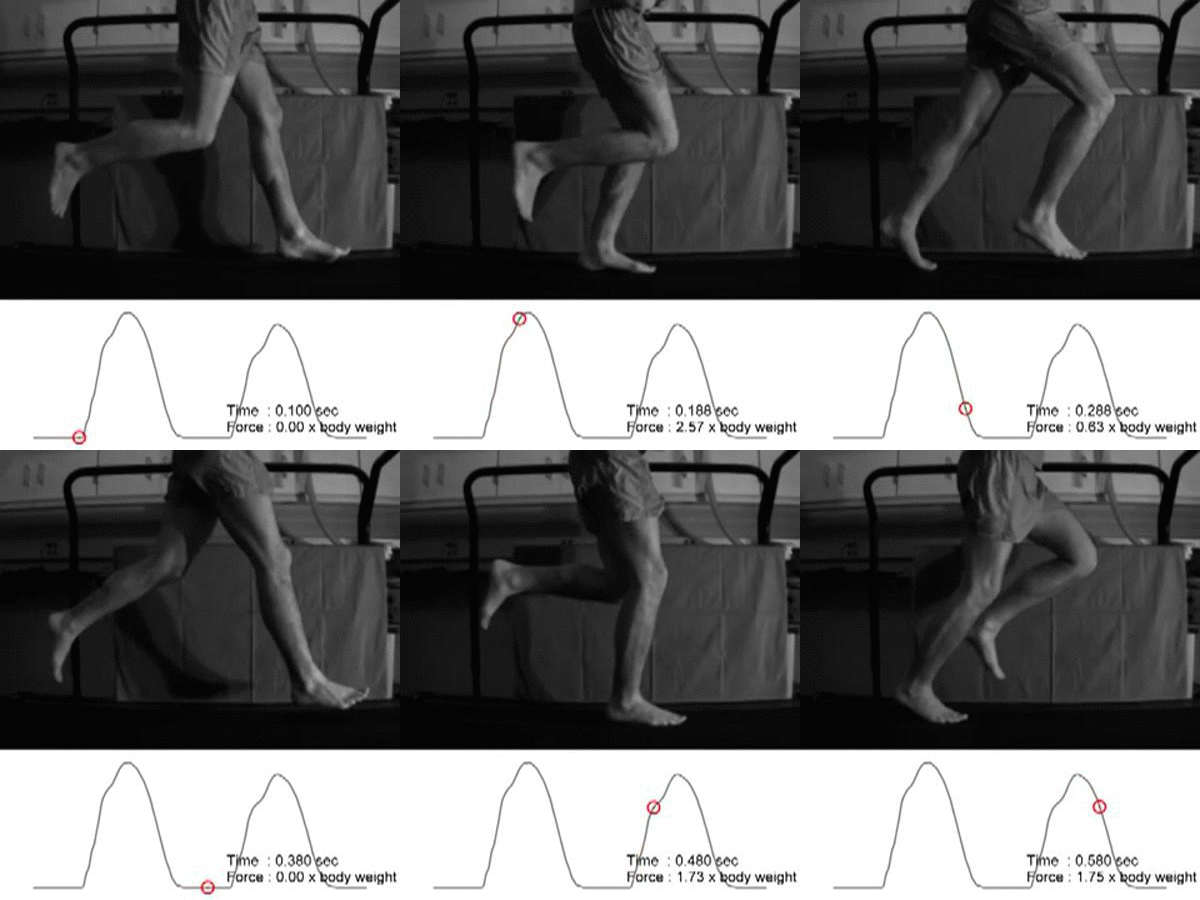
When you run barefoot, or in a pair of ultra-light "shoes" like Vibrams, you learn very quickly not to do that, or you stop running. The "right" way is to land on the ball of the foot, with the knee slightly bent. The knee bends further to dissipate the force of the landing. This is how evolution "meant" for us to do it.

I have a bum knee now, for unrelated reasons, so I can't run for the time being (or possibly ever again). I was, in fact, specifically warned against it by one of my array of bodyworkers just this past week. I kinda miss it sometimes, because it actually can be quite meditative, once you get into your rhythm.

EDIT: phrasing.

EDIT 2: The "wrong" under discussion in The Fine Article might have more to do with why we run than how. Though, if so, premising the argument in "evolution" is perhaps specious. Thanks, follow-ups, for pointing that out more clearly.

25 comments

No offense to you personally, but it's kind of disconcerting that this is the top comment. You've outright admitted to only having "used to run a bit" -- and not very much, at that. But then go on to promote barefoot running as if you're somehow a fully qualified expert who knows enough to talk on the matter and declare barefoot running is _clearly_ the answer.

I'm not saying you're wrong or right. This shoed/barefoot discussion has been inflaming the running community for decades. But there's really no substantial evidence that barefoot running is better.

Anyway, I just think the way this was presented -- basically as fact -- is dangerous. And given that it's the top comment with very little pushback in the comments is kind of scary.

Maybe I can chime in here, I've been running competitively through HS, College, and some marathons after. Barefoot running is only revolutionary to some people because it correctly aligns the incentives to have proper form. If you're barefoot/vibram running with proper form, you'll pretty much instantly feel all this discomfort of the impacts in your heel, knee, and back. This discomfort doesn't exist when you're in a very cushy pair of trainers. This is why it's become such a big thing, people all of a sudden understand why running can be fun, because they're doing it correctly for the first time in their lives.

I don't think barefoot running is inherently bad for you long term or anything, I've had friends do 80+ mpw, including trail/gravel running in vibrams with no problem. Those guys/gals are < 140 lbs with impeccable form though.

I think barefoot running can be an amazing way to "teach" people the correct way to run, but for most people, they should take that form and move it over to a shoe that does have a bit of impulse reduction. There are many steps between vibrams and super cushy shoes.

Look for something with a low heel toe drop/offset (I'm at 4mm right now) so that your heel isn't forced to land before your midfoot. Racing flats are gonna be just a step up from vibrams, then you get into shoes like the Saucony Kinvara, which remove some durability from the heel (which doesn't really matter as you're landing on your forefoot) to reduce weight but still have padding.

Running shouldn't hurt anything other than your pride. If you're feeling pain, don't run. Don't be scared about going to your local shoe store and having them show you what's up. Happy trails.

I don't run often, but I hike a TON. 10+ mile hikes, 3-5 times a week, over moderate elevation changes. After three weeks at Yosemite in July a couple years ago, I've completely moved on from heavy hiking boots, to Inov8 trail shoes. Ultralight, 0-4mm drop. Best move I've ever made. Just did a week in the Canadian rockies, over HEAVY terrain, and rock scrambles. No more overheating, stronger feet, and I can go MUCH further distances.
> If you're barefoot/vibram running with proper form, you'll pretty much instantly feel all this discomfort of the impacts in your heel, knee, and back.

I don't understand. Do you mean with improper form?

+1 on the Kinvara. I'm a current college XC runner, and I've been running in the Kinvaras (many different versions) for 5 years now. I've found that the low weight makes a big difference, allowing you to run with a higher cadence and thus with shorter, lighter strides, reducing impact forces and generally improving form.
As a lifelong athlete the on-your-toes style of barefoot running is the best way to run. If you cannot run on your toes you are not built to run. There are rare heel-running sportspeople but running is not their competitive strength. Over long distances it is easy to fall back on heel-running out of laziness, because the impact is absorbed more by joints and less by tired muscles, but that is a failure of fitness and a sub-optimal style.

Barefoot vs shoes is more of a personal choice. A cushioned heel can permit bad style by reducing pain, whereas barefoot forces proper technique or else breaks your feet. However proper technique once you have it doesn't depend on footwear.

> As a lifelong athlete the on-your-toes style of barefoot running is the best way to run. If you cannot run on your toes you are not built to run.

Nonsense. You can go tell Meb Keflezghi, winner of both the Boston and New York marathon, that he's not built to run. He's a prime example of a heel striker [1], though slightly less prominent in his later years.

More generally, in [2], a study of elite level runners in the half marathon, found that at the 15km point the top 50 was comprised of 62% rear-foot strikers, 36% mid-foot, and 2.0% fore-foot strikers.

If a certain running style works for you, i.e. you've been running injury-free, don't try to change it. You are more likely to do harm than good.

[1] https://runblogger.com/2011/11/meb-keflezighis-running-from-...

[2] http://journals.lww.com/nsca-jscr/abstract/2007/08000/foot_s...

> Meb Keflezghi, winner of both the Boston and New York marathon, that he's not built to run. He's a prime example of a heel striker [1], though slightly less prominent in his later years.

Trained hard and overcame the limitation for a time? I did say there are exceptions.

> More generally, in [2], a study of elite level runners in the half marathon, found that at the 15km point the top 50 was comprised of 62% rear-foot strikers, 36% mid-foot, and 2.0% fore-foot strikers.

Reflects that heel-strikers are more common.

From a quick search:

1,991 runners were classified by foot-strike pattern, revealing a heel-strike prevalence of 93.67% (n=1,865). A significant difference between foot-strike classification and performance was found using a Kruskal-Wallis test (p < 0.0001), with more elite performers being less likely to heel-strike.

https://www.ncbi.nlm.nih.gov/pmc/articles/PMC4801105/

> I did say there are exceptions.

You said: There are rare heel-running sportspeople but running is not their competitive strength.

Do you agree that Meb Keflezghi's competitive strength is running?

The study you link to mentions multiple studies that say that 75-80% of elites are heel-striking. Would you call that rare?

No, I think his competitive strength is probably mental fortitude, but that's just speculation.

We're splitting hairs now.

The numbers tilt steeply towards toe-striking at the competitive end, because toe-striking has a higher technical floor and ceiling.

But again, what you're saying here is purely anecdotal. Actually, it may not be, but I have absolutely no idea because the way you are presenting it is in a purely anecdotal way.
Is this not basic physics looking at pivot points? If 160+ pounds is landing on your heels, the shock of that must be absorbed entirely by your knees and hips. If the same weight lands on the the front of your feet, you have the added absorption offered by your toes, ankles, and achilles tendon. That's not exactly anecdotal.

As for the long-term health effects of one or the other, that's still being debated and might be dependent on the joint health of the individual runner. See [1].

[1] http://journals.lww.com/acsm-msse/Citation/2013/12000/Forefo...

I don't know if your heel touching the ground first is the same thing as what you're describing. I usually run as a 'midfoot' but I sometimes let my heel touch the ground first. I don't drop my weight onto it, though. I just roll the foot forwards. 'Heel striking' doesn't mean running on your heels.
I agree with you that there is no proof that barefoot running is better for you, but the problem is there is no proof that cushioned shoes are better for you either...

I have been a minimalist/barefoot runner for 4 years and have run a 50 mile ultramarathon and am currently training for 100 mile ultramarathon. I am constantly asked how/why I do it and the best answer that I can come up with is because I like the way it feels. I feel light on my feet and strong. That being said I would only recommend someone to use minimalist shoes if they truely believes it will be better for them over the long run. When I transitioned it took me 4 years of have sore arches, achillies, and calf musles. Because of this inital pain most people use this as proof that it is bad for you. I spent a lot of time with rollers working out pain in my legs. My muscle and tendons have now become strong enough that I don't get pain. In the last three years I haven't once had a running injury and I average around 50 to 60 miles a week.

I view minimalist running as a long term benifit to me. I want to be able to run into my 60s and 70s. I have consciously made the gamble that minimalist running will allow me to do that. Time will tell if the gamble pays off or not.

All the people I know in their 60's 70's still running are doing like 2-5 miles per day maximum. Few ran marathons more than casually. All of them wear shoes. But all of them had to iterate a lot to find shoes that work for them.

Running two marathons per week strikes me as way beyond excessive, if the goal is just to be running later in life.

I agree.

Evidence out there seems to suggest that trainers are bad by overcushioning the feet or placing the body in a bad position, but...

For example, I'm sure our neolithic ancestors ran long distances because they had to. There's nothing implicit in this about whether it's good for us, and we don't know how many of them got eaten or died because they had bum knees!

our neolithic ancestors also ran on grass/ forest floor, not asphalt or concrete.

I run in cities. I love my trainers.

Well, it's definitely worse for us because even with an inch of padding, our knees still take a huge amount of force when striking that way, even if we don't notice it per strike. Heel strikes on locked knees are a bad way to run, period.
I've run consistently for the past 30 years, most often in the spirit of the article: long, slow, meditative runs. What my cross country coach in high school called Long Slow Distance ("limber up gentlemen, we'll be doing LSD today!"). Tried a fitbit for a while, found that reducing it to numbers took the joy out of it. I'm back to where I started: no accelerometers or earphones, outdoors, ideally on a trail. I don't go all that fast or do big miles, but it's pretty much where I'm happiest.

About bum knees: I've often been warned that running will ruin them, but I stopped running for two years in my mid-thirties due to work, and then blew out my knee in a frickin' coffee shop, of all places--because the muscles holding it together had weakened from not running. Major surgery, took forever to recover. Limped for well over a year and thought I might never run again. Got a new job and started biking to work--about 4 miles each way. Within a month the limp was gone, a month or so after that I was running again. Been six years and my knee feel great. If you haven't tried gentle cycling and it's an option, you may want to consider it. I think maybe the low-impact nature of cycling let the knee strengthen without being stressed, and once the strength was back, it could handle the stress.

Are you me?!?

I too went all in on the numbers, heart rate monitor, detailed running plans, 5k competitive park runs every weekend. I thought I should run at least x times a week or I'm doing it wrong.

Holy cow, did it suck the enjoyment out of it. Having MapMyRun shout in my ear every kilometer meant I couldn't just zone out and enjoy the run.

Then I fell down some stairs at a tube station in London and popped my patella. Fortunately it popped straight back in, and it healed on its own but it took months and it was over winter so I stopped running.

When I got back in to it I decided it was time to go "au naturel". No head phones, no shouty applications, just me and the road. I've kept it up, and don't ever plan to go back to my former approach. I've also found that if I switch up cycling and running there's less strain on my healed knee whilst still allowing me to exercise 2 - 3 times a week. I always recommend to people now that if they can they should cycle and run.

Is there any human endeavor where going super technical, analytic, and by-the-numbers on it sooner or later robs all joy of it?
I guess it's related to personality types.

Some people simply will not undertake an activity they wish to improve upon (exercise, coding, playing an instrument etc) without objective numbers guiding them and relaying their progress.

Others, like myself and perhaps OP, are happy enough to undertake an activity and be less scientific about their performance so long as they "feel" they are making progress and more importantly enjoy the activity.

To add to my previous post. I do try to strike a balance. For example the vast majority of the time I don't measure myself, but every now and then for curiosity I'll strap on a heart rate monitor and mobile app like MayMyRun to see how I'm performing versus a few months ago. I still don't have the voice shouting progress in my headphones, and I still run without music, but it's interesting to see the results and a nice outcome if they have improved.

> I guess it's related to personality types.

This and it also depends on your experience. When I started running I also used a heart rate monitor and training plans guided by an app. By the time I got a feeling how fast I can run I ditched the heart rate strap. Now I still use a running watch with gps, but do not let it set my pace. On the other hand, I'm not ino competitive running, I'm doing it just for fun.

Totally agree. The friendly competition and social sharing aspects of Strava make me enjoy running more, not less.
I've ran all my life and having metrics does not rob any joy out of it for me. I wouldn't take one person's anecdote as fact.

For me, heart rate monitors and Strava have greatly improved my running and cycling enjoyment, as well as made me more likely to run. Strava has lots of metrics, and encourages competition with others, and my heart rate monitor (and accompanying watch that tells me my heart rate) gives me direct feedback to how hard I am running, and if I need to slow down or pick up the pace.

> I always recommend to people now that if they can they should cycle and run. And not only because of some health reasons, I would miss either of it if I concentrated on only running or cycling.
I think we as humans really need to learn a line between medical treatments and help-your-self. Medicine is dolled out far too easily, when as you mentioned, activity that our body is meant to do is so much more effective.

The simply things in life like exercise are so amazing for us. At work I have back problems, yet they completely go away as long as I keep my core in check. I did this by simply buying a pull up bar for easy upper body workouts and almost like magic, the pain is gone. As an aside, physical activity (mild lifting weights, and pull-ups) also seems to stay off repetitive elbow pain I was having from computers too.

We're simply machines being used wrong and seeking incorrect fixes. Medicine is obviously needed in many cases - running won't fix everything.. but I wish doctors would be harder on people. We know what helps, we know what fixes things. Doctors seem almost to be enablers, more than anything. Almost to a harmful degree..

I'll add my own anecdote here. I'd been having arm/shoulder aches for several years due to typing/mousing and when I started indoor rock climbing, it basically entirely disappeared. I'm assuming stretching/strengthening other arm muscles is what addressed it.
I always tell people to do pushups. It's the simplest exercise to do just about anywhere with your height in floor space. I guarantee that will clear up 99% of your back issues, especially those from excess time spent in a computer chair. Every hour or so, get up, bang out 10-20 pushups. You'll be amazed.
Yes, I don't run for time, either, nor do I run with earphones on. I just jog, and my mind drifts off to work on some problem or other.
TL;DR, the gist of the "wrong" is that we've been trained by "trainers" (over-padded athletic shoes) to run in a straight-legged, heel-lands-first manner.

Any reputable running clinic will teach you to make contact with the ground at the middle of your foot with a slightly bent knee. That's just well understood, proper technique, regardless of footwear.

The real problem is people hitting the pavement without learning the basics of good technique because they think we're somehow "evolved" to just "do it right", which may be technically true but it's meaningless in practice.

Edit: cleaned up the tone a bit.

Having been to a run clinic, I can absolutely call bull on the claim "Footwear is irrelevant, here.". At least the run clinic I went to assured me multiple times that my impression that wearing "trainers" specifically and greatly increases the difficulty of running "correctly" by striking with the middle of your foot with slightly bent knee. The large heel of virtually all training shoes makes landing in the middle of your foot extremely difficult - especially if you're unfamiar with that way of landing your foot.

Footwear does matter, at least until you know intuitively how to do the motions. I never did master a mid foot strike, the closest I was ever able to get was not landing on my heel quite as hard, essentially rolling off it quickly.

I liked the pair of vibrams I wore until I wore through the rubber sole, but they are a bit expensive, and my foot shape means me pinky toe doesn't really fit up into the to things, I rather thought it unnecessary overall to separate the toes. I've been on the lookout for good places to run entirely barefoot as well, but I'm not as daring as some. :)

Was the clinic run by a store selling overpriced Vibrams by any chance?

I've run on regular runners for years. Nothing about them makes good technique harder. There may be less feedback you're doing it wrong (in the form of less pain and discomfort), but the designs themselves don't stop you from running properly.

That said, it's not easy. It requires real self-awareness and a willingness to fight the urge to overrun your stride length.

Well, it was two clinics: a running shoe store in Utah that does not sell vibrams, and then a university physical course called "Jogging.". I already in the vibrams back then, but was not permitted to use them in the class, this was probably 5 years ago now. The strongest feedback about the general difficulty of hitting midfoot properly in shoes with a heel was in the jogging class, I asked about it in the running test at the shop as well. I've visited with doctors on the topic as well, but I suppose I csn't say that I have visited a medical clinic dedicated to helping you run correctly just yet. :D

The major problem was that I could overdo the motion, hitting on the ball of my foot, or underdo it and hit the heel, but hitting the sweet spot for middle foot landing is- well, I can agree with the way you put it, but I'd intensify the statement: the feedback from a well-shoed foot is so weak that an inexperienced person like me will literally not be able to tell the difference between a foot strike that is actually correct and one that is not. My understanding is that a your shoe's heel on a midfoot strike actually still generally touches first, it just does not hit as hard, bit then, like I said, I never really mastered this.

I should mention, well, both the class and the shop took detailed video of me running, from multiple angles, and analyzed them with me, along with analyzing the sole of my regular running shoes (I did own both vibrams and regular running shoes at the time, the vibrams we're sort of my special cases, most especially because they were quite annoying to wear if it rained substantially!)- but analyzed where the wear and tear was on my regular running shoes.

Out of curiosity, have you ever tried running barefoot? I spent four years of cross country practice in high school desperately fighting my tendency to overstride. At the start, my stride rate tended towards the high 70s (a healthy stride rate is high 80s, low 90s), and I barely got to the low 80s by the time I graduated.

The first time I went running barefoot, my stride rate was over 90. Instantly. If someone had told me, I would have been spared four years of stride rate exercises.

You might be right to claim that someone who's run barefoot their whole life will have no trouble running properly in standard runners, but if you don't already have perfect form cushioned shoes are not doing you any favors.

As a ball of the foot runner for 15+ years, I have worn Vibram for short distances comfortably but they were always too painful for long distances (15+ miles). My most comfortable non-racing shoe for long distance are ASICS Kayano. I can finish a 15 mile run on those without any pain in my body.
> overpriced Vibrams

A particularly odd criticism, since Vibrams cover the same price spectrum as more traditional running shoes, and both groups are essentially centered on selling shoes for just above $100 (and have been for more than a decade now).

>I've been on the lookout for good places to run entirely barefoot as well, but I'm not as daring as some.

If you're fortunate to live near a good beach, I've found the hard packed sand along the water's edge to be the practical ideal surface for barefoot running. It's best if the beach isn't too sloped, and of course you have to mind the shells and other debris. Moonlit beach runs have become a highlight for me on coastal vacations. :)

I would second this, that sand you mentioned is perfect, plus I'm taller and have more weight so anything softer than asphalt is a plus.
Vibrams Fivefingers are not the onle "barefoot" shoes, there is a wide variety on the market now.
Agreed. The notion (expressed in the article) that most people don't require training to run correctly is patently false.

Most people aren't even breathing correctly, the idea that you can pick up after decades in schools and sedentary jobs and start running miles with no input in a way that won't get you hurt is rather dangerous.

> Most people aren't even breathing correctly

What's the correct way to breathe? Isn't not dying "correct"?

LOL, perhaps in its most basic form.

Do you breathe using your chest or your stomach? How deeply? At what cadence? Through your nose, or through your mouth?

All of these things really matter when learning to run comfortably.

I'm curious how it matters, can you be more specific? You didn't answer the question, what is the "correct" way to breath? What bad things happen if you don't breathe correctly, aside from passing out or dying? You'd have to be consciously trying to not breathe for that to happen, right? If there's discomfort, what adjustments am I making naturally that might be "incorrect"? What about breathing is so non-obvious that it requires training and not instinct?

I run a lot, and I normally don't have to think about breathing. If I need more air, I breathe faster or deeper without thinking about it. My cadence very naturally goes at a multiple of my stride, because it's more comfortable. I breathe through my nose sometimes and through my mouth sometimes. The deciding factor is usually whether my mouth is dry or there's a lot of dust in the air. I rarely notice which. Both my nose and mouth are holes in my face that facilitate getting air into my lungs, so I'm not getting why there's something "correct" about using one or the other?

What does this notion that there's a "correct" way to breathe have to say about normal variations in human physiology, e.g. larger/smaller lungs, skinny vs heavy, larger/smaller sinuses, mild asthma, etc.?

As you mention, it's about rhythm and timing with your stride to maximize comfort and minimize effort so that running is challenging but not unnecessarily strenuous.

Being conscious of your breath forces you to manage pace. If you're trying to maintain an aerobic pace, noticing when you start breathing hard is a signal to dial back.

Additionally, particularly in colder climates, it's also helpful to breathe in through the nose and out through the mouth, in order to warm and moisten the air before it hits your lungs, thus increasing comfort.

Sounds like you've probably already landed on an effect breathing technique for you. But just because you figured that out on your own, don't assume everyone else naturally will. People unfamiliar with aerobic exercise may not realize it's abnormal to be gasping and out of breath while running.

Most people don't go to running clinics, because there's no obvious reason to assume that you need to be taught how to do something that you've been doing just fine since you were three. It's extremely counterintuitive, and I don't think you can really blame most people for getting it wrong.
> Any reputable running clinic will teach you to make contact with the ground at the middle of your foot with a slightly bent knee.

Honestly, I'm shocked anyone lands heel first anyway. I was never a runner.. but even as a youth, I didn't do this. It was obvious what felt good, and what felt good was engaging the knee and ankle, using them as springs, etc etc.

I don't understand why people need to be taught how to run. Very strange to me.

Most runners I see around here have never been to a clinic.
How does one find a running clinic?
Google? ;)

Many shops that sell running shoes will also offer clinics, coaching, races, and other activities. Helps them build brand awareness and community. Of course, they're goal is to sell more product, but generally, the events that are co-hosted with manufacturers will be obvious.

Even if your local running shop doesn't host events themselves, they can almost certainly point you to a local running club which likely will host events.

That said, I'm not sure that a attending a clinic will be fruitful if you're a completely new runner. It might be better to get some good running shoes and run a bit on your own first. Get a feel for what you enjoy, hate, and what aches and pains you get over time. Then attend the clinic - you'll be more in-tune with your body and better able to communicate with the coach.

Just my $0.02 as a long-time casual runner. I do race, but not seriously. Currently, run twice a week - 7-8 miles on the weekend, and another 4-5 miler during the week. I cycle the other days.

Google is your friend! Local shops specializing in running often provide clinics themselves, or can provide references to local clubs. In Canada, a chain called The Running Room is pretty good. I'm sure there's equivalents in most major cities.

The same groups typically organize running groups, training programs, etc.

How is it even possible to not run in this fashion? I mean, the way you described it, is what running is right? I can't even picture someone running and landing on the heel or back of their foot. That would resemble some kind of bizarre speed-marching technique. I've never seen anyone in my life run like that.
>When you run barefoot, or in a pair of ultra-light "shoes" like Vibrams, you learn very quickly not to do that, or you stop running. The "right" way is to land on the ball of the foot, with the knee slightly bent. The knee bends further to dissipate the force of the landing. This is how evolution "meant" for us to do it.

There's more to it than that. Please make sure that you are pushing off with your heel. Many people assume that barefoot running is the same as running on the balls of your feet, but if, after your toes touch, you aren't subsequently landing and pushing off with your heel, you are likely to injure yourself, and more seriously than if you didn't barefoot run at all. The small, delicate toes in the forefoot are not meant to handle the load of landing and takeoff.

FYI: This movement doesn't feel natural or normal for most people until they have tried it a bunch - the muscles and flexibility for it aren't there. It took me about six weeks of practice, but I was not a particularly frequent runner - mostly because of the knee pain of running 'normally'. The pain was eliminated by running barefoot instead.

I've been running recreationally since high school, I average about 20 miles/week, an even mix of road/trail. I'm also a bit heavier than a typical avid recreational runner, putting more stress on my legs and feet.

Having gone through a variety of shoes, I'd like to caution people about the minimalistic shoe trend, especially if you run mostly on pavement. It's true that overly cushioned shoes can cause heel strike and poor form. But switching to ultralight shoes can cause much worse problems. Ultralights provide little/no lateral/pronation support, increase exposure to rolling and road hazards due to the more flexible sole, more easily pinch nerves and ligaments on the top of the foot, and make it harder to relax your leg muscles (increasing the likelihood of irritated ligaments and cramped muscles).

If ultralight shoes work for you, that's great. But if you're a casual runner, I would urge you to visit a good running store that analyzes your gait, and try on a variety of models. Many shoe makers assume a particular shape of foot. You need to try a number of shoes to see which ones fit you best. Don't try to pick the most or least cushioned shoe based on some mantra you've heard.

Also, "pushing off with your heel" is not a thing. It's impossible to finish the liftoff from the heel while running. You can talk about the angle at which most of the liftoff force is delivered, or whether the heel descends to contact the ground at all (vs. running on your toes), but you don't push off with your heel while running.

P.S. The biggest improvements to my running (aside from switching from ultralight back to stability shoes) came from joining a running club, and from buying a Garmin GPS watch and tracking my workouts against my friends from the club on Strava. So the only premise in the article that I agree with is that treadmills are silly :)

I second this.

I've always wore "normal" joggers, been running, playing sport etc without a problem for decades.

Swapped to minimalist shoes, and bam, had shin splints for months, I assumed it was the amount I was running for a while before I realised it was just the shoes and their lack of support.

Went back to my normal shoes and got insole supports for my new shoes, the shin splints went away very quickly.

Turns out a lot of what works for you differs based on your foot shape. I happened to have a very high arch, and my foot couldn't handle the shoes with a low platform because it caused me to pronate. So either I go barefoot or I go decent support.

I have had a similar experience, but am still trying to find the right balance.

I'm a little heavier than the average runner and was getting shin splints in regular running shoes on the "back side" of my leg. Switched to barefoot shoes (and probably didn't build up slowly enough) and had Achilles tendon issues. It fixed the shin splint problem for a while, but then they reappeared, this time on the front side of the leg.

I'm now on insole supports and regular shoes, but still not able to run as much as I'd like without the tell tale signs of shin splints showing up.

I suspect my running gait is partly to blame, but it's surprisingly difficult to change this after years of one method.

As I've mentioned elsewhere, did you change your running style at all? Shin splints suggest heel striking. Barefoot running feels a bit like running backwards compared to regular running - it's not the same motion at all.
Did you alter your running style in any way? Fwiw, shin splints with barefoot shoes sounds a lot like heel striking.

Barefoot running feels a bit like pedaling a bicycle backwards, compared to the common running style.

> Also, "pushing off with your heel" is not a thing.

It's imprecise language, to be sure. I think it's more about where you're concentrating the force. If you look at the .gif that 'WalterSear shared down-thread, you'll see that the greatest force is just before the heel lifts, not after.

That's the difference, I think, between "pushing off" with the heel or the forefoot: where, specifically, in the stride the maximum force is applied.

So can anyone sum up what the right way to run is?
When I changed my running style, I was given all the tips here, and they're certainly right, but it's a lot to think about when you're running. It didn't click for me until I concentrated on just two things...running more upright, so that my foot strike was almost directly underneath me, and upping my cadence to force myself to take very short steps. I was given the recommendation to strive for 180 strides per minute, so when I was relearning to run, I basically counted out a waltz beat in my head, 1-2-3, 1-2-3, ... Do that roughly once per second and keep your feet moving at that pace and it becomes hard to do it wrong.

Oddly enough, I expected that running with that cadence would fatigue me much faster, but midway through my first run, I found myself being less fatigued than my previous technique.

If all else fails, bend the knees and go down few cm. Then try to kick you butt with the heel going up. This will naturally lean you forward and your striking leg won't heel in first on the next strike.

Also, try to keep your head in the same virtual horizontal line. Head/torso going up and down can cost up to 40% more energy.

For extra points, your torso shouldn't be swaying, arms moving should be enough.

YouTube marathon runners for Olympics and look at some training videos for in depth info.

Simple: observe a kid running before he gets used to padded shoes. That's the natural way of running and is similar to experienced runners.
In my experience, here are the things to be actively controlling: don't hunch over (keep your back relatively straight), keep your arms bent at 90 degrees and swing them moderately (not too little, not too much), don't lock out knees, don't heel strike (strike with the blade or ball of your foot, whichever you prefer). If you're swaying side to side, you may need to place your feet closer to the centerline of your body. Everything else should come naturally.
>swing them moderately (not too little, not too much)

Just had to point out this delicious tautology.

Anyway, I don't think you can sum up correct running form in words, or if you can then it's not useful. My advice would be: keep your tempo (steps/minute) around 170-180, do ankle mobility work and hip/glute strengthening. A high tempo lessens time in air each stride and thus velocity when hitting the ground, lowering impact on joints. Ankle/hip/glute work will stave off most muscular imbalances, which are the root cause of many form problems.

"Barefoot" or "Regular"?

They process is entirely different.

I haven't seen anyone speaking up for treadmills here so I guess I'm going to be the only one to do so.

I don't think treadmills are silly at all.

If you live somewhere flat and you want to train to run up mountains when you go on holiday a treadmill is a useful tool. You don't get the thinning of the air but they can give you access to long steep gradients you wouldn't otherwise be able to train against.

As a cyclist, I use a smart trainer and Zwift for much the same sort of training.

It isn't impossible to push off from the heel. Imagine running in in sand and making an attempt to leave no mark. After you catch yourself gently and your heel touches the ground you let it all go, your whole weight, into the ground and then push off with the heel. The forefront and the toes leave the ground last, but they aren't pushing, they are being picked up.
>Also, "pushing off with your heel" is not a thing. It's impossible to finish the liftoff from the heel while running.

So what is going on in this picture?

https://i.makeagif.com/media/3-05-2014/hQcYHP.gif

I see the maximum force being applied just as the heel leaves the ground. Maybe the maxima is >just< slightly after, but the heel is still involved.

The ball of the foot is doing the pushing at that point, and the ball of the foot finishes the liftoff. Try and take a few steps where the ball leaves the ground before the heel, you'll see.
The ball of my foot may be the last thing to leave the ground, but when I run barefoot style, I'm pushing off with my heel.
Your heel doesn't have leverage to lift your body off of the ground. If your heel is leaving the ground it's either your knee lifting it or your toes pushing it. In the gif you linked, and in proper running form, you push with the balls of your feet. Your ankle / heel system is solely a fulcrum that doubles as a dampening spring.
You can't draw any useful conclusions from that. It is only depicting vertical force. Pushing up, not pushing off.

Pushing off refers to forwards, longitudinal force. Walking and running are commonly modeled by inverted pendulums, and the best time to increase the energy of the pendulum is at the extreme of the range of motion. The middle of the swing is the worst time to add energy to the system.

Or think of it physiologically. If you are adding energy mid-stride, the gluteus maximus is responsible for producing all forwards force. (Which might be a fair assessment, humans's are unusually large for mammals.) Adding energy at the end of the stride allow the gastrocnemius to provide thrust as well.

yes, i they were focusing on the vertical force because it is the more likely to cause injuries and , when jogging, most of the total force.

i think everybody agrees that the forward sprint is in the end of the step, from the ball of the foot

Looks like over-supination in that picture? The heel is definitely not pushing off, the forefoot is last to touch the ground.
You're right. Thanks.

Pushing off with the heel is actually specifically (if indirectly) part of what I'm working on with the bodyworker I mentioned, even. I really should have completed the thought.

Thanks for catching and clarifying that.

Oh, another thing: $20 water shoes last only slightly less long than $100+ speciality 'barefoot' running shoes. :)

https://www.amazon.com/gp/product/B002Z7EOK8/ref=oh_aui_deta...

Why not make your own? ^_^ http://barefootted.com/sandals.pdf
Not really true. I used to go through Walmart's $20 a pair a month walking. $60-$160 shoes I usually do 400 km running on them.

90+kg here.

They might last as long, but do they work the same? I have $5 socks that outlast my shoes, but socks aren't exactly a replacement for shoes, right? Water shoes and barefoot running shoes seem like two different types of foot covering.
They work the same. The entirely flexible sole is the key.
Or, don't push off with your heel, if that's more natural to you and is what your body is conditioned for.
Do you have some more information on this? Are you talking about running on paved road, or in (rough) terrain? I admit I have some difficulty visualizing how you combine landing on the ball of your foot with pushing off with the heel (so I at least agree that it doesn't feel natural :-).
I'm definitely no expert, I'm afraid. Perhaps others can chime in. But notice how, in this gif, the maximum force is applied just as the heel starts to lift:

https://i.makeagif.com/media/3-05-2014/hQcYHP.gif

I think it's hard to imagine in part because it involves such a radical shift in the center of gravity, bringing the body over the knee, so the foot can act as a springy lever, minimizing the impact of your heel on the ground.

http://www.barefootbruce.com/images/100_Barefoot_Biomechanic...

It's also something I found >literally< impossible to do when I started, because in addition to the lack of knowledge, my tendons and muscles had never performed the motion before. So, please be careful anyone who tries to pick this up, and don't overdo it until you are limber and strong enough in the small stability muscles of your feet. But >do< pick it up. Such a more efficient, and less painful way to run.

It might be clearer phrased as pushing through the heel, instead of off it. Or maybe that just makes it worse. It's a bit in the vein of riding a bike: you can't very easily explain it to someone who's never done it; with sufficient practice, the right neurons will just start hanging out together at some point and then it's pretty much automatic.
Thanks, that makes a lot more sense.
I read 'Born To Run', went out and bought a pair of vibrams, then did a nice jog around a lake, maybe 4-5km. I was running barefoot style, landing more towards my toes and I felt fantastic.

The next morning I discovered that apparently, this was the first time I'd ever really used my calves before. I walked like an old man for three days, trying my best not to cry during my stretches.

Over time, I got better and took it slow, and I still swear by thin-soled shoes, but I'd advise anyone interested: take it slow at first!

I use that technique without Vibrams. I remember years ago when I learnt proper running, same feeling about the calves. So I think it has to do with the technique rather than the shoes.
>I used to run a bit. Did an informal "couch to 5k" over a couple of months, before I'd even discovered that was a thing. The single most effective thing I did for my running was to buy a pair of Vibram Five-Fingers shoes.

The single most important thing I've done for my running, is run more and lose weight. This is a universal thing. Everyone who gets good gets good via more running and losing weight. Running more can be hard. If there is a shoe that helps you do it, go for it. But as pace increases sometimes a shoe as minimal as a vibram can be problematic. Its certainly isn't necessary for everybody. People set world records without ever using a strange shoe.

I'd like to add: if things aren't going well for you running more may not be the answer.

Source: I learned all about my terrible running form that kept sending me back to physical therapy by a doctor who actually bothered to look at me running and cared enough about the biomechanics to tell me what I was doing wrong.

Just like math and science (or arts or music) doesn't come naturally to everyone, the same is being connected with and in control of the muscles in your body. If you've spent the bulk of your adolescent and adult life in a chair (like I did), chances are your core muscles and stabilizers are weak and you won't be utilizing them correctly just by running more.

I've almost always been towards the lower end of the healthy BMI range for my height (to the extent BMI is even a meaningful metric), so that wasn't a consideration for me.

That said, absolutely: if you're at all overweight, you specifically need to account for that in your regimen, and train up to running with that load. If you don't, you won't be running for long — one way or another.

I was also never running for pace. I found a comfortable pace and incrementally increased my distance. YMMV.

> People set world records without ever using a strange shoe.

Zola Budd was pretty fast with no shoes. http://www.garycohenrunning.com/images/ZolaBarefoot.jpg

>People set world records without ever using a strange shoe.

People set world records without using shoes even. The Vibram is less strange and more a compromise between foot protection and flexibility. In other words: gloves aren't strange, mittens are.

I thought the barefoot/minimal part was not the focus of what we are doing wrong (I only run in Vibrams, it's plainly much better but you have to start incredibly slow and work up to it).

His point about what we're doing wrong was treating it as a speed based sport or a chore to do to be healthy, with a bunch of gadgets to mediate the experience, when it should be a relaxing, fun meditative practice where you disconnect from everyday stresses. I find that to be a very good point and I'm surprised people didn't find it clear. It explains the treadmill hate as well.

I'll own having missed that as well, or at least overlooking it in my having read the "wrong" as being about the how, and not the why.

I think the gadgets and accessories can be helpful, but absolutely: they're not the point. They, and the speed-sport or health-chore nature he decries aren't relevant to why I run (ran), so I paid them less mind.

Thanks for the perspective!

I still mostly run with headphones playing an audiobook honestly. When I don't I really appreciate just how focused and serene the experience is. I guess it's just a habit I can't break, and that occasional bad run is much worse without a distraction.

Seems a lot of people missed it, so maybe I just caught it because it's so close to my opinion.

>I only run in Vibrams, it's plainly much better

Let me know the next time you see Asbel Kiprop, Eliud Kipchoge or Evan Jager wearing a pair of those.

Marathon shoes are much closer to Vibrams than to regular running shoes. They just have a bit of extra cushion to make a long asphalt running session manageable.

In fact, running on Vibrams on sand or grass is very similar to using cleats on the track. I say this as a ex-competitive runner.

> Marathon shoes are much closer to Vibrams than to regular running shoes.

No, they aren't. Track spikes maybe, marathon shoes definitely not.

Have a look at the Adidas Adizero Adios [1], a shoe that Kimetto ran in to set the world record. It has a heel of 26.7 mm, and a heel to toe drop of 9.3 mm, and is quite stiff. A Vibram has maybe 4 mm of rubber, no drop, and is very floppy.

Yes, they are less cushioned than the average running shoe, but they are very far removed from Vibrams. I say this as an amateur runner, but I regularly run 100+ mile weeks.

[1] http://www.runnersworld.com/shoe/adidas-adizero-adios-3-mens

Since an actual competitive runner responded I'll skip that part.

I'll just point out that I agree with Vybarr about what the reasons to run are and why one should do it. I really hated running until I tried those shoes (very minimal shoes in general, nothing special about Vibrams specifically unless you are out in nature on very uneven terrain and need separate toes to help balance), now it is a joyful experience that I look forward to. There is a reason that owners got so excited about those things that it started to annoy people. I'll stand by my statement, and if I ever feel the need to compete at long distance then I'll wear whatever shoes get that job done the best.

I Googled the first name you posted and he also appears to be wearing minimalistic shoes, looks like Nike Frees?

http://www.all-athletics.com/files/imagecache/photos_big/pho...

Those are running spikes. Runners use them in track/XC for races/intense workouts. No one wears them for all or even close to the majority of their running. They're also very stiff in the exact same way that feet aren't.
I never felt very good about running until I got Vibrams in my early 50s. They have steadily improved the shoe, but I think it could stand to have some more shock absorption in the ball of the foot area, where you land. The other unnatural thing we do is run on concrete and tarmac pavement. We also did not evolve to run on such hard surfaces for such great lengths. There are not too many places in the world where you can run on solid granite for long distances, which is the natural equivalent of modern pavement.
The Newton running shoes are made for forefoot running, and more or less force that running style. Worth a try.
You're exactly right it's a big mess of conjecture. He's not done research or methodical testing.

Nutrition, excercise, running, all seem to make anyone comfortable giving advice, with even the smallest amount of anecdotal personal experience.

Why is it you can walk into a gym (or any place) and be told with such confidence the best way to run, eat, sleep?

It's not that I don't want to hear it, I'd love to hear how to best do these things. Just don't make every bit of advice you have an extrapolation of what worked for you or for what you saw work for one other guy.

Barefoot running sounds great to me. I like to do it, it feels good, it's very intuitive, it evokes the romance of nature, freedom, even spirituality. Does that prove the commercial products out there have no benefit? Does it prove everyone should switch to barefoot running? Does it mean I should go down to a gym and try to convince people to do it?

It's really commercial products that have to demonstrate they're providing a benefit compared to what's been the norm for millions of years. And they've never done so to my knowledge.

That said, if you've been particularly sedentary or aren't used to walking barefoot, you should definitely be careful in the transition. Individual physical histories, mobility, etc. have to be taken into account when recommending advice.

I do think kids should be encouraged to run barefoot as often as possible, though. Activity in general will set them up to avoid many of the mistakes of their sedentary elders.

People stepped on glass an nails many times in the past. Is this not part of your knowledge? Perhaps I'm biased, as I have a scar running up my foot from having run barefoot as a child.

Furthermore, I can honestly attribute none of my current good health to it.

You're supposed to look where you're going. Like keeping your eyes on the road.

I've got lots of scars from being a child who doesn't pay attention to his surroundings. That's normal.

You can't exactly run an experiment to see how your life would have been different had you run around in cushy sneakers that didn't let your feet move as intended, but you can certainly see the ways in which shoes which significantly modify the way your feet are used can deform your feet and posture.

+1

I am 53 and started running about 5 years ago. I started running using traditional running shoes, but after 3 months I almost gave up, due to my right knee (that had undergone ACL replacement surgery) constantly being sore.

Then I switched to Vibram's Five Fingers. I have now been running over 5 years wearing Vibram's and I have no knee pain and no major injuries. If you would like more info on barefoot running, the book "Born to Run" is a good read.

Try out a pair of Vibrams, you will never go back!

For anyone considering running in Vibrams, take note that the evidence suggests they actually promote injury. I haven't researched it deeply, but this article seems like a good starting point:

https://deadspin.com/the-scientific-case-against-vibrams-fiv...

I stumbled on a documentary: "The Tarahumara - A Hidden Tribe of Superathletes Born to Run"[0] that goes specifically into that.

Basically, these people run 400 miles or something bare feet.

[0]: https://www.youtube.com/watch?v=FnwIKZhrdt4

Don't you lose about 1/3rd of your stride when you strive to land on the front of your foot as opposed to the heel? Doing heel first lets me put my leg way in front of me as I land on it, then roll over it and push forward once my foot is directly under my body, like a spring. This means longer, more powerful strides. To land on the front of the foot, my leg would have to be very close to my body, meaning shorter, quicker strides. I tried doing this style of running - landing on the front of my foot as opposed to the heel, but I found myself having to use strides way shorter than what I'm used to. Is this correct, i.e. are the strides you have to use noticeably shorter and I would just have to get used to it if I want to do it that way?
Here is the theory. Lean forward until you start to fall. Put one foot out to catch yourself. Note where your foot lands. This is where your foot needs to land to stop a fall. You will feel a significant jolt. You have successfully sucked up all the energy of your fall and stopped yourself. You put on the brakes. Now try this again, but place your foot short of where you did the first time. You shouldn't fall, but you will keep moving forward and will need to take another step to stop the fall. Now you have stopped yourself from falling over two steps which is less jolting. Now try again and place the second step short of where you would need to place it to stop, then the third, then fourth. Now you are running. If you want to go faster, shorten your stride and focus on turning your feet over as quickly as you can. If you want to slow down or stop, lengthen your stride and absorb your forward energy. You could overcome the braking action of a long stride by pushing off hard with your back foot but this is not as efficient and harder on the joints. That's the theory. The way to find out if it works for you is to experiment. For me, as soon as I understood this, running became a lot easier. If it works for you, be sure not to overdo it at first.
Yes, many more and shorter stride is the way to go. A good way to get into it naturally is joining a trailrunning group. (I'd recommend buying a pair of inov8 for the trails, but that's another topic.)

Edit: Anecdotally, I know a bunch of really great runners and they all have a strike where they land on the ball of the foot.

Not a kinesiologist, but I think running landing on the ball of the foot will be more energy efficient, recycling momentum more effectively than heel-first landing. Eventually, you'll get faster and better at running using the ball of foot landing, at least that's what happened anecdotally for me. At first it was a difficult transition, but long term more efficient and effective.
Yes, the stride will be shorter, but you get used to it. You can still produce a longer stride by "kicking" out as you lift off and trying to raise your knees up as high as possible
> The Fine Article doesn't really go into how we're doing it wrong

The way I understood it is that it's wrong for it to be considered a "sport" rather than a "meditation", that is, it should be less about competition and more about relaxation.

That makes the reference to evolutionary origins even more confusing, as I doubt our ancestors were ‘meditating’ while running prey to ground. If it is truly a survival thing, then running under stress inducing circumstances (hunger, competition, forced exercise etc) would be more in line with what Gorg the cave man was doing...
So what? The fact that something evolved for a reason doesn't mean that you have to do it for the same reason. Take outdoor camping, for instance. Our "ability to camp" evolved, because we had to survive in the wilderness. Yet, many people today do it (from time to time) for fun, not because we lived in the wild in the past.
> the gist of the "wrong" is that we've been trained by "trainers" (over-padded athletic shoes) to run in a straight-legged, heel-lands-first manner. When you do that, your knee is locked (or at least straight) as the foot lands, which transmits the force of the landing up your leg and into your lower back.

Any of a sufficiently competent teacher, sufficient miles, or sufficient speed will train you not to do that.

Where does walking fit into this? As a person that does not run but walks i notice the wear on the outer back step to wear more than other parts of the heal. I walk in a straight stride with no duck walking. Always wondered with all the miles i put in and a generally fit body, if i am doing it wrong?
Aside from the form, I also wonder about the distance. Is it healthy to run long distances at a constant heartrate vs interval training?

As described in an article linked in the one posted, humans seem to have evolved to run long distances [1]. I wonder how we could reconcile that with the fact that long distance running at constant pace seems to be bad for our hearts [2].

[1] http://news.nationalgeographic.com/news/2004/11/1117_041117_...

[2] https://www.ncbi.nlm.nih.gov/pmc/articles/PMC3538475/

> Is it healthy to run long distances at a constant heartrate vs interval training?

It depends what you consider long distance. Marathons definitely are not healthy. 10ks probably are.

Intervals are great for actually increasing your VO2max without blowing out your cardiovascular system.

Funnily, when you run a raceday marathon, your heartrate (or at least mine) spends most of its time in the 160+ bmp cardio/anaerobic range. You won't be able to do that if your training doesn't involve at limit intervals that increase your cardio capacity.

From the abstract: However, this concept is still hypothetical and there is some inconsistency in the reported findings. Furthermore, lifelong vigorous exercisers generally have low mortality rates and excellent functional capacity.

I'll take low mortality and excellent functional capacity.

Sure, I'm not implying long distance running is unhealthy. I believe it is healthy, but there is some evidence some long distance running forms are unhealthy.

Thus, I wonder how that running humans hypothetically evolved with differs from what we practice as sport these days. Perhaps their pace was lower and broken into intervals.

> The "right" way is to land on the ball of the foot, with the knee slightly bent.

I always tell my gf that you can differentiate the people who have only started ahtletics- or sports-related things after the age of 20 by looking at the way they run. When you're a kid and you play football (soccer) or basketball all day long with your buddies on a hard pitch you learn how to run correctly, don't know if that happens by instinct or because the terrain forces you do to so.

There's also a difference between running (barefoot or not) in terrain, as opposed to running on paved roads - so in a sense things started to go wrong with the Romans (in Europe).
> When you run barefoot, or in a pair of ultra-light "shoes" like Vibrams, you learn very quickly not to do that, or you stop running. The "right" way is to land on the ball of the foot, with the knee slightly bent. The knee bends further to dissipate the force of the landing. This is how evolution "meant" for us to do it.

I'd encourage even an experienced runner to try and do a lap around the track barefoot. It really does highlight the importance of form.

Treadmills don't prepare you for uneven surfaces so they are somewhat harmful in excess. Hard flat level ground is not uncommon in nature, but the ideal stride is reactive not simply repeated endlessly.

The best example I can give is a long stairwell with one step 1/2 an inch off is liable to trip people up. Yet running up uneven surfaces is easy when your paying attention.

Ever since this became a meme, I have made a habit of noticing other runners' strides. Women almost never are heel-strikers. Men land a little farther back in general, but still more of them hit mid foot than on the heel. Not every shoe will work for every foot, but I don't think that one needs to go as far as the five-fingers shoes.
Ultra-long distance dudes from Mexico the Tarahumara allegedly run like this. I also heard a story about some guy in Aussie who ran like that - won some crazy long distance race too, smashing the record. It is true that a man will beat a horse in a race if the man is allowed to pick the distance. How about that for evolution? The ultimate persistence hunter.
If it's hot (say, above 70 degree F), a well-trained man can out run a horse over a long distance. If it's cold, the horse will win. The horse's cooling is largely dependent its breathing which is constrained by its pace.
FEI Endurance horse run to 100 kms in over 15 hours. Ultra-marathons of 100 miles are won in just over 14hrs. In UAE, in Slovakia, in Wales. In all conditions, man beats horse over distance.
The man might still win even if the horse is allowed to pick the distance...

Seriously though, marathon runners since ancient times have worn flat, unpadded sandals/footwear. Slight protection from stones, otherwise allowing the body to run naturally.

You can still run touching the front of the foot and with the knee bent while running shoes, though it's true "barefoot" running forces you to do it in that way
I ran cross country in high school and I just ran barefoot around the neighborhood. I'd run 10 miles barefoot sometimes. I had Vibrams but didn't like em as much.

The great thing about running barefoot is that you can feel the ground under your feet. It makes it much more interesting to run and less boring.

I HATE wearing shoes, but I don't think I could ever bring myself to run barefoot in New York. I don't know what it is about barefoot running that is so stimulating -- maybe it's the simple exercise of avoiding constant danger? -- but wearing shoes certainly dampens the thrill.
Haha avoiding danger definitely makes it more interesting... or when you step on an acorn!