Hacker News new | ask | show | jobs
by WalterSear 3247 days ago
>When you run barefoot, or in a pair of ultra-light "shoes" like Vibrams, you learn very quickly not to do that, or you stop running. The "right" way is to land on the ball of the foot, with the knee slightly bent. The knee bends further to dissipate the force of the landing. This is how evolution "meant" for us to do it.

There's more to it than that. Please make sure that you are pushing off with your heel. Many people assume that barefoot running is the same as running on the balls of your feet, but if, after your toes touch, you aren't subsequently landing and pushing off with your heel, you are likely to injure yourself, and more seriously than if you didn't barefoot run at all. The small, delicate toes in the forefoot are not meant to handle the load of landing and takeoff.

FYI: This movement doesn't feel natural or normal for most people until they have tried it a bunch - the muscles and flexibility for it aren't there. It took me about six weeks of practice, but I was not a particularly frequent runner - mostly because of the knee pain of running 'normally'. The pain was eliminated by running barefoot instead.

4 comments

I've been running recreationally since high school, I average about 20 miles/week, an even mix of road/trail. I'm also a bit heavier than a typical avid recreational runner, putting more stress on my legs and feet.

Having gone through a variety of shoes, I'd like to caution people about the minimalistic shoe trend, especially if you run mostly on pavement. It's true that overly cushioned shoes can cause heel strike and poor form. But switching to ultralight shoes can cause much worse problems. Ultralights provide little/no lateral/pronation support, increase exposure to rolling and road hazards due to the more flexible sole, more easily pinch nerves and ligaments on the top of the foot, and make it harder to relax your leg muscles (increasing the likelihood of irritated ligaments and cramped muscles).

If ultralight shoes work for you, that's great. But if you're a casual runner, I would urge you to visit a good running store that analyzes your gait, and try on a variety of models. Many shoe makers assume a particular shape of foot. You need to try a number of shoes to see which ones fit you best. Don't try to pick the most or least cushioned shoe based on some mantra you've heard.

Also, "pushing off with your heel" is not a thing. It's impossible to finish the liftoff from the heel while running. You can talk about the angle at which most of the liftoff force is delivered, or whether the heel descends to contact the ground at all (vs. running on your toes), but you don't push off with your heel while running.

P.S. The biggest improvements to my running (aside from switching from ultralight back to stability shoes) came from joining a running club, and from buying a Garmin GPS watch and tracking my workouts against my friends from the club on Strava. So the only premise in the article that I agree with is that treadmills are silly :)

I second this.

I've always wore "normal" joggers, been running, playing sport etc without a problem for decades.

Swapped to minimalist shoes, and bam, had shin splints for months, I assumed it was the amount I was running for a while before I realised it was just the shoes and their lack of support.

Went back to my normal shoes and got insole supports for my new shoes, the shin splints went away very quickly.

Turns out a lot of what works for you differs based on your foot shape. I happened to have a very high arch, and my foot couldn't handle the shoes with a low platform because it caused me to pronate. So either I go barefoot or I go decent support.

I have had a similar experience, but am still trying to find the right balance.

I'm a little heavier than the average runner and was getting shin splints in regular running shoes on the "back side" of my leg. Switched to barefoot shoes (and probably didn't build up slowly enough) and had Achilles tendon issues. It fixed the shin splint problem for a while, but then they reappeared, this time on the front side of the leg.

I'm now on insole supports and regular shoes, but still not able to run as much as I'd like without the tell tale signs of shin splints showing up.

I suspect my running gait is partly to blame, but it's surprisingly difficult to change this after years of one method.

As I've mentioned elsewhere, did you change your running style at all? Shin splints suggest heel striking. Barefoot running feels a bit like running backwards compared to regular running - it's not the same motion at all.
Did you alter your running style in any way? Fwiw, shin splints with barefoot shoes sounds a lot like heel striking.

Barefoot running feels a bit like pedaling a bicycle backwards, compared to the common running style.

> Also, "pushing off with your heel" is not a thing.

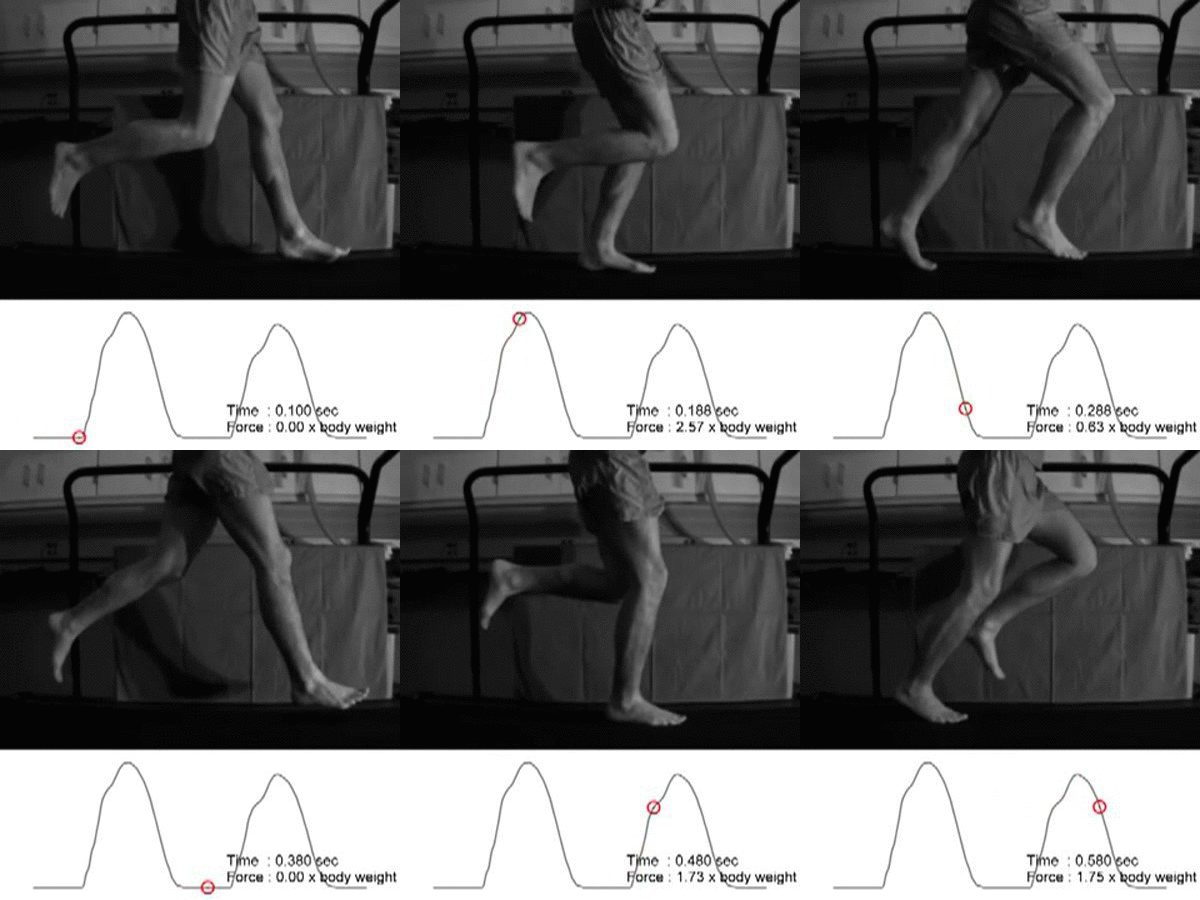
It's imprecise language, to be sure. I think it's more about where you're concentrating the force. If you look at the .gif that 'WalterSear shared down-thread, you'll see that the greatest force is just before the heel lifts, not after.

That's the difference, I think, between "pushing off" with the heel or the forefoot: where, specifically, in the stride the maximum force is applied.

So can anyone sum up what the right way to run is?
When I changed my running style, I was given all the tips here, and they're certainly right, but it's a lot to think about when you're running. It didn't click for me until I concentrated on just two things...running more upright, so that my foot strike was almost directly underneath me, and upping my cadence to force myself to take very short steps. I was given the recommendation to strive for 180 strides per minute, so when I was relearning to run, I basically counted out a waltz beat in my head, 1-2-3, 1-2-3, ... Do that roughly once per second and keep your feet moving at that pace and it becomes hard to do it wrong.

Oddly enough, I expected that running with that cadence would fatigue me much faster, but midway through my first run, I found myself being less fatigued than my previous technique.

If all else fails, bend the knees and go down few cm. Then try to kick you butt with the heel going up. This will naturally lean you forward and your striking leg won't heel in first on the next strike.

Also, try to keep your head in the same virtual horizontal line. Head/torso going up and down can cost up to 40% more energy.

For extra points, your torso shouldn't be swaying, arms moving should be enough.

YouTube marathon runners for Olympics and look at some training videos for in depth info.

Simple: observe a kid running before he gets used to padded shoes. That's the natural way of running and is similar to experienced runners.
In my experience, here are the things to be actively controlling: don't hunch over (keep your back relatively straight), keep your arms bent at 90 degrees and swing them moderately (not too little, not too much), don't lock out knees, don't heel strike (strike with the blade or ball of your foot, whichever you prefer). If you're swaying side to side, you may need to place your feet closer to the centerline of your body. Everything else should come naturally.
>swing them moderately (not too little, not too much)

Just had to point out this delicious tautology.

Anyway, I don't think you can sum up correct running form in words, or if you can then it's not useful. My advice would be: keep your tempo (steps/minute) around 170-180, do ankle mobility work and hip/glute strengthening. A high tempo lessens time in air each stride and thus velocity when hitting the ground, lowering impact on joints. Ankle/hip/glute work will stave off most muscular imbalances, which are the root cause of many form problems.

>Just had to point out this delicious tautology. Anyway, I don't think you can sum up correct running form in words, or if you can then it's not useful. My advice would be: ....

Just had to point out this tasty contradiction. ;)

"Barefoot" or "Regular"?

They process is entirely different.

I haven't seen anyone speaking up for treadmills here so I guess I'm going to be the only one to do so.

I don't think treadmills are silly at all.

If you live somewhere flat and you want to train to run up mountains when you go on holiday a treadmill is a useful tool. You don't get the thinning of the air but they can give you access to long steep gradients you wouldn't otherwise be able to train against.

As a cyclist, I use a smart trainer and Zwift for much the same sort of training.

It isn't impossible to push off from the heel. Imagine running in in sand and making an attempt to leave no mark. After you catch yourself gently and your heel touches the ground you let it all go, your whole weight, into the ground and then push off with the heel. The forefront and the toes leave the ground last, but they aren't pushing, they are being picked up.
>Also, "pushing off with your heel" is not a thing. It's impossible to finish the liftoff from the heel while running.

So what is going on in this picture?

https://i.makeagif.com/media/3-05-2014/hQcYHP.gif

I see the maximum force being applied just as the heel leaves the ground. Maybe the maxima is >just< slightly after, but the heel is still involved.

The ball of the foot is doing the pushing at that point, and the ball of the foot finishes the liftoff. Try and take a few steps where the ball leaves the ground before the heel, you'll see.
The ball of my foot may be the last thing to leave the ground, but when I run barefoot style, I'm pushing off with my heel.
Your heel doesn't have leverage to lift your body off of the ground. If your heel is leaving the ground it's either your knee lifting it or your toes pushing it. In the gif you linked, and in proper running form, you push with the balls of your feet. Your ankle / heel system is solely a fulcrum that doubles as a dampening spring.
"pushing" isn't the only way to apply force. from the gif the ball of the feet start and end the "pushing", but this is unrelated to how much lifting you do with the heel
You can't draw any useful conclusions from that. It is only depicting vertical force. Pushing up, not pushing off.

Pushing off refers to forwards, longitudinal force. Walking and running are commonly modeled by inverted pendulums, and the best time to increase the energy of the pendulum is at the extreme of the range of motion. The middle of the swing is the worst time to add energy to the system.

Or think of it physiologically. If you are adding energy mid-stride, the gluteus maximus is responsible for producing all forwards force. (Which might be a fair assessment, humans's are unusually large for mammals.) Adding energy at the end of the stride allow the gastrocnemius to provide thrust as well.

yes, i they were focusing on the vertical force because it is the more likely to cause injuries and , when jogging, most of the total force.

i think everybody agrees that the forward sprint is in the end of the step, from the ball of the foot

Looks like over-supination in that picture? The heel is definitely not pushing off, the forefoot is last to touch the ground.
You're right. Thanks.

Pushing off with the heel is actually specifically (if indirectly) part of what I'm working on with the bodyworker I mentioned, even. I really should have completed the thought.

Thanks for catching and clarifying that.

Oh, another thing: $20 water shoes last only slightly less long than $100+ speciality 'barefoot' running shoes. :)

https://www.amazon.com/gp/product/B002Z7EOK8/ref=oh_aui_deta...

Why not make your own? ^_^ http://barefootted.com/sandals.pdf
Not really true. I used to go through Walmart's $20 a pair a month walking. $60-$160 shoes I usually do 400 km running on them.

90+kg here.

They might last as long, but do they work the same? I have $5 socks that outlast my shoes, but socks aren't exactly a replacement for shoes, right? Water shoes and barefoot running shoes seem like two different types of foot covering.
They work the same. The entirely flexible sole is the key.
Or, don't push off with your heel, if that's more natural to you and is what your body is conditioned for.
Do you have some more information on this? Are you talking about running on paved road, or in (rough) terrain? I admit I have some difficulty visualizing how you combine landing on the ball of your foot with pushing off with the heel (so I at least agree that it doesn't feel natural :-).
I'm definitely no expert, I'm afraid. Perhaps others can chime in. But notice how, in this gif, the maximum force is applied just as the heel starts to lift:

https://i.makeagif.com/media/3-05-2014/hQcYHP.gif

I think it's hard to imagine in part because it involves such a radical shift in the center of gravity, bringing the body over the knee, so the foot can act as a springy lever, minimizing the impact of your heel on the ground.

http://www.barefootbruce.com/images/100_Barefoot_Biomechanic...

It's also something I found >literally< impossible to do when I started, because in addition to the lack of knowledge, my tendons and muscles had never performed the motion before. So, please be careful anyone who tries to pick this up, and don't overdo it until you are limber and strong enough in the small stability muscles of your feet. But >do< pick it up. Such a more efficient, and less painful way to run.

It might be clearer phrased as pushing through the heel, instead of off it. Or maybe that just makes it worse. It's a bit in the vein of riding a bike: you can't very easily explain it to someone who's never done it; with sufficient practice, the right neurons will just start hanging out together at some point and then it's pretty much automatic.
Thanks, that makes a lot more sense.