Hacker News new | ask | show | jobs
by myshpa 1193 days ago
It's not just the draughts.

https://www.seaspiracy.org/facts

"Species like thresher, bull and hammerhead sharks have lost up to 80-99% of their populations in the last two decades.

Seabird populations have declined by 70% since the 1950's.

Studies estimate that up to 40% of all marine life caught is thrown overboard as bycatch.

Six out of seven species of sea turtles are either threatened or endangered due to fishing.

Over 300,000 whales, dolphins and porpoises are killed as bycatch every year.

2.7 trillion fish are caught every year, or up to 5 million caught every minute.

Fish populations are in decline to near extinction.

11 comments

And in EU, the French government just announced that it will "strongly oppose" forbidding deep ocean scrubbing nets in "protected areas" (which are therefore totally unprotected). They look like caricature villains from a comic book or something. Bonkers.

For history, here's the criminal, senseless moron, shame on him, shame on them all: https://www.youtube.com/watch?v=NtfGFt1c5H8

The Dutch experimented with pulse fishing [0]. This had some good benefits for the sea and didn't seem to negatively impact the fishing industry over here much. It was banned again by the EU, according to some due to lobbying on behalf of other countries that were afraid they'd have to start investing in it too.

0: https://www.wur.nl/en/dossiers/file/pulse-fishing.htm

Someone thought building a giant taser and electrocuting everything on the seabed was a good idea.

https://www.pulsefishing.eu/what-is-pulse-fishing/techniques

If it doesn't destroy the plants too, it probably ~is better for the ecosystem than what it's replacing, but if aliens come and start dragging electrocution nets over human cities to electrocute us all, we won't be able to say we didn't have it coming.

I’ll… I’ll take that risk.
This doesn't look like a significant advance in sustainability, rather in fishing efficency; a "better" sustainability score doesn't mean it's sustainable. In the same way that replacing coal with nat. gas doesn't solve global warming.
Studies estimate that up to 40% of all marine life caught is thrown overboard as bycatch.

This is a fairly important part. It’s one thing to fish and eat. It’s another thing to fish and destroy. Trawling is the strip mining of the sea.

In the US, you are required to discard bycatch under penalty of law. As a professional fisherman you aren't even allowed to eat it. They don't want to discard it, they are required to.

The regulation nominally exists to disincentivize bycatch but anecdotally it seems to just ensure that bycatch becomes waste.

It would be better to ban the type of fishing that produces enormous bycatch and also destroy the seabed.
Governments and corporations lack motivation to cease this behavior, as there are continually available markets willing to pay for and meeting consumer demands.

One of those major issues that seems likely to drown with a million other major issues.

There’s a big difference between bycatch you can’t keep and being required to throw away all bycatch, I’m presuming that’s what you mean.

NOAA states:

>Fishermen sometimes catch and discard animals they do not want, cannot sell, or are not allowed to keep.

There’s a huge difference in not allowed to keep and we would keep for ourselves. If you’re netting a bunch of undersized fish you have to release them, I catch lots of undersized fish I’d love to eat but I’m not legally allowed to.

https://www.fisheries.noaa.gov/insight/understanding-bycatch

> it seems to just ensure that bycatch becomes waste.

Not exactly. Bycatch becomes energy diverted towards the scavengers part of the trophic chain. They are feeding other animals with it.

If you're allowed to keep bycatch, then the incentive to reduce it is suddenly gone - easier to just find a way to accidentally also make money off it.
The law of supply and demand expects the marginal cost of each additional fish to be more expensive. What if it's not. What if it costs the same amount of money to catch fish until you catch the very last fish. Suddenly the price of fish jumps from $.03/fish to infinity. Some sort of quota system has to be implemented and enforced to not come to such an abrupt halt on a market like that. Fish is one thing, at least there are alternatives, but peak oil, or peak natural gas are going to be, barring some technological mitigation, catastrophic to our modern way of life.
"For example, Mitsubishi, a company which handles 35-40% of Japan’s imported Atlantic bluefin tuna, has been deep-freezing and stockpiling thousands of tons of bluefin each year, seeking to profit by selling bluefin at extremely steep prices in the future when the bluefin tuna is extinct or near extinction."

https://www.independent.co.uk/climate-change/news/revealed-t...

https://web.colby.edu/st297-global18/2019/01/21/atlantic-blu...

Won't this encourage fishermen to continue fishing bluefin at higher prices?

What a dark future: "Bluefun tuna is extinct in the wild but you can still eat it from Mitsubishi"

And then: "Today the last bluefin tuna in the history of the world was sold for $20M to a billionaire."

Something like that...

We've already seen it in Futurama with the the anchovies (A fishful of dollars).
$20 million is a steal!

One sold for $3.1 million back in 2019.

amazing and awful
The Tuna wars, begun have they.
In Japan, you can buy farm-raised bluefin tuna. It is nicknamed "Kindai tuna". Read more here: https://www.gov-online.go.jp/eng/publicity/book/hlj/html/201...
I remember one of my undergrad economics professors going on a rant about how we will never run out of oil or tungsten or whatever because the marginal cost will increase gradually until we find alternative materials.

It sounded very intelligent and convincing to me at 18, and sounds downright idiotic to me now.

This is different than fish, as tungsten is recyclable and doesn't rot.

Read up on the Simon/Ehrlich wager. Nobody knows the future, but your professor was demonstrating a solid economic principle.

I know that oil and tungsten are materially different from fish. Marginal costs of digging things out of the ground does in fact tend to increase gradually with scarcity, as do incentives to devote resources to basic research into recycling, consumption reduction, and alternatives.

But teaching undergrads about tungsten and not fish is just propaganda.

Edit: To be clear, the point is not that my professor was idiotically wrong about oil and tungsten specifically. The "idiotic" part is to assume and furthermore imply to young students (who don't know any better) that the general principle holds equally well in all domains. Maybe "arrogant" would be a better word than "idiotic".

Oil and gas are different than metals though because some deposits spurt out of the ground, while others require heroic drilling, pumping and refining efforts that take more energy to realize. This is the concept of energy returned on energy invested (EROEI). When it takes more energy to get the oil out of the ground than is in the oil, it might be better to use the energy for something else and leave the oil in the ground.
Tuna can’t survive as a species with just a handful of tiny deposits scattered around the planet.

And if we found alternatives to Tuna, it doesn’t mean that other species like sharks and Orca can.

Indeed, your professor was starting under the assumption that our civilization will not collapse. If you want to know what happens when the resources your civilization is built on run out, you're probably better off asking a historian than an economist.
s someone who degreed in economics, and has been studying the economic resource situation formally and informally for nearly five decades, what I've come to realise is that economics has a very shaky grasp on the actual, and sensible, pricing of extractive resources.

Economically, mining is exploitation of any resource on a basis which fails to account for the full ecological formation costs of that resource.

In the case of petroleum, we can look at one ecological cost: time.

Petroleum formed over a period of hundreds of millions of years. It's been extracted by humans for a couple of hundred years. Even on napkin math, the time cost is being discounted by on the order of one million fold.

If the resource were so vast that it could not be meaningfully exhausted, this wouldn't be an issue. But we've hit peak conventional oil within numerous major producer countries, and quite probably the world, which corresponds to roughly half the total exploitable resource having been exhausted.

The economic theory most often mentioned for pricing of nonrenewable resources is Hotelling's Rule, formulated in 1932. I've read that paper numerous times, and the fact that strikes me most about it is that although it cites earlier economic works and numerous references of the author himself, it cites absolutely no scientific, geological, or petrochemical references. It's utterly devoid of any real-world grounding.

And we have pricing data to invalidate it, one of the most comprehensive being crude oil prices dating to 1870 or so. That's published as part of BP's Annual Statistical Review of Energy, showing both nominal and inflation-adjusted prices.

What's clear is that price does not follow the trend predicted by Hotelling, but rather reflects, at various times, unrestrained extraction (when the price collapses), various catellisations and embargos (when it peaks), and several periods of long-term managed output, during which it remains quite nearly constant. The longest and most stable such period was from the early 1930s to the early 1970s, following the establishment of regulated extraction in the United States (at the time the world's peak, and surplus-capacity, provider of oil).

Immediately prior to this period, following major discoveries and unregulated extraction in East Texas, the price fell from a target $1/bbl to $0.13/bbl, and finally as low as $0.02/bbl. The rational for pricing wasn't Hotelling's model, but the bare minimum price required to meet marginal costs of extraction.

More recently, in the 2000s and 2010s, what's emerged has been the flip side of demand destruction, where prices of oil can rise to the point that economic activity can't support them, and demand collapses, with it ultimately price (as more expensive marginal wells are withdrawn from production). Price has see-sawed between highs as the global economy surged, and lows, as it collapsed. Sometimes exogenously as with the 2020 global COVID pandemic, which saw US spot futures prices fall negative briefly at contracts expired and delivery had to be made --- there was no available storage and traders paid to have their oil offloaded.

The upshot is that extractive commodity prices don't behave as one might expect during periods of exhaustion. Rather than rising monotonically, they'll jump around on thin trading, surges in supply and demand, and external influences.

> someone who degreed in economics

Condolences ;)

> I've come to realise is that economics has a very shaky grasp on the actual

It can't be taken seriously if the first thing it does is disregard externalities.

Economics is here only to validate the current system, has no other meaning than that.

Condolences ;)

As Herman Daly has noted: know your enemy.

I've found in particular the rationale around land rents for minerals and extraction, dating to David Ricardo, are an interesting place to poke around. Hotelling's Rule is based on that, though through an intermediary.

There's also the associated legal concept of the Rule of Capture, which is applied to the notion of property rights in mineral resources is also based on some curiously fallacious legal argument. Which also leads me to realise that amongst various categories of knowledge, legal practice seems to be its own animal, based variously on statute, precedent, and persuasion, rather than empirical foundations.

(Other realms of knowledge include revelatory knowledge, commonly in religion; convention and authority, in various fields; communities of practice as with technical arts and some societies; and poetic or literary knowledge, essentially of narrative and record which are passed down but again need have no basis in any external empirical foundations.)

There's the equivocation between economic wealth and accounting profits, which are ... somewhat related ... but divided by the fact that the former includes all accounting of external costs and benefits, whilst the latter does not. Financial systems are cost- and risk-externalising machines.

I've recently discovered Katharina Pistor through the Ezra Klein podcast. She writes on the relationship of property to economics. She is hitting on themes I'd been struggling towards and does some excellent analysis and research. Transcript:

<https://www.nytimes.com/2023/01/13/podcasts/transcript-ezra-...>

Book: The Code of Capital (2019) <https://libgen.rs/book/index.php?md5=D936D0247CB138F23F157A7...>

Naomi Oreskes and Erik Conway have just published The Big Myth, which looks at the selling of the notion of free markets, specifically in the US. It's an outgrowth of their earlier work on disinformation in the tobacco, CFCs/ozone layer, lead, and oil / global warming disinformation campaigns by major corporations.

<https://www.kirkusreviews.com/book-reviews/naomi-oreskes/the...>

I've yet to land a copy, but from several interviews the work seems useful though quite probably incomplete, as there was an earlier practice of such advocacy in Britain, as evidenced by The Economist's prospectus announcing in 1843 a new publication "THE ECONOMIST, which will contain— First.—ORIGINAL LEADING ARTICLES, in which free-trade principles will be most rigidly applied to all the important questions of the day..."

<https://www.economist.com/unknown/1843/08/05/prospectus>

A later editor of the Economist, Francis Wrigley Hirst, was key in persuading Oliver Wendell Holmes of the concepts of free markets and their applicability to the realm of free speech, ultimately leading to the expression "the free market of ideas" in a 1950s US Supreme Court judgement. That draws on (though mischaracterises) John Stuart Mill's writings on free speech and liberty as well.

I've written on that last variously on HN, this seems a reasonably coherent summary:

<https://news.ycombinator.com/item?id=22850549>

For those interested in more, an Algolia search: <https://hn.algolia.com/?dateRange=all&page=0&prefix=true&que...>

Susan Gordon's written on how J.S. Mill's notions have been distorted and misrepresented in "John Stuart Mill and the 'Marketplace of Ideas'" (1997) <https://philpapers.org/rec/GORJSM> (full text on Sci-Hub / LibGen).

Other criticism of the concept, Stanley Ingber, "The Marketplace of Ideas: A legitimizing myth": <https://scholarship.law.duke.edu/cgi/viewcontent.cgi?article...> (PDF)

There's more, though this is a good start and seems to be less generally acknowledged even amongst notable critics of economic orthodoxy. Steve Keen, Philip Mirowski, and Mariana Mazzucato would be other good names to read.

If you want less of something, tax it. Tax the caught fish.
> If you want less of something, tax it

If you want less of something, don't subsidize it.

> Tax the caught fish

How would you tax the bycatch?

How would you price the dead whales, dolphins and turtles?

How would you price the sharks dying because the populations of fish are collapsing?

By taxing the caught fish.
> 2.7 trillion fish are caught every year, or up to 5 million caught every minute.

Bycatch aside, this number absolutely floors me. There is no way this number can sound remotely sustainable to anyone, right?

I love seafood, but I know the issues with overfishing so I don't eat it often and when I do, I do my best to only eat sustainably caught or farmed fish...but I feel absolutely hopeless seeing numbers like this.

Overfishing is an issue for sure, but the number just speaks to home unfathomably huge the oceans are.

Poke around and look up how big wild schools of anchovy can be, or how many krill it takes to feed a whale. And each of those numbers you find are just teensy little blips. The ocean is really big and its teeming with life.

The ocean is really big and its teeming with life.

As earlier responses have noted, this is an exceedingly common misperception. It further fails to acknowledge harms done.

Estimates are that upwards of 90% of all marine animal life has been destroyed largely by human activity.

Vast fisheries have utterly collapsed, notably Grand Banks cod off Newfoundland, sardines off California, orange roughy, and more. Surviving fisheries are hugely impacted, often with both far fewer and far smaller individuals than in historical records.

Records and understand themselves are exceptionally limited, as major scientific study of the oceans dates only to the mid-20th century, after which much of the harm had already been done.

A fascinating trivium is that there is more oil floating in tankers over the oceans than there are fish swimming in it.

And, as myshpa noted, the deep oceans tend not to have much biological activity. Fish (and plankton) aggregate near continental boundaries where upwelling provides essential nutrients. Sunshine and water alone are vastly insufficient.

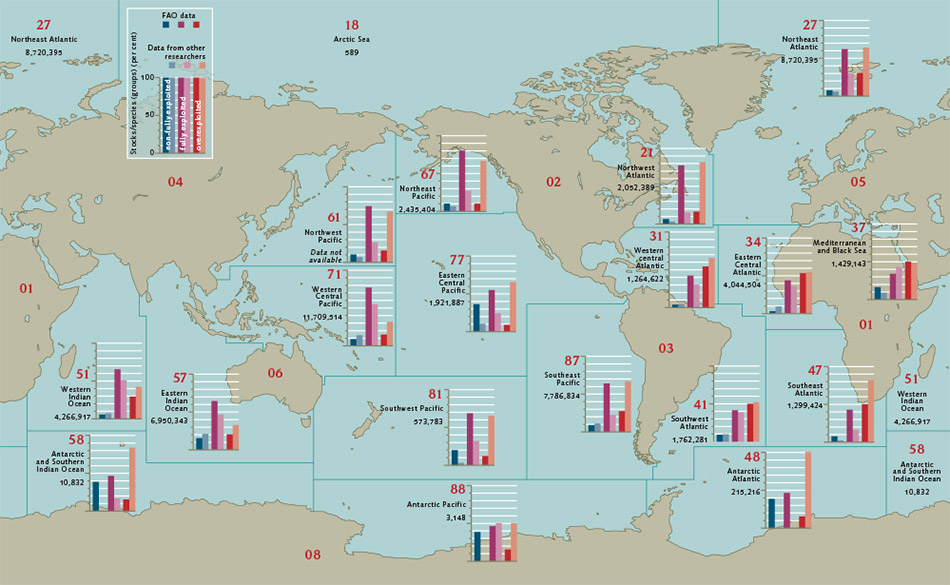
Map of global fisheries / fish stocks: <https://www.theglobaleducationproject.org/earth/fisheries-an...>

State of fisheries: <https://worldoceanreview.com/en/wor-2/fisheries/state-of-fis...>

Notably this map showing sustainable- / over-exploitation status: <https://worldoceanreview.com/en/files/2013/04/wor2_c3a_s52_3...>

"There are large areas in the middle of the major oceanic basins called the subtropical gyres. These could be considered the deserts of the ocean in that the biomass (total mass of all organisms) density and biodiversity are low. This is because the ocean circulation doesn't replenish the nutrients available in these areas for algae to live off, which are the base of the food-chain.

In general, you tend to find much more biomass and biodiversity closer to the coasts. But you can get hotspots of productivity in other places such as upwelling regions and also near seamounts (shameless plug of my paper on this)."

"People assume, well oceans are massive so fish stocks are massive as well. But if you went hunting for game as a protein source you wouldn't assume it lives at the top of every mountain and bottom of every valley. You know it has a range that confines its distribution and therefore its abundance. You dont go hunting across the vast, empty desert.

Commercial fisheries know this and are squeezing the last bits they can out of the pelagic fish we all expect on the dinner table (tuna, mahi, etc), but as you aptly point out, the majority of fisheries biomass is near the coast. Fish we eat do not come from habitat that covers 70% of the planet, its much closer to < 10 %."

https://www.reddit.com/r/askscience/comments/imu81a/if_you_p...

https://www.sciencealert.com/there-s-a-desert-in-the-middle-...

> The ocean is really big and its teeming with life.

The ocean is really big and was teeming with life.

There, fixed it for you

It's not just fish.

The sheer number of animals that are slaughtered to produce meat for human consumption is absolutely mind-boggling. In addition to the fish, humans killed 72 billion chickens, 3.3 billion ducks, 1.3 billion pigs, over a half-billion geese, turkeys, rabbits, sheep, and goats (each!), over 300 million cattle, and over 70 million rodents for food in 2019 alone [1].

Animal agriculture overall generates more CO2 emissions than every automobile, ship, and airplane on Earth - more carbon than the entire transportation sector. An overwhelming majority of arable land on this planet is used to feed those animals, fated to death from birth, rather than humans - in many developing countries, humans starve while livestock are plumped for slaughter and export. [2]. 75% of historic deforestation in the Amazon, 55% of erosion, 60% of nitrogen pollution, and 44% of anthropogenic methane and nitrous oxide emissions (each) are a direct result of animal agriculture [3].

If you live in the US, like I do, it's not just the animals and the environment that suffer under animal agriculture. It's an open secret that undocumented children are exploited to work in slaughterhouses in this country [4] while politicians are actively rolling back protections for those exploited children [5] to ensure that boneless skinless chicken breasts stay cheap at WalMart.

There is no such thing as sustainable animal agriculture - it is a lie used to greenwash products, to make us feel righteous when we pay for corpses at the grocery store or restaurant. The only sane and ethical response to this devastation is to completely reject the economic exploitation of animals - to adopt a fully vegan philosophy. Of course, this does cause some difficulties in the modern context (especially in the US), but the trouble of learning to cook vegetables and seitan is nothing compared to the harm that animal agriculture causes to billions of humans and non-humans every year. (It also cured my high blood pressure and pre-diabetes in three months, but everyone knows vegetables are good for you :)

[1] https://www.fao.org/faostat/en/#data/QCL (https://web.archive.org/web/20211208184438/https://www.fao.o...) [2] https://www.colorado.edu/ecenter/2022/03/15/it-may-be-uncomf.... [3] https://climatenexus.org/climate-issues/food/animal-agricult... [4] https://www.nbcnews.com/news/us-news/feds-find-100-children-... [5] https://www.axios.com/local/nw-arkansas/2023/03/13/arkansas-...

>>There is no such thing as sustainable animal agriculture - it is a lie used to greenwash products

Yeah I absolutely don't agree. I don't believe it can be done at scale - but it can be done. Watch a channel like Harry's Farm on youtube - guy basically has cattle on moors where nothing else could possibly grow - they just stay there all year, eat grass, then one day they get slaughtered. There is nothing about farming them this way that's unsustainable.

>>The only sane and ethical response to this devastation is to completely reject the economic exploitation of animals - to adopt a fully vegan philosophy.

I think you might be getting too much of that "greenwashed" propaganda yourself friend.

We should be fighting against factory farming with all our might, and especially the US is a sad place when it comes to animal rights. But going out and saying it can't be done sustainably is a lie peddled by people who either literally can't imagine how it can be done, or who don't want to see it. I believe meat can be sustainably produced, but it should be reflected in its cost - people shouldn't be eating meat 3x times a day because it's so cheap.

> I don't believe it can be done at scale

Sustainable animal husbandry represents less than 5% of the total.

> but it can be done

We may also find farms where there are no animal inputs used. It can be done.

> it should be reflected in its cost - people shouldn't be eating meat 3x times a day

Removing all subsidies for dairy, meat & fishing would help a lot.

>> The only sane and ethical response to this devastation is to completely reject the economic exploitation of animals - to adopt a fully vegan philosophy

> I think you might be getting too much of that "greenwashed" propaganda yourself

If you don't see the logic in it, then you just haven't found the power to really acknowledge all the problems associated with it.

https://en.wikipedia.org/wiki/Cognitive_dissonance#Meat-eati...

https://en.wikipedia.org/wiki/Carnism

>>Sustainable animal husbandry represents less than 5% of the total.

That sounds very different to "There is no such thing as sustainable animal agriculture - it is a lie used to greenwash products"

>>Removing all subsidies for dairy, meat & fishing would help a lot.

I agree.

>>If you don't see the logic in it, then you just haven't found the power to really acknowledge all the problems associated with it.

I absolutely do see the logic in it, but someone saying that the only way to solve this is by going vegan is no different than someone saying that the only way to solve global warming is to stop driving cars. Would that solve the problem? Of course it would. Are the chances of that happening greater than 0? No, they aren't. This isn't personal criticism of course - if you feel that going vegan is consistent with your logical and moral stance, please go ahead. But I don't think we should even pretend that veganism is the solution to this problem on a global scale, because I don't believe you would get anywhere near the required number of people on board with it. The steps that I think are far more realistic are - more sustainable animal husbandry, sharp rise in cost of meat to reflect its true cost(which will naturally reduce the amount of meat consumed), and yes, like you said - removal of artificial subsidies to those industries.

> the only way to solve global warming is to stop driving cars. Would that solve the problem? Of course it would

No it would not. We have to do many things to solve it, not just one thing or another.

And nobody argues that we should stop eating ... that would equal stopping driving. But as we can drive electric instead, we can also eat something else than animals.

We already get majority of calories out of plants ... animals supply only 18% of calories and 37% proteins (https://ourworldindata.org/land-use).

>> Sustainable animal husbandry represents less than 5% of the total.

Mea culpa. That max 5% is non-industrial farming. How big part of it is sustainable i do not know.

Nearly 100% of my meat comes from locally raised grass-fed-and-finished cows. They are rotationally grazed and live their whole lives in the outdoors. It is actually much, much cheaper than buying meat from a supermarket - ground beef is half the price, steaks are as little as 10%, because all cuts are priced the same. (My dairy comes from another, similar farm, and while it is much better, it is more expensive.) I also went all through the slaughterhouse and no, there's no kids there.

I eat a lot of eggs. 100% of my eggs and the occasional chicken come from my parents, who, with twelve chickens, produce an insane surplus of eggs, letting them eat whatever bugs they find and feeding them scraps.

People will argue this isn't scalable, and maybe it isn't. But the price of my beef suggests it is underutilized at this time. Certainly more rural and semirural people could keep chickens. I would favor this alternative anyway, since industrial-scale food production isn't just inhumane, it produces inferior products that are subject to enormous risks and shocks as producers race to centralize and become more and more efficient. You don't want hyperefficiency in your food supply. Hyperefficiency means fragility.

Massive industrialized agriculture is its own ecological disaster. The farming of corn for ethanol (!!!) and the massive, endless fields of soybeans and canola in the US midwest (foods eaten by almost no American a few decades ago) are permanently destroying the ecology of nearly half the US. It's annihilating topsoil at alarming rates, eradicated huge swaths of natural wildlife, and filled watersheds with massive amounts of fertilizer and pesticides which are then contributing to killing all the fish. You see how we've come full circle.

Do you know what would be great and sustainable for the midwest? Fill the plains with cows. For thousands of years, they were filled with ruminants. The cows must be kept in tightly packed herds to emulate their behavior when predators are present. This will regenerate the topsoil, as that's what formed much of it in the first place, and end the flow of poison into the waterways. I'm not opposed to returning the buffalo instead, if you prefer.

You talk about greenwashing - that's a big part of the push behind veganism. Obviously there's sincere people like you, but there's a lot of money in producing highly processed foods and (soon) artificial meat. Highly processed foods (besides being a health disaster) can be easily produced via "food science" from relatively stable, controllable inputs, which animals are not. They are much easier to scale, which is where the real money comes from when you're selling commodities. Frequently, even when one input does become a problem, it can be replaced with no obvious impact to the consumer.

It's not about taking a holistic look what what we need to do ecologically and environmentally, which would include meat. It's about cash.

> fated to death from birth

Everything born into this world will die. That's nothing special about livestock.

> my meat comes from locally raised grass-fed-and-finished cows

https://yourveganfallacyis.com/en/humane-meat

> It is actually much, much cheaper than buying meat from a supermarket

Thanks to subsidies ... taxes taken also from vegans ;)

> the massive, endless fields of soybeans

"More than three-quarters (77%) of global soy is fed to livestock for meat and dairy production. Most of the rest is used for biofuels, industry or vegetable oils. Just 7% of soy is used directly for human food products such as tofu, soy milk, edamame beans, and tempeh"

https://ourworldindata.org/soy

> Fill the plains with cows. For thousands of years, they were filled with ruminants

You need also predators ... and I don't mean weekend hunters. Without predators the ruminants tend to stay in one place and eat everything, till nothing than desert remains. See Sahara and near east.

https://journals.sagepub.com/doi/full/10.1177/09596836166704... Blame it on the goats? Desertification in the Near East during the Holocene

> there's a lot of money in producing highly processed foods and (soon) artificial meat

Not yet, and artificial meat may not be here in next few decades (the scale is the problem). Soon is an overstretch. Artificial meat doesn't need to be highly processed ... in principle it's just plant protein (flour), starches, colorings (red beet etc.) and spices, maybe oils and vitamines. No magic, no complicated processes involving toxic chemicals etc (depends on the oils, tho).

> holistic look what what we need to do ecologically and environmentally, which would include meat

Meat is not necessary in those equations. We don't need to eat meat to live and prosper. We have composting and syntropic agriculture. We don't need animal inputs in agriculture. We can rewild areas used for animal farming (75% of 50% agriland of habitable land) and let the wildife rebound and manage the ecosystems. We can restore carbon sinks (double the forests) and stop anthropogenic wild life die offs. We don't have to rape the nature as we do now. For that the vegan movement is the logic outcome.

>> fated to death from birth

> Everything born into this world will die

https://www.dominionmovement.com/watch

Sorry, your first link is profoundly unpersuasive. I don’t see anything wrong with killing animals for a purpose, nor anything inherently evil in suffering. I appreciate that you have a different value system, but I don’t share it. I do have a problem with treating animals as commodities and as inputs to industrial processes.

> Thanks to subsidies ...

Incorrect.

> "More than three-quarters (77%) of global soy is fed to livestock for meat and dairy production. Most of the rest is used for biofuels, industry or vegetable oils.

I think it’s clear I oppose growing soy for animal feed. At any rate it’s misleading to exclude vegetable oil as something people directly eat, when nearly every American consumes a huge proportion of their daily calories from soy and canola oils.

> You need also predators ... and I don't mean weekend hunters. Without predators the ruminants tend to stay in one place

Yes, I specifically mentioned the need for rotational grazing, which builds up topsoil and stops desertification.

> We don't need to eat meat to live and prosper. We have composting and syntropic agriculture. We don't need animal inputs in agriculture. We can rewild areas used for animal farming (75% of 50% agriland of habitable land) and let the wildife rebound and manage the ecosystems.

I disagree. I and many other people need meat to prosper.

Ecosystems are not steady state without our inputs. And certainly nobody besides me is going to support the mass reintroduction of predators. What you’re describing is just a different kind of human managed ecology.

Also, properly managed livestock can absolutely be a carbon sink.

With your last video, you’re preaching to the choir. It’s still true we all die.

> I don’t see anything wrong with ... anything inherently evil in suffering

We won't be able to find a common ground.

> Ecosystems are not steady state without our inputs

Everything's going very well, indeed.

> It’s still true we all die.

Yes ... so there was nothing wrong with concentration camps, because all those people would have died anyway?

Let's agree to disagree.

> There is no way this number can sound remotely sustainable to anyone, right?

Why not? How many fish are born every minute?

Overfishing and dwindling fish populations are pretty established facts.
What does that have to do with the number?
I get that you wanted the original poster to realize that a big number doesn't necessarily mean anything. But we already know it's not sustainable.
You can either point at the number and say "Look at this number! Can't you just tell that it isn't sustainable?" or you can say "It doesn't matter what the number is, we know it's not sustainable for other reasons."

But neither of those is a support for the other. If you start with the assumption that the number is unsustainable, you're not doing anything when you look at the number.

This is a classic Tragedy Of The Commons.

Establish ownable fishing rights per ocean areas, and regular greed will solve this problem.

We've heard similar arguments in post-soviet countries regarding farming land - private land owners will take better care of the land, will protect the wildlife, won't poison their own land, etc.

Privatization didn't help ... small owners rent their land to the big ag, wildlife is still being decimated, land degradation accelerated, and now there are new deserts in central Europe (last week there was a sand storm in Hungary and Slovakia).

I mean, the USSR’s state-run actions completely drained and destroyed one of the largest inland seas in the world. Public isn’t always the answer either.

What really works for ocean policy is putting informed experts in charge of global regulations and everyone adhering to the rules under strict observation and penalties. It’s just really hard to get those institutions setup.

There’s an opportunity to use the existing UNCLOS framework to establish rules around commercial fishing operations, but they’ve been stalled for years. Likely because China is the worst offender and currently disputes a lot of the rules around sea/ocean territory given their interests in their immediate maritime spaces.

Just look at the state of forests in those countries... Parts of unique national parks razed to the ground... Land owners just want to get rich ASAP everywhere.
> wildlife is still being decimated

Wildlife isn't owned by anybody. Contrast this with cows. Cows are in no danger of extinction, despite mass slaughter of them.

I will happily cover my land in radioactive sludge today [1], in exchange for a one-time payoff that exceeds what I paid for it (Or, worse yet, what I can expect to recoup from it in <whatever finite time horizon I care about>).

Also, it's not like fish are going to respect lot borders. Overfishing in the lot next to mine will damage my lot's value. The only correct way for me to respond is by overfishing my lot.

[1] And leave my neighbours to deal with the long-term fallout.

The empirical experience is that landowners take good long term care of their land. That is how it keeps its value.

You may be disappointed to learn that lucrative radioactive sludge cover opportunities are quite hard to find in today's market.

You're right the fishing right zones need to account for fish migration paths etc.

Where are you from? I'd like to move if people around you take care of their land. Here in Michigan people don't often do that.

My private well is contaminated with 85 ppt (and my bloodstream, at 30ppt years after fixing the water supply) of PFAS because Wolverine tannery owners decided to dump ScotchGuard contaminated scraps in the swamp behind their homes.

The river through that same town, likewise, is no longer a world-class trout stream because homeowners on the stream banks fill it with nitrates and algae blooms by fertilizing their lawns. Lakes are clogged with zebra mussels because fishermen won't clean their boats and drain livewells/bilges while traveling between lakes, and the very fish they're going around to catch are down precipitously as a result of those actions. Once-productive farms? Soil's depleted. Old growth forests? Clear-cut, replaced by scrubby tangles and immature pines. The whole Great Lakes ecosystems? I give it less than a decade before invasive carp come through Chicago's unreliable electric deterrent.

The lack of radioactive sludge opportunities is unique, most other land-destroying activities are well established.

Land keeps its value because it's scarce and the growing population and growing economy keeps needing it, not because it's maintained to anything remotely like the ecological quality it once had.

Imagine someone just flying a helicopter through a forest scraping up the wildlife in huge nets, picking out the snails, and dropping the rest of what they scooped up to their death. Yet it happens all day every in the oceans and no one cares.

It used to be for every pound of wild caught shrimp caught, more than 4.5-5 pounds of other fish species were caught as bycatch and discarded dead. But now thanks to by catch reduction devices that is down up to 30%, so an optimistic 3.15-3.5 pound of bycatch.

I also feel that not building world-destroying robots should be something we should be able to reach consensus on. My current favorite world-destroying robot photo is from the battle of Lutzerath:

https://i.redd.it/bonkanv0xiba1.jpg

If that photo doesn't cause people to wake up to what's being done, ostensibly on our behalf, I don't know what will.

We’ve already destroyed a third of Earths forests, and most grassland has been converted to agriculture. We didn’t use nets, but the result has been the same.
Cancel all commercial fishing
You could not simply cancel it. You would also have to sail around sinking the scofflaw fleet, which might cause tensions with other countries.
1) International waters.

2) I paid more than I’d like so the US could buy the biggest guns.

I would love to see all commercial fishing banned as well for something like 10 years. Unfortunately there are other countries that would not respect the ban and even if not countries, individuals would ignore it as it would create a black market.

I still think the idea should be discussed and maybe g20 nations come up with some agreements.

Hopefully things like lab grown fish improve and maybe we can move people away from the real thing.

I keep telling my kids they are lucky anytime we get the treat of having some fish as in their future it may not be something available to the common person.

Lab grown fish are one thing, but simple fish farms already work really well, the issues are that the fish don't eat a natural diet and are sicker and less healthy to eat. Maybe that's an easier problem to solve than growing fish meat in a lab.
Farmed fish are fed pellets made of wild caught fish though.
That depends on the species. Farmed catfish eat mostly soybeans and corn (maize).
> eat mostly soybeans and corn (maize)

It still means deforestation, biodiversity loss, soil degradation, poisoning the ecosystem with pesti/herbicides and fertilizers on land (with the associated runoff into the waterways) and a lot of organic waste on the water (each salmon farm in scotland produces as much organic waste equivalent to a town of between 10 and 20,000 people each year).

Likely we could use both methods and see what works best. I’m not sure how well fish farms scale up but imagine lab grown meats will scale up.
I'm unclear why you'd stop at commercial fishing . Just ban all fishing and all fish consumption. The premise that your children could one day eat fish is the problem
The us has a large surplus of Asian carp. It’d be beneficial for the ecosystem if this invasive species became popular to eat to encourage more fishing of it.

Not all commercial fishing is bad.

Is recreational fishing that big of an impact?
Equals to kill several millions of people. Bad idea.
Worse idea: doing absolutely nothing to change our course of action until our decisions no longer matter because ecosystems have collapsed and hundreds of million of people are dying. That's how you get The Jackpot.
Trying to solve complex problems with simple improvised solutions is the definition of populism, and is normally worse than doing nothing.
We have to do something. This is something. Therefore, we have to do this.
Hunting ocean fish to extinction will have the same effect.

So, we may as well save the fish.

And Farming. And rent. And student debt. And Janice.
No, we should not ban farming or forgive student debt.
It makes me ashamed to be human. Reading stuff like that, and thinking about what we do to cows, sheep, lambs, chickens, etc, it dawned on me a while ago that humans have no right to treat animals like they're just a bunch of cells to be treated however we want, like a serial killer treats their victims. But that animals are fellow beings, a lot like us in many ways. I didn't want pain, or someone to kill me, so I figured they didn't either.

It was so easy to stop eating animal "products". The whole thing started to seem obscene, like a nightmare - ads on TV trying to tempt people to eat slaughtered baby sheep etc. I thought I'd miss the taste of meat but never have. (I feel so weird writing that sentence now.)

I encourage everyone reading this not to be a part of the problem, to stop contributing to this desecration. If no-one ate meat, this genocide of sea life would just stop. For every person that stops, we get closer to that. I realize in some cultures, it's not so simple, but in many, it is.

>But that animals are fellow beings, a lot like us in many ways. I didn't want pain, or someone to kill me, so I figured they didn't either.

I respect your noble pursuit of not eating meat, and I have encountered arguments similar to yours enough times now that I feel compelled to respond in genuine kindness as someone who does like to eat meat (within "reason").

Animals are benignly cruel to each other beyond your imagination or the production of what nature documentaries will show you. Nature is a fight of survival. No animal wants pain or to be eaten, yet that is the reality that every wild animal faces. The conversation of humanizing animals is very interesting, but in the process we disregard the reality of their natural existence. Their lifespans are short, and often brutal. I weigh the reality of wilderness to the reality of industrial farming and ask myself if there isn't some kind of middle ground. I think there is. You can raise animals in pastures where they free range outside. They have a relatively peaceful, predation, free life after which you consume them (by killing them quickly and painlessly).

I deplore the reality of industrial farming and "agricultural waste". Chickens being raised for one singular body part and then thrown away. We do not treat any of our food with respect, living or otherwise. We are not efficient. We do not care about quality. We don't even try consuming the whole thing. That's where I find this industry disgusting. Meat should not be this disposably cheap.

> Animals are benignly cruel to each other beyond your imagination

https://yourveganfallacyis.com/en/animals-eat-animals

> They have a relatively peaceful, predation, free life after which you consume them

https://yourveganfallacyis.com/en/humane-meat

They're not fallacies, they're fundamental disagreements.

1. No, animals do not have rights.

2. No, animal lives are not morally equal to human lives.

3. No, eating animals is not cruel.

If you disagree with these then that's fine, we can have a discussion about that, but you have to understand that not everyone agrees with you on these points otherwise you'll become that annoying vegan that pushes their beliefs on everyone.

Let's ;)

> No, animals do not have rights.

What about pets? Let's talk about dairy industry ... why don't we switch to dog milk? Nothing wrong with dog's milk. Full of goodness, full of vitamins, full of marrowbone jelly. Lasts longer than any other milk, dog's milk.

Why?

No bugger'll drink it. Plus of course the advantage of dog's milk is that when it goes off, it tastes exactly the same as when it's fresh.

> No, animal lives are not morally equal to human lives.

https://yourveganfallacyis.com/en/animals-are-not-intelligen...

> No, eating animals is not cruel.

I won't talk about this until you watch this: https://www.dominionmovement.com/watch (warning: very graphic content).

Then come back and tell me that what we do to the animals is humane and morally ok. Killing (and skinning alive) living beings who don't want to die when you don't have to is not humane.

> otherwise you'll become that annoying vegan

I'm already there ... and I don't care. I'm using my voice for those who can't speak. And they don't matter less than you do.

Ok, but it might get long. And again, I'm not looking for an adversarial discussion.

1. Animal Rights

Animals don't have rights because rights are a human construct. Absent humans, animal rights don't make any sense. Animals can only have "rights" in their relationship to humans, and humans are the ones enforcing those "rights". Therefore I don't think animal rights as a term makes sense. To me, they're closer to societal rules (or laws) for interacting with animals. This also goes for pets.

I don't know what you're getting at with dog's milk. Sure, I'll drink dog milk. Lots of people eat dog all over the world too.

2. Animal lives

Morality is a concept that applies to humans as they deal with other humans. You can only be judged immoral by another human being. A human being slaughtering a cow isn't judged to be immoral by the cow, because the cow has no concept of morality, only survival.

Therefore, the unprovoked killing of animals is not inherently immoral, like killing humans is. However, the purpose and method can be deemed immoral.

3. Eating animals is not immoral

Killing an animal for food is acceptable to me, and to the vast majority of people, since it is something we are all subject to in nature. Having food preferences is also not immoral. Bears and other animals have food preferences. Therefore choosing to eat meat instead of something else is not immoral.

However, I believe causing undue harm and cruelty are immoral. I don't want to contribute to a system that enables that cruelty.

4. Dominion

I don't know why you linked me this. I've already seen it. I know how fucked up industrial farming is. That doesn't mean eating animals is immoral.

Lastly, I disagree that they don't matter less than me. They do, I think humans are more important than animals.

> I won't talk about this until you watch this: https://www.dominionmovement.com/watch (warning: very graphic content).

False equivalences abound. Do you argue against people legally consuming marijuana because the cartels skin people alive?

> And they don't matter less than you do.

Do you think life in prison or even the death penalty should be on the table for a drunk driver that hits and kills a pregnant skunk? Because that’s what would happen if it was a pregnant woman instead.

We drink dairy milk because our culture has evolved along with dairy cows themselves. Maybe in an alternate timeline we'd be milking dogs. The cultural connection is why people are so attached to their meat (me included).

As a member of an older school farming community, livestock make natural fertilizer and meat from grass, bugs, and surplus grain. They play an important role in completing the nutrient cycle. Meat ends up being a bit of a luxury (limited quantities), but it's a product of sustainable land use imo

Your first point isn't consistent as a counter argument. Parent wasn't saying "animals do it so it's fine for us too". That's obviously wrong given the broad range of behaviors animals have that would be absolutely ridiculous if a human did them.

Parent was saying killing animals to eat them is not necessarily cruel. All animals die. In nature, this death is often painful and drawn out. Farming, with very little compromise, can be immensely more humane that what the average wild animal experiences. It is often not, but that can be fixed, both by the individual (buy from local less horrible farms) and by society (better regulation).

All that being said, I mostly avoid meat and dairy due to concerns over animal treatment.

nice, thanks for the links
Animal rights is the most important movement. Everything every other movement says applies to animals as well, yet they get ignored, and they do not have a voice.

From the article

> "It's devastating," he said. "This is more than just an income issue for me. It's an inability to do what I love. So, on a financial level and on a personal level, it's devastating."

I'm glad it's a financial loss. Nobody should be a commodity. And it's wrong that it's what somebody loves to do.

We moved to the Irish countryside and hearing the dairy cows wailing for their calves that have just been taken away from them is an uexpected meat/dairy deterrent.
When I was much younger, we had a donkey that had a breach birth, and the foal became stuck. It was awful, in every sense of the word. The foal ended up dying mid-birth, and we then did everything we could to save the mother. To the point where we were had a chain wrapped around the dead foal for pulling, and we had to cut up and break its bones to get it out.

We eventually saved the mother, but that donkey was truly scarred. For about two years, I would of said that donkey was clinically depressed. It really changed my perspective on just how intelligent animals actually are, and I’m sure they feel complex emotions just like us.

Heartbreaking story.

I had never paid much attention to donkeys until the neighbours got one a couple years ago. They really are a fascinatingly emotive and sensitive animal and more like a pet than typical livestock. It comes up to the fence to socialize with us and get snuggles, and rubs noses with our border collies. It plays with their German Shepherd and with their kids in the yard. It likes to snuggle. It is protective of the miniature goats and sheep that it cohabits with.

I expected it to be more similar to a horse, but it's different. Far less aloof. Kind of want one of my own now.

I wonder if today's epidemic of depression isn't in part fueled by the consumption of milk from grieving cows.

That distress has to get into the milk; this is one of the pathways of epigenetic regulation -- meaning the distress is heritable, and may impact cross-species.

And it is a completely unneccessary practice. See https://ec.europa.eu/eip/agriculture/en/find-connect/project...

On this farm, calves are kept with cows for 5 months after birth.

I've always been impressed by vegetarians, because of their comfort in the moral convictions that keep cows alive and suffering for their dairy and children, but never dead for their meat (and an end to their suffering).
A lot of them don't seem to realize dairy and veal go hand in hand. Or some are vegetarian for other reasons (health, ecological, religous, etc)
The thought-terminating cliche raises its head again.

There is nothing "ecologically" sound about keeping cows alive and burping on the cheapest feed available. This is not a criticism of your response, just pointing out that these kinds of cliches become culturally embedded after a certain amount of time, even if they do not reflect the reality.

I'm not disagreeing with you, I'm just saying that people have lots of different reasons for choosing to be vegetarian, and animal welfare isn't always their concern. I certainly recognize dairy has a large ecological impact (I live in Ireland after all; we're choking on dairy) but someone who eats dairy and beef probably has a greater impact than someone who eats dairy and plant-based foods.
Humans need to start living in harmony with nature. We need to stop using artificial fertilizers that end up in the ocean and slowly suffocating and starving animals. I like oxygen and so do they. We must also stop spraying literal poison on the land and exterminating the insect population that other animals need to survive. We must stop cooking the planet and especially the oceans, and stop burning forests in order to grow things like avocado.

However I understand that people do need to eat something, and thus I would encourage people to consider their diet based on the more complex plane than vegetarian vs meat. Most food, especially cheap food, do have negative consequences on the environment. If you can, look into the background of food you buy, alternative raise and farm your own food (chickens are excellent pets and one of the best way to keep grass down without using machinery, and they eat practically everything that would go into a compost). It doesn't scale but it do reduce the problem. Those that want to take a even bigger step can try the few environment friendly choices like say seaweed and shellfish. There is zero risk of mussel genocide, through one has to be aware of the farming method.

Humans cannot help themselves disturb the delicate balance in many natural systems. Corporations are the real extremists today and a difficult challenge our society faces due to the effects it has on human society and all other species on this planet.
> We need to stop using artificial fertilizers

80% of the population will starve to death if we do this. Is that what you want?

As I began in my second paragraph above, people do need to eat something. Right now that means sacrifice the environment if we want to keep everyone alive in the short term.

Long term we could have farming that has zero environmental impact, like vertical farming with fully contained and controlled environment. It would cost huge amount of money and with the current economical system it would be impossible to feed everyone on the planet, but the technology is technically there.

Right now however, a person should to take into account the environmental impact that different food has. Going into a store and buying a avocado will leave the buyer with some blood on their hands. They can try to reduce the amount of blood by making a difference choice depending on how a specific food is produced, but it will be more complex than just looking if it contains meat.

IMHO going vegan is the only practical strategy for reducing the impact of your diet. You have no practical way of knowing most of what's going on in the supply chain for most products, or their true carbon footprint, but overall, the footprint of growing plants and feeding them to animals is way higher than just eating plants yourself. The laws of physics are, to some extent, "on your side" when it comes to boycotting animal products for sustainability reasons.

There ~are some plant products with well publicized ethical or sustainability scandals like coffee, chocolate, date palm, and avocados, that are worthy of looking into once you've already gone vegan. By all means look into those and try to source them carefully if you can or add them to your boycott, but be careful not to buy into the greenwashing false-equivalence that because some plant products ~are wasteful, it's OK to eat meat.

For some people it will feel like the best way to only have some amount of blood on their hand will be a vegan diet. Obviously not all vegan diets are the same, and foods like avocado which is popular in vegan diets are quiet bad and should be avoided. Basically anything which on the purchased packet says imported from an country that has rain forests should be avoided if one want to avoid having the blood of animals that live in rain forests.

Being a mass murder of fewer victim than some other mass murders can be an important distinction for some people.

Still I would highlight that a small scale farmer or hobbyist who raises his own animals has likely less blood on their hand than a vegan who live in a city and eat imported fresh veggies.

There is also the aspect of long term strategies. Vegan diets are not sustainable and long term we do need to change how we produce food. Shell fish and seaweed are one of the few sources of food that we could produce in very large quantities without harming the environment around us. Insect farms would be an alternative, but those seems much less likely to be effective in term of changing the world.

There is a lot of green washing in crop farming. Practically all production of artificial fertilizers uses natural gas, and leaks from those operations is one of the major contributors to global warming. We have waters as large as the Baltic ocean being turned into a desert from runoff. People may feel happy to not eat fish, but fish were killed in order to produce the food that people eat. The deaths "just" happen to be a byproduct that accumulate slowly under the surface, and slowly moves towards mass extinction.

Wealthy people in developed countries won’t change. They either don’t want to inconvenience themselves or acknowledge that they’re the problem - or both.

People will instead say nonsense like, “corporations are the problem.”

I think it’s great that you’re taking steps to reduce your impact on the world (I’ve made many myself: no meat, no kids, no driving, no flying, small dense housing), but honestly don’t get your hopes up for anyone else following suit.

Wealthy people's habits may be the problem, but its important to understand that putting the blame on individuals' choices is a trap and distraction. The solution is regulation. Heavy, obtrusive, expensive regulation, which is required because as you say most people won't change.
> Heavy, obtrusive, expensive regulation, which is required because as you say most people won't change.

People will just vote it down. And not just the rich; the middle classes, the working classes, practically anyone who stands to lose even a few dollars or a few luxuries. People will only accept regulations that don’t affect themselves.

Yeah, I honestly don’t care if most people won’t change. I’ve done what I want to for the planet and I’ll be long dead before the bill for climate change really comes due. It’s their kids’ problem not mine. Good luck to them.
At the risk of being trite, your comment did make me think of the line from the end of The Lorax:

“Unless someone like you cares a whole awful lot, Nothing is going to get better. It's not.”

I’ve cared enough to live a drastically different life from most Americans (albeit, it’s a way of life I prefer and I’d live this way even if it was worse for the environment). That’s about all I’m willing to do.
The meat I eat comes from a ten minute bike ride's distance from my house.

The heavily-processed vegetable-based "product" aggressively marketed to you has been shipped halfway round the world, having been farmed using just about the least sustainable farming practices imaginable.

Which one is harming the environment?

Transport is a small contributor to emissions. For most food products, it accounts for less than 10%, and it’s much smaller for the largest GHG emitters. In beef from beef herds, it’s 0.5%.

Very little food is air-freighted; it accounts for only 0.16% of food miles.

Many of the foods people assume to come by air are actually transported by boat – avocados and almonds are prime examples. Shipping one kilogram of avocados from Mexico to the United Kingdom would generate ... only around 8% of avocados’ total footprint. Even when shipped at great distances, its emissions are much less than locally-produced animal products.

https://ourworldindata.org/food-choice-vs-eating-local

If your grocery doesn't have locally produced, affordable, delicious vegan junk food by now you should be pissed off at the people producing your food and demand better.
I don't eat junk food.
If someone said I could live my life and be happy but at the end I have to die or not live at all I am going to choose life. The same is true for the animals I raise. They get to have a very peaceful life where they are spoiled. They get heat in the winter, fresh water daily, the correct amount of calories each day, treats which they love like fresh picked berries and other foods they love, protection from predators, and all and all a very privileged life. But in the end they do die as painlessly as I can make it.

If I didn’t raise these animals they just wouldn’t have existed to begin with. So I do feel bad they have to die but I also gave them a great life.

All those things could presumably be said about Scandinavian prisons but anyone would still prefer freedom ;)
What's an animal going to do with it's freedom? Go get a college degree and launch a startup?
Your animals are pets, not a food production system. Those animal farming practices will not scale to feed 8 billion people. Most ~humans are not receiving the standard of care you claim to be providing your animals with.

The idea that continuing to live is a personal decision is tempting as a part of a moral code (Ayn Rand takes this idea to absurd conclusions, for example.), but depression/suffering must be ~extremely severe for people to get over their self-preservation instinct. You are ~not, in any meaningful way, making a conscious decision to continue living for the rest of your natural life. You never gave consent to be in the situation you're in as a human being, and the animals you're raising ~certainly didn't.

How does this affect plankton levels? Without predation we’d expect biomass to appear elsewhere, right?
Overfishing usually results in jellyfish blooms - if there are no fish to consume the available zooplankton then jellyfish will. There's stacks and stacks of papers written on that phenomenon.
So people just need to start harvesting jellyfish and eating them instead of fish.
> So people just need to start harvesting jellyfish and eating them instead of fish.

Why to eat stupid jellyfishes when all that you need to enjoy a 100% nutritive and delicious diet is to start eating other people?. Hoomans are plenty, easy to find, fatty, err sorry... enormous, yummy, delicious and had everything that our body needs.

Can we talk seriously again now? Only the 0,0001% of the jellyfish species are edible and they are basically a water globe devoid of nutrients.

Phytoplankton Population Drops 40 Percent Since 1950 ... that translates to an annual drop of about 1 percent

https://www.scientificamerican.com/article/phytoplankton-pop... [2008]

wild...as a hunter who has made the trek to California a few times for Javelina hog and black bear, i had no clue they even offered a permit for salmon at all...its just not something advertised much.
Also, coral reefs and kelp forests are suffering unprecedented losses.