Hacker News new | ask | show | jobs
by dcchambers 1193 days ago
> 2.7 trillion fish are caught every year, or up to 5 million caught every minute.

Bycatch aside, this number absolutely floors me. There is no way this number can sound remotely sustainable to anyone, right?

I love seafood, but I know the issues with overfishing so I don't eat it often and when I do, I do my best to only eat sustainably caught or farmed fish...but I feel absolutely hopeless seeing numbers like this.

3 comments

Overfishing is an issue for sure, but the number just speaks to home unfathomably huge the oceans are.

Poke around and look up how big wild schools of anchovy can be, or how many krill it takes to feed a whale. And each of those numbers you find are just teensy little blips. The ocean is really big and its teeming with life.

The ocean is really big and its teeming with life.

As earlier responses have noted, this is an exceedingly common misperception. It further fails to acknowledge harms done.

Estimates are that upwards of 90% of all marine animal life has been destroyed largely by human activity.

Vast fisheries have utterly collapsed, notably Grand Banks cod off Newfoundland, sardines off California, orange roughy, and more. Surviving fisheries are hugely impacted, often with both far fewer and far smaller individuals than in historical records.

Records and understand themselves are exceptionally limited, as major scientific study of the oceans dates only to the mid-20th century, after which much of the harm had already been done.

A fascinating trivium is that there is more oil floating in tankers over the oceans than there are fish swimming in it.

And, as myshpa noted, the deep oceans tend not to have much biological activity. Fish (and plankton) aggregate near continental boundaries where upwelling provides essential nutrients. Sunshine and water alone are vastly insufficient.

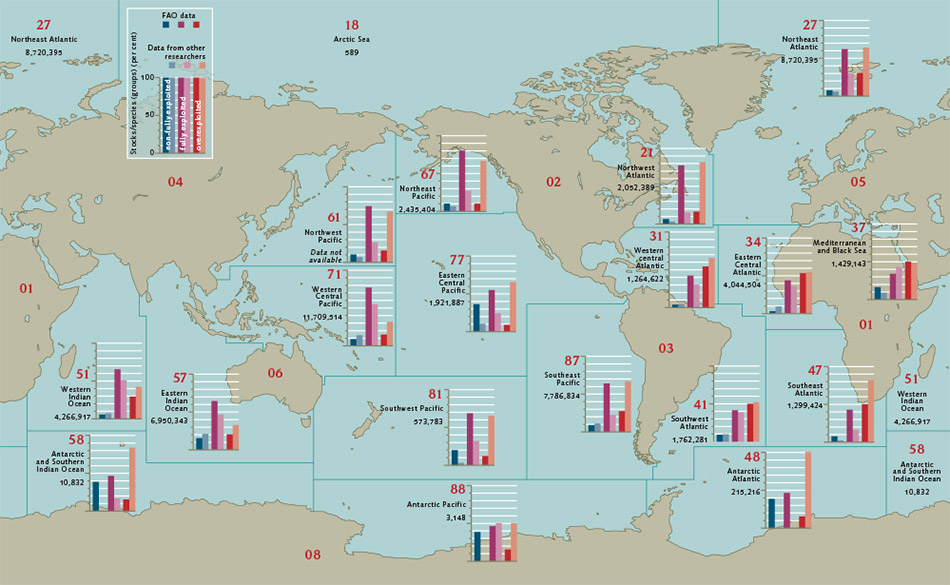
Map of global fisheries / fish stocks: <https://www.theglobaleducationproject.org/earth/fisheries-an...>

State of fisheries: <https://worldoceanreview.com/en/wor-2/fisheries/state-of-fis...>

Notably this map showing sustainable- / over-exploitation status: <https://worldoceanreview.com/en/files/2013/04/wor2_c3a_s52_3...>

"There are large areas in the middle of the major oceanic basins called the subtropical gyres. These could be considered the deserts of the ocean in that the biomass (total mass of all organisms) density and biodiversity are low. This is because the ocean circulation doesn't replenish the nutrients available in these areas for algae to live off, which are the base of the food-chain.

In general, you tend to find much more biomass and biodiversity closer to the coasts. But you can get hotspots of productivity in other places such as upwelling regions and also near seamounts (shameless plug of my paper on this)."

"People assume, well oceans are massive so fish stocks are massive as well. But if you went hunting for game as a protein source you wouldn't assume it lives at the top of every mountain and bottom of every valley. You know it has a range that confines its distribution and therefore its abundance. You dont go hunting across the vast, empty desert.

Commercial fisheries know this and are squeezing the last bits they can out of the pelagic fish we all expect on the dinner table (tuna, mahi, etc), but as you aptly point out, the majority of fisheries biomass is near the coast. Fish we eat do not come from habitat that covers 70% of the planet, its much closer to < 10 %."

https://www.reddit.com/r/askscience/comments/imu81a/if_you_p...

https://www.sciencealert.com/there-s-a-desert-in-the-middle-...

> The ocean is really big and its teeming with life.

The ocean is really big and was teeming with life.

There, fixed it for you

It's not just fish.

The sheer number of animals that are slaughtered to produce meat for human consumption is absolutely mind-boggling. In addition to the fish, humans killed 72 billion chickens, 3.3 billion ducks, 1.3 billion pigs, over a half-billion geese, turkeys, rabbits, sheep, and goats (each!), over 300 million cattle, and over 70 million rodents for food in 2019 alone [1].

Animal agriculture overall generates more CO2 emissions than every automobile, ship, and airplane on Earth - more carbon than the entire transportation sector. An overwhelming majority of arable land on this planet is used to feed those animals, fated to death from birth, rather than humans - in many developing countries, humans starve while livestock are plumped for slaughter and export. [2]. 75% of historic deforestation in the Amazon, 55% of erosion, 60% of nitrogen pollution, and 44% of anthropogenic methane and nitrous oxide emissions (each) are a direct result of animal agriculture [3].

If you live in the US, like I do, it's not just the animals and the environment that suffer under animal agriculture. It's an open secret that undocumented children are exploited to work in slaughterhouses in this country [4] while politicians are actively rolling back protections for those exploited children [5] to ensure that boneless skinless chicken breasts stay cheap at WalMart.

There is no such thing as sustainable animal agriculture - it is a lie used to greenwash products, to make us feel righteous when we pay for corpses at the grocery store or restaurant. The only sane and ethical response to this devastation is to completely reject the economic exploitation of animals - to adopt a fully vegan philosophy. Of course, this does cause some difficulties in the modern context (especially in the US), but the trouble of learning to cook vegetables and seitan is nothing compared to the harm that animal agriculture causes to billions of humans and non-humans every year. (It also cured my high blood pressure and pre-diabetes in three months, but everyone knows vegetables are good for you :)

[1] https://www.fao.org/faostat/en/#data/QCL (https://web.archive.org/web/20211208184438/https://www.fao.o...) [2] https://www.colorado.edu/ecenter/2022/03/15/it-may-be-uncomf.... [3] https://climatenexus.org/climate-issues/food/animal-agricult... [4] https://www.nbcnews.com/news/us-news/feds-find-100-children-... [5] https://www.axios.com/local/nw-arkansas/2023/03/13/arkansas-...

>>There is no such thing as sustainable animal agriculture - it is a lie used to greenwash products

Yeah I absolutely don't agree. I don't believe it can be done at scale - but it can be done. Watch a channel like Harry's Farm on youtube - guy basically has cattle on moors where nothing else could possibly grow - they just stay there all year, eat grass, then one day they get slaughtered. There is nothing about farming them this way that's unsustainable.

>>The only sane and ethical response to this devastation is to completely reject the economic exploitation of animals - to adopt a fully vegan philosophy.

I think you might be getting too much of that "greenwashed" propaganda yourself friend.

We should be fighting against factory farming with all our might, and especially the US is a sad place when it comes to animal rights. But going out and saying it can't be done sustainably is a lie peddled by people who either literally can't imagine how it can be done, or who don't want to see it. I believe meat can be sustainably produced, but it should be reflected in its cost - people shouldn't be eating meat 3x times a day because it's so cheap.

> I don't believe it can be done at scale

Sustainable animal husbandry represents less than 5% of the total.

> but it can be done

We may also find farms where there are no animal inputs used. It can be done.

> it should be reflected in its cost - people shouldn't be eating meat 3x times a day

Removing all subsidies for dairy, meat & fishing would help a lot.

>> The only sane and ethical response to this devastation is to completely reject the economic exploitation of animals - to adopt a fully vegan philosophy

> I think you might be getting too much of that "greenwashed" propaganda yourself

If you don't see the logic in it, then you just haven't found the power to really acknowledge all the problems associated with it.

https://en.wikipedia.org/wiki/Cognitive_dissonance#Meat-eati...

https://en.wikipedia.org/wiki/Carnism

>>Sustainable animal husbandry represents less than 5% of the total.

That sounds very different to "There is no such thing as sustainable animal agriculture - it is a lie used to greenwash products"

>>Removing all subsidies for dairy, meat & fishing would help a lot.

I agree.

>>If you don't see the logic in it, then you just haven't found the power to really acknowledge all the problems associated with it.

I absolutely do see the logic in it, but someone saying that the only way to solve this is by going vegan is no different than someone saying that the only way to solve global warming is to stop driving cars. Would that solve the problem? Of course it would. Are the chances of that happening greater than 0? No, they aren't. This isn't personal criticism of course - if you feel that going vegan is consistent with your logical and moral stance, please go ahead. But I don't think we should even pretend that veganism is the solution to this problem on a global scale, because I don't believe you would get anywhere near the required number of people on board with it. The steps that I think are far more realistic are - more sustainable animal husbandry, sharp rise in cost of meat to reflect its true cost(which will naturally reduce the amount of meat consumed), and yes, like you said - removal of artificial subsidies to those industries.

> the only way to solve global warming is to stop driving cars. Would that solve the problem? Of course it would

No it would not. We have to do many things to solve it, not just one thing or another.

And nobody argues that we should stop eating ... that would equal stopping driving. But as we can drive electric instead, we can also eat something else than animals.

We already get majority of calories out of plants ... animals supply only 18% of calories and 37% proteins (https://ourworldindata.org/land-use).

>> Sustainable animal husbandry represents less than 5% of the total.

Mea culpa. That max 5% is non-industrial farming. How big part of it is sustainable i do not know.

Nearly 100% of my meat comes from locally raised grass-fed-and-finished cows. They are rotationally grazed and live their whole lives in the outdoors. It is actually much, much cheaper than buying meat from a supermarket - ground beef is half the price, steaks are as little as 10%, because all cuts are priced the same. (My dairy comes from another, similar farm, and while it is much better, it is more expensive.) I also went all through the slaughterhouse and no, there's no kids there.

I eat a lot of eggs. 100% of my eggs and the occasional chicken come from my parents, who, with twelve chickens, produce an insane surplus of eggs, letting them eat whatever bugs they find and feeding them scraps.

People will argue this isn't scalable, and maybe it isn't. But the price of my beef suggests it is underutilized at this time. Certainly more rural and semirural people could keep chickens. I would favor this alternative anyway, since industrial-scale food production isn't just inhumane, it produces inferior products that are subject to enormous risks and shocks as producers race to centralize and become more and more efficient. You don't want hyperefficiency in your food supply. Hyperefficiency means fragility.

Massive industrialized agriculture is its own ecological disaster. The farming of corn for ethanol (!!!) and the massive, endless fields of soybeans and canola in the US midwest (foods eaten by almost no American a few decades ago) are permanently destroying the ecology of nearly half the US. It's annihilating topsoil at alarming rates, eradicated huge swaths of natural wildlife, and filled watersheds with massive amounts of fertilizer and pesticides which are then contributing to killing all the fish. You see how we've come full circle.

Do you know what would be great and sustainable for the midwest? Fill the plains with cows. For thousands of years, they were filled with ruminants. The cows must be kept in tightly packed herds to emulate their behavior when predators are present. This will regenerate the topsoil, as that's what formed much of it in the first place, and end the flow of poison into the waterways. I'm not opposed to returning the buffalo instead, if you prefer.

You talk about greenwashing - that's a big part of the push behind veganism. Obviously there's sincere people like you, but there's a lot of money in producing highly processed foods and (soon) artificial meat. Highly processed foods (besides being a health disaster) can be easily produced via "food science" from relatively stable, controllable inputs, which animals are not. They are much easier to scale, which is where the real money comes from when you're selling commodities. Frequently, even when one input does become a problem, it can be replaced with no obvious impact to the consumer.

It's not about taking a holistic look what what we need to do ecologically and environmentally, which would include meat. It's about cash.

> fated to death from birth

Everything born into this world will die. That's nothing special about livestock.

> my meat comes from locally raised grass-fed-and-finished cows

https://yourveganfallacyis.com/en/humane-meat

> It is actually much, much cheaper than buying meat from a supermarket

Thanks to subsidies ... taxes taken also from vegans ;)

> the massive, endless fields of soybeans

"More than three-quarters (77%) of global soy is fed to livestock for meat and dairy production. Most of the rest is used for biofuels, industry or vegetable oils. Just 7% of soy is used directly for human food products such as tofu, soy milk, edamame beans, and tempeh"

https://ourworldindata.org/soy

> Fill the plains with cows. For thousands of years, they were filled with ruminants

You need also predators ... and I don't mean weekend hunters. Without predators the ruminants tend to stay in one place and eat everything, till nothing than desert remains. See Sahara and near east.

https://journals.sagepub.com/doi/full/10.1177/09596836166704... Blame it on the goats? Desertification in the Near East during the Holocene

> there's a lot of money in producing highly processed foods and (soon) artificial meat

Not yet, and artificial meat may not be here in next few decades (the scale is the problem). Soon is an overstretch. Artificial meat doesn't need to be highly processed ... in principle it's just plant protein (flour), starches, colorings (red beet etc.) and spices, maybe oils and vitamines. No magic, no complicated processes involving toxic chemicals etc (depends on the oils, tho).

> holistic look what what we need to do ecologically and environmentally, which would include meat

Meat is not necessary in those equations. We don't need to eat meat to live and prosper. We have composting and syntropic agriculture. We don't need animal inputs in agriculture. We can rewild areas used for animal farming (75% of 50% agriland of habitable land) and let the wildife rebound and manage the ecosystems. We can restore carbon sinks (double the forests) and stop anthropogenic wild life die offs. We don't have to rape the nature as we do now. For that the vegan movement is the logic outcome.

>> fated to death from birth

> Everything born into this world will die

https://www.dominionmovement.com/watch

Sorry, your first link is profoundly unpersuasive. I don’t see anything wrong with killing animals for a purpose, nor anything inherently evil in suffering. I appreciate that you have a different value system, but I don’t share it. I do have a problem with treating animals as commodities and as inputs to industrial processes.

> Thanks to subsidies ...

Incorrect.

> "More than three-quarters (77%) of global soy is fed to livestock for meat and dairy production. Most of the rest is used for biofuels, industry or vegetable oils.

I think it’s clear I oppose growing soy for animal feed. At any rate it’s misleading to exclude vegetable oil as something people directly eat, when nearly every American consumes a huge proportion of their daily calories from soy and canola oils.

> You need also predators ... and I don't mean weekend hunters. Without predators the ruminants tend to stay in one place

Yes, I specifically mentioned the need for rotational grazing, which builds up topsoil and stops desertification.

> We don't need to eat meat to live and prosper. We have composting and syntropic agriculture. We don't need animal inputs in agriculture. We can rewild areas used for animal farming (75% of 50% agriland of habitable land) and let the wildife rebound and manage the ecosystems.

I disagree. I and many other people need meat to prosper.

Ecosystems are not steady state without our inputs. And certainly nobody besides me is going to support the mass reintroduction of predators. What you’re describing is just a different kind of human managed ecology.

Also, properly managed livestock can absolutely be a carbon sink.

With your last video, you’re preaching to the choir. It’s still true we all die.

> I don’t see anything wrong with ... anything inherently evil in suffering

We won't be able to find a common ground.

> Ecosystems are not steady state without our inputs

Everything's going very well, indeed.

> It’s still true we all die.

Yes ... so there was nothing wrong with concentration camps, because all those people would have died anyway?

Let's agree to disagree.

> There is no way this number can sound remotely sustainable to anyone, right?

Why not? How many fish are born every minute?

Overfishing and dwindling fish populations are pretty established facts.
What does that have to do with the number?
I get that you wanted the original poster to realize that a big number doesn't necessarily mean anything. But we already know it's not sustainable.
You can either point at the number and say "Look at this number! Can't you just tell that it isn't sustainable?" or you can say "It doesn't matter what the number is, we know it's not sustainable for other reasons."

But neither of those is a support for the other. If you start with the assumption that the number is unsustainable, you're not doing anything when you look at the number.