Hacker News new | ask | show | jobs
by jbrun 1653 days ago
It's a bit paradoxical. I have a tech company and most staff want to come to the office 1 day a week. Getting them to come is very tough. Many of my staff and friends don't want to have kids, make no effort to find a partner and find all sorts of excuses. Netflix, the internet and these things are part of the problem, but I have no clue what the solution is. There is only one way to not be lonely - be with people who care about you. That requires an investment of time and of your emotions - something many people seem unable or unwilling to do. You have to get out into the world and invest in others.
21 comments

They need stable, actionable futures. Homes they can afford to own, communities they can raise kids in, an environment that won't go up in flames; they need systems that have their back.
The parent comment:

>Many of my staff and friends don't want to have kids, make no effort to find a partner and find all sorts of excuses

Is the lack of affordable housing and/or environmental disasters really responsible for people who lack the precondition (eg. having a partner) for buying a home?

When was having a partner a precondition for buying a home? Furthermore, what’s the point of finding a partner when the cost of a permanent place together might exceed both your incomes put together, much less a place big and safe enough to raise a family.
> When was having a partner a precondition for buying a home?

When you make an offer on a house you're bidding against two-earner households. For a lot of us in tech the salience of this fact is diminished by the industry's high salaries, but for most folks this is a really big deal.

This is only an issue because of constrained supply driving prices up.

If there was more supply, prices would stabilize somewhere lower. Given enough supply that point would be somewhere one income could support.

It's the constrained supply paired with high demand that drives prices up and requires multiple high incomes to compete (especially in places where this has been taken to the extremes because of NIMBYism and entrenched anti-build regulation/incentives).

Regardless of market conditions, DINK still offers a huge economic advantage because, well it's in the name: two incomes, ~half the living expenses compared to a single. It's popular because it's meta.
Sure, I'm all-in on YIMBYism, but some places will always be more desirable than others and those places will likely always cost more and all things being equal buyers with two incomes will be more likely to be able to afford those houses.
> When you make an offer on a house you're bidding against two-earner households.

what does that matter aslong as your bank has approved the mortgage. I don't see why seller would care.

are you saying that ppl are bidding for mortgages that high that bank needs both of their incomes? wow.

>are you saying that ppl are bidding for mortgages that high that bank needs both of their incomes? wow.

I don't know about the US but that has been the case in the UK for a long time now, especially for family sized houses.

We went from married women not being able to work to not being able to not work. I'm not sure it was an improvement.

It might not be a strict precondition, but it's still a pretty strong precondition. Maybe "precondition" isn't the best word here, but I think my original point still stands. Suppose someone claims that people are deciding not to have kids for whatever reason (eg. global warming, unaffordable healthcare, expensive houses)[1], and I retort by saying that people aren't bothering finding a partner[2], so they're not meeting their "precondition". Sure, you can theoretically raise a kid without a partner, but if you're not even bothering to find a partner, then maybe it's fair to say that's the main reason, rather than blaming global warming or whatever?

[1] analogous to your comment https://news.ycombinator.com/item?id=29473019

[2] analogous to my reply https://news.ycombinator.com/item?id=29473223

When was the last time you asked for a mortgage? This is fairly standard nowadays, and has little to do with the size of your income. Banks prefer a mortgage in multiple names because it reduces their risk. If you're over 40, in my country it is all but impossible to get a mortgage on your own, regardless of income.
I'm making a far more banal claim: buyers with two incomes have more money than buyers with one income (all things being equal and across large numbers of people) and the latter will always be at a relative disadvantage.
I think it can be. What people “want” is sometimes constrained by what they think is possible.
Good point on agency. Throughout their lives GenZ has either had less agency or felt like we have less agency to do what we want. Certainly true for some financial goals like buying a house
The oldest gen z are just out of college though. I think it’s the younger millennials you might be describing (people a decade into their career with little prospect of home ownership).
> little prospect of hope ownership

A devastatingly accurate typo

Haha oops :) Fixed it now.
Back in the 60s, people were buying homes in their early 20s or even late teens because it was that affordable. Obviously that is a bit of a historical anomaly, but it's almost a necessary complement to the idea you're supposed to become an adult and mature and grow up after age 18.
Perhaps we ran in different social classes but in the 60's most believed that you had to save a good portion of one's life to afford a home and worked towards that end. Home ownership was not a given - it was considered an enormous investment that took much of one's life to prepare for.

However, the affordable rental market greatly mitigated that and allowed "delayed" home ownership until a suitable nest egg was constructed.

They also had things a lot harder in many ways than we do. The 60’s is over 50 years ago now. The world changes a lot in that time. Basing your expectations on the 60’s is unrealistic.
Yes you're right. We do have many modern conveniences and information they didn't have. So why would we go backwards on this key metric of home prices and rent? Or housing as a percentage of household income? It is an economic, social, and moral failure (see the situation in Los Angeles)
> Basing your expectations on the 60’s is unrealistic.

We use historical standards to measure progress all the time. The thing we should be exploring is "why has home ownership become so expensive?" and "what can be done to alleviate that impact?" Anything else is a distraction.

Up to the 1990s it was possible to buy a home on a single income in NL.
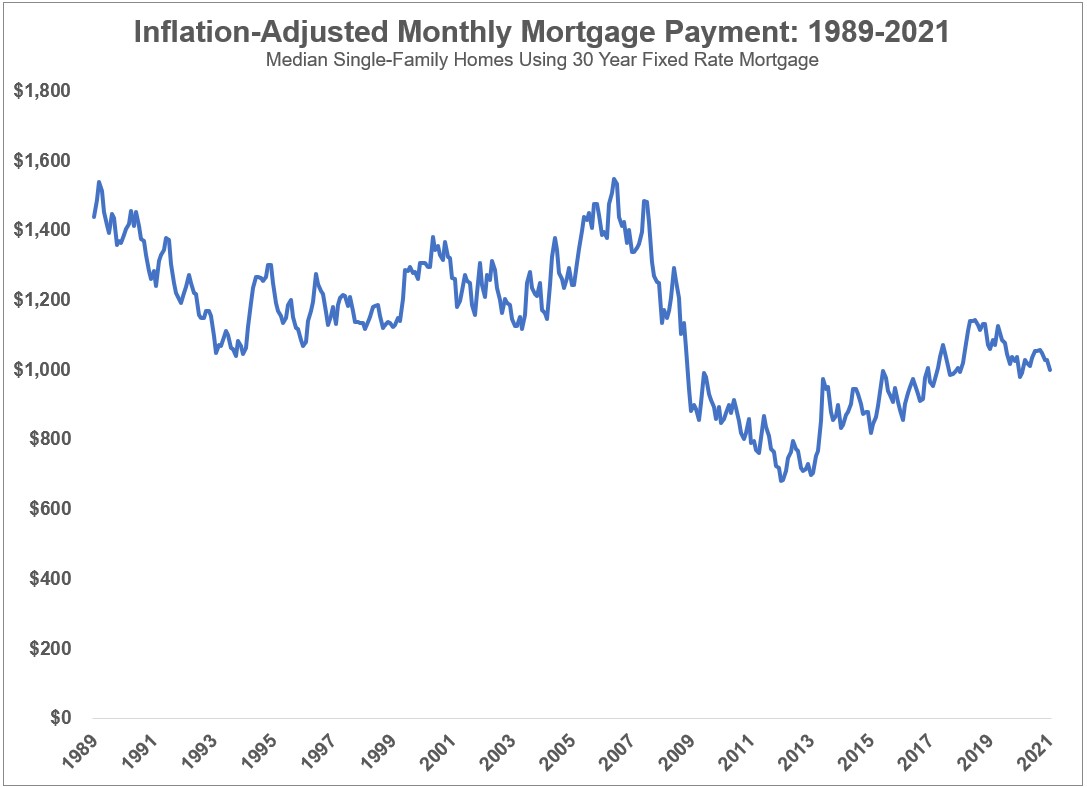
Source? At least in the US mortgage payments (adjusted for interest rates and inflation) have been trending down since the 90s.

https://awealthofcommonsense.com/wp-content/uploads/2021/03/...

As someone who graduated college into the Great Recession, I was told and shown no path to work for the better part of a decade after college-despite going back to college to become more marketable in that period. And seemingly nobody cares about people like me because we don’t get the ink that the people slightly older or younger than us get.

On the other hand, I do wonder how the economic outlook for work in the US looks once the deeper portions of the boomers retire and open up work. Not a lot of optimism though.

I’m the same age (although skipped college). Lots of friends in the same situation needing to get multiple degrees before finally finding their way into unrelated careers.
I think a lot of this lack of agency is what's driving the current interest in things like van life and digital nomadism. Whichever way you sell it, the idea that people ought to live every year until their 40s spending a huge chunk of their wages paying off some random Baby Boomer's mortgage through extortionate rents rather than their own is a bleak thing to face, especially when you can't even hang up a picture or adopt a pet in a lot of cases.

I for one am planning on moving onto a sailing yacht next year, while it's not exactly much cheaper that money is better spent on the inevitable maintainance than keeping the landlord's wine cooler full!

I'm sympathetic to the later part, but first part not what they want.

They want the dynamism of being able to change jobs and careers, they all want the opportunity for career progression which for the most part isn't there (it's always been competitive).

That means more risk and all the things that come along with it.

I think even 'remote work' will have a serious of consequences we're not ready to accept, which is that it will make workers even more fungible.

If someone literally can't show up for work ... then they're generally going to be seen as more easily replaced or changed around.

We need to fixing housing costs badly though.

https://www.ted.com/talks/simon_sinek_why_good_leaders_make_...

This talk really changed my thought process on careers. Basically every corporation in America is fundamentally unstable to work for, where you COULD be laid off for essentially arbitrary fiscal goals. That instability makes it impossible to trust your leaders (i.e. the company) to actually support you. As long as the people who pay your salary don't think long term about organizational health, people will be forced to play games and constantly job hop.

This coupled with the fact in tech at least that the easiest way to get a raise -- and usually a substantial one -- is to switch to a new company. If a person can either: spend a year genuflecting and begging their manager for a single-digit raise*, or spend three weeks interviewing and get 15%-plus more to do substantially the same work...all else being equal, which should we pick?

*Not to complain about 5%. For the vast majority of workers that's an unattainable dream -- but that just furthers the point that the worker is not treated as an asset.

> They want the dynamism of being able to change jobs and careers, they all want the opportunity for career progression which for the most part isn't there (it's always been competitive).

Why do people want this though? 50 years ago, you could be a mechanic, work 50 hours a week and own a house. The wife could be at home to take care of the kids. These days, both have to work 60 hours a week to afford a rental apartment.

in the 70's, a home cost about 4.5 times the median yearly household income. Right now it's about 7 times the yearly income. That doesn't seem like a massive increase (even though it's more than a 50% increase), but employment of married women also increased from 40% to 60%. So while we have, on average, more earners in a household, we pay more of our income on housing. It's a double whammy.

So people want careers in order to start earning a living wage in order to be able to actually raise kids and live a meaningful life in a nice home. People don't just want a career because they want a career, they want that because they don't want to be wage slaves who don't get to live a life. Also, they don't get to raise their kids, because they don't have time for that.

Absolutely. Another HN commenter put it very nicely in a recent similar thread: people are working so they can make enough money to afford to be able to work.

If two adults have to work full time to have a house with kids, then they also have to be making enough for child care and various other things that they might be able to do more cheaply if only one of them was working.

> If someone literally can't show up for work ... then they're generally going to be seen as more easily replaced or changed around.

Remote is the _only_ option for 90% of great jobs if you live anywhere outside a few big tech hubs.

> If someone literally can't show up for work ... then they're generally going to be seen as more fungible.

It depends of the company culture.

> Homes they can afford to own

In Germany where I live home owners are in the minority (40%). In Europe on average homeownership is about 70%. Yet, we are one of the richest countries in Europe.

Furthermore, buying a house on credit does not mean you own it — since as long as you pay your debt it’s the bank that owns it really.

Finding a partner and maintaining a relationship got nothing to do with owning a home. I am saying that as a dad without owning a house.

Looking at this list:

https://en.m.wikipedia.org/wiki/List_of_countries_by_home_ow...

I am also not really sure I really would want to live in the top countries with the highest percentage of home owners.

Being a tenant in Germany cannot be compared to being a tenant in the US.

Being a tenant in Germany is essentially as stable (if not more stable) as taking a mortgage on a home in the US. This is still the type of stability the state provides, which is quickly disappearing worldwide as all funds go into real estate due to a decade of zero (or negative) interest rates.

If you cannot pay, you will be evicted within 1-3 months.
> Yet, we are one of the richest countries in Europe.

We have strong social security, but Germans have few assets and those aren't really equally distributed. I don't think financial problems are standing in the way of kids though.

You really have to know how to look after yourself, and be happy with yourself, before you can really bring another person into the mix in the form of a committed relationship (using the example of people not having partners or not thinking about children).

There's been an expectation for a long time that your self-worth as a person is connected to being with someone else, and therefore your path to increase self-worth is through a relationship, and then through creating a family by getting married and having kids.

It's not true though, it just forces you to get stuck in unhappy, abusive, or co-dependent relationships with other people because throughout all of your childhood and your formative years, you've been told that happiness is in the other person. That other person has to be responsible for making you feel complete, and you have to be responsible for making them feel complete. I think it's pretty bizarre that we've been taught to give up control over our own sense of self in that way.

Nobody is making excuses, and the internet and Netflix aren't the problem, and it's not as simple as getting out and meeting people. A partner and a baby won't suddenly make you less lonely or more happy, more likely you'll just have two unhappy people who have to work even harder to make a living, and a child that requires therapy.

The one way to not be lonely is to be happy being alone. If you're happy being alone, happy being with yourself, then you have a conscious and mature choice to make about whether or not you'll be happy being with someone else too.

But if you think the only way to not be lonely is a relationship, then sure, maybe you won't be lonely... but will you be content? And if you can't get the relationship, will you just grow bitter and hateful towards the people who won't give you that happiness you so desire?

> You really have to know how to look after yourself, and be happy with yourself, before you can really bring another person into the mix.

That's not really true though. We're born social animals, we die social animals. Being solitary isn't a means of "finding oneself" so that one is ready to "bring other people into the mix". It's just a way of slowly going crazy. There's a reason why solitary confinement is a form of punishment, or even torture.

Solitary confinement could drive someone to think differently, but the point was that solitary activity, not confined, is totally tolerable by some and not necessarily a bad thing.
You don't need to know how to look after yourself. This is perfect is the enemy of the good type situation.

Not being a fully realized person doesn't stop you from making connections. Even deep great friendships. You and your friends can grow together over time. You can cut out friends that are not a good fit over time if they are bad for you (abusive, etc.).

In fact, I find more and more the people who are most successful around me are those who just go for it rather than being contentious and trying to perfect themselves. I think the best place to be is, at always, in the middle. Too much alone time and you may be very independent but you don't want to spend time with others as they're worse company than your own self. Too little alone time, and you become codependent and don't learn to be independent.
Of course, but this isn't the same thing as the parent poster's surprise about people not finding partners or having kids.

I'm talking specifically about that kind of relationship. As everyone has pointed out, it would not be great to take this approach while making friends and doing the things friends do.

"A partner and a baby won't suddenly make you less lonely or more happy, more likely you'll just have two unhappy people who have to work even harder to make a living, and a child that requires therapy."

There's nothing wrong with being single, but as a statistical matter, I'm going to go out on a limb and say there are many people, even flawed people who haven't found themselves, for whom a partner and a baby will make them feel less lonely and more happy, otherwise wouldn't our species be extinct? The fact that humans continue to be born suggest nature predisposes us to certain behavior which we see as being in our best interest.

I'm likely projecting a lot of my own life experience because I'm afraid of what might come out if I got involved with someone. Because I've had a history of not so great mental health and I basically have a hard trusting myself that I could be mature. So for me, I have to deal with my own shit first, but maybe as another commenter suggested, perfect is the enemy of good.

I feel like if someone goes into this with the expectation that a romantic relationship, or a family and kids, will solve their problems, then they might find out that they're wrong. Like, they're hedging all of their bets on those things and when you look at, say, the incel community, then you can see it's almost an all-or-nothing proposition because so much is riding on sexual or romantic validation at the expense of almost everything else.

And there are the people who have children to try and rescue a marriage, and then they find out it doesn't work like that. Sunk-cost fallacy, maybe you're not happy with someone and you're also not happy alone, but there is someone else out there who connect with you in the way you need.

If I were to rephrase my original post, I'd say that you should listen to your needs but you shouldn't dismiss that some of those needs, maybe, are fulfilled by you, and not someone else. So make sure that you keep yourself happy and don't put the entirety of that responsibility on another person.

Personally, my priority has been to make close friends and to do my best to keep them, while not being afraid of losing them over time.

Or to put it all another way, I'm the only constant in my life and everything and everyone else is a variable.

This is a pervasive cope. Relationships, romantic and otherwise, are necessary for most people to be happy. "You're not ready for relationships until you're happy alone," is something people say that doesn't make any real sense. It doesn't indicate a personality deficit, either. It's completely normal and healthy to require relationships for happiness; pretending that this is some sign of mental disorder is a disturbing modern coping mechanism.

What's stranger is that it's rarely a cope for the person saying it. Instead, they are explaining away others' desires as unhealthy, while they often have those desires already fulfilled themselves. It's as though the speaker is uncomfortable with others being lonely and seeks to demonize it as a personal failing.

The comments below echo what I think. We are social animals, deal with it.
All I can think: turn off the internet.

Internet in the morning. Have your coffee, catch up on the news, your social.

Then put the internet down for the rest of the day. Go out, ride a bike with a friend, go hike with a friend, go to a coffee shop, library....

Doesn’t this depend on having friends who are off the internet too?

In the before times, I’d go to get drinks with friends and often found they were chronically distracted. If there’s a lull in conversation they pull out their phones. I go to the bathroom and come back and they’re swiping through Tinder.

I got married before the dating apps got popular so I never went down that particular rabbit hole, but I feel like they’ve severely damaged people’s ability to pay attention to where they are and who they’re with.

If there’s a lull in conversation they pull out their phones.

I despise how this behavior has been completely normalized. Especially in the dating sphere. People putting their phones on the table to make sure they never miss notifications is just so fucking disrespectful to the people you're actually with.

> People putting their phones on the table to make sure they never miss notifications is just so fucking disrespectful to the people you're actually with.

FWIW, I don't use my phone while out to eat with another person, but I do put it on the table—on silent!—because it's large enough to be uncomfortable in my front pants pocket(s) while sitting.

Personally I never understood it as disrespectful, because I assume they’ve got some personal shit they might not be able to be uncontactable for. What if someone they know is in the hospital or they’re in some other high priority issue? What if a close friend of theirs is in a tenuous health position? What if they’re checking on their children? And most certainly they’re not going to tell me and frankly I’m not entitled to whatever shit they’ve got going through it we’re just getting to know if we like each other broadly. I think assuming I should have dedicated time to someone who is just seeing if we get along is rather selfish of me- I don’t know their life enough to know if they have other priorities they’re trying to balance.
> What if someone they know is in the hospital or they’re in some other high priority issue? What if a close friend of theirs is in a tenuous health position? What if they’re checking on their children?

Even if any or all of that is true you can still put your phone away. If it's an emergency someone will call you.

It’s also possible you miss a call, so if you check your notifications you’ll see you did. Again, I think this is all super judge mental over something that frankly isn’t my business.
there was a time before people were reachable 24/7 and at no point in that time did the world or people's lives collapse.
Sure, but we’re not in those times anymore. It’s weird to be like “I’m dating someone so I choose not to pick up it I miss a call from my ailing mother”.
You can always find new friends once you start meeting people off internet. Tbh I find purely online friendships not to last long, especially now as an adult.
This. Just hit some random shit on Meetup.com that looks interesting which bridges the gap to the real world.

Online social is a complete shit show. You’re spending time with peoples outward persona not real people.

Everyone is at work.

In germany if you take a walk during the daytime your looked upon as a "slacker".

Friends require to be condemned to boredom together.

Relationship require something called perspectives in life. Why produce spawn for a dieing world?

This is what you wanted in the 70s when you demonstrated for a "humanity" capable to hold back from environmental destruction.

Its a species of monks, waiting in their cells to dwindle to zero.

Of course. That's the type of "boomer solution" that a) solves nothing b) only makes sense for those who don't have that problem in the first place

It goes the same way of telling "stop being sad" to depressed people or the most meaningless advice of "just be yourself".

Or, perhaps a more charitable reading may be "if you’re not staring at a screen perhaps you’ll meet people while out and form social bonds"?

If you’re very online and you’re lonely being very online then proposing that you change what you’re doing to perhaps get different results is not the same thing as "have you tried not being sad????"

And why do people think someone just going offline will magically start talking to people (where? with whom?)

It's like telling an obese person to go exercise. It is meaningless advice. "Oh but can they figure it out right" Well, if they could maybe they wouldn't be so lonely.

And even more in boomer style "just take your printed CV to McDonalds to get a job" pulling people offline might be just cutting the only social link most of them have, instead of leveraging it.

If you spend all your time just mulling about online, or watching Netflix, or playing a game, then it's not surprising that you are lonely. You are engaging in solo activities that other people can't really join.

It is not anymore surprising that you are overweight if you don't exercise, and especially if you aren't cooking at home ever.

Cut out any drugs, go to bed at a reasonable hour, exercise, get a hobby, eat decently. If you don't know how to do those things or have medical issues preventing you, go to a doctor/therapist/personal trainer/nutritionist/life coach.

No you aren't going to become a social butterfly just because you finally logged off your game, but if you try a few different organized social events (board game meetups, hiking group, whatever) you will probably start talking to a few people.

If you still can't, then you need to talk to a therapist. You probably have either never developed or allowed your social skills to decay and need help to get them back on track.

> And why do people think someone just going offline will magically start talking to people (where? with whom?)

Necessary (but not sufficient) for change in life to occur is for the person wanting change to desire it happen and make effort for it to happen.

To answer where: whatever activity you choose to do with other people, assuming you choose an activity that can be social - typically something based on your interests, and if you're not sure what those are, try a bunch and see which ones you enjoy. Part of building a social circle is developing interests of your own and then finding people who share those interests with you.

To answer with whom: the people that are doing these activities that are there to do them but also be social. There are tons of places out for hobbies and activities where you can meet people, but you have to go to those places, put in the effort with the activities, and be open to making connections with people, and even then, that may not work, but you'll never know unless you try.

Let me give you an example from my life. In my early twenties I was lonely and I spent most of my time forum posting and chatting on IRC/AIM. I was talking to people but not making connections. An acquaintance of mine who had a lot more friends and connections suggested that perhaps I was spending too much time forum posting and chatting and not enough actually out doing things. I resisted this change for about a year, but I found that continuing to do what I was doing wasn't changing my situation. I decided to make a change in my life and to start pursing interests and connections. Weekday, I would go to work (which required me to be online as a computer programmer), but then to limit my online time at home and make an effort to go out and meet people. I didn't go out every night, but I spent some time away from the screen - I got better at cooking, I started reading more, and I focused on discovering new interests.

In some cases, this was having a drink (not necessarily an alcoholic one if you're not into alcohol) in a bar during a football game to meet other football fans. Another was to go bowling once a week which turned into joining a league. Another was to go to a farmer's market to pick up fresh vegetables. The last was joining a local Linux users group. Starting all of these activities, engaging in them with the mind of being social, coupled with learning about myself, led to both personal and professional connections being made - I met my wife, I met a future employer and hopefully startup co-founder, and I met friends that I still bowl with to this day. It was my desire to go to these events, to be open, to talk to people who were open to being talked to, and to meet regulars and connect with them that helped me move forward. I don't want to make it sound like it was all sunshine and roses - it left me tired, some of the activities I tried left me physically sore because I wasn't really fit enough for them, some of the people I met ended up being terrible people and I had to learn to cope with that/cut them out, and I had a few failed relationships along the way which bruised my heart. None of that would have happened if I just stayed on forums and chat and never made an effort to change. There is also the chance that I wouldn't have met people out and doing this, but I never would have had the opportunity if I hadn't tried.

> It's like telling an obese person to go exercise. It is meaningless advice.

If someone is obese and asks for advice on how to become more healthy then suggesting exercise (along with some exercises they can get started with - see above for my analogous answer to that) is not meaningless. If someone is obese, asks you for advice, you give them advice, they don't follow it, and then they complain about how things aren't changing and that it was meaningless that you gave them advice then the obese person might bear some responsibility for their situation not changing.

> And even more in boomer style "just take your printed CV to McDonalds to get a job" pulling people offline might be just cutting the only social link most of them have, instead of leveraging it.

Anyone that is suggesting that you go _completely_ offline is wrong - I am not suggesting that at all! You cannot go _completely_ offline and be productive, educated, and social these days. Many of the social opportunities that I mentioned above these days are organized online, so you will need to be online in some cases to know when they're happening and to keep in contact with the people you meet there. What people are suggesting is that you limit the amount of time you spend online outside of work and the necessary time to find these activities, learn about them, and maintain the connections you make while doing them.

> go to a coffee shop, library....

Don't forget your mask. The pandemic is still on.

Not entirely sure why you're downvoted. I'm nearly deaf and I fully rely on lipreading. I've basically concluded I will have no social interactions in public until masks go away. I can't even make it through checkout sometimes without frustrating others. No one has the patience to try and bother to communicate with barriers. I can't count the number of times someone has finally screamed "never mind!" and made shooing gestures. Even the bus scares me. It's very hard to tell someone's emotional state both unable to see their face or hear them. I worry about being assaulted.

I know hearing people experience a mild version of the above. It's the most visible aspect of how the pandemic of virus has led to the pandemic of loneliness.

Thank you for sharing. I had no idea that the introduction of masks has also had the side effect of making deaf people blind in this aspect. Yikes.
I'm sympathetic to people with hearing impairment. It's a shame that most mask-wearing, at least in my area, is arguably "virtue signaling" as single-layer masks do largely nothing to prevent aerosolized viral transmission. N95s and other serious masks, on the other hand, actually work. So tired of seeing people walking their dogs in the park or bike-riding alone while wearing surgical masks. It literally does nothing except make me think those people are crazy. And this is in a county that is 85%+ vaccinated.
As apt as those suggestions may be for this crowd, they are neither practical or even polite for a huge proportion of the country.
Can you elaborate?
There are many neighborhoods in America that don't have coffee shops, at all. And many that you wouldn't want to be caught dead cycling around in on a pushbike.

On a broader scale, the median wage in America is only ~30k, while the cost of rent and basics far outpaces any increase in wages. So the idea that people would use the time off from their excessive working lives to go hiking is actually a bit insulting.

The comment I responded to reeks of ignorance of the reality of the daily lives of so, so many Americans; who if they have any free time and disposable income it sure as fuck isn't going to be spent hiking up mountains and buying decent hiking gear.

... I visited Pittsburgh last winter, and was struck at the differences between neighborhoods. In Squirrel Hill the coffee shops were open and trading, the sidewalk was free of snow, people got their groceries delivered from Giant Eagle. In Braddock, the sidewalks were cracked to pieces, layered with demonically slippery ice that hadn't seen a grain of salt in years. There wasn't any cafe, or bagel shops, or proper grocery store; there was a dollar store and a bodega with people outside trying to sell me clothes, or threaten me because I only gave them a dollar.

So I dare you, go to your city's equivalent of Braddock and ask them how much they like hiking. Ask them how much free time they have, ask them why they don't socialize in coffee shops. [I'm not shitting on Braddock - I liked it, there were nice people there, and many neighborhoods are far worse.]

The reality is that poverty amplifies loneliness while reducing the ability to socialize, but so many Americans are happy in their little bubbles while huge portions of the country crumble around them.

The world knows how unequal American society is, from welfare to justice to infrastructure; but wealthy Americans seem not to be interested (or to even think of themselves as wealthy). The blissful ignorance of most American's daily struggle is only blissful for the ignorant.

This isn't flamebait or nationalistic prejudice; just my own observations about a country that seems to be racing blindly to an even darker place.

>The reality is that poverty amplifies loneliness while reducing the ability to socialize

Without diminishing how incredibly unequal/bimodal some areas of America are, I wonder if the second part of this statement is statistically backed up.

When I was poor I frequently interacted with different people waiting for the bus, riding the subway, hanging out outside the mobile home park drinking, etc. Now, borderline-rich, I find it much harder to interact with people. I drive alone in a car, live in a luxury condo complex where no one talks to each other, etc. (Although there's also a pandemic going on so apples-to-oranges)

Stats seem mixed [0]

[0] https://greatergood.berkeley.edu/article/item/are_the_rich_m...

The pandemic has affected the poor's ability to socialize far, far more than the wealthy. Your examples are each of choices you make that poor people do not have.

The stats aren't mixed, they're "u shaped" according to your link. Again, the difference is that the wealthy are lonely by choice; the poor by lack of options.

This is my impression also, that lower incomes are more social and community involved (church etc).
Also just because a certain subset of the population doesn't have various aspects of the suggestion doesn't mean the suggestion is invalid, or that the spirit of the suggestion, literally "go out", isn't even more broadly applicable. I might even say that your suggestion that lower income people at large can't "go out and do things" is what is disconnected from reality.

> This isn't flamebait

It kinda feels like you're looking to nit-pick/fight though.

30k? Fwiw I think your stats are way outdated. That was like 1999.
You may well think so, but no.

Median income was $31,133 in 2019, according to the Census.

Hence my point.

Edit for the response below: Median income is not the same as median household income.

Edit for the edited response: Sure, median wage in real terms is $35k, a whole 4k more annually.

Keep in mind though that 85.8 percent of males and 66.5 percent of females work more than 40 hours per week; "the most overworked developed nation in the world". That's not out of choice, that's out of fear, propaganda and necessity.

We've lost the community aspect. Previously, communities were essential for survival but nowadays it's easier than ever to be independent.

Work remote from your computer. Buy food, water, sex and get dopamine hits from social media.

When you don't really need anyone, it's hard to be vulnerable and try to open up to new people. So here we are, we have everything at our fingertips and yet we're empty.

Lost? It was dismantled and it was done with intent. Let us not forget the people who did it and how they did it. "There is no such thing as society. There are individual men and women and there are families." - Margaret Thatcher It's much harder to build something than it is to tear it down.
How did Thatcher make it so Americans don't really bother to know their neighbors anymore(can your believe people used to borrow a cup of sugar from their neighbors-- now I feel like that'd make be seen as crazy)? How did she make it so that people feel like calling is weird and people should just text(and dropping by unannounced is just annoying, even if your a friend, which in the past was considered an occasion to show hospitality)? Did Thatcher make society secular so they don't meet and socialize at church every Sunday(with the subtext that the all knowing and all good wants us to do it even if we don't feel like it)? There are definite changes to society.
I think it is the cities really. It should be easier to connect to people there, right? The opposite seems to be true in my experience. Sure, you cannot select the people in your nearer community, but they seem to be far more engaging. My experience at least as someone that mostly lived in the city. Maybe it has something to do with having more of a stake yourself.
Please don't mistake my including that quote as asserting that Thatcher single-handedly lowered social trust. I used it as an example that sums up a broader ideological goal of a larger group of people. We both agree on the implications of such a change. Maybe you agree that some people pushed for systems which resulted in this conclusion and some occurred by other factors?
I see what you're saying, and it does indeed play a part in the grand picture. Many of the causes, though, are choices we made as a society. People don't want religion even if your tell them it offered important social benefits. They don't want to be forced to go somewhere one day a week, and they don't want a moral leader telling them they need to be love each other more, for example.

People also don't want to value just the presence of strangers, the way the in some countries the culture treats it as an honor just to invite people over to your home. Even in America a sense of neighborhoodliness was seen as a virtue in the past. That, though, is a positively strange idea in modern day America, in fact. I wouldn't even try to say I consider an honor to invite the awkward guy we work with over and talk with him(not saying I necessarily do have those virtues myself, I'm also a product of our times). People would not understand it at all.

I chose these particular examples because they were so common in the past and are now controversial. I'm sure someone will tell me they don't need religion or that some strains divided people more. I'm also sure some people will tell me it's weird and possibly even pointless to insist we all invite each other and make friends, even with the awkward people that have a hard time socializing, and I'm sure some will say they don't need that to be happy anyways.

Looking at large scale trends, though, these are things that were important to American society in the past that are now not so common. They were foundational to societies cohesivenessm. And they just haven't been replaced completely with institutions that replace those functions-- which is the key issue here. You don't have to be religious or invite lots of house guests-- I'm not saying that-- but damn if those kinds of things didn't provide benefits for society. And those also certainly aren't all the institutions that needs to be replaced.

I'm not entirely sure who pushed for these changes, but I do know people today relish them-- and even if their great grandparents can't out of the grave and said "I can tell your first hand these are the institutions that kept us from being lonely" I think many would still outright reject them.

> I'm not entirely sure who pushed for these changes.

If a historical analysis isn't your thing(and I get that), the next best thing anyone can do is look for it in the present. Anywhere we see people pressing for the individualization of responsibility, assuming the inability of groups of people to affect positive change, or the "I'm not responsible for anyone but myself" attitude, we see a person with this mindset realizing a reality where everyone is more distant, alone, and lonely.

Happened all over the world in different systems. My friends from Ukraine recall living under the iron curtain when religious gatherings were banned and the communists trying to spread fear of neighbor (you could be ratted on) and the benefit those in power achieved when the citizens didn’t trust each other.

I think the powers that be benefit when citizens don’t trust each other in almost every hierarchical system because it’s a more stable condition (people aren’t banding together for the greater good).

I believe Thatcher was used there as an example of the prototypical predatory neo-cunt, sucking value out of the common good and funneling it into privatized friends hands in a most-vicious negative feedback loop.

In America, Reagan did a lot of the same shit; as did daddy Bush, Clinton, W, Obama, Trump and now Biden. There is bipartisan corporate oligarchy kleptocracy, and the Brits have caught up by defanging any people power in the Labour party via vile smear campaigns.

In both countries the tactics are the same - buy the media, the police, and the politicians. Sell weapons to the worlds worst regimes. Deregulate finance and environmental protections, subsidize fossil fuel bastards, and privatize healthcare and every other common nationalized good from water to waste.

The widespread fear and distrust and doubt you speak of is spread through the media with full intent by these people, so as to get away with more shit more easily.

I think it’s more of a subtle shift that that?

Tech enables people to maintain communities digitally over distance and self select into ones they match with on metrics better than just location.

This has pros and cons. The con is people used to socialize with local people and groups (because it was the only option) and now do that less.

The pros include being able to communicate with people you wouldn’t be able to otherwise (like we’re doing now), if you’re growing up in a small town this is huge.

I think we’re missing a good way to connect the digital communities to the real world more frequently. Maybe metaverse will help, maybe better cities with cheaper COL so people can move around more easily, maybe remote work? I don’t know - we’re still in the middle of a big transition.

We are in the discontinuity between national states and burbclaves.
Why do you project your stereotypes and expectations over your employees? They're adults and if they wanted partners/kids/office work, they would go and get them. Maybe you're the one who has to adapt to the new world instead of 'finding issues' and even assuming you're the one to 'fix' your employees.
Except that empirically, on average, they're miserable, by self-report. It's the most depressed generation.

https://www.mhanational.org/number-people-reporting-anxiety-... https://www.aecf.org/blog/generation-z-and-mental-health

Not great reports but I've read actual papers on this in the past.

I see those are American self-reports. From experience, here around Eastern Europe, I am surrounded by people content with being single. If anything, life doesn't get cheaper.
So they say, but single people are statistically more unhappy to the degree that they don't live as long as married people. Saying this as a single person
Best response I can think of is 'Simpson's paradox'
Yeah I don't really understand their comment either - do you need a partner and kids to not be lonely? Maybe some people just enjoy the freedom of independence.

Not everyone has to subscribe to the "get married and have kids" philosophy of life.

Do the positions your staff work promote having enough time and emotion left after a days work to go out and pursue those things? Does your staff have enough financial stability to make impulsive but fun decisions? How do you quantify your answers to these questions? By asking your staff directly? During staff meetings or Zoom calls? Or by actually watching the decisions they make and the problems they face?

Many jobs out there use up workers like a resource. And the well is running dry.

I've chatted with a couple of people who feel that their country (USA) is descending into chaos, and they don't feel like investing in a doomed future. I agree with the general feeling, but I'm trying to use it to motivate myself to have more fun.

As to why people feel doomed: Republicans are putting the most faithful trump zealots in places to most influence the next elections. Remember that the Republicans believe the previous election was stolen.

This gives them motivation and means to throw out results where Democrats win.

If they do that, I'm not sure if the country will split or fall into civil war.

The utter insidious evil of the election theft lie from trump is going to destroy the USA by removing any trust in elections.

This belief appears to be an artifact of people spending way too much time on social media, where suppositions are amplified into emotional Armageddons with little basis in reality.

The United States' status of "doomed" isn't supported by any metric.

> The utter insidious evil of the election theft lie from trump is going to destroy the USA by removing any trust in elections.

This kind of invective is just utterly counterproductive. If you want to see a brighter future, start building.

The world is not that presented by the distorting effects of the shrill voices of the doomsayers.

>The world is not that presented by the distorting effects of the shrill voices of the doomsayers.

I completely agree. These doomsayers are powerful because we give them our attention, so if we ignore them they are impotent. We've collectively decided as a society that our attention is valuable so when we give it to people who want to do us harm by enraging us so we follow their political ideology, terrifying us so we doomscroll through the news all day, or showing us a highlight reel of the lives of our peers to make us feel like failures we're pretty much stealing from the pockets of our own futures.

Each of our realities is a canvas and we let some of the most ruthlessly calculating human beings of our generation scrawl all over them every day, but we as individuals can choose for this not to be the case. You don't build a brighter future by hoping someone at the top notices you, the people at the top are there because they benefit from the status quo so of course they're not going to help. You build a better world by starting small, and one small change is kicking the doomsayers out of your precious attention span.

If people actually think their country has a chance of upcoming civil war (or many other crises like ecological collapse), they should expand their in-person social network -- mutual aid is an important resiliency strategy.
Which is made all the more difficult when people react violently to your attempts to connect with them, because they perceive your political stance as a threat (usually through misunderstanding). No wonder we clam up and brace for war.
To be clear -- my comment is more about finding likeminded people who you can depend on if shit actually hits the fan. People who "react violently to your attempt to connect with them" are not great candidates for shit-hit-the-fan buddies.

Crossing the aisle is another commendable but unrelated thing.

People have always thought the world is ending. It's more likely things will just change somewhat, as they always have. Some things will get better, some things will get worse. As they always have
> Republicans are

It's not just the Republicans though. There are also quite a lot of maliciously incompetent Democrats too.

>The utter insidious evil of the election theft lie from trump is going to destroy the USA by removing any trust in elections.

I have the unenviable position of being against trust in elections and also against Trump.

There are dozens of us.
We held the majority in 2016, but are nearly extinct now.
Why do you think the Republicans also feel doomed?
Is there a name for activity that we want to have done, but don't often want to do in the moment? You know how lots of people want to exercise regularly, but at any given moment when they could choose to exercise, they end up not doing so? That's how I feel about going into the office. A lot of times when I end up in the office I overhear interesting chatter I wouldn't have otherwise heard, or I catch up with a colleague I normally wouldn't have talked to that day. In the abstract, I wouldn't mind going into the office a couple of times a week, but on any given day I can easily come up with a reason why it makes more sense to stay home that day.
I think once you get out of the habit of these things, and there is nothing forcing you to do them, they’re difficult to find the motivation for even if you know they might be good for you. I know for a fact I would be happier if I went into the office every day (but still had the flexibility to work remotely in situations where that was necessary). But despite this I can’t find the motivation to go. The carrot doesn’t work, I need the stick - but it no longer exists.

I think tackling loneliness is like most other things that are good for you (eating healthy, exercising, budgeting) - they’re hard to do even though you know they’re good and they’re relatively simple.

I got involved with a weekly online poker game with some college buddies early on during the pandemic. It's been life changing. I know at least once a week I'm hanging out with friends and there are no expectations or pressure other than shooting the shit and playing poker.

I'm drastically less lonely based on that one life change. It's incredible what a difference that can make.

Fantastic advice! Lately I've been re-thinking how I've made friends throughout my life. I had some things right but some others were misguided. Creating intentional spaces was something right. I put myself into situations where I could be friendly with workmates during lunch and definitely felt engaged and friendly with the people there.

Over the years though, it felt more and more hollow. We've had time to step back and think lately. I realized what was missing was emotional openness and that comes with a little vulnerability. While being friendly with workmates is nice, it isn't the place to show emotional vulnerability. I had set myself up to never be able to turn associates into friends.

It finally clicked as to why people keep their work and friends separate. I'm glad you found your groove. The quality of life that comes with having deep friendships is incredible. I hope stories like these inspire others to take a step toward realizing deep friendship.

Absolutely. I don't get a lot out of small talk. (or "people talk") Some people do and that is certainly easier to get that from co workers. I like deep talk. Or talking about ideas. Sometimes you can get that from coworkers but typically that type of stuff isnt directly tied to work so its cut off after a 45 minute lunch or is relegated to office happy hours which is fine but again I don't find booze helps with actually feeling connected. It just tricks one into thinking they feel connected for a time. But that another topic entirely.
I like the adage ‘community is showing up’

Weekly seems important. I am part of a mens group that has coffee weekly at 6AM, it’s awesome.

I could be wrong, but do you think it's possible that your staff actually fall in the 39% bucket? That is, they either don't feel loneliness or feel too little of it to do anything about it.

Otherwise I agree with you on dealing with loneliness.

As their employer there are limits to what you can do, and there is also a cultural aspect that is forming how people perceive the issue (Netflix, the internet, seeing a lack of investment from the individuals).

There are things you can do to help. Provide flexibility, paid time and/or funds to do side activities like hobbies and sports. Have them participate in conferences or expert groups. Offer opportunities to test out new activities like diving, skiing, wall climbing, and so on. Not as a team building exercise, but as activities which employees can do to improve their own well being.

There is definitely not only one way to not be lonely. Of course we are social creatures and loneliness is a part of being deprived of social interaction…but being lonely and being alone can be 2 completely different states. And being surrounded by people, even those that care and support you, can still leave someone feeling lonely.

If someone doesn’t want to find a partner and gives you “an excuse”, please don’t make it your problem.

I think the key insight in your comment is that adulthood takes a kind of social maturity and that we have crashed a lot of institutions that have developed over centuries and millennia, and that people (including everyone) don't quite yet fathom the degree to which they were a part of the social fabric.

I wish education and homes were a bit less expensive, I feel a bit for Gen Y/Z as they've been through 2 existential crisis and definitely have some legit beefs, but on this one, I think they should be coming into the office, joining social groups.

Political polarization, and not vaxx polarization is part of the problem, sadly every brand on the Internet that communications anything is a bit part of the problem, some more than others.

I used to read the newspaper everyday and cared about societal issues. After this pandemic & the response to it, I've lost all faith and excitement about society. My loneliness will only get worse
The 'newspaper' is not a source of social issues, it's all political, particularly in the US.

Your community is.

Also, the global response to the pandemic has been the most amazing thing in human history: we have never been so rapid and coordinated. Never have international institutions worked together across the globe in concert like this.

We had a vaccine crated before the disease even hit the West, we tested and manufactured over several months.

Vax hesitancy is understandable, although the anti-vax stuff is terrible, it's mostly been an American thing.

Even the coordinated economic measures, as crap as they are ... were on the whole good.

If this were 50 years ago, we would be dying at 5x the rate and the Fiscal Policy / Central Banks I don't think would have reacted and we would be in a terrible recession with serious calamity. It would have been destructive globally, maybe even leading to war.

You bring up some good points, I agree the vaccine was a miracle and I hope we can find many more cures to all the diseases out there. However, I personally am more gloomy about how countries are witholding information about the origins of the pandemic, nations without domestic vaccines have been left behind with who knows how many dead, lockdowns + economic pains + supply shortages + postponed elections have led to terrible crises like the war in Ethiopia or the overthrow of democratically elected leaders like in Myanmmar.

As for the "community," that has slowly been disintegrating in modern societies around the world. I can only personally attest to not feeling like I belong to one myself, whether it be a neighborhood, church, workplace, or anything else that people find community in. Not necessarily for lack of trying, but for not finding a group of people who deeply understand and accept me - aka loneliness.

China's coverup of their ills is a 2/10 for the bad things they have done even in recent history. That's normal.

As far as group cohesion, yes, it's a problem, I totally agree. Though don't think anyone 'understands' anyone, often not even their spouses or closest relatives, so keep your chin up and keep an open mind, be thankful for the things you do have.

Thanks for the positive message. As I've grown older and matured, I've learned to be content and even amusedly appreciative of both the beauty and many flaws of the world. I've also developed a better relationship with myself through writing more and giving myself the time and space to think about and appreciate who I am and how far I've come.

Hope you have beautiful day and a beautiful life ahead.

I would love to go to the office more often, but honestly it's just not worth it. Nowadays I live in a country that is notorious for its strict work-life separation, and just trying to get to know people during lunch, or go out for a beer on a Friday is almost impossible. Most of the tech department is from abroad actually, but I guess cultural assimilation is a very real thing.
This is similar to the concept of miswanting. Sometimes, the things we think we want aren't always what's good for us. Staying at home is easy and seems attractive, but is actually making us more isolated. Reducing effort sound attractive, but in the end removing friction doesn't actually bring happiness. Effort is difficult, but makes us better off in the end.
There’s another way to get over being lonely and that’s to be ok being alone for stretches of time. It can be recharging, for some.
> That requires an investment of time and of your emotions - something many people seem unable or unwilling to do.

Unwilling or stolen by tech companies who engineer addiction?

Do you think there could be any beliefs or behaviors on your part that may be contributing to the situation you describe?
I think a big reason we don't do that is that our societal narrative is one that focuses on self. In the US in particular we have a strong cultural disposition towards "self reliance" and "individuality", which often shows up in our politics as throwing our neighbors under the bus to save a few cents on our tax bill. We are encouraged not to think about the effect we have on the people around us and believe that we 'deserve' and have 'earned' things as an individual because that mindset is easier to sell to. Self-sacrifice is for other people. We even idolize rich celebrities and sociopathic billionaires.

I mean, just look at this comment further down:

> I've chatted with a couple of people who feel that their country (USA) is descending into chaos, and they don't feel like investing in a doomed future. I agree with the general feeling, but I'm trying to use it to motivate myself to have more fun.

> You have to get out into the world and invest in others.

I agree. So with the context of that statement I will give you my opinion about your other statements:

> I have a tech company and most staff want to come to the office 1 day a week.

How many of those staff have to do work in the office? There's no reason to go to the office if you can work from home other than to socialize with others. And I don't know about you, but I think socializing with coworkers leads to a very unprofessional work environment. I'd rather stay professional.

> Getting them to come is very tough.

As it should be. Work shouldn't be their only way to socialize.

> Many of my staff and friends don't want to have kids, make no effort to find a partner and find all sorts of excuses.

I don't want to have kids. I wouldn't mind a partner but I don't particularly make an effort to find one.

What you see as excuses are perhaps your own opinion.

I particularly think it to be really fucking selfish to bring a child into the world when the child won't succeed better than you. Despite the tech sector and certain trade sectors, the job market is shit. Education is shit. Climate is shit. Government is shit. Neighbors are shit. Why the hell would you think now is the time to have children?

> Netflix, the internet and these things are part of the problem, but I have no clue what the solution is.

But on that point I quite agree with you

Everyone is different. There is not "the solution". There are many, sometimes mutually exclusive, solutions.

For me: work shouldn't take up all of the time I would require to run errands. Other businesses' time are completely within my own employer's time. There's literally zero time for me to go deal with a bank problem or take the car or lawnmower to the shop. If I have an electrical, or plumbing, or stovetop, or refrigerator issue that needs immediate attention then I have to take time off of work to do that. And there's only a few weeks given for that. I've seen people have to take a few weeks off just to deal with problems and then they have zero time for themselves. Where are they supposed to find time to build relationships or fix the problems that matter to them?

> There is only one way to not be lonely - be with people who care about you.

I've been around for a few years. It's one thing to care about someone; I care about many people! But I don't really want to learn more about them because what they're interested in is utterly empty and devoid of meaning to me. I imagine it's the same in reverse: the people who care about me don't really want to care about the things that I care about. That's where loneliness is.

You say you have a tech company and I see from your bio that you're "founder and president". How much steering can you provide? Can you steer your company's goals to align with the things that your employees care about? Because until that happens then I won't believe that you really care about your employees.

You care about your company and, on the peripheral, are your employees who seem to be dragging their feet with regards to your company. And that makes you peripherally concerned about your employees but not meaningfully concerned. At least, that's the surface impression I get without knowing who you are, what you do, or anything about your company; an assumption. I hope I'm wrong :)