I know this will sound needling but it’s not, but have you ever been truly poor? By that I mean, have you been in a situation where you don’t know where your next meal is going to come from and you have no belief that anything in the future is likely to change such that that you would have confidence about where your next meal will come from?
I will freely admit my bias: I have been very poor before and I lean towards protections for the most vulnerable in our society at the expense that some people will have to sacrifice somewhat between Uber and their other gig.
I totally agree that we need to protect our poor people from being exploited.
However, I think that trying to place market restrictions on two parties making an agreement is not the right way to go about it.
If we had a stronger social safety net (either something like a UBI, or some other form of economic assistance), we wouldn’t need to try to manipulate the market with blunt restrictions on trade.
There are a LOT of things a market economy is bad at, or simply won’t address... externalities, extreme poverty, taking care of people who don’t produce something that the market will pay for, etc.
Attempting to force a market to address these issues by passing blunt laws is extremely inefficient. If we want to support poor people (which I want to do), we should tax everyone and pay to support them. Then we can let the market do it’s thing and set prices and wages and contracts without having to guess at what policies will force the market to fix the issue we see (without also causing unintended consequences like we see here)
The reason these restrictions exist is to address the inherent power differential between the contractor and the contractee.
The company will be around next month if they don't contract you. If you're living paycheck to paycheck, you may not be. Thus, you're not meeting on a level playing field and these rules are built to prevent you being taken advantage of.
This is particularly relevant to Uber drivers, as driving for Uber is unskilled labor. It's not you freelancing as a $200-500/hr software engineer. After all if you are, you can just incorporate a contracting business and pay yourself benefits out of the take -- then this whole conversations is moot.
> If we had a stronger social safety net (either something like a UBI, or some other form of economic assistance), we wouldn’t need to try to manipulate the market with blunt restrictions on trade.
This is my free-market argument for UBI and socialized medicine also. I believe UBI and socialized medicine promote, not detract from a true, a free-market economy.
The reason these restrictions exist is to address the inherent power differential between the contractor and the contractee.
There are other easier ways to address that differential. Namely: unionization. In many European countries, there are no minimum wage laws. There is no government agency equivalent of OSHA. Instead, they have unions, where workers themselves band together and collectively bargain to ensure they're adequately compensated and given a safe working environment.
Instead, we in the United States, have chosen to make the government our union. Then we're shocked and surprised when it does a bad job, or when its blanket policies have disproportionate impact on certain industries.
That's a good observation, and hold true in Canada to an extent too. In the US, union participation is 10% [1] while in Canada it's about 30% [2]. In the EU it's just short of 60% [3]. Amazing how each doubling or tripling of labor union participation rates creates monumental changes in the way employees are treated: minimum 35 days of PTO in Europe, guaranteed child care, mat/pat leave. It's almost like collective bargaining works.
US PTO: 0 days (!!), CA PTO: 16-30 days, EU PTO: Up to 36 days.
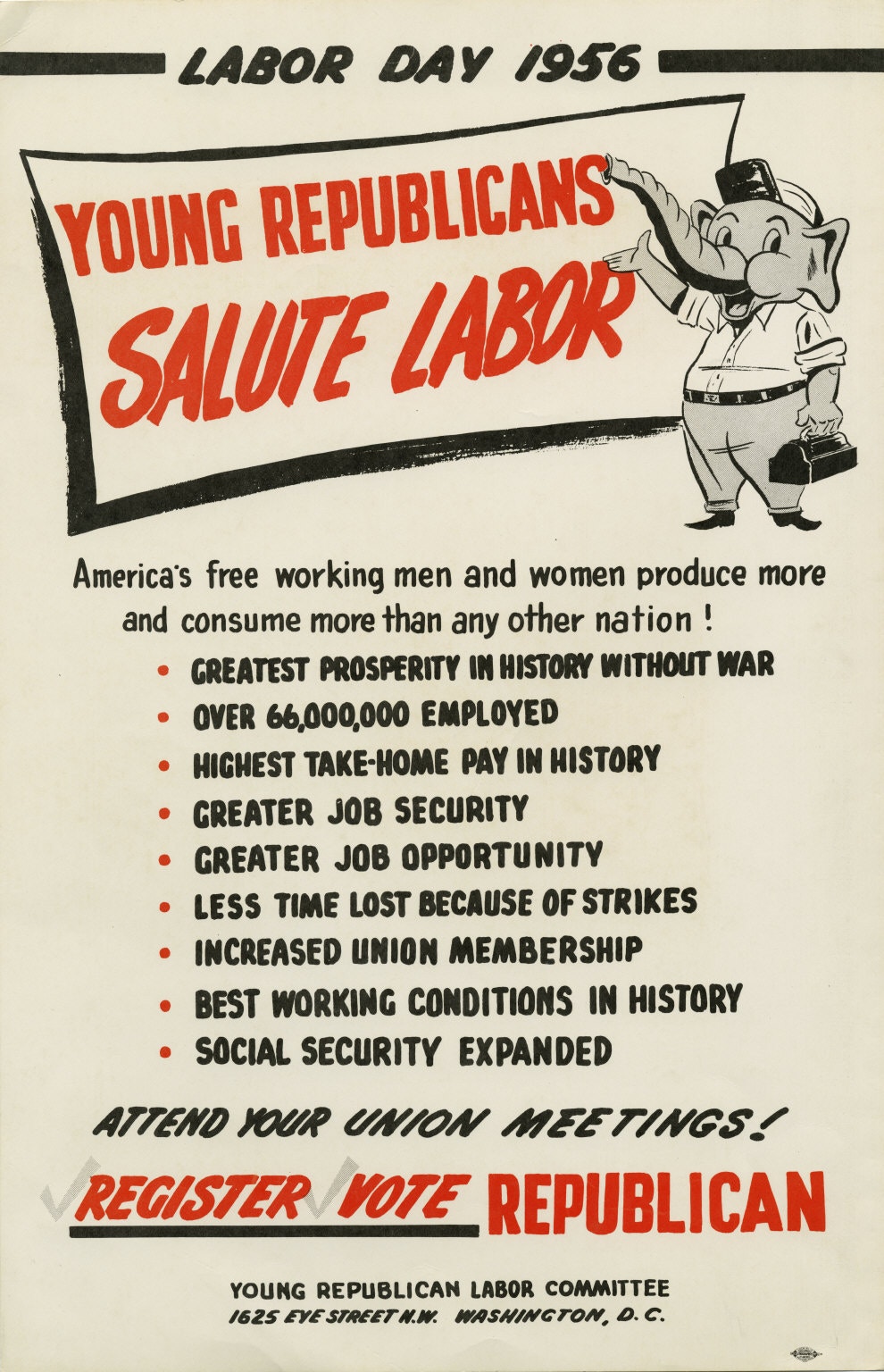
It was only 50 years ago that the Republicans were the party of labor unions [4]. How times changed.
Sure some european countries do not have minimum wages by law (like Norway). But which countries don't have an equivalent of OSHA?
Also, be very careful in comparing unions in Europe with the US, the systems are very different. Unions in Norway for example are not "per company", they are usually working across a whole industry or even across all industries for a particular education/work-role (like engineers). Employees chose freely whether to be member of a union, or which one to pick - and membership is independent of an employeer/contract.
> The company will be around next month if they don't contract you. If you're living paycheck to paycheck, you may not be. Thus, you're not meeting on a level playing field and these rules are built to prevent you being taken advantage of.
This is only true if the employer is a labor monopsony. Otherwise you can still refuse them and go work for another one, and they have to be the high bidder to receive your labor. You may have to work somewhere but you don't have to work there. Even the software engineer has to work somewhere.
Do you think it would be a better use of time and resources to find each and every single market that is subjectively not sufficiently competitive and break up the participants/introduce new participants -- or create some blanket rules that stop people from being taken advantage of (up to and including UBI and socialized medicine)? Why let anyone fall through the cracks?
> Do you think it would be a better use of time and resources to find each and every single market that is subjectively not sufficiently competitive and break up the participants/introduce new participants -- or create some blanket rules that stop people from being taken advantage of (up to and including UBI and socialized medicine)? Why let anyone fall through the cracks?
You say that as if they're mutually exclusive, but they really solve two separate problems.
If you have a monopsony on labor (note that this is not very common for unskilled labor; think company towns), it means that people are being compensated unfairly, in the same way that monopolies overcharge customers unfairly.
But even if you don't, there may be people whose fair market wage isn't enough to live on. Even if there are thousands of employers who need unskilled labor, it's still possible for the supply to outstrip the demand, which is the exact scenario that a UBI works well for -- the market wage may be $4/hour, but supplemented by a UBI it's enough to live on. Meanwhile in the same circumstances some other policies, like minimum wage, do the opposite -- when there is a glut of labor, price controls increase unemployment and make the problem worse, because then people don't get $4/hour plus a UBI, they get to collect unemployment until it runs out and then starve to death.
As an individual welfare recipient, my "ownership and control" of the welfare system is effectively zero.
The majority of people, who happen to have a job, who don't want to pay for people who do not have a job, but who also have no interest in more competition from the bottom, are effectively in control of the welfare system, immigration law, and many other regulations that prevent people from exercising their right to work. It's a racket.
"you are free to work or leave" isn't actually true, though. It only works if no one has problems, if there is a safety net, or if you simplify the world too far.
People need to eat and have housing. Some folks have to pay child support or risk going to court. Some folks have to pay for medicine or risk dying.
You really aren't free to work or leave until we have the choice to work. An actual choice - as in, me, an able-bodied human, can decide to just stay home and make artwork (without selling). And I wish folks would stop pretending this isn't the case. So long as we have poverty and poor folks that are just-over-poverty, we have people that can be exploited.
That's where we are at, and the laws keep the exploitation from going further: Without those laws, what is to stop folks from doing such things? The market doesn't correct for it - if it did, we'd see better wages now.
A low-wage worker is basically powerless, and can be made more powerless by things like a past felony conviction or court-ordered child support and things like that.
They have limited choices, yes. This doesn't change the fact that they do have a choice.
Tell me how limiting their power and opportunity further helps them exactly? What were they doing before ride-sharing and other contract work? What jobs are suddenly available for them? Wouldn't creating new opportunities be better? Wouldn't creating a new classification be better? Wouldn't creating a general health and benefits pool for everyone be better?
Yes, better situations can/should exist, and yes, this legislation is terrible and helps nobody. The opposition is that a real solution was never sought after and instead we have unintended consequences, not that things were fine before.
the underlying assumption is that these companies _still_ would want people to do work (as that is how they make profit). So by forcing these companies to take workers on at a less advantageous terms, the workers gain more.
Of course, in reality, these legislations don't have the right effects, because companies' profit motive is stronger and more creative. After all, legislators' motives are to appear good to their electorate, not actually achieve results where as companies' motives _is_ to achieve results.
The real power differential is between citizens and the government. It's easy to think the government makes no mistakes when you don't experience any of the changes.
Maybe instead of feeling proud that millions have lost opportunity, it would be better to create legislation that actually does improve their lives for once.
These blunt instruments are all we have had for a century with no definitive date on replacement we have to keep legislating like they are never going to happen since they may not.
Let's say I work for a drywaller. One day my boss has me working on a wall 20 feet up with no harness on a rickety old scaffold. This isn't normal, it's just the weird conditions on this one site.
I can refuse because I know if I get fired over it, there's always UBI? And UBI will also abate my fear that I'll be blacklisted from getting another drywall job? Or even a painting job. Or really any labor job ever again.
That's the kind of UBI that would be abused in exactly the way its opponents predict.
I don't consider safety regulations to be in the same category as the employee/contractor distinction. I do think there are some safety things we should not be able to freely give up.
If you require certain safety or other guarantees from employers, but allow someone to arbitrarily just say, "but I'm not an employer", what have you accomplished? They are absolutely connected.
But this specific issue is whether you can avoid micro management legalization by providing a social safety net. I don't dismiss the idea out of hand, but I do have some questions. It's the perfect topic to explore via a civilized debate.
This would probably be something that would have to be determined after actually trying it out. If we have a good social safety net, are there still a lot of people working in dangerous jobs? Is there still a pattern of exploitative behavior from employers?
I would also argue that our safety regulations should not be tied to whether a person is an employee or a contractor. Safety rules should be the same regardless.
I do think some regulation will still be needed, even if everyone had enough that they didn't have to work to survive. It is simply too easy for an employer to hide the danger from their employees; without regulations and inspections, it is likely that a lot of employees wouldn't even realize the danger until something bad happened.
> However, I think that trying to place market restrictions on two parties making an agreement is not the right way to go about it.
There are restrictions placed around how much you can charge in interest for taking a loan. Imagine if someone were to place a 1000% loan because they knew the people taking them were desperate enough for their next meal that they would take that that.
These laws exist for a reason. That they inconvenience you (or anyone else) is irrelevant.
---
edit: well, not irrelevant... it's the entire point.
This is my point why we need a better social safety net... we wouldn't have to ban 1000% loans if we made sure people were never desperate enough where that was their best option.
If we instead simply ban 1000% interest, it doesn't mean those people suddenly have better options than they did before... if means they are forced to pick an even WORSE option.
You protect people by having an effective and sustainable social state, not by making the economy more inefficient and offloading your social policies to the hands of the companies that are least able to avoid them.
Is this really what you want? To have your economy become less able to sustain social welfare, and to have the least moral companies become a greater and greater part of the economy? Because with the policies you are advocating that is what you are selecting for.
I’ve never been poor. But I wasn’t exactly middle class. My parents were immigrants.
Poverty is terrible, and I agree it should be dealt with. But how has this law helped? Uber and Lyft are more than willing to leave all of California rather than stay and deal with the regulation. They’ve made that clear. It’s more economical for them for halt business in California rather than adhere to the regulations. That’s a rather poor incentive set for on behalf of the California regulators. Regulations don’t exist in a vacuum.
> Uber and Lyft are more than willing to leave all of California rather than stay and deal with the regulation. They’ve made that clear.
Given that Uber adjusted their platform to adhere to the ABC test in jurisdictions where the justice system upheld the law, I doubt that they'll leave.
If they were to leave, though, that would be a good thing. There are dozens of companies that do follow the law and do pay their taxes that are champing at the bit to eat Uber's lunch.
You mean the taxi companies that Uber and Lyft effectively replaced that were even more sleazy? I’m still wondering how the taxi industry managed to get an exemption from these new standards and why that was deemed fair.
No, there are dozens of start ups that want to compete in Uber's market, but can't compete against an entity that doesn't follow the law and is never held accountable for it.
I dont think there are... Uber and Lyft filled a market need for lower cost ride services.
The key was they were LOWER COST than a taxi, if everyone had to be full employee's with all of the costs that entils it is likely the fare will be at or higher than taxis,
And given there would be less competition between drivers, the service would also drop
It would just be a taxi service which was universally hated as too expensive with poor service.
> Uber and Lyft are more than willing to leave all of California rather than stay and deal with the regulation.
Ok. And why is that bad? The office work / engineers will stay. If there's need for transport, the drivers will work for transport in other ways. If nobody wants to pay for better conditions of drivers, then we just exposed the VC funding as unsustainable in a long run - it would happen sooner or later.
Why stop at Uber drivers? Why don’t the California regulators just regulate away all jobs that don’t pay a livable wage? Why don’t the California regulators just raise the minimum wage to $90k a year?
Like I mentioned in the post above, regulations don’t exist in a vacuum, just because you say something should be a certain way doesn’t mean it will be. There are costs, and Uber and Lyft have determined that it’s not economically feasible for them keep operating in California under those regulations.
If we’re ok with California regulators dictating what jobs should exist regardless of what the market can support, then this is the result.
> Why don’t the California regulators just regulate away all jobs that don’t pay a livable wage?
That’s what they did with AB5, and also decided to regulate lucrative freelance gigs while they were at it. The result however wasn’t that companies hired former contractors as employees; no they just farm all their freelance work to out of state freelancers.
"There are costs, and Uber and Lyft have determined that it’s not economically feasible for them keep operating in California under those regulations."
Do you know that's the case, or do you just mean "that's what they said!" It's in their interest to say they just can't afford to treat their workers better- that they'll be forced to shut down- regardless of whether or not they can afford to.
It's by no means clear that drivers for Uber/Lyft will have viable prospects in this scenario. These jobs did not exist pre-ride-sharing companies. It's not like all these drivers were driving cabs before.
> These jobs did not exist pre-ride-sharing companies.
Is it your contention that taxi's didn't exist pre-Uber? Or that Taxi's weren't jobs done by ordinary people?
I can tell you as someone who is over 40, I would regularly form relationships with Taxi drivers so that I could simply call them up and ask them if they'd be available on X day, X time, and if they could use the "special" rate, and the answer was yes. Where special rate meant paying just them and not the taxi company I met them through.
There is nothing special about Uber or Lyft, and if they leave California the existing Taxi company's will fill in the gap.
My contention is that the number of people driving taxis pre-Uber was vastly less than the number of taxi drivers plus Uber drivers plus Lyft drivers, and the total number of rides-for-hire was vastly lower pre-Uber than post.
Pretty sure that is illegal, if not it is unethical
> if they leave California the existing Taxi company's will fill in the gap.
Clearly there was a demand for something other than taxi's, while you seemed to like it, and did unethical things to get your rate lower. For most people they found the taxi service to be unappealing and over priced, Thus uber and lyft where born
The need for transport will not go away. The moment uber and Lyft leave, other companies will come in. There may not be 1:1 replacement of the drivers, but a lot can jump ship. Others? It will suck when it happens, but hopefully they can find other jobs. There's going to be quite a few office jobs for people with cab experience at companies trying to take over the market though.
This would be the immediate effect today. An alternative description is "VC money supports the axe hanging over unprofitable uber jobs". The question is - does uber need to find a solution to this problem today or in X months?
If somebody is vulnerable, I'd say it seems like a very bad thing to make them work by threatening them with homelessness and poverty, enforced by men with guns.
If most people want to help them, as apparently most people do (these laws need to get passed in a democracy, after all), why does that help need to be enforced by men with guns?
I don't see how that question is relevant, and you could easily turn it around and ask: Have you ever been so poor that you would have been willing to work for less then minimum wage, but couldn't find work due to the minimum wage?
If poor people are whom these meddlesome laws are supposed to protect, then draft the laws that way.
Someone who is not poor doesn't want to be screwed over by some protect-the-poor labor law.
E.g. it could be that a freelancer must be considered an employee if they are paid peanuts. If they are amply compensated, then not.
Various other kinds of labor laws could be sensitive to compensation. Nobody should be required to work without a break. But some consultant taking $200/hr from you should probably not be entitled to 8 hours pay for 7.5 hours work, with a paid 30 minute lunch period.
Work safety should be non-negotiable. Anyone working on your site should be safe, highly paid or not.
Labor regulations do not protect the most vulnerable in our society. They create far more vulnerability and marginalization, by getting in the way of private contracting and initiative. And the more regulations are piled on to "solve" the problem, the more this occurs. See the dismal situation of, e.g. socially marginalized ethnic minorities in places like France as an example.
And if we as a society decide that people should have health care, food to eat, and shelter , we shouldn’t put the burden on private companies. Companies should focus on making money and paying taxes. The government should use that tax money to provide universal healthcare, increase the earned income tax credit and make it easier to get throughout the year.
A private company shouldn’t be worried about providing a “livable wage”. A “livable wage” to my 18 year old son staying at home is not the same for a single mother of two doing the same job - that reality was part of the structure and purpose of the EITC. It’s just implanted badly.
I don’t need big government to make decisions for me.
The comment you replied to already makes the following point, but I'll try to make it more succinctly, since you apparently didn't read the whole comment:
And if we as a society decide that people should have health care, food to eat, and shelter, and that we should put the burden on private companies, we should do so in the form of corporate taxes.
If you speak english there is a very good likelyhood you dont know what it really means to be poor.
Exhibit A:
Take most countries in south America, like Peru, Bolivia or Ecuador. They have labor laws that mandate workers should receive x (usually 3) months severance for every year worked.
As a result massive underemployment which means people are literally working the streets to make ends meet.
Minimum wage is the least of your worries when your wages will come from selling produce in the middle of the road.
You havent seen poverty until you see people living on top of garbage heaps picking up traah to survive.
Thats the kind of stuff you see in countries swimming in labor regulations.
Sure, I've been poor, but that's not a necessary condition to think through this situation (as if any of these politicians have experienced such conditions).
These laws are not protecting anyone, they're preventing opportunities for them. A new classification between employee and contractor would've been a real solution. That would've been real progress to create benefits while maintaining flexibility. But that's not what happened.
How does eliminating Uber help the poor? Over regulation kills jobs, so a poor person could make $10 per hour, with all of these “protections,” now they make $0 because the job disappears.
Why would I pay an uneducated, inexperienced person to sweep floors $20 per hour? I’ll do it myself first. But at $8 am hour, the numbers make sense. So rather than one job at $8 per hour, now there is no job paying $20 per hour.
What’s better for the poor? $8 per hour at an entry level job, or $20 per hour for no job. And presumably when that $8 per hour worker gains experience and can provide more value, he either gets a raise or goes to another job that will pay what his skills are worth.
Business owners don't hire unnecessary people out of the goodness of their hearts. If they're paying someone full time to sweep floors, it's because it's a necessary business expense. The owner hasn't the time nor the inclination to spend 8 hours a day doing that person's task. If they can identify slack in the person's job, they will try to cut hours, but barring that, they will keep that person employed at a higher salary, raise prices to maintain profits if they're able, and all of their local competitors will do the same, as they are in the same boat.
That’s observably false. I have commented before that I choose not to hire an assistant any more because I am intimidated and overwhelmed by labor regulation compliance. There are many, many, marginal jobs like this. Jobs that could serve as an entry point to an industry for a person, and a business owner might happily hire someone and give them a chance to learn on the job, but if faced with too many hurdles, will simply do the work themselves.
This has the effect of making people even more dependent on college, btw. And can effectively make certain types of career paths disappear entirely.
Thing of a greeter at Walmart. How easily can Walmart just do away with greeters?
1. There exist jobs that are not worth paying someone X/hour, but are worth it at some number less than X. For the purposes of this discussion, X is "a livable wage".
2. There exist people who work, but do not need to X to survive; retirees who just want to be out of the house, mentally handicapped individuals for whom being out doing work and meeting people is helpful, etc.
Those two points are facts.
Requiring that every job pay a livable wage means that the combination of the above two will no longer be available. Those jobs just will not exist if they need to pay that much. As a result, some subset of group 2 will no longer be able to work (this part is opinion, but seems a reasonable conclusion).
So, the tradeoff is being made to make live worse for some of those people in group 2... in order to make life better for people in a different group. That may or may not be a good tradeoffs. But just the fact that it exists as a tradeoff means that "no job may pay less than a living wage" is not a black and white topic; there's a grey area.
it's not set in stone, and that's part of the beauty of it. Who are you to say whether or not another person may take such a job at a wage they find agreeable?
Not every single employee is necessary in the sense that the business would go bankrupt without them. (Even if that were actually true, the minimum would drive some businesses into bankruptcy, so I don't see how it would help your case.) Rather there's always a choice on the margin. The business can sweep the floor every day, every other day, twice a day, etc..
"And presumably when that $8 per hour worker gains experience and can provide more value, he either gets a raise or goes to another job that will pay what his skills are worth."
That's a mighty strong presumption to make. What skills exactly does one build up sweeping floors? And who is going to be incentivized to give out raises, when they could just hire a new person at the base wage?
Every year tons of new Javascript developers graduate from colleges and bootcamps. Why do any of them get raises when companies could just hire at the base wage? Sweeping floors may not be very exciting but you can learn skills - perhaps purchasing (supplies), handyman work (path to union labor), maybe the CEO notices the floors are freaking spotless and this guy has never been late once in the past year and decides to give him more responsibility...
JS developers are entering a growing market that constantly needs dramatically more developers than currently exist. This is not going to be true for cleaners of restaurants in 2020.
I will freely admit my bias: I have been very poor before and I lean towards protections for the most vulnerable in our society at the expense that some people will have to sacrifice somewhat between Uber and their other gig.