Hacker News new | ask | show | jobs
by arcticbull 2108 days ago
The reason these restrictions exist is to address the inherent power differential between the contractor and the contractee.

The company will be around next month if they don't contract you. If you're living paycheck to paycheck, you may not be. Thus, you're not meeting on a level playing field and these rules are built to prevent you being taken advantage of.

This is particularly relevant to Uber drivers, as driving for Uber is unskilled labor. It's not you freelancing as a $200-500/hr software engineer. After all if you are, you can just incorporate a contracting business and pay yourself benefits out of the take -- then this whole conversations is moot.

> If we had a stronger social safety net (either something like a UBI, or some other form of economic assistance), we wouldn’t need to try to manipulate the market with blunt restrictions on trade.

This is my free-market argument for UBI and socialized medicine also. I believe UBI and socialized medicine promote, not detract from a true, a free-market economy.

4 comments

The reason these restrictions exist is to address the inherent power differential between the contractor and the contractee.

There are other easier ways to address that differential. Namely: unionization. In many European countries, there are no minimum wage laws. There is no government agency equivalent of OSHA. Instead, they have unions, where workers themselves band together and collectively bargain to ensure they're adequately compensated and given a safe working environment.

Instead, we in the United States, have chosen to make the government our union. Then we're shocked and surprised when it does a bad job, or when its blanket policies have disproportionate impact on certain industries.

That's a good observation, and hold true in Canada to an extent too. In the US, union participation is 10% [1] while in Canada it's about 30% [2]. In the EU it's just short of 60% [3]. Amazing how each doubling or tripling of labor union participation rates creates monumental changes in the way employees are treated: minimum 35 days of PTO in Europe, guaranteed child care, mat/pat leave. It's almost like collective bargaining works.

US PTO: 0 days (!!), CA PTO: 16-30 days, EU PTO: Up to 36 days.

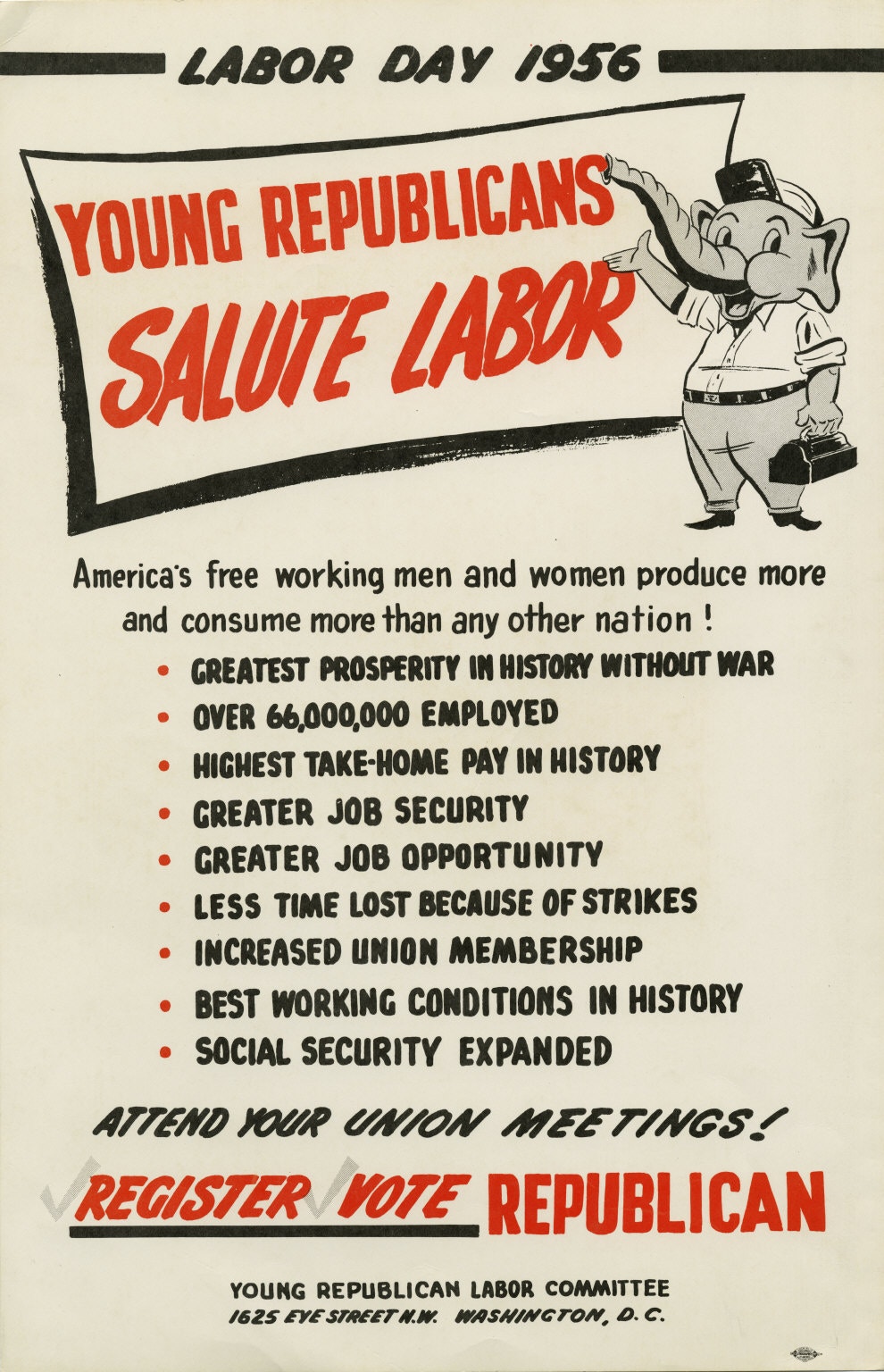
It was only 50 years ago that the Republicans were the party of labor unions [4]. How times changed.

[1] https://www.bls.gov/news.release/union2.nr0.htm

[2] https://www150.statcan.gc.ca/t1/tbl1/en/tv.action?pid=141001...

[3] https://tradingeconomics.com/european-union/labor-force-part...

[4] https://theintercept.imgix.net/wp-uploads/sites/1/2016/07/la...

Sure some european countries do not have minimum wages by law (like Norway). But which countries don't have an equivalent of OSHA?

Also, be very careful in comparing unions in Europe with the US, the systems are very different. Unions in Norway for example are not "per company", they are usually working across a whole industry or even across all industries for a particular education/work-role (like engineers). Employees chose freely whether to be member of a union, or which one to pick - and membership is independent of an employeer/contract.

Labor unions in Canada are similar, they tend not to be per-company, but rather broad like CUPE [1] which represents 2% of the Canadian population.

[1] https://en.wikipedia.org/wiki/Canadian_Union_of_Public_Emplo...

Isn't that also the case in the us, with unions like the UAW?
The UAW is an odd example of a super multi industry union. The Resident Advisors at my university were obligated to be UAW members.

The UAW theoretically got involved in the employment contract negotiations, but none of the RAs could get in touch with them despite paying union dues. There was a group trying to organize action to leave the UAW and form an independent union.

Large organizations tend towards incompetence and corruption over a prolonged period of time.

> The company will be around next month if they don't contract you. If you're living paycheck to paycheck, you may not be. Thus, you're not meeting on a level playing field and these rules are built to prevent you being taken advantage of.

This is only true if the employer is a labor monopsony. Otherwise you can still refuse them and go work for another one, and they have to be the high bidder to receive your labor. You may have to work somewhere but you don't have to work there. Even the software engineer has to work somewhere.

And if the employer is a monopsony, fix that.

Do you think it would be a better use of time and resources to find each and every single market that is subjectively not sufficiently competitive and break up the participants/introduce new participants -- or create some blanket rules that stop people from being taken advantage of (up to and including UBI and socialized medicine)? Why let anyone fall through the cracks?
> Do you think it would be a better use of time and resources to find each and every single market that is subjectively not sufficiently competitive and break up the participants/introduce new participants -- or create some blanket rules that stop people from being taken advantage of (up to and including UBI and socialized medicine)? Why let anyone fall through the cracks?

You say that as if they're mutually exclusive, but they really solve two separate problems.

If you have a monopsony on labor (note that this is not very common for unskilled labor; think company towns), it means that people are being compensated unfairly, in the same way that monopolies overcharge customers unfairly.

But even if you don't, there may be people whose fair market wage isn't enough to live on. Even if there are thousands of employers who need unskilled labor, it's still possible for the supply to outstrip the demand, which is the exact scenario that a UBI works well for -- the market wage may be $4/hour, but supplemented by a UBI it's enough to live on. Meanwhile in the same circumstances some other policies, like minimum wage, do the opposite -- when there is a glut of labor, price controls increase unemployment and make the problem worse, because then people don't get $4/hour plus a UBI, they get to collect unemployment until it runs out and then starve to death.

> The reason these restrictions exist is to address the inherent power differential between the contractor and the contractee.

Being effectively prohibited from working on my own terms - even if the best terms I can negotiate are poor - doesn't give me any power.

It makes me a subject to the crappy welfare system, which now has far more power over me than any employer would have ever had.

The difference is the welfare system is joint-owned and joint-controlled by you, a citizen.
As an individual welfare recipient, my "ownership and control" of the welfare system is effectively zero.

The majority of people, who happen to have a job, who don't want to pay for people who do not have a job, but who also have no interest in more competition from the bottom, are effectively in control of the welfare system, immigration law, and many other regulations that prevent people from exercising their right to work. It's a racket.

> As an individual welfare recipient, my "ownership and control" of the welfare system is effectively zero.

No, it isn't. Every citizen has the same share of ownership and control as every other. One person, one vote and all that.

That’s not mutually exclusive with a single person’s vote having effectively zero effect in and of itself.

Also I’d argue that even if technically everyone only gets one vote, some people exert much more control than that by influencing voters, politicians, etc, through their wealth or other sources of power.

One person one vote doesn't mean equal power, it means the power distribution isn't nailed down by law.

It is rather apparent that some people - and certainly some groups - have a lot more power than others in any country. Voting just means the power is a little more mobile, and can shift over time.

1 randomly selected citizen has, practically speaking, no ownership or control of the welfare system.

"One person, one vote" also has the obvious problem if similarly situated people constitute 5% of the population and it takes 51% to effect a change in policy.

This also provides a reasonable explanation for why existing policies are so ineffective -- politicians still want your vote (5% is 5%), but they also don't want to lose the votes of the other 95%, so if they can convince the 5% that they're getting something when they're really getting nothing (or worse than nothing), they get elected again.

There is no power differential. You are free to work or leave. These laws only took that power away from the individual.

A new worker classification between contractor and employee would be a real solution, but a real solution was not the goal of this legislation.

"you are free to work or leave" isn't actually true, though. It only works if no one has problems, if there is a safety net, or if you simplify the world too far.

People need to eat and have housing. Some folks have to pay child support or risk going to court. Some folks have to pay for medicine or risk dying.

You really aren't free to work or leave until we have the choice to work. An actual choice - as in, me, an able-bodied human, can decide to just stay home and make artwork (without selling). And I wish folks would stop pretending this isn't the case. So long as we have poverty and poor folks that are just-over-poverty, we have people that can be exploited.

That's where we are at, and the laws keep the exploitation from going further: Without those laws, what is to stop folks from doing such things? The market doesn't correct for it - if it did, we'd see better wages now.

A low-wage worker is basically powerless, and can be made more powerless by things like a past felony conviction or court-ordered child support and things like that.

They have limited choices, yes. This doesn't change the fact that they do have a choice.

Tell me how limiting their power and opportunity further helps them exactly? What were they doing before ride-sharing and other contract work? What jobs are suddenly available for them? Wouldn't creating new opportunities be better? Wouldn't creating a new classification be better? Wouldn't creating a general health and benefits pool for everyone be better?

Yes, better situations can/should exist, and yes, this legislation is terrible and helps nobody. The opposition is that a real solution was never sought after and instead we have unintended consequences, not that things were fine before.

> You are free to work or leave.

the underlying assumption is that these companies _still_ would want people to do work (as that is how they make profit). So by forcing these companies to take workers on at a less advantageous terms, the workers gain more.

Of course, in reality, these legislations don't have the right effects, because companies' profit motive is stronger and more creative. After all, legislators' motives are to appear good to their electorate, not actually achieve results where as companies' motives _is_ to achieve results.

Generally if it's "take it or leave it" and the other party refuses to negotiate with you then there is a power differential at play.

Whether or not it actually affects you as an individual is a different story.

> There is no power differential. You are free to work or leave.

There's no power differential, you can choose to live or die. See, easy.

The real power differential is between citizens and the government. It's easy to think the government makes no mistakes when you don't experience any of the changes.

Maybe instead of feeling proud that millions have lost opportunity, it would be better to create legislation that actually does improve their lives for once.