Hacker News new | ask | show | jobs
by nik_s 2304 days ago
The general issue with this measure of mortality (dead/(infected + dead)) is that you're assuming that the infected won't die. In a disease that is exponentially growing, a better approximation of evaluating your survival chances is to look at the death to recovery rate (dead / (recovered + dead)). Based on the available data [1], we are closer to 7.8% than 2% mortality, which is closer to the final mortality rate of SARS of 9.6% [2].

Nevertheless, I think all these statistics need to be taken with a grain of salt - I doubt that the numbers we are seeing are of very high quality, given the political and cultural pressures in China to underreport, the lack of test kits, corona virus deaths being attributed to other diseases, ... On the flip side, it's very likely that mild cases will never be reported, which in turn would decrease the mortality rate.

[1] https://gisanddata.maps.arcgis.com/apps/opsdashboard/index.h...

[2] https://en.wikipedia.org/wiki/Severe_acute_respiratory_syndr...

[edit: corrected the formula - thank you @anhner and @11thEarlOfMar for spotting the mistake]

[edit: indicated that there's also a chance of under-reporting mild cases - my edit coincided with @Tenoke's post - sorry for noticing this late @Tenoke]

28 comments

I do have one question and I'm asking this seriously, not to start an argument or to attack someone. I also saw this here in a lot of the posts about covid-19. We have numbers, but every time people tend to ignore them or say we should not trust the numbers, take them with a grain of salt, "I think this is way worse, it's going to get way worse" and so on. It's like there is this thirst for disaster or some global drama everywhere, and this is not something that I would expect from Hackernews. If the numbers don't align with our hopes or fears, we should take them with a grain of salt and trust the gut feeling of whoever comments. It's quite weird to see that when it comes to this, people seem to think that it's some sort of conspiracy, China is hiding numbers, now EU is not doing things properly, as I see it everywhere "my country can't have 0 cases, I know that our airport is a big hub and it can't be, we will be doomed as we probably have hundred of cases instead of none and our government is not doing anything".

I'm not saying that this virus is not a threat and I worry for my parents as this could be a big issue for their condition, but we've gone down the rabbit hole with the hysteria in the press and online and it's scary to see this need for a global pandemic and the urge to constantly feed the panic monster.

The problem is in the healthcare capacities.

I live in a country with ~2mio people. If you're patient zero here, you get a comfy private room, your own bed, 5 doctors, 10 nurses, whole research teams, respirators, priority with all the tests, examinations, etc. Same for patient 1, 2, 3.

If 200k people get infected (10% of population), and only 10% of those need extra medical care, that's 20.000 people. We don't have that many hospital beds, doctors, respirators.. probably not even enough medicine (some test have shown that malaria medicine and aids medicine works on some people). You get thrown into an army tent or a school gym with many more ill people, and you get almost zero resources. Need a respirator? Sorry, only 5 available at that location, and are used on other people.. or kids.. or pregnant women... and you can just slowly suffocate.

China built a hospital in a couple of days. I don't think there's a country in EU that can do anything remotely fast as that.. we probably need 10 days just to discuss where to put the emergency tents, and even then we'd get protesters not wanting them there. Same probably in the USA.

We also don't have companies making respirators and other medical equipment. Large countries who do, are making them for their own hospitals (if they're not stuck in paperpushing hell with the government).

Basically, if there's a wide-spread epidemic, a lot of people will get really really fscked.

I don't disagree with your position - if there's a wide-spread epidemic, things will go bad, especially as the healthcare system gets overwhelmed. But that's not a novel or interesting point of view, and I doubt many would disagree. So why go around inciting panic?

Lets try some other numbers. If 1% of the population gets infected, and 1% needs extra medical care, that's 200 people. If 0.1% of the population is infected and 0.1% of the population need extra medical care, that's... two people. That's not so scary, and I'm not going to slowly suffocate. (There's no need to threaten me with asphyxiation, thanks.) We don't have any reliable information, so any numbers used for "back of the envelope" math might as well be relating my birth date to star signs and be used to find my future lover, for all the basis in reality they ultimately have.

I mean, you're scared. I get it, I'm scared too. I feel powerless in the face of this epidemic and being told to wash my hands a bit more, and touch my face less only serves to reiterate my impotence. Is that where the thirst for disaster potential comes from? An addiction to the panic endorphins?

(I am genuinely curious, and am hopeful that mns' comment will stimulate commentary about the meta-topic.) (And apologies for singling you out personally, ajsnigrutin, the other sibling replies are of the same nature and yours was the comment I chose to reply to.)

That is where speed of spreading the disease comes in. If you can limit it so that 1% of population in local area is sick simultaneously, then it is fine.

If you cant limit the speed of spreading the disease, then the hospitals will miss those needed respirators and more people will die. Cause respirator is necessary if you are one of the unlucky ones.

Which is where "hysteria" around locking areas, washing hands and testing people on airports comes in. That is why locking cities, working from home and having some reasonable amount of food so that you are comfortable. The whole point is to slow down spreading, so that resources are available for sick people.

> I feel powerless in the face of this epidemic and being told to wash my hands a bit more, and touch my face less only serves to reiterate my impotence. Is that where the thirst for disaster potential comes from? An addiction to the panic endorphins?

It is not impotent to wash hands and touch face less and avoid unnecessary crowd. That done in masses is to slow down the spread. It is all actually useful.

But if you get a bunch of "it's just a flu" people, who sneeze everywhere and don't wash their hands, that "1%" number gets higher. I'm not saying we should close up the whole country, but basic measures (you're ill, even if it is just a flu, you stay home... people must wash hands. Hand desinfectants at stores, schools, etc. No large gatherings if it's not neccessary. If you can, work from home, if someone near you got sick. etc)
According to the Chinese papers, something like 15% of cases are serious and need hospitalization. If it does become widespread, it would be a major calamity (though most people would survive and the world would move on once it is over).

As to whether it will become widespread, the jury is still out. China appears to have gotten it under control, but it took drastic measures to do so. The rest of the world has yet to demonstrate an ability and willingness to do the same. There is a decent chance this will spread as widely as the swine flu did, but with more than 20x the case fatality rate, we would be looking at tens of millions of deaths worldwide.

And you forgot the last thing: Europeans would never put the money in.

The Coronavirus isn't new. Since mid-January we knew this will be serious. Nothing has been done since to prepare.

Maybe Europeans can't build a field hospital in ten days, but we haven't even tried to start building anything in 40 days.

We wait until it hits our shores, as is now the case and then throw our hands up in the air.

it already has hit your shore.
From the parent:

"as is now the case"

that was edited in.
> If you're patient zero here, you get a comfy private room, your own bed, 5 doctors, 10 nurses, whole research teams, respirators, priority with all the tests, examinations, etc. Same for patient 1, 2, 3.

I read a similar comment from someone on another forum. If you're certain this will end up a pandemic, with almost everyone eventually catching it, your best move is to catch the virus as soon as possible, ensuring you'll get the best care.

Though this assumes you can't get it a second time, after the antibodies are generated. This appears not to be the case with this virus, possibly.

How fast or slow does the virus evolve towards lower mortality? If you get infected months later, is it still essentially the same virus, or a less aggressive strain?
Given the 2-3 week transmissible incubation period where the infected show no symptoms, it doesn't seem like there's short enough feedback loop for the lethality to be tempered through natural selection within the initial period of the outbreak (which we're just beginning).
>Given the 2-3 week transmissible incubation period

No one knows if it's transmissible during the entire incubation period. It's almost certainly not given how other viruses behave. Also the possibility of transmission during asymptomatic periods doesn't mean that it's likely, or that most transmissions happen during that time.

There are reports that you can get it a second time, and it is worse on the second time:

https://www.theburningplatform.com/2020/02/15/hubei-doctors-...

Or, hole up and wait for a vaccine.
"As of 2020, there is no cure or protective vaccine for SARS that has been shown to be both safe and effective in humans." https://en.wikipedia.org/wiki/Severe_acute_respiratory_syndr...
Spot on. Medical facilities are not up to support in times of widespread epidemics. Which means most people would not get any treatment and you should expect mortality rate to increase over time as it becomes more widespread.
You can see this in provincial level mortality rates: at low infection concentrations, it's a more deadly than flu but nothing insane. But once resources are swamped (e.g. in Hubei), the mortality jumps an order of magnitude.
Thank you. I have this constant argument with those that want to shut borders and blow up our economy as a result: that if you break the stats down on Hubei vs everywhere else, it’s a very different picture of the virulence and mortality rates.

Hubei’s mortality rate for literally everything at the moment would expected to be higher than anywhere else given how stretched their resources are.

I don't understand. How is the mortality rate being worse when resources are stretched thin a point in favour of not shutting borders?
That "10 day hospital" is the field hospital equivalent of a school gym.
Yes, you are right, if 10% of people in your country get infected it would be an absolute calamity... because it is already such an extreme scenario. Does it even have a precedent in modern times?
The 1918 flu pandemic.
And that's still ignoring the factor that many of those care workers will get ill themselves compounding the problem significantly.
The numbers probably get worse with scale rather than better because larger countries can get away with having lower medical capacity than smaller countries (i.e., larger countries will be more efficient).

The U.S. could probably build a hospital very quickly, but neither China nor the U.S. can build enough hospitals quickly enough, let alone equip them, let alone train nurses and doctors quickly enough.

If the brown stuff really hits the moving fan blades, then military tent cities it will be, and it will be more like bad hospice care than like bad hospital care.

One thing this crisis will do is highlight the need for more emergency pandemic handling capacity. That means: a) faster testing of vaccines (e.g., do double-blind testing on medical staff, since they need it most), b) faster emergency mass production of vaccines, c) faster emergency distribution of vaccines.

Creation of new treatments (new anti-virals, ...) on an emergency basis is necessarily going to lag because it's much more costly and time consuming than development of new prevention (vaccines). Manufacturing new equipment (respirators) and so on also takes time (retooling, etc.). Building hospitals takes even longer (even if you can pull together to build one very quickly, equipping it will take time). And training staff takes eons. Throw in supply chain disruptions and, really, I think only emergency development and testing of new vaccines is plausible on a timescale similar to that of a pandemic.

It's not like you can have a ton of spare capacity around: that's very costly too, and there's depreciation issues. Reaction time needs to be faster instead.

One thing I'd like to see come out of this is a treaty or agreement on cross-certification and inspection of bio labs around the world, and an agreement to not develop bioweapons, or at the very very least to not develop bioweapons that are trivially transmissible from human to human. I think it's becoming clear that SARS-covid19 was leaked accidentally from the BSL-4 lab in Wuhan, or at least that it's very plausible that it came from there, and that is rather upsetting -- this must not happen again!

I thought you had a good take till I got to the end and saw a conspiracy theory that to my knowledge has very little basis in fact. Simple explanations (species jump, evidence of similar viruses in adjacent species) are way more likely than some arcane BSL 4 leak. We shouldn’t compound hysteria with wild conspiracies.
My reasoning for thinking this is worthy of panic:

I recently moved to China. The PRC has good numbers (internally) and knows more about COVID-19's severity and risk profile than anyone else. And, on the ground, the PRC is putting the entire country on what amounts to wartime footing (in a way that's unimaginable to most HN readers), to the point that it's willing to sacrifice a quarter or more worth of economic production because the alternative is potentially worse.

It's managed to be successfully contained here (it's been some time since I saw any corpses ferried out of my apartment complex), but Western countries, let alone developing countries, simply lack the state capacity to respond as decisively and effectively as China has.

I'm hoping Spring ends up curtailing the pandemic; letting warmer temperatures do their work requires slowing down the virus' spread as much as possible, and that requires significant disruptions to people's everyday lives.

My read on the Chinese reaction is the same in that they seem to be taking it very seriously indeed. But it might not be because the PRC are so worried about the disease per se. They may just be worried about the unrest and panic an insufficient response could cause. I.e. the PRC may be trying to prevent the infodemic more than the epidemic, to use current parlance.
One interesting frame to view this through is as a stress test of Chinese state capacity. I.e. is the state able to rapidly deploy resources vastly and effectively, at the cost of very dear priorities, to achieve some key national security objective?

If I were a CPC member, I'd be pretty happy with how this has gone. It was able to turn an initial misstep into a triumph: the people I talk to tend to take the view that China got a pop quiz and scored a B+, while all the other countries around are getting the same exam take home and flunking it.

China is taking it seriously which is different from addressing it competently ... welding occupied apartment buildings shut, throwing undiagnosed into Hotel California[1] quarantine centers, randomly spraying things with who knows what, etc does not inspire a sense of efficient effectiveness in onlookers.

[1] - "Welcome to Hotel California / ... / You can never leave!"

Both probably play a role in the equation of how China and the PRC has acted thus far in the wake of the disease. I certainly don't think China is acting with some far greater knowledge of the virus than other affected states/countries. The virus genome has been mapped and the world is working on developing a vaccine (I believe I read a recent story that Hong Kong claims they developed one). Unfortunately (or perhaps fortunately), any kind of vaccine will need to go through phases of testing and validation to ensure its efficacy and this process will inevitably take time. That time will regrettably see more people fall victim to Covid-19.

Of course, China was also probably worried about the economic and political repercussions of appearing to the world as not being strong or proactive enough in its response. So much of the global supply chain relies on China that even having the resemblance of not being in control of the situation would have produced a far greater economic bloodbath than we've seen thus far.

I have the polar opposite view, China is not transparent with their numbers, and their response is hamfisted because they aren't competent and a lot of it is theater (typical of communist regimes.) It is possible that in many years more people will die from cancer from their irresponsible spraying than the actual virus. Western countries are also traditionally cleaner, and things like "gutter grease" aren't common. I have much more faith in the west than hamfisted policies from China.
They may not be transparent with their numbers, and certainly weren’t in the early days, but what about their response has been not competent? And what does gutter grease have to do with this virus or containment?
Does this look like a competent response to you? Or do you think is was thought of by a bureaucrat within the CCP? This is one of many examples. https://www.youtube.com/watch?v=Yw7M-fUaIb0

Also fecal matter might be part of the transmission. Gutter grease is produced from sewage waste (in many case.) https://www.bloomberg.com/news/articles/2020-02-20/fecal-tra...

When talking about competence in containment we need to look at aggregate data. Clearly there will be pockets of mishandling things, everything from medical facilities to airports etc.

Aside from the initial mishandling due to downplaying the situation and hiding information, the subsequent actions seems to have been pretty effective. Outside of Hubei the virus seems to be pretty well contained and relatively quickly at that.

If making a stupid PSA video is the criteria for incompetence, I'm not sure I've ever interacted with a single competent organization that was large enough to film one.

I don't care about their filmographic teams. I care about whether or not the control measures are working.

They actively tried to cover it up and waited until it was too late to take action, and they're engaging in a lot of sterility theater.
Never heard of that vile substance before: https://en.m.wikipedia.org/wiki/Gutter_oil
It is interesting how in times of crisis, people start looking for a heavy handed, authoritative response to the situation. Moderates will be brushed aside as weak and impotent.

I do not disagree with you on the point that China's response has been herculean, but we must not forget that this also comes at a hefty price, one that I am personally not willing to pay.

> I do not disagree with you on the point that China's response has been herculean, but we must not forget that this also comes at a hefty price, one that I am personally not willing to pay.

One that you're not ever willing to pay, regardless of what you'd get for it? Even if it saved a million lives?

Given N=1, we obviously don't currently know how effective these quarantine measures have been so far, compared to whatever platonic ideal that does not come at a 'hefty price'. [1]

I think it's more likely then not that we will have a better grasp on it in a few months, when other countries start having outbreaks, especially if they don't react seriously to them. It's becoming quite clear that travel restrictions on their own are not going to keep the virus isolated.

[1] I have no idea what exactly you mean by that, so I'm going to assume you are not a fan of the quarantine, as implemented in China.

Edit: Thank you for clarifying your point, by pointing out that your concern is for the overall context - the other repressive systems of the CPC. I am very deliberately not addressing them in this sub-thread.

By hefty price, did not mean any potentially mishandled quarantine measures. Quarantine is a compromise, a hard one, and I am certainly in no position to form an informed position on this matter.

I meant the human rights violations perpetrated by the regime. This is always the price we seem to have to pay for a "competent crisis handling". I would indeed rather choose a free, but impotent country.

It is ironic that personal freedoms and public health are not often compatible. Doubly important to be aware of what we are being sold.

EDIT:

--- As the replies to my comment indicate I have totally misunderstood the paper. And there IS in fact evidence that the temperature changes the transmission. Sorry my bad. leaving the rest as is ---

> I'm hoping Spring ends up curtailing the pandemic; letting warmer temperatures do their work requires slowing down the virus' spread as much as possible, and that requires significant disruptions to people's everyday lives.

from this paper "Temperature significant change COVID-19 Transmission in 429 cities": https://www.medrxiv.org/content/10.1101/2020.02.22.20025791v...

> There is no evidence supporting that temperature changes COVID-19 transmission. Methods: We collected the cumulative number of confirmed cases of all cities and regions affected by COVID-19 in the world from January 20 to February 4, 2020, and calculated the daily means of the average, minimum and maximum temperatures in January. ....

EDIT: I'm also very worried about this point you mention:

> the PRC is putting the entire country on what amounts to wartime footing (in a way that's unimaginable to most HN readers),

the effect of isolation/quarantine can have massive psychological damage and after-effects (especially on kids), such as PTSD, depression, ... years after the virus is gone:

"The psychological impact of quarantine and how to reduce it: rapid review of the evidence" https://www.thelancet.com/journals/lancet/article/PIIS0140-6...

Very much underrated. There isn't enough dialogue right now with the public about what they are likely to expect.

To be clear, the "There is no evidence supporting that temperature changes COVID-19 transmission" is part of the background statement of the paper. The paper establishes evidence that temperatures do significantly effect transmission rates.
correct, I have messed up here. edited the orig. post to make it clear. thanks for pointing it out everyone.
Note that the quote above is the background of the paper, not the conclusion, which states:

"The study found that, to certain extent, temperature could significant change COVID-19 transmission, and there might be a best temperature for the viral transmission, which may partly explain why it first broke out in Wuhan. It is suggested that countries and regions with a lower temperature in the world adopt the strictest control measures to prevent future reversal"

That paper correlating temperature with transmission is comically bad. As stated above, the likelihood warmer temperatures by themselves will have any affect on COVID-19 transmission or deaths is close to zero.
I've been seeing comments all over that the temperature will reduce transmission, and even heard it cited in the news today. I'm very skeptic about this since citing SARS research is useless here.

fwiw trying to find evidence of this claim in studies relating to covid19 (peer reviewed or not) has so far yielded no results.

"citing SARS research is useless here"

Huh? SARS is the closest studied virus there is to COVID-19. It is certainly not useless. Of course there are no/few results for COVID-19, it didn't exist until a few months ago and even then was relatively unknown until about a end of January.

Did you move to Hubei? I have been in Shanghai through this entire thing and have an extremely hard time believing you saw any corpses ferried out of your apartment complex. 94% of the reported deaths are in Hubei - what city are you in exactly?
My mining through his comments shows he is from Beijing [0].

[0] - https://news.ycombinator.com/item?id=22149446

Broadly speaking, I was trapped in a lower tier city for a couple weeks after LNY, which is where I saw two corpses removed from my apartment complex. Not in Hubei. Recently allowed to travel back to Beijing.
I agree with this sentiment, to a point. Economic growth is, at least to Western eyes, the main point of derived legitimacy for PRC. If the calculation is that blowing containment of the virus was a worse threat to that than 2 quarters of negative growth then, yeah, this is a big deal. I think I disagree a little with Western countries' governments not being able to enact policies for containment. What I'm more concerned about is people who live in Western countries actually following them, and the government failing to force compliance.
"letting warmer temperatures do their work"

The likelihood that warmer temperatures per se will have any affect on COVID-19 transmission, morbidity, or mortality is close to zero.

I guess this comment has garnered some negative reactions from people. I have yet to read/hear/come across a plausible explanation regarding how the warmer temperature will actually curtail transmission or improve health outcomes. Is there an actual theory here or are people just paraphrasing our genius President's semi-coherent remarks regarding same.
For the same reason(s) the common flu is more prevalent in the winter. Wikipedia has some proposed explanations: https://en.wikipedia.org/wiki/Flu_season#Cause.
I think being skeptical of numbers from China is reasonable.

Historically speaking even inside China it is a pretty well known quantity (even openly spoken of in China) that local governments are hesitant to give bad news to the central government until it is too late and so on. The result usually is the central government is behind the ball dealing in broad (sometimes less than useful) strokes until things are resolved.

As far as any conclusions you can draw such as "well it must be much worse". I think that is pure speculation.

Specific speculation that isn't founded in much and IMO not helpful. The scale and wonkyness of China's efforts could be because this is a very dangerous / misunderstood disease ... or the massive efforts simply a byproduct if poor internal information / a product of the political nature of China.. panic by their leadership (historically they're very wary of any unrest of their own population), or both.

Skepticism of some information from countries with proven track records of not being forthcoming / have had issues with accurate information is reasonable. Conclusions based in nothing, not so much.

I think China has reached a tipping point in this one though and local governments are giving the information they have to the central government. When this started hiding things was a reasonable policy for the local governments, but now that this has so much international attention I think it is clear to everybody in local governments that being caught hiding anything is worse than whatever good could come out of the best case of hiding something.

Do not mistake the above for local governments having good information to give. I'm also not sure if China is giving everything out either publicly or internationally.

Of course I'm just an outside observer with no inside knowledge making what I think are reasonable guesses.

If my original post gave off the impression of being conspiracy-theory-driven, I want to apologize, because that wasn't the intent.

My original post aimed at clarifying that death rates in exponentially spreading diseases that have a lag between infection and possible recovery and death is a tricky topic, and that the numbers generally reported seem to not take this nuance into account.

I think collecting accurate data in the middle of a crisis is incredibly difficult for a host of reasons, none of which need to originate from ill intent. Test kits may be missing, data may be collected differently, methodologies for evaluating "who is infected" and "who has recovered" may differ between countries, patients' records might just not be a top priority for hospital staff, ...

Didn't want to make it sound like you are promoting a conspiracy, sorry, it's just that everyone treats the numbers as somehow manipulated. My point is that the current numbers are all that we have - we are mostly technical people here - looking at them, there is no obvious statistical anomaly to say that yes, China is hiding something from us. Maybe the numbers are not fully accurate, and it's too early to tell, but these are the stats that we have, there is no reason for jumping on the bandwagon and questioning everything now. You can't really hide things at this global scale, no government wants to bomb its economy and cause an epidemic by hiding the infections, I just think that people/countries handling this are overwhelmed and not prepared, there is no malice. It would be good for people to be rational about this and help others be properly informed, and right now it looks more like a desire in a lot of places for something big or bad to happen, I don't see some worried, more like hungry for bad news.
"looking at them, there is no obvious statistical anomaly to say that yes, China is hiding something from us"

Sure, but we wouldn't be able to find any statistical anomaly if China was hiding something because we simply don't have enough data ourselves to determine that.

I feel like your stance may be the opposite extreme of fear-mongering, which is downplaying the potential unreliability of data that many people have good reason to speculate about (as you might've already seen in this thread SARS cases were underreported).

Yet your post seemed to hint at willful manipulation of data, which isn't something for which there is reliable concrete evidence for, and which in my view is adding to the paranoia. The line of thinking for eg:, Chinese numbers are untrustworthy, WHO numbers are untrustworthy etc, is very frequently echoed by the western press, and even here in HN.
People’s mistrust of China data stems from the known manipulation of economic indicators by Chinese authorities. The running assumption is that this behavior would apply to virus outbreak data, but this is unproven.
They lied about their numbers during the SARS outbreak.
I think you're referring specifically to the "political and cultural pressure in China" part of my original post. I was basing this on reporting from the New York Times [1] of the original outbreak. It very well might be that the reporting has improved since then, but I do think that there is evidence to say that there was manipulation of data, or at least a very strong incentive to under-report cases initially.

[1] https://www.nytimes.com/2020/01/30/podcasts/the-daily/corona...

> It's like there is this thirst for disaster or some global drama everywhere

Yes, I see the same effect skewing media and popular perception. It's an artifact of natural selection biasing human responses to perceived potential danger. It slightly enhanced survival rates to incorrectly fear every rustling bush hid a hungry tiger than correctly calculate it was almost certainly a squirrel. Hence, every historical era is overrun with politicians, pundits, journalists and activists incentivized to leverage this innate bias in service of their cause.

After a few decades of observing this in action, my best model is to assume everyone has some bias driven by their background, perspective and incentives - even if it's entirely unconscious. Then it's just a matter of determining direction and degree to apply a debiasing adjustment.

Journalists tend to sensationalize, whether overtly or merely through curation ("the bad thing isn't so bad" doesn't get clicks). Politicians either over or underplay threats depending on the context. Exaggerating the Huawei threat to support tariff policy or minimizing COVID-19 to reduce negative economic perceptions in an election year.

In my estimation, some sources, such as the CDC, are less biased not necessarily because they lack biasing incentives but often due to those incentives having opposite signs and offsetting each other. For example, the senior CDC administrators who control public statements (as opposed to the medical and science staff doing the work). Those administrators are most likely good people trying to do a very tough job as well as they can. However, they also live in a world of budget battles, congressional hearings, and the media blame-game. In the underplay direction, a public panic makes things worse and leads to post hoc blame game ("why wasn't the CDC ready?"). In the overplay direction, people not taking the threat seriously means they don't cancel large events or reduce airplane travel and it spreads faster.

There does seem to be a section of punditry and commentators, internet and traditional media, who are absolutely salivating for a big dramatic disaster. A lot of people seem to enjoy the thought of doom. It's as if everyone's joined a doomsday cult, like the Millenium.
As well as the opposite, the "it's just a flu" person, which honestly I've not given much thought before and am morbidly fascinated by.
> It's like there is this thirst for disaster or some global drama everywhere

People like to pretend like the world is causing their internal state, that their mood is an inevitable product of the environment they're in. I feel catastrophic, disastrous, and look at all the evidence that the world is headed for a cliff! True, we're embedded in our world, but a peaceful person doesn't spend as much time focusing on Eschatology.

Life is confirmation bias. Numbers can help, I suppose.

Exactly this. It feels like this day and age people are trying to blame everything around them for their troubles. They can't bare to look at themselves and think "maybe I need to change?"
I agree, there is a doomer mentality that applies to everything (climate change, geopolitical tensions, etc) and which the media are more than happy to fuel to sell paper and commercials.
While I agree with the overall sentiment, in the context of a novel pandemic, downplaying the risks is far worse than overplaying them IMO.
The problem with that reasonning is that it applies to pretty much every "risk", without consideration of quality. What you're saying is "better safe than sorry".

I'm sure you wouldn't suggest putting everybody systematically in quarantine for a flu epidemic, every year, makes a lot of sense. Yet the death rates for influenza is much higher than coronavirus atm..

edit: much lower -> much higher

True, but the same claims are made about the other things you mention also.

Boy who cried wolf story comes to mind.

> While I agree with the overall sentiment, in the context of a novel pandemic, downplaying the risks is far worse than overplaying them IMO.

Probably true, as long as you're not one of the ones rounded up and sent to prison, er, I mean, quarantine.

Or the people who will lose their job because of the economic impact of an unnecessary panic.
Unfortunately, sickness and death also have an economic impact. I have no idea how to balance those two forces.
Overplaying increases the baseline of perceived risk, so you'll have to overplay it even more next time to provoke the same reaction. That's difficult, because once you're at "we're all going to die with 99.9% certainty", will people really care tomorrow when it's 99.99% or 99.999% the day after that?

It feels a bit like throwing antibiotics at everything. Sure, it's effective in the moment, but you're lowering the future effectiveness.

I think that it's possible, but unlikely, that this will 'blow over' and turn out to be a tempest in a teacup.

But I also think that it is extremely worrying that this 'HN/internet hysteria' has so rapidly become part of the national conversation. Just yesterday we (NL) had a prime-time broadcast about this.

The way I see it, it doesn't matter whether the facts align with the response. Clearly this is treated as more than just another virus, this will have effects on our global economy and compounded by a general sense of unease about there not being some big recession, it's going to have effects and they will suck.

Practically speaking, it means that I stock up on shit so at the very best I don't need to wait in line for things.

More hypothetically speaking, I'm thinking of our economy collapsing to some extent, because either it was due to anyways, or because it will because of a pandemic, or because it will because of everyone thinking there's a pandemic even when it's not that bad and <insert definition of pandemic> is not a cause for panic.

We're in panic mode, and I'm surprised and worried that this is not just an 'internet thing'.

Agreed. I think we all know at this point that the numbers are not perfect, and that's OK. Also we all need to recognize the hysteria that seems to be ratcheting way up this week.
I don't think that calling the numbers unreliable implies incompetence or even worse, malice, on the part of the reporting country. It's simply difficult as shit to come up with reliable stats on something very new in the middle of an outbreak. Think of how many people aren't even noticing that they have the virus, and thus will never be counted as infected. This is just as true in Milan or California as it is in Wuhan. All numbers are noisy and subject to substantial revision. It is, however, quite clear that this virus is not as serious as SARS or especially MERS. It can still kill millions if it infects hundreds of millions though, so that's just a comment on whether you, individually, should worry about getting it.
> It is, however, quite clear that this virus is not as serious as SARS or especially MERS.

I know that the 'severity' of the virus often refers to how severe it is once you have it, but in the context of new viruses and pandemics, IMO 'severity' should refer to overall potential impact. Covid-19 blows SARS/MERS out of the water on that front given its different transmission profile and already-established footholds.

COVID-19 is uniquely terrifying because it is so hard to quarantine. The fatality rate also doesn't factor in the debilitation rate: survivors aren't walking away from this thing unscathed - you have to worry for yourself also. A reasonable amount of panic is healthy, panic is an emotion that we experience for very good evolutionary reasons. Fight or flight often overidentifies threats, but it can underidentify them (e.g. America's official response).

Conspiracy theories aside.

To me I simply have never seen this before. I remember SARS, and H1N1. There was a big media blitz about both, but that was it.

With this I am seeing cities / countries on lockdown. I have friends that can't go home in Italy because of the lockdown. My own government (Canada) has asked us to prepare for pandemic, and we only have a handful of cases ?!?

There's a difference between "my honest prediction is that this is legitimately going to get way worse, because of X, Y, and Z", and "I feel a psychological need to pretend that this small problem is much bigger than the information makes it seem, because I like drama".

I've been watching Canada's medical system's near-total non-reaction to this situation. Basically the measures they have taken are to caution people not to worry to much or discriminate against Chinese people. Based on that, our throughput of travellers, and the fact that asking people if they've been in Wuhan in the last two weeks is no longer good enough to rule out cases, it's obvious that it's just a matter of time before Canada has a serious outbreak.

When I crossed the US border recently, all they asked me was whether or not I've been to China.

I think it's just realistic to acknowledge that at some point we lose the containment game, and that's very likely happened already. Maybe the long term consequence is a flu season that is twice as lethal. Or maybe there will be a very effective vaccine that eraducates the virus next year. Who knows.

> We have numbers, but every time people tend to ignore them or say we should not trust the numbers, take them with a grain of salt

Well, the numbers are very wrong. That's known. There are plenty of large factors with unknown impacts pushing the numbers both ways.

But there are about as many people saying "it's not that large a problem" as there are saying "this is way worse"... What is just natural when we don't have reliable numbers.

>It's like there is this thirst for disaster or some global drama everywhere, and this is not something that I would expect from Hackernews.

Being somewhat of a cynic, it doesn't surprise me to see it here. HackerNews posters apparently love thinking about global catastophes and societal discontinuities. Read the breathless posts warning of dire consequences arising from the tariffs on in China 24 months or so ago. The flurry of horrific predictions arising as a result of Brexit. The neverending hysteria about CO2, ocean warming, ocean acidification, the mass-extinction insects, etc....

Most posts to hackernews come from workers who are bored... they turn to HackerNews to read interesting articles. And, there is nothing more interesting than fantasizing about some event that would give them a reason not to go work the next day. It's a normal thing to do... back in my day, it was nuclear strikes and Soviet invasions ( "wolverines!!"). Nowadays it's viruses and CO2... (a poor substitute, in my opinion, for the much cooler angst about nuclear winter and the like... but, to each their own.)

And, whatever the cause celebre may be at the time, you can always count on posters getting really ticked off at skeptics and responding along the lines of, "You just don't get it! The science is clear! This time it's different!"

Conversely, there's a group of people who like to show off how sensible and level-headed they are by being able to rise above the concerns of other people. They do this by handwaving away problems rather than engaging with the evidence.

The threat of nuclear war was (and is) real.

The mass reduction of insects is well-documented.

The threat of rising CO2 levels is one of the most-studied phenomena in science.

> "You just don't get it! The science is clear! This time it's different!"

Actually, it's not necessarily different. There are historical precedents for viral pandemics. The flu pandemic of 1918 killed 50–100 million people.

That doesn't mean this outbreak will be on the same scale, but it's not unreasonable to be concerned.

>Conversely, there's a group of people who like to show off how sensible and level-headed they are by being able to rise above the concerns of other people.

Quite right. Let us at HackerNews strive to be part of that group. ;)

There are plenty of other sites for the chicken-littles.

In any case, I don't expect to persuade you...

But a couple months from now, when Covid-19 is but a memory and we're off with the next impending catastrophe (Caribbean volcano? Tremors along the San Andres? Killer Bees? Whatever it may be...) perhaps you'll be so kind as to revisit this thread and give me an upvote. Likewise, if a couple months from now I'n in a crowded hospital, feverish, and on a ventilator, before I pass, I will request the nurse log me on to HackerNews so I can return here and do the same for you.

> But a couple months from now, when Covid-19 is but a memory ...

Still backing this claim, 11 days later?

Yep.

Check back in 37 days.

It would give me no satisfaction for it to be retracted :(

And I hope lurquer will not find themselves in the situation they suggested above.

Complex society is more fragile than you think: https://en.wikipedia.org/wiki/Late_Bronze_Age_collapse
It's because modern life is exceptionally easy. Anyway, it's good for the markets anyway.
Currently, it's better to overestimate the gravity of the situation, than to underestimate. Better to err on the right side. Panic is bad, but at least you get prepared.
ever since the beginning of this crisis, countries have been either hiding or underreporting the numbers. lack of adequate testing means that clusters are discovered late, after the virus has had a chance to spread. it's not so much a thirst for disaster as it is a thirst for knowledge so that we can better prepare ourselves. even in the US, the CDC seems at odds with the president as to the severity of the virus and its spread. if anything, it's governments that are "aligning the numbers" so as to avoid mass panic, downturns in markets, etc.
What evidence can you point to of this "hiding"?

Lack of adequate testing is a factor, I Grant you, and a big one -- but clusters are discovered late because it now appears that people can shed virus when they're not symptomatic.

Perhaps the most notorious happened at the very beginning, search for Li Wenliang
> We have numbers, but every time people tend to ignore them or say we should not trust the numbers, take them with a grain of salt, "I think this is way worse, it's going to get way worse" and so on.

I think everyone notices it now because they all say the same thing and in the same manner. It's always, the numbers can't be trusted ( China/WHO/CDC/EU/UN/US/etc ) followed by an "anecdote" and/or their own made up numbers and without fail an intentionally misleading and false mortality/fatality rate. Every covid and even non-covid thread has the exact same fearmongering. Whatever the case, it's definitely intentional and feels a tad bit organized.

The most bizarre thing to me is that people are taking the numbers with a grain of salt and assuming this means the real numbers are worse.

Deaths are terrible, but they are also really easy to count. Hospitalizations are terrible, but they are only marginally harder to count correctly. Most of the difficulty is that there is some evidence of undercounting at this stage, but it isn't very strong.

Non-hospitalizations of untested citizens with matching symptoms are practically impossible to count accurately.

Each step leads to more error, but these errors may actually imply reduced severity rather than greater severity. Its bad, to be sure, but seriously, there is too much public panic in the air right now.

What level of expected infections and deaths would justify their panic, and how much do your estimates differ from those numbers?
> On the flip side, it's very likely that mild cases will never be reported, which in turn would decrease the mortality rate.

Indeed. This calculation ignores severe underreporting of mild cases--for example, Johns Hopkins researchers (the same ones who made that map you linked to for data) estimated that only ~10% of cases in mainland China (mostly Wuhan at the time) were being reported [1]. That would put the mortality rate at under 1%, which is close to the evidence we have from elsewhere (e.g. the Diamond Princess).

dead / (recovered + dead) is only a reasonable estimate if you actually have good numbers for the recovered count. We don't, so it's irresponsible to use it.

[1] https://systems.jhu.edu/research/public-health/ncov-model-2/

> That would put the mortality rate at under 1%, which is close to the evidence we have from elsewhere (e.g. the Diamond Princess).

Since it takes 3+ weeks to die from this illness, we're not going to know the fatality rate from the diamond princess for another month. And that's still going to be a lower bound since they'll all be getting medical care from often before they're even diagnosed.

>And that's still going to be a lower bound since they'll all be getting medical care from often before they're even diagnosed.

It's not a lower bound because cruise ships skew much older than the general population. All 4 who have died so far have been in their 80s.

Good point. That you can at least try to correct for to match various populations though.
We know the percentage of people who are in critical condition and it's very low.
>The general issue with this measure of mortality (dead/infected) is that you're assuming that the infected won't die.

On the other hand, there are also a lot of infected who only have a mild version and are never checked and recorded, which swings it in the other direction.

Edit: Seems like the parent post later edited their post to mention the above.

In the case of the Diamond Princess, all infections, mild to severe, have been identified. Out of ~800 infected, 4 have died, which suggests that with the best case scenario the mortality rate is 0.5%.

This also should be read with the context that cruise ship passengers tend to be older.

Also, that number will climb a bit.

The biggest risk isn't the bare mortality rate when properly treated, but the actual mortality rate when the healthcare system is loaded to capacity and there are additional patients to handle. And since the worst patients end up in respirators for a week or more... Well, it makes the problem of load balancing keepalives very literal.

I think it’s also safe to assume that all ~3,700 people onboard were exposed to the virus, so it gives an idea of the exposure vs infection rate as well.
Agreed. Hypothetically, there was a quarantine going on, but it was pretty half assed.
As you said cruise ships skew much older than the general population, so this tells us very little about the actual mortality rate. All 4 people who died were in their 80s.
IMO it’s one of the best data points we have. As I understand it, everyone on the ship was exposed, everyone was tested, we know exactly how many people became infected, and under close to ideal treatment conditions, there have been (so far) 4 fatalities of elderly patients.

Yes, this doesn’t tell you what happens with less than ideal care (higher fatality rates), or under different populations (lower fatality rates) but it’s a world of difference from the 10% fatality rates being tossed around elsewhere in this thread.

4/800 = 0.5%. And if you accept the very reasonable likelihood that actually everyone on the ship was exposed, 4/3700 = 0.1%.

>but it’s a world of difference from the 10% fatality rates being tossed around elsewhere in this thread.

I agree.

I misspoke when I said very little. I was taking issue with the OPs assertion that 0.5% was a best case mortality rate. I should have said it's closer to an upper bound assuming ideal treatment, since it looks like this is much worse for the elderly.

Best case was ambiguous phrasing, but I intended it to mean "in the case of the best possible treatment."
That seems to be the numbers (0.5%) coming out of S. Korea, which I believe has the best publicly available numbers. See https://corona-live.com so far it seems accurate and the linked supporting articles are from "internet reliable" sources ...not fringe.
I came to say that the diamond princess is kind of an ideal case for getting a handle on things because it's a largish finite closedish population, kind of like why ecologists often love islands.

One thing that's puzzling to me though is even though the infected rate from the diamond princess is reported at 700+, the recovery rate is still reported at 10+. So what's going on with the other 690+ people? Are they still sick in a way they could still deteriorate? It's confusing because the cfr based on dead and recovered is still pretty high.

Again, though, the diamond princess is helping to clarify things, because nonreporting and nonpresenting aren't issues for the most part.

Which makes it more or less identical to flu.

There are around 400,000 deaths from flu globally, every year. (The numbers vary by quite a bit.) And that's after vaccination efforts.

So far I'm seeing no evidence to persuade me this is significantly deadlier. Everything that has been said about COVID-19 - the stress on healthcare, and so on - has already been happening during flu waves. For decades.

The real difference is the scale of the response. Flu's effect on the economy is a little more than a rounding error, but not by much.

Because of the measures taken, this is likely to have very significant negative economic and social effects which will last far longer than the danger of infection.

Which makes it more or less identical to flu.

No, it makes it about 5x worse than a typical flu season (10x worse than what America is seeing this year).

However, we're also talking about older people who were healthy enough to travel on a cruise, a large number of people over 80 wouldn't do this.
.5% is far lower then the commonly reported mortality rate. That it occured in an older (and therefore more at risk) strengthens the evidence that other estimates are overstating the mortality.

Of course, within the population of old people, I would expect cruise goers to be relativly healthy; so I would expect this population to be more vulnerable then the general public, but less vulnerable then their age based demographics.

It will be very useful data but how many have recovered? We need to wait at least two more weeks.
Thank you - I came to the same conclusion while still editing my post - I think my edit and your post coincided. I clarified this edit in my original post.
But that could be said about any disease. As is, it is mortality given that you have symptoms which is a pretty good measure to have. For everything else, you need some many more parameters, better tests etc. Even a test for antibodies in blood which would be the gold standard can fail. Also, we do not know how many people are naturally immune to the disease. May be 10 world wide, maybe 10%, who knows?
>But that could be said about any disease.

With diseases that have been better studied, we have large population studies to determine how many people have been infected for every 1 person reported.

>As is, it is mortality given that you have symptoms which is a pretty good measure to have

We don't know that because we have no idea how many people have mild to moderate symptoms and haven't been tested.

At best it's mortality given that you are severe enough to seek treatment.

> mortality given that you have symptoms which is a pretty good measure to have

It's a very bad metric to estimate the impact of an epidemics. It's way worse than useless for that, it can only lead to baseless panic.

It's a pretty good metric for many uses, just not for this one.

In the hardest hit areas like Wuhan, almost everyone has been tested.
> "Wuhan, almost everyone has been tested"

Very doubtful. This is a city of 11 million people. I doubt they would have the kits or lab capacity to test even 1% of the population so far.

Reference for that, please?
In the who presentation, Dr Bruce Aylward mentioned this. I'll try to dig up the exact spot in the clip for you. At 1:07:44 this is discussed in depth: https://youtu.be/-o0q1XMRKYM
Thanks for the link! He says that there have been door to door testing of temperatures, and I'd nitpick by saying that's not quite the same thing as testing everyone for the virus, but it is better coverage than I had realised.
Surprised! I worry about unintended consequences. During an epidemic, officials visit every home! Potentially spreading the virus unintentionally thru healthcare personnel. Don't know if I'd open the door to somebody who admits having visited thousands of people before getting to me...
Yeah he's rolling with what he's got. The antibody studies that come at the tail of these things would be definitive.
Here's a response I wrote earlier to that.

After he said that someone else from the WHO contradicted him.

"The claim was quickly challenged by an infectious diseases expert who serves on a committee that advises the WHO’s health emergencies program.

Gary Kobinger, director of the Infectious Disease Research Center at Laval University in Quebec, said it would be highly unusual for there not to be mild or symptom-free cases that are being missed. He pointed to the fact that outbreaks have popped up in countries far from China — including Iran and Italy — because people with mild infections were not detected and traveled to other places.

'There are mild cases that are undetected. This is why it’s spreading. Otherwise it would not be spreading because we would know where those cases are and they would be contained and that would be the end of it,' said Kobinger, who insisted that mild, undetected infections cannot be ruled out until people who haven’t been diagnosed with the illness can be tested for antibodies to the virus.

'As long as we do not have good serology data, I think that it is completely speculative to say that there are no undetected cases,' Kobinger said."

What Dr. Aylward says makes no sense and reads more like a PR fluff piece designed to praise China to keep them happy, and as Kobinger points out he's probably wrong. From the same press conference he says this "If I had COVID-19, I’d want to be treated in China."

Which is obviously bullshit.

He gives more detailed numbers about Guandong: at the height of the epidemic, they performed 320000 tests, of which less than 0.5% were positive, which means that they missed less than 200 cases. In other words, Aylward thinks the Chinese numbers are basically correct. Even though of course not all cases are detected, we are not looking at magnitudes more undetected cases driving up the infections in the background.
Your formula has the opposite problem, by looking at cases that have a known outcome you are biasing results towards cases that end quickly (in particular cases that end in death).

For a proper estimate we should look at cases where the infection is known to have begun e.g. a month ago. Then the mortality rate should be somewhere between dead/infected and dead/(dead + recovered).

There's also the possibility of reinfection and false negatives. The best data we have is not even close to perfect.
> Your formula has the opposite problem, by looking at cases that have a known outcome you are biasing results towards cases that end quickly (in particular case that end in death).

Unless I'm mistaken, that would only be true if cases that end in death are much faster than the cases that end in recovery. I have found it difficult to find detailed statistics on the topic, so I cannot tell you that it's definitely true or not, but I agree that it's an important variable that should be taken into the equation.

With many viral respiratory bugs, symptoms appear a few days after infection, peak a few days after that, and then there's a long tail of sniffling and coughing. Deaths happening in the peak and recovery being declared nearer the end of the tail leads to the intuition that maybe deaths could cluster earlier than recoveries. Of course, I don't know how/when recoveries are being tallied right now and don't want to guess.

Bigger picture: lots of factors go into a good estimate, and epidemiologists are not new to mathematical modeling. When back-of-the-envelope math doesn't get the same prediction as the consensus models of what's going on, we shouldn't assume the epidemiologists are wrong.

I don't think a sensible mortality rate can be computed at this point, because we have no idea, not even good estimates, how many people contracted the pathogen. 10 dead out of 1000? Or 10000? Or 20000? In Wuhan they apparently checked ~almost everyone for symptoms - temperature - but showing symptoms != infected. So far it seems that there is an exceptionally large proportion of infected people showing no or barely any symptoms.
doesn't that mean that we can only compute an upper bound on the mortality rate?

We will never know for certain how many cases there are, but _of the cases we know about_ we can compute a reasonable upper bound on mortality. Were more likely not to learn of cases than were not fatal than we are of cases which are fatal as severe cases are more likely to seek treatment.

With the measurement people are using, yes, you can only know an upper bound.

It's possible to discover an actual estimate, but it takes time and resources. Researchers may care about doing that after the crisis passes, but it's very unlikely anybody will care about this right now.

Which is fine, people keep pointing to all these unknown as "we can't possibly compute the morality rate!" Which leaves the door open for assuming its way higher than estimated, when in reality current estimates are likely an upper bound.
Although I think the official estimates are severely overestimating the lethality (by an order of magnitude), I also think there isn't enough information for establishing an upper bound yet.

Current estimates are bad.

5 people have died that were on the princess cruise out of 705 infected. At just over 1/2 a percent, it is more deadly than the flu, but not 2% and certainly not 7.8%

The princess cruise gives us a crucial piece of information which is a fully tested population.

2 things to consider:

1) population is like older due to being a princess cruise which would increase death rate.

2) not everyone is cleared yet, so more deaths could come

Wouldn't the quick discovery and level of care also factor in?
And how healthy are their immune systems? I imagine they are eating a lot of sugary foods, drinking more than usual and staying up later in a time zone they are not acclimated for.
Only 4 have died, and all 4 were in their 80s.
You are correct: https://bnonews.com/index.php/2020/02/the-latest-coronavirus...

I must have remembered the wrong number.

4/705 = 0.5% (1/2 a percent), which is still pretty high vs the flu, but not 2% or 7.8% or whatever crazy numbers people are quoting.

> a better approximation of evaluating your survival chances is to look at the death to recovery rate (dead / (recovered + dead))

This formula is still fundamentally wrong because it assumes that the time between infection and death is the same as the time between infection and recovery. I don't see why that would be true.

The argument is it’s a closer approximation. Abstractly if the average death took place X days after infection and recovery took more than 2X days after infection then deaths:infection is a better metric. On the other hand if the average recovery takes less than 2X then deaths:recoveries is a better metric. And if it’s close to 2X then averaging them is a better idea.

Of course detection also lags infection so that’s another consideration. I suspect that’s the real difference as outside of China a lot of cases where discovered before symptoms developed due to blood tests.

PS: South Korea has 1,766 confirmed cases, 13 dead, and 26 recovered. Iran has 245 confirmed cases, 26 dead, and 21 recovered. Those numbers are far enough apart to suggest underlying differences in reporting, which is I a larger issue. https://en.wikipedia.org/wiki/2019–20_coronavirus_outbreak

I don't understand your first argument. Surely increasing the denominator would lower the mortality percent?

Also does the total number of infected not include the dead?

But the infected who isn’t dead may or may not die at the end. So using infected as the denominator is not accurate. But using just the recovered as denim Arie is also incorrect unless you have enough samples. Using China’s figures are wildly inaccurate because of lack of tests and transparency. So maybe a better complex model can be derived from current datas
Indeed, you are right - I corrected the formulas.
I agree with your general point that rate=deaths/infections is making a big assumption about unresolved cases and almost surely gives a too low number -- but rate=deaths/recovered I think does the same thing in the opposite direction. Unfortunately we just don't know right now. It would be nice to see deaths vs recovered vs mild cases vs critical cases for people who have been infected >N days, but that's much more nuanced information to consume than some "death rate".

Btw, you made a point about exponential growth, but is that happening? The logarithmic graph on https://www.worldometers.info/coronavirus/ appears flatlined to me. Maybe (probably?) that's just about containment in China, but when we're discussing death rates that's where most of the data is.

According to Johns Hopkins data Feb 27, 2020 [0], Iran would come to:

Deaths: 26

Recovered: 49

(26 / (26 + 49)) = 34.7%

[0] https://gisanddata.maps.arcgis.com/apps/opsdashboard/index.h...

We can conclude that Iran is severely underreporting cases.
Or severely overreporting deaths.
We also have that Iran does not have the health care system to even provide proper equipment for their health staff. This is a case of massive under reporting, but unfortunately that means they are not containing it and do not even know the extent of their problem. That is the teal worry with Iran, not some super deadly variant

The diamond princess saw almost 100% exposure and only 0.5% of people died who got infected. Depending if you choose that stat, or the 2% WHO star, that suggests 15-100x more cases are in Iran than their lousy health system realizes.

A few days ago I looked up the numbers for the 1918 flu - https://en.wikipedia.org/wiki/Spanish_flu

- world population: 1800 million

- infected: 500 million

- dead: 50 million

I did not know it had been that bad.

These numbers have been revised substantially upwards in the last few decades. I think the estimates were closer to 10-15 million in early 2000s.
There's this weird social media thirst for this to become the next spanish flu. My family (midwest conservatives) fall into one of two camps:

1. This was sent by Jesus and is a prelude to the rapture, literally.

2. The spanish flu happened 100 years ago, and 100 is a big round number, so this is going to do the same things.

It's very strange and surreal around the home town right now. Many elderly are openly embracing what they see as their future deaths because it's God's will.

I'm very, very confused by all of this.

It is kind of interesting. Well, the fundamentalist Christian part is expected; there is a very creepy number of people who expect and welcome the Rapture (knowing full well many of their friends aren't along for the ride).

As for the rest of the world, I think catastrophe is a spectacle and people like to "live in interesting times". Take a NASCAR crash and multiply it by 10,000,000, you know.

> 1. This was sent by Jesus and is a prelude to the rapture, literally.

This one has me concerned. There's a lot of overlap between that group and the preppers with itchy trigger fingers.

I've seen remarks from some about believing the virus is the case ("pestilence, floods") with others responding "Yes, praise God. It's time to make your peace".

I think religion near the end of life, like the phrase "there are no atheists in foxholes" can be a powerful coping method to give the end of their lives perceived meaning. My Grandma is around that age and has grown more religous - looking at the end from a more pessimistic perspective for her likely seems rather bleak. Hopefully it's more that and less enjoying the idea of the end of the world.
My own personal opinion is that the Great Recession and it's repercussions (inequality, deaths of despair, the hallowing out of middle American economies, the opioid crises, Flint water crises, etc) over last 10+ years have really ramped up a zeitgeist of inevitable doom. I don't really blame anyone in the Midwest for being full of doom and gloom, because for the most part that's all they have known for the last decade.

My other opinion is that more so than racism and actually believing Trump would make America great again, that most of the support that pushed Trump over the edge came from wanting to burn the whole thing down.

I'd say 99% of my post-millennial friends (zoomers?) live with not just the assumption that their lives are shittier than previous generations, but more importantly with the assumption that the dire climate change predictions are true.

While some of them might still have kids, or act 'irrationally' in relation to that belief, it's there, and I can't help but feel it's going to have huge effects over time as these people become politically active and vote.

To be clear, that's putting aside my beliefs on these issues. Just describing what I'm seeing.

I would agree with that. During the last election cycle (and already this one), the one thing the polls consistently got wrong was just how pissed "Joe-Midwest Average Voter" is that his life is much worse than his parents' were at the same age.

When people online and in the news express how they just don't understand why people still support Trump, it's because they're not trying to understand. If all you care about is disrupting as much of the system as possible and pissing people off as much as possible, you're getting exactly what you wanted.

Well the death rates seem to be lower outside of China so that doesn’t seem to support that China is understating the lethality of the virus, nor that it is particularly more lethal than the chinese numbers.

Re the higher death rates in the chinese province, I thought it was due to people not showing up to hospital when having milder symptoms, but I watched an interview of a french doctor who suggested it is rather because of the lack of medical infrastructures in that region, to which the chinese remediated by building these spectacular field hospitals.

I think you mean (dead/(recovered+dead)).
Indeed - thank you, I adapted the formula in the original post.
The dead / (recovered + dead) is the worst-case assessment, since most of the people who have not technically recovered yet (but may not even have any symptoms anymore), won't die either.

The dead / (infected + dead) is the best-case assessment, since some of the people who have not recovered yet, will die.

A somewhat better metric would be dead / (infected X days ago) where X is the median time for the illness to fully develop.

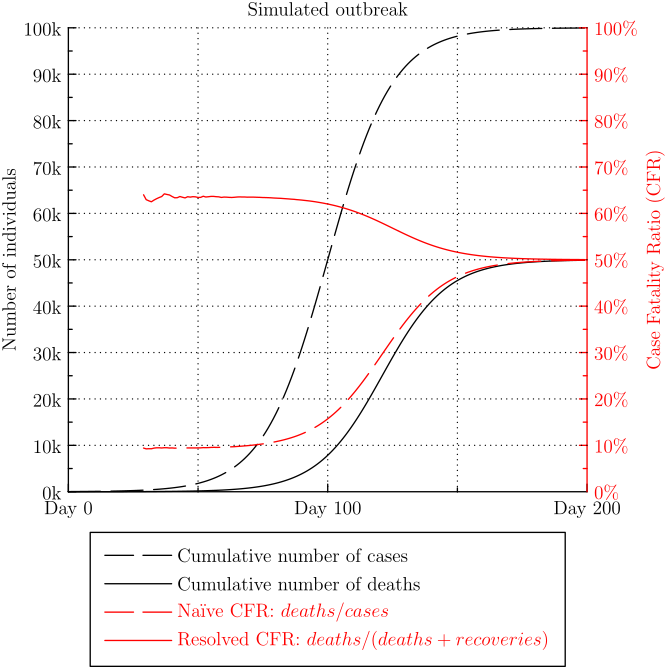
You are exactly correct. With the formulas you described:

naïve CFR = deaths / cases

resolved CFR = deaths / (deaths + recoveries)

It can be shown pretty dramatically in outbreak simulations how more accurate the resolved CFR is than the naïve CFR. See for example the chart https://blog.zorinaq.com/assets/outbreak2.svg In that specific example, the naïve CFR underestimates by 5x, while the resolved CFR is only off by ~1.3x. I ran this simulation as part of my blog post on how to estimate the Case Fatality Ratio of the coronavirus: https://blog.zorinaq.com/case-fatality-ratio-ncov/

The infected might be terribly maimed for the rest of their life as well. Can you imagine if they develop COPD or some similar chronic inflammatory lung disease because of this?
On another page [1] Worldometer correctly explains the better estimate of mortality deaths / (recoveries + deaths) for ongoing outbreaks. Not sure why they got it wrong here.

[1]: https://www.worldometers.info/coronavirus/coronavirus-death-... "Coronavirus Mortality Rate"

The survival rate is also probably thrown off though because some countries have better trained health professionals. No one in the US (that made it to US care) has died as of yet. In other countries without advanced facilities available, the rates are much higher. If the disease hits Africa and more of the ME, the rate will go up. While in the US, and richer countries like Germany, etc the rate will probably be low.
There's some validity to that, but a lot depends on how widespread the disease becomes. There are about 100,000 ICU beds in the US, and they can't all be allocated to coronavirus patients. Not having access to a ventilator would be pretty much equivalent to a death sentence for some patients. There are <100,000 ventilators in the US, and they're not evenly distributed (some areas and hospitals have very few). It wouldn't take much of a pandemic to exhaust our supply of ICU beds and other critical-care resources.
To me this article seems to be missing the most important stat from the original article, which is that the case fatality rate as measured is 2.9% inside Hubei (possibly under-reported) and 0.4% outside.

I think this strongly suggests that, as one would expect, the situation is much worse if patients lack the medical resources for care. And it also shows how important quarantine and preventative measures are.

You have to take into account that 80% of cases are not severe, so you could have it and just think it was the flu. Most people wouldn’t go to the hospital in that case, so that 7.8% figure is not realistic. The WHO numbers (2%) do at least try to take this into account

I’m legitimately confused why we’re seeing these responses make top response on hn. It’s WEIRD

Right. It takes 3+ weeks to die from CoVID-19, so if they're looking at people who were diagnosed as late as Feb. 11th then this is going to be a substantial underestimate of fatality. Especially since as awareness of the disease has increased, the time to diagnosis after first symptoms has fallen from 5 - 6 days to 1 - 2 days.
I have heard this argument that the real mortality rate may be under-reported for this reason since the outbreak began around the start of January and it makes sense to me.

On the other hand, what do you say to the claims that the real mortality rate is much lower due to people infected but with symptoms so mild they don't seek treatment?

How on earth is this the top rated comment? You can't make up your own statistical measure for mortality rates for a novel virus unless you're an epidemiologist. Of course there is under-reporting of mild cases...there's a shortage of test kits!
How would you know the number of infected people? You know the number of infected people with symptoms that were severe enough to get tested.

For the same reason: How would you know the number of people who have recovered? You know the number of people who were observed and then recovered.

Built a simple `PyMC3` model based on your comment: https://github.com/zachwill/covid-19
Dead / (dead+recovered) is overestimating (even assuming 100% detection of mild cases) because it takes longer for people to recover than to die from it.
You assume recovered data is correct? Maybe it takes longer to be counted as recovered than it takes on average to die. This could change the rate
It's difficult/impossible to put a specific probability (which would be an oxymoron) on any one particular person dying. The somewhat vague risk factors take time to accumulate from statically-larger samples if there were more deaths. We know it's a couple of orders of magnitude worse than the seasonal flu but less than the 1918 flu and the plague, hence the extreme quarantine measures to reduce its infectivity to essentially 0. Once quarantine goes into effect, it doesn't matter how infectious is a pathogen because it's dead because of math.
> specific probability (which would be an oxymoron)

Not at all. For example, if I flip a fair coin, I can assign a very specific probability to the event that I get heads.

> We know it's a couple of orders of magnitude worse than the seasonal flu

Maybe one order of magnitude. Seasonal flu is about 0.1-0.2% mortality in the US. The evidence suggests that covid-19 is less than 1% mortality.

> hence the extreme quarantine measures to reduce its infectivity to essentially 0

It doesn't need a high mortality rate to justify extreme quarantine measures. The fear is that it will become a perpetual thing, another seasonal illness like the flu. Even if the mortality rate were the same as the flu it would be worth taking extreme measures to avoid that.