Hacker News new | ask | show | jobs
by a9a 3140 days ago
It will be interesting to see how Lyft's partnership with Waymo evolves given this tech announcement and Waymo's acknowledgment that they plan to offer their own ridesharing service.

Lyft's approach to self-driving partnerships in general seems to rest on the assumption that self-driving providers will catch up to each other before any of them can fully handle everything a human driver can do. If this assumption is correct, Lyft ends up in the great position of being compatible with all major self-driving providers before any of them can feasibly launch a standalone service without Lyft's driver network (who wants to take a car service that doesn't take you downtown? Or doesn't work in the rain?). Ideally, this means Lyft can negotiate favorable terms with all the providers and maintain their position as marketplace brokering between riders and ride providers (either human or robot).

But, if this announcement means Waymo is truly way ahead of the competition, is Lyft aiding and abetting its own demise by covering Waymo's short-term holes (weather, urban areas, etc) up until the day that Waymo can cut Lyft out and run their own service? If Waymo is the only self-driving game in town, and they solve the urban case, why do they need Lyft? I wonder if we'll see any tension develop between the two if leadership at Lyft starts to get concerned about this scenario being a likely outcome.

5 comments

Here is the most probable scenarios I foresee.

If you are a pessimist about autonomous being bigger part of transpiration then add 2 years to DATES shown below.

2021 : Electric Self-driving on-demand FLEET Car 1000 miles/month SUBSCRIPTION from Google, DiDi, Uber, Renault/Nissan,Tesla, VW,Toyota,GM for $400/month

2024 :same 1000 miles/month SUBSCRIPTION $200/month

At $200/month Subscription price for 1000 miles/month (which is average US driver car mileage/month), savings are so big as average car ownership is around $400/month ( AAA Estimate ) , all inclusive of

- Car depreciation

- Insurance cost

- gasoline cost

- Repairs & maintenance costs

- extra 1 hours/day you get in NOT-Driving

(EDIT: This Model I mentioned is Summon only, there is NO OWNERSHIP of the Car, is it monthly pay instead of per RIDE Pay . In this Model, All the Major CAR Manufactures of today offer these FLEETS with monthly pay of 1000/miles month SUBSCRIPTIONS.

Being a) no-driver Cost b) ELECTRIC c) RIDE Sharing d) mass adoption -- is the key for Lower price tag of $200/month )

The above is Phase 1, in Phase 2 starting 2025 Google will be supplying only "end-to-end Autonomous vehicle Software system" for a fee of $5000/year per car for ALL the CAR FLEET companies .

Google will run small FLEET of Autonomous CARs for the purpose of "Reference implementation of Software" much like "Pixel Android Phones" to showcase the Reference implementation of Android ( for all other Android Vendors )

I still think that proper self-driving cars are such a paradigm shift that predictions of how it will work are still up in the air.

For example, right now I live on the west coast and my parents live on the east coast. 4 kids, Minimum of 40 hour drive or $3500 flight.

Here's one tiny example:

I can work remotely for a few weeks and my boss doesn't mind. The kids sleep for 8+ hours at night. Friday, Saturday, Sunday, Monday nights driving for 12 hours (mostly sleeping) means I am at my parent's house on Tuesday and I either take Monday as vacation or work remotely from a friend's house in Ohio. We see friends in flyover country that we rarely visit or see national parks on Saturday and Sunday.

I can now take the whole family to my parents taking just 2 days of vacation/remote for the trip, for only the depreciation cost on my car. Car trip isn't too bad because the kids are awake for a total of the running time of 6 movies.

Car usage will go up by an order of magnitude because a major cost of driving isn't the dollars, but the time.

> Car usage will go up by an order of magnitude because a major cost of driving isn't the dollars, but the time.

This is why I think self driving cars will make traffic worse, not better. The more comfortable it is to be inside a car and the less people mind long car rides, the more people will drive (self driving or otherwise). If road infrastructure is the same, that necessarily means a much higher density of cars on the road. It's possible that self driving cars will be more space efficient on the road, but ten times more efficient? I think it's more likely that there will just be way more cars on the road and traffic will worsen considerably.

To detail one particular addition of traffic to the roads: students - with self-driving cars, students from K-12 may much rather want to have the independence to hop in a car rather than ride a "stinky school bus". Parents may end up loving it, especially those who already drive their kids to school. And I'm sure the school districts would love self-driving cars, because it means they can pass the travel expenses onto the parents to pay for those cars, instead of having to buy tens of millions of dollars worth of buses, pay bus drivers, liability and insurance, gas, etc. (where I grew up a single school bus cost the district over $1m; we had a fleet of maybe 40-50 buses)

In my home-town of 30k people, nearly 2,000 of those are high school students alone, plus probably another 1,000 elementary school kids, and maybe 800 middle school. No doubt they'd all want to use the cool tech to ride to school instead of taking the school bus. Add 4,000 more cars to the road please. (And as for ride-sharing, that may be fun once in a while, but why do that when I can get an entire entertainment pod all to myself?)

The self-driving platform will financially nudge you in the right direction.

Currently Uber charges more during rush hour.

It's rather obvious that self-driving operator will implement similar price discrimination e.g. $10 if you drive alone, $5 if you share with one or more people.

And the more they want you to share, the bigger the surcharge e.g. if $10 vs. $5 doesn't have desired effect then maybe $20 vs $5 will.

It's a win-win during rush hour (operator makes much more money from the few people who don't care about money and minimizes over-all traffic by packing more people into a single car).

Still, traffic will be worse when you compare one bus with 50 people vs. 12 self-driving cars with 4 people each. A bus is 14-15m long, whereas even a small car like the Chevy Bolt is over 4m. So parked bumper-to-bumper the cars produce >3x as much traffic, and then you add some gaps for actually driving you're up to 4x.

Personally I'm very skeptical of both the claim that a) self-driving cars will see huge adoptation at the cost of car ownsership and that b) self-driving cars will give less traffic, less pollution and be significantly cheaper than owning a car.

On the latter point, we have basic economic theory: say the average American today spends $600/month total on owning a car. Why would anyone price a self-driving service at $200/month? No, they'd go for an initial price of $400/month for a couple of years to get customers, then sneak back up to $600/month once they've caught most of the market.

Why would the self-driving car vendor charge $20 if you ride by yourself or $5 if you share with one other person? They'd be getting less revenue for a longer, more time consuming trip due to the need to pick up and drop off the 2nd passenger.

I could see them charging something like $10 for one person and $7 each for 2 (which is close to actual Lyft pricing). That way they give a price break to the user, while they themselves also make more money, so they have an incentive to offer that pricing even if the trip takes longer, or they can't find a 2nd rider.

> where I grew up a single school bus cost the district over $1m

What? Per year or once? If per year I wonder what amounts of corruption must be going on. A simple 31-seater bus from Mercedes costs approx. 285.000€ to buy new (https://www.busplaner.de/omnibusmagazin/omnibustest/10035/Me...), which means over a 5y life it's 57k/y... add the same for insurance premiums and the driver, and still I can't get anywhere close to that figure of 1M/bus per year.

In the US, school buses are typically 70-80 seaters; when I was in high school ~4 years ago, I rode a Blue Bird Vision (https://en.wikipedia.org/wiki/Blue_Bird_Vision). These will get around ten miles to the US gallon of diesel and cost around $110,000 US. The lifespan of these buses is typically around 20 years; each school day, they might be driven a hundred miles or more. $1m over 20 years seems reasonable.
I live near an elementary school and I seldom see school buses on the road in the morning, even if I drive in front of the school. I do see fleets of SUVs. The question is, are these cars dropping off kids because the kids like it or because the parents like it? Is it because of class/status or stranger danger? If it is stranger danger, is the parent going to entrust their kids to multi-passenger Lyfts? Or even to single-passenger Lyfts?

If it is class/status, what is the view of a public conveyence like Lyft vs the personal car?

Our city in it's infinite wisdom doesn't have public school buses except for special needs kids. So everyone drives their kids to school unless they are close enough to walk (most aren't). The school district uses full size buses for the special needs kids. It's insane. I'd gladly pay higher property taxes, or even a flat fee to have school buses.
There is no shortage of Uber, at least, outside any fancy place that serves $16 cocktails at closing time. And they already have nicer cars for those who want to pay more
And if the cars are self-driving, the school doesn't need parking. The kids can be dropped off and the car will drive itself home. Of course that means a doubling the total number of physical trips, but that isn't the school's problem.

I'm waiting for the ability to, rather than pay for parking, have my car circle the block while I eat lunch. The cost of running an electric vehicle for a few hours is far less than paying to park.

The "drop off lane" at my local elementary school is already a 30 minute traffic jam, and that's with parents in the cars hurrying the kids along and school staff directing traffic. You think a robot car is going to get a kid out of a seat with their backpack and lunch faster than a parent? The pick-up line is even worse, as the kids are individually dismissed after the driver has been authorized by the school staff. The current breed of self driving cars would flip out trying to navigate an elementary school parking lot with kids running all over the place and crossing at random spots. The idea of a robot car delivering my kids to school so I don't have to is appealing, however I can't imagine a worse application of the technology, given the reality of the situation.
> self driving cars will make traffic worse, not better.

I definitely see your logic towards higher density with things like 'office cars' so people do more travel. Or sleeping cars but that would be outside typical peak hours. But would self driving increase volume that much? Possibly if people stopped getting trains/busses but this should be remain cheaper and faster via priority lanes most cities have.

Also in general;

Freeways; most traffic jams are caused from someone breaking and then the next person breaks a bit more and so on creating a jam. With self driving car the computers will be able to talk and do a 'everyone accelerate on this mark' and get the flow happening even on very crowded roads. And ideally accident reduction that often creates traffic jams.

Cities: Algorithms will start making little efficiency improvement to driving. All the little things like removing unnecessary lane changing. People double parking to drop something off. And like those futuristic car intersection scenes where cars dont stop at lights but all go through an intersection from every direction reducing traffic back-ups.

We will need to make rules to adapt and keep the flow, e.g. stop people have cars driving around the block rather than parking. Ensure we have 'road neutrality' so the wealthy dont pay a premium for faster trips where other cars in the fleet move aside and slow everyone else type deal.

Anyway, I dont profess to know the answer. Its all a guess! I do suspect the benefits will outweigh additional trips people might take. Besides, who knows, maybe by then we'll have the 'Boring company' or equivalent making private roads so only the plebs use public roads anyway....

> With self driving car the computers will be able to talk and do a 'everyone accelerate on this mark'

This won't even be necessary as the self driving cars will have vastly superior reaction time when compared to humans. Especially if the cars are electric and thus have almost instant power to the wheels.

Especially if you use tricks like radar underneath the car in front of you so you can react to what the car one car ahead of you does etc.

Also a lot of the highway traffic jams are caused by too small distance between the cars. A self driving car should be much more efficient in keeping enough distance between the cars to keep up the flow.

> But would self driving increase volume that much?

Absolutely. Not even accounting for induced demand, you'll see ~30% more vehicle-miles due to empty-vehicle repositioning.

As you say, accelerations and decelerations can be synchronised, accidents reduced, and standing wave behaviours eliminated, all of which will indeed help traffic flow more efficiently. But this is not by any means enough to compensate for empty-vehicle redistribution, much less induced demand.

> And like those futuristic car intersection scenes where cars dont stop at lights but all go through an intersection from every direction reducing traffic back-ups.

That's only possible in environments where there are no pedestrians or cyclists -- eg., segregated motorways/freeways, which already have no intersection conflicts. At best it represents a space saving, not really a time saving.

> This is why I think self driving cars will make traffic worse, not better.

Yeah, of course self driving cars are going to make traffic way worse! Who even thinks otherwise? Suddenly you are going to have millions of disabled and homebound seniors wanting the cars to take them to do grocery shopping and errands, kids being driven around to and from from school and practice, and low income residents sleeping in their cars commuting to work in higher income areas of the country. Self driving cars will make traffic exponentially worse.

another climate apocalypse... 'cos even if all of these cars are electrical, they still need quite a lot of energy to be built and, after a while, destroyed...
One mitigating factor for that is that service cars will have much higher duty cycles (80%+?) than private cars currently do (5%).

What might be interesting is how they deal with peak usages like commute hours. Would swarms of cars try to hop over to the next time zone when it's easy?

I feel the same way but I feel a little guilty for feeling that way. It feels like saying climate change will get way worse if poor people can afford to eat beef (because cowd fart and stuff).
You are absolutely right, and this is not widely understood yet. I expect people to live farther from work and spend more time in cars and in traffic. On the other hand, need for parking will plummet and that should free up a bunch of space in cities, increasing density. I wonder if there is money to be made betting on this in the markets? Which companies will benefit, or lose, from these shifts?
that’s very true. i read somewhere that something crazy like 30% of traffic in city areas are people looking for car parking. don’t have a source on it, but the parking situation definitely shouldn’t be ignored, at least as far as the most built up/problematic areas are concerned
> i read somewhere that something crazy like 30% of traffic in city areas are people looking for car parking.

Without a source, this is just a made-up statistic, i.e., worthless.

Here's a source for you, though [1].

> Sixteen studies of cruising behavior were conducted between 1927 and 2001 in the central business districts of eleven cities on four continents (see Figure 1). ... About thirty percent of the cars in the traffic flow were cruising for parking. The data varied widely around these averages, however; on some uncrowded streets no cars were cruising, while on some congested streets most of the cars were cruising. Cities have changed since these observations were made, and the data are selective because researchers study cruising only where they expect to find it.

[1] "Cruising for parking" by Donald Shoup http://shoup.bol.ucla.edu/CruisingForParkingAccess.pdf

If we have self driving cars the roads in cities will get a lot wider as no side parking in many streets many 2 lane or 1 lane would become 3 or 4 lane streets as well. Would allow for dedicated bus lanes as well so traveling by bus could also become a lot faster.
I agree that traffic will be "worse" in some sense, in that there will be more of it. But maybe not "worse" in the important sense of how annoying it is, since we won't be consciously piloting a machine through it.

Instead we could be sleeping, playing video games, working on laptops, etc.

I think that vehicle design will shift a lot once we start optimizing for these new use-cases, and this might make a big difference to how tolerable road journeys are.

This is all very hard to predict though...

Agree that it's going to be harder to predict, and probably dependent on the individual.

When it comes to commuting in the Pacific Northwest, for most of the year an extra half-hour of available daylight at the end (or start) of the day is the difference between getting out climbing during the work week, or not.

Personally, I'd trade a comfortable commute for that extra time, no question. Of course, maybe a self-driving car could allow for working during the morning commute, and getting off earlier... Hmmm.

> maybe a self-driving car could allow for working during the morning commute, and getting off earlier

That's what I'm hoping for. It's already sort-of possible in the special-case of commuting on a bus like Google/Apple/etc. offer in the Bay Area.

Can we reach the point where working while in transit is as productive as being on site (face-to-face meetings notwithstanding)?

> for working during the morning commute, and getting off earlier

Surely you mean turning your 8 hour shifts into 10 hour shifts?

The economics of self driving cars make any such assumptions sort of up in the air.

Maybe self driving car fleets will be so numerous, they will optimize via carpooling in busy urban pockets. Maybe people will stop driving there own self driving car to work and use these. Maybe people will own/ride in really small self driving car that network to optimize and self park.

> The more comfortable it is to be inside a car and the less people mind long car rides.

This may not be generally correct. People also like to commute quite a bit by rail in certain areas. Living on the east coast I can tell you this because of #of people using NJ Transit and Amtrak is big. Cars take much longer to get to NYC already. Commuting to city via subway trains is so that there is shortage of housing right in manhattan where no one goes by cars.

Traffic might be worse, initially, but once people are okay with sharing seats in a van, you might see a massive rise in ad-hoc ride-sharing/carpooling. These services know where you're getting picked up and where you're going, so there's no reason that can't route close vehicles/riders designating as okay with sharing to have a higher rider ratio per trip. Even with increased total per-person trips, we might be able to achieve a relatively low per-vehicle trip increase.

Couple that with the ability to reclaim a lot of space designated for parking, and forward thinking cities might make themselves much more walkable as well.

  once people are okay with sharing seats in a van
That's going to be a long wait in the US! People would rather pay 10x to sit in their own luxury bubble in traffic and have everyone see how fancy their luxury bubble is vs. /gasp/ sharing it with others. Most people here don't want mass transit, they want their big truck / SUV to haul 1-4 people ("it's safer for my kid").
> People would rather pay 10x to sit in their own luxury bubble in traffic

I think it has a lot less to do with the bubble factor than the fact that public transportation in the US just sucks, period.

My 3-mile commute from Menlo Park to Palo Alto would take

- bus: 58 minutes (2 minute walk from home to bus stop + 12 minutes average wait for ECR bus + 10 minutes on ECR + 12 minutes average wait in Palo Alto Transit Center for bus 22 + 15 minutes on bus 22 + 7 minutes walking to work)

- train: 51 minutes (4 minutes walking from home to station + 30 minutes average wait till next train + 5 minute train ride + 12 minutes walking to work).

- running: 35 minutes end to end

- bike: 15 minutes end to end

- Uber: 13-20 minutes

- driving: 8-12 minutes

I bike, but I can see why others would drive. Public transportation is basically defunct here. I can run faster to work than taking public transportation. That says something about seriously how bad it is.

I think that depends quite a bit on the people in question, and quite a bit on what types of vehicles come to market to support this usage. Compartmentalized vehicles with shutters of some sort might find quite a bit of use. People that don't own a car and want to get around cheaply might find quite a bit of use. Designated child-only vehicles for school shuttling might see quite a bit of use. A small stretch vehicle with lots of doors would be perfect.[1]

1: https://jalopnik.com/5344758/six-door-prius-limo-totes-kids-...

Road Traffic won't worsen as you mentioned, let me explain why ? Increased capacity utilization.

I assume, you are a technical person. If you look back at year 2000, In a typical IT company there is a server Box for each category. A Database server box , a WebServer Box ( physical machines ) etc.. very few people used viruvalization etc.. Physical Machines capacity utilization is around 15% . Come to 2017, with Amazon AWS cloud is providing on demand servers to thousands of companies, all of them TIME Sharing tens of thousands of Servers.

Same thing applies with self-driving cars. Higher utilization by ride sharing leads to FEWER cars on the Road. Today average occupancy in a car may be 1.3 with Self-driving RIDE sharing, if it goes to 2.6 that is HALF the CARS on the ROAD compared to today.

Doubling the average people in car from today is much EASIER, since that BEHAVIOUR of Sharing is tied to FINANCIAL gains to people. If you ride by yourself , 1000 miles/month SUBSCRIPTION cost is $500 vs. If you Share it is $200/month, that motivate people to SHARE and leads to LESS cars.

OP's probably referring to induced demand [0], or something similar to Braess's paradox [1].

But I see your point though. If people are incentivized to share a car then that might reduce the load.

That said, my suspicion is, once you take the driver out of the equation, you can do so much more than just ferrying people. E.g courier/shipping services, or mobile food stalls (food truck that sells food while moving on the highway, once engineers figure out how to safely and autonomously speed match two cars), etc. The induced demand may be greater than the savings from ride-sharing.

[0] https://en.wikipedia.org/wiki/Induced_demand [1] https://en.wikipedia.org/wiki/Braess%27s_paradox

Yes, the financial incentives for sharing the RIDE , coupled with Induced demand make Autonomous cars so cheap like $200/month for 1000 miles/month SUBSCRIPTION, the adoption goes exponential at this point .

I will give you one great example of 'Exponential adoption' happened in recent history of technology.

In the year 1998, at the early days of Internet, we used have only WIRED Broadband Router. Everybody has a 100 Feet CAT 5 cable in the home, when you need to connect a different computer/laptop you change that CAT 5 to that ROOM from Router. 100 Feet CAT 5 wire used to cost $75 those days.

When Wireless ROUTER are released in the next 10 months, at the cost of $100 every body bought, it is no brainer instead of Buying couple of CAT5 100 Feet wires which each cost $75 and still inconvenient .

In my memory this is the most RAPID adoption in a matter of one year , whole USA moved to Bought WIRELESS Routers.

Same thing will happen with , Electric Self-driving on-demand summon CARS where it costs $200/month using it any time vs. owing CAR costs $400/month ( insurance , Gasoline , etc.. )

You're ignoring the time cost (or assuming that other people don't care) -- if the ride takes 20 minutes by myself or 30 minutes by the time the car finds another passenger going my way, and then takes an earlier exit ramp to drop off that passenger, next time I'm not going to select the shared ride option.

That's the only thing that keeps me from using something like Uber Pool today -- I don't want to spend extra time picking up/dropping off another passenger.

> The more comfortable it is to be inside a car and the less people mind long car rides

There are places with comfortable public transport today but it seems most prefer would prefer a 40 minute drive than a 1 hour train ride even though it frees up their time.

> it seems most prefer would prefer a 40 minute drive than a 1 hour train ride even though it frees up their time.

A train ride frees your time up less than an autonomous car ride because on a train you have no personal space. You always have to be aware of people around you and where your own belongings are, watch for your stop, etc. In a car you can focus on whatever you're doing.

I agree, in the short term.

In the long term a critical mass of well-behaving self-driving cars may be able to regulate traffic much more efficiently than humans currently can.

In the medium term we may also see dedicated self-driving car lanes with higher speed limits.

But will it be worse than taking public transportation?

In my experience Public transportation sucks. It's fine for getting around locally, but is terrible for commuting.

For a short 3 month period I found uberpool to be far superior to taking a train. Some days it cost a dollar more. Some days it cost less. The travel time was pretty much equivalent plus it was more comfortable.

I hate driving in rush hour traffic but as a passenger I didn't mind.

You are probably judging public transportation from an American point of view. The vast majority of public transport systems in the US are greatly under-developed compared to what is done elsewhere. A small European city such as Toulouse has orders of magnitude better public transport than Los Angeles or San Francisco for example.
This can be fixed quickly with congestion pricing.
Camper-van, pick-me up at the office (London) on Friday evening, by Saturday morning we in the highlands of Scotland.

It sounds silly - but the more automation the more I want to spend within my fictional camper-van. Soccer away match - no problem. Trip to the beach again, overnight.

It is like an sleeper train - only more comfortable and spacious, as it would be my families camper-van.

>Camper-van, pick-me up at the office (London) on Friday evening, by Saturday morning we in the highlands of Scotland.

I just want to point out that there is a pretty decent sleeper train that departs from the center of London and will have you wave up in the center of Glasgow. You'll have a full-size bed with sink, toilet etc. and a dining car and a bar if you want to avail yourself. Tickets are pretty cheap too.

There are also sleeper trains to the highlands.

They leave a little earlier, at 21:15, and stop at the stations in the Highlands between 7 and 10 the next day.

If you wake up with the early sun, like I did, then the views from the train are wonderful.

https://traintimes.org.uk/London/FTW/21:00/today

https://www.seat61.com/CaledonianSleepers.htm

I get the impression that people who make this sort of comment have never ridden a night bus with beds.

It is in no way comparable to a sleeper train, which rides on relatively smooth, straight rails and isn't constantly swerving about and dumping everybody on to the ground. You need to "sleep" in this tensed up position where you're wedged in between ends of the bed using your core to keep you in place.

On the sleeper buses in China, you'll often see people standing in the aisle, getting a rest from "sleeping" while building strength for another bout of it.

So yeah, you'll get to Scotland the next morning. But next time you'll take the train and rent your van at the station.

> Friday, Saturday, Sunday, Monday nights driving for 12 hours (mostly sleeping)

It's really sad that the United States has let passenger rail deteriorate to the point that people are forced into this situation. Really, really poor foresight.

Passenger rail in the United States probably doesn’t have the same economics as the other places you’re thinking of. I recently drove across part of the country, and it is shocking how much space there is with absolutely nothing there. There is a 100 mile stretch of I-80 without cell service or signs of habitation. If you live in a city, it’s easy to forget that the United States is much, much, bigger than Europe or Japan.
> There is a 100 mile stretch of I-80...

Logistically speaking, empty places are really, really easy to build rail through. (Politically they may not be).

These rail networks already exist, but they are often not dual line, aren't engineered to support fast trains, and there aren't passenger rail options that utilize them. All of these factors are due to consistent under investment because of chick-and-egg and political problems. It's a real failure of national investment.

You can Google around but the cost per mile of new railroad track is comparable, if not a bit less, than interstate highway. And there are _tons_ of miles of interstate highways.

The US has just chosen poorly.

You can have way more passagers on a highway than on railroads though. Capacity wise cars are the better choice because its a continuous flow. Plus, they get you where you need to be, not just where the track stops.
> If you live in a city, it’s easy to forget that the United States is much, much, bigger than Europe or Japan.

I assume you mean “less densely populated” (bigger, per capita) rather than actually bigger; it's actually smaller, not bigger, than Europe.

True, the continent of Europe (10.2 million km^2) is larger than the United States (9.8 million km^2), but the context suggests wskinner meant a comparable geopolitical entity such as the EU.

The US covers roughly twice as much area as the EU (4.5 million km^2), which includes most of the countries we're talking about. If we want to add the rest of continental Europe (mainly western Russia), we might also add the rest of continental North America (mainly Canada).

> Passenger rail in the United States probably doesn’t have the same economics as the other places you’re thinking of. I recently drove across part of the country, and it is shocking how much space there is with absolutely nothing there. There is a 100 mile stretch of I-80 without cell service or signs of habitation. If you live in a city, it’s easy to forget that the United States is much, much, bigger than Europe or Japan.

Visit China sometime. Lots of space, lots of high speed rail. The high speed rail is incredibly nice to use, puts airplanes to shame.

What we need is more large metro areas to take trains between. Over here on the west coast, our largest cities are not even what China would consider a tier 2 city.

(To be fair, by Chinese standards, NYC is the only reasonably sized city America has!)

That stretch is I-70 between Moab, UT and I-15 about 150 miles south of Salt Lake City. It's an absolutely breathtaking segment of road. I truly recommend visiting it.
The one I was thinking of is actually I-80 north of Utah to outside of Sparks, Nevada. But yes, the section of I-70 you’re thinking of is quite nice.
What? Europe is actually bigger than US. US is less than 10M Km^2, Europe is more than 10M Km^2
More important difference is that a lot of the empty space in Europe is at its northern and eastern extremes and America's empty space is mostly in the middle (and Alaska).
https://futuretravel.today/what-it-s-actually-like-to-travel...

It takes longer than driving, and a sleeper car is more expensive than flying. The cost is similar to driving for a family of 4, once you account for depreciation on your car.

In Europe, it would be very rare for someone to drive for that long. They would take a train or plane.

Anyway, indeed self-driving cars can be disruptive for long-distance travel, also in Europe.

Suppose you are traveling between two small towns that are hundreds or thousands of km apart. I think the most reasonable model would be self-driving car from town A to nearest high-speed rail station, high-speed rail to station close to town B, and then self-driving car to town B.

Rail companies could sell the ticket for the whole thing, and owning a car for long-distance travel would make no sense.

Your kids must be saints. If I had been cooped up with my parents and sibling as a child for 40 hours even in a large van or RV with robo-Uber at the helm, someone would probably have been murdered at some point :-) As for my adult self, lie-flat seating on planes trans-Pacific is OK but it's still pretty boring. Even if I could work at some level in my comfy cross-country van I'd still take a significantly faster option given the choice.
I think you perhaps misread the post. It suggests that there is only 12 hours driving per day but the kids would be asleep for at least 8 of those. The idea being drive overnight and stop at the next waypoint (see friends in flyover country/national park etc) during the day. I guess the plan being to do interesting stuff when awake and travel when asleep, for the most part.

I suppose as long as you get in the hours you need to as a remote worker and the sleeping is comfortable then this would be pretty sweet for even very long journeys.

It would take a complete redesign of car interiors to something far more comfortable/secure for lying down but no reason that problem couldn't be solved.

Tesla camping is already a thing [0].

Also perhaps more people would start buying VW camper vans. VW are planning an electric version [1].

[0]: https://www.bloomberg.com/features/2016-tesla-camper-mode/

[1]: http://www.bbc.com/news/business-40998128

>It would take a complete redesign of car interiors to something far more comfortable/secure for lying down but no reason that problem couldn't be solved.

Well, it's solved. They're called RVs. As a kid (or even as an adult), I think I'd still find it being pretty cooped up. It's one reason that I've never taken long-haul Amtrak that I suspect I'd find is more interesting in the theory than in the practice.

I've never been in an American RV, which I know are huge, but still narrower than a train. The ride on a train is usually much smoother than the best road, and of course you can walk around, use the dining car etc while the train is moving.

There are some pictures of various Amtrack train interiors at [1], aimed at tourists. That toilet next to the seat is weird, I think I'd prefer a shared toilet at the end of the corridor. But overall, the US has very spacious long-distance trains.

(I have taken one long-distance Amtrack train, for about 11 hours. The standard seat was as big as a first-class seat in most of Europe.)

[1] https://www.seat61.com/UnitedStates.htm

But you can stop and get out, see new things. Journeys are adventures. I let my kids stop us and we all get out and go see whatever.
Sure. A roadtrip--though that's still a long roadtrip. But if you're robo-pedal-to-the-metal across the country instead of flying you're not doing a lot of adventuring along the way.
A $30,000 car that lasts for 200,000 miles costs you $0.15/mile or $450 one way for 3000 miles (I ignored age-based depreciation, but also didn't account for other costs like maintenance and insurance). At 30 mpg (because a car that a family of 6 can feel comfortable riding/sleeping in for 40 hours is not going to be a compact car), that's around $250 for gas.

So you're at $700, or $1400 both ways.

With advanced purchase, you can get flights from SFO to NYC for $250, so that's $1500 for your family of 6.

I find it hard to get good sleep in a car, I can't imagine having a good experience trying to sleep 4 nights in a row. Nor can I imagine spending 40+ hours in the car over 4 days with the kids, even if they are sleeping a lot of that time.

Using similar calculations, we figured it at about $2k for our roadtrip last summer, so sounds right.

However, flying:

$550 after taxes and fees is the cheapest I've gotten an LAX/IAD roundtrip for in a while, so $3300 minimum for flying.

Parking for 3 weeks is about $200

$3500 is the flying price, and often I can't get tickets for under $600 that match our schedule.

Depending on the 405, it can take 3 hours to reach LAX and park. You really don't want to have to be running through the airport with little ones, so plan to be there 90 minutes before flight. It usually only 4 hours in the air going west-to-east (east-to-west is longer) but figure time sitting at the gate an taxiing means a minimum of 5 hours on the airplane. So nearly 10 hours of travel time.

Issues with flying that were non-issue in car:

We cannot change our schedule even by a few hours without incurring fees with the airline.

LAX/IAD, plus price sensitivity means almost certainly flying United. I'm not paying the economy plus price times six, so my knees are touching the seat in front of me the entire time.

We had a 20 month old, already nervous from flying for the first time fall asleep on the taxi-way with her seatbelt on, resting her head on my wife's lap. The flight attendent insisted she must be sitting up for takeoff. Said child was screaming for the next 90 minutes from being woken up.

kid potty training? Not while flying, since the fasten seatbelt sign always goes on at the most inopportune times.

It's true that none of these were enough to get us to stop flying (having a kid with PTSD was what did that; you don't want to be locked in a box with 200 strangers when he gets triggered), but it was surprising how much less stressful it was even compared to flying before we had him.

Perhaps cross-country will still be niche, but certainly day-long road trips will jump in popularity when nobody has to do the driving.

You also need to calculate the cost for a rental car at your destination when flying. So add roughly $100/day to your total stay. When driving, you save that right away.
This whole discussion is about how self-driving cars will make car ownership unnecessary -- you don't need a rental car at your destination, you just call a cheap self-driving car to drive you around just like you do at home.
The parent was comparing flying to driving cross country.
While I agree that it's impossible to make predictions, your example is a massive edge case.
I don't think it's an edge case: If an operator redesigns the interior of their fleet with large, comfortable reclining seats, long distance travel by road will become much more competitive with business-/first-class air travel. Boarding at my house and being dropped off at my destination and sleeping all the way (or working if you're a telecommuter, or watching movies) is quite appealing to me - the lack of TSA and/or Rapey-scan is a bonus

edit: changed a few words for clarity

I've been on long distance buses with large, comfortable reclining seats and convenient pickup/dropoff points for 8 hour plus journeys more than most sane people

I assure you it's not the human driver which means that most people strongly prefer other methods of transport.

I feel like a car has greater potential for comfort than even a "comfortable" reclining bus seat.

For example, right now the idea of a folding bed in a car isn't something you'll ever see as an option, since it would only really appeal to people trying to live in their cars, which probably don't overlap much with the "people who buy fancy cars with fancy extras" market segment. However, in a future where a car can auto-drive you on a long-distance trip, why not offer an actual bed mode in the car as a purchasable option?

A closer analogy (rather than a bus) would be human-driven limousine: not bunched up with strangers, door-to-door service (not just "convenient" location). Even that considered, I am yet to encounter a limousine designed for long-distance travel (but that might just be because I'm not rich). Also, the human driver and the associated control interfaces takes up interior space which would have been put to other uses.

It's not about the driver for me - I would hire such human-driven limousine today (for a reasonable cost). I think the costs of finding the driver a place to stay and planning their trips in order for the driver to get home frequently makes such a service impossible today. This problem would go away if the car was self-driven - the service becomes scalable.

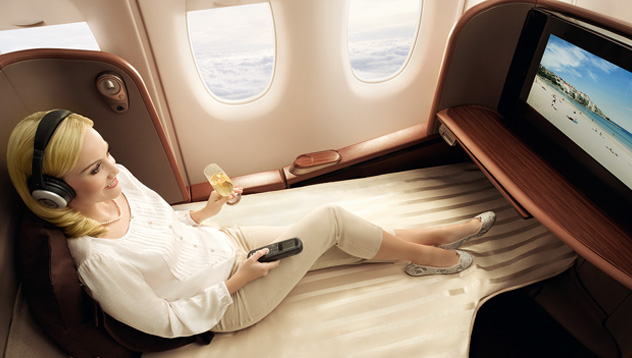
I don't think the comparison is as apt as, for instance, a 1st class intercontinental seat on Singapore airlines.

https://www.singaporeair.com/saar5/images/navigation/flying-...

The line from travel via auto mated car to TSA style security invasion is actually pretty short.

It just takes one person to decide to go carmageddon and now every car will have weight restrictions, luggage restrictions, then there will be ~~economy cars~~ pods and more.

The moment you start paying for a seat, and the car is owned by someone else, the owners are going to see exactly how LITTLE they can keep in the car, and still get someone to use it.

Unlike flying which benefited from budget airlines, car transport is not likely to benefit more people by going this route.

All this thread is filled with people talking about some sort of benevolent firm wanting to take care of its customers.

The moment the market place hits it's growth plateau, people will be cutting corners to reduce weight, and improve fuel efficiency.

As for rapey scans - they will just expect people to get to a hub, and from that hub pick up their cars.

The hub will have the rapey scans.

The point of the TSA is to make the public feel that something is being "done", post 9/11.

Its a product of fear, not of security requirements.

So you can take it as a bet, that if any of the scenarios come true here - you will eventually return back to TSA levels of security theater.

Do you drive?

Because motion sickness prevents a large amount of people from watching movies or doing work in a car, even if you could make a decent enough workspace. The start and stop mode of car traffic is much different from an airplane or even train, and the road surface varies so much by area that potholes would make sleeping, working, or what have you a nightmare.

A lot of this discussion seems dominated by people who don't use a car or understand driving.

Am I the only one who gets car sick when reading or using a computer in a car? Everyone keeps talking about working while on a long commute in a self-driving vehicle. Doing more than 30 minutes of it is not really an option for me.
No. Me too. Can’t even read in a plane, or watch a video. Won’t even think about getting on a boat.
Nope, not alone. Might be something with sudden acceleration changes - doesn't happen to me on a train, and only rarely on a bus.
Yeh things will change... you sorta already see stuff like this in Asia where drivers are common... people have vans with offices in the back and work while their driver takes them to places.
How common is that? I've never seen it.
I've never seen that.
Would be interesting to see some photos of such vans.
People didn’t just use computers to speed up existing processes. They also started doing brand new things that were infeasible without computers.
i never thought about this: you can just fill a car with a bunch of stuff and send it somewhere. makes mailing heavy stuff potentially dumb in some cases, depending on how things price out. also, maybe moving cross country gets easier for the same reason.
>> "Car usage will go up by an order of magnitude because a major cost of driving isn't the dollars, but the time."

This is the Jevons paradox applied to time cost. Definitely true.

The logical conclusion of this may be the self-driving RV as "tiny home". Especially given how expensive property prices are. Laws currently prevent you in some areas from "living in your car", but if you're exempt from that so long as the car is moving? Well then.
Ha... If we can take that idea into a further extreme, we'll end up with Snow Piercer.
> for only the depreciation cost on my car

Ignoring fuel!

Thats a cost that occurs no matter the system (you drive, you own a self driving car, dystopian wasteland of ordering cars).
By then SpaceX will fly you there in 30 mins plus the trip to the spaceport.
"If you are a pessimist about autonomous being bigger part of transpiration then add 2 years to DATES shown below."

I think you drastically underestimate the possible values of pessimism. In my opinion, truly autonomous vehicles driving in arbitrary, real world, public roads in my lifetime sounds optimistic ...

Yeah, having done robotics in the past, I'm super skeptical of promises of level 5 autonomy in the real world, even in the medium term.

I mean, we were able to do level 5 trucks in the desert two decades ago! But the human world is much less benign, and the perception problem is hard. And the history of AI is littered with limited solutions that failed to scale.

So I'm more curious about the purported GM testing of level 4 in Manhattan, it's a much more realistic and far less forgiving driving environment.

I think it might be possible that the subscription fleets that already exist in many cities can be used to "summon" (like teslas can be summoned) a few blocks ro a few miles, autonomously, because they know the area.

That makes these subscriptions much more convenient than having to pick up/drop off a share car in a fixed spot.

The user uses the car for a while in semi-autonomous mode (car can drive 90, 95 or 99% with user supervision) and then the user can return it by letting it drive back. If the car is stuck it just stops and a driver from the fleet company comes along to drive it.

I think a scenario like that could be viable in small scale for some metropolitan areas (good climate, limited user base etc) within 5 years.

I intend to be an early adopter of these subscriptions, but there's a key item they don't overcome: kids. When you have kids you don't just have to bring them everywhere, you have to bring lots of equipment everywhere. Baseball, hockey, football, etc. has lots of equipment that people are accustomed to leaving in the back of their vehicles. Same goes with strollers and diaper bag for babies. I don't know how we'll overcome that, most families will presumably still need to own at least one car. However, many two-car families should be able to downgrade (upgrade?) to one car and a subscription.
Your comment was interesting. However, I found the use of all caps very distracting. From the guidelines:

“Please don't use uppercase for emphasis. If you want to emphasize a word or phrase, put asterisks around it and it will get italicized.”

Just my two cents.

Even with italics, 2-3 emphasized words per sentence is way too much to take seriously
I'd bet my left nut that by 2021 there won't be a self-driving car subscription service. I'd be surprised if your average consumer could buy them by then.
If a significant percentage of the population shift to a subscription service where they summon cars on-demand, the benefits to smoothing out everyone's commute schedule will grow dramatically. Ride-sharing will help, but assuming population keeps out-pacing growth of infrastructure in already-congested area, removing individual car ownership and switching to a shared pool will increase avoidance of peak hours. I really see a future in which having most people work 8-5 will become incredibly inefficient, and more work will be done on flexible / rotating schedules (or more remotely).

Which means the little benefit of daylight savings that is there will disappear, which would be awesome. Long-live the driverless car subscription model.

Why would you want to own a self-driving car? You'll just summon it from the nearest parking lot when needed.
My car doubles as a "everything I need when I take the kid out" storage. We always have:

- diapers

- changing pad

- strollers

- extra clothes

- kids movies for the tv in the van, queued up to where we left off

Sure, people in places like NYC just carry all that stuff with them when they take the kid out, but they also take the kid out less often or move to the burbs because it's a huge pain in the butt.

I'd much rather own the car simply so that I can keep all my stuff in it that I need when I go out.

When I lived in the Metro DC area (Bailey's Crossroads in NoVA) with a 1-2 year old we kept that stuff in the bottom of our stroller (mostly in a single medium-sized bag). We took the stroller everywhere via buses and trains. We very rarely drove our vehicle while living in DC since a couple grocery stores, several restaurants, and several department stores were within easy walking distance (about a mile) from our house. With the stroller, we used carabiners to hold bags on the walk back. For longer excursions (all day to a museum or zoo), I'd bring a backpack with misc stuff in addition to what was in the stroller. Our stroller had a detachable car seat integrated (the car seat set locked into the stroller when using it as a stroller), which allowed us to use taxis if needed.
Yes, we've done all that too when traveling. But it's a lot easier to just hop in the car and go, knowing that all that stuff is already there.
It's only easier if you know you'll have parking at your destination. If you live in a city with convenient transit service, you don't need to worry about parking.

And if you want to take a long stroll down the waterfront, you don't need to return to your car to go home, you just hop on a different train.

... and someone else mentioned the car seat, too. Always fun!

However: unless you are planning a very large family, this is a transitory phase. I noted as my kids matured the amount of crap you have to lug around drops precipitously. I can't see that many people needing to carry the stuff on the bulky end of this for years and years. I carried my kids sequentially in a back-pack (3 years separation, so #1 was walking everywhere when #2 came along) and managed to fit all the above (aside from movies) into the back pocket of the kid backpack (strongly recommended for the transition to walking, incidentally, as a backpack is almost zero hassle when empty, while a stroller is just as hard to push empty as full).

But back on topic: you could lease a car/van for the Peak Kid bit of your life and still save money.

Yeah I know it goes down over time and then won't be an issue anymore. We did in fact get a van that I plan to keep for Peak Kid.

I fully expect to be using at least one driverless vehicle before they leave to college. I'm just not sure if it will be exclusively a rented driverless car or something else.

Wait until your kids get involved in sports and you have to haul around a trunk full of equipment.
For non-personally-owned self-driving cars to catch on, you'd probably have to see an expansion of convenient storage lockers near parking lots.
don't forget the bulky and heavy car seat(s)
For subscription cars to be even remotely usable by anyone with small children, you have to summon a car with the correct configuration of car seats.

Having to install one just won't fly. if you can't get one with the right car seats, it's a no go for a daily use family car. On the other hand it might easily work as a second car in such families. I'll probably need to own/lease my own car for the foreseeable future, but I'd be very happy to not have to own two like I do now. And my requirements for a second car are much simpler.

Right!! I totally forgot that part because it's just always there. But yes that's actually the worst part.
Easy, have a self driving cart to follow you wherever you go!
pfft, made up problems. You will submit to not owning anything. You don't need a house either, just go to an AirBnB every night.

Everything must be a service. Ideally provided by google.

Next thing your going to say is that waiting for 15 minutes in the rain with a crying baby while you get gouged for triple price because of nearby concert is a problem for you. Just suck it up and accept that car ownership is a outdated idea and you need to bow to the will of the tech hipsters and conglomerates.

An entire AirBnB? You're just an opinion-having meatball, there to get adverts screamed into your face 24/7 while you have opinions and allocate your UBI.

https://pbs.twimg.com/media/BzOVUGrIIAAH8c9.jpg:large

There won't be everything as a service, because you won't have anything. There's no need for you to do anything in this fiat-advertising-bubble-money future world. Expect maybe a stream of soylent and a ventilated cage, unless you have pro-tier skills in extracting money from Stanford Prison Experiment 'customers'.

we (people with families), will just create our own zones outside of cities with identical tacky housing that will make childless hipsters go blind. there will be no avocado toast, and the only music will be alternative rock from the mid 1990s
Hey I have a family and you better not even try taking away my avo toast buddy!
I agree, say now you may have two CARS each costing $400/month ( AAA estimate ) Total cost of ownership ( Insurance, gasoline, Repairs, depreciation ).

Now when some thing is available for $200/month , you won ONE CAR like OLD way ( for Kids etc.. ), and your spouse may use FLEET CAR .

Sure, I can totally see us ditching the second car for a self driving subscription. We barely use the second car as is, but we use it just enough that it's still cheaper than Lyft/Uber. Unless the self driving rental were even cheaper, it wouldn't make sense.
I store tons of stuff in my car so I can have it available at all of the various places I end up, and while I would happily believe I am not in the majority, this does not seem to be something that would be rare. While I don't feel the need to "own" a car (I literally rent a car continually, paying in 30-day cycles), it would be extremely annoying to not have consistent control over most of the storage space in a car (I often even have stuff in the back seat I am dragging around with me forever). And no: while I do love driving, I feel no need to drive, and would welcome a future where the car drove for me... but it will be a much more awkward arrangement to get me to be OK just summoning random cars temporarily.
It would be pretty easy for a fleet service to also provide a bin that you can persistently store your stuff in. When you summon a car, the system puts your bin in before it goes to get you.
I envisage systems of standardised storage lockers, you can pull the whole locker into your car, 4 fit in the car for 4 users, you can wheel them into work, or lock into cabinets around the place, when there's no car parks they'll be lots of free space, 1% can be for storage lockers.
Why would there be no car parks?

People tend to travel at similar times. Your total number of cars required is still going to be high.

I agree, there are good % of people like you for all right reasons to have a their OWN CAR "same CAR" every day.

There will be different flavors of pricing for needs like yours, like 'Keeping CAR With you'. How about this pricing

Option 1: The CAR will be in serving people 10 streets around your Home, will be available whenever you want but costs you $300 /month ( It will have two Locker boxes in the Truck to keep your Items ALL the time, and your LOCKER BOX opens only with your Smart Phone ).

Option 2: you lease Autonomous car, it is all yours to keep, but the price is like $500/month Lease .

Lockers in the trunk reduce the ability to go grocery shopping :/
There is no Ownership, it is Summon only

When I said, $200/month for 1000 miles/month is one time pay, there is NO per ride PAY. It is like you pay your Cell Phone Bill.

Use those 1000 miles in that month whenever you want .

But do you get rollover miles?
It is Summon only, no ownership.

when I said $200/month SUBSCRIPTION for 1000 miles, no Per RIDE pay

WHY must YOU keep CAPITALIZING RANDOM WORDS?
Sorry, I will avoid that in future ..
I recommend surrounding words with asterisks to get a less screamy emphasis.
With the following caveat, I'll bite: "Not available in adverse weather conditions or outside service zones". Said service zones wouldn't include anyplace where increased crime is a concern.

The cars would also probably have to be inspected and possibly cleaned between each use...

I'm also uncertain the tech is advancing quickly enough to justify a 5 year timeline. Not to mention ensuring society and the government is onboard with this. It would suck to be stuck in an automated car by a picket line of displaced drivers.

Why do you think crime is a big deal?

If you just want to steal a car, cities are littered with them. If you want to rob people, humans are also not hard to find. And an autonomous vehicle will have excellent video recording, fast notification of police, and hard-to-disable vehicle tracking.

Weather, though, is a giant issue. Chandler, AZ has 90% dry days and rarely gets more than an inch of rain per month [1], so I think it's no coincidence they've started there. As a Michigander, I grew up driving in all sorts of shitty weather, so it's astonishing to watch San Francisco drivers fall apart in heavy rain. I expect auto-automobiles to be no better.

[1] https://www.usclimatedata.com/climate/arizona/united-states/...

Automated cars will be better than most of us in these conditions. If you live somewhere that only snows a few days each year, you can't drive in it very well. You don't even have the right tires.

Fleets will change their tires for the conditions and the automated system will be just as good at driving in adverse conditions as it would be if it drove in them all year. The sensors will see things human eyes can't.

I don't know how long it will take to happen, but it's inevitable.

Sure, eventually it will be better. But I wouldn't be shocked if bad-weather automatic driving lagged at least a decade behind what they can get away with in Arizona. It's a significantly harder problem, and much more difficult to generate reams of data to test against.

Worse, the risk shoots way up, and people will be much less tolerant of risks that aren't under their control. "Driver Ends Up In Ditch" is never news in places with real winter. But "Google Almost Killed My Family" sure will be.

Places that only get a few days of snow are typically paralyzed by that snow (schools close etc), so the autonomous cars being paralyzed aren't really a problem in those areas.

But for a lot of northern and central europe, northern US, canada etc where people are used to changing tyres and driving for several months in snow, the autonomous cars will have a harder time.

On one hand like you say, they can see things we can't. But on the other hand, there are zero lane markers, and sensors are typically covered in snow.

For example: I have parking sensors and a rear camera on my car and those are completely covered a lot of the time in winter. I still use my car and just ignore that the parking sensors scream constantly and the rear camera shows the inside of a wad of snow. That situation would be worse for an autonomous car because those sensors aren't just nice-to-have, they are fundamental to to the operation of the car.

Vandalism.

Rocks thrown, sensors spray-painted over, side panels (and sensors) graffitied, interiors damaged, forced into stopping and their chassis stripped (or their occupants held up).

And while the police may be quickly notified, they will not be so quick to respond. Ask someone in a big city about the police's response time to their car being vandalized or stolen... Not to mention, all those fancy cameras? Ask a small business owner with CCTV how useful it is to catch robbers.

> Said service zones wouldn't include anyplace where increased crime is a concern.

What? Is someone going to try to steal a car without a steering wheel?

How about forcing the car to stop and rob the occupants? Or stripping the car of all those expensive electronic components?
The electronics would be locked down. You can't even steal a phone these days and use it without the owner's password.
Inspections can be automated with computer vision and gas sensors
Or just cameras and some "is this car clean?" UI.
I think Google providing/licensing the software and tech to other manufacturers is risky and leaves open the possibility for a new provider to slide in and undercut with each car provider. Google should leverage their early position and corner the market where they'll be a sole player and dominate for the longterm.
Let us explore the case of competitor offering software by under cutting Google with low price .

Let us take the established known history of 'Evolution of Android on smart phones'. By 2010 as Android share is growing world wide, everybody know there is big money to be made in FUTURE ( By Ads and other means ) by supplying Mobile OS even at free of cost at THAT time.

But nobody is able to do it, even microsoft with it Billions even after after offering Mobile OS Free to vendors .

Now with self-driving Car software, google with DeepMind, Self-driving Teams hundreds of Deep Learning engineering working and developed advanced Neural nets have at least the edge of few years over competation.

Again in 2025, google will choose to limit as "software system supplier" from the "position of strength" that is

1) Let the FLEET companies compete for LOW MARGIN monthly SUBSCRIPTION FEES and provide high value software

2) By limiting as software players, it treats all FLEETS as equals avoiding the "formation of Consortium of" FLEET & Car Manufactures".

Beyond 2025, both FLEET and Car manufacture will be SAME ONE Entity, With out running FLEET, you can not Survive as CAR Manufacturer as there are FEW "end User Buyers" left as majority start moving to "on-demand Summon Monthly Subscription" pay model .

2017 US new Car& Truck Sales are at 17 Million Vehicles , by 2022 it will reduce to 14 Million, then by 2025 10 Millions, then the decline Accelerates .

Even number of different CAR Models are around 500 worldwide, by 2025+ they should reduce to 100 models and Lots of mergers and shutdown of CAR companies

With Android, Google was able to maintain its influence by the use of the Play store and other external services tied directly to default and popular apps (i'm aware there are hacks to get around certain restrictions within the AOSP).

Those same concepts won't necessarily be applicable to self-driving car tech.. unless Google is able to establish auxiliary services required to support the self-driving network (public monitoring stations, deep mapping, etc) that can further solidify their position while continuing to distribute just the software. This would further raise the bar for competitors to enter the market.

I’ll bet you money there’s no legal self- driving car subscription like that in DC by 2023
I'm not willing to bet on specific prices or business models but I will bet you $100 that a traveler will be able to take a self driving car from Reagan Airport to The Hay-Adams Hotel on or before Dec 31, 2023.
I love my cars. That being said it took 1.5 hours to drive the 30 miles to work today with traffic down the 17/85/101. I would sign up for this in a second and sell one of the cars.
IMO it's solving the wrong problem. Did what you do at work require you to be there, or could you just as well have done your work from home / a close co-working facility?
You missed demand pricing
What I mentioned is general pricing..

As you said, there will be all kinds of Demand pricing.. one example You will have 1000/miles per month general rate. If you use peak hours 8 AM to 9 AM , then it is counted as 2X miles of real distance etc..

Think it's unlikely that Waymo will build out and operate a full fledged ride service - there's a lot of other factors to work out like scheduling, routing, supply-demand management, optimal vehicle distribution, pooling etc that they could just delegate to Lyft for.

They might just build a service to the extent of push a button and a vehicle will come, and take you where you tap. That's enough to work inside a controlled town environment. As times goes by there'll likely be a merger with an actual ride sharing company.

The thing is these rideshare companies: Lyft, Uber, Ola, Grab and Didi Mechagodzilla Chuxing, these companies all exploded out of nothing, they're all so young.

The software they run on is complex, but not so complex that it can't be replicated.

So if you're a company with the secret sauce, that being a validated autonomous OS, you would most definitely want to run the consumer facing end of the business yourself, because that's where the real profit margins are hiding. Back-end software, fleet maintenance, and harware: this stuff is all eventually going to become commoditized. Customer experience will be the differentiator.

A thing to keep in mind is that a fleet of sensor riddled robotaxis will gather far more granular data about the world than just a standard human driven taxi, so the potential is there to take fleet management logistics to another level that no conventional rideshare can hope to compete with.

Really, if you let your imagination run wild with what can be done with that kind of data about the world, well, oh my gosh. You're building a live action parallel universe made out of networked lidars and running annotated data through pattern recognizers.

The privacy implications would make the hairs on your back stand-up if conceptualizing the astronomical amount of data that's going to kicked around hasn't already made you dizzy. It varies from company to company, but a typical test vehicle gobbles up something in the neighbourhood of 4 terabytes a day. In the future that number will go up. Thousands and thousands of Robotaxis.

The evidence for the real profit margins being in the customer facing bit isn't strongly supported by the current market being so competitive that the companies run at VC-subsidised operating losses in most markets whilst fighting endless legal battles. If the secret sauce that changes all that is the self driving tech, the profit remains all in that. Ride locating software is relatively straightforward for a company with Alphabet's resources to develop, the business side less so, especially when its core businesses are notoriously poor at customer service and making far too much money from an existing search near-monopoly to want to risk attracting complaints about anti-competitive behaviour in new markets. And they could still can collect all that juicy data if other entities paid them enormous licence fees to run the consumer facing bit of an autonomous vehicle operation, maintain the vehicles, obtain permits in 1001 jurisdictions and design cars and ownership models to consumer preferences

Unique, regulated and highly complex software and hardware components seems far less likely to become commoditized than ridesharing apps that essentially already are, and of course viable markets for the driving tech exists even if the driver can't be dispensed with altogether.

If they're serious they'll just buy Lyft. That's probably Lyft's strategy. Get Instagramed/WhatsApped.
I agree those other factors are complex and challenging to develop, particularly for Waymo which has the additional challenge of delivering self-driving tech that works.

But Lyft (and Uber for that matter...) doesn't really have those capabilities today anyway, at least to the extent they will be needed for autonomous fleets. They have blunt tools for supply and demand management, but drivers take on much of the risk in terms of positioning, routing, and deciding whether or not to get on the road in the first place. If Waymo owns their fleet, will they let Lyft have complete control over their assets without some balance or at the very least data to make sure the vehicles are being used efficiently? And if Waymo learns enough about scheduling, routing, etc. to make sure Lyft is using the vehicles efficiently, how much harder is it for Waymo to just run the vehicles efficiently themselves and capture the value of owning a direct relationship with the end rider?

> there's a lot of other factors to work out like scheduling, routing, supply-demand management, optimal vehicle distribution, pooling etc

These things come along the way. If there is a service that's 10x cheaper than Lyft, I could imagine most people would churn to that service. The technology shift from human to completely autonomous driving is so huge that it could just disrupt the current market structure.

>If there is a service that's 10x cheaper

Why would a ride service based on autonomous cars be 10x cheaper? It's not like 90% of the current revenue or costs are human labor. I'm not sure the exact ratio of driver labor vs. gas/maintenance/depreciation, but I'm pretty sure it's less than 10:1.

I haven't personally done the math but my understanding is that the current (possibly subsidized) rate for Lyft/Uber is in the $1.00 to $1.50 per mile range. The IRS rate for car usage is about $0.53/mile.

Presumably the cost for a heavily utilized vehicle is going to be lower per mile. OTOH, any commercial fleet service is going to have costs on top of the base mileage cost. (The $0.53 figure also ignores any distance the vehicle might have to travel to pick you up.)

So it's probably reasonable as a back-of-the-envelope swag to assume that, if a fully autonomous vehicle were available today, you could probably undercut a "ridesharing" service by about 50%. It's definitely not suddenly going to be almost too cheap to meter just because you take the driver out of the equation.

I think it could eventually be much cheaper but I don't know about 10:1.

If autonomous cars don't crash, the insurance will be super cheap. If they are electric, then maintenance and operating costs should be very inexpensive.

When cars don't crash, they don't need to be designed to crash, so you can start building the cars out of lighter materials. When the car is far lighter, then the drivetrain can be simpler and energy consumption should be less.

I could see taxis serving city centers that are more like a golf cart than a Crown Vic. So the cars should be cheaper to buy or lease as well.

Some of the same technology that's needed for autonomous driving could be applied to the maintenance and repair side as well. So when the cars do break, I think they could be repaired inexpensively by other robots.

I can imagine all the people involved in the taxi industry being replaced by taxi.py.

All you need next is to build A near B and you can take the person out of the car entirely. They can walk to their destination, and the car can be made out of aerogel and powered by fairy dust and the ride sharing software is simpler, the logistics are easier to manage, wear and tear is reduced, and the companies can have a valuation into the stratosphere.

> I could see taxis serving city centers that are more like a golf cart than a Crown Vic.

http://www.tqsmagazine.co.uk/wp-content/uploads/2013/02/john...

> All you need next is to build A near B

That will never happen. When my car can drive itself, I'm moving further out of the city.

>When cars don't crash, they don't need to be designed to crash

No matter how good Waymo's driving is, unless they're the only things on the road, their cars will need to be collision-safe.

Using china as an example, taxis (and Uber equivalents) are much cheaper there to use than the USA while non labor costs (gas and cars) are actually more expensive than in the states. So I would guess labor is a large part of the cost, or it doesn’t really make sense. Maybe not 10x cheaper, but half as much is probably reasonable.
50% of rideshare rates with a driver seems like a very reasonable ballpark. There are reasons it might be somewhat more or less but it's probably pretty close. Which means you probably change car ownership outside of dense areas where it's already marginal a lot less than many assume. I might use my own car less at those rates but I'd absolutely still own one for a variety of reasons.
In china I didn’t own a car, it was about 2X the cost to buy one (for what I wanted() vs. the USA, plus parking was a PITA in a city like Beijing where it was often illegal (parking in the second lane each way of a 4 lane street). In many places, car ownership and use fees are a lot more than the USA, but somehow taxis are very reasonable as alternatives.

Having move back, I now own a car that I have to fill up with gas once every couple of months (I don’t drive it much, but with a baby uber isn’t an option)

In NYC, another large cost is the real-estate to park the vehicle when not in use (~$300/mo). This could presumably be reduced or eliminated as well.
What if you go with small electric cars? Does that cut the cost further?
Electric and small/utilitarian vehicle economics can apply equally well to a car you own or a rideshare service with a driver.
You can run a car for longer with no driver and of course the human capital involved is none. But the flip side is that the cars wear out quickly.
A lot of taxis are already run 24 hours a day, switching off between drivers at shift changes. The per-mile gas, maintenance, and depreciation (ignoring any fixed per-day or per-year costs) are already much more than 10% of the total cost of a ride.

I came across a (possibly outdated) Uber pricing model for LA of a $5.60 minimum fare and a $0.90 per mile charge, and among other fees, NYC cabs are $2.50 per mile. Compare both of those numbers to the IRS mileage rate of $0.53 per mile to get a very rough lower bound on some of the costs.

The fare for NYC is incorrect -- $2.50 is the base price and $0.505/mile and $0.50/minute the car is stopped (i.e. in traffic if they're waiting). There's also a $1 surchage between 4-8pm on the weekdays.

http://www.nyc.gov/html/tlc/html/passenger/taxicab_rate.shtm...

Also I feel like these are all things Google is already really good at. They already do most of these with Maps/Waze.
Also, the challenges involved in "scheduling, routing, supply-demand management, optimal vehicle distribution, pooling" are far easier to replicate than self-driving capabilities. Don't think this'll be a huge challenge for Google to do themselves.
Google already has a smaller ride sharing service with Waze. It differs from Lyft and Uber in that passengers only cover gas costs.

https://www.waze.com/carpool/

Yeah, I think Waymo is much better off selling shovels to prospectors than trying to mine all the gold themselves. A lot of people will try to get into the ridesharing business, some of them much better capitalized than Waymo.
Better capatilized than Waymo? Alphabet has over $100b cash with less than $4b debt and over 40% on shore.

Only Apple has more with about $260b cash but over $100b debt and over 90% offshore so tax liability yet to be paid.

What better capitalization are you speaking? Also realize Alphabet could also raise additional capital bpver easily. They are the only ones truly able to so level 4 and they are miles and miles ahead of everyone else literally.

https://www.wired.com/2017/02/california-dmv-autonomous-car-... The Numbers Don't Lie: Self-Driving Cars Are Getting Good - Wired

Sorry, excellent point. For some reason I was thinking of Waymo as independent, even though I know that's not the case.
Seriously, if Google wanted to actually build it's Waymo car, it could just buy Chrysler, probably in cash for ~$8-15B. It doesn't need anyone... then again, I get a sense that they have no interest in getting into that market due to the lower margins.
I think the China/US rivalry will guarantee that there will always be at the very least one major rival to Waymo with global ambitions.
If history is to repeat itself, Waymo will dominate on the whole planet excluding China, where Chinese self driving companies prosper but cannot reach outside.
I am not convinced. Many sovereign nations will think twice before handing a foreign corporation the keys to their mass transportation industry. They will have the motivation, and the means, to keep manufacturers in check, and play them off of each other. Hopefully this will prevent runaway monopolies from taking root.

I think it will be very hard to convince French regulators, for example, to allow any foreign corporation to have more visibility and control over the national transportation system than the French government itself.

And unlike ridesharing, which appeared practically overnight, self-driving car technology is under mainstream scrutiny several years before achieving meaningful scale. This means regulators have more time to prepare.

The car industry, and the national transportation infrastructure, is considered a matter of sovereignty, and a politically sensitive topic. This won't be anything like ridesharing, consumer electronics, or advertisement.

I think (and hope) that the result will be that Waymo will fail to get a winner-takes-all stranglehold on the global self-driving car industry. Instead it will be forced to compete on a relatively level playing field, against Didi, Apple, Amazon, or whoever decides to compete in the space. The more the better.

I am rooting for the regulators on this one. If they fail to protect our national transportation systems from Google-style walled gardens... Then that sends us down a very scary road, where almost every aspect of society and government ends up privatized, and managed from either the US west coast or China, with no accountability or representation.

You are just thinking too much!
You're asking all the wrong questions.