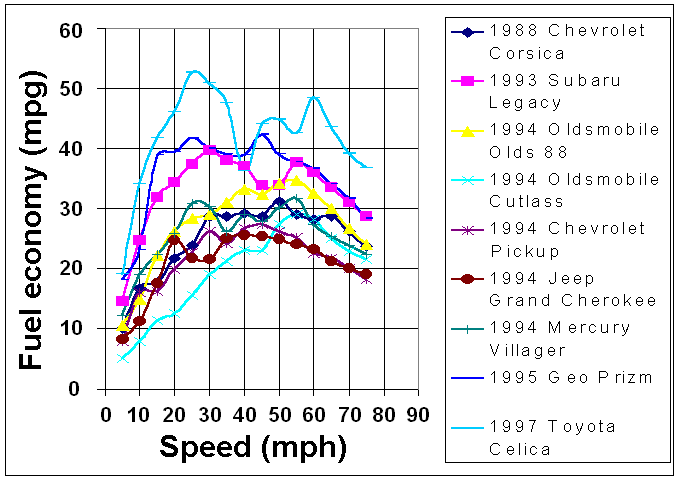
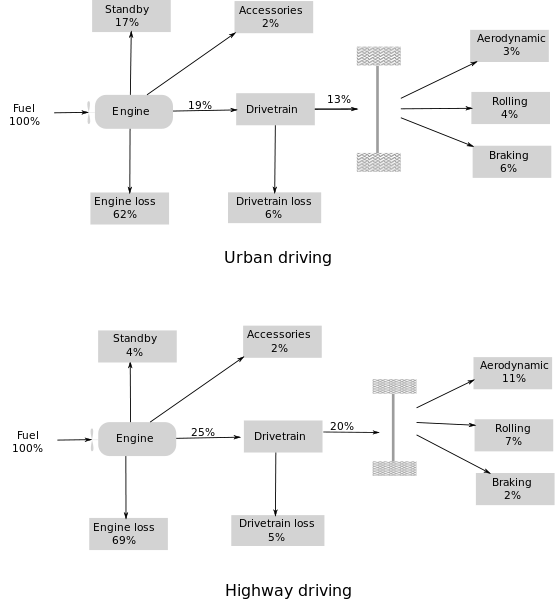
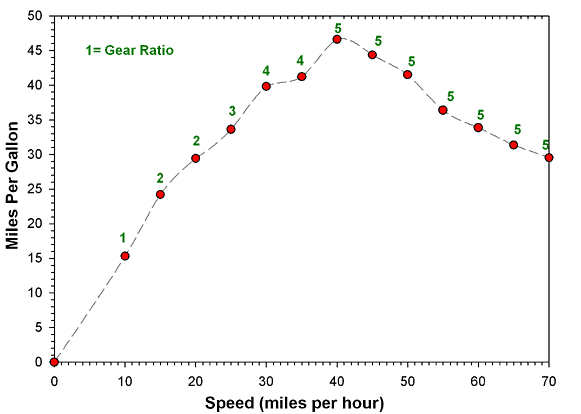
| It's not always the most efficient for every car, but there are lots of charts showing this tradeoff. Some cars are more efficient at 65 or 70 than 55 (97 Celica), but in modern gas cars, 40-50mph is where you hit a peak, and you start getting worse from there. 40mph on the highway is painfully slow though, so people generally pick an optimal point higher than that. (One inconsistency I've found is how the Motor Trend test below sees a very high peak at about 40MPH and a decline after, while other sources show a flatter peak). And 55MPH seems more like a magic number the author picked, but not a bad one if we don't know the model. Generally cars are geared so the engine begins entering its optimal / most efficient RPM range where it can produce more torque in top gear around 40-50mph, and rolling resistance and wind drag (which is a cube function of speed) contribute to make mileage worse after that. Usually the speed at which you first shift into top gear and cruise comfortably is close to optimal. Efficiency doesn't start dropping for a while because of the cubic nature of drag, and the engine sometimes is more efficient at higher RPMs for a bit (see nols' post on manufacturer optimization). Fun fact: At top speed (254mph), a Bugatti Veyron will use its 26 gallon tank in 12 minutes. An older chart: http://upload.wikimedia.org/wikipedia/commons/a/a9/Fuel_econ... A newer chart:
http://blog.automatic.com/wp-content/uploads/2013/12/mpg-vs-... Motor Trend chart:
http://image.motortrend.com/f/roadtests/sedans/1208_40_mpg_c... http://www.motortrend.com/roadtests/sedans/1208_40_mpg_compa... (One thing that bothered me is how the Civics in the last two charts were so different) |




Which is all to say, do we expect this to stagnate forever at 55? Is this a hard physical limit? I understand drag gets higher there. Are there no tricks left to us?
And again, I fully concede that this is likely not the most pressing fact around. Just one I am curious on.