|
|
|
|
|
|
by taeric
4499 days ago
|
|
|
This was exactly the angle I was looking for. I am still not entirely satisfied with this, as it does not flat out state why better gearing couldn't achieve some increase. That is, my naive understanding is aligned with what a sibling post said. That there is an "ideal" torque rating of my engine. Seems that if my cruising speed isn't stuck at that number, than some gearing changes could be made to put me there. Why does that not work? (Adding a 7th gear, for example, seems to be a natural idea.) I'm curious to hear that the ideal speed would actually be below 55. Do you have good references on that? Also, I'd assume the "switching out of the 4-wheels-on-ground" refers to such as trains and friends? |
|
|

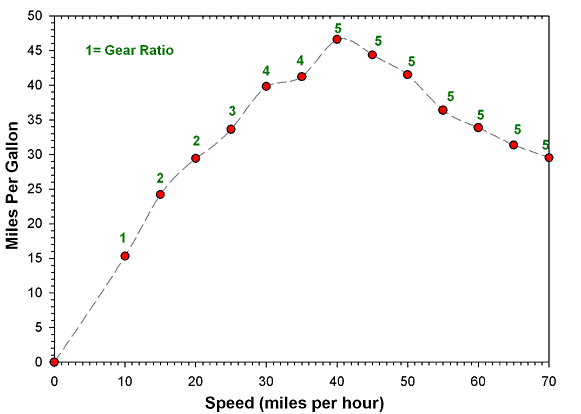

In the engine and drivetrain, force per unit of fuel is dependent on velocity (this is probably a pretty complex dependency), but you can probably tune the system to have peak efficiency at whatever speed you want.
For aerodynamic drag, it's a function of the square of velocity. You can certainly work to lower the drag coefficients, but whatever the force is at 39 mph, at 55 mph it will be about double, and about 78 mph will be double that.
Realistically, it makes sense to put the peak of engine and drivetrain efficiency in the range people are going to be driving the most; so this is why many vehicles will be most efficient around the 55-70 range.
If you're willing to radically change behavior, you would likely have a much more efficient vehicle if you tuned for 40 mph, and people drove it at 40 mph. At lower speeds, other frictional forces become more significant as well, so maybe tuning for 5 mph isn't a great idea.