Hacker News new | ask | show | jobs
by exue 4452 days ago
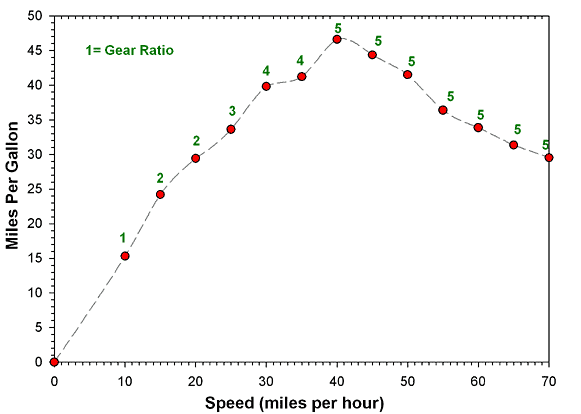
Longer gearing will improve the high-end efficiency where it wasn't yet optimal - to help 90MPH you could target that with your super 7th gear at "ideal" torque/RPM. However the overwhelming aerodynamic drag means the peak efficiency won't shift to the right much, and it'll probably stay around 40-45mph (the power required is proportional to the cube of speed and 11x stronger at 90MPH than 40MPH) [4]. In many cases that super 7th gear wouldn't help 40mph (peak) at all if 5th/6th had already optimized 40mph.

I think the 55-70 range is pretty optimized on production cars today, including those with 5 or 6 speed transmissions - but you may be able to make more gains with longer gears/a CVT at speeds above that. In an earlier age of 3-4 speed autos (and sometimes a national 55mph limit), manufacturers had fewer gears to work with so a super long gear for 80MPH efficiency would trade off midrange efficiency and acceleration, and the EPA didn't test that anyway until 2006 w/ higher highway speeds

[4] My reference on the ~40MPH ideal speed (which I'm now more convinced about is the ideal for cars today) is the Motor Trend [1] test (all economy sedans peaked 35-40ish), several Hypermiler/car specific forums [2] and some personal cruise control tests with some rental/Zipcars with a digital gauge. Other ways to test include Scangauge/the Torque Android app. (The reason the ~40mph peak isn't even lower, is due to gas engines especially larger ones, being less efficient if they produce too little power - there is a minimum RPM at idle and always friction). So my earlier statement of "optimal peak would have been 30-40" - it's already around 40, and it doesn't have to achieved in top gear.

I put "ideal" in quotes earlier since the torque peak is one of many factors for the engine - the ideal cruise RPM is almost always lower due to less engine friction and lower pumping losses when you aren't asking for full power. If you ask for more power, your optimal RPM goes up closer to the torque peak. A generic motor from a friend's auto engineering class [3] (If you say had a Honda S2000 with a torque peak at 7500rpm, cruising there would kill your mileage)

Yeah, though by 4-wheels-on-ground I was mostly referring to flying/maglev type vehicles, or perhaps a vastly different design that had very little aerodynamic drag

[1] http://image.motortrend.com/f/roadtests/sedans/1208_40_mpg_c... http://www.motortrend.com/roadtests/sedans/1208_40_mpg_compa...

[2] http://www.metrompg.com/posts/speed-vs-mpg.htm http://www.metrompg.com/posts/photos/florida-speed_vs_mileag... http://www.metrompg.com/posts/rpm-mpg.htm

[3] http://i.imgur.com/5MEEDnx.jpg - the asterisk would be near the torque peak

2 comments

Thanks for the comments and further reading. I see I should have also made clear I was never expecting anything in the upwards of 90mph range. The article was quite leveled at 55, though. Seems upping that to 60/65 should at least be possible.

I'm not sure I understand what you mean on "if 5th/6th had already optimized 40mph." Again, it may be my naive view, but I had thought each gear would have its own optimum. Or, were you just saying "top, be it 5th or 6th"?

I can definitely understand the wind resistance point. It really just comes down to my being somewhat incredulous that it is pinned at a mph point. Surely with better gearing, we have pulled the number up from where it was back when I had a 3 speed automatic? You seem to be implying otherwise.

Got it - I think you're asking why the peak is still so low at 40mph, and why we haven't shifted it toward 55, or 65. The reason there is a peak at all and we aren't most efficient at 5mph is due to (1) for gasoline cars, low efficiency at low loads - a motor may have a maximum of 200hp but only asking 10hp to power you means you'll pay a lot of frictional/throttling losses (at 10hp you'll be in the far bottom left in diagram [4]) (2) "fixed costs" per unit time - power steering, power brakes, alternator for electronics. Those two factors push us out to the right, whereas wind and rolling resistance push us to the left.

I'm not an automotive engineer so I don't understand the overall system equations, but I suspect for a given vehicle weight of ~3000lb, drag coefficient ~0.30, and 4-cylinder gasoline motor characteristic that provided sufficient passing acceleration, the "solved equation" for economy cars happens to end up in in the 35-45 optimal range. Gearing can't move the peak so much as make the decline less severe. (In my experience 4 speed autos generally had similar top gear ratios to 5 speed manuals of the time, but had other losses/at in-between speeds)

If you wanted to just shift the peak to the right, you could (1) equip an engine that is very large/extremely inefficient at low power outputs, and had higher parasitic losses and (2) reduce drag. Thus, it would make sense to drive faster, to move your motor out of the extreme bottom right in [4], and "spread out" those parasitic losses over a larger distance.

Adding more gears makes the slope go down less steeply after 40mph (but it's always going down consistently - see the Motor Trend article). The reason I used a 90mph example is I believe most 6 speed transmissions today already have 6th gear optimized for ~70mph cruising due to their motivation in post-2006 EPA testing. By optimized, that doesn't mean the optimal MPG in that gear occurs at 70mph, just that we've eliminated the gearing mismatches/inefficiencies compared to a CVT, which always has "perfect gear ratio". You could still add a 7th and find improvements at 80/90 probably.

So if 5th gear (in a 6-speed) had optimized 40mph, and 40mph is inherently more efficient, we would be driving there instead for overall peak MPG. I was trying to say that with enough gears, you don't need to be in top gear for optimal MPG due to drag. Hope that makes sense

I was actually asking why don't we keep the peak at 55 from dropping till later. I fully grant this is because I was ignorant of the lower peak at 40.

I should probably have added that most of my understanding in gearing comes from bicycles. I fully expect that my limited understanding there will not necessarily transfer. However, it has built up an intuition that gearing makes a huge difference. It is easy to get a sense that the other components of the equation have the final say, but it is impressive the difference going from a mountain to a road bike.

And again, thank you for the responses. I don't know as that I learned anything I can use in making decisions, but I do feel I have at least learned something.

Got it, hope that helped! I'd be very interested to see what the analysis is for a bike and what the optimal human efficiency is like.

In my experience riding road/hybrid bikes vs. mountain bikes, the lower resistance tires reduce the effort even if the gearing is similar. I'm also guessing the human leg has a narrower efficiency range in terms of RPM and power produced, so bikes usually have 15+ gears.

Now that I think about it, the 'simplest' way to explain the curve is - the vehicle/powertrain variables determine the efficiency curve with ideal gearing e.g. a CVT. If you have a 4 speed transmission, you choose 4 optimal points and imagine a steeper efficiency fall off in between each point (4 flattened parabolas with vertices at the optimal points).

The wikipedia article covers it decently.[1] And, the tires definitely have the most obvious effect at getting up to speed. However, I know that my top speed is higher on my road bike than it is on my mountain bike of similar tire size. I have mostly attributed that to the gearing. (Simply put, I am peddling as fast as I can on the mountain bike and going slower than a modest peddle on the road bike.)

Mayhap I am wrong there, as well.

[1] http://en.wikipedia.org/wiki/Bicycle_gearing

Good comment.

Nit: aerodynamic drag force is modeled as quadratic (squared) with speed. The power required is force times velocity, which means the power is cubic with speed, but the force is only quadratic.

Good catch! Knew I was missing something when the other comment referenced a quadratic relationship. (Updated)