|
|
|
|
|
|
by exue
4456 days ago
|
|
|
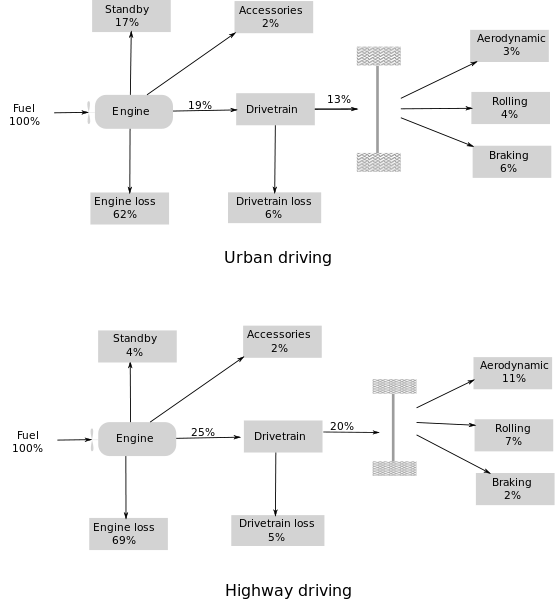
OK, now I understand where you're coming from. The physical limit is that at higher speed, we must expend more energy per unit of distance, to overcome drag (relatively little is lost in braking or rolling resistance of tires.) [1] So on any planet with an atmosphere you will have to contend with this. The 'ideal' speed isn't really even 55MPH, but lower if you had all variables at play to get the maximum MPG at any speed (probably 30-40MPH), but manufacturers expect people to cruise on the highway faster so they adjust the gearing. If you're asking how to push out the curve so that going faster than 75MPH doesn't offer a huge loss of speed, lower drag coefficients are the trick. Or switching out of the 4-wheels-on-ground automobile. [1] http://upload.wikimedia.org/wikipedia/commons/thumb/0/05/Ene... In this generic diagram, the ratio of drag (air)/rolling (ground) resistance is 11-to-7. As you get to higher speeds, the ratio tips even more in favor of drag. Fun fact: The Bugatti Veyron gets 2.15MPG at its top speed of 250MPH. |
|
|

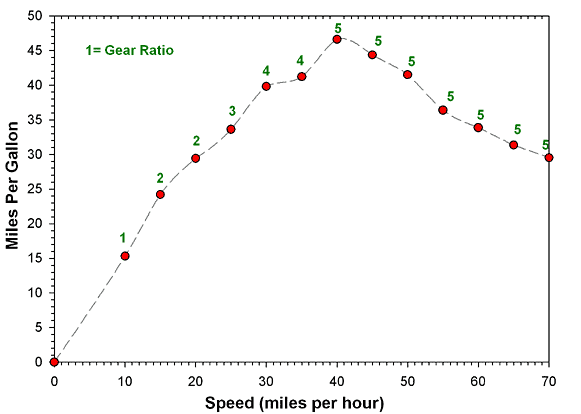

That is, my naive understanding is aligned with what a sibling post said. That there is an "ideal" torque rating of my engine. Seems that if my cruising speed isn't stuck at that number, than some gearing changes could be made to put me there. Why does that not work? (Adding a 7th gear, for example, seems to be a natural idea.)
I'm curious to hear that the ideal speed would actually be below 55. Do you have good references on that?
Also, I'd assume the "switching out of the 4-wheels-on-ground" refers to such as trains and friends?