But that's because elections these days are incredibly close. It's like being upset that the best statistical answer to "who will win a coin toss" is "well it's 50/50".
edit: facts cannot be insolent. The youtube link is a guest on the view named Stephen something, from this week, saying the words that i typed into the comment box. Not clicking it is doing yourself a disservice; as it is "source cited."
Don't get mad at me for relaying this information.
Sure. And what was the probability of something like that happening? About a coin flip.
It is an election using First-Past-the-Post counting. A 50:50 probability doesn't mean the final count will be close, it (usually, anyway) means there is evens odds which side is about to win decisively. The county results are expected to correlate, as are the swing states in all likelihood.
You'll note that the distribution mode for a Trump win was 312 electoral votes; which is what he got. They do a good forecast - it suggests there was a 50-50 chance Trump wins, and if he wins the most likely outcome is ... exactly what happened.
If it was a Harris win the best bet is she would have gotten 319 electoral votes with high correlation in the swing states too.
you still didn't watch the video i linked^, and you did not answer my actual question: 89% of counties turning red compared to the 2020 election is a 50-50 chance? Can you show your work?
^ The person in the video explains why thinking it is 50-50 chance is detrimental to the liberal cause.
Counties don't vote and Trump's popular vote "mandate" is smaller than Clinton's popular vote win in 2016.
Here's a fun stat: literally 40 states have a population that is less than the population of Los Angeles county alone. Why doesn't Los Angeles itself have 80 senators?
> why doesn't Los Angeles itself have 80 senators?
The electoral college internally balances the power of a population against the difficulty of holding land. Look at New York State, where NYC mostly holds court. If it were a country you’d see rebellion. Because while the city outnumbers the country, it’s culturally more similar to itself than the country, and that in practice leaves lots of people disenfranchised.
(Personally, I think the President should be popularly elected. But the Senate should continue resembling our geography.)
Even if you buy into the whole notion of "representing geography", the problem is that state boundaries ceased to be representative of any meaningful kind of political distinction a long time ago, as evidenced by the massive red/blue splits in many states. It's not just NY - you can see the same thing in other large states, e.g. in WA where the split is geographical within state boundaries - west of the Cascades is very blue, east is very red. Nor is it unique to blue states - TX has the same exact issue with blue counties having a lot of population that is effectively not represented at all.
Unless and until this is fixed, there's no meaningful "geographic representation" in the Senate, so it's strictly a negative.
> Here's a fun stat: literally 40 states have a population that is less than the population of Los Angeles county alone. Why doesn't Los Angeles itself have 80 senators?
Because in a federal system it is often considered important to provide the less populous states with some protection against the more populous states always getting their way. The US Constitution does this by balancing representation based on population (the House) with equal representation of each state (the Senate).
The US is not the only federal constitution to do this - the Australian constitution has the same design (indeed, copied off the American model), except having 6 states instead of 50, Australia went with 12 senators per a state instead of only 2 - hence Tasmania (population 571,200) gets 12 senators, and so does New South Wales (population 8.153 million).
Things don’t have to be this way - instead of a federation one could have a unitary system. But in the case of both countries, protecting the power of the smaller states was considered important at the time of the constitution’s drafting - and the smaller states likely would not have agreed to it otherwise
Where it is different, is Australia doesn’t have the same “red state” vs “blue state” dynamic the US does. In Australia, while some states lean more one way than the other, they essentially all are “swing states”
Well, both by the majority of the drafters of the US Constitution, and the majority of the drafters of the Australian Constitution.
And the authors of the German Constitution – the German upper house, the Bundesrat, represents the German states (Länder), and although (unlike the Australian and US Senates) it does give more populous states a greater number of seats, the number of seats is still out of proportion to population: in Bremen there are 223,830 people per a seat, compared to 2,977,586 people per a seat in North Rhine-Westphalia.
And the authors of the Swiss Constitution – the Swiss upper house (Council of States) gives two seats each to twenty of the country's cantons, and one seat each to the other six (which six are traditionally referred to as "half-cantons")
And I'm sure I could dig up more examples – globally, the majority of federations have an upper house which provides, either equal representation to each state/province, or if not equal, then at least representation that deviates significantly from proportionality to population.
> Definitely not James Madison who only grudgingly accepted this framework in Federalist No 62
I'm not sure if Madison should be interpreted as "only grudgingly" accepting this framework – but even if that's true (Madison was very much an advocate of centralized power and supporter the interests of the big states over that of the smaller states), many of the other delegates at the 1787 Constitutional Convention viewed it more positively, even as a necessity – the majority of delegates agreed to the Constitution containing this provision, and it is unlikely such a majority would have if it had been ommitted.
> the German upper house, the Bundesrat, represents the German states (Länder), and although (unlike the Australian and US Senates) it does give more populous states a greater number of seats, the number of seats is still out of proportion to population: in Bremen there are 223,830 people per a seat, compared to 2,977,586 people per a seat in North Rhine-Westphalia.
To be fair, though, in the US, the House also has unfortunate proportional-representation anomalies, too, because the total number of Representatives has not changed in over a century. See Wyoming vs. California for an illustrative example.
I don’t personally recall, but it’s kind of a silly idea to break down presidential votes by county anyway. At least counting states matters legally in elections. And counting people matters as a way to judge desires and sentiments.
Counting by counties combines the unrepresentativeness of the Electoral College with the legal irrelevance of the popular vote.
Not sure why I can't reply to the sibling comment...
anyway, the reason for the east/west divide in population density is that the west is dry. See maps at climate.gov (https://www.climate.gov/news-features/featured-images/new-ma...). By convention people refer to this line as being at the "100th meridian" but the 98th may be more accurate.
Bit of a tangent, but I've always wondered why the United States has a very clear dividing line between the populated east and relatively empty west. It's really visible in the first map you shared. Is there a historical reason behind that line? Or some geographical boundary?
My understanding, as an american, is that the Federal government "owns" most of the land west of either the Mississippi River or the Sabine. Or used to "own" it. So getting land for personal/business use in that geographic region is harder than eastward. I don't know the term of art, but it's like the Federal Government - via the BLM, USDA, USFS, or whatever - has right of first refusal for all land sales.
I know that my understanding can be wrong, but this is what i've heard and perusing some maps bears out at least some validity.
If you include Alaska, which is a huge state (I hear bigger than Texas), land starts voting very blue due to Alaskan native influence. They don’t have counties though, just boroughs (Alaska still goes red even if it’s land goes blue due to population distribution).
Louisiana doesn't have counties, either. I live in Louisiana, and when i said "counties" i included the parishes in my state, and any other geographically distinct entity of the same legal merit.
there are 3300 counties in the US. People live in all of those counties.
Did you know that there are about 2,160 counties across these 40 states that collectively have a smaller population than Los Angeles county? Who cares about a "county map"?
The View is just a chit-chat show anyway, so a source that proves that somebody said something on it doesn’t prove anything compelling.
Anyway, my computer can’t play YouTube (ad blocking issues).
The underlying thing that is annoying people, I think, is that this is (as far as I can tell based on what you’ve written) a factual mathematical issue. That sort of thing is easily conveyed via text and equations. Why would anybody want to watch a video of somebody explaining math?
> The View is just a chit-chat show anyway, so a source that proves that somebody said something on it doesn’t prove anything compelling.
This is a fallacy. I repeated numbers, that person was also repeating numbers, however, they're on a national news program and no one has given any reason that the numbers stated were wrong. It does not matter who says something, you have to weigh it on the merits of the statements.
It isn't a "factual mathematical issue" it's a sociological issue, and it's bearing out in this comment thread - burying one's head in the sand because "Los Angeles is bigger and has more people" or "land doesn't vote" or "so what, it wasn't a majority" is missing the forest for the trees. Something about the platform did not work for our neighbors. A platform that worked in 2008, 2012, (2016 if you reckon the pundits are correct), and 2020 - it ceased working in 2024; and merely "doing the same thing" going forward won't work.
I think the unspoken part is this: "If the left just pushes on as it has been, the midterms and 2028 aren't going to be '1.5%' margins"
People often assume i am part of the opposition party.
And to answer your question, the video is a guest on the view who i don't know, saying the exact numbers i quoted. I was quoting the person on the view, which aired yesterday or something.
what's interesting, is instead of discussing what i said prior to the link, you chose to instead try and make me feel bad for linking a video.
also what bias? I didn't make the stats up. Statements of fact cannot be insolent. If you disagree with the facts, then let's talk about that, and look for more data. However, what has happened in this thread is thinking i have an agenda, other than i think people need to hear what they were talking about - in that clip
The mentality that "it was real close to 50-50 and trump didn't get a majority of the vote and therefore we can keep on doing what we're doing" is what the video clip was talking to. It didn't work, and the tactics need to change if anyone wants to see change.
I don't care that people want to argue with me personally. But it's not doing themselves any favors, as it pertains to getting people elected they want to see in office.
>what's interesting, is instead of discussing what i said prior to the link, you chose to instead try and make me feel bad for linking a video.
Others had already rebutted your assertion at least as well as I could, so I didn't feel the need to repeat what had already been offered.
However, given your initial rationale:
>>note: not clicking that because you disagree with me is really doing yourself a disservice.
was a poorly constructed straw man. Which I noted. It wasn't that I was rejecting you, I was clarifying that I (and likely many others) come to HN to discuss matters of interest to us.
If I wanted to watch videos, I'd go to youtube and the like. I came to HN instead.
I'd point out that you didn't make clear that you were "citing your sources" with the video link.
Now that I know the source ("Stephen Somebody or other" who managed to get himself booked on some low-information blab fest to make his important pronouncement), my initial response, "[s]o tell me what you think, don't link to some rando on youtube," was spot on.
All that said, linking to video sources is absolutely reasonable. In fact, I've referenced stuff from videos several times.
But each time, I made sure to explain the context of the video, the text of the quote and, most importantly, who was being quoted.
The thought that the vote was "real close to 50-50" and "trump didn't get a majority of the vote" and "therefore we just need to do what we're doing and it'll work out OK in 2028 and the midterms" is what the video clip i linked was talking to.
Specifically, nearly every reply to my comment, other than yours, argued that "the number of counties that switched" is irrelevant, as if that happened by accident, as if your neighbors apparently changing from blue to red for the 2024 election isn't a bellwether of something else. Trump still got a plurality of votes. Asking "why" is something that needs to be done.
Nearly every comment assumed something about me, because i quoted a statistic. I knew, because i have been on internet forums for over a quarter century, that no matter how i phrased my comment, i was going to get downvoted and argued with.
>The thought that the vote was "real close to 50-50" and "trump didn't get a majority of the vote"
Yes. Both of those things are true. Other folks correctly mentioned that.
>and "therefore we just need to do what we're doing and it'll work out OK in 2028 and the midterms" is what the video clip i linked was talking to.
Who said that? Not me. Not anyone else on this thread.
Rather, various folks rebutted[0][5][6] your assertion (whether you're quoting some rando or not) that "there absolutely is a mandate." Which is a ridiculous statement, as the current incumbent only received 1.5% more votes than his opponent. That's not a mandate, that's a squeaker.
What would constitute a mandate? Contrast the results with the 1972, 1984 or 1996 elections, which actually conveyed a mandate. Go ahead and compare the results of those elections (definitely mandate elections) with the 2024 presidential election where[4]:
   Trump won the Electoral College with 312 electoral votes,
   while Harris received 226...

   Trump won the national popular vote with a plurality of
   49.8%.
1972: "President Richard Nixon defeated Democratic Senator George McGovern in a landslide victory. With 60.7% of the popular vote, Richard Nixon won the largest share of the popular vote for the Republican Party in any presidential election.[1] Nixon also won 49 of the 50 states.
1984: "Reagan won re-election in a landslide victory, carrying 525 electoral votes, 49 states, and 58.8% of the popular vote. Mondale won 13 electoral votes: 10 from his home state of Minnesota, which he won by a narrow margin of 0.18% (3,761 votes), and 3 from the District of Columbia, which has always voted overwhelmingly for the Democratic candidate."[2]
1996: "Clinton defeated Dole by a wide margin, winning 379 electors to Dole's 159 and taking 49.2% of the national popular vote to Dole's 40.7%."[3]
As you can see, 1.5% is a tiny margin compared with real mandate elections. So your youtube/The View rando is flat wrong about a mandate for Trump.
Which says nothing at all about future elections or election strategies for the Democratic Party. You're trying to put words in the mouths of others. Please stop.
I don't think someone can claim a "mandate" based on not even having won 50% of the vote. You need to at least be able to say that over half of the voters wanted you to win in order to use language like that.
That 1.5% is the only thing that mattered for "mandate" purposes. Trump won, but on a razor's edge, and that should give him some pause. (It won't.)
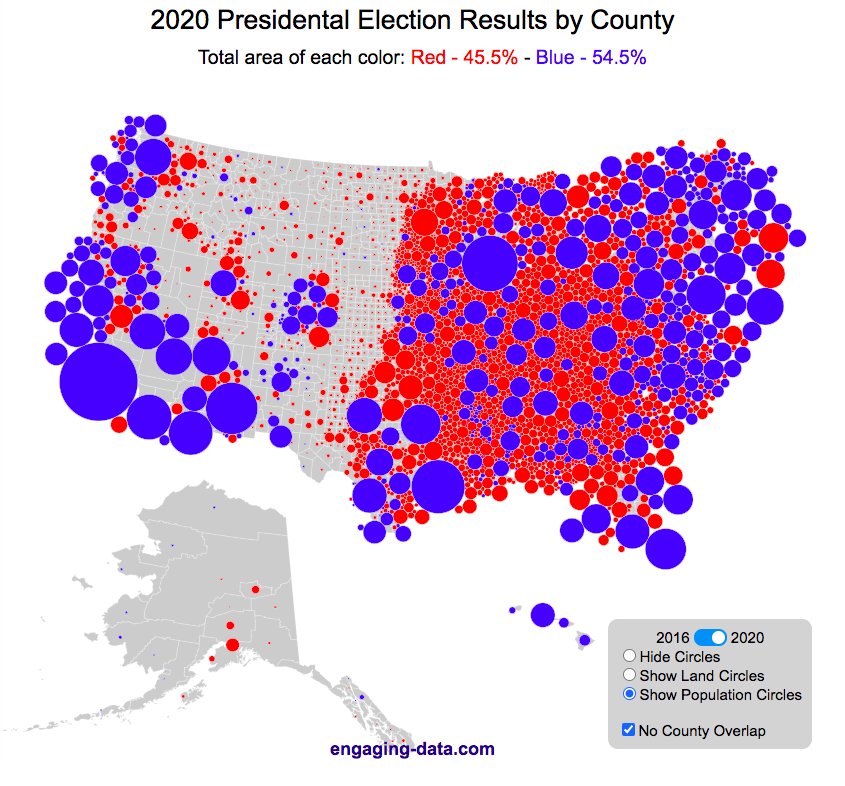
89% of counties turned red. Looking at 1.5% total difference is missing the forest for the trees. Trump got all swing states.
To quote: "this is absolutely a mandate."
https://youtu.be/zG3n2IeaTPA
edit: facts cannot be insolent. The youtube link is a guest on the view named Stephen something, from this week, saying the words that i typed into the comment box. Not clicking it is doing yourself a disservice; as it is "source cited."
Don't get mad at me for relaying this information.