Hacker News new | ask | show | jobs
by aaronbrethorst 473 days ago
Counties don't vote and Trump's popular vote "mandate" is smaller than Clinton's popular vote win in 2016.

Here's a fun stat: literally 40 states have a population that is less than the population of Los Angeles county alone. Why doesn't Los Angeles itself have 80 senators?

https://en.wikipedia.org/wiki/2016_United_States_presidentia...

https://en.wikipedia.org/wiki/2024_United_States_presidentia...

Setting aside 2000 and 2016 (EC winners lost the popular vote), you'd have to go back to 1968 and Nixon's squeaker of an election over Humphrey to find a closer popular vote: https://en.wikipedia.org/wiki/List_of_United_States_presiden...

3 comments

> why doesn't Los Angeles itself have 80 senators?

The electoral college internally balances the power of a population against the difficulty of holding land. Look at New York State, where NYC mostly holds court. If it were a country you’d see rebellion. Because while the city outnumbers the country, it’s culturally more similar to itself than the country, and that in practice leaves lots of people disenfranchised.

(Personally, I think the President should be popularly elected. But the Senate should continue resembling our geography.)

Even if you buy into the whole notion of "representing geography", the problem is that state boundaries ceased to be representative of any meaningful kind of political distinction a long time ago, as evidenced by the massive red/blue splits in many states. It's not just NY - you can see the same thing in other large states, e.g. in WA where the split is geographical within state boundaries - west of the Cascades is very blue, east is very red. Nor is it unique to blue states - TX has the same exact issue with blue counties having a lot of population that is effectively not represented at all.

Unless and until this is fixed, there's no meaningful "geographic representation" in the Senate, so it's strictly a negative.

> Here's a fun stat: literally 40 states have a population that is less than the population of Los Angeles county alone. Why doesn't Los Angeles itself have 80 senators?

Because in a federal system it is often considered important to provide the less populous states with some protection against the more populous states always getting their way. The US Constitution does this by balancing representation based on population (the House) with equal representation of each state (the Senate).

The US is not the only federal constitution to do this - the Australian constitution has the same design (indeed, copied off the American model), except having 6 states instead of 50, Australia went with 12 senators per a state instead of only 2 - hence Tasmania (population 571,200) gets 12 senators, and so does New South Wales (population 8.153 million).

Things don’t have to be this way - instead of a federation one could have a unitary system. But in the case of both countries, protecting the power of the smaller states was considered important at the time of the constitution’s drafting - and the smaller states likely would not have agreed to it otherwise

Where it is different, is Australia doesn’t have the same “red state” vs “blue state” dynamic the US does. In Australia, while some states lean more one way than the other, they essentially all are “swing states”

"in a federal system it is often considered important"

by whom?

Definitely not James Madison who only grudgingly accepted this framework in Federalist No 62: https://avalon.law.yale.edu/18th_century/fed62.asp

> by whom?

Well, both by the majority of the drafters of the US Constitution, and the majority of the drafters of the Australian Constitution.

And the authors of the German Constitution – the German upper house, the Bundesrat, represents the German states (Länder), and although (unlike the Australian and US Senates) it does give more populous states a greater number of seats, the number of seats is still out of proportion to population: in Bremen there are 223,830 people per a seat, compared to 2,977,586 people per a seat in North Rhine-Westphalia.

And the authors of the Swiss Constitution – the Swiss upper house (Council of States) gives two seats each to twenty of the country's cantons, and one seat each to the other six (which six are traditionally referred to as "half-cantons")

And I'm sure I could dig up more examples – globally, the majority of federations have an upper house which provides, either equal representation to each state/province, or if not equal, then at least representation that deviates significantly from proportionality to population.

> Definitely not James Madison who only grudgingly accepted this framework in Federalist No 62

I'm not sure if Madison should be interpreted as "only grudgingly" accepting this framework – but even if that's true (Madison was very much an advocate of centralized power and supporter the interests of the big states over that of the smaller states), many of the other delegates at the 1787 Constitutional Convention viewed it more positively, even as a necessity – the majority of delegates agreed to the Constitution containing this provision, and it is unlikely such a majority would have if it had been ommitted.

> the German upper house, the Bundesrat, represents the German states (Länder), and although (unlike the Australian and US Senates) it does give more populous states a greater number of seats, the number of seats is still out of proportion to population: in Bremen there are 223,830 people per a seat, compared to 2,977,586 people per a seat in North Rhine-Westphalia.

To be fair, though, in the US, the House also has unfortunate proportional-representation anomalies, too, because the total number of Representatives has not changed in over a century. See Wyoming vs. California for an illustrative example.

I've heard this my entire life, too. However, having lived more places than just California, I see California as having undue influence on the entire country. Prop 65 warnings pop up on things outside of California. I've even seen stuff labeled as CARB outside of California. These are trivial examples, but both of those things are California legalities. If Louisiana had undue influence on the US, more packaging would have French language as well as English; just as a trivial example.

Something that affects someone living in Los Angeles County may not affect someone in any of the other "2xxx" counties that have less population. For instance, i have a well for water. I don't worry about water shortages in California when i run my well. My water usage doesn't affect Los Angeles at all. And not even in the "butterfly" way because the jetstream goes the other way. This, again, is a trivial example.

Policing in L.A. is different than policing in LA. roadworks are different. Disaster preparedness is different. Fire risks are different. Taxation is different. Health needs are different.

What this boils down to: Californians, and specifically the valley and L.A. County residents, have a loud enough voice to push this agenda, but only when someone they don't like wins. California was happy to put a republican actor in office when the republican actor was "from California."

I think prop 65 warnings are about the worst example of undue political influence. Companies do this outside the state on a completely voluntary basis.

Their adoption in other states completely bypasses the national legislature due to the real world economic power of the Califonia market. They dictate external behavior by regulating their internal market.

What part of this is undue? States and individuals should have the ability to exercise power through self regulation, essentially threating to take their ball and go home.

Where I find more fault with California and Californians is when they interfere directly with external state politics. The classic example of this would rich Californians dumping money into political campaigns and ballot initiatives in other states, influencing their 'internal* politics.

California is larger than many countries, and more productive than many countries as well (at least as far as GDP goes). Of course it should have a proportionally large influence on the rest of the country; it's not "undue".
> To be fair, though, in the US, the House also has unfortunate proportional-representation anomalies, too, because the total number of Representatives has not changed in over a century. See Wyoming vs. California for an illustrative example.

This is not unique to the US either. Section 24 of the Australian constitution guarantees each "Original State" [0] a minimum of five seats in the House of Representatives. On a population basis, Tasmania should only have 3 seats, but due to this clause they have 5 instead. This means Tasmania gets one seat per 114,240 electors, compared to one per 179,021 for NSW. This means Tasmania's seats-per-population in the House is 1.576 times that of NSW.

This is actually more disproportionate than the US House – Wyoming gets 1 Representative for 587,618 people, California gets 1 per 758,269 people – hence Wyoming's seats-per-population is only 1.290 times that of California. (Australian politicians have significantly fewer voters electing them, but that's almost inevitable with a population over 13 times smaller than the US – although consider Ireland, who have 174 seats in their lower house, but only 5.308 million people, meaning each TD only represents 30,000 people – that would be like Australia's House having 888 members, or the US House having over 11,000; if the US House had Australian-sized districts, it would have around 2000 members)

One difference is the size of the US House is at the discretion of Congress, so by increasing the size of the House, they could reduce the disproportionality. That is not possible in Australia without a constitutional amendment [1] since the Australian constitution requires the House to be "as nearly as practicable" twice the size of the Senate. Since the Senate has six states with 12 senators each, for 72 senators (plus 4 territory senators, but the High Court has ruled they don't count for this purpose), the House must be "as nearly as practicable" twice 72, which is 144 members. Currently the House has 151 members – but the 5 territory representatives don't count for this calculation, which brings us down to 146, which is "as nearly as practicable" to the required 144. The phrase "as nearly as practicable" lacks a precise definition, but it would seem any deviation big enough to significantly impact proportionality is likely to be ruled unconstitutional, while the small deviations (a handful of seats) that have thus far gone unchallenged are unlikely to make much of a difference to it. One method which wouldn't require a constitutional amendment would be to significantly increase the number of states, by splitting the existing six states into multiple parts, which in turn could significantly increase the size of the Senate and hence the House – but that is even less likely than a constitutional amendment is.

[0] an "Original State" means a state at the time of the Australian constitution's enactment. Australia currently has six states, all of which are Original States – like the US, the Australian constitution has a procedure to admit new states, but unlike the US, that procedure has thus far never been used

[1] the procedure for amending the Australian constitution is very different from that of the US – a national referendum, with both a majority nationwide, and a state-wide majority in a majority of states. What it has in common with the US constitution, is being very difficult to amend in practice – because most attempts to change the Australian constitution end up failing to pass the referendum

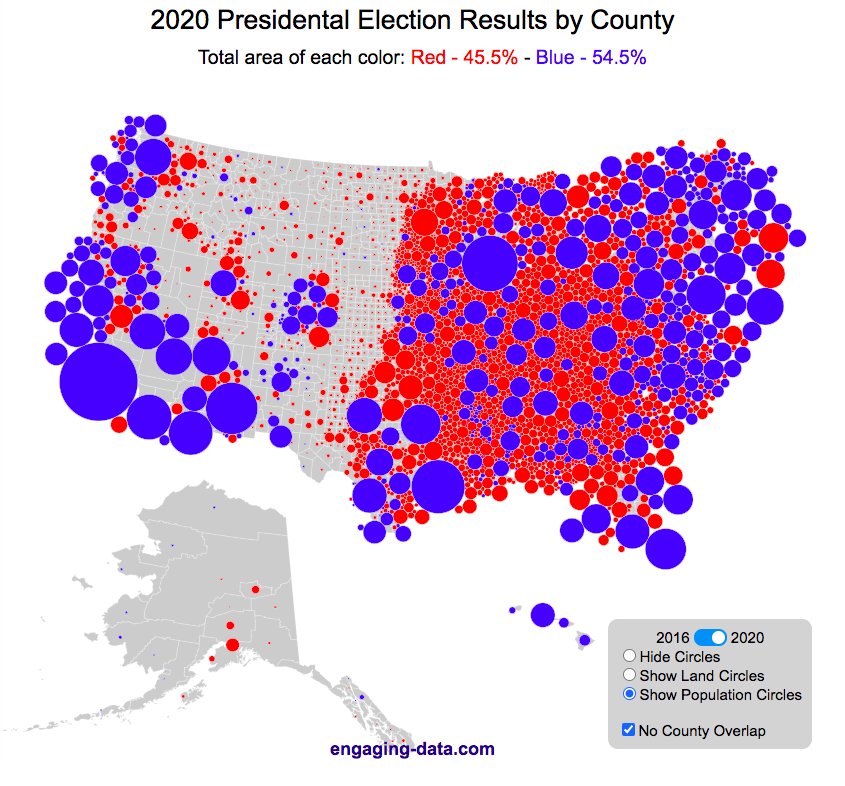
Out of curiosity, do you recall seeing a "county map" of the blue votes in the 2020 election?
I don’t personally recall, but it’s kind of a silly idea to break down presidential votes by county anyway. At least counting states matters legally in elections. And counting people matters as a way to judge desires and sentiments.

Counting by counties combines the unrepresentativeness of the Electoral College with the legal irrelevance of the popular vote.

Why would we have? It's pointless. As the GP said, land doesn't vote.

The more interesting map is the one where you weight the display by population, since it gives a much more accurate representation of how the USA is divided: https://engaging-data.com/pages/scripts/d3Electoral/countyel...

The tool on that website is actually pretty informative to play with if you want to quickly see how adjusting the map style can change the perception. https://engaging-data.com/county-electoral-map-land-vs-popul...

Not sure why I can't reply to the sibling comment...

anyway, the reason for the east/west divide in population density is that the west is dry. See maps at climate.gov (https://www.climate.gov/news-features/featured-images/new-ma...). By convention people refer to this line as being at the "100th meridian" but the 98th may be more accurate.

Bit of a tangent, but I've always wondered why the United States has a very clear dividing line between the populated east and relatively empty west. It's really visible in the first map you shared. Is there a historical reason behind that line? Or some geographical boundary?
It is a function of both geography and history, both based on water. The line you are seeing in the east is the rain shadow of the Rocky mountains.

Moving east from California, you have the great basin desert, followed by the Rocky Mountains, and then the relatively dry great plains.

Population follows precipitation.

https://gisgeography.com/us-precipitation-map/

https://www.thoughtco.com/geography-shapes-us-regional-weath...

My understanding, as an american, is that the Federal government "owns" most of the land west of either the Mississippi River or the Sabine. Or used to "own" it. So getting land for personal/business use in that geographic region is harder than eastward. I don't know the term of art, but it's like the Federal Government - via the BLM, USDA, USFS, or whatever - has right of first refusal for all land sales.

I know that my understanding can be wrong, but this is what i've heard and perusing some maps bears out at least some validity.

If you include Alaska, which is a huge state (I hear bigger than Texas), land starts voting very blue due to Alaskan native influence. They don’t have counties though, just boroughs (Alaska still goes red even if it’s land goes blue due to population distribution).
Louisiana doesn't have counties, either. I live in Louisiana, and when i said "counties" i included the parishes in my state, and any other geographically distinct entity of the same legal merit.

there are 3300 counties in the US. People live in all of those counties.

There are only a few boroughs in Alaska but some of them are larger than Texas.
Did you know that there are about 2,160 counties across these 40 states that collectively have a smaller population than Los Angeles county? Who cares about a "county map"?
people who don't live in Los Angeles might be curious why their neighbors suddenly switched to voting red.

why is everyone assuming that i'm not intelligent enough to know that "land doesn't vote"? The county voting maps are a proxy.

Because they’re a meaningless proxy?
it tells you that your neighbors voted for trump, and we might ask why. It isn't meaningless, if you live in a historically "blue" county and it went red, why did it go red?

I understand that counties can have various sub-regions and cultures and all of that, but not every county does. there's 3300 counties, and people live in all of them. Knowing that your neighbors voted for Trump might incline introspection.

at least that's what i hoped i could point out. Apparently shoot the messenger!