A lot of people here are bringing up all of the expensive gear surrounding the iPhone that helped give it the professional look. This isn't unique to iPhone as a sensor.
I work in TV and have spent a great deal of time on set shooting. The only time I've ever relied entirely on the camera's sensor and lens for a high quality image is shooting outside, and even then that requires adjustments, such as facing away from the sun, moving away from contrasty shadows, ect.
Outside of documentaries, every other shoot will have a great deal of time, effort, and money spent on lighting and set design to elevate what is being shot. For scripted projects/films, an even smaller % of shots will be shot with the raw, available light/environment.
What Apple did with the iPhone 15 proved that the iPhone can be used in a professional setting without being the on set bottle neck. For example, a short film shoot which had it's budget blown entirely on renting an Alexa will be bottle necked by the lack of lighting for the scene. Similarly, a short film which had its budget blown entirely on renting lights will be bottle necked if its shot on an iPhone 4.
The goal is balance and for smaller productions, that balance is found in budgeting. If anyone on set has an iPhone 15 Pro in their pocket, the shoot suddenly has a viable second camera-- maybe its not good enough for the entire shoot, but its surely going to be good enough as a B-Cam or even as an A-Cam in certain scenarios where a smaller form factor is required to get the shot.
I don't think Apple is sugar coating their demonstration here with all the expensive toys being used in parallel with the iPhone. The use of these tools in parallel with the iPhone IS the demonstration.
Like any good video, if its shot correctly and edited correctly, you won't have an easy time visually identifying what sensor is being used.
Without the expensive gear, the iPhone looks considerably downgraded compared to better source equipment. I had a Canon 5DII the day it was released and within a week some friends and I had a music video entered into a festival, and within a year, two short films, all done without any extra lighting or equipment - including gimbals. The source camera and lenses were good enough - and the look was amazing compared to camcorders - to achieve this.
Forgetting "shoots" and professional lighting, the iPhone isn't going to have the massive range of other equipment, and when you're spending literally thousands of pounds on studio time, lighting hire, operator costs, etc etc, are you really going to pick up and shoot on an iPhone when you've got a Black Magic or Sony or Canon at hand? Unless you're being paid by Apple?
I get that it's viable but there really is a lot of road between viable and superlative.
To be fair, the iPhone is not a camera, its a smart phone with a camera. There is no question that a DSLR with an interchangeable lens will beat out iPhone.
> The source camera and lenses were good enough - and the look was amazing compared to camcorders - to achieve this.
I would bet that the camera and lenses used didn't do the heavy lifting there, the selection of the location, the time of day, and the direction from the DP did. An expensive lighting setup isn't a requirement for a good image but good lighting is. Whether its natural or artificial is up to the DP.
The minimum viable quality you need for a project depends on the needs of the shoot.
> Forgetting "shoots" and professional lighting, the iPhone isn't going to have the massive range of other equipment, and when you're spending literally thousands of pounds on studio time, lighting hire, operator costs, etc etc, are you really going to pick up and shoot on an iPhone when you've got a Black Magic or Sony or Canon at hand? Unless you're being paid by Apple?
Of course not! I don't think anyone thinks the iPhone 15 is replacing the main camera on a shoot with a proper budget. But could the iPhone 15 be an additional camera for specialty shots or experimentation? Absolutely. For instance, if I'm shooting an unscripted scene with two people talking alone and I can mount my phone for a passable wide shot that can roll the whole time, giving me flexibility to shoot both individuals without losing coverage, then that's a huge value add.
I think in cases like that and in cases where people want to experiment without buying into a camera system, the iPhone becomes elevated beyond being just a mobile camera.
> I get that it's viable but there really is a lot of road between viable and superlative.
Totally agree, however I don't think I argued that. From my perspective, a viable camera is a viable camera for a job. The iPhone 15 seems viable from my viewing and it lives in my pocket while every other viable camera does not. That to me is the impressive feat. iPhone not living up to a proper DSLR is expected.
I think it's just not true. Supplementary equipment is REQUIRED to get something decent out of the iPhone. Without it the quality really is not great at all.
If you don't have any budget then you don't have the equipment then the iPhone is just not that useful for anything more than amateur vlogging type of stuff.
Also, it's funny seeing arguments about 1k+ iPhones being able to "save money" for video production when a Canon 5D MKII can be picked up for about 500 with a decent lens; and it cost less than 50 a day to rent. Results would be infinitely superior to the iPhone.
The iPhone can be a camera argument to justify its price is simple pure nonsense.
Maybe. I reprocessed a couple of 5D2 raw files a year ago with new tech (Capture One 22) and the images were fabulous, no complaints. I shouldn’t have been too surprised, I was making A1 prints from the 5D2 in 2009 so the camera is more than good.
But the 5D4 is superior, from the lovely focus-pulling via touchscreen to 1D-grade focusing. Let alone GPS, dual cards and the buffers.
There were definitely areas where these SLRs could improve from generation to generation, which seems to be much reduced regarding the iPhones, since the form is fixed, and upgrades or changes are often extremely unobvious.
The new Olivia Rodrigo music video/ad was shot on an iPhone. And it shows. Even on 4k, there's blurriness, color balance issues, and noticeable artifacts that just aren't present on videos shot with a proper video camera (i.e., the commercials airing right before and after).
Yes, the iPhone can be used as a video camera. The same way that a camcorder can be used as a video camera. And neither of them are anywhere close to professional-level quality without a lot of extra work and equipment: you actually need more expensive equipment than you would with an expensive camera (and this other equipment usually costs a multiple of what a good camera would cost).
All of Jet Lag The Game and DankPods are shot on iPhone and they look fine. It doesn’t look like some ultra high quality movie production but they also don’t stand out particularly looking bad, it’s completely fine for the content m
I don't think many people were really wondering if this sort of thing "could" be done.
IMO that's not the important question.
The question is, did the people who filmed and created the video with the iPhone hardware actually enjoy this process / workflow? Or did this process cause a bunch more pain and hassle to deal with the iPhone as the source camera?
Compared to some alternative they could have used.
Is there actually a compelling reason to use an iPhone for this type of work over the various alternatives?
> Or did this process cause a bunch more pain and hassle to deal with the iPhone as the source camera?
Did you read/skim the article because that's the focal point of the whole piece and discussions taking place in the videos. The whole thing is touting how easy the pros were able to slot this in and do their normal workflows on top.
> Is there actually a compelling reason to use an iPhone for this type of work over the various alternatives?
I'd guess cost is the big one, and the fact this will be in your pocket already for a lot of people.
I read the part where the people who were paid to use the iPhone 15 to film their videos told the company paying them lots of money to do that they enjoyed using it to film those specific videos.
And then I noticed that those same professionals went right back to using regular video cameras for their next shoots. (See e.g., Olivia Rodrigo...who shot 1 music video with an iPhone 15 because Apple paid $$$ for to do it and went right back to using regular video equipment for everything else. Also Sodenberg, for an earlier version of the iPhone, who uses regular video equipment after that brief, well-funded experiment.)
Well, the misleading thing is that Apple's implication is "you too can make videos that look like this with just the phone in your pocket" (emphasis mine).
> the pros were able to slot this in and do their normal workflows
Because you can't do it with "just the phone in your pocket". You can do it with the $50-100K of equipment you see on that page, just using the phone as the camera, one small part of the process. (Not to denigrate the camera's role - I am a photographer, though not a videographer, so I appreciate the importance).
I’m not sure what your objection is here. As you point out, they have photos that very prominently feature professional lighting and tripod equipment. They even explain in a caption that they customized it for the iPhone.
How is that misleading that all they used was “the phone in your pocket”?
Well, for one, they had to take that phone out of my pocket and they didn't because it is still in my pocket :)
They also had to take the phone out of their pocket otherwise all we would see if dark and pocket sand.
Then of course to make the actual video you see in the presentation they had to use a whole bunch of other equipment without which the phone in my pocket would not produce the result we are seeing.
So, misleading, but not more than any other Apple marketing claim. We are used to it now. The reality distortion field has not been breached so maybe Steve Jobs will return with a whole fleet of dark star destroyers to conquer the galaxy once more.
Oh yeah, totally agree on that point. Apple always does these "shot on iPhone" things that just don't look anything like my videos. But I also have never once been bothered enough by it to put my videos through editing software/color correction/etc. So I can't really complain.
I think it does still highlight that you can take this device far, almost as far as you'd ever need to. I think most people making videos are doing it for youtube and social, they would invest in a few smaller accessories that would cover 80% of the needs and would never need to use all of what Apple had at their disposal (the SpaceCam rig is excessive, a lot can be done with amateur/affordable gimbles and rigs). So, it's selling the fact that it's a good starter device for budding videographers (plenty of room for you can grow into it). But also not likely to convert pros away from whatever they're already using.
You can rent a RED camera and lenses for $3,000/week. If you're a major production, then this is a non-issue.
If you're doing an indie/film school short or similar, I can't see people breaking down their tech budget as "$100K for lighting, gimbals, etc., and $1100 for an iPhone".
I think the best comparison for the iPhone is looking at DSLRs that do not shoot RAW but do shoot in Log. The workflow out of iPhone compared to say, an a7s, should be relatively similar, aside from the differences in sensor capabilities such as color depth, dynamic range, ect.
I can see a lot of potential use of the iPhone 15 as on hand as a "deploy anytime, anywhere" B-Cam. For the editor, having that B-Cam to cut away to is invaluable and for small shoots or tight schedules, slapping the iPhone 15 on a cheap tripod is at the right level of convenience to give that a shot.
You can rent an EOS C700 and 6 CN-E lenses for $2000/week. RED for not much more.
If you're making a tiny budget indie, you already have similar caliber equipment. You're not renting high end ARRI and Panavision optics.
I love that you can make good video with such small equipment. I just think if you're doing something like this, optimizing for "well, let's buy an iPhone" over the benefits of traditional cameras is odd, even for a smaller scale production.
Frankly, I think, "show us what you can do with an iPhone and a small gimbal, a couple of basic continuous lights, even if it doesn't look as good as this production" would have given a better view of the capabilities and potential.
Your $50K budget indie film isn't going to be able to afford any/much of the equipment in that article, either. And then, in fact, it's generally more difficult to rent that stuff than it is to rent cameras.
If you don't have any of those alternatives in the first place.
The Best Food Review Show Ever went to Egypt for a series and the authorities impounded their video equipment and wouldn't let the team access the equipment until they left Egypt. Sunny, the host, was super frustrated but stated that the default was buying a few iPhones and filming the whole show through those devices.
The phone itself looks like a pretty insignificant portion of the total equipment cost. Why would you use an iPhone instead of an full camera at that point?
Yes, a phone is a small part of the cost in this set up.
An actual film camera instead can be much, much more per day.
In reality no one other than apple is going to have high end professional light rigs and a phone camera. But plenty of people could use the money they aren't spending on a "proper" camera on better lighting instead and perhaps get a better final product than the historical configuration of "we've spent a tonne renting the camera, let's see if we can afford any lighting".
This is not some low-budget video, it’s a high-end production.
If you have that kind of budget, your producer probably won’t care if you’re using an iPhone or a Sony FX-3(0) or even a rented “real” cinema camera like a Sony Venice or an Arri
Obviously not but any other professional production would have those, all Apple did is remove the real camera and put an iPhone in. So any professional video setup able to afford say a camera rental and shit lighting or Bob the producer’s iPhone for free and actually good lighting can feasibly pick the latter.
This seems to be more like people doing software development on their laptop vs at a desk with large monitor, a proper keyboard and ergonomics.
(on a tangent, there are no osha-approved laptops, they are not ergonomic. To work for hours, you should have a proper body posture. You should be looking forward at the screen with your head balanced on your neck, not up or down. there is also posture for arms, wrists, shoulders, etc.)
The compelling reason for Apple is to show off their phone. Other than that, I can't imagine the workflow on set is more effective. However, maybe the team enjoyed the process simply from the novelty and challenge of it.
I love their commitment to walking the walk with the camera on the iPhone, but as this footage shows, while YES it is "shot on an iPhone 15 Pro Max" it also uses thousands of dollars worth of equipment that makes it hard for the average user to replicate similar quality.
Apple is showing that an iPhone Pro can be used by _professionals_ to replace their existing camera. It’s not trying to replace an entire studio (yet). That would be like expecting a new centrifuge machine to replace an entire lab of equipment. Nobody expects an average user to compete with professionals, even if they were given a $20k RED camera.
A Blackmagic Pocket Cinema starter bundle comes close, would be under 1500 but over 1000 USD. Gives you BRAW or ProRes, both log. Infinite more control over the captures, huge ecosystem of (professional) tooling and equipment that is compatible with it.
That's already way more than you need to beat the iPhone. The iPhone can't even capture 4k 60fps ProRes on device - you need to connect an external recording device to use that.
Also note that, according to its datasheet, the iPhone cannot capture video on its tiny 48MP sensor at that resolution at all - just 4k.
So I think the important question is though, if you had spent thousands on dollars on a camera would those lights still be required?
If the answer is yes, then the feat is still an important one.
I know that some lights would still be required, but I honesty don't know the answer if they needed additional lights to compensate or if they could have gotten away with less.
Yes the lights are very important. Lighting is more than just about “how much light there is”.
Important considerations include where the light is coming from, how diffuse it is, and its color.
Lights (or flashes for photography) get used even outdoors. Amateur outdoor headshots usually give the subject racoon eyes since the eyes are sunken in versus the eyebrows. Pros will get light on the face to get rid of that.
> If the answer is yes, then the feat is still an important one.
I can recommend watching the Better Call Saul DVD documentary, they regularly have the lead lighting guy answering questions in there. The tl;dr was to me that yes, you definetely need additional lighting, even if your camera has a massive, light sensitive sensor.
I don't think anyone expects an iPhone to compete with a top of the line Arri 65 or other IMAX enabled cameras when it comes to low light performance (the sensor on these is huge after all), but the intro shot with Apple Park shows that it's possible.
Maybe don't try to reenact a shooting of Barry Lyndon on an iPhone, but for nearly everything else it seems to work just fine.
Explaining that semi-obscure reference: Barry Lyndon is a Kubrick film that famously has shots lit by only candlelight. This was accomplished by using extremely ”fast” lenses created by NASA for (I believe) the Apollo missions.
> After "tinker[ing] with different combinations of lenses and film stock," the production obtained three super-fast 50mm lenses (Carl Zeiss Planar 50mm f/0.7) developed by Zeiss for use by NASA in the Apollo Moon landings, which Kubrick had discovered. These super-fast lenses "with their huge aperture (the film actually features the lowest f-stop in film history) and fixed focal length" were problematic to mount, and were extensively modified into three versions by Cinema Products Corp. for Kubrick to gain a wider angle of view, with input from optics expert Richard Vetter of Todd-AO. The rear element of the lens had to be 2.5 mm away from the film plane, requiring special modification to the rotating camera shutter.
Maybe I should have written the question better, since I know you would still need lights.
But to me the important question is if it has any impact on the number of lights. If you still need all the same lights to use the iPhone that you would for a camera that is several thousand dollars. it is still really cool.
I think you could shoot Barry Lyndon’s candle light scenes on iPhone just fine. The lens was custom made ƒ/0.7 because the film was shot at ISO 100, IIRC.
People forget how much more sensitive silicon is to light than film.
Edit: got currious, it was ISO 100 pushed 1 stop during development[1]. So, since an iPhone's ƒ/1.78 main lens is ≈2.5 stops slower than ƒ0.7, using ISO ≈1200 should give you the same exposure (if shot at 24fps). Certainly doable.
The answer is no, and that's exactly what "The Creator" showed. High end cameras today are good enough that you can shoot entire blockbusters with only a single light or even with only available light.
But it's not so much to compensate, just to ensure that your shot is lit the way you want, without the weird hard shadows and background-brighter-than-foreground problems that occur in your average space that hasn't been specifically lit for film/TV.
I think what this shows is that it's capable of being used at all for pro-level work. No, I don't have all the nice gear that Apple has, but I can have the same camera.
It's similar to how they show MacBook Pro users making movies, doing AI work, processing huge datasets, etc. The message is that I don't need to do all those things. But if I did, the computer would be good enough to do them.
In the context of the iPhone's camera, I'm not going to shoot an ad on one, but it's clearly going to be good enough to take pictures of my vacation.
> but it's clearly going to be good enough to take pictures of my vacation.
Is that clear? Even ignoring the form factor, I expect you would be quite disappointed casually shooting your vacation on a camera typically used on these types of shoots.
It's clear to me, perhaps because I don't know enough about it to appreciate why I might be wrong. When it comes to cameras, I'm just a regular Joe who points my phone at stuff and then it shows up in Photos. More camera == more better, right?
That may be true, but cinema cameras are often less camera in many ways. For example, they often lack autofocus (at best, poor autofocus). It assumed you will have a dedicated focus puller on set. Probably not something you want to bring with you on vacation.
Like siblings comments have mentioned, the gear has always been part of the game. Before I was in software I did low budget videography. Lighting, audio, set equipment, editing, and the little bits that add extra quality have always been part of a good production. There are hacks to make equipment or repurpose things for the same effect as the expensive and nice hardware you’re seeing.
One of the most common hacked together items is a steady cam rig. The simplest version is made from a couple iron pipes and an appropriate screw for your camera mount.
> worth of equipment that makes it hard for the average user to replicate similar quality.
Define quality. What I take away from the documentation is that you can replace iPhone's in workflows that would have traditionally used a heavy and expensive film grade camera. The gimbals, rigs and software used the video are actually quite normal for professional video shoots and you'd see them in use with more expensive cameras as well.
That's always been part of the prosumer equation; kit to go around the digital lynchpin. It's the void Digidesign/Avid filled with the mbox series back when.
Consumer --> Prosumer --> Pro
Aka tacit endorsement of the incumbent 'way things be.'
Also interestingly, shot with the Blackmagic app. Not sure if they also used Davinci or FCP. But if they would have used FCP, I guess they would have mentioned it?
you can likely jerry rig a cart and attach a tripod to it, not expensive, bottom line is that it is possible with the iPhone to film something like that.
“a great deal of fancy equipment — from drones, gimbals, dollies, industrial set lighting, and other recording accessories — is still required to make iPhone footage look this good.”
But that’s just a standard requirement to make stuff look that good.
Slap a cheap lens on an Alexa and light like an amateur and you will get a subpar video-result with the only redeeming factor being the sensor.
And sure, the sensor (or medium) does matter, but production design and good lighting can be used to make almost any camera look great. I don’t think thhere’s anything wrong with that.
Steven Soderberg shot a movie some years ago on an earlier iphone. Some of the shots were truly terrific because of attention to the above.
You can copy or emulate a lot of high-end/cinematic/filmic looks quite affordably.
For light you need output + size of light source, easily attainable on a budget.
Good audio solutions also exist for reasonable $$.
What you pay the most for when using expensive equpiment is more features related to interconmectedness and lifting some of the work in post-production, and durability. But it does not nescessarily translate to better images than what can be achieved by even bedroom-indie filmmakers
You can be skeptical of it like the Verge or impressed by it like some in these comments, but either way it's good that Apple is showing you exactly what that means in practice.
The transparency here is welcome and both Google and Apple should do something similar when it comes to the photographs they show off when rolling out new phones. They shouldn't show a photo in those keynotes without also showing exactly what it took to get those photos out of those phones.
Is it though? How much does all the associated gear, operators, actors, sets, producers cost? In the context of professional video production, a one time savings of $6k seems pretty small.
The point is what the footage looks like. It’s about the camera output.
An iPhone + good lighting + microphone will give you fantastic footage.
You don’t need the drone or lift. If you’re not trying to do those effects they don’t matter. The iPhone can give you great results if you own one, you don’t need to buy a fancy camera, you can spend your budget elsewhere if you’re getting started.
Yeah, I think the real target of this kind of marketing is indie/student filmmakers. People whose entire budget for a short film is a few thousand dollars they've pooled together.
The first party camera is designed to be operated by every human being on the planet. Redesigning it to accommodate highend workflows makes as much sense as redesigning a $50,000 cinema camera to accommodate parents who want to record their kid's soccer game.
I believe it could be designed in a way to accommodate both user groups. I don't mind another app but they've always been paid (while writing this I checked and turns out Blackmagic camera is free, awesome!)
Most software/hardware goes for one group, as otherwise you'll need to make sacrifices to equalize the experience. It's just not feasible to build something that works as well for average joe as for a professional user, they use their tools differently.
I was honestly curious about that myself, I have generally just used the stock one but I am now curious if that one works better or has some better features.
One of the big advantages to the Blackmagic Camera app is that you can shoot Apple Log into an H.265 container rather than ProRes, saving huge amounts of storage space.
It also has far better features for exposure, focus peaking, etc. It's the same UI which is in Blackmagic's actual cameras.
Genuine question, since I'm not part of the Apple ecosystem and my smartphones tend to be from the low end of the range.
Even my humble one takes great pictures and video, but the touch-screen UI is really limiting. Whereas professional movie camera work has smooth pan/zoom work that, at least until now, was done with appropriate controls. Do professionals using a slab phone have external pan/tilt/zoom/focus rigs that they can plug in as an accessory, or do they have to do all that via the touchscreen UI?
If you watch the video, you can see that they have a big rig with like a gimbal and external controllers and screens. So it's not "just an iPhone" but it's also not a $50k+ pro camera body.
I think a lot use separate apps. I had a gimbal that I used to use with an old iPhone with buttons to move the gimbal and direct the phone, but also with buttons to start/stop recording, and do other things without touching the phone itself. This gimbal was in the $300-$500 range.
Look at pretty much any one of the pictures in the article for your answer.
No professional camera, iPhone or not, isn't in a rig/harness/on a trolley etc. That's for pan/tilt/push in/pull out. For controlling camera settings/zoom/focus, the article says they are using Blackmagic Camera.
A major problem with telephone cameras, including the iPhone (not sure for the last model), is that they suffer from very notable reflections of light [1] which are very distracting. Dealing with this on a set must not be easy.
I think that explains why they did this one at night and it had that same annoyingly dark look as modern streaming shows. "Look, our phone makes it possible for the best DPs and colorists in the world to produce the same unwatchable dimness as they could with cameras costing orders of magnitude more!"
Yes! I recently watched Hello Tomorrow during the day and had to turn up the brightness on my TV to make out some of the scenes. Day or night shots in the show didn't matter, it was all too dark and pale looking.
Watching the same episode at night for me was a much nicer experience.
~4 yr old 4k Samsung Smart TV with all the motion blur and vivid stuff turned off.
I'd love to see what they did to work around the framerate issues. iPhones record in variable framerate (they just encode one frame, once that's fully encoded read the next frame and repeat). This leads to fps varying by up to ±10%, which causes a lot of issues with most editing software.
MKBHD says it was a camera app from BlackMagic. Their software Resolve is used in professional movies, but for some reason it's also available for free with some minor limitations. I've used it when I needed quickly combine some simple video clips and it was really intuitive use. Though the color grading and other advanced tabs looked scary to a noob :)
The iPhone 15 Pro Max costs more than 1400€. You can get a nice "real" video camera for that money!
Now, the iPhone has the advantage of being always available (without all the pro gear that Apple used). But in the case of a production like this, that's not relevant.
My guess is that most upcoming filmmakers on a budget will continue to other options such as Blackmagic cameras.
It was a guess, based on what so many editors in Hollywood use. The "behind the scenes" video confirms it though - yes, they were using DaVinci Resolve.
I hope Apple takes that as a shot across the bow -- they need to up their game with FCP and its ecosystem, if the contractor they hired to produce an Apple event shot on iPhone and edited on Mac doesn't even use FCP.
“The production was advised by Apple’s Jon Carr, a Pro Workflow video specialist whose credits include Top Gun: Maverick and Terminator: Dark Fate, and Jeff Wozniak, who has worked on productions including Transformers: Dark of the Moon, Avatar, and Iron Man 2.”
I can’t even imagine how annoying it must be for that guy to be working with Apple on stuff with the last name Wozniak and to have everyone whispering around him “is he related to Steve??”. It’s an uncommon enough name that it’s not an unreasonable supposition.
Good on them for walking the walk. But I genuinely believe you could, with that equipment, get the same footage with a 10-year-old dslr-camera and its stock lens for just a few hundred bucks.
Presuming they also shoot this behind the scenes video with an iPhone as well, the video quality is out-of-focus for the individual on the right at 0m39s.
Look how the right side of their face is fuzzy, not well defined.
I wish somebody can tell me what was wrong with the video being shot on iPhone, is it visible for a professional eye that it is iPhone? I was always told that the lens and matrix size is everything. Have things changed dramatically since the time you could only make a good shot on a full-frame DSLR?
It's noticeable if you're specifically looking for it, but much harder to tell. Log color makes a huge difference, and the equipment they're using around the iPhone, along with the editing (and now better color grading) really close a lot of the gap.
"Full frame DSLRs" were not ever the cameras that took the best pictures, they were just the top end prosumer for a while. Mirrorless are somewhat better than DSLR now, rangefinders always were if you were into Leica, and medium format or large format have always been better than full frame.
Lens and matrix size is everything when you cannot control the environment, when you can change the lighting and design the scene, then you can make up for the smaller sensor.
While watching the presentation, I found the faces a bit too sharp, but I was watching on a different, newer screen, which I imagined had a higher pixel density than the one I'm used to everyday.
But I just checked and the difference is neglectable (224 vs 218 ppi), so my guess is the over-sharpening of the iPhone.
Not that it was bad, just different enough to be noticeable.
This is a super impressive tech-demo. Not practical for us consumers (who don't have expensive pro-level equipment surrounding the phone-camera), and not meaningful for professionals (who would just use a normal camera), but it is still a pure technical achievement that deserves a look and a cheer.
-1 for Apple for using a third party app to capture the footage. I dont have an iphone so how do they control the camera app without touching the screen?
This could have been accomplished with an iPhone 8 years ago. For a keynote that 99.9% of the population will watch on YouTube, what is this trying to prove?
It's an interesting demonstration, that's about it.
An iPhone 8 years ago (iPhone 6S released Sep 2015):
- Is limited to a 12MP sensor (15 Pro has 48MP on the main sensor)
- Can only shoot 4K SDR at 30fps
- Cannot shoot ProRes LOG mode
You could absolutely get a great video with an iPhone 6S. Soderbergh shot all of Unsane with an iPhone 7 and FiLMiC Pro. But comparing the video quality from Unsane to this clearly shows how far the iPhone has come.
It's an interesting demonstration. That's all it ever needed to be.
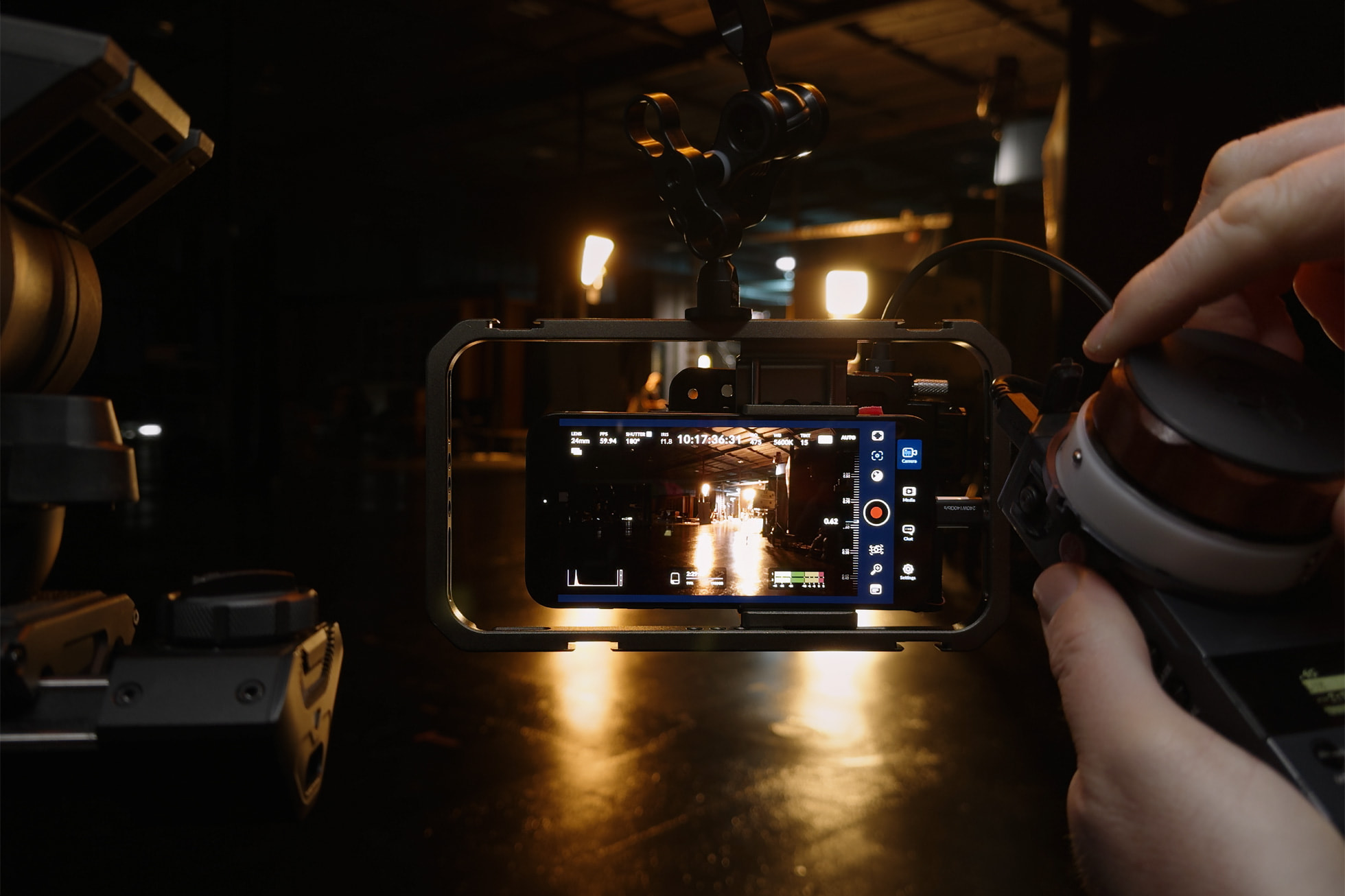
I work in TV and have spent a great deal of time on set shooting. The only time I've ever relied entirely on the camera's sensor and lens for a high quality image is shooting outside, and even then that requires adjustments, such as facing away from the sun, moving away from contrasty shadows, ect.
Outside of documentaries, every other shoot will have a great deal of time, effort, and money spent on lighting and set design to elevate what is being shot. For scripted projects/films, an even smaller % of shots will be shot with the raw, available light/environment.
What Apple did with the iPhone 15 proved that the iPhone can be used in a professional setting without being the on set bottle neck. For example, a short film shoot which had it's budget blown entirely on renting an Alexa will be bottle necked by the lack of lighting for the scene. Similarly, a short film which had its budget blown entirely on renting lights will be bottle necked if its shot on an iPhone 4.
The goal is balance and for smaller productions, that balance is found in budgeting. If anyone on set has an iPhone 15 Pro in their pocket, the shoot suddenly has a viable second camera-- maybe its not good enough for the entire shoot, but its surely going to be good enough as a B-Cam or even as an A-Cam in certain scenarios where a smaller form factor is required to get the shot.
I don't think Apple is sugar coating their demonstration here with all the expensive toys being used in parallel with the iPhone. The use of these tools in parallel with the iPhone IS the demonstration.
Like any good video, if its shot correctly and edited correctly, you won't have an easy time visually identifying what sensor is being used.