Hacker News new | ask | show | jobs
by imnotreallynew 1314 days ago
As a curiosity, how many people in this thread are home buyers that sat on the sidelines over the past year or two and are now waiting for prices to drop?

I’m in that camp and I’m starting to suspect there are enough people in that camp that any noticeable drop in prices will be immediately met by strong demand, even at current rates.

25 comments

We bought a year ago.

Since you cannot predict the future I recommend not waiting “for prices to drop”.

Instead, buy a house when you find one you love and that you can afford. Houses are not widgets- each have pluses and minuses and optimizing for price won’t make you happy.

If somebody bought early this year, they may be trapped in their home with negative equity for a decade, like many were after 2008.

Your advice is mostly sound, but buying in a bubble can have severe and very real ramifications on you, even if you can afford the monthly payment. You may not be able to move without writing the bank a large check, and many won’t have the cash on hand

You seem to be looking at buying a house as an investment. I'd argue otherwise: your first piece of real estate is a necessity, not an investment - you always need a place to live. So, in financial terms, you're closing a short position, not opening a long position.

Of course there is non-negligible friction if you need to move, so you do want to be mindful of not buying right at the peak, but in general I think you're overstating how much you need to worry about prices: you don't profit when prices go up, since you'd also have to pay more for a new place, and as long as you can afford the payments, your home moves in line with the market and don't need to sell, you also don't need to let falling prices affect your sleep. Your position is market neutral, you are mostly giving up flexibility.

While I think you're right in ordinary times, this doesn't work during a bubble. You could be totally blocked from moving if your home is worth a fraction what you owe on it, no matter how necessary the move is (job, school district, family).
Even then there are some mitigants: you could try to rent out your first home and rent or even buy a new one. Tax-wise that would work against you (usually, in most places), but it probably wouldn't bankrupt you.

I agree, of course you don't want to have bought right before a dip. But if you sketch out a few scenarios and look at the overall and your individual situation (eg, Would rental income cover credit payments, even in an adverse scenario? Do you have expenses you could claim in years when you're renting out? Do you have other uses for the property, eg within a family?), you might find that you can manage the risk (or not). It's definitely not risk-free, but there's also significant upside potential if you can make a long-term commitment.

> this doesn't work during a bubble. You could be totally blocked from moving if your home is worth a fraction what you owe on it

Do you actually mean after the bubble has burst? Because during the bubble, why would your house price be a fraction of what you owe on it?

He might be thinking of people in the US who are not in Alaska, Arizona, California, Connecticut, Idaho, Minnesota, North Carolina, North Dakota, Oregon, Texas, Utah or Washington.

In those states first mortgages are "non-recourse" loans. What that means is that if the borrower does not pay off the loan the lender's remedy is limited to whatever they can get foreclosing and then selling the house.

With a non-recourse loan if I find myself owing a lot more on my mortgage than my house is worth I've got the option of just walking away and letting the lender foreclose. I will no longer have a house after that, but my possessions and savings and investments and income will be safe.

In the other states first mortgages might be "recourse" loans. With those if selling the house isn't enough to pay off the loan they can come after you personally for the difference.

With a recourse loan the lender can come after me for the shortfall if the foreclosure sale isn't enough to pay off the loan. They might go after my possessions, saving, investments, and income.

Most people are putting down 20%. Even if you have a non-recourse loan that's a huge loss. Plus the hit to credit record means you probably won't be able to take out a new mortgage for years.

It'd only be a tiny percent of people who found themselves underwater, but with so little equity they didn't care to lose it, and who also didn't care about tanking their credit score for the next decade.

> You seem to be looking at buying a house as an investment. I'd argue otherwise: your first piece of real estate is a necessity, not an investment - you always need a place to live.

You need housing, but you can get that without home ownership.

And then it's even more expensive
Exactly. Buying is not always a good financial decision either. In current environment, renting makes far better financial sense than buying.
I wish it was that clear cut. Here in Australia there is an acute shortage of rentals and rents are going through the roof [0]. As with everything, there is always a caveat.

[0] https://www.macrobusiness.com.au/2022/05/australias-rental-c...

Very few houses were underwater for a decade, most markets were already above 2008 levels after 10 years.
Many regions were underwater for a decade, yes.

All of Florida, Vegas, Phoenix among others.

Some markets were down 60% peak to trough (Florida). The ones that rose the most also tended to be the ones that fell the most

However, they would have a loan between 3-4% which seems to 1-2% lower than current rates.
If housing collapses, rates will go down significantly. You’re not missing anything on rates by waiting
Usually you cannot, but the fed has expressly told us they will be raising interest rates. They could be lying, but I think this is one of the few times you can "predict the future" and expect rising interest rates to influence demand.
But long term treasury yields are now lower than short term treasury yields. This indicates that the market expects inflation and interest rates to drop in the future. As long as this is true, prices for houses will not go down as everyone assumes that a refi will be possible in 1-2 years. Housing market will be stuck while this sorts itself out.
You can’t refi with negative or low equity, as most who bought in the last year are likely to have.

If inflation does come down rapidly, it’s likely to be coupled with a sharp increase in unemployment.

Rates fell significantly from 2005 to 2012, yet housing continued to fall. Whether lower rates or higher unemployment is the stronger force this time remains to be seen.

Given housing is by far at a historical peak in real terms, I suspect a reversion to the mean in real prices is more likely than not

> This indicates that the market expects inflation and interest rates to drop in the future.

It indicates that the market thinks the Fed will be effective. It's also (generally) indicative that a recession is on the horizon. We're starting to see the layoffs in certain sectors (tech especially). Unemployment rising tends to cause more mortgage defaults which will tend to lower home prices.

> As long as this is true, prices for houses will not go down as everyone assumes that a refi will be possible in 1-2 years.

A lot of potential buyers don't qualify at current (and rising) rates. They've been taken out of the market entirely. Wells Fargo saying that applications for new mortgages are down 90%. Assuming that's happening industrywide (no reason to doubt that) it's going to start effecting prices - and already is in some markets.

Yep. Powell specifically said they're targeting the housing market and need to reduce prices until people can afford to buy homes again.
I thought the median home price has been pegged to the median salary of the given area for the last 50 years? How can prices fall if salaries don't?
US median home sale price increased about 40% since 2020: https://fred.stlouisfed.org/series/MSPUS

Wages increased about 15%: https://fred.stlouisfed.org/series/CES0500000003

So home prices grew faster.

Also, since mortgage interest rates have gone up higher than pre-pandemic, homes affordability is even worse.

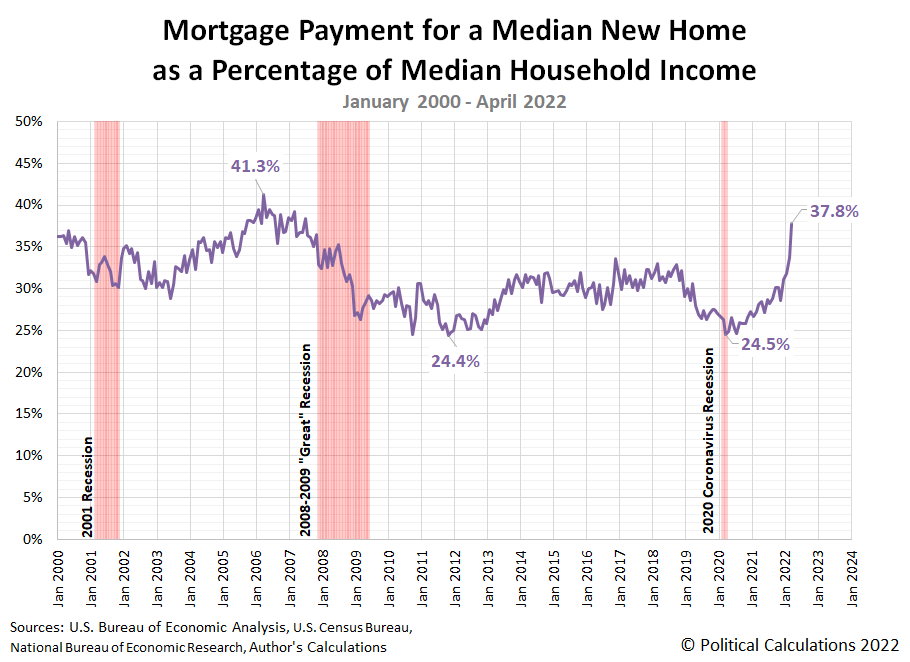
This is the chart I am referring to concerning mortgage payments, which IMO have remained within 10 percentage points of where they've been since 2000:

https://static.seekingalpha.com/uploads/2022/6/7/saupload_mo...

There is a sharper rise now of higher payments, but historically its not even where it was in 2006 and still is lower than figures not seen in this present chart, like the the 1980s.

In the end home prices don't march up in a vacuum, the money has to come from somewhere. People pay these prices and they can do so because they are skilled workers who are paid such incomes to afford homes in the Bay area or Boston or other high cost of living areas. It's not all private equity. When you add more high income jobs to an area than units of housing for decades, a housing crisis for the working class is the natural result, but for high income earners they will always be paid enough to afford the median mortgage payment or else the median will shift accordingly to meet the market where it is.

The Fed wants average salaries to fall. Either through more unemployment, or lower salaries.

Reducing the housing demand, and therefore prices or at least price growth.

> buy a house when you find one you love and that you can afford

Finding one that you both 1) love AND 2) can afford is the real trick. Most people have to choose one or the other.

> Since you cannot predict the future I recommend not waiting “for prices to drop”.

This is questionable advice, and biased I guess.

It's quite easy to review historical sale data and see if a person is buying at a peak price. No it likely won't be the only or final peak, but it's a useful indicator.

> optimizing for price won’t make you happy.

On the other hand, not optimizing for price can make you significantly unhappy. Being immobilized due to an upside down mortgage, and stretching monthly finances can be really stressful.

My wife and I just bought.

The problem for us is the inventory has completely dried up. Our market has a lot of second homes. People who wanted to cash out already have. The people who weren't ready to sell, seem to be willing to "wait it out".

In the long run, it doesn't _really_ matter. We're well within our budget and plan to be in this home for a very, very long time.

The people that aren't selling are still paying upkeep and property taxes. Unless they live in it, they will tire of the financial bleeding eventually and start to understand the "sunk cost fallacy."
Correct. However, second homes are a bit different. They don't get used as often and the financial bleeding is viewed different. They're also in a market where AirBnB/VRBO is extremely lucrative. If you can tolerate a bit of pain from renting it out, there's really no finanicial bleeding.
Anecdotally, Airbnb rentals are a lot less profitable now. An informal and definitely biased survey of friends I know who run 1-4 units: price drops of about 40% are happening, and they have significantly fewer inquiries.

I predict that will continue as potential guests tighten their belts. And as more 2nd homes are a drag on their owners cash flow, there will be more people listing on ABNB to make some cash. That will cause a glut of supply and further drive down prices.

local regulations ruin AirBnB/VRBO in most places in CA
Good, the regulations are for the benefit of residents, not faux-hoteliers.
Airbnb was benefitted me many times as a resident when the renter protections in my city made renting difficult. Renting an airbnb allowed my landlord to bypass renter protections which made it very low friction to use airbnb whereas signig a lease was nigh impossible because landlords wanted all kinds of evidence I'd be a good renter as it was so hard to kick a renter out.

By using Airbnb, I was able to continue living and working in the city by ceding away my rental protections in exchange for not needing good credit and other assurances for the landlord. Win-win.

> any noticeable drop in prices will be immediately met by strong demand, even at current rates

As long as people are okay with buying insanely overpriced homes they will not fall.

But careful, you might be fired too. Or lending may be even higher later (forcing lower prices). Or rates will be high be many years. Or you'll go underwater and not be able to refinance. Or your taxes will also go up. Or maybe you need to move/divorce. Or maybe you die and your next-of-kin can't pay the house and be foreclosured. Or maybe you can dump the cash in bonds/stocks and make more money. You may have more kids and need to move to a bigger house and be forced to sell at a loss.

For that and more, /r/REBubble/

As a curiosity, how many people in this thread are home buyers that sat on the sidelines over the past year or two and are now waiting for prices to drop?

Waiting for a price drop doesn't really work.

Firstly, when prices start to drop people stop selling. You might want a cheaper house but the supply will be severely limited so you probably won't get what you really want.

Secondly, when prices drop it usually comes with other changes in the market. Mortgage lenders are weirdly skittish at the moment, and they stop lending the instant anything looks bad. If you need a high loan-to-value mortgage (eg 90% of the purchase price) you probably won't get it in a downturn.

I bought a place about 18 months ago and got a 5 year fixed interest mortgage because I figured we're going into a period of inflation and maybe recession so interest rates will probably go up. My timing was off a bit but it's going to save me a fortune over the next few years (and then I get a huge shock when the fix rate ends... yay!)

> Firstly, when prices start to drop people stop selling.

Most people who sell their home also buy a new one at the same time. So if those folks remove themselves from the market, it doesn't really change anything as they are decreasing both the supply and demand by an equal amount.

The net balance in supply and demand comes from first time buyers, investors (both buying and selling), immigration vs emigration, and the elderly (moving to care facilities or passing away). Investors have significantly reduced purchases, and as economic conditions deteriorate I expect them to start selling (for example a lot of AirBNB hosts bought at the top of the market and are starting to get nervous as bookings are declining).

Basically, you can have a market with record low inventory and still see significant price decreases if demand is also low. The fact that we have record high employment and inflation and we are still seeing prices either level off or decline is very concerning. If employment starts declining we are certainly going to see a lot more selling pressure.

It won’t. Real estate is on track for at least 20% crash from here. People with 3% rates don’t want to sell and move to 7%. So, they are renting out at loss and therefore renting is becoming amazingly cheaper compared to buying. This further reduces demand and increases supply and it’s a classic recursive cycle that will only accelerate as rates will go up even more for next 6 months. My advice would be to rent house of your dream for next year while housing crashes. The best time for buying would be when interest rate hits below 4%.
Why would renting become cheaper? Most people have told me that there will be less people buying so more are renting, therefore rental prices go up. Right?
The number of households artificially increased as a result of student loan payment deferments and the general COVID free money bonanza. More households = more rental demand = higher rent.

Expect that to revert to the mean (people move back in with their parents, get roommates) if this is a long, deep recession. Less demand = lower prices.

Right. Rentals are scarce and sky high in my area.
I am in that camp as well. But... my rent is less than half the cost of a mortgage (including taxes and insurance) for a similar place. And this doesn't even account for maintenance costs. My landlord prefers long term tenants, so has shown no interest in raising our rent, and even if they did we are under rent control which will limit the damage. And while we are definitely paying under market rent, it is not by that much. So I feel fairly confident we can find something similar on short notice, and with more time could probably find a really good deal.

So after years of holding our down payment money in low interest savings accounts, I am now moving it into CDs and bonds that have nice returns which will result in a nice chunk of change. And if prices don't come down anytime soon, I am more than happy to keep renting. I think prices would need to drop by almost 40% before I would really consider buying at this point.

For context, I am in the Bay Area so it might be a somewhat unique situation to our market. But in the four years that I have been renting at this particular location, rents have not really moved much while house prices are up 50%.

I think I'd do what your landlord is doing if I were in that position.

Having a long term reliable renter, which I'm sure you are, give them a rent that is a good deal (slightly below market), and they'll stay. Even if your rent doesn't cover mortgage and expenses, eventually you or other renters are going to buy the property for your landlord, and that's worth a lot.

Especially if home prices are up 50% - keeping your rent stable and you there paying it means your landlord is getting a spectacular deal.

Agreed. It is worth mentioning that in CA my landlord is benefiting greatly from Prop 13. They bought the house a long time ago, it is almost certainly paid off by now. And due to prop 13 they have locked in absurdly low property taxes. This is a big quirk to the CA rental market. Anyone buying a property now in order to rent it out is going to see significant negative cash flow. I think AirBNB renters can squeak out a positive cashflow, but they better hope bookings don't dry up.
Unfortunately CDs and bonds rates are way below inflation, so you are going to lose money if you don't buy assets. I am in similar situation and don't know what to do.
Inflation is trending down and there are plenty of long term CDs and bonds with decent rates that will almost certainly mature long after this current inflationary period comes to pass. The Fed has given strong signals that they intend to tackle inflation regardless of the cost. So locking a 10+ year CD or bond at current rates is almost certainly going to beat inflation in the long term. Also FWIW, I do expect rates to continue to rise for a few more months, so I am keeping plenty gradually rolling my savings into these investments.
Inflation is trending down from 9% to 6%. The longest CDs I can find are for 5 years only with 4.25% rate. 6%-8% inflation could stay for a decade.
This was the same logic used by bulls in the GFC.

Turns out “cash on the sidelines” disappears quite fast when assets broadly devalue.

Housing is correcting faster than GFC, though it remains to be seen if it ends up deeper. But when it falls at this pace, people start to get cold feet

What's GFC in this context?
The Great Financial Crisis, e.g. 2008, housing bubble etc
But the mortgage payment is in the process of skyrocketing. Even if home values drop, the majority of people are going to have less ability to buy a house as more of that money will go to the bank.
That rewards savers. It also means savers end up saving more money, as higher interest rates reduce demand for loans creating downward pressure on the real estate market.

The spenders of what they didn't have got rewarded for long enough.

Yeah just put some change in your piggy bank every now and then and eventually you’ll have $400,000!
Even when I was a forklift driver, a job available in practically every middle-sized low COL midwest city, I could save $10k a year by only spending on necessities. That's only like 15 years to buy a house somewhere like a middle-sized Midwest town with forklift jobs. Not too shabby if you can buy a house by 33.

The piggy-bank method does work. Maybe more people should be doing it rather than us having a system inflating the hell out of our economy through loans with negative real interest rate.

I just Googled it and the average forklift driver salary is $40k. After tax and retirement you’re taking home around $2500/mo. After putting $1200 in your piggy bank you’re left with $1300 to pay for rent, food, gas, car, phone. I seriously do not think that is possible, let alone pleasant.
Saving $10k/year is $833.3/month going in to savings (so $1600 left to live with). Doable if your rent is cheap.
> the average forklift driver salary

Of course, one may choose to work harder than average to make more than the average.

> I seriously do not think that is possible

Rents can be very low in these kinds of places, especially if you're young and willing to share a house with others. I personally knew a couple who spent less than $20k a year on all household expenses; granted it was a few years ago, but they weren't even in a very low CoL area.

The downvoters are being pedantic. Sure you could save 400k in cash with thrift and gumption, but the simple fact is that almost no one does, and certainly not enough people to soak up all the excess housing stock as rates continue to rise. A person could save that, but people do not.
In a big city $400k only buys 1/3 of the house.
>I’m in that camp and I’m starting to suspect there are enough people in that camp that any noticeable drop in prices will be immediately met by strong demand, even at current rates.

Same. I dropped out of the market last year after refusing to take part in the insanity. No, I am not going to waive all contingencies, give you 5% earnest, and bid over appraisal, for the hope of having my offer selected. Hopefully this will change with the corporate money drying up.

The price of a home is what people that want to live in the area are willing to pay per month (important detail!) to live there. This is made up of the principal, the interest, and property taxes. As interest rates fell more and more, the interest part of the monthly payment went lower and the principal part went higher. Coupled with inflation, we saw dramatic rises in prices.

Interest rates are going up so we'd expect to see prices go down, and they likely will in some markets. However, we are also seeing inventory dry up since who wants to sell their house and get a new mortgage at a massively higher rate?

With a low interest rate and inflationary pressures, current home owners are living for free. They can leverage this as well as their appraisals have all shot up.

I've made this comment before but you can correctly time a downturn and still end up worse off than people who buy at the height of the market. You lose upside, low interest rates, and continue paying rent (which has zero return). It depends on how long you can hold out during a bear market and what exactly interest rates do.

Plus there's the quality of life factor if the home you purchase is a better fit for your life... spending 10 years in a home you don't enjoy has a mental cost to it.

FWIW we borrowed $2m at 2.5% (thanks Bay Area prices!) Thanks to that low rate even if the house drops in value by 30-40% we still come out ahead on the mortgage cost assuming we stay in the house. And it is likely any money not spent on the down payment or paying it off early can be invested which thanks to the current market and interest rates can take a risk to get a good return (stocks are discounted right now) OR easily find safe investments that exceed the mortgage APR.

Plus we have a house that fits our family way better with a lot more space. We also have knock-on effects (installed Solar with a <5 year payback, something renters can't do).

It is hard to imagine a scenario where waiting out this downturn would have worked out better for us.

> spending 10 years in a home you don't enjoy has a mental cost to it.

You buy a house at the top, find out you don't like it, and you'll stay 10 years in it just to break even.

That's why it is just one possibility. I usually only ever see people patting themselves on the back after the Nth time they're finally "proven right" about housing being over-valued. My point is just that you can be right about housing (or the stock market), make well-timed correct decisions, and still end up losing compared to the supposed "chump" who just went with the market. It all depends on your exact situation, exact market conditions, etc.

My guess is most people doing the back-patting have never run the numbers on an adverse scenario. They just see the top-line number dip and say "see, I was correct to wait!"

tl;dr: Run the numbers comprehensively for several scenarios. Include gains you missed out on, rates moving against you, your time horizon, risk appetite, etc. It isn't theoretical, real people have lost real money by being correct about a downturn.

> My guess is most people doing the back-patting have never run the numbers on an adverse scenario.

It's a $300K+ of lumpsum in the stock market. Usually it's the correct thing to do. But sometimes you buy at the worst time and lose ~30% or more.

We bought at pretty much the rock bottom of 2020/2021 interest rates (nothing like wiring away your hard earned money on the very same day when the US capitol was being overrun and the government seemed just about to topple…)

We had to work hard to avoid areas in SF that had been overbid. We didn’t find a bargain but we found a good deal, something that the prior owners needed to let go off but which wasn’t in a super popular area. This was in a hot market. So I think in the coming market you will find good opportunities.

So, as I obsess over listings today pondering if there might be an opportunity… I think that there will be good deals to be had, but not necessarily steals. In the Bay Area, people trip over themselves to live in a few neighborhoods so I think prices in those highly sought after areas won’t reach absolute bargain levels.

But If you are prepared and ready to step in you can already find properties that I think are marked down.

I’ve been watching closely dreaming of a place for our parents, or maybe more space for us, or maybe a rental…

Great SNL skit: https://youtu.be/yEfsaXDX0UQ

> SF...good deal..

There are no good deals in SF, those are probably the worst deals you can find in the country at any point in time.

Ultimately you have to live somewhere and people don’t choose to live in the cheapest place “in the country at any point in time.”

At the time we bought we found a house that gave us more space than the apartment we rented previously and where our newly arrived daughter could spend her first few years. It’s not one of the trendy neighborhoods and yet it’s close to downtown SF and the peninsula, where we work. We can afford it on one income. All those factors made it a good deal for us. I feel ok about it so far, but I’m certainly open to the possibility that there are better options.

I have not found that to be true unless you are looking for a standalone single family home. If you are looking at condos, SF has had good deals during the pandemic as that particular market segment has been hammered.
Almost bought a second home a year ago to get out of (and sell) our starter home. Was looking at houses with a realtor, a few new constructions, etc. Both glad and not glad we didn't buy at the time.

Glad because everything is likely to crash at this point and we would certainly have an underwater mortgage, but not glad because with the more than doubled mortgage rate since we were looking, it'd be stupid to sell our current home and upgrade now (especially with prices still high), so now we feel stuck (granted, stuck in a home with a fairly cheap mortgage payment, so it could be worse, but stuck nonethless).

We also held off on refinancing during the super low mortgage rates, because we were pretty sure we were going to buy a new house so it would have just been wasted money, but now it's obvious it would have saved us some money. I had a feeling that would be the case, but my wife seemed adamant we were going to move last year (until we both got too busy with work), so I held off on pursuing it.

I'm in that camp, kinda. We're looking for a small "vacation place". The area we wanted to buy in saw ~40% increase in the first half of this year. We hope it goes back down the same amount (but have no idea!)

In my case, I think it is increased AirBnB demand. Don't know if that will start to ebb.

> I’m in that camp and I’m starting to suspect there are enough people in that camp that any noticeable drop in prices will be immediately met by strong demand, even at current rates.

What you're missing is that when the bottom is in nobody will want to buy a house. They'll be way too terrified or plain incapable of acting. Afraid of losing their job. Of further declines. Of the bottom falling out of the economy. Of homelessness invading their area. Of they job they lost.

Depends on the location but I would say that there are going to be a lot of people who bought homes on expected gains in equity / salary that haven't priced in inflation. Ive been watching homes in a couple markets and the prices have come off and things aren't moving quickly.

If you want to see significant drops in pricing thats going to depend how the winter macro economic environment hits everyone. Next summer is when you will see movement is my suspicion.

Well, the problem with this strategy is it assumes you're employed and still in a financial position to buy a house once prices drop. Housing price drops are rarely disconnected from wider economic issues. If you're unlucky enough to be in the 13% at Facebook then you're likely going to be unable to take advantage of lower house prices when they finally drop.
Me - I can't imagine it changing, in the Bay it also blows my mind houses that were 1.3MM pre pandemic are now up to 2.3MM
Even well before the pandemic, Bay Area prices were out of line with fundamentals (i.e. completely insane).
It's an interesting question, but you might also want to ask which markets people are based in. While the overall economy, interest rates and other factors do correlate to some extent, of course, some other important fundamentals (and price movements) can vary significantly even within the same country.
Home prices won't drop unless people are forced to sell by massive unemployment. Otherwise they'll just sit.
Half of the posts here over the last few days are about layoffs. Maybe we are in the midst of “massive unemployment”?
Lol this is just the beginning.
Some owners will also be forced to sell as adjustable rate mortgage monthly payments increase. Those have still been popular among small investors (and some individual homeowners trying to live beyond their means).
Only 10% of mortgages are ARMs and a smaller subset of these folks may not be able to afford and forced to sell. This is not going to be the hail mary people need.
Institutional investors, flippers, etc almost all use revolving credit lines that adjust with the fed funds rate.

Investors have been ~20% of the market in recent days. The smart ones hedged for interest rate risk, but most didn’t

Prices aren't going to drop significantly in major markets because political forces won't allow it--there are simply too many retiring people with the bulk of their assets tied up in their house. Probably prices will get eroded by higher-than-usual inflation until they come down to somewhat sensible numbers in real dollars, which is somehow more politically palatable, but that's a much more gradual process, so there won't ever be a "great time to buy" in that scenario.
We were thinking about buying for ourselves but opted not to.

However we did hedge that decision by buying my mother in law an apartment and essentially becoming her landlords. We timed it as well as we possibly could have and locked in 2.5% on a 30 year in December of 2020.

You will be catching a falling knife. You think people are going to jump in while prices are falling? That's not how it works.

And what part of economic collapse do you all not get yet?

We have waited the last couple years, so it's no sweat to wait another year or two for the prices to correct and interest rates to come back down to Earth.
I'm with you there and I know several others who are too. I don't see home prices coming substantially for hot markets for this exact region
I’m gonna be buying once my lease is closer to done. I’ve been watching the prices fall in a nearby city for about a year
boomers are going to start downsizing or moving to retirement communities eventually. I'm holding back part because of what you said, and part because I can't really make up my mind about where I want to live long term. Happy to rent and collect index funds in the mean time.
boomers are going to start...

Whatever the Boomers are going to start doing, the majority of them have probably already done it. I'm the last of the Boomers, depending how you measure, and typical retirement age is single digit years away for me. The first of them started whatever they were going to start doing close to fifteen years ago.

75% of my neighborhood is old people slowly dying, or moving to retirement facilities.

When I took my two year old trick or treating last week, I got a lot of comments on how nice it was to see kids in the neighborhood again.

Then the next major milestone for the early ones then will be assisted living and death, both of which will free up homes and other assets.
The big trick is that a lot of systems right now for older folk are built around taking over legal custody of their home, as payment for end of life care or for living money because boomers didn't save for retirement. I don't think we are going to see boomer housing turnover to younger generations. The boomers broke basically every system and process designed to let the next generation get on their feet.
maybe not via inheritance, but in most cases these homes will be sold on the market or the land will be redeveloped into other housing.
But if they are sold to people who then rent it out, instead of selling it as a home, it has reduced the stock of housing. The game being played is to try and force as much of the US as possible to be renters instead of owners.
maybe, my parents are in the middle and they'll probably stay in their house for another 5-10 years I guess.