Hacker News new | ask | show | jobs
by notch656a 1318 days ago
Usually you cannot, but the fed has expressly told us they will be raising interest rates. They could be lying, but I think this is one of the few times you can "predict the future" and expect rising interest rates to influence demand.
2 comments

But long term treasury yields are now lower than short term treasury yields. This indicates that the market expects inflation and interest rates to drop in the future. As long as this is true, prices for houses will not go down as everyone assumes that a refi will be possible in 1-2 years. Housing market will be stuck while this sorts itself out.
You can’t refi with negative or low equity, as most who bought in the last year are likely to have.

If inflation does come down rapidly, it’s likely to be coupled with a sharp increase in unemployment.

Rates fell significantly from 2005 to 2012, yet housing continued to fall. Whether lower rates or higher unemployment is the stronger force this time remains to be seen.

Given housing is by far at a historical peak in real terms, I suspect a reversion to the mean in real prices is more likely than not

> This indicates that the market expects inflation and interest rates to drop in the future.

It indicates that the market thinks the Fed will be effective. It's also (generally) indicative that a recession is on the horizon. We're starting to see the layoffs in certain sectors (tech especially). Unemployment rising tends to cause more mortgage defaults which will tend to lower home prices.

> As long as this is true, prices for houses will not go down as everyone assumes that a refi will be possible in 1-2 years.

A lot of potential buyers don't qualify at current (and rising) rates. They've been taken out of the market entirely. Wells Fargo saying that applications for new mortgages are down 90%. Assuming that's happening industrywide (no reason to doubt that) it's going to start effecting prices - and already is in some markets.

Yep. Powell specifically said they're targeting the housing market and need to reduce prices until people can afford to buy homes again.
I thought the median home price has been pegged to the median salary of the given area for the last 50 years? How can prices fall if salaries don't?
US median home sale price increased about 40% since 2020: https://fred.stlouisfed.org/series/MSPUS

Wages increased about 15%: https://fred.stlouisfed.org/series/CES0500000003

So home prices grew faster.

Also, since mortgage interest rates have gone up higher than pre-pandemic, homes affordability is even worse.

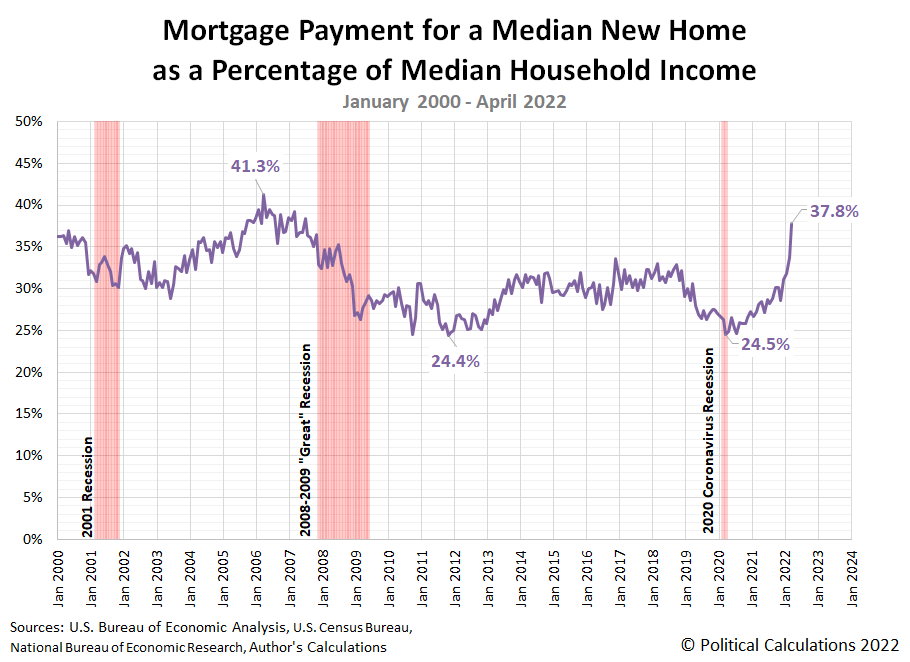
This is the chart I am referring to concerning mortgage payments, which IMO have remained within 10 percentage points of where they've been since 2000:

https://static.seekingalpha.com/uploads/2022/6/7/saupload_mo...

There is a sharper rise now of higher payments, but historically its not even where it was in 2006 and still is lower than figures not seen in this present chart, like the the 1980s.

In the end home prices don't march up in a vacuum, the money has to come from somewhere. People pay these prices and they can do so because they are skilled workers who are paid such incomes to afford homes in the Bay area or Boston or other high cost of living areas. It's not all private equity. When you add more high income jobs to an area than units of housing for decades, a housing crisis for the working class is the natural result, but for high income earners they will always be paid enough to afford the median mortgage payment or else the median will shift accordingly to meet the market where it is.

The Fed wants average salaries to fall. Either through more unemployment, or lower salaries.

Reducing the housing demand, and therefore prices or at least price growth.