Hacker News new | ask | show | jobs
by minutillo 1401 days ago
There's another reason why touchscreens are used. It breaks up one of the "long poles" in the project schedule.

Hardware buttons and switches have to be designed, tested, re-designed, and validated very early in the process of designing a new model so that there is time to figure out how to manufacture / source all the parts, how they integrate with the rest of the car's systems, and how they'll be wired and assembled. Just imagine what the impact would be if late in the process a new feature needs to be added! Pretty much forget about it, add it in the next major model refresh.

With a touchscreen all those dependencies go away. The hardware team just says "there's going to be an iPad sized capacitive touch screen here for climate/infotainment, and another custom sized display here for the instrument cluster". The software guys can independently do the design of the UI, changing things down to the very last moment, or even after the last moment if the car can be updated.

30 comments

The solution to that is simple. Put four/five physical buttons down each side of the screen, maybe along the bottom too, and then you can make everything still programmable in software. I have no idea why you absolutely need to put buttons in the middle of the screen to be touched. It's one thing to put items or whatever that can be selected, or allow pinch/zoom, but in reality almost all interaction just boils down to picking between a limited set of options at any given time.

With a decent response time and hierarchical menus, it's easy to make a system that is navigable without looking. Throw in some (hopefully non-annoying) audio feedback, and it is extremely accessible--even by a blind passenger! In fact, that's a good benchmark. If a blind passenger could operate the thing, then the driver should be able to as well.

This. %100 this. The airline industry figured this out years ago with some of the cockpit controls. (admittedly there are a lot of other buttons and switches for the pilot to worry about too, but it seems like the digital display panels always are flanked by rows of buttons which were used for interacting with the panel. Works great even with gloves on and does not lock you into a single feature set.
Lab equipment does the same thing. Decades ago, oscilloscopes started having banks of buttons corresponding to an area of the screen, and knobs that have context sensitive functionality.

Those can be placed side by side with buttons that have fixed purposes delineated by printed or debossed lettering.

I realize that we're getting pretty far from the automotive use-case, but this style has worked remarkably well over the years, and has made it into all sorts of equipment.

Two more examples that everyone ought to be familiar with- ATMs and electronic voting machines
A few months ago I met a teen (maybe 15 y.o.) who was trying to withdraw money from an ATM that had a non-touch screen. He kept failing and trying to tap on the screen.

He was doing it for his grandfather, a wheelchair user, who was nearby. The grandpa couldn't use the ATM himself because there was no wheelchair ramp. Seeing the teen's failing attempts he started asking passerby for help.

My takeaway from this story: we need more wheelchair ramps, not touchscreens.

Seconded. Touchscreens are great in many contexts but I have never liked them on atms. The latency between tapping something and the result might be the bank checking my account balance, or might be something wrong with the UI. When I'm dealing with money stuff I don't want any distracting ambiguities.

Having said that I like machines enough that I assume I can figure anything out because it was intended to be used by someone, so I rarely struggle unless it's a truly awful design. Touchscreens are way more intuitive for most people, though in cases such as you describe I wonder what the helpless people think the buttons outside of the screen are there for and why they're reluctant to try pushing them.

ATMs in my area have started to ditch the physical buttons.

I’ve never seen an electronic voting machine and hope I never will.

I suppose it doesn’t rain much in your area? Buttons tend to work even when moist. Touch screens tend to give you the wrong amount of money out of your bank account.
When did you last vote? The 2016 election is when I first experienced them. I asked to vote by paper as I wasn't comfortable with electronic voting machines, so they gave me a paper and pen to fill it out, which I was then to feed into the computer.
Two more examples:

The context dependent buttons on old feature phones

The red/green/yellow/blue buttons on old TV remotes for Teletext

Military equipment commonly uses these Multi Function Displays too.
Not to mention every video game system ever.
and cockpit display systems
Professional audio equipment has been doing this for awhile too
Just learned a new word, "debossed" and I love it
If you look at those MFDs, many also have rotational controls in the corners (some even have two levels of dials, one sitting on top of the other), which are another key way to keep the UI tactile and promote muscle memory.

Things like eliminating lag, organizing menus into predictable paths that can easily be committed to muscle memory, and designing buttons and dials that can be used even in high vibration environments, are all key design criteria for these cockpit controls. It's so sad that automotive design refuses to take any lessons from that industry.

When using the touchscreen in my old Nissan Leaf, I used to anchor my thumb underneath the display so I could hit controls reliably via muscle memory even when the road was bumpy. Preposterous that we have to do these kinds of hacks when there are much better solutions.
This comment reminds me of this video, where a F-15C fighter pilot breaks down the "Human Interface" in the cockpit where there are over 250 buttons and various other displays including HUD and panels and a button they aren't allowed to press because it requires an engine rebuild afterwards: https://arstechnica.com/features/2020/06/human-interface-com...

It suggests it was meant to be part of a series but I've not found any other examples????

I was going to cite the example of the Garmin G1000 glass cockpit. Even moving a cursor around a map requires pushing a physical knob in 360° to guide it.
I wouldn't call the Garmin G1000 a paragon of UX design though. I wish there were some serious competitors that would give the UX another try (like Avidyne), but Garmin seems to be the standard now.

Philip Greenspun wrote about some of its problems (back in 2006):

> In some ways this makes life more difficult for the pilot. For example, suppose that you are busily trying to fly the airplane and study an approach plate when ATC gives you a new transponder code. With a less integrated system, you know exactly where the buttons are to enter a transponder code and your fingers will find their way there almost automatically. The buttons are always in the same place, i.e., on the physical transponder box, and they never change their function. With the G1000, you find the soft key labeled "xpdr" and press it. Then some more soft keys take on the function of digits. It is clearly a less direct and more time-consuming procedure. Similarly for entering a frequency into COM 2. With a traditional radio stack, you reach over to COM 2, which is probably underneath COM 1 and labeled "COM 2". You twist the knob that is always there and that always adjusts the COM 2 frequency. With the G1000, you study the COM freqencies display (typically four numbers) and figure out which number is surrounded by a box. This is the number that you are going to be changing if you twist the COM knob. If the box isn't surrounding the number you want to change, you have to think long enough to push the COM knob to toggle between "I'm adjusting COM 1" and "I'm adjusting COM 2" modes.

> A 1965 Cessna has what computer nerds would call a "modeless interface". Each switch and knob does one thing and it is the same thing all the time. This is a very usable interface, but it doesn't scale up very well, as you can see by looking at the panel of a Boeing 707. Both the Avidyne and the G1000 have some modal elements. Knobs and switches do different things at different times. The G1000 is more deeply modal and therefore, I think, will always be harder to use.

https://philip.greenspun.com/flying/avidyne-versus-garmin

> I wouldn't call the Garmin G1000 a paragon of UX design though.

In some ways I would. I wouldn't call it "intuitive," but once you understand its semantics, it's phenomenally predictable in its behavior. And quite well thought through I think. Here's one of my favorite examples: On the MFD, in an urgent situation, two of the most helpful pages are the "map page," and the "nearest page." These are (unintuitively) the first and last page. Until you realize that that means you can access both without looking which page you're on by spinning the page knob either all the way left or all the way right.

It isn't perfect, but I find it generally well thought through.

I certainly can't argue with the points about transponder and com1/com2 inputs, but within the parameters for the device, I consider the UX for the G1000 to be ... maybe not a paragon in its entirety, but certainly much more thoughtful than what I encounter in other life daily.

many ATM machines I have seen do this as well -- just a blank set of buttons on either side of the screen
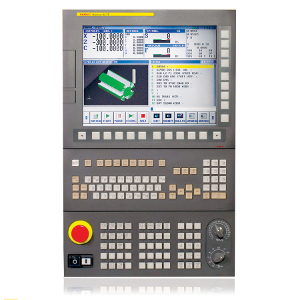
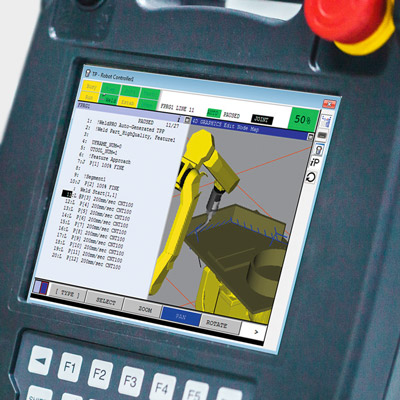
CNC, robotic, and industrial equipment too: Human-machine interfaces have rows of "Soft keys", buttons whose function changes depending on the context. Many machines used soft keys in the ages before touchscreens were available, but manufacturing is slow to change and even with the advent of multi-touch high-resolution color displays, they've remained. For examples:

https://www.fanucamerica.com/images/default-source/cnc-image...

https://www.fanuc.eu/~/media/corporate/products/robots/acces...

https://i.imgur.com/3vsHBhl.png

(OK, maybe the AB went a little overboard on the number of function keys...) but these are really effective tools to structure menus and build HMIs.

I'm not so sure that's an optimal solution. If you are going to use the display to show the UI, you may as well just use touch interface, as long as it is responsive enough. Physical controls make more sense when they are optimized for ergonomics so that they can be used without looking.
> If you are going to use the display to show the UI, you may as well just use touch interface

This is just absolutely not true in practice.

Many synthesizers have the described design where you have a set row of knobs or buttons and what those controls do changes based on the current mode or state. A screen tells you the current function of each control.

It is much easier to build up muscle memory that lets you grab the right control and do what you want than it would be if you had to interact with the screen itself. The difference is so stark that it's hard to even explain if you haven't experienced it first-hand.

And this is for musical instruments used in live performance, often in the dark, where muscle memory and interacting instantly and correctly is vital.

Exactly, trying to use a software synth without some sort of hardware interface with physical controls becomes a nightmare very quick in any situation that isn't just sitting on your computer at 12am leisurely editing synth patches.

The same it turns out is true of steering a multi-thousand pound metal rolling deathbrick.

Even those kinds of modal interfaces with physical knobs/switches/buttons are often regarded as clumsy and aggravating compared to knob-per-function interfaces where everything control does just one thing and always that one thing.
I think the point here is that most people who use the interface a few times will learn the necessary key sequences. This learning can happen with the car at rest, and after that the user can keep their eyes on the road. It's not perfect, as some people have a slower learning rate than others, but it's sure better than a touch screen.
Well, if the control all change in meaning depending on the interface state, you can only memorize sequences if there is a reset somewhere. And those will probably be very cumbersome sequences.
If there are "back" and/or "home" buttons that's a non-issue. And that's been my experience with oscilloscopes with this kind of interface.
Most of the ones I have used allowed you to navigate the UI using physical buttons on the steering wheel. Something similar to a up/down/select/back button group with some other specific buttons for frequent actions.
Yes, buttons on the steering wheel are ones of the most useful ones, though even they become capacitive e.g. in new VW, BMW, Tesla Plaid.

I have a VW car with a basic HUD (2015-ish era HUD, where a glass pops up). It can show lane keeping state, adaptive cruise control, current speed, recognized signs and navigation directions. Those features are essential for normal driving, so I don't look at all on the instrument cluster (either dials or the screen). The fact that you don't need to look down and change the focus of the eyes makes a significant difference.

That's fine if the controls work without significant lag. Last week I drove a minivan whose blower speed was controlled by a multi-purpose knob, and each speed change took several SECONDS to be affected. Pathetic.
Very common in military systems as well.
> The solution to that is simple. Put four/five physical buttons down each side of the screen, maybe along the bottom too, and then you can make everything still programmable in software.

This, though functions like climate control, audio, and anything needed to operate the car while in motion should still have dedicated buttons. Touchscreens in cars are an abomination.

> I have no idea why you absolutely need to put buttons in the middle of the screen to be touched.

They don't need to, they're just following the touchscreen all the things UX fad. Turns out capacitive touchscreens were a great fit for cell phones, but that doesn't mean they have a place anywhere else.

Why are capacitative touchscreens such a great fit for cell phones? Because the physical size is so limited. You want to use the same physical space for output (screen) and input (buttons). For a car instrument panel, physical size mostly isn't a concern.

"Touchscreen all the things" was cargo-culting. Apple made a trillion dollars with touch screens, therefore we should use touch screens too.

There are truly obscure things in cars you don't do often. Changing settings. Programming the radio. Changing a drive mode for specialized off-road use. Getting a report on usage / economy / etc.

If an operation is infrequent and doesn't need to be made when driving, burying it in a touchscreen menu sounds great: conserve those physical control surfaces for stuff that matters so you don't have a ridiculous surplus of buttons. You can go and put the majority of functions on touchscreen menu hell. But don't go and put the climate or windshield wipers or even audio modes on touch surfaces, please. :/

> If an operation is infrequent and doesn't need to be made when driving, burying it in a touchscreen menu sounds great: conserve those physical control surfaces for stuff that matters so you don't have a ridiculous surplus of buttons..

That's a bit of a straw man. No one seriously says literally every function needs a button.

And it makes sense to bury seldom-used things in menus. However, there's no reason those menus need to be touchscreen menus.

E.g., in my car, care settings are in a menu, but the screen for it is in the instrument panel and controlled by buttons on the steering wheel. I believe the reason is when it was made they still offered a low-end trim level without a touchscreen entertainment system. This menu is better than a touchscreen, but IMHO it would have been better with done with menu-buttons in the center console screen.

> That's a bit of a straw man.

It's not a straw man; it's nuanced agreement. It's a shame that people expect argument so much that they can't see where the edges of one opinion are being offered.

> However, there's no reason those menus need to be touchscreen menus.

Might as well be touchscreen menus. Using up and down buttons to pick things in a modal interface isn't clearly superior to a touchscreen for experienced users and worse for new people.

A good button menu system is better than a bad touchscreen, especially with experience. But in a rental car, I appreciate the touchscreens to pair my phone, etc.

And speaking of audio, make the volume control a real analog knob that's directly in the output circuit, so when I quickly spin it down it immediately goes down. Not some encoder that's trying to rationalize how far down I really meant to turn it, with an inevitable delay.
> make the volume control a real analog knob that's directly in the output circuit

I don't miss noisy potentiometers :D

And having a bus with user operations being streamed to it means that designers can choose mappings and behaviors late.

The issue is the delay. I have a lot of amplifiers with knobs that are perceptually instant, even if they really are encoders behind the scene. Stuff is fast enough now that there's no reason for delay. I've built control systems that use encoders that operate at 1000Hz over slower embedded networks than are in modern cars.

And stop having bizarrely chunky steps between volume levels, too. It annoys me regularly that so many of my digital devices have less than a dozen steps between minimum and maximum, leaving me with either too quiet or too loud, and nothing in-between.
If you’ve ever rented a car in another country, you will find yourself in those menus. Probably while driving. The best cars are when the menus are easy to get to, using buttons on the wheel.
> But don't go and put the climate or windshield wipers or even audio modes on touch surfaces, please. :/

I agree with that, but I don't see any added value of a touchscreen for the other things you mention. It could as well be a deep menu that is still accessed with many button presses to drill down into it.

> It could as well be a deep menu that is still accessed with many button presses to drill down into it.

I think if I'm not driving, the usability of picking from menus by touch is usually nicer than using buttons to navigate.

If I'm really experienced with the controls, buttons are better than a meh touchscreen.

In a rental car, I appreciate the touchscreen menus.

And even then… there were people that still preferred the physical keyboards on smartphones even as they fell out of fashion because everyone was chasing apple.

Swipe keyboards are good enough and physical keyboards are out of fashion long enough that it’s been a while since I’ve seen an bluetooth keyboard build into a phone case. But I haven’t actually tested my preference in years.

Car manufacturers are not cargo-culting Apple as much as Tesla. People in industry saw touch screen and went meh, but then people voted with wallets and opinions (Tesla has one big touchscreen, so modern, so much wow, lightyears ahead of everybody else! - heard it gazillion times in the past, no matter how much I tried explain to folks how utterly shitty and cheap that approach is in cars).

In similar way as current/recent SUV cargo-culting. For premium performance manufacturers like Porsche or BMW it didn't make sense, why have bulky car with shitty driving characteristics, slower, much higher roll risk, much higher center of gravity, much smaller inside space than usual family wagons, that costs more to run and buy it from premium brands... thats what you have Fiat Peugeot etc for. Especially for people who drive on paved roads 99/100% of the time, ie typical soccer moms.

I know that inexperienced drivers enjoy higher seating position and feel safer, but I would suggest taking some driving lessons if thats a problem for a given driver, much better results and resulting real safety.

Yet Cayenne and X5 and whatnot sold like hot cakes for premium money because footballers and other celebrities bought them, so eventually every manufacturer jumped on that bandwagon, screw any logic if people buy it. The more performance the brand, the longer it took them to pick this trend up, and thus Ferrari is the last (from what I gathered, not following this topic seriously). And so folks today buy crossovers and god knows what other names are in vogue these days, which are tiny short cars with high ground clearance. To drive in cities.

Even an experienced driver can appreciate not having the view completely obstructed by the clouds of droplets from the wheels of other cars in a rain and no amount of driving lessons can make one see through the water. On top of better visibility in all weather conditions, SUV offer easier loading/unloading, easier access for setting up children in the child seats and, even though not an off-road vehicle, still much better in the adverse weather (snow, floods) because of high clearance. If you're are not racing the only reason to choose a wagon is the few more cubic feet of room are more important to you than anything above. This is why SUVs displaced wagons IMHO, I doubt people buy so many RAV4s and CR-Vs in the US just because of some footballers who bought Uruses.
> Even an experienced driver can appreciate not having the view completely obstructed by...

Couldn't agree more. I have ~50 hours of seat time driving a high performance mid engine car on a track but in any amount of traffic I prefer my truck. Better visibility, and (imo) better safety due to weight.

It's rarely brought up but even an elementary understanding of physics makes it obvious that less massive things are more fragile and susceptible to deformation than more massive things, all else being equal. Sadly that last point involves a zero sum game: the safer a heavier vehicle is to its occupant the more dangerous it is to others. Even more sadly its a game many people are forced to play.

I don't think that's the reason.

Touchscreens let you build arbitrary UI/UX. You can click anywhere and do gestures anywhere and type anywhere. When there doesn't need to be UI, like when watching a video, the whole phone is the screen. So the UI can optimize for the best UX. It's much more powerful.

With physical buttons, software is pigeon-holed into UI designed around those buttons. It's a massive trade-off. Something we take for granted like navigating a website becomes much more tedious when you only have buttons.

Just look how much effort goes into making software-specific hardware like the scroll wheel/drum on old-gen music players like the iPod, yet it doesn't solve something as simple as typing in a song search query.

> Why are capacitative touchscreens such a great fit for cell phones?

Because you are always staring at the display while using it?

I touch typed this comment but never obstructed the display to do it.

Why would I want I/O to become IO?

I would love a cell phone in a Multi Function Display(MFD) format A row of soft buttons down each side(a software ecosystem that expects soft buttons is also needed).

It would be great, there is very little in the way of a worse UI than trying to use a touch screen in a moving vehicle.

Remember, even the original iPhone still had physical buttons/switches for Home, Sleep/Wake, Ring/Silent, and Volume Up and Down.
It's interesting that Apple still keeps silent toggle switch on iPhone. It looks useful but now Apple sells Apple Watch.
> "Touchscreen all the things" was cargo-culting. Apple made a trillion dollars with touch screens, therefore we should use touch screens too.

IMHO, that's one of Apple's biggest competitive advantages. They have so much cachet that everyone assumes whatever they do is "best" and mindlessly apes it. That way they never have any real competition, because followers are always at least a step behind.

> Turns out capacitive touchscreens were a great fit for cell phones

Yes but to be clear they are still an enormous compromise there. Maybe it is this generation of UX people, maybe it is fundamental to the technology, but there hasn't been much advancement in touch interface tech in years. Apple tried "deep touch" or whatever with feedback but then abandoned it because nobody (users or devs) wanted to deal with it. We just deal with all the downsides of touch screens because the rest of the device gives us such an incredible capability, even with the (sometimes literally) painful UX.

> Turns out capacitive touchscreens were a great fit for cell phones

Sure. However removing the physical buttons on cellphones was a pretty big loss that the touchscreens do not make up for.

I disagree. Increased screen size as a result of removing physical buttons makes up for the loss of physical buttons in my view.

You can now watch a movie, play a game, even browser a crappy website with desktop-only layout on an iPhone Mini. Try to do this if half the screen estate is replaced with physical button.

I am a big fan of physical buttons though, I which apple would add more of them on the sides, with some programmables, that would be awesome. Some Android devices have this for example.

Maybe not in usability but in component costs it likely was great.

As you know, products aren't made for the customer, they are made for the equation: customerMoney - (ProductionCost + MarketingCost etc etc) = Profit

Another solution is to not make every make and model have a completely custom dashboard interface. The physical interface for turn signals is completely standardized. The physical interface for windshield wipers is about 95% standardized (I wish we would finally decide on if the short bar or the long long bar indicates frequency of activation or delay between activations). The physical interface for the radio is mostly standardized, at least the icons on the buttons are well defined and understood. It just gets worse from there. The climate controls look standardized, and often have well-established icons and coloring, but not standard positioning. Then again, even things that are standardized, people can't fully grok: how many people know how to find out which side of the vehicle the gas tank is on while sitting in the driver's seat? It's so goofy, the Mini I drive regularly is infuriating because the touchscreen has a paddle/joy-knob in the center console for navigation, and you turn it COUNTERCLOCKWISE to move "forward" and "down" through menus/option lists.
> The physical interface for turn signals is completely standardized.

You might think that, but lots of people complain about how BMWs have different turn signal stalk behavior than other cars.

In my area, Tesla's too. Particularly after they superSpecialZoom off at the lights and then want to change lanes - into me on my motorbike.

Easy enough to dodge but it'd be nice if people didn't simply assume they are alone at the front. I don't.

>> how many people know how to find out which side of the vehicle the gas tank is on while sitting in the driver's seat?

Is there actually a way (apart from pulling a lever to open it and looking in a mirror if it is the type which flips open)?

The symbol on the fuel gauge indicating the side of the tank opening is a myth isn’t it? Doesn’t consistently hold true for my car, and people seem to remember the version the does - does the hose indicate the side of the flap or the side the hose needs to be on?

> The symbol on the fuel gauge indicating the side of the tank opening is a myth isn’t it?

It exists. It's a small arrow, and most _rental_ cars have it. For cars sold to the public it's hit or miss. My new car doesn't have it either.

The symbol is an arrow[1], not the hose.

[1] https://6abc.com/gas-tank-indicator-prices-road-trip-tips-su...

Encoders are great for this too. Music hardware often uses mappable encoders with LED rings to indicate the current value, and/or with the screen showing what the encoder is controlling.

https://www.ableton.com/en/products/controllers/apc40mkii/tr...

https://www.native-instruments.com/en/products/komplete/keyb...

Yep -- my favorite version of this is in the Ensoniq ESQ-1. 1980s box that helped pioneer the use of digital readouts in synths. Digital readouts eventually became terrible in synths because of "menu diving" (look into the Yamaha TG-33 for an awful example). But the ESQ-1 had a few cool features to keep editing simple:

1. The entire page hierarchy was only one level deep. You had 10 buttons that select a parameter, and a single data entry slider. So, with two hands, you could very rapidly manipulate parameters. I believe the Yamaha DX7 also had this, but what made the ESQ-1 cool was that the button usages were listed right on the digital readout next to the buttons themselves, rather than off to the side and hard-coded to the parameter. So it was like hitting a hardware button that could automatically remap.

2. Again unlike the DX7, there was no button-press needed to "edit" -- you just hit the button and moved the slider. It felt very natural to use even though it was technically a digital parameter being editing. If you needed additional editing power, you could still hunt for the other buttons outside of the 10 "screen" buttons.

I had one about 5 years ago, and swapped it for a JP-8000. I regret it. Very cool synth, very innovative UX.

Even for buttons I've seen small matrix displays beside the button (or even underneath its plastic shell) acting as the label and indicator. This prevents the need of having the programmable buttons next to the screen, but at increased cost.
I have a Roland FANTOM keyboard which has a touchscreen UI, however it also has a row of knobs and buttons that offer an alternate control surface without having to touch the screen. It's so much better.
> With a decent response time and hierarchical menus, it's easy to make a system that is navigable without looking.

There is a difference between working with a touch screen where you can focus on it and using a touch screen where you need to focus elsewhere (like the road). There is also a difference between something like a plane where you have a great distance from other moving objects most of the time and a car where you are regularly around other cars.

My wife has a slightly older car with no touchscreen. We can operate it by feel. Without ever needing to take our eyes or focus off the wheel. My car has a touch screen. I can't operate that by feel. Constant glances are required.

These are different experiences. Looking at the situational environment is important when creating a good user experience.

I wish I could buy a car with more physical buttons. Would make the whole car driving experience more usable with me as a less distracted driver.

Those same systems are used in jet fighters and ground attack planes where they (along with a HUD - another thing now available in cars) are used to support split second decisions.

Having tactile, easily memorized controls with screens is a solved problem in the avionics industry. It's just that car makers refuse to learn any lessons from them.

BTW, what you are describing has a name: "Soft keys", and had first been developed for use in air plane cockpits. (<https://en.wikipedia.org/wiki/Soft_key>)
Computer keyboards have had them for decades also (PF keys, labeled F1--F12), though I've only really seen them used on mainframe terminals and old DOS programs like WordPerfect.
As you say, not much seems to make deliberate use of them as a constant feature such that you could expect familiarity to be rewarded. So, with the Functions on keyboard they are usually a lucky dip.

Soft keys specifically have an intuitively understood relationship - usually through physical placement - with the screen to link them to their purpose. The "softness" is about the keys purpose, as it can change depending on context of the screen.

A key without a intuitive link to the patch of screen, is just another F-key...

They really should.

Even commercial and fighter aircraft -- which have human-interface requirements of incredible depth and complexity -- are transitioning to large touchscreen displays. ALL of which require physical boundary buttons and knobs as a redundancy for touchscreen controls.

In fact, controlling the screens via buttons are the preference for many pilots since accurately fiddling with touchscreens during turbulence, pulling Gs, evading missiles, while being task-saturated etc is very hard to do, but doing the same with physical buttons is far more reliable. Button-pushing tasks can be performed from memory in the blind (or while not looking) (a.k.a. "memory items").

There's always been a dichotomy in human-machine interfaces between airplane customers (airlines, charters, governments, and militaries) vs. their own pilots. Airplane builders have to keep up appearances and look cool by putting in putting in flashy, futuristic features like big screens and AI, and ditching old button-laden displays and the "old way of doing things." It too often disregards the needs and wants of pilots and "human factors" engineers. Fortunately, safety comes first, so the buttons and redundancy must stay.

FWIW this is what Audi's MMI does. (Or used to do? My car is old.)

The control panel has:

* 6-8 buttons for switching between different MMI modes, labeled

* 4 universal buttons, function contextual to the current screen

* 1 return button

* Turn/press controller

I can navigate 90% of the menus blindfolded. Despite my older MMI not being a marvel of UX, I can access functions 5 actions deep, while driving, from pure muscle memory.

Audi's phased out the entirely physical-button driven interface in favor of touchscreen and trackpad-based inputs. There was a generation in between that also had an odd and extremely large implementation of the legacy combination dial/joystick/button thing.
That sucks. Touchscreens have become so cheap (because economies of scale), Audi is probably saving manufacturing cost by not having physical buttons, simply because of the custom design cost of integrating buttons into a PCB and then programming it[1]. Touchscreens might even be cheaper than non-touch screens. They often have higher resolution. Audi is probably transitioning to using software stacks designed to build touch-screen apps instead of buttons and don't want their software devs to even think in that outdated mode of "buttons". It's completely self-serving and chasing the design trends, tripping after Tesla tech woo, not consumer demand.

[1] Which is totally ridiculous IMHO, because even with my completely amateur skills, wiring up a few buttons to an embedded chip is NBD.

I doubt design cost is relevant, and software stacks also don't really care. Support for hardware buttons is a very thin layer, and widespread.
I only drove an Audi once, and loved that little joystick thing. It was perfect.
I f'in hate this thing. I've used it on my partner's car, and it doesn't compare to a few real purpose driven buttons. Try adjusting which vents are blowing, or something like that. Total PITA!
Audi have had this for years, dial with four buttons around it down by the handbreak so you don't have to reach up. Also some industrial pick and place machines work this way, I used to operate them over 20 years ago and the speed you could navigate through the screens once you built a bit of muscle memory beats any touch screen.
Well, "beats a touch screen on input" isn't really a bar as much as a line on the floor.

Another comment claims Audi no longer uses this system and went to touch as well.

Could well be, my car is over 10 years old.
>The solution to that is simple. Put four/five physical buttons down each side of the screen, maybe along the bottom too

Absolutely. It's why smart-phones and tablets (the ultimate 'touch' devices) still put some physical buttons (power, volume control).

A well designed UI, complemented with physical input (buttons or knobs) is best.

Dedicated, single-purpose buttons that work all the time are clearly superior to touch screens. That's why even smartphones have them.

Context-sensitive buttons are less awesome. They might be superior, if you memorize the combination, but they're decidedly inferior to touchscreens for the long tail of infrequently used features.

The study linked here focused on "simple" tasks, and the top performing cars probably have dedicated buttons for everything measured. The story would likely be very different for context sensitive buttons, and subjective reporting would likely be unreliable, if studies on the speed of mousing vs keyboarding are anything to go on [1].

[1]: https://ux.stackexchange.com/questions/30682/are-there-any-r...

More to the point: the missing physical buttons that really grind people's gears are gimmes. You need some way to control the heating and air. Some way to control audio. Some way to control safety stuff like wipers and signals. These have been around as long as the things they control. Decades! It is known. This is the way.

Give those physical buttons and 99.999% of complaints vaporize, and people are happy. Apply your idea for stuff that's up in the air. Boom. Done.

A central rotating knob or directional jiystick that can be pressed is also fairly intuitive. I fortunately they've futzed that one up often too by making it rotate and a directional pad (such as in Honda Odysseys, at least circa 2017), where you can rotate and also tilt the knob left or right, and I can never remember whether a particular menu section wants one or the other to change selections.

To the automakers, when two controls have overlapping things they're good at doing, maybe pick the one that fits best and just include that, but at a bare minimum make sure they are always used consistently and clearly, please.

My dream:

* a row of programmable buttons with LED or lit e-ink screens for software developers to go nuts with =) – and for end users to customise to their preference. * static physical buttons for basic functions (climate control, wipers, cruise control, volume, etc.)

And of course a large touchscreen with buttons on the sides as well.

ok, ok, it’s probably too expensive… As an option maybe? Let the end users vote with their wallets.

General-purpose buttons whose action changes with context are just as bad as touchscreens. The whole point of tactile interfaces is that the buttons and controls have a consistent action regardless of context. A button that sometimes does one thing and sometimes does another depending on what is on the screen is no better than a touchscreen, since it requires active attention to operate.
> it requires active attention to operate.

It just requires context. How that context is critically important. If it is a hierarchical menu, then the context is the navigation path (i.e. the sequence of previous button pushes, each of which transitions from one state to the next). Importantly, with a fixed hierarchical menu, the path to a button's functionality doesn't change and can be memorized. With some audio feedback, the current state can also be announced, so that a person's mental state matches the state the interface is in.

There are several problems with touchscreens, not the least of which is the context issue. The next issue is there is no tactile feedback, which requires you to look at where you are touching, often because interactive things can appear anywhere.

Doesn't this assume that you're advancing a state machine from some known initial state? If you are in the middle of a navigation and you are interrupted, in order to figure out what to do next you need to recover context. The more your muscle memory remembers the sequence ( 1 -> 2 -> 2 -> 3/4 for raising/lowering the fan speed ) the less you'll be able to access it consciously and the more you'll have to look at the options to figure out what to do.

The lack of tactile feedback on touchscreens is an issue when using it, but I'm not convinced that it's any better or worse for partial-attention tasks. For full attention tasks (e.g. navigating a settings menu) it's far superior to a button-based approach.

Well, certainly having some buttons with context dependence is still better than having touch screens.

Also, hard no to "just as bad". I have no issue with volume control buttons also being camera triggers on my phone, for example.

Details matter.

In the context of operating a vehicle I'm going to stick with "just as bad".

When you aren't driving, if you have to set up something (like configure the doors to auto-lock when when you shift into drive or something) then a touchscreen is clearly superior. You can navigate to a menu and read the options and select the appropriate one. But like the camera shutter button, this is a situation where you can afford to pay some attention to the task at hand.

While operating a vehicle, if you're trying to turn up the fan on the A/C, then using a button to switch to climate controls, then using a button to switch to fan settings, then clicking the up button three times, is just as bad as a touchscreen, because if you switched to climate but didn't yet switch to fan settings, and you have to put more attention on the road because you're exiting, you've lost context and can no longer know where you are in the navigation with looking and assessing the situation.

So dedicated climate controls >>>>>> touchscreen or context-buttons. The difference is close enough to be indistinguishable.

If you get a popup saying "there's traffic ahead click here to accept a new route" then dismissing it by jabbing the screen and dismissing by jabbing a button, it's really hard for me to see a lot of air.

Sure, I don't disagree with you here. Climate control should be dedicated buttons.

There's a place for middle ground though: sequences of button presses.

For instance, keying in 1-3-4 to enable this or that feature (where the buttons are 1 to 5).

It can be done purely by touch, but it'd be hard to discover and memorize such sequences without a screen. However, once you discover them, you don't need to look at the screen.

The solution is to have a "mode selector" so that the buttons have a fixed meaning in that mode. Like a 3 position rotary selection switch, all the way the left could mean basic AC control.

I'd love buttons with braille on the surface so I could read what they said without looking at them. Does someone make mems braille screens?

*edit, looks like there is a bunch of stuff in the works

https://duckduckgo.com/?t=ffab&q=mems+braille+screen&iax=ima...

Absolutely. I have a 2016 Outback with a touchscreen that I can't see in sunlight about 90% of the time. I can, however, see the smudge on the screen where I press play for audiobooks. (Plugging a phone in pauses the audiobook.)

I'd love more physical buttons because, and this may come as a shock, usually when I need to use these darn things, I'm driving.

Just like every gasoline pump I've used in the last decade.
I think that manufacturers are too busy trying to be the Steve Jobs of cars.

They're thinking about making their vehicles look differently than everyone else's instead of thinking about what would work the best?

Is there a standard for this or any defaults in an OS for this? In the past, I've been monumentally frustrated by the inability to bind inputs to non standard keys.

I've tried building out several projects like this, and using HID keyboard as standard, you are relegated to ANSI keystrokes or combos that a user/os wouldn't need, or third party drivers that come with their own headaches. Another option is a video game controller.

I never understood why we can have a billion emojis but adding some additional unused input mappings is a bridge too far.

Like the Apple Touch Bar.

The problem is that it’s contextual, so you still have to look to it you can trust that a hardwired button won’t change purpose; that’s the important property here.

This is not a solution. You still have to look at (or listen to???) the screen. But now you also have to find and operate one of several identical input devices that are not colocated.

This works for cheap oscilloscopes because you're not simultaneously driving a car. What you're proposing would make the safety issues worse, and probably be unacceptably frustrating for most people.

That's not a panacea. My Honda CRV has buttons along the side of the screen, and after seven years of owning it, I still have to look at the screen to do anything.
Exactly. Back in the hardware days of music technology, I had an Akai S2000 Sampler. I could navigate the most commonly used functions by touch alone, using actual buttons - even with complex menus.

With simple menus (or a custom setup of your own), the common things could be on buttons, instead of taking your concentration off the road.

And put different textures on them so you can easily feel which button you have (so long as you don't have gloves on.)
Put physical buttons and knobs on and allow configuration of the image displayed on the button - like programmable keyboards.
> even by a blind passenger

but not by a deaf driver

Because unlike airline and medical industry, the auto industry does not have regulation around user experience.

Normalized functionality is required by law for air and medical to reduce risk of operator error.

The auto industry does not have to consider a confused operator killing someone else. That risk is on the individual driver, not a hospital, airline, or airport.

I had a car that had a single physical input: a dial that you could press. The dial would move the focus around the screen, and you'd press the dial to click. This was, in my opinion, a far superior experience than regular touch screens, and it probably doesn't suffer from the problem you're describing.
For use cases where you don't want to look away from the main task you're performing, it's definitely better than a regular touchscreen.

You don't have to aim your finger at anything, you just have to scroll and check whether you're there, yet.

And you'll start remembering how many notches you have to scroll to reach the functions you need, becoming less dependent on the screen at all.

The difficulty is in balancing the number and arrangement of submenus and the buttons/menu entries triggering whatever function, although the same issue exists with regular touchscreens.

I'm starting to feel like I'm shilling for Mazda but this is exactly how the touchscreen control works in all their new cars.

Physical dials and buttons for all the important controls for, y'know, driving the car - but for stuff like interacting with maps, streaming music and all the other CarPlay/Android Auto apps - what you've described is exactly what they have, and I got used to it very quickly. Even though the touchscreen works at low speed, I never use it.

I'm sure there are other manufacturers who have resisted the urge to copy Tesla's omni-screen and I'd love to know who they are.

No but it converts the action into a multi-step process. A button is a single-step process. Multi-step is fine for infrequent configuration-type actions that happen when you are not actively driving but are a distraction while driving.
It’s also a multistep process with a touch screen: 1) find the button on the screen 2) lean over to reach it 3) touch it and look at it while doing so to confirm you did it right.

In a clickwheel car the wheel moves the focus rect. You twist it blindly to approximately the right spot. Then you look at the screen and adjust one or two clicks and press to confirm. You won’t trigger the wrong action by accident and the focus rect makes the operation async: you don’t have to look while you turn the wheel, you can look at the screen when it suits you.

Audi used this through around 2018. It's wonderful. Absolutely superior to a touchscreen. It's very hard to precisely touch a screen at the distance and angle typical of a car touchscreen (and even harder if you're actually driving the car). Wheel-and-button means more scrolling through options, but zero accidental inputs, and you don't need to focus on the precision of your inputs.

It's a bad interface for everything but a car screen, and an unquestionably superior one for a car screen.

> The dial would move the focus around the screen

That sounds dangerous. It's basically the interface that AppleTV uses.

I find it extremely confusing, as I frequently select the wrong item (and I have been using AppleTVs for years).

Also, it's no fun to program.

AppleTV remotes have a problem where they're too sensitive. You almost can't click without entering a "move left/right" touch command. In many ways, Apple has found a way to get the worst of both worlds by trying to incorporate both worlds into one touchpad (yes, even in the newest remotes).
I agree. The newest remote is a big improvement, but I find the touchpad to be all but worthless (I assume it is useful for games, which I never play on the TV).

I wish there was a way to disable the directional part of the touchpad.

Really? That sounds like the worst of both worlds to me; you still have to look at the screen to see what you're selecting, but you also can't just click the thing you want directly.
> you still have to look at the screen to see what you're selecting

Asynchronously, yes. And since there's physical feedback (detents in the turning), you can do it by feel eventually.

> you also can't just click the thing you want directly.

If it's off screen, you still have to do some kind of scrolling, and hope you don't inadvertently select something while trying to scroll. I do this ALL THE TIME with the touch screen I have.

The jog dial is great. I don't have to watch my finger find the right thing to press on the screen. This more than halves the time I spend looking at the screen.

Also, our car (BMW i3) has 8 programmable buttons (like old-school radio presets) that let me jump around in the user interface to frequently used screens.

Some niche things I use frequently (check my email for new GPS destinations, bypass FM auto-tuner, and advanced energy efficiency monitors) are buried two or three menus deep, so I created shortcuts for them. I use buttons 1, 3 and 8 all the time.

I use the jog dial more frequently than the shortcuts though. The menus provide fast access to more commonly used stuff (pair bluetooth, choose podcast / artist / album, control GPS zoom and routes, turn off screen). You can skip audio tracks and initiate phone calls to people in your phone book with dedicated buttons and a thumb dial on the steering wheel.

There are dedicated buttons and knobs for climate, and eco drivetrain modes.

Does it still have a touchscreen? My 2010 BMW has iDrive which works great for almost everything. It only falls down with text entry because I have to scroll through the alphabet. It does do predictive entry so I don't have to type the whole address but it is the one time a full keyboard would be nice and even I admit that's too much in a car.
The key is to design the menus in such a way that it's easy to memorize (long press to pop up to the top menu, scroll all the way to the right, back two clicks left, press to get into the climate control menu, etc.) The power of this approach is amplified when the controls are thoughtfully designed with precise tactile feedback and multiple dimensions of interaction (e.g. two dials or a dial surrounded by multi-function buttons) and the menus are designed to take advantage of those dimensions.
The BMW i* line is like this, and although it works alright, it's a terribly clunky experience when you're actually driving, even more distracting than a touchscreen.
And you can't even use it when the car is moving above 10mph.. I have the same system in my Lexus.
I don't have any of these problems with the jog dial on my BMW i3. I can use it at any speed, and it is much less distracting than all the touchscreens I've used from a half-dozen manufacturers.

Sadly, BMW seems to be switching to android auto. Having a jog dial is about as important as the overall vehicle form factor, being an EV and safety. Hopefully, they'll become more popular over time.

BMW's i-drive interface is OK but it's not great. What I definitely do appreciate about BMWs, however, is that they provide some dedicated hardware controls, e.g. the volume knob. I also like the fact that they seem to be dedicated to the idea of making most everything doable with the shuttle puck thingy, which lets you sit in a comfortable driving position while going through menus and only glancing off the road briefly.

My main gripe with touch screens is not that you have to look at it at all, it's that you have to keep looking at it while you're touching it. With the shuttle control, you can glance over to see that the focus is on the right item, then look back at the road while you click it. Hitting a button on a touchscreen at arm's length while driving a vehicle over even minor bumps is basically impossible without looking. And in most cars, you have to slightly lean forward as well. Aiming error is introduced all the way from your upper back through your shoulders, arm, and fingertip. It's absolutely ludicrous that some car manufacturers don't see this.

cars that support android auto try to do this. theres a button on the steering wheel that turns on the voice assistant like a phone. you can do a lot an definitely not take your eyes off the road.
I had an ipod once.
I've long had the belief that a handful of multi-function buttons below a touch-screen headunit or something would be ideal. Give me physical buttons and a very clear and easy way to tell what "mode" they're in (and switch it if necessary). As long as you don't have too many functions and have glance-able labeling (perhaps with small OLEDs on the buttons themselves) you'll get the best of both worlds

edit: hire me VW, I'll fix your awful infotainment lol

Effectively an ATM-style interface?
Yeah, actually. But maybe a bit nicer. Think like 2-4 dials that have multiple functions (adjust temp, volume, seat warmer, etc.) with a small OLED to indicate which, then like 4-6 buttons above the dials (but below the screen) that have ATM style multi-function with the infotainment screen (or themselves have small OLEDs).
Yes, that is definitely a key reason touchscreens are used.

This does NOT mean that it is a good reason.

The design team saves time & project risk once, and every user for decades (the car is supposed to live that long, right?) pays for the entire life of the car, a few pay with their own lives or the lives of a random pedestrian/cyclist because they are distracted by a bad UI at just the wrong moment and end up in a preventable accident.

Plus the test in the article is GREAT! It should be enhanced and required as a manufacturing standard. The test should also include blindfolded trials, or with a screen blocking the dashboard — it's not rare to have to operate the controls without looking at the dashboard — rainy, cool, dark, in 2-way traffic, and your windshield is fogging fast... that should require 1.5sec blindfolded for a person new to the car.

"Hardware buttons and switches have to be designed, tested, re-designed, and validated very early in the process of designing a new model"

To be fair though, the buttons should be pretty standard from the previous model or other models. Vehicle design is generally iterative, building off the prior models.

Hi, I am the guy who was going to buy a house in the countryside and who might need to talk to you about killing hornets. (https://news.ycombinator.com/item?id=32149932)

I'm contacting you to tell you that I bought the house, and I have finally moved, and I love it here.

But guess wha? We have hornets. And I already hate them. 10 minutes ago I removed my first nest. It was a small one, inside our mailbox! Highly inconvenient and disgusting.

There must be some other nest nearby, those buggers keep coming to pester us while we eat.

Do you have any pointers about how to find where a hornet's nest is?

Well, not really. They do make traps for different types of hornets. That can help, especially if you place them in April to catch the queens. You might be able to try "bee lining", but I'm not sure how well that will work for hornets as it's traditionally done with honey bees.
Yes, but a lot of car manufacturers got around this by making a relatively common control suite for all of their cars. There are car-specific items, and luxury versions of a brand tended to change it up from the standard, but most manufacturers seemed to have an identical set of buttons/knobs for climate control in each of their cars.
> Yes, but a lot of car manufacturers got around this by making a relatively common control suite for all of their cars. There are car-specific items, and luxury versions of a brand tended to change it up from the standard, but most manufacturers seemed to have an identical set of buttons/knobs for climate control in each of their cars.

I drive in rental cars quite often and it's always a huge relief when I'm at the desk to pick up a vehicle and they hand me a key for either an Audi or a VW.

Before even I've even seen the vehicle, I know I'll be able to use the controls in it.

I am pretty sure my 2022 tacoma has the exact same clutch start cancel button as my 1998 4Runner did. But then that’s a very Toyota thing to do.
I had to look up what a "clutch start cancel" button even does.

For anyone else curious, "allows the truck to be started without the clutch pedal depressed". This generally causes the vehicle to lurch forward as the engine starts with first gear already engaged.

I am curious if you've ever had to use that button?

Not the OP, but I used to use it while off-roading.

If you are in 4-lo it means you can start the car in gear on a tricky section and not have to worry about using the clutch or rolling backwards while the clutch is disengaged. Part of this is probably to do with the unconventional parking brake that toyota trucks use. They have a t-handle under the steering wheel, so it is harder to use the parking brake as a hill-holder than it would be with a truck with a traditional lever style brake handle.

It has a very limited use case, but its handy when you need it.

whoa t-handle under the steering wheel? which truck (or year?) is this? my 4runners and tacoma's all had what I thought was the standard the pull up handle in the centre between the seats!

will say with the newer one has hill assisted breaking, makes starting on hills while off-roading quite a bit easier :) wasn't sure I'd like it, ended up liking it quite a bit

Haha. Showing my age. All my Toyota Trucks were from the last millenium
The Tesla Model S/X did this right. All commonly used functions are on the steering wheel, with customizable rocker knobs, and voice control works.
In 3 Tesla's I've owned, voice commands are only 80% accurate. This is with a male midwestern accented (U.S.) English. I can talk with a Texas drawl... if that is necessary, to see if the car gets my speech better.

My wife, on the other hand, thinks voice recognition is a joke, and doesn't even bother trying. Its hard to call voice recognition redundant or helpful to the touch screen.

Agreed. I never need to look at my screen to change volume, skip songs, adjust the A/C.
Sometimes "long poles" are good.

Having a touch screen means they can (and will) half ass the UI/UX because they can update it later.

Also, this isn't just a car problem. You can see it all over the web and mobile apps. I'm a huge fan of rapid iteration, but it has the unintended side effect of allowing people to ship half baked products because they "will iterate on it over time"

Yeah I'm starting to notice how pre-release slowness is hand-waved away... but the reality is that they may not actually fix it in time for production (or ever).
> if late in the process a new feature needs to be added! Pretty much forget about it

This is a feature of the physical process... can you imagine how annoying it would be if the dial for your aircon or volume control kept changing it's position!

If they can't plan the feature properly, I don't want it, I don't want a buggy piece of software with UI that changes every week. In a way I wish this was true for modern software as well... no more updates at any time, at least try to get it right the first time rather than just rushing any old shit out of the door "because you can fix it later AKA never".

I understand there is a balance to be struck with these manufacturing decisions and quality - sometimes it's worth sacrificing some things so that other areas can benefit and the overall quality can improve or the reach that a product has is greater - but this is nuts, touchscreens in cars is just dangerous and annoying.

In the world I'd love to live we as a humanity would conduct an experiment: design two cars differing only in touchscreen/regular controls, produce, sell them and collect accident history.

Let's say touchscreen version would end up having a bit more accidents, say, one death more per 10000 machines sold.

And then the critical step: for every other touchscreen car ever designed by anyone, charge a manager who signed off the touchscreen with one manslaughter for every 10000 machines produced.

That makes sense.

Do aftermarket physical panels exist for consumers to replace their touch dashboard with physical buttons linked to the same functionality? That'd sidestep the long pole issue and give drivers the ability to customize their cars.

If they don't, I imagine the Devil's in the "linked to the same functionality" details. It could be that carmakers make doing this legally or technically impossible or maybe just that there isn't demand for aftermarket adaptor software.

No, we lost what little ability we had to do that when manufacturers abandoned the globally used single and double DIN radios for tightly coupled and proprietary systems tied to each individual car. NOTHING on current cars control and "infotainment" systems is upgradeable or changeable by the buyer anymore.

Oh, and a reminder: Stand for freedom and NEVER buy a car that has a data connection (Internet or private radio) back to the manufacturer. I want my car talking to its manufacturer (and by invisible proxy, the big ad tech corps, governments, and insurance companies) exactly never.

Can one still buy those?

(I think it is not trivial to buy a dumb TV set that doesn't phone home… that'll soon hold for cars as well, I'm afraid.)

How hard could it be to have physical buttons with miniature lcds in them so that their labels could be programmed as well?

In fact my 2022 Honda Civic has climate controls with dynamic labels like this, with LCDs in them. I see no reason why these couldn’t be programmable.

Also the left half of the gauge cluster in my Civic (behind the steering wheel) is an LCD that can almost perfectly imitate a physical needle gauge one moment and or be a settings menu the next, and a fully customizable output the next.

Or, and hear me out on this, just standardize and keep it as modular as possible. Competition is said to require innovation, but we're all familiar with how this tips into planned obsolescence and just pushing out a new model with largely cosmetic changes every year for marketing purposes. It's not so uncommon to see excellent overall designs acquire incongruous and thus ugly chrome for no other reason than to distinguish this years' model from last.
The obvious solution is to use a touchscreen with cheap plastic buttons that sit on the touchscreen and emulate touch.
Genuine question, why do buttons take so long when keyboards are so standardized ?

Mechanical keyboards have mastered haptics, replaceability and reliability over high repetitions. They could easily iterate over a mechanical keyboard housing that's custom, but the individual components within it stay completely interchangeable.

Also, why is it so hard to understand that touchscreens can be good if they've got haptics ? Is a mac-book-sized haptic-trigger motor THAT HARD to facilitate in a vehicle ? Is a blackberry like physically moving touchscreen a complete no-go ?

Lastly, I wonder if touchscreens can be used as a large capacitive backend to put physical buttons on top of. That way the UI can be designed independently, and the independently tested buttons get added last minute onto whichever grounding spot on the touchscreen is agreed upon by the designers.

That's the rationale, for sure; but for mechanical features physically built into the car that can't be altered by software, there should be physical buttons.

I don't even like electronic climate controls. I drove a minivan last week that had a click-wheel for the blower speed, which inexplicably suffered from a several-second lag. Yes, multiple seconds before the fan speed changed, making the selection of one a ridiculous pain in the ass.

And any UI that makes you poke at a button or twiddle a dial to iterate through a list one item at a time, without showing the whole list at once, is a monumental failure. You see this blunder way too often, when there should simply be a drop-down list for a finite number of options.

> With a touchscreen all those dependencies go away

Not quite. You need a rough idea of where the controls are going to be so you can make sure that the user can reach them. The placement of that "iPad sized capacitive touch screen" is incredibly important, especially if the user has to search for the control.

That's no less true with hardware controls, and I'm probably splitting hairs, but it's not as simple as just allowing for it. There is still hardware to consider early on.

And when manufacturers do forget to plan for it, and shovel a touchscreen into an old-design cockpit, it's super-obvious, and awful.

Because this paradigm has been working so well for the software industry. Physical buttons being better (and safer!) for a driver is so obvious it's almost not even worth testing. No science required!
Cost and driver safety are orthoganal. You can't increase driver safety without increasing the cost. And given how we treat companies which don't grow their profits yearly, it's (sadly) an unsurprising output.
> Hardware buttons and switches have to be designed, tested, re-designed, and validated very early in the process of designing a new model

No they don't, just use the same ones as the previous model.

> if late in the process a new feature needs to be added! Pretty much forget about it

What are you going to need to do while driving?

Operate the headlights. Operate the wipers. Operate the climate control fan speeds, mode, and temperature. Operate the windows.

There are not an endless number of essential operations that cannot be foreseen at design time. These are the ones that should have single-purpose, fixed context physical controls.

I get it, but how much more crap must you pack into the interface of a car, to the point where you can't decide ahead of time, like with all of the other physical components? This is lazy design and the results are terrible. Is this really what people want, or what the car design echo chamber believes people must want, because Tesla is somewhat successful with it?
It is almost as if there is a market for a touchscreen that can reconfigure itself to present arbitrary tactile physical buttons.....
No, the problem is that a car interface isn't supposed to reconfigure itself. You're supposed to be able to learn to use it blindly.

Designers need to be able to make decisions and stick to them. If they can't do that, it means they suck at their job.

As long as the design team has the discipline to freeze the button layout for any given car, so the driver doesn't have to deal with moving or disappearing buttons.
I've heard it's also cheaper from a hardware perspective, because ultimately any modern car was going to have some kind of screen anyway, so you get the screen to replace every instrument cluster. It might then mean using a better screen for usability reasons, but all of the other instrument cluster parts no longer exist; they cost $0.
I worked on a project (not cars, phones) where we replaced an older model that was operated through buttons and LEDs with a newer model that was just a giant multitouch screen. Surprisingly to me, it was way, way cheaper! And cheaper in multiple dimensions: the hardware buttons and LEDs weren't just more expensive, they implied a multi-step manufacturing and testing process on every unit. The touch screen was relatively standard and just came as an integrated assembly from a supplier.

We also went through a phase where we had a hybrid interface, the most common interactions done through hardware controls, everything else on the touch screen. There was always some level of regret associated with the hardware stuff, like we had some extra LED we never actually needed or just one more button would have been nice.

It is really common for $1mil+ super-cars to have OEM turn signals, window toggles, etc. from budget cars for this reason.
Yes, but the most important reason is cost. Alps catalog for switches has been diminishing and they are becoming more expensive.

Development/schedule impact is NRE, but any addition to COGS impacts the bottom line in every car.

An MPD (screen with buttons around the edges) gets you best of both worlds.
Maybe a button cluster for cars could be standardized? Everything relating to AC, heat, etc could work with similar symbols and placement. Everything else had to go below or above this module?
Games are fine with simple controllers which provide 2 analog sticks and a few buttons. Why can’t cars do the same? They have even put touch displays on steering wheels!
For their front car doors Vw, Audi, Seat have been using same design for years. Touchscreens are just an easy way to cut costs.
Clearly! One more dependecy gone away, phew!

On the cost of what? Driver safety?