Being ugly, middle aged woman is like invisibility cloak in certain work environments.
In one of my first jobs I worked with female electrical engineer like that. It took me few years to gradually discover how good she was. She had good ideas and solved problems but we somehow forgot where the idea came after we talked it over. It somehow became team effort. After someone was boasting how they had high scores in Mensa test, she just casually mentioned that she had scored 155.
I later started a company with her. The best decision I have ever made. Imagine working with Elon Musk who is enthusiastic about chess, crocheting and mushroom picking.
I had similar experience. We had a middle aged woman at work (we were all fresh college kids at the time). Nobody took her seriously ever - she talked weird, dressed weird (tennis shoes to work etc) and the girls in my team especially weren't kind to her.
Everything changed soon after she joined our team. She had never seen Java code before, but she was able to guess what we were doing wrong and likely where, and she was often correct. That is when I learned common sense and imagination are more important than just plain knowledge (and fancy degrees).
This is true for men too - but different set of parameters, height being one of them.
Wow, grim. As someone who’s on their way to being an ugly middle aged female engineer this is tough reading. Did you ever tell her you spent years completely discounting her and ‘stealing’ her ideas? I wonder what she thinks about that.
> Did you ever tell her you spent years completely discounting her and ‘stealing’ her ideas
I don't think the "discounting"/"stealing" was intentional... and it's not necessarily exclusive to women. "Selling yourself" is a skill that even men struggle with, especially the quiet, introverted, but definitely intellectual types.
Selling yourself can be hard, but I have to say in my time of browsing HN I’ve never seen a male engineer complain about being completely ignored in their job in the way the commenter describes. Overlooked in interviews due to ageism, yes, but once they get in I don’t have the impression it would take a middle-aged man with an IQ of 155 YEARS to get out of ‘invisibility mode’ (and would his attractiveness come into it at all? Probably not, if most of his coworkers are also male). If anyone wants to share their experience here to prove I’m wrong, please do!
> I have to say in my time of browsing HN I’ve never seen a male engineer complain about being completely ignored in their job in the way the commenter describes
To be frank, that's because in most environments a male engineer would be told it's their own fault for not trying harder to get recognized / pushing their "personal brand" more (i.e. they'd be social punished for pointing out this problem, rather than getting social justice.)
Men internalize this early in life, and so don't bother to complain about such things no matter how often it happens to them.
> Selling yourself can be hard, but I have to say in my time of browsing HN I’ve never seen a male engineer complain about being completely ignored in their job in the way the commenter describes.
As a stereotype, men are more aggressive, even the quiet ones. After all, there's all that extra testosterone.
I'd guess that if men are overlooked they're more likely to lash out. And also because of this, other men tend to be more careful around other men, because they know in general that other men can lash out.
Again, everything I say is based on stereotypes, your mileage may vary, etc.
FWIW, it's possible she intentionally positioned herself that way to some degree.
Women tend to have a lot of their ideas stolen anyway. Being "invisible" and unattractive at least cuts back on the sexual harassment.
Being a female engineer means she probably was making a lot more money than most women will ever make. She may have mostly made her peace with the fact that it sucks that if she were a man, she probably would have gotten more credit and so forth, but for a woman, she had a fairly good life.
There are women making good money who are just mad as hell at the injustices in their lives, but some women are more pragmatic than that. Many of them will not admit that publicly because they don't want the assholes of the world to infer that it's perfectly fine to crap all over women. After all, this woman is "happy" with it!
But their internal metric can be along the lines of "I live in a first world country. In the grand scheme of things, I overall have it pretty good. There are literally billions of people worse off than me. I am just not going to waste my time pointlessly on bellyaching over this."
No, I'm not. I'm positing a possible alternate explanation, something other than "straight up victim," for a woman who reportedly was extremely competent, with a high IQ, a successful career and so forth.
I am doing so based on what I have known about the life and attitudes of a serious career woman I was quite close to and based on my own first-hand experience as a 55 year old woman who was one of the top students in my graduating class, had a corporate job for a time and other life experience.
Oh she knows. She also knows that there was nothing she could do. If she pushed back she was being a bitch. If not, nobody notices. We became friends and started company together. She was already 20 years older than me. She is now financially independent and retired. In the end she did better than anyone else in the company where we met.
This happened in late 90's early 2000's so things may have changed.
I'm a male of above average height who (by western standards) would probably rate as fairly attractive thanks to some lucky genetics. Those inherent characteristics are only part of the picture, though; at various times in my life I have varied in attractiveness greatly (i.e. deciding to work out, maintain a proper weight, and generally paying attention to my appearance), so I have experienced both sides of this effect (I imagine many attractive people have had similar experiences; remaining "attractive" is non-trivial).
People do, clearly, have a bias towards whatever their standard of attractiveness is. I don't think this is really a controversial observation; it's subtle in some situations, overt in others, but it almost never disappears.
This is also enhanced by another effect the article doesn't really hit on: confidence. Once you realize people perceive you as attractive, you start to understand how this advantage tilts the world in your favor. You realize people may listen a bit more, so you speak up a bit more. You start putting yourself out there and more and more opportunities fall into your lap.
This is, as I hinted above, something that people can make a conscious effort to achieve. I've got certain genetic advantages, and I acknowledge that, but it's amazing how far simple physical fitness, careful grooming, and confidence can go.
For men who perceive themselves as unattractive, I would strongly recommend that you put forth the effort to become attractive, even if your own self-image is that you are unattractive. Your genetic predisposition may set limits and boundaries on how far you can take this effect, but if you even move the needle a little bit you can start to see gains (I'd not presume to make any such recommendation to women, because although I feel confident that attractiveness has never hurt me as a male, I do not know whether attractiveness is such a "clear win" for women).
It's unfortunate that humans are wired this way, but you might as well take advantage of it.
> For men who perceive themselves as unattractive, I would strongly recommend that you put forth the effort to become attractive, even if your own self-image is that you are unattractive.
In dating, I've always heard two rules:
1. Be attractive
2. Don't be unattractive
What's attractive is very subjective. But what's unattractive is almost universal. Take a shower, wear antiperspirant, groom your hair, and make an effort to be in good physical shape. Men, if you're growing a beard, groom it. If not, shave it regularly. I look back at pictures of my early 20s when I shaved like once a month out of laziness, and damn I looked terrible. #BlunderYears
I've seen first-hand people that believe they've failed at #1, so they ignore #2.
I am probably the most beautiful person I know. I am in every way an embodiment of physical perfection. I stand in the mirror and sometimes can’t help but notice just how remarkable my reflection is. Despite all of this, I’ve had a long, and very difficult life. So many of the ugly people around me are faring far better. So I’m not so sure.
Yes, you may. And I thank you in advance for that recommendation.
However I’m not sure how useful it will be. My reflection has a way of emerging everywhere I go, like the sun piercing a dark cloudy sky, my warmth eventually finds its way into my surroundings.
I know this is a clever jest, but this reminds me of Elliot Rodgers' manifesto "My Twisted World" for some reason (probably because real-life narcissists actually think like this):
"How could an inferior, ugly black boy be able to get a white girl and not me? I am beautiful, and I am half white myself. I am descended from British aristocracy. He is descended from slaves. I deserve it more. ... The injustice!" -- p.84
And the fact that most of the responses to you are confused by it shows how ludicrous it is. And yet when someone uses that exact same reasoning in a different context people are somehow unable to see its absurdity and vehemently agree with it.
Individual anecdotes are also informative but the scientific data is pretty clear, women who are more attractive and men than are taller (and more handsom) do better in business and wealth. We have strong biases towards them. It doesn't mean all attractive and tall people do well, just there is a clear trend across society that they are promoted more.
> In a meta analysis of the role of attractiveness in criminal sentencing, it was found that unattractive people received 120–305 percent longer sentences than attractive people.
I wonder if this is an evolved phenomenon. Societies where punishment was harsher on the less attractive was faster to remove less fit genes than otherwise and, thus, out competed their adversaries.
Beauty isn't as simple as being born looking a certain way. It can be influenced by health. It can be influenced by social savvy. It can be influenced by socioeconomic class.
To think that it merely reflects your genes vastly oversimplifies it.
(I was once "beautiful." I have a genetic disorder. This is a subject I have thought a lot about over the years.)
"The ladies have as much beauty here as in other places, but bloom and softness are not to be expected among the lower classes, whose faces are exposed to the rudeness of the climate, and whose features are sometimes contracted by want, and sometimes hardened by the blasts. Supreme beauty
is seldom found in cottages or work-shops, even where no real hardships are suffered. To expand the human face to its full perfection, it seems necessary that the mind should co-operate by placidness of content, or consciousness of superiority."
-- Samuel Johnson, A Journey to the Western Islands of Scotland.
The beauty as symmetry metric is purely genetic, but yes, grooming can add a lot of beauty points. The other metric is also body type preference, which seems more scarcity related - people in food-scarce locations will consider larger bodies attractive, but will change their preferences if they relocate to a different part of the earth.
A symmetric person will likely be considered beautiful in rags (unless they’re malnourished) and a non-symmetric person can be considered beautiful with some grooming, both physical and personality wise. The Queer Eye show made this pretty popular, at least in my circles.
As a guy, I find that most guys dismiss beauty as luck while chasing girls who have it.
They fail to realize that a sizable percentage of attractive girls don’t roll out of bed a 10. They watch what they eat, they run, work out, pay special attention to clothes, makeup, hair, etc. It adds up to a couple hours each day. In the age of instagram, the bar has only risen higher.
When I see beauty now I think of the effort it takes to stay that way and silently congratulate them.
Actually not really, I mean if you're ugly and rich you're just ugly with money. You may get benefits just because you've money. But if you don't show off then there's no way to influence your "perception of beauty"
Beauty has more to do with culture (what do we consider good looking and what not) but there's also an objective beauty that has to do with body proportion for example
> if you're ugly and rich you're just ugly with money
Spending money on the right things can make a large difference. Teeth, skincare, diet, haircut, clothes, time in the gym, quitting a job that would keep you in the sun too long, ...
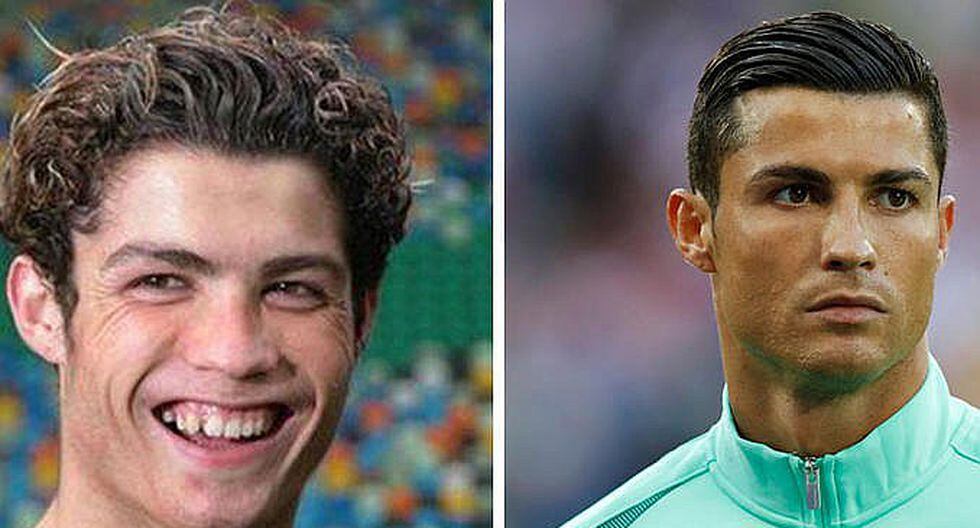
As an example, check pictures before and after being millionaire of some rock stars, actors, sportsmen, etc and you will see how money can really change the looks.
Take this picture before after of Cristiano Ronaldo, for example:
You have no idea what aesthetic surgery can achieve. They can crush your skull to shambles and give it a completely new shape. If you think trashy when thinking about aesthetic surgery, you've only identified the cheap stuff and seen the addicts and failures.
Ugly rich people either don't care or don't consider the risks worth it.
Not really, because your beauty strongly depends on hair cut, skin care, clothes you wear, the way you move and so on. How fit you are and how healthy you are. In case of women, the exactly right make up.
The same person can look beautiful and ugly depending on all of that.
We never talk about it? Seems for a long time it's all we talked about. You don't have to go very far online without running into somebody ranting about the privileges that beauty brings, and people with that privilege talking about how it's not a silver bullet to life's problems and brings with it it's own challenges.
Fat shaming, thin shaming, thigh gaps, Chads and Stacys, my head hurts just thinking about it all.
There are some important points raised here, but also a lot of sloppiness. If so much is riding on beauty then it should be important to be precise so as to understand what is going on.
Beauty is inherently subjective to the point of including wild contradictions such as Europeans going to great lengths to tan their skin while Asians may poison themselves with attempt to bleach their skin to make it lighter. This is not some simple scale even if there may be examples of people that are considered beautiful by many.
Modernity has made it common to be out of shape and overweight, so people who put extra effort into maintaining their health tend to be considered more beautiful than others. This means that to some extent beauty is a parameter that can be controlled. This leads to complex trade offs where beautiful people may be strongly desirable, but end up eating and exercising in a very controlled way which makes deep socialization with ordinary people awkward. Want to share lunch or a snack? Sorry, I don't snack and am not eating lunch today or most days. Want to share a drama? Sorry, I am going to the gym and expect to come back too low on time and energy for that. And so on.
Even in the most trivial sense, I have seen it in action.
Me (normal looking guy) and the GF (average-trending-to-pretty) at a fast food restaurant. I go up to the counter and ask for a couple extra sauce packets, only to be told they are 0.25 each.
GF goes up 1 minute later, asks for two sauce packets and is given a hand full, for free.
I used to believe people were born beautiful and there is some truth to it but even the people I've thought were most beautiful, if I look hard enough, generally I can see they're just normal people who spend more time on grooming, style, clothing, posture, presentation, charm, etc... Maybe they got lucky and some of it came naturally, not necessarily genetically though possibly but more like serendipity to gain those habits or skills.
Take the most beautiful person you know and see them when they're sick and they rarely stay attractive.
In any case it's arguably learnable. I don't know if this example will resonate but certain cities have a culture of beauty. Tokyo is one. People dress up to go out, at least most women do. I use to think it was either (a) they were born attractive or (b) the city attracted beautiful people. But, I've changed my mind. Instead the city culture has set a standard and people, in general, feel pressure to try to adhere to it.
I know it's an anecdote but a very attractive women once told me the only difference between attractive and not is effort. We all probably know exceptions but in my experience they are fairly rare. I'm not saying everyone can be a 10 on a scale of 1 to 10 but I'm confident the majority of people can be 7-8 even 9 with effort. Many of the most beautiful people I know, put them in drab clothing with no make up and try to remove your memory of their prior attractiveness and they just look like plain ordinary people.
You can't be unattractive and then hit the gym for a few months and put on a collared shirt and be hot. Better looking than before sure, but not beautiful. It is a nice myth for people to comfort themselves with I guess. It is also viewed as unattractive to 'try really hard' when it comes to physical appearance so you can have the reverse affect if your efforts to make yourself attractive are too blatant.
I'm 5'5. Working out won't change your height but it definitely changes the way you look. I have a beautiful girlfriend. I also have been compliment plenty of times on the way my clothes fit and how I'm in great shape.
Yes, being short sucks, but it sucks not being born a millionaire too. No reason to be down about it.
If you think being short sucks, try being short AND bitter.
> I know it's an anecdote but a very attractive women once told me the only difference between attractive and not is effort.
I think this is nonsense. I'm like a 2/10 looks wise on a good day. No amount of effort is getting that number anywhere close to what people find acceptable.
I can wear the nicest clothes money can buy, I'm still going to be seen as a well dressed ugly guy.
Unless you've got leprosy or elephant man disease you're more likely than not lying to yourself and refusing to take responsibility for your present situation
Something I noticed recently (prepandemic of course) after living in Silicon Valley for 20 years: the amount of plastic surgery that you see around town in Palo Alto has really gone off the charts. Both men and women. So much botox. So much nips/tucks.
Software is centered in Silicon Valley, entertainment is centered in Los Angeles, and ageism is rampant in both industries. It's not surprising that a culture of plastic surgery would emerge here compared to a place like New York, whose main industry is finance (where being perceived as older isn't nearly as much of a career headwind).
In one episode some man who was supposed to be super attractive to everyone had no idea he was so bad at everything. He passed through life because everyone let him off the hook for his beauty.
In another episode a beautiful assistant started at the studio and charmed everyone into getting her way. When Liv confronted her about it she replies that if it's fair for Liv to use the brains her genetics gave Liv than it was fair to her to use the beauty genetics gave her.
> On the unofficial but universally-understood 10-point scale of looks, I’ve heard people call themselves a five, but never a one or a two. You might tell a friend “you’re a 10” but when was the last time you told someone you respect “you’re ugly.” In the world of euphemisms, “average” is the new below average and “ugly” is a taboo term reserved mostly for high school bullies or kids playing in sandboxes — or whatever it is five year olds do now.
Or maybe it's because beauty, just like most other traits in nature, follows the normal distribution, so most of us are around 5, and very few are really ugly (or astonishingly beautiful).
“If a person has ugly thoughts, it begins to show on the face. And when that person has ugly thoughts every day, every week, every year, the face gets uglier and uglier until you can hardly bear to look at it.
A person who has good thoughts cannot ever be ugly. You can have a wonky nose and a crooked mouth and a double chin and stick-out teeth, but if you have good thoughts it will shine out of your face like sunbeams and you will always look lovely.”
I have met my share of people who by rights ought to be physically attractive but are not, which also reminds me of Shelley: Half sunk a shattered visage lies, whose frown/
And wrinkled lip, and sneer of cold command...
So if I see someone with a wonky nose and a crooked mouth and I don't perceive anything that gives me the impression of sunbeams shining out of their face, should I assume they have ugly thoughts rather than good ones?
While I agree with this overall, this list in the middle of the article was unsourced and presented as "just-so":
> Here is a list of features that are objectively beautiful, and their absence, objectively ugly. Facial and body symmetry; proportional anatomy, height (particularly among men); a full set of straight, white teeth; a full head of hair; clear, evenly-toned, taut, skin; a well-toned physique; proportional features; large eyes.
Of these, the "well-toned physique" is probably historically incorrect[1] - excess weight signified wealth and health for much of human history. Likewise, "a full head of hair" is somewhat gender-specific - super important for women, but many men can rock a bald head pretty well.
Overall, I think beauty ideals are somewhat more flexible than this article assumes. This is especially true for romantic attraction and especially in some communities.
I find the CNN examples tenuous. If the same logic was applied to today's relics in the future, historians might say that 8 foot tall anime women were idealised beauty, in the same way newly discovered buildings tend to be called temples. In reality (from the male perspective) preferences vary massively between individuals.
If Rubens' women are an ideal, why aren't Picasso's?
Nietzsche claimed Socrates' renowned and profound ugliness would've been seen as an implicit argument against him in his trial since ancient Athenian culture openly associated ugliness with untrustworthiness.
I recently went on a first date with a woman that was certifiably gorgeous and wound up having one of the most fascinating conversations on this topic.
She discussed her prior career in the military, where she spent 8 years and ultimately got pushed out by a high-ranking officer (also female) in her division for very political reasons. It wasn't just a superficial rant, she described an incredibly detailed pattern of abuse and obstruction by some of her COs.
My main takeaway was that attractive people tend to get more attention. Much of it is probably good attention, but this isn't always the case. A few days after that date, I heard about Vanessa Guillén, an Army soldier murdered by a CO after suffering from persistent sexual harassment by him[0].
> I heard about Vanessa Guillén, an Army soldier murdered by a CO
The other soldier mentioned in that article was the same rank, not a commanding officer (CO). In no way diminishes the seriousness of the apparent murder, of course.
Depends how you quantify privilege. I've seen a few convincing arguments that, for men at least, height is a better predictor of success than intelligence.
Steve Martin once said about Gael Garcia Bernal, "I'd do anything to look like that guy, except eat right and exercise."
It's very seductive to justify people's anxiety and envy by synthesizing a narrow difference into an perceived injustice. If a person is truly repellent or creepy, it's because they present something that triggers a sense of danger or disgust in others, which is completely relative to the individuals. Liars are usually repellent, so are predators, manipulators, often the mentally ill, when you get a waft of that aspect of who they are. You have to ask who benefits from you not trusting your instincts when it comes to being around people you may feel repulsed by.
But there are lots of superficial traits that people associate with those categories of people, that don't actually serve as a remotely valid indicator. And those kinds of associations, permeated throughout society, serve to make some people's lives worse in a very real way. People on HN often overestimate the rationality of humans, and underestimate the perpetuating effect that stereotypes have.
The main issue is https://en.wikipedia.org/wiki/Halo_effect , but what gets missed when people use the Halo Effect term is that when the performance of someone attractive or charismatic is only average, we blame them for having "deceived" us, when it was our own bias toward them that caused the disappointment.
Criticizing the "privilege" of the attractive as a means to de-legitimize them personally seems to double down on this error and seduce people who have the conceit of blaming others for their own biases into further self-justification, imo.
I didn't take the article as seeking to "de-legitimize them". Having privilege isn't a sin (unless you acquired it through some ill means, but that's not even possible in most cases).
Privilege is nothing more than a social factor to be aware of, both for the haver of privilege whose perspectives might be warped by their experiences, and for the social systems (like the justice system, mentioned in the article) who at least in theory are trying to be objective about things.
Don't take it so personally. Privilege doesn't make you a bad person, and raising awareness of it is a good thing.
A lot of people would argue the idea of privilege is not a neutral or valueless observation at all, and more precisely, it resembles a new original sin invented by a secular movement instead of a religious one. Critical frameworks that rely on it earn extra scrutiny. I recommend taking that personally.
I think "a lot of people" is an over-statement, I don't think an intrinsically broken moral judgement made by a minority of people should be allowed to delegitimize the real issue, and I don't think the OP was talking about anything but the real, legitimate issue.
Privilege is nothing but an acknowledgement that some people have advantages in life that they didn't earn. There is no possible world in which it doesn't exist, and almost by definition its holders can't usually be blamed for holding it. But we can a) take steps as a society to decrease its impact in various ways, and b) see it as a reality-check on social-darwinist or meritocratic thinking.
People are more biased by charisma, beauty, having a skill, being fashionable, being talented, working hard etc etc. The idea that race alone is a deciding factor is minor compared to how attractive you are in general.
Note that most (all except one?) of the studies on attractiveness in sentencing were using mock juries or similar (unlike the race based statistic which uses real data).
In the single study that was based on real data there was no control for income. The impact of that should be obvious to all: richer people are generally better groomed in court and have better representation.
Funny thing is in some Asian countries having a certain form of "crooked" teeth is often seen as more attractive (in woman).
Similarly having body volume (e.g. slightly overweight) is often seen as attractive (in man). (As it convoys wealth, only wealthy people can afford to eat that much.)
Honestly most, not the large majority of people is not ugly and can have reasonable good looks if they do carry them self properly and war clean clothes, hair, etc. Sure much more can be done using makeup or similar but that costs time and money every day and is normally not necessary.
Sure people which look rally good still do have some benefit. I just mean that for many people the problem is not inborn bad looks but how they carry them self IMHO. But then beauty is very subjective so I wouldn't be surprised if many people thing differently.
Judging by stereotypes, I wouldn’t expect people here to pay that much attention to their looks. But clearly it matters...a lot. After reading this article, it shouldn’t be a surprise to anyone why people, especially women, spend so much time and money obsessing over their appearance.
Yes, you could argue that it shouldn’t be this way and people shouldn’t dwell on looks so much. But it doesn’t matter how right you are. Attraction isn’t rational. It’s emotional and instinctive.
So do yourself a favor and always try to look your best. You don’t need to care about what people think about you, but should care about what people feel towards you, because it will impact the quality of your life.
How does one separate cause from effect here? People who are more privileged have two advantages: they have more resources with which to maximise their 'beauty', and also beauty standards will tend towards emulating those of higher status.
I don't think we realize how much "work" some people have had done.
Take Elon Musk. It's amazing how his hair grew back and that's he's aged so well considering the stress he's under. Hair implants, Botox and a nip and tuck here and there will keep you looking your billionaire best.
I was oblivious to this type of thing with men until my wife started pointing it out.
It's no wonder that among the things that money can buy is happiness if plastic surgery improves your esteem and how people react to you.
Someone else mentioned intelligence, but being born human puts sets you up better than any other living being on earth
Also everything is a privilege now:
- being human
- being alive
- having two legs
- having two hands
- having two parents
- having a computer at home
- having an iphone
Beauty is a gift but not a privilege. I don't think the attention you get or you don't get for it is valuable or is going to change your life.
Sure, some of the people around you are going to pay more attention to you but you will not earn anything for it. No investor is going to invest on you because you are beautiful. You don't get to control your life only because you are beautiful.
It's other talents that you have and the choices you make that really helps you to construct your life. And you get more privilege when you are more successful. If someone is extremely beautiful and made a career in beauty or fashion, it's not because (s)he is beautiful. Otherwise every naturally beautiful person could make it.
Its amazing that people I work with spend years and years at school learning "skills" but spend no time learning looking good, social skills or how to dress properly.
It depends, we have the dumb blond stereotype and I know of developers who are attractive and have a harder time interviewing because they get perceived as dumber. It could be that there's an unconscious bias of hiring someone that looks like a stereotypical movie hacker (long hair, beard, wearing old tech swag, etc). This is of course changing slowly after Apple made a push on cleaning up the image of all the higher ups to have them be part of the presentations and now all companies seem to hire PR consultants that work the appearance of their clients. You sort of see this aesthetic trickle down with time.
There are only two ways to fix what he had. First is a hair transplant, he would be around NW6 now so it was a lot of grafts. Second way is a hair system (rebranded toupee), you can't really tell if someone is wearing one if it's good, you can have exposed hairline, modern hair styles etc.
There is probably an interesting article to be written about how the pursuit of superficial qualities harms deep qualities. E.g. rock bands of the 70s tended to be quite ugly, but they made great music, while bands today look very good, but make terrible music.
Amusingly, Sir Ive is an example of both: back when he was a goofy mustachioed designer he came up with beautiful designs like the iMac, and then when he spent time at the gym and getting fancy T-shirts he produced … a bunch of metal-and-glass rectangles, and disaster of an HQ.
Imma have to disagree with you hard on the first paragraph haha. Rock became oversaturated and stagnated as a genre, I'm not sure the clothes had much to do with it.
It's certainly true that beauty is a massive privilege and discriminator but the title is somewhat hyperbolic; it is unlikely to be the greatest (compared to the more obvious ones like race and gender etc) and is certainly talked about, though not as much as it should be.
The title is not saying 'this is the greatest privilege of all, and we don't talk about it'- it's saying 'among the privileges we don't talk about, this is the greatest.'
Still might not be true, but it's less hyperbolic.
You're reading it as "beauty is the greatest privilege, and we never talk about it" but I'm pretty sure it's meant to be read as "out of the privileges we never talk about, beauty is the greatest one". Race and gender are not part of the category "privileges we never talk about".
The effort to assign a total ordering to various "privileges" seems like a fools errand to me. Wouldn't these characteristics differ in magnitude from one individual to the next also? It is almost as if everyone is a unique individual combination of a multitude of characteristics.
The way we evaluate people as beautiful depends on race, they are not independent variable. If people inherently perceive white features as more beautiful or female features as more beautiful, then beauty perception will be impossible to distinguish from those other biases.
> Beauty might be the single greatest physical advantage you can have in life.
Oh for God's sake, some people are born without eyes.
> Attractive people might have a hard time coming to terms with all of this. Doing so would require relegating at least part of their achievements to something mostly unearned.
No one deserves anything. The idea falls apart as soon as we even begin to examine it. I could walk into the woods and build a hut out of mud and sticks. Did I "earn" that mud hut, or was I privileged to be born with hands? Does the fact that most people are born with hands matter? If so, how can we quantify how it matters?
At the end of the day, none of this makes any sense, and we need to come up with notions of "success" (socially speaking) and "property rights" (legally speaking) that are based on something else.
There definitely is a line to be careful with, but I do think this is the vast majority of what is happening with most social justice movements today.
Black Lives Matter is not fighting for cops to shoot more white people to equalize the numbers, they are trying to show how it is possible in lots of similar situations to deescalate situations without killing anyone, even with violent offenders if training is good, and officers don't have a bias (explicit or subconscious) against the type of person. It is also very obvious to show that minorities are being over-policed and often harassed for just living their lives.
I think similarly with this issue of the leg up that attractive people have in the world, the only way we can fight it is by acknowledging it exists and trying to actively re-evaluate every decision we make about who we choose to interact with, and how much it is informed by these types of bias. This is not the same as giving the attractive people a -10 on whatever evaluation they are a part of. It is always going to be true that correcting for these types of bias will be inexact, welcome to life, but saying we just shouldn't give a shit about less attractive people is a worse outcome for all of society, and its not like author is asking for infinite effort from everyone to correct this. Talented people exist everywhere, if we don't push those of disadvantaged groups up, only some of them will "pull their bootstraps" hard enough to overcome things on their own. People need to be introspective to correct for their biases, there really isn't a way around that, we are imperfect beings quick to pass judgement.
I have a distinct memory of a part of the confirmation hearing of Sonia Sotomayor, she had written about her need to actively review her background when starting a case, to see if she might have prior experiences that would color her judgement. Republicans tried to spin this as, she acknowledged she is biased, obviously she can't be an objective judge. But she defended herself well and asserted it is effectively impossible, to just be objective without this kind of evaluation. Effectively the same argument that people correctly make about the virtual impossibility of just being "race-blind", we all have things we have experienced that color our perceptions of different people, ideas and places, we cannot ignore that fact and just go on asserting we are good objective decision makers with no special effort to account for these things.
In the specific example of police brutality you are right, however BLM organizations are also generally anti magnet school/charter school, which in many poor primarily black neighborhoods is the only good school option for children. Since these schools get to choose (for the most part) who they enroll they tend to take all the more gifted kids/kids with good family environment out of the normal public school. This obviously leads to greater inequality of outcome, which activists try to "correct" by forcing everybody to be in the low quality public schools.
Remember this when people go on and on about "equity". In the grave, all men are equal.
The reason we have low-quality public schools is because education is criminally underfunded and poorly handled, especially in poor areas because of property tax funding.
I don't fully support removing magnet schools, but you can bet that if rich families had to send their kids to the same schools as the poor kids, they'd be lobbying all day for better funding. Apportioning funding per-head from state taxes rather than property taxes would be a good first step.
I think the leftys, who I generally hang around and aggree with get a lot wrong about schools. We spend a lot on schools, other countries that spend a lot less get better outcomes. I mean FFS the richest country in the world with a 85% graduation rate, it's completely insane. Fixing the schools isn't a one-dimensional problem, and I think there are some charters that have good ideas. While they do generally under-serve students with differing abilities, I think that is talked about too much and is used to try to discredit everything they do. There are problems in the schools, absolutely, everyone agrees, and unfortunately aversion to change comes from every level, but unfortunately it's often on different issues/changes. Teachers, parents, students, admins and politicians all have things they balk at that prevents fixing the schools, we need to change a lot of minds or have a huge top down reworking of schools, but unfortunately that runs right into one of the issues people get all worked up about, local control.
> forcing everybody to be in the low quality public schools.
Seems obvious to me that the issue isn't that private or magnet schools are high quality, but rather that public schools are low quality. Basically, the goal is still, bring people up. The "bringing down" in this case is not only temporary, it's only actually "bringing to baseline."
A bunch of rich people and state congresspeople's kids being forced to go to "shitty public schools" sounds like a great way to force the issue.
Leaders of "justice" movements want power. The best way to get power is to make an outside group the enemy and tell your followers their problems are only because of the enemy. Next, you position yourself as having the answer and if your followers will only continue doing what you say then they will be lifted, their problems will subside, and the enemy vanquished. As long as you can keep an enemy front and center and your followers problems never subside your power will continue to grow.
You write this in a way that implicitly dismisses the Cause of various social justice movements as indistinguishable from any group with leaders. Are you claiming that there's no difference between Black Lives Matters and Jim Jones' church?
It's a little hard to act like they're being disingenuous when the supposed enemy acts in ways that are completely consistent with being an actual enemy, though. Only when the supposed enemy is not.
> There’s a lot of vitriol aimed at rich people right now, regardless of how they attained their wealth.
Part of the problem is that our current property regime does not distinguish between property acquired through accession [1] and property acquired through extraction.
There is this weird philosophy that all "market transactions" are equally legitimate and that market price is the correct (and only reliable) indicator of economic value. This view ignores the fact that market prices are as much a product of market structure as they are a reflection of people's preferences.
Our current property regime evolved that way for precisely that reason. Distinguishing the two and highlighting it would be a subversive, rather revolutionary act, which would attract a lot of hate.
I don't care how you made your money, hoarding it should be looked down on. Greed is bad, we don't need to make things illegal, but I sure as hell am going to think anyone with a privately owned Yacht is a little bit worse of a person than someone reinvesting their money in their community and trying to explore new ideas, or if you are tired and don't want to personally invent stuff or run another business, go find some enthusiastic entrepreneur to support. I am not against rich people having power, I think we should get them to pay their damn taxes and fair share, but beyond part of their money that ought to be allocated by a democratically elected government they can do what they want with their wealth to control the world. But anyone using their money to just show how wealthy they are is going to get serious judgement from me, and I think that is a healthy way to think about rich people.
I think it should be likely obvious from my statement above, I want there to be talented people, and I really don't see a substantial movement to pull down successful people.
What are examples of things people are doing that make you think we are going in this direction?
but seriously everything you are saying is seething with value judgements.
> should get them to pay their damn taxes and fair share
what constitutes a 'fair share'? Who gets to decide?
it's easy to criticize yachts. Let's say a billionaire did something "you might like" like throw a ton of money into a basic physics project. But what if that basic physics project is looking for superluminal neutrinos? Or maybe you'd criticize that the billionaire just wanted to get their name out, which is, essentially vanity, an obviously negative character trait.
Or we could get into sketchier territory. What if the billionaire spent tons of money in "development" in an "underdeveloped country". Is that bad or good? Who gets to decide?
I mean the ironic thing is that on many metrics, buying a yacht could be the least bad thing of the three things that I have mentioned, at least the likelihood of buying a yacht actively hurting someone else is relatively low.
Absolutely, there are certainly ways to put on a show like you're helping people and not really care.
Finding those people is harder than the Yacht idiots, but that's why we have watchdogs for public charities and can make laws regulating what people can do with a charity.
If people are making investments not as part of a public charity, we have journalists to hopefully keep some high level accountability, but yeah youn can do bad stuff with money in a lot of ways, go figure.
Even people doing lots of good can still be seen on a spectrum, I love a lot of the work Bill Gates is doing around the world, but I think he worked really hard to fight FOSS, and I think the world is worse off in some ways for it.
I'm saying buying crazy expensive luxury goods is never a good thing, it's just a waste of resources to prop up someone's shallow ego.
On taxes this will forever be an evolving discussion. Hopefully with good policies over the next few decades we can even out some of the income and wealth disparities and need a smaller welfare state. When that happens I'm all for tax cuts.
But at this point the capital gains rate is absolutely in need of change. Taxing the rich is really politically popular, across the political spectrum. If someone has to pay %39 on a million dollars of earned income, the "job creators" making billions can pay something closer to that on their income too.
Totally agree, but I believe anyone who has lots of money, and wants to defend they have money because they are smart and successful should realize that merely being a consumer isn't a very impactful way to contribute to society. Using piles of money to just scale up being a consumer to an absurd level is stupid.
I also think I wouldn't shed a year if Rolls Royce went out of business. There are manufacturing, design, welding jobs out there on markets that actually make sense to scale up. Some things in life you can currently buy don't provide enough value to justify them existing at all. They simply exist as a middle finger to everyone with less, propped up by the idiots that but them.
I'm not saying make anything illegal, I'm saying I judge people who support this and would encourage everyone else to do the same.
Hit-men are people too, people don't magically get defenestrated when they speak out against Putin.
This absurdist remark is just to point out that just because people get paid to do a job, it doesn't mean it's a job we as a society want people to have.
>There’s a lot of vitriol aimed at rich people right now, regardless of how they attained their wealth. I imagine it’ll soon be transferred to talented people as well.
As a rule, few wealthy people extract 100% of their wealth and few earn 100%.
The wealthy that extract 98% sure try to downplay that part and try to pretend that they're among the miniscule number who earned 90+%.
Most manage to self delude themselves that vitriol against the wealthy IS vitriol against talent. Their egos demand it.
Perhaps it's here already? We see a lot of posts here on HN denigrating the value of higher education and saying that highly-educated people are gatekeeping.
The objection is not to highly educated people gatekeeping (though they should know better), but that people with a status that helps unlock further wealth are gatekeeping.
> I imagine it’ll soon be transferred to talented people as well.
It is already, and the logic is something like: talent is largely a function of practice and access to education. Having the means and opportunity to practice and be properly educated is a privilege.
You can find _plenty_ of words written regarding the inherent racism, sexism, ableism et al in various hobbies due to unequal access; from GitHub hobby repos to enjoying nature through hiking and camping.
Zero-sum methods (robbing Peter to pay Paul) work doubly to achieve equality: reducing the 'higher' person and boosting the 'lower' person in a single action. Very quick and efficient if equality of outcome is the first priority.
Sure, identifying these inequalities is a step in making things 'more equal' but how does society correct something that is arguably biological in nature (our preference for beauty)?
Masks? A government backed hotornot.com that issues beauty bonus points to improve ugly hiring outcomes?
People who are good with numbers approach financial situations from a position of privilege, surely that's an equality killer? Do we impose Financial acuity tarrifs in addition to standard taxation?
Obviously these are absurd examples but there is a point of diminishing returns and even negative outcomes in the pursuit of TOTAL equality.
Lifting people up suggests targeted interventions to help individuals. If they face powerful beauty standards, help them find ways to become more beautiful. If there's a hard standardized test, help them find ways to pass it. Justice movements will sometimes engage in these kinds of things, but it's more common in my experience to say that the standards are simply wrong and need to be replaced with more equitable ones.
One example: fit people made fun of because they are fit. The message that everyone is beautiful the way they are and that there's no need for further improvement is detrimental to the society.
I recently discovered it, Akira The Don seems to be the most prolific.
Basically it amounts to taking audio related to self development and layering over electronic beats. I like the format and think it's a really cool way to spread ideas.
Although this is a real phenomenon, individuals do possess the ability to improve their looks. With maybe a couple exceptions, nearly everyone can become very attractive if they take care of themselves, dress well, and lead a healthy lifestyle.
> nearly everyone can become very attractive if they take care of themselves, dress well, and lead a healthy lifestyle.
You're going to have to define very attractive. No amount of healthy lifestyle will make your breasts bigger. No amount of dressing well will make your face less ugly (short of putting a curtain in front of it).
There are hard limits to what you can do as an individual without surgery. Even with surgery, you still will run into a wall.
Yeah of course those things are out of control. My point is that the things you can control have a huge impact. Maybe you can never be a 10/10 because of some specific flaw, but you could likely be at least an 8. Also flaws tend to be seen more as quirks in more "attractive" people.
I am inclined to agree with you, but as a counterpoint consider that if you're an African-American woman, the cost of adhering to U.S.A beauty standards is high, several hundreds of dollars a month. This is not an exceptional but a considerable minority that can't become 'very attractive' without heavy expense, and can't easily lead a healthy lifestyle when they are priced out of everywhere but places that are food deserts.
As a counterpoint, you have facial scarring, skin conditions, gross asymmetry, bad proportions, bad teeth, nerve damage from Bell's palsy or the like, pigmentation problems, and so on to more or less obliterate the "nearly everyone" bit.
I guess I should have been more specific, how about 95%+ of the population? I just more often than not hear this line of thinking from people who definitely could look better but choose not to put in the effort to do so. In general I do agree its a problem, but its one people have actual agency over.
One of the first “privileges” I learned about in my life was being tall. Why was it the first? Because short kids and friends I knew would openly lament about being short. Something I could tell they think about constantly, and something I never thought about.
I suspect it’s played a large role in dating and interviewing for jobs, though no one ever openly says “you’re projecting more confidence simply because you’re taller than average”
Really? I disagree. Those who do not have beauty, end up compensating for it by exceeding in some other trait, and in the end, these other traits, or the ability to exceed in these other traits is the privilege, those not endowed with beauty get. So, it balances, and sometimes to the benefit of those not endowed with beauty.
Do you feel that way about every differential advantage, such as money and family support in childhood, or is there something unique about beauty that causes people to compensate better?
> Those who do not have beauty, end up compensating for it by exceeding in some other trait
Unless you're not intelligent either. Or don't have the socioeconomic advantages of a good education. Or are a poor athlete. And, of course, there are people who are all of these things. Being beautiful does not mean you cannot excel in other traits.
Everyone does not start equal. People's genetics and the circumstances of their birth are causes of inequality. It does not end up balanced.
"In the year 2081, the 211th, 212th, and 213th amendments to the Constitution dictate that all Americans are fully equal and not allowed to be smarter, better-looking, or more physically able than anyone else. The Handicapper General's agents enforce the equality laws, forcing citizens to wear "handicaps": masks for those who are too beautiful, loud radios that disrupt thoughts inside the ears of intelligent people, and heavy weights for the strong or athletic."

In one of my first jobs I worked with female electrical engineer like that. It took me few years to gradually discover how good she was. She had good ideas and solved problems but we somehow forgot where the idea came after we talked it over. It somehow became team effort. After someone was boasting how they had high scores in Mensa test, she just casually mentioned that she had scored 155.
I later started a company with her. The best decision I have ever made. Imagine working with Elon Musk who is enthusiastic about chess, crocheting and mushroom picking.