Hacker News new | ask | show | jobs
by _5ysi 3202 days ago
Having worked at two manufacturers in the Midwest, anecdotally the majority of forklift drivers, line workers on specific lines, and even many white collar office roles were filled by temp agencies. A similar structure existed for engineering too; we would have a problem and the engineering firm with workers under the same roof would develop a solution.

For the temp workers the motivation was always very clear and very much based on working around labor laws. If a forklift driver got in an accident, it wouldn't be counted in the same way. Line workers could be less rigidly brought on board or let go with seasonal or other varying demand. They were cheaper too and everyone worked hard to try and become a regular employee.

I am not sure what a solution is, after all these types of temp companies only exist to skirt existing labor laws, suggesting these laws may defy economics a bit too much. On the other hand what other ways do we have of increasing the bargaining position of labor? Growing the economy, but that isn't something a politician can honestly promise. Pulling back from globalization would, but that is bad economics and bad for national security. Perhaps something like earned income tax credit? Or perhaps we should just continue waiting until the rest of the world develops and the supply of labor finally becomes constrained.

6 comments

The solution is simple. Criminal prosecution of the executives of the company, coupled with treating white collar crime the same way we treat street crime.
Like the great George Carlin once again, if you wanna stop illegal drugs just start executing the bankers laundering the drug money.

https://www.youtube.com/watch?v=qDO6HV6xTmI&feature=youtu.be...

Can't even begin to think about all of the negative side effects this would have...
Ending right to work laws and bringing back unions.
When the notion of a union was proposed to the management at Fierra, the owners spread the word that if the workers began forming one, everyone would be immediately fired and replaced.

source: My grandmother used to work at this very factory when we first moved to Canada. She worked for about 5-6 years, starting in the 90s.

When you are new to a country, don't speak the language or know the laws well, you don't have as much power as you think.

An industry based union would make them more difficult to replace, increasing the price of labor
I don't really get this line of thinking, it just seems like a denial of globalization, automation, and economics. Instead of helping the workers it more seeks to punish American capitalists--including all the people like me who hope to retire in the future with investments that grow. When the rest of the world is developed enough that a union could span the entire globe, then this would at least be logical again.

As an electrical engineer working for the company, two of my assigned jobs were 1) evaluating the cost effectiveness of replacing all the forklift drivers with robots and 2) installing new equipment to eliminate repetitive lifting roles on the packaging lines. I was actually surprised how much cheaper the human forklift drivers were than the robots (mostly this was because we had really efficient, hardworking drivers and the robots needed special accommodations and could not handle all special cases).

I left the company because it was very demoralizing working alongside people who you were being paid to replace. But make no mistake, the autonomous forklifts would have been cheaper if the company had to employ the drivers directly, taking the hit to their safety record and bottom line.

There are other ideas for increasing the bargaining position of American labor and reducing capital inequality. For example, plugging up the mechanisms by which trade deficit capital returns to the United States (through economics--not by law, so by increasing property taxes in cities with big foreign investment, reducing the federal debt, switching to regional taxation system, etc.). Another example, if economics, as a collective school of thought, could reconsider its obsession with monetary inflation and consider if technology driven deflation is actually a bad thing. A worker getting a deflationary pay raise would be in a much stronger bargaining position and would actually be claiming some of the rewards of all the technological advances of capitalism by default.

That just seems so paternalistic to me. You agree that those low on the totem-pole should have it better but handing them a method of direct-action, to collectively and directly make their work environments better doesn't make sense?

>Instead of helping the workers it more seeks to punish American capitalists--including all the people like me who hope to retire in the future with investments that grow.

This is actual nonsense. If you don't believe that making the middle and lower class better off is good for an economy, I don't know what to tell you.

I know I shouldn't be taking the bait but here goes anyway.

Smart union leaders today would be working on organizing and building relationship with peers in other countries. Fighting for US state backed monopolies is fighting on the old battleground with outdated weapons that may be immoral (state enforced monopolies often are).

> That just seems so paternalistic to me. You agree that those low on the totem-pole should have it better but handing them a method of direct-action, to collectively and directly make their work environments better doesn't make sense?

If were going to use the loaded word paternalistic, requiring people to be a union member is more paternalistic than giving them the option. Also I propose policies that (I think) would make work more valuable. Do you think it is fair that the Federal Reserve transfers and additional 2% of workers' pay to capitalists and politicians every year?

> This is actual nonsense. If you don't believe that making the middle and lower class better off is good for an economy, I don't know what to tell you.

Not my belief at all.

>Smart union leaders today would be working on organizing and building relationship with peers in other countries.

Smart union leaders today are trying to figure out how to end right-to-work so they can actually exist.

>Fighting for US state backed monopolies is fighting on the old battleground with outdated weapons that may be immoral (state enforced monopolies often are).

Minor quibble here - that a monopoly exists and that it exists in the US does not make it backed by the state. Monopolies don't need state backing to exist.

But I also agree that we should dust off Teddy Roosevelt's big stick and use it to smash the monopolies/oligopolies if that helps.

>If were going to use the loaded word paternalistic, requiring people to be a union member is more paternalistic than giving them the option.

Right-to-work is about ending free association, it's odd to paint unions as anti-free association. In an ordinary market environment a widget company could set up an exclusive supply deal with a plastic company where plastic is supplied at a set rate under certain agreements and we'd all be fine with that. But if we switch out "plastic" for "labor" and "plastic company" for "labor union" then suddenly we outlaw it. The idea that you think government should interfere in the contractual dealings of labor-supply in our market but not commodity-supply describes the hypocrisy.

>Also I propose policies that (I think) would make their work more valuable.

That's why I called it paternalism. What you think makes their work more valuable is good but even just giving them the tool to decide what is good for themselves is bad.

>Do you think it is fair that the Federal Reserve transfers and additional 2% of workers' pay to capitalists and politicians every year?

Take your Friedman talking points somewhere else.

>Not my belief at all.

But it's exactly what you described. You think that labor organizing in an effort to gain higher pay will hurt your capital investments.

>I know I shouldn't be taking the bait but here goes anyway.

Me too lol.

Hi I wanted to wait a day to have a more personal conversation with you, I hope you see this post.

Idk if you are involved in any union leadership roles, but I am a single earner below the U.S. median income in a rust belt state. I also save some of my income and invest it, so I'm a capitalist. Again if your involved in any union leadership, I would support you if you focused on organizing the monopoly on labor around the world. I like investing my income in American companies and I would rather see workers around the world claim more of their value added, rather than have American companies close, foreign capitalists win, and all labores lose.

With regard to state backed monopolies, I was talking about unions in states without right-to-work. Since it is codified into law that labor cannot exist outside of union X, these unions are state backed monopolies. And I don't really spend any time thinking about whether this is morally justified (ie I don't spend any time thinking about whether we should have right to work laws), it is a pointless thing to spend time on because companies can manufacture anywhere in the world but there is no global government with power to enforce its laws globally. So right to work exists, regardless of what the states of Michigan or Ohio thinks. There is evidence for this being true as there has been a long term decline in private sector unions coinciding with globalization, but no similar fall in public sector unions, because for public sector work the workers possible locations are trivially within the jurisdiction of the government.

> Take your Friedman talking points somewhere else.

Wow ad hominem much? Marx and Keynes also have the index of prices as a fundamental variable in their equations. It doesn't matter to my point about 2% inflation whether the head of the Fed is more Marxist, Keynesian, or Friedman monetarist. As long as the Fed mandate is to have inflation there will continue to be a long term, regressive redistribution of workers wages towards existing capital and those with the power to borrow new capital. I am actively, in my life, trying to get Democratic Party leaders to admit this is true so that I can justify voting for one. It is super duplicitous for Obama to speak so much about inequality and support minimum wage increases yet at the same time stab all the workers in the back by tripling the currency supply and continuing the policy of long term inflation wage theft.

Neither Obama nor Trump started these policies but I don't know which is morally worse, systematically lying about it and covering it up or simply not caring about unfair inequality at all.

An easy change we (the U.S.) could implement on our own, next election, that would reduce wealth inequality in America without hurting economic growth at home or the people in developing nations... would be remitting the Federal Reserves' profits directly to the people as cash dividends. If this had been in place this year every citizen would be receiving around $300. The shareholders of the federal reserve should be the people, equally. When powerful capitalist benefit from the system, the little capitalist should get their share of the rewards too. After this the next step is resetting the inflation target to be always within a tight band on either side of zero.

> I don't really get this line of thinking, it just seems like a denial of globalization, automation, and economics.

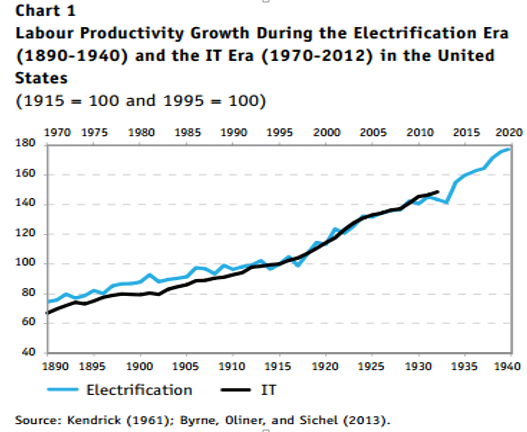
So what is the qualitative change in these three factors that changed so much in your opinion? Globalization was important for the US from its very inception (example: European price and production developments where a big factor in the Panic of 1819[1]). And productivity growth has been more or less constant over the last 100+ years [2][3].

[1] https://en.wikipedia.org/wiki/Panic_of_1819

[2] https://cdn-images-1.medium.com/max/800/1*i79QfQsgSagYNZl17o...

[3] https://www.bls.gov/lpc/prodybar.htm

I think it has been the gradual march of technological progress and globalization. For example remember the civil war was largely fought over protectionist trade policies for northern manufacturers. And that was in the age of sail when many goods would not even make if from North America to Europe. Similar protectionist policies would be unthinkable now. Also the rise of America from being an upstart industrial power like China and India are today to being a wealthy nation with (relatively) high standards of living for its low and middle class.

Unions are fascinating, honestly I am surprised that the era in which they were strong ever existed so early in history. They rely on having a monopoly on labor or at least a large percentage of it but with modern transportation the size of the labor pool is just too large and too poor for a relatively small, wealthy nation like the US to organize it.

If I had to point to seminal events causing the change, they would be construction of the Suez and Panama Canal, MacArthur's reconstruction of Japan, and Nixon opening trade with China. This last one could be the reason we are all still alive today, but clearly the American middle and lower class have born the brunt of the costs relative to where we all were after WWII.

Btw thanks for the discussion. Has been a while since I read about panic of 1819! I also blame the aspects of Keynesian economics that do not constrain the growth of government debt for increasing the power of existing wealth relative to the working class, but I admit that is a more questionable opinion.

>For example remember the civil war was largely fought over protectionist trade policies for northern manufacturers.

That's a falsehood pushed by the south to deny their support of slavery. This short video about it from prager University is helpful: https://www.youtube.com/watch?v=pcy7qV-BGF4

Here you can read South Carolina's actual declaration of Succession, where they make a point of spending most of the 13 pages talking about how their "right" of slavery was being infringed upon: http://www.teachingushistory.org/pdfs/DecImmCauses.pdf

My previous reply is being down voted a lot so I'll try again and compare them.

These tariffs were effectively a tax on slavery and a redistribution of income from agriculturalists in the south to industrialists in the north. The major cause of the South's succession may have been slavery, but the immediate cause can still be these taxes which were putative to slavery. They didn't suceed in response to the emancipation proclamation.

Either way, my point is that tariffs and protectionism had profound economic impact benefiting the industrial north and Midwest at that time.

I'm not sure if people even at that time knew which of the two was the more prominent cause of the war.

Edit: MacArthur's reconstruction of Japan is just a easily identifiable event. What I am really saying though is how industrious the Japanese people have been since the age of exploration. Perhaps the seminal event should have been Commodore Perry or the Meiji restoration.
Of course, that too comes with it's negatives. Unions have both positives and negatives. It's not a simple discussion.
Corporations have both positives and negatives, yet somehow there's never a debate over whether we should have those.

It's very strange to me that employees organizing and working together is so controversial, but management doing the same thing is not only expected but we can't even envision anything else.

I think one reason it seems so strange is that it is sort of a mis-characterization/failure of communication that easily happens in politics. There is nothing wrong with unions in principle, but once someone has written into law exactly what a union is, then the possibility for mistakes and unintended negative consequences exist. When the UAW were fighting for better wages and conditions in bygone days, I don't think many at that time thought the same laws would contribute to GM declaring bankruptcy and needing to be bailed out by all 300+ million Americans, who were never involved in any of the bad decisions made.

And reasonable people can quibble about who shoulders more of the blame, but one can't deny that American labor costs were significantly higher than foreign competition and were largely impossible to adjust.

Unions today need better leaders, who realize that the future is in collaborating across national borders with their brethren at all global corporations. The United States simply cannot enforce its own labor laws in China or any other proud nation. Workers created unions themselves, they did not need government to do it for them...which is good because neither the US nor Russia or China rules the whole world.

Unions are a counter-balance to corporate power which helps to preserve the power of labor. That unions have some negatives does not mean we should not have them.
What is an alternative to unions that gives workers some power in the relationship between worker and employer?
The ability to get another job.
A company with 100 employees losing an employee costs them ~1% of their revenue until a replacement can be found.

An employee losing their employer loses ~100% of their revenue until a replacement is found.

The two are nowhere near equivalent.

On the other hand, when employees unionize, a company with 100 employees stands to lose ~100% of their revenue if employees choose to strike. That puts the two sides on an even footing.

And when companies coordinate to prevent that? It doesn't even have to be explicit behind the scenes coordination. Companies that base your salary offer off of your previously salary are still coordinating even though they don't plan it
Why? All the law does is prevent compulsory membership in a union. That seems like a good thing.
No, because it introduces the free rider problem. It creates an incentive for any particular union member to defect from the union, because they no longer have to pay fees, but are legally entitled to whatever the union negotiated for.

It's like a law that prevents compulsory membership in a fire insurance plan, but also allows you to sign up for retroactive fire insurance after your house burns down.

It's sole purpose is union-busting.

> but are legally entitled to whatever the union negotiated for.

How so? Wouldn't they be independently discussing their salary with management at that point? What law guarantees that non union workers get the same benefits as union workers?

Thanks to the National Labor Relations Act, if a union represents >50% of employees of a company, then the union's negotiations apply to all employees.

So, you have an incentive to not pay union dues, as whatever the union negotiates for, you will get without paying a penny. Not to mention that if there's a members-only agreement, where members get more pay/benefits/etc, this creates a reason for an employer to not hire union.

Due to this, unions can't really fight for members-only agreements.

Sounds like the National Labor Relations Act needs to be repealed as opposed to right to work laws.
How would temp agency workers having collective bargaining with the temp agency (their employer) prevent Fiera from switching to a non-unionized temp agency?
I'd prefer not being forced into a union myself if my compensation was linked to the productivity of my peers I'd make much less.
I'd prefer all sorts of things that I don't get. See this portion of my other comment:

Right-to-work is about ending free association, it's odd to paint unions as anti-free association. In an ordinary market environment a widget company could set up an exclusive supply deal with a plastic company where plastic is supplied at a set rate under certain agreements and we'd all be fine with that. But if we switch out "plastic" for "labor" and "plastic company" for "labor union" then suddenly we outlaw it. The idea that you think government should interfere in the contractual dealings of labor-supply in our market but not commodity-supply describes the hypocrisy.

Workers could form a corporation and enter into such a deal if they wished, this is about forcing new employees to use the contract other employees have negotiated.
> what other ways do we have of increasing the bargaining position of labor?

You tighten the labor market.

It's not coincidental that unions, which depend on a tight labor market for a bargaining position (striking is fundamentally their real weapon), have been on a downhill trend since basically the same time that trade laws were changed to favor capital, via removing barriers to both foreign labor and foreign trade. In some cases the labor supply is slackened by bringing in more workers, in some cases by just offshoring production to a place where the labor market is already slack.

Most of the reasons used to justify this were related to the West's perceived existential struggle against Communism: it was necessary to open the door to China trade because that was a wedge against the Soviets; NAFTA was necessary to secure America's standing "as world champion of the free-market cause" (ref. http://www.nytimes.com/1993/11/09/business/worldbusiness/09i...) as a hedge against an increasingly multipolar world in the 1990s; continued rounds of deals, up until very recently with the failure of the TPP, have always been justified similarly.

Though I am not intimately familiar with Canadian politics historically, I assume that the justifications there were similar (and with significant arm-twisting from their southern neighbor).

Intriguingly, the necessary sacrifices for American leadership (let's not call it 'hegemony'), in the form of the cost of economic subsidies to Western allies necessary to keep them toeing the free market line, have always seemed to fall on American -- and Canadian, apparently -- workers, and benefited businesses and business owners. Workers are constantly reassured that, despite appearances, these deals have been good for the country, and somehow by extension also them personally, but this explanation is starting to wear thin, as it becomes more and more apparent that the gains have gone to a small portion of the country at the expense of a great many. The gig is seemingly up.

Pro-trade, pro-business parties (such as the British Columbia Liberal Party, mentioned in the article as a recipient of donations from the factory owners) should take note of the current state of the US Republican Party, and take steps not to overplay their hand. While the gains made by businesses and capital owners at the expense of industrial workers are impressive, history suggests that going down this road too far leads to what we might politely call a "disruptive overcorrection", either to the political hard right or hard left. In the US, we have seen this frustration elect the first unashamed populist and trade skeptic of the modern era (well, at least, someone the electorate apparently thought was a populist; time will tell); if things had gone a bit differently we might have gotten free-trade skepticism in the form of a Socialist (Sanders).

The current path, or just telling workers in the industrialized world to suck it up until they hit wage parity with the developing world, is not sustainable. Governments that try may find themselves replaced by governments that don't.

I couldn't agree more with everything you have said here!

On the justifications for opening international trade, I believe, contrarily, that Nixon was one of the greatest president of the 20th century and that opening trade with China was a most important decision affecting humanity's survival. But since then, government policy has seemed blind to the fact that the working class has been paying all of the costs.

I agree we need to do something in the meantime, before global prosperity is able to rise close enough to our own. Conveniently, I also think the current organization of global fiat currencies is exacerbating the effects of globalization on American workers and preventing them from benefiting from technological advances which would otherwise be minimizing the problem. If we could get our government spending under control, then set the target inflation rate to zero, and even be unafraid of minor deflation caused by manufacturing and efficiency improvements...this would do a lot to blunt the growing inequality between existing wealth and work. Trade deficits financed by fiat currency would have a supply/demand correction if we didn't provide so many short circuits for reserve note capital to return to the US.

The solution is simple: make every company involved in a project liable for every worker.

Worker has an accident? Make sure that both the factory, the temp agency, and any intermediaries are liable.

If every company involved in a project was liable for ensuring employment laws are upheld, there would be no point in using “temp agencies” to shift the blame.

Temp agencies are a somewhat recent move to circumvent employment laws; we should be able to fix that loophole.

Its not that there are no consequences for safety incidents involving temp workers. It is more about company prestige and preserving the existing benefits of being an full team member. Both of the companies I worked for had very good safety records among all workers in the facility, most serious incident in years was a severed thumb.

American companies generally have good safety records and a good regulatory environment. Contracting the riskier jobs is mostly done to safeguard the company's image, or it is like other contracted jobs and is done for cost savings or temporary work. With forklift drivers, there was just always going to be some minor collision incident every month, and its easier for the big company bureaucracy if this doesn't count towards their accident statistic or if some other account can be billed for the damage. Its just risk aversion and risk management since the penalties are high for screw ups and protecting the image of the company treating its employees well. Also they could be paid at ~1/2 the total compensation of a team member.

> I am not sure what a solution is, after all these types of temp companies only exist to skirt existing labor laws, suggesting these laws may defy economics a bit too much.

The solution is to limit the labour pool or, in other words, limiting immigration.

> Pulling back from globalization would, but that is bad economics and bad for national security.

How is it bad economics? And what is your benchmark for success? Are you optimising for GDP, for quality of life, GDP per capita, what?

> Or perhaps we should just continue waiting until the rest of the world develops and the supply of labor finally becomes constrained.

Good luck with that, it'll take 200 years.

Correct, limiting immigration is a solution. While I personally am more favorable toward immigration, I respect people who support Trump's opinion on this. They have a point, the contract between citizens is...between citizens.

Bad economics from the point of view of maximum efficiency of human labor across all humanity.

I was not suggesting we just wait complacently, more lamenting that it seems to be the only not-actively-failing policy idea we have pursued up to this point.

> Bad economics from the point of view of maximum efficiency of human labor across all humanity.

Only if you think of humanity as a labour pool. Immigration hurts developing countries as it siphons away labour and especially educated labour, preventing their development... If the goal is economic parity across nations, you help the development of other countries through investment, not by taking their workers.

Smart people emigrating to a place where their talents can be put to use and then sending their greater earnings back home is efficient. I don't think that economic parity across nations should be a primary goal of any nation's policy, but I do think it is basically an inevitable, positive side effect of trade. As an aside, I'm also not 100% sure maximum efficiency of human labor across all humanity should be a goal of national policy either, but that is usually what I consider good economics.
> Smart people emigrating to a place where their talents can be put to use and then sending their greater earnings back home is efficient.

It's not though, because the sudden influx of foreign money in a concentrated number of hands causes inflation in the home country, making the cost of living higher for those living there, while the majority are still working lower paying jobs. Not to mention the efficiency loss from the fact they're driving down wages in the host country; so they're losing market value on one end, and then driving inflation on the other (and when prices are higher than the local economy can support it's not efficient).

My ex came from a country that suffered from mass emigration, the place is a complete shit-show and is actually less developed today than it was 30 years ago. Half the buildings are abandoned, most are dilapidated, corruption is everywhere, and now the place is a major drug trafficking hub.

> I don't think that economic parity across nations should be a primary goal of any nation's policy, but I do think it is basically an inevitable, positive side effect of trade.

This should definitely be a goal of anyone who cares about alleviating global poverty and suffering.

> As an aside, I'm also not 100% sure maximum efficiency of human labor across all humanity should be a goal of national policy either, but that is usually what I consider good economics.

There's no such thing as good or bad economics. Economics just describes what is. You can have multiple 'good' or 'bad' policies. It really just depends what you want to optimise for.

Also, maximum efficiency often comes at the cost of driving the price of labour down. If everything was 100% efficient, far less labour would be required than is being used right now, so in the end it comes down to ownership of capital and how things are distributed.

I think we mostly agree on most things were talking about.

>> I don't think that economic parity across nations should be a primary goal of any nation's policy, but I do think it is basically an inevitable, positive side effect of trade.

> This should definitely be a goal of anyone who cares about alleviating global poverty and suffering.

Agreed it is very admirable to spend your wealth, time, or influence in a ways that alleviate real poverty around the world. However I don't think it is in the contract between citizens of a nation that their taxes should be spent on this to a large extent.

> It's not though, because the sudden influx of foreign money in a concentrated number of hands causes inflation in the home country, making the cost of living higher for those living there, while the majority are still working lower paying jobs. Not to mention the efficiency loss from the fact they're driving down wages in the host country; so they're losing market value on one end, and then driving inflation on the other (and when prices are higher than the local economy can support it's not efficient).

Being from the US where people want to immigrate to, I haven't thought about this a whole lot and not sure if I understand all of what you are saying. Surely having a wealthy outside investor who is originally from your own country is better or at least equal to another outside investor? Do people lose voting rights when they emigrate, for most countries? (not rhetorical)

> Also, maximum efficiency often comes at the cost of driving the price of labour down. If everything was 100% efficient, far less labour would be required than is being used right now, so in the end it comes down to ownership of capital and how things are distributed.

Again agreed, although the price of capital and living should also be falling! I am not sure what we are talking about with regard to good and bad economics being a thing. All of that was just answering your correct call for clarification about what I meant above.

> what other ways do we have of increasing the bargaining position of labor?

You tighten the labor market.

It's not coincidental that unions, which depend on a tight labor market for a bargaining position (striking is fundamentally their real weapon), have been on a downhill trend since basically the same time that trade laws were changed to favor capital, via removing barriers to both foreign labor and foreign trade. In some cases the labor supply is slackened by bringing in more workers, in some cases by just offshoring production to a place where the labor market is already slack.

Most of the reasons used to justify this were related to the West's perceived existential struggle against Communism: it was necessary to open the door to China trade because that was a wedge against the Soviets; NAFTA was necessary to secure America's standing "as world champion of the free-market cause" ([per the NYT](http://www.nytimes.com/1993/11/09/business/worldbusiness/09i...) as a hedge against an increasingly multipolar world in the 1990s; continued rounds of deals, up until very recently with the failure of the TPP, have always been justified similarly.

Though I am not intimately familiar with Canadian politics historically, I assume that the justifications there were similar (and with significant arm-twisting from their southern neighbor).

Intriguingly, the necessary sacrifices for American leadership (let's not call it 'hegemony', it has such an ... imperialist ring to it), in the form of the cost of economic subsidies to Western allies necessary to keep them toeing the free market line, have always seemed to fall on American -- and Canadian, apparently -- workers, and benefited American businesses and business owners. Workers are constantly reassured that these deals have been good for the country, but this explanation is starting to wear thin, as it becomes more and more apparent that the gains have gone to a small portion of the country at the expense of a great many.

Free-trade proponents have managed to extract a great deal from labor, but the gig is seemingly up.

Pro-trade, pro-business parties such as the British Columbia Liberal Party should take note of the current state of the US Republican Party, and take steps not to overplay their hand. While the gains made by businesses and capital owners at the expense of industrial workers are historically audacious (in the sense that they didn't result in getting anyone killed by an angry mob, which should be ),