Hacker News new | ask | show | jobs
by _5ysi 3206 days ago
I don't really get this line of thinking, it just seems like a denial of globalization, automation, and economics. Instead of helping the workers it more seeks to punish American capitalists--including all the people like me who hope to retire in the future with investments that grow. When the rest of the world is developed enough that a union could span the entire globe, then this would at least be logical again.

As an electrical engineer working for the company, two of my assigned jobs were 1) evaluating the cost effectiveness of replacing all the forklift drivers with robots and 2) installing new equipment to eliminate repetitive lifting roles on the packaging lines. I was actually surprised how much cheaper the human forklift drivers were than the robots (mostly this was because we had really efficient, hardworking drivers and the robots needed special accommodations and could not handle all special cases).

I left the company because it was very demoralizing working alongside people who you were being paid to replace. But make no mistake, the autonomous forklifts would have been cheaper if the company had to employ the drivers directly, taking the hit to their safety record and bottom line.

There are other ideas for increasing the bargaining position of American labor and reducing capital inequality. For example, plugging up the mechanisms by which trade deficit capital returns to the United States (through economics--not by law, so by increasing property taxes in cities with big foreign investment, reducing the federal debt, switching to regional taxation system, etc.). Another example, if economics, as a collective school of thought, could reconsider its obsession with monetary inflation and consider if technology driven deflation is actually a bad thing. A worker getting a deflationary pay raise would be in a much stronger bargaining position and would actually be claiming some of the rewards of all the technological advances of capitalism by default.

2 comments

That just seems so paternalistic to me. You agree that those low on the totem-pole should have it better but handing them a method of direct-action, to collectively and directly make their work environments better doesn't make sense?

>Instead of helping the workers it more seeks to punish American capitalists--including all the people like me who hope to retire in the future with investments that grow.

This is actual nonsense. If you don't believe that making the middle and lower class better off is good for an economy, I don't know what to tell you.

I know I shouldn't be taking the bait but here goes anyway.

Smart union leaders today would be working on organizing and building relationship with peers in other countries. Fighting for US state backed monopolies is fighting on the old battleground with outdated weapons that may be immoral (state enforced monopolies often are).

> That just seems so paternalistic to me. You agree that those low on the totem-pole should have it better but handing them a method of direct-action, to collectively and directly make their work environments better doesn't make sense?

If were going to use the loaded word paternalistic, requiring people to be a union member is more paternalistic than giving them the option. Also I propose policies that (I think) would make work more valuable. Do you think it is fair that the Federal Reserve transfers and additional 2% of workers' pay to capitalists and politicians every year?

> This is actual nonsense. If you don't believe that making the middle and lower class better off is good for an economy, I don't know what to tell you.

Not my belief at all.

>Smart union leaders today would be working on organizing and building relationship with peers in other countries.

Smart union leaders today are trying to figure out how to end right-to-work so they can actually exist.

>Fighting for US state backed monopolies is fighting on the old battleground with outdated weapons that may be immoral (state enforced monopolies often are).

Minor quibble here - that a monopoly exists and that it exists in the US does not make it backed by the state. Monopolies don't need state backing to exist.

But I also agree that we should dust off Teddy Roosevelt's big stick and use it to smash the monopolies/oligopolies if that helps.

>If were going to use the loaded word paternalistic, requiring people to be a union member is more paternalistic than giving them the option.

Right-to-work is about ending free association, it's odd to paint unions as anti-free association. In an ordinary market environment a widget company could set up an exclusive supply deal with a plastic company where plastic is supplied at a set rate under certain agreements and we'd all be fine with that. But if we switch out "plastic" for "labor" and "plastic company" for "labor union" then suddenly we outlaw it. The idea that you think government should interfere in the contractual dealings of labor-supply in our market but not commodity-supply describes the hypocrisy.

>Also I propose policies that (I think) would make their work more valuable.

That's why I called it paternalism. What you think makes their work more valuable is good but even just giving them the tool to decide what is good for themselves is bad.

>Do you think it is fair that the Federal Reserve transfers and additional 2% of workers' pay to capitalists and politicians every year?

Take your Friedman talking points somewhere else.

>Not my belief at all.

But it's exactly what you described. You think that labor organizing in an effort to gain higher pay will hurt your capital investments.

>I know I shouldn't be taking the bait but here goes anyway.

Me too lol.

Hi I wanted to wait a day to have a more personal conversation with you, I hope you see this post.

Idk if you are involved in any union leadership roles, but I am a single earner below the U.S. median income in a rust belt state. I also save some of my income and invest it, so I'm a capitalist. Again if your involved in any union leadership, I would support you if you focused on organizing the monopoly on labor around the world. I like investing my income in American companies and I would rather see workers around the world claim more of their value added, rather than have American companies close, foreign capitalists win, and all labores lose.

With regard to state backed monopolies, I was talking about unions in states without right-to-work. Since it is codified into law that labor cannot exist outside of union X, these unions are state backed monopolies. And I don't really spend any time thinking about whether this is morally justified (ie I don't spend any time thinking about whether we should have right to work laws), it is a pointless thing to spend time on because companies can manufacture anywhere in the world but there is no global government with power to enforce its laws globally. So right to work exists, regardless of what the states of Michigan or Ohio thinks. There is evidence for this being true as there has been a long term decline in private sector unions coinciding with globalization, but no similar fall in public sector unions, because for public sector work the workers possible locations are trivially within the jurisdiction of the government.

> Take your Friedman talking points somewhere else.

Wow ad hominem much? Marx and Keynes also have the index of prices as a fundamental variable in their equations. It doesn't matter to my point about 2% inflation whether the head of the Fed is more Marxist, Keynesian, or Friedman monetarist. As long as the Fed mandate is to have inflation there will continue to be a long term, regressive redistribution of workers wages towards existing capital and those with the power to borrow new capital. I am actively, in my life, trying to get Democratic Party leaders to admit this is true so that I can justify voting for one. It is super duplicitous for Obama to speak so much about inequality and support minimum wage increases yet at the same time stab all the workers in the back by tripling the currency supply and continuing the policy of long term inflation wage theft.

Neither Obama nor Trump started these policies but I don't know which is morally worse, systematically lying about it and covering it up or simply not caring about unfair inequality at all.

An easy change we (the U.S.) could implement on our own, next election, that would reduce wealth inequality in America without hurting economic growth at home or the people in developing nations... would be remitting the Federal Reserves' profits directly to the people as cash dividends. If this had been in place this year every citizen would be receiving around $300. The shareholders of the federal reserve should be the people, equally. When powerful capitalist benefit from the system, the little capitalist should get their share of the rewards too. After this the next step is resetting the inflation target to be always within a tight band on either side of zero.

> I don't really get this line of thinking, it just seems like a denial of globalization, automation, and economics.

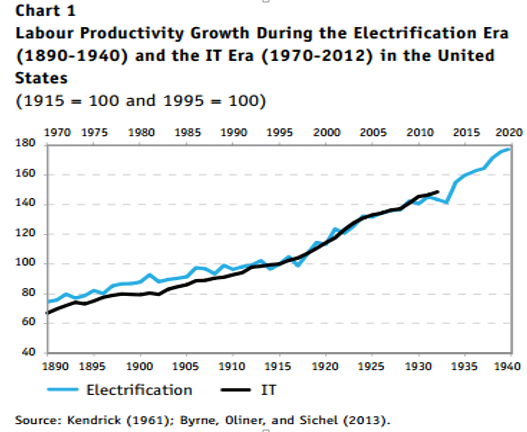
So what is the qualitative change in these three factors that changed so much in your opinion? Globalization was important for the US from its very inception (example: European price and production developments where a big factor in the Panic of 1819[1]). And productivity growth has been more or less constant over the last 100+ years [2][3].

[1] https://en.wikipedia.org/wiki/Panic_of_1819

[2] https://cdn-images-1.medium.com/max/800/1*i79QfQsgSagYNZl17o...

[3] https://www.bls.gov/lpc/prodybar.htm

I think it has been the gradual march of technological progress and globalization. For example remember the civil war was largely fought over protectionist trade policies for northern manufacturers. And that was in the age of sail when many goods would not even make if from North America to Europe. Similar protectionist policies would be unthinkable now. Also the rise of America from being an upstart industrial power like China and India are today to being a wealthy nation with (relatively) high standards of living for its low and middle class.

Unions are fascinating, honestly I am surprised that the era in which they were strong ever existed so early in history. They rely on having a monopoly on labor or at least a large percentage of it but with modern transportation the size of the labor pool is just too large and too poor for a relatively small, wealthy nation like the US to organize it.

If I had to point to seminal events causing the change, they would be construction of the Suez and Panama Canal, MacArthur's reconstruction of Japan, and Nixon opening trade with China. This last one could be the reason we are all still alive today, but clearly the American middle and lower class have born the brunt of the costs relative to where we all were after WWII.

Btw thanks for the discussion. Has been a while since I read about panic of 1819! I also blame the aspects of Keynesian economics that do not constrain the growth of government debt for increasing the power of existing wealth relative to the working class, but I admit that is a more questionable opinion.

>For example remember the civil war was largely fought over protectionist trade policies for northern manufacturers.

That's a falsehood pushed by the south to deny their support of slavery. This short video about it from prager University is helpful: https://www.youtube.com/watch?v=pcy7qV-BGF4

Here you can read South Carolina's actual declaration of Succession, where they make a point of spending most of the 13 pages talking about how their "right" of slavery was being infringed upon: http://www.teachingushistory.org/pdfs/DecImmCauses.pdf

My previous reply is being down voted a lot so I'll try again and compare them.

These tariffs were effectively a tax on slavery and a redistribution of income from agriculturalists in the south to industrialists in the north. The major cause of the South's succession may have been slavery, but the immediate cause can still be these taxes which were putative to slavery. They didn't suceed in response to the emancipation proclamation.

Either way, my point is that tariffs and protectionism had profound economic impact benefiting the industrial north and Midwest at that time.

I'm not sure if people even at that time knew which of the two was the more prominent cause of the war.

Edit: MacArthur's reconstruction of Japan is just a easily identifiable event. What I am really saying though is how industrious the Japanese people have been since the age of exploration. Perhaps the seminal event should have been Commodore Perry or the Meiji restoration.