Hacker News new | ask | show | jobs
by raj_o 3506 days ago
This makes no sense. A person who studies medicine, knows what his comparative advantage is, or should be. A business that makes springs, knows where to focus their energy in order to compete. The idea that a country doesn't know is because a country doesn't have an over-seeing rule-maker (a government) defining the rules of play.

Outside of a regulatory framework, in modern economics, comparative advantage won't work. It will be those with the most power (derived from success or money or something else) will win. Those with the most resources wins. And yes those who can game the system will win. Otherwise you'd take the 'capital' out of capitalism. After all, who wouldn't capitalize over the stupidity of another country that let you take advantage of it?

Outside of natural resources, can you please tell me how an area on this earth can have an advantage over another area. I am befuddled by this argument for free trade, in regards to countries.

1 comments

The point is that comparative advantage is discovered in the market. I may think that I'm the best at painting houses - and I may be better than most! - but in striving for the best gains I can, I may find that my comparative advantage in doing something else, something I'm more expert in, is greater. To wit, "what is the best use of my limited time?"

An advantage can come out of any number of things - climate, location relative to a trade route, particular local demands or preferences, or just happenstance. As you note, comparative advantage is not just about whole countries, but also about regions, companies, and individuals - so that it's not just about an "area of earth" but about the variety of things that happen in each place. Comparative advantage is an argument that trade makes people (regions, cities, etc.) better off even if they have nothing they are the best at.

Markets and governments are necessarily linked. So even though you might "think" you are no good at painting houses, because you can't compete with foreign labor, actually what's happening is that their government has figured there is a huge multiplier for them to capture all the house painting work in your country, and therefore, they subsidise and protect their own house painters and help them in any they can. So that they can eventually force you out of the market. See China on consumer electronics, solar panels, etc.

And if you say "but the perfect market wouldn't have any subsidies or aids" then you are living in a fantasy world made up by economists! They don't even have to subsidise, all they need to do is make it slightly easier for house painters to do their work there than anywhere else in the World, by easing legislation and lowering taxes. They will outcompete you just by following less laws and regulations and paying less tax. Because everyone ever has agreed that laws and tax should exist, you need to explain how "perfect" markets will ever exist. Again, look into China and it's the exact same thing. They don't need subsidies, they create Special Economic Zones.

Anyway the idea that markets exist separate from governments is a fiction made up by economists. See "Debt the first 5000 years" on a description of how anthropologists have found that actually, the most common origin of a market is government intervention.

Well, I disagree with David Graeber on the very nature of money and exchange, so take that as you will. I'm well aware of the argument though.

I don't think most economists have ever argued that markets exist outside frameworks of property rights and rules of trade. And while these things have often been laid out by governments, it does not necessarily mean that they always are, or always must be (where we take "government" to signify a usually-geographically-bounded entity with the monopoly of force.) Just the same, money has often been issued by governments, but does not necessarily mean that only governments can issue or create money. Markets exist wherever trade exists, and are shaped by governments - sometimes well, sometimes badly, and always within certain constraints of reality.

As pertains to the supposed advantage of government support of industry - take a closer look at China. The most dynamic sectors of the economy there - in assembly and manufacturing - have been the least directly subsidized and encouraged. The big State Owned Enterprises, in steel, concrete, and other heavy industry insulated from competition, are the most saddled with debt and are not innovative and dynamic. The main effect of their subsidy to these industries is philanthropize everybody's consumption of their products. Sucks for the Chinese taxpayer, but everyone else gets cut-price goods. And you'll note that, even after getting "pseudo-monopolies" on various economic sectors, prices in those sectors have kept falling. The "drive-out-competitors-then-raise-prices" drama never seems to appear - and it's no surprise, because these companies are competing with each other.

Also, this is very good. This is what I come to HN for. Good to awesome discussions between smart people. I wouldn't say subsidies are a good thing, that's not what I'm saying at all. I do believe that market forces exist and that they have good effects. The limits of my language and economics knowledge fail me here, but I agree that competition is a good thing and that "state picks the winners" is a bad thing. Bad and good being defined in terms of efficiency and higher productivity.

But the idea that free trade is "awesomely good for everyone" which is pushed or that markets can exist without governments or that a "perfect market" would have no government intervention seems to have no basis in reality, as far as I've read. Markets and governments exist in a symbiosis that can have good or bad effects, and there's increasing knowledge on how to manage the relationship so that most people in most places benefit. The arguments towards Total Free Trade with No Protectionism and Free Movement of Capital (capitalized because those are the ideas that I have qualms about) seems to ignore, in my opinion, the following things:

On No Protectionism: Masses of workers might lose their jobs and be unable to retrain, creating a huge structural unemployment problem.

On Free Capital: Quoting Jonathan Goldsmith talks about in his segment on Charlie Rose, if you allow for capital to move freely, you brake the contract between labor and capital that's been made through tremendous conflict and compromise in the West. Capital can manufacture goods outside of the country and reimport it, breaking the fundamental agreement of sharing of profits that allowed the West to become so good to live in during the 20th century.

And that is the recipe for tremendous income inequality and the destruction of local manufacturing.

On the Loss of Manufacturing: Vaclav Smil has said that "without manufacturing you have no middle-class"

Basically Free Trade with No Protectionism seems to mean the destruction the local population's wellbeing in exchange for "economic growth" that benefits very few people at the top. The pieces are there if you want to connect them.

Of course, I would agree that free trade and no protectionism is not good for every single person all the time - just in the same way that people whose jobs are automated, or simply do not exist any more due to changing demand, often find it difficult and hazardous to adjust. Sometimes people do get a bit carried away in presenting free trade as a winning proposition for all individuals all the time.

But the primary counterargument is that attempts to restrain free trade generally a) reduce overall output and productivity b) give domestic producers a captive market and no incentive to improve c) incentivize smuggling and corruption in getting around barriers and d) cause local industry to fall behind and inevitably be overtaken in global markets even with domestic supports.

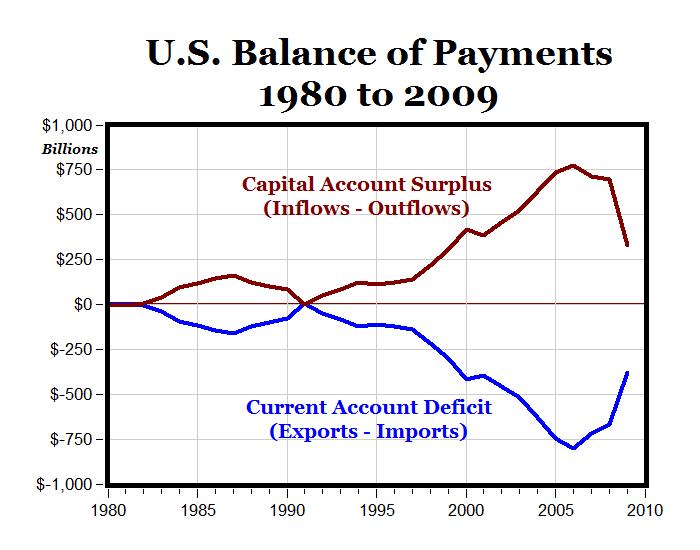
On the free movement of capital, one notes that the US, for example, has a large "trade deficit". But what does this mean? Essentially, that US consumers are net exporters of dollars in trade for foreign goods. But where do these dollars go? Well, they come to the US as part of "capital account surplus" - that is, the movement of capital investment into the US. While the immediate impression is of "industry moving overseas", the US is in fact an enormous net destination of capital investment. ( http://3.bp.blogspot.com/_otfwl2zc6Qc/TMybFmTdp1I/AAAAAAAAOm...) If they restricted the movement of capital, it would mean shutting out incoming capital investment, not keeping it from leaving.

So what happened to manufacturing? In a word: automation. The US manufacturing sector is at an all-time high in terms of value produced, but it's quite true that it employs fewer people than it did during its heyday. Manufacturing didn't decline, it's just that people don't work there like they used to. ( https://www.aei.org/wp-content/uploads/2015/10/mfg1.jpg ) This is what's felt as being "without manufacturing", but really it's just the automation of manufacturing, just like the automation of farming. This is overall a positive process, increasing productivity, but in the short-to-medium term it can be painful.

I'm familiar the automation argument. Still the latest studies have placed the loss of jobs to outsourcing in the millions.

I also think the automation argument has another flaw and a very simple one. By tracking jobs that have been outsourced you are tracking old jobs in some factory that put people out of work. But what about the factories that don't get built, or the labour Forces that don't get trained to make new goods ?

By removing trade barriers and allowing capital to reimport manufactured goods you have removed the incentives to invest and maintain a workforce.

If trade barriers were still up, my guess is there would be huge training programs for people to go into certain professions that would be needed to manufacture goods locally. I.e. The IPhone is produced in China, and Steve Jobs once told Obama the reason was he couldn't find the 5 millions engineers or so he needed in America to build it.

If the trade barriers were still up that would make manufacturing in China uneconomical, then Apple would start a massive training program to train those engineers in America. Apple didn't do that program because it didn't need to, it could find them in China at a cost of 20-to-1. Compare that to Intel, a company that keeps their production in the US, which has invested in programs to train engineers in America.

If capital can move freely it will choose the cheapest available workforce, and it can't find that workforce it will train it in the cheapest possible location. It will then reimport goods manufactured with the lowest-investment workforce into the highest-profitable markets to sell it. Because free trade.

So even though automation is part of the story the destruction of trade barriers also has another effect, which is the removal of incentives for capital to invest in labour training. And that's the origin of the barista economy that people keep complaining about - businesses have no reason to invest in America anymore to manufacture their goods. They absorb the highly educated workforce paid for with a lot of public money, and they benefits from it, while reinvesting as little as possible in the economy and dodging as many taxes as they can.

Is there any example of property rights existing without the monopoly of force by a government ?
I would say yes, historically and presently in various "unowned" regions like international waters and more importantly in "cross-border" exchanges where parties to a trade generate some system of property trust due to the fact that recourse to the government of the "other" country is impossible. (Here we get into the thorny question of whether self-defending individuals/organizations are themselves governments, and so forth.)

But that's not the main point that most economists are making (except the rather unusual anarcho-capitalists like Rothbard and the like.) The point is that there are property rights that are more or less in accordance with certain aspects of reality, and attempts by governments (or indeed private actors) to enforce property rights at odds with physical and informational reality is going to cause serious problems. For example, if a system of property rights says that nobody can own title to exclusive use of land or water, then I've set up a system where the inevitability of needing to physically occupy some land or water conflicts with the impossibility of acquiring stable property in it. Conversely, if a system of property rights says that the first person to speak and claim a phrase owns all rights to it forever (like some super-copyright), then it's just made normal language extremely cumbersome. The primary point of economists in the whole Menger-Hayek-Mises-Hazlitt meta-tradition is that while a government of some kind is probably inevitable, it should recognize that appropriate property rights depend on certain properties of the things themselves, and not arbitrarily defined by the government. (This is a sort of compact way of saying "property rights need to be defined differently between private goods, public goods, club goods and pool goods, due to their actual physical differences.)

International waters are still subject to the rule of law of "states" that exist on land. Unless you plan to live your whole life on sea you have to dock somewhere.

Also these people are only respecting the rules they have already interiorised from living in developed economies. If you look at history, individual private property does not show up as something innate. Tribes owned areas and fought for them, but they didn't have much individual property within themselves (neither did they have barter economies).