Hacker News new | ask | show | jobs
by cyberferret 3517 days ago
But the current concept of time is also based on the outdated industrial age concept of a 'working day' being 9-5.

I doubt many of the people on HN for instance, work those set hours in this day and age. Nowadays it is purely a convenience factor to keep the worker drones in the same hive so they can gather for the next interminable meeting.

With the rise of remote working, and other forms of communication tools, no one has to be constrained by those arbitrary work hours any more. I personally do my best work late at night and well into the early hours, and have indeed had remote meetings with overseas team members at 10 or 11 pm my time because it actually suits me better than 3pm my time, which is when I usually try and sleep off my post lunch lethargy. (Note: I see the irony in 'post lunch' - The concept of 3 set meals a day is also another byproduct of the agricultural/industrial age that is not really as relevant in modern society where families tend not to dine together at a set time any longer).

7 comments

For those who live in our Ivory Tower of the software industry that may be true, but the 9-5 concept is not outdated for a vast majority of working humans on the planet. Lets not project our reality onto the rest of the world.
Here's a fun thing though:

Japan adopted the 9-5. But Japan is on solar time, and thus the sun comes up at 4 AM during the summer in Tokyo. Japan also doesn't do DST. So 9-5 is actually 11-7 in "equivalent sunlight"

The idea of time zones is to keep people in sync, but most of the world is not even on a "12PM=Solar Midday" schedule! So when the sun comes up at 4, if feels weird, because it doesn't match what you see elsewhere on the same longitude.

Are you sure you got it right?

If I understood correctly, Akashi is the "standard" (as in, fixed from Greenwich) reference in Japan, some 270 miles west of Tokyo, that means that the Sun is at the highest point just some minutes before 12 in Tokyo, which is not significantly different from what happens in London when the DST is not active? England sees the highest Sun at around 1 pm when the DST is active, but that's only one hour, give or take the minutes of seasonal variations from the real solar time, and that really only when DST is active, and Japan, as you say, doesn't do DST, and has the similar seasonal variations.

Therefore I don't understand your "11-7" equivalence.

I think his error is in assuming that the zenith should correspond to the midway point of your workday. Which is entirely not true: Our society is organized around getting to work first thing in the morning, and having some sunlight left after work hours for social activities.
My point is that 9AM in Tokyo and 9AM in Madrid or Virginia are vastly different in terms of "position of the sun", despite being the same longitude.

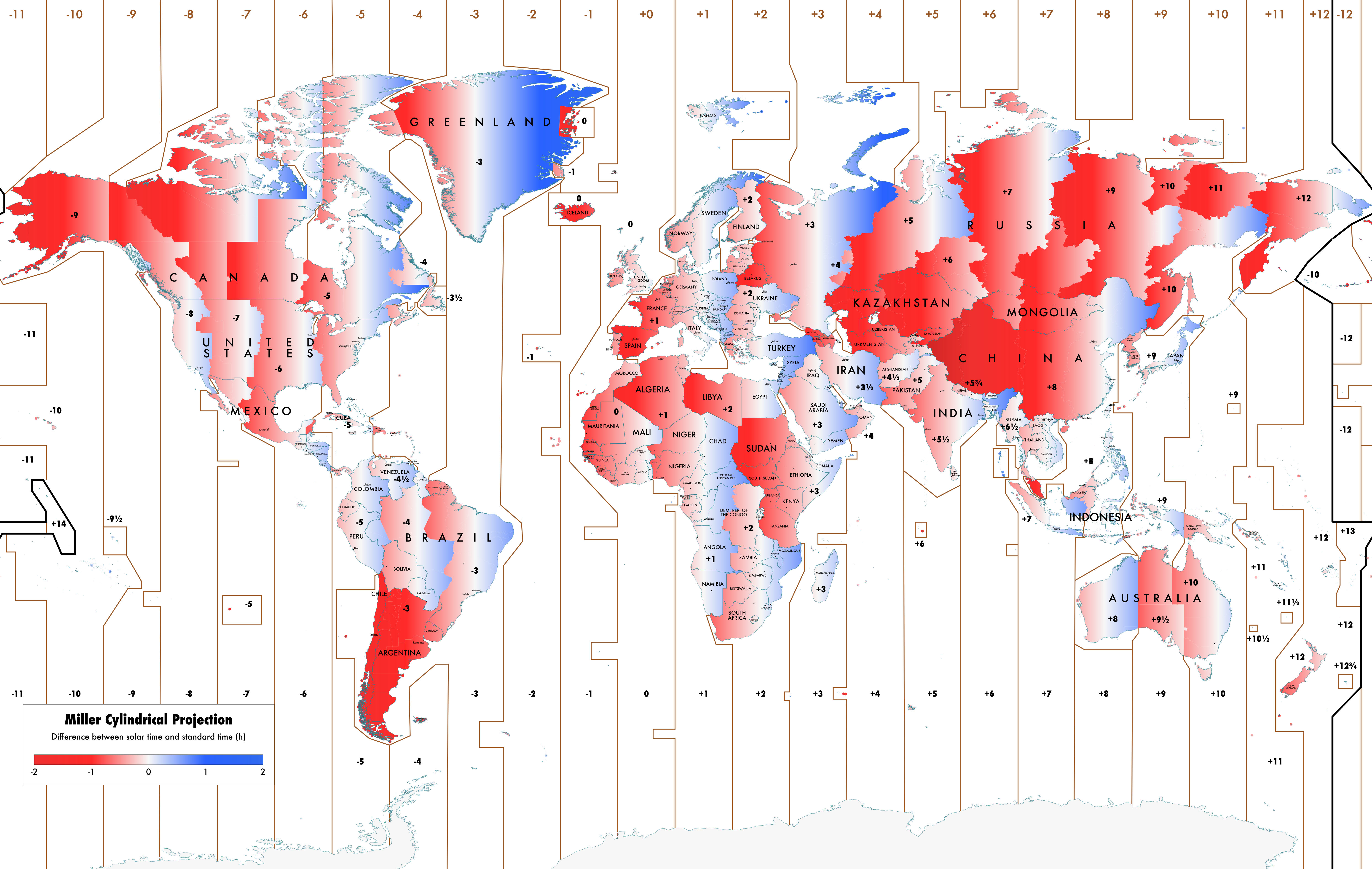
http://blog.poormansmath.net/images/SolarTimeVsStandardTimeV... <-- this map shows the difference between clock time and solar time. Western Europe and much of the US is 2 hours behind solar time compared to Tokyo.

So Tokyo is set to a 9-5, but if they want to follow the same strategy of getting to work first thing in the morning, then they should be doing 7-3, or even a bit earlier due to DST non-observance.

Main point is that 9 AM means vastly different things, even counting for longitude. Standard time has become standard, in setting when people wake up, but it's far from the locally ideal situations.

Thanks for the picture, nice. I see it's from

http://blog.poormansmath.net/the-time-it-takes-to-change-the...

As the picture shows, Spain and the parts of France are the extremes in the Europe, in the rest of Europe the Sun is closer to being at 12:00 (not counting DST) not too different to Tokyo.

Yes, the map you link shows is that some parts of the world have wider time zones than it would allow all the people living there to have the Sun very close to 12:00. But your "Tokyo sunrise" argument is still not a good one. All the areas (and cities) in the map that are "relatively white" have Sun at the highest point around 12:00 noon. Tokyo is "relatively white." New York and LA are also "relatively white." So I still don't know what is your perspective for Tokyo being strange. Can you please explain? The dramatic example would in fact be Spain or even Argentina.

I see even bigger error in his argument based on when "the Sun comes up" since it's dependent on the latitude even in the same time zone. He should ask somebody living close to the North pole.

http://geography.about.com/od/physicalgeography/a/longestday...

"Reykjavik, Iceland Earliest Sunrise: 2:55 a.m. from June 18th through June 21st." (Reykjavik is 64° N)

"London, United Kingdom Earliest Sunrise: 4:43 a.m. from June 11th through June 22nd." (London is 51° N)

"Tokyo, Japan Earliest Sunrise: 4:25 a.m. from June 6th through June 20th." (Tokyo is 36° N)

When I lived in London the seasonal variation in sunrise was just one of those things you lived with.

Everyone gets wrenched by the start and end of BST, but generally if someone says "5pm" or "17:00" you get a seasonal sense of how much daylight that implies. I can't imagine the US - or anywhere else - being different, except possibly close to the poles.

Absolute sun position matters a lot less than the felt relationship between clock time and sun position. That sense changes slowly but reliably over the year.

The obvious benefit of time zones is that virtually everyone you interact with daily has the same subjective time sense. Everyone knows that midday is going to be bright, midnight is going to be dark, and the rest is going to vary with the season.

A single universal time would lose that.

Yeah, I grew up in Oslo, Norway, and found his idea that the sun rising around 4am in summer was something unusual very strange. To me, sunrise occurring well before I wanted to wake up in summer was the norm.

But then we also have far longer periods of sunlight during the summer.

What's annoying me even now in London is that sunset still comes too early during the summer (during the winter, on the other hand, I definitively appreciate the longer days here vs. Norway)

the 9-5 concept is not outdated for a vast majority of working humans on the planet. Lets not project our reality onto the rest of the world.

On the contrary, the 9-5 concept has never applied to the vast majority of working humans on the planet (agriculture, health, factories, sales, even most offices don't keep those hours). With growing communication across time zones, their difficulties have only recently become more obvious, previously this sort of communication was rare, now it is becoming commonplace.

The solution to not being sure if someone is working at a given hour is to schedule a call, preferably using a sane shared timekeeping standard which doesn't change hours at the whim of politicians.

> the 9-5 concept has never applied to the vast majority of working humans on the planet (agriculture, health, factories, sales, even most offices don't keep those hours)

Also, reproductive work (nursing children, taking care of the sick and elderly, cleaning the house).

You really think so?
So far you have the most levelheaded comment I've seen (out of 4... not a big sample size), but just wanted to agree.

We all need to get off our high horse and be more specific, at the risk of smaller readership. For global teams that are making software, GMT / 24 hour clocks are great. But lets not project our reality onto the rest of the world. I love that comment!

The opposite is also true - don't imagine a 1930's production line factory or bank clerk as the reality of a majority employee population working day.

Farmers, truck drivers, pilots, bakers, hospitality workers, nurses, street sweepers, security guards and a thousand other jobs are NOT bound to a 9-5 working time. Indeed, outside of government or large corporations, I struggle to find many professions that ARE bound (or have to BE bound) to these hours.

I think first, second, and third shift are pretty much just as rigid if not more so.
I think this could be a good impetus to get rid of that. Right now the concept of 9-5 is often adopted by pure inertia even when there is no reason to do so. The day we'll have to all translate the current '9-5' to a different number, it will be a serious chance to reevaluate if that's appropriate.

For instance my place has a requirement on being there around 9:30 in the morning even though we should be part of the "Ivory Tower" club you mention since we actually work day in day out with people on different time zones.

Same with public services opening at 9h an ending at 18h, forcing everyone else to open holes in their schedule to get there.

Don't forget that the people working in said public services also need to open holes in their schedules to access the services that other companies provide.

What kind of hour staggering were you thinking about to try and solve the scheduling problem?

In the US, try 9-6, unfortunately.
I am in the US and try to do 9-5, plus or minus an hour on the start time, sometimes leaving at 4pm. And while I am usually among the first to leave the office, I don't feel guilty about leaving by 5 any longer considering the occasional odd hour conference call and late night work that pops up.

I miss out on time with my family if I leave later than 5, and I prioritize that over looking busy in the office. After 5 my mental capacity and productivity is dwindling anyways.

Would love to stay on DST and never go back. Kids don't sleep in an extra hour. It makes for a rough week.

It's not outdated. Of course, if the only thing you do is programming and you never intend to leave the house, then it may be outdated. Otherwise, most establishments still have working hours - that may not be exactly 9-5 but pretty close to that framework - and people still have breakfasts, lunches and dinners, and there are a lot of business and social conventions based on those assumptions.

Some jobs have the luxury of ignoring that, but that's just a perk, not a wide tendency. Just as if remote working in software allows one to work in one's pajamas, it doesn't mean all other clothes besides pajamas are now an outdated concept.

I propose that it should be outdated though. Does a lawyer have to be in the office at 8am to finish drafting that closing statement for his hearing next week? Does an accountant have to finish his client's tax assessment before 5pm?

I know lots of lawyers and accountants who do that stuff at all hours - exactly the same hours as I do my programming work.

20 years ago, I used to do the whole 'business lunch' thing with a lot of them too. Nowadays, it is usually a quick 'coffee catchup' at all sorts of hours - sometimes 9pm, which works better for us than the 12pm or 1pm lunch sessions used to.

Technology, plus the burdens of modern working life, means that 9-5 is really just a placeholder for "Oh, well those are the official times that denote when I will be available to do work stuff", but heck, that is really my "interruption time band" and my REAL work times are usually outside of that...

You assume that people would be free to chose their schedule, based on their specific constraints.

However that's not how that will work out for the majority. You abolish 9-5 expectation, all fine until you get a boss that is a night owl and he wants you available from 6PM to 3AM AM. Enjoy both not having family time anymore and not being compensated to work what would be a night shift in current society.

You take the example of the lawyer here above. Right now he need to be in the office because his assistants/PA will be in the office at that time and there is no reasonable expectation he can force them to be available at other times.

This depends on what kind of job you have (and on how you are being compensated). If you made a 40 hr/wk for salary deal with your employer and now you're actually available for 40 hours while also doing your actual work outside of that time, you might want to reevaluate your work-life balance.
Lawyers and accountants can - and do - keep flexible hours when not dealing with clients. When dealing with clients, there's still expectations that the lawyer would be able to meet you somewhere within 9-5, and not at 2am. Of course, there are exceptions, but that's a convention. People want to have lives outside job, so there should be an agreement when we have "meeting points" that we're expected to be on the job, and when there's no promise.

> just a placeholder for "Oh, well those are the official times that denote when I will be available to do work stuff"

It's not "just", it's very important coordination point. If lawyers kept random hours and you needed a lawyer, it's be much harder for you to find one because you'd also look for one that has suitable hours. Not impossible, but harder. To lower transactional costs, the hours are roughly synchronized.

The working day is based on when humans naturally want to be active. Remote work, while increasing, is a fraction of work that's actually done. Humans are wired (in the majority) for the day, and our time conventions match that.
Yes, it's tough being an outlier. I am a night owl, not a morning lark -- this is my biologically-determined chronotype, not something I do because I'm lazy.

It's always been a struggle to force myself to conform to society's idea of "normal hours," especially in high school when I had to wake up at 6 AM.

I realize most people struggle relating to this; try imagining starting your day at 10 PM, if you're a "normal" morning lark.

I work 9-5, and I honestly wouldn't have it any other way. I like having a fixed time where I'm working, and then 16 hours to do whatever I want. I prefer to wake up, work for the first half of my day, and then have the second half of my waking day in the evening.

In fact, most people in my coworking space also work 9 to 5.

Same goes for set meals (except that I don't have breakfast). Usually when I'm hungry enough that I want to eat, it's conveniently lunch time. And the second time I get hungry is usually around 7 pm.

That is perfectly fine too. Routine and habits are important. If 9 to 5 works for you, then great - go for it. My argument is that what if it doesn't work for you do to things like child care, commuting, or other important commitments?

Personally, my wife and I like to be home when the kids come back from school at around 2:30pm, so we tend to break our work days to spend the afternoons with them to help with homework and chat to them etc., then resume working once they are in bed.

That works for use because we work from home too. Obviously wouldn't work for many others. But why not make things work for us, especially now we have the capability to do so via tech and modern corporate culture?

You eat on "lunch time" because you got used to eat at the same time. For some it is 11:30 for others 14:00. It's just a habit.
> With the rise of remote working, and other forms of communication tools, no one has to be constrained by those arbitrary work hours any more

No, that's completely untrue for the vast majority of workers.

Because convention dictates that they have to be in the office between 9-5, or because those are the only times that they can actually do the work they are paid to do?

I appreciate that factory assembly line workers, shopkeepers and many others have to have set hours, but even so, does that have to conform to the 9-5 standard?

An example using Banks, an ancient entity that exemplified the 9-5 ethos: Here in Australia, most banks don't open their doors until 9am, then close promptly at 4pm. Their reasoning - they have to prepare floats and cash drawers in the morning and cash up at the end of the day, thus the restrictive times.

Problem is - everyone else in town has to work between their designated 8am and 5pm, thus are otherwise occupied during the bank's opening times too, which makes visiting the branch office an impracticality.

Except during lunch hour. And when do the banks send most of their staff on lunch? That's right, between 12pm and 1pm, which is when everyone else can actually get there and experience short staffing at its absolute worst.

Why on earth don't they do a 'double shift', whereby one smaller team comes in at, say 6am to start the preparation and open the doors at, say 7am and work until 1pm. Another team can come in at 11am and work through to 7pm, doing the cashing up and closing the doors at 6pm. That way the bank will be open before and after other people's work times for convenience, and the dreaded lunch hour rush will actually be double staffed for better service.

That 1920's inefficient mindset really has to give way these days.

> Why on earth don't they do a 'double shift', whereby one smaller team comes in at, say 6am to start the preparation and open the doors at, say 7am and work until 1pm. Another team can come in at 11am and work through to 7pm, doing the cashing up and closing the doors at 6pm.

The reason they don't do this is that that would require workers to stay at work later, which would take away from time spent with kids, eating dinner with family, etc. You're only thinking of this from the perspective of the customers' convenience, but the banks' employees are people too, and they don't want to have to be at work long after everyone else finishes up with work. If you were a cashier at the bank you'd feel differently about this.

If you check my shift suggestions though - the 'evening team' start at 11am in my example.

I've run my own businesses for over 30 years now, and in almost all cases, we give our employees a choice over their preferred working hours. Guess what? Some of them are 'early birds' and love coming in really early when they feel productive and like the fact that they can leave early and still catch up with friends for coffee or a late lunch at 2 or 3pm.

Some preferred spending their early mornings getting kids ready for school or going to extended yoga classes, running errands etc. and coming in closer to lunch time and working later, leaving the office after 6 or 7pm to avoid the rush hour traffic.

The solution could work to suit the employees as well as the customers. Time to be creative about this, rather than refusing to budge from an outdated mandate.

Well, not only that, but also keeping the thing open all day and night would cost extra and the most common tasks can be served by the machine anyway. And especially in the case of a bank we have to keep security in mind too.
I'm guessing you don't have kids. I used to work whenever I wanted, but now my kids have childcare from 8-5:30, and that is when I work.
2 kids. They are grown up now, but when younger, they were actually cared for by family or a friend of the family who was a professional carer. We were fortunate enough to be able to dictate their care times to suit our schedule.

I daresay that if your childcare centre only offered a 11am to 7pm slot then your work schedule would shift accordingly. And why wouldn't a child care institution offer split shifts like this? It would cater for people who have long commutes or actual shift work. I know employment contracts, overtime rates and EBAs/Government legislation comes into play - but all these are things that have to be reconsidered in light of modern workforce practices.

11am-7pm? Kids are often up at dawn and forcing other times is bizarre. So by 1900 the kids would be going mental.

While it would be nice if there was slightly later childcare and work to shift peak hour, I don't really think it will work.

Don't kids go to school where you live?
Well, I was thinking babies and toddler aged kids when talking about this. School aged kids are a different kettle of fish, but then again - school here finishes at 2:30. We have a generation of 'latch key kids' because of the gap between the time when kids come home and their parents do.

I've posted elsewhere here that my business tries to cater for this, by allowing earlier start time and/or reduced hours for parents who want to be home for their kids, or collect them and take them home themselves.

Must admit I find it strange that social implications like this aren't more of a focus in modern society. Surely we can make the whole working/school cycle more effective?

Where on earth do you live that school is 9-5?
I work from 9:30 or so to 6. The reason is that it overlaps with co-workers' working time.

When I worked remotely in the UK for a company based in California (normal time difference 8 hours), I'd work into the evening for exactly the same reason. It's far more efficient; it makes IM possible, and changes email threads from multi-hour conversations to multi-day conversations.