Haven't heard of this company before. A good synopsis I dug up in their fundraising announcement:
> JetZero, co-founded in 2020 by start-up veteran Tom O’Leary and aerospace legend Mark Page, is developing the world’s first commercial all-wing airplane. With up to 50% better fuel efficiency and lower carbon emissions compared to existing commercial airliners, JetZero's Z4 will offer the aviation industry a clear path to achieving its 2050 net-zero goals while also elevating the passenger experience. Working alongside the US Air Force, NASA, and the FAA, and backed by decades of investment and research into blended wing technology. JetZero looks to enter commercial service in the early 2030s.
Where an "all-wing" airplane is, kudos to Gemini,
> one that merges the main body and wings into a single lifting surface. This can reduce drag, lower fuel burn, and expand interior space.
The design has been in the works since at least the late 1980s which is when the B-2 stealth bomber was developed.
For an all-wing design to work the onboard flight control system needs to make thousands of microscopic surface adjustments every second to keep the flight stable. This is much more practical with today's computing power and technology, even if the concept may have been thought of long ago.
Yep. I'd say the way forward for testing is the freighter, which doesn't have evacuation issues, doesn't unload at passenger airbridges and (if packed properly) doesn't have the same sensitivity to rolling motions.
But freighters generally have lower utilization on less price-sensitive routes, so operators tend not to care so much about fuel economy (and for related reasons, usually aren't new aircraft). So however much easier the route to certification might be, it's a horrible market...
"A clear path to zero": what a joke. It will be 25% less fuel, 75% SAF which are nowhere close (how will one grow enough without fertilizers ?), or worse, hydrogen which is even more nowhere close (how much energy you need to produce H2 ?).
just ditch the plane. That will be so much money you can invest in net-positive technologies.
Except there is another issue, how many people do you fit in this shape ?
If you can only fly 30 people that's not very efficient as it would mean more flights.
Also I believe the further away you are from the rotation axis of the plane where it turns left or right, the more unpleasant your flight may be
The very comment thread we’re in has a quote stating you get more interior space because of the incorporation of wings into the body.
They appear to make more sense for large passenger jets because the interior volume scales better. There’s a ton of practical concerns though.
They won’t fit into existing airport setups. Seats near the wing will move waaay more than near the center during banking turns (maybe they’ll be cheaper lol)
I don’t think it’s a given they’ll replace what we’ve got, but who knows.
Regarding capacity, iirc, one of the advantages of this style of body is greater internal volume.
And another company working in the same space, Natilus, is planning to fit 150-250 passengers on theirs, somewhat comparable capacity-wise to a 757, but about 30% smaller length/width.
Tangentially related Good news: You can avoid about half the greenhouse effects of flight by slightly changing the flight plan to avoid cloud forming regions
Bad news: this generally wasn't counted before and when counted roughly doubles the impact so in some senses you're back to where you started.
But it's a much lower hanging fruit than anything else and as yet we're not doing it.
I hope I'm not overinterpreting, but I get the sense that you think that's morally better than simply avoiding contrails. If so then this is surely a mistake! While an individual who imposes heavy costs on himself to do something socially valuable is certainly demonstrating commitment to the cause, the best solution for society is the one with the lowest costs.
Actually, lots of people acting together regularly accomplish things - almost everything wortwhile is accomplished that way, probably back to our non-homo ancestors.
As a simple matter, it keeps my city clean - we all put garbage in the bins (yes there's a law, but no way could it be enforced if the great majority of people didn't do it already). More dramatically and recently, the protests in India.
> society
Society is us - you, me, everyone. Nobody else is coming to help us.
I'm responsible for what I do, for the consequences of my actions. It's embarassing to say it's someone else's job (especially when the someone else is 'society'), and therefore I'm not going to do anything.
I think you've misunderstood my comment. I understand that people can do things together. My point was that the best thing to do together is to solve our problems at lowest total cost, and that choosing a high-cost solution can be individual "virtue signalling".
That term lacks all credibility - it's just a weak attack based on mind-reading - and is a signal itself.
Most people actually want do good - humans naturally are very social and want to do well for the group - and without prioritizing signaling. How sad that some are so politically driven by reactionary politics that their contribution is to snipe at others.
This is an issue, a question of an issue, with the maximalist position. By simply using trains wherever possible and avoiding 'frivolous' travel a huge impact can be achieved on one's carbon footprint.
Wandering can be slower paced, or to places that are magical but nearer and connected via alternative to planes. Also we can avoid using planes for less important things, like business meetings etc.
homo sapiens could avoid wandering in the skies for 200k years, yes we can avoid it. Finding joy in life should not really be correlated with flying often to faraway places.
Just stop subsidizing flying, maybe even tax the fuel a fraction of the value it’s destroying and I bet most of flying will suddenly turn out to actually be completely avoidable.
It is a bit complicated as flying isn't much subsidised in cash terms and if you put large taxes on fuel, flights will divert to nearby countries with less tax.
In the UK there is air passenger duty which is for example £102 per passenger on economy seats to the US. I think they are reluctant to raise it too much incase business shifts elsewhere.
Insane take - this is just ensuring that the only people who get to enjoy travel are the rich. Nothing in our society is improved by taking a privilege that's widely enjoyed and restricting it to the wealthy or very wealthy.
It’s a privilege with most externalities _not_ taken into account, i.e. it’s hurting us all because we ignore its true cost and make it available in vast quantities.
Since the global South will suffer the most from climate change, they might disagree with developed nations ‘subsiding’ flights.
In many instances there are alternatives. Amsterdam to Berlin is served by good rail (except when DB are crappy) and flight options. NYC to DC or Boston. Maybe, someday, SF to LA, and others.
IMHO you can remove the "good" and "except when". DB is 30% of the time a frustrating experience, which I've noticed makes me want to avoid it, even though I love trains. Trains in the rest of Western Europe are pretty great!
Boy what happened to DB since 2022? That was when I last travelled in Germany and I was never able to relate to everyone’s online complaints about them.
Did Berlin to Nessau through small routes: wonderful. Berlin to Prague? Stellar, if long. Berlin to Munich? Amazing all 4-5 times, unless they forget to stock up on soft pretzels.
Fair, Deutsche Bahn is awful. Went to Berlin with them last November and instead of getting in at 9:00 PM we got in at 1 AM, which was especially horrible given we had a 6 and 8 year old with us.
We should be careful not to confound a call to reduce with a call to eliminate. I don't think most people want to completely abolish modern air travel.
So, getting better at manipulating clouds will help prevent planetary heating. I assume there is a huge amount of public support for this scientific research?
What I really want, is a plane that can load passengers like containers--or like a rollercoaster car. Of course, it should be comfortable. I just mean that the passenger compartment should be modular. So you can put your luggage in and get settled while sitting in the airport, and then when the plane comes in, it just side-loads everyone all at once. Once landed, it just slides everyone off, and you can just
I know that the crew uses the typical seating time to refuel and load luggage in the underbelly, but one can dream of not having to wait to get off the airplane.
So, essentially that's how it works in the game Elite: Dangerous where you load and unload the passengers in cabins which are measured in tons. They can even be stolen mid-flight by anyone with a hatch breaker drone. Unfortunately, you cannot jettison them in the void of space.
Then there are the Imperial slaves which are considered cargo and not passengers, but it's a different story...
Apart from just being highly unrealistic and not very practical, hospitals are much worse than airports in every way. Why not just get injected at the airport itself? And why an injection? Why not inhale some dream gas? Less intrusive and scales better.
I would argue that the most wastage is in how people embark and disembark. During Covid I flew a few times back home and they did line-by-line from the middle through both doors, and that was quite good and efficient.
An engineering nightmare. But as a passenger, it might be nice. Can take time getting on to the container and settled, and then the whole container gets loaded.
Big screens are an OK workaround for no passenger windows, but they still have to contend with severe structural pressurization challenges, strict emergency evacuation rules, and incompatibility with current airport gates.
In a conventional aircraft you sit on the roll axis. In a blended wing body design you can have off-axis motion that can increase motion sickness. Rather than rolling with the longitudinal axis of the aircraft, you move up and down when the aircraft banks. Not necessarily a deal breaker, but an additional difference to deal with.
> Note, too, that a larger lifting body needs to bank less to execute the same turn as a craft with more loading.
This is not really helpful for passenger comfort. For a turn to be comfortable, you want the turn to be such that the effective force the passengers feel has no sideways (relative to the passengers) component, and the required roll angle is only a function of the velocity and turning radius. The aircraft design is irrelevant.
Coördination stops lateral passenger movement. It does nothing for up and down. (Coördination is also about more than comfort. It keeps the flow attached to the wing. If your passengers are slipping, so is your wing.) In a roll, with a tubular fuselage, everyone—pilot and passengers—feel about the same vertical Gs. OP’s point is in a flying wing, the folks on the tips will lift up or drop down relative to the pilot and thus experience extra Gs.
My response is (a) this can be controlled in avionics and training, i.e. don’t do that, and (b) now that I think about it, vertical Gs aren’t as sickening as lateral ones.
Specify a maximum roll rate in training and normal-law software and this problem is solved
> Specify a maximum roll rate in training and normal-law software and this problem is solved
I’m wondering whether there are major airfields with traffic patterns that require roll rates that would exceed whatever maximum is desired for comfort. My intuition is that the situation would be tolerable at most airfields but that normal-law limits that are too restrictive could be dangerous.
A few years ago, I would your use of diaeresis an admirable quirk. But now, especially given the em-dashes, I'm wondering if you're an LLM overtrained on the New Yorker.
I learnt on mentour pilot (or maybe captains speaking?) that the airbus most of the time optimizes for comfort by having a constant g force as you ascend or descend or something like that. Unless you are high aoa. So there are systems that so this sort of passenger comfort thing for sure.
I don't understand your point. Does the wider passenger compartment leads to more extreme transitions at the edges? Is there something else at play I'm not thinking of?
Picture being on the end of the wing and how much you move up or down when the plane rolls.
An airliner entering a 30 degree roll over 3 seconds would have passengers pop up or down 25 feet, with at least +0.3 and -0.3G of acceleration. It would come with a "going over the top of the roller coaster" feeling. This is in addition to the roll / rotation.
No way. Looking out the window is one of the joys of flying.
Picking out my house, seeing tiny cars on a remote highway, etc. Even 100+ MP cameras and high resolution screens won't come close to that level of detail.
I've been that guy, but only if the scenery is interesting. Still, my attitude is that at noon, people don't need to have a blanket placed over their cage like parrots to make them sleep.
I also was on a flight once that had a very bouncy landing with all the windows down - when I didn't realize we were anywhere near the ground yet. I'm not into tuning out reality to that degree, and don't really feel obligated to help anyone else do so either ;)
I love looking out plane windows at night. Distant lightning storms, cities, fishing boats, highways, country borders lit up and stretching as far as you can see.
But are you willing to pay 10-20% more for that joy? I personally would rather pay less money to fly, not get to see out the window, and spend those dollars on, say, a fancier meal at the destination. Or to have an extra day at the destination if my trip length is money-bound rather than time-bound. Or put those dollars towards an extra hour of childcare. Or … I have so many uses for dollars that give me more utility than “see out the window while flying”.
Where that number comes from: they claim 50% reduction in fuel consumption, which sounds doubtful to me, and fuel is about a third of flight costs, and I’m making some generous assumptions around perfect competition.
My primary destination is Europe <> NZ which is about 24 hours in air so personally I'd give up everything for flat seat. Doesn't have to be business class seat - just something barest of the bare, basically bunk beds.
Thing is with current structure airlines would dilute business class too much and airplane manufacturers would increase density all while decreasing fuel use per passenger - none of which is desirable.
We don't really have to guess: as jet engines became more fuel-efficient, inflation-adjusted prices for air tickets dropped. And as oil prices fluctuate, so do ticket prices. There's a bunch of noise in both these trends but the best explanation for them is that competition between airlines drives prices to roughly the cost of provision, of which 30% or so is fuel.
Make the entire hull 'transparent' by wall covering screens. Think The Sphere in Vegas. Some fans to blow the wind through your hair, and now you are gladly paying extra for the bird-like experience ;)
I'm fine with not looking out of the window if the seat is comfortable and I can get to the bathroom more easily. And I'm sure I'm not the only one. Window enjoyers such as yourself will still be able to get the window seats.
I don’t know how many people are claustrophobic, but for me this would be a non-starter.
Edit: apparently 12.5% of the population has claustrophobia. If 5% of flyers choose a different airline due to simulated windows that would wipe out any cost benefit from fuel savings.
I don't think it is that simple. If a route has mixed offerings and the cheaper option is the windowless plane, it's likely to be full and they'll save on fuel costs for the full flight and can charge extra for a normal flight off hours and come out way ahead.
Be nice to not have to deal with that one guy who didn’t close their window when it’s dark cabin time on long multi-Timezone flights; leaving the sun to blare in when you’re really trying to get some shut eye.
IIRC, minimum one window for each rows is a safety requirement, so that firefighters can see inside a burning plane or something. I think that is believed to be how that fence appeared.
No, virtually all the radiation with the exception of UV is passing straight through the airframe. The protection an aircraft body offers is negligible.
Jeez way to ruin of the few remaining joys of flying. Lock everyone in a tin can. You will experience reality through screens only and you will enjoy it
This question is deeper than you think. Until the 20th century, most people didn't travel even a fraction of that many miles per year. The most prolific travelers, such as Mozart, did not travel nearly as much as a person who's commuting to work every day by car or train -- just to sit in a chair in the office instead of at home. When it comes to transportation, we burn fossil fuels and pollute the planet with CO2 for mostly needless reasons.
Our generation thinks we're so much "smarter", but we're living on an ecological credit card that our children will have to pay, not to mention many of the planet's ecosystems, just so we can all have "memories of actually being in Venice" rather than simply a picture of us in Venice, which in the end is the artifact we have. (If we are that insistent on "being everywhere" and checking off a bucket list, perhaps "Total Recall" was onto something LMAO.)
You’re not wrong. Having traveled a fair bit it does eventually turn in to basically a big theme park experience. I still like looking out the window though
Not this again. They’ve clearly hired a new PR firm
Suffice it to say, from stable aeronautics at-edge, jet way footprint efficiency, ground support efficiency, airframe pressurization, cargo & passenger logistics, lifespan, and certification, there are many, many reasons “tube + wings” is the dominant airframe architecture for all non-military aircraft.
There are many reasons for a lot of things, until you overcome those reasons. That's the point of innovation. There are many reasons not to make a reusable rocket too.
Yes, but this "innovation" (as sold) must exist as a viable commercial airplane.
So far, I see zero evidence that this company has addressed any of the aforementioned challenges beyond theoretical fuel consumption and theoretical passenger logistics.
As someone who has 31 hours towards their single-engine ppl cert, I absolutely abhor the stagnation of general and commercial aviation due, largely, to certification barriers, BUT even having a viable flight-worthy blended-wing concept does not make for a viable mass market product.
Not related, see the near half-century of "alternative" wing and airframe designs that are absolutely better at a few pieces of the puzzle, but also absolutely failed to be viable when integrated into a fully functional and safe airplane.
This company needs to focus on success in a niche product role before addressing the safety, integration, and manufacturing needs of the mass commercial aviation market. They are not (atm) backed by this sort of "patient capital".
Not related, see all of the VC and failures required by Whittle (in wartime no less) to develop the jet engine or Tesla's corporate journey from Roadster -> S -> Y.
It's a lot like saying, "as someone 5 hours into driver's ed in my mom's honda civic, I believe that future stability control algorithms in self-driving cars..."
Or the difference between a (noob) software user and a software engineer.
theres just some serious serious challenges here i dont think any of them are impossible to overcome but it would span so many more years and so much more funding to get thru. fuselage pressurization which they claim to have worked around (sus) is one of the spookiest imo.
traditional looking commercial jets, their designs, their manufacturing processes, their innovations (yes boeing/airbus do innovate and have for a long time even though it doesnt seem that way) have all been shaped heavily by human blood. to some degree a radical new design almost guarantees more deaths at a commercial level there's really no shortcutting this without it.
dont get me wrong im super open to the possibility that something like this is possible itd be better for the whole world, but there's no way we get there without re-experiencing some hard lessons if we want to push it pash some sort of proverbial finish line
Even small changes to time tested designs provide significant risk. A completely new body style will inevitably provide completely new failure modes.
Pressurizing a tube vs pressurizing a pancake (or flattened sphere, or some other easy approximation) will have very different mechanical loading characteristics. Turbulence (differences in air speed/pressure) across a large flat-ish surface that also has a signifiant pressure differential will also prove challenging to design for and scale up.
Aerospace is a very high dimensional design process. Doing anything different puts you into unknown territory real fast.
If some letters were capitalized it would be easier to read but without this gets downvoted as wordsalad. Almost illegible. Punctuation exists for a reason.
If not this again, what would be your ideas of the path forward for aviation?
All of the constraints you mentioned are the results of decades of optimization around the tube-shape aircraft design. Meaning the design has to be proven first. Infrastructure will adapt.
Also, I suspect the first application will be military, such as Next Generation Air-refueling System (NGAS):
Agreed. There are always large amounts of money being poured into aviation and most of what comes out is knowledge.
It's always exciting to see futuristic designs and bleeding edge tech but there are a lot of footnotes in aviation history filled with these.
I think electric aviation (in general aviation) is probably the best/real frontier to watch for innovation currently. Many advances in aviation come from much smaller operations doing something successfully.
Interesting choice to build in Greensboro. That's also where Boom chose to build a factory and it looks massive as you leave the airport. The plan for this company's factory looks like it will be significantly larger.
The reason that these companies are choosing Greensboro as a base is due to the fact that the GSO airport has a relatively-long 10,001-foot runway but comparatively little commercial air traffic. Additionally, the airport property is quite large compared to some "urban" airports, and is under a lot of active land development to make room for more manufacturing facilities.
The HondaJet HQ is here (and has been for some time), as well as a number of aircraft repair facilities inside the airport fence, and there are ~5mil people within a 90 minute drive of GSO, so it's becoming easier to source talent for aerospace as well.
Our long runways and the fact that we only have around ~7 flights arriving/departing per hour, and the proximity to Washington DC, is why GSO is used quite often for training operations for "Air Force One" - we see 28000 and 29000 do very low passes over our house around once a month as they do touch-and-go and go-around drills, so it's always funny to see the flurry of "did you guys see that?" posts on Nextdoor.
An experimental/homebuilt of similar but not exactly the same design, the Dyke Delta https://en.wikipedia.org/wiki/Dyke_Delta of which about 50 have been built, has its pilots reporting a comfortable ride.
It’s also much smaller. The main problem will be that the people sitting outside experience a lot of vertical motion when the aircraft rolls. That’s only a problem with the full scale design.
It was more fuel efficient only over a very narrow band of the entire flight envelope. Also, it suffered from snap-stalls and very poor stall recovery due to its delta wing.
This is, primarily, why you only see delta wings used in super-sonic aircraft where these limitations are more than made-up for its ability to go trans-sonic with (relative) thrust efficiency.
JetZero’s Demonstrator is on track for first-flight in 2027. The Demonstrator is being built in partnership with Scaled Composites, a subsidiary of Northrop Grumman.
Scaled Composites? Now that’s a name I’ve not heard in a long time…
This reeks of Vern Raburn and Eclipse Aviation all over again, haha. That failed terribly. SV’s ego is pretty funny sometimes. Eclipse even tried to develop their own avionics.
When looking at potentially revolutionary technology companies, I tend to evaluate more harshly than I would with normal companies.
Three things on the JetZero website trip my BS detector. First, it appears they’re developing their own avionics displays/interface? That’s a terrible idea, they need to be laser focused on one core task.
Second is this quote: “The Pathfinder team has built and flown five generations of scaled aircraft over 30 flights. The most recent flights validate both the configuration and control laws of our full-size Jet1 Demonstrator.“
Over 30 flights seems really low. They should be testing way more than that, no?
Third, I spy a full-scale interior mock-up. There isn’t even a working prototype, but they’re paying people to pick out carpet colors?
I really want this to succeed, but it doesn’t look like these are serious people.
Why so few? I'd expect them to be flying daily or as often as possible, to gather as much data as possible. The next step is a full-scale demonstrator. No doubt they have their reasons, but I wonder what they are?
The people they do that have a lot of experience and make a lot of money. Fortunately, most of the world doesn’t have the software business’ cavalier attitude about safety-related things being perfectly safe.
Just because they are worse than they should be doesn’t mean they’re comparable. Cheap Chinese consumer goods? Sure. But aerospace and software aren’t in the same galaxy when it comes to QA and accountability. Source — I worked in software for decades and currently work in aerospace manufacturing.
Why has one of the images in the header carrousel got it featuring what looks like a refueling probe for refueling other aircraft sticking out the back? The other two don't.
It looks like they've taken this mostly from an older Boeing BWB design for future air-to-air refueling aircraft (although the wing shape is a bit different).
Fluid dynamics is my jam (most of my masters was studying it)! Even in the intro to fluid mechanics book, they spent a good half+ chapter why a flying wing is superior and how you can have it designed similar to movie theater seating. But my professor spent a class explaining why regulation will kill it even though the design is great.
The regulations currently require all passenger aircraft to be able to maintain positive static stability, which is inherently at odds with the aerodynamics of an all-wing design. As technology and test-flights demonstrate that these designs are actually feasible (and safe), I expect the regulations will eventually be updated.
I always liked TU Delft’s similar Flying V concept which had KLM and Airbus backing, but I’ve no idea if they have a route to production. https://www.tudelft.nl/en/ae/flying-v
Pratt & Whitney PW2040 turbofan engine, same as the Boeing 757 and the C-17. They say that the plane itself is so efficient they don't need a cutting edge efficient engine.
Hard to imagine it as a passenger aircraft any time soon, but if they manage to get the demonstrator built it looks like it could make a useful aerial refueling tanker.
I love how the last image of the landing page is a model of the most efficient plane ever designed on a pole attached to what may be the least efficient vehicle ever made, the infamous US tax-loophole-pick-up truck
You mean the infamous best selling truck of all time globally? The vehicle that actual working people use everyday? Just because you see a few people use them not for work doesn't really mean anything.
Just because some people go to work in inefficient and dangerous-to-others cars does not make them more efficient. I am working a construction job, does this mean I should not think about what I am doing ?
I wish them all the luck in the world. Aviation is in a massive rut and needs bold new designs and innovation. That being said, what makes this company different from the others that have come before? What makes their path to success more likely? The problem is likely less the technology and more the decade(s?) of burning money with no ability to sell anything because you have to certify everything. That cliff is so bad we got the 737 max instead of a real new design. In an industry where new tech should be bringing us new commercial designs yearly we are instead getting very minor iterations because even the massive players out there can't afford to bring a 'new' design to the table. I -really- want to see this succeed. Good luck.
> Aviation is in a massive rut and needs bold new designs and innovation.
Why does it need bold new design and innovation? More people (can afford to) fly every year, more safely, and with broadly more consistency than they ever have. The success of the commercial aviation industry as a whole is breathtaking.
The 737 max is a great example of the rut we are in. In order to put more efficient engines on they needed more ground clearance. This has been the issue with 737 forever and why they have that odd flat scoop on the bottom of the engines. That isn't great for efficiency. It is because they can't redesign the wing without years long recertification. So, yet again, instead of redesigning the airframe to optimally place the engines they pushed them forward impacting the cg of the aircraft and requiring them to hack systems into the aircraft that countered for the reduced forward cg. Then, because they again didn't want to go through the recertification nightmare, they claimed no new training on the aircraft was needed. This led to pilots not knowing how to handle when the systems added failed. The root cause of the hacky design and missing training was avoiding a years long certification process that would have made it cost prohibitive to create an aircraft with more efficient engines. This is a minor change compared to building in really innovative new features.
To your argument of (paraphrase here) 'it is good enough why innovate'. I flat out reject that argument. Horse and buggy were good enough. The telegraph was good enough. We only needed 1 mb of memory because it was good enough. We are missing so much right now. We potentially could have small, efficient, point to point air taxi service for the average person, completely dismantling the massive, and horrible to deal with for people, hub and spoke system. Travel could get so much better and cheaper, but instead we have the 737 max. An incremental change on a decades old design because real innovation is lacking in the industry.
> To your argument of (paraphrase here) 'it is good enough why innovate'.
That's not my argument, you are putting words in my mouth. My argument is "you better have a good reason to argue the commercial air industry is stagnant because the industry's incremental progress over time has been incredible." Look at this chart: https://en.wikipedia.org/wiki/Fuel_economy_in_aircraft
That's crazy!
The issue with your 737 MAX story is the trade-offs they made - oversized engine without massive recertification or requiring airport retrofits - worked. It is an absurdly successful product despite the early engineering failures. It is the best selling Boeing aircraft of all time and the second best selling commercial airline of all time (to the a320).
Innovation for the sake of innovation isn't worth anything, the current commercial airline stack is deeply optimized and delivers low cost, safe travel to hundreds of millions of people globally. What, exactly, would you like to see innovation on? What trade-offs are you willing to make?
I spent a few years in the commercial airline industry. They have a ton of problems, very few of them would be solved with a revolutionary plane design.
From an engineering perspective, it's a solved task. Designing an airplane is on par with designing a suspension bridge.
From a regulatory perspective, the layers of bureaucracy needed to get approval to build a bridge has nothing on starting up an airline manufacturing company. Once you have a company with a history of approval, you can practically do what you want, but getting to that point is nearly impossible.
The difference is that there establishment space launch companies were basically monopolies using ancient technology and processes. That’s not true for commercial aviation, which is subject to pretty relentless cost pressures.
Seems like that’s what a lot of people say about a lot of legacy businesses though when facing pressure from a startup. Obviously doesn’t always work, but sometimes!
Bullshit i cant hear you. Commcercial airliners are sold at a loss and are basically giant jobs programs. Modern jetliners are enormously efficient already; there has been a continuous race over the last century to this end.
Feels like no windows is almost a deal-breaker? No? Do humans handle small enclosed spaces with no way to look outside well? The mock-up image looks like a small two-or-three seat compartment, which seems like it would be awful. Maybe an open space would be less claustrophobic, but still. Imagining just a normal jetliner today with no windows feels... not great. And I'm not sure having a giant flat screen wrapped around me would solve the problem.
I don't mind no windows at all if they have "digital windows" as substitutes. You're already 40,000ft in the air I think windows aren't really gonna help your claustrophobia. Not like you can open the door and walk out for a bit.
Maybe. I think people could survive it, sure. But I also wonder if there's a part of our lizard brain that just for safety's sake prefers to be able to see out of any small enclosed space we might find ourselves in. And that lizard brain is smart enough to know that a flat screen is fake. Again, I just think of flying in a plane today but with no windows and I, at least, am immediately squigged out.
I also feel like a lot of modern air travel is designed around making something that's highly unnatural and inherently terrifying into something palatable for most people. I'm not talking about actual safety, but the perception of safety. Which isn't exactly a logic thing. More about keeping that lizard brain from freaking out too hard.
I get motion sickness when sitting sideways or backwards on a car. People tend to become nauseous when they sense motion but don't see it, or what they see doesn't align with their other senses. Even the small amount of lag that a "digital window" would likely have, will make things much worse.
Actually no windows doesn't even pass Passenger Flight rules and regulations. In Asia, its mandatory that windows should be opened, visible during takeoff and landing.
Doesn’t that technically only mean that all windows that exist need to be open, and having no windows at all would satisfy the requirement “all windows are open”? Or is the second sentence an addition to the first?
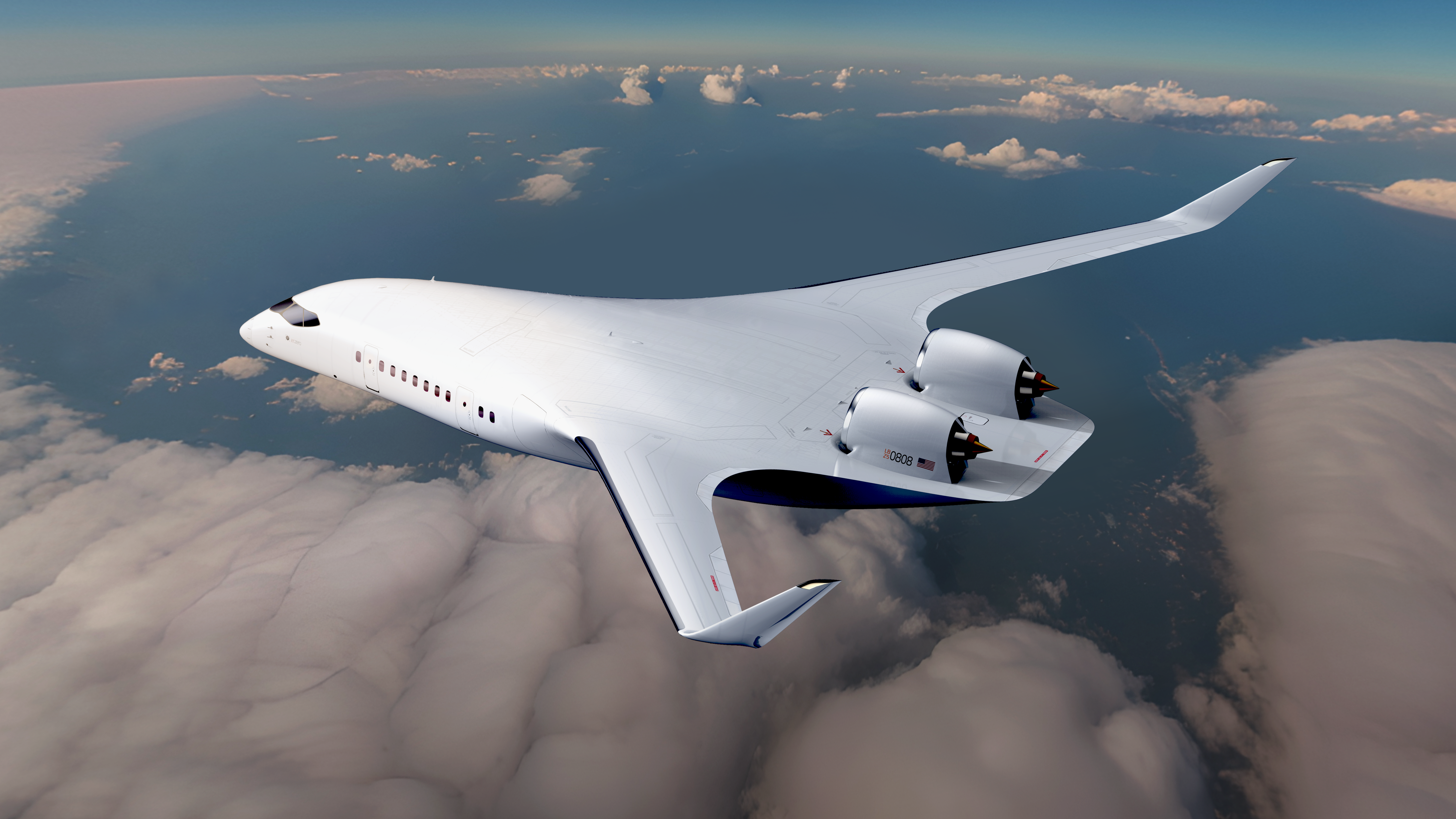
> JetZero, co-founded in 2020 by start-up veteran Tom O’Leary and aerospace legend Mark Page, is developing the world’s first commercial all-wing airplane. With up to 50% better fuel efficiency and lower carbon emissions compared to existing commercial airliners, JetZero's Z4 will offer the aviation industry a clear path to achieving its 2050 net-zero goals while also elevating the passenger experience. Working alongside the US Air Force, NASA, and the FAA, and backed by decades of investment and research into blended wing technology. JetZero looks to enter commercial service in the early 2030s.
Where an "all-wing" airplane is, kudos to Gemini,
> one that merges the main body and wings into a single lifting surface. This can reduce drag, lower fuel burn, and expand interior space.