Hacker News new | ask | show | jobs
by asfasdfaaaaaaa 1018 days ago
> 3. Rotational farming with grass seed and ruminants. Roaming cattle are literally the answer to climate stability, for multiple reasons.

Source please. I've only seen Big Meat selling this point before and all info i've read on it points to it being very false.

The one guy who has famously promoted this idea also killed 40,000 elephants in Africa [0] to learn that he was wrong so i'm not going to take his slightly updated idea that cows will fix it instead...

[0] https://www.fastcompany.com/2681518/this-man-shot-40000-elep...

3 comments

Would you prefer he double down and not admit the elephant slaughter was a mistake?

Ruminants are not "the answer" to climate stability, and big meat is as pernicious as big ag or big oil or anything else, but neither are ruminants the foundational problem Monbiot et al claim. Our industrial approach to animal agriculture (to all agriculture, or all industry, for that matter) is closer to the root of the problem. Even closer to the root, I would argue, is a general predilection to exploit resources for short term benefit instead of entering balanced, reciprocal partnerships with the land and our fellow species for long term success.

having grown up around farms,

It's not roaming cattle...it's a mix of animals that contain cattle as in: -some cattle -some goats -some pigs -some chickens

Some solar farms already use goats in the USA to keep grass and weeds down...the group of animals together has some benefits as opposed to focusing on one group of animals alone....too long of an biology ecology lesson to put here...but you can go to your local land grant university ecology department and ask them to explain it to you as it is a fascinating subject and kissing cousin to why vertical farming never ever is sound from an investment money stand point.

https://plantbasednews.org/news/environment/george-monbiot-r...

‘It’s Pseudoscience’: George Monbiot Blasts Regenerative Grazing In Heated Debate

“So any story that says it’s good to be farming these livestock, it’s good to be eating these livestock, is a story which justifies among the most devastating processes on Earth,” he said. “It is climate science denial.”

Monbiot linked this denial to the interests of major corporations like McDonald’s, General Mills, JBS, and the Murdoch Network, who he says have “backed and weaponized” the idea that grazing cattle is environmentally beneficial. “The story is false,” he said. “When you make a grand claim such as this one, that livestock can mitigate climate change, either you produce the evidence for that claim or if you cannot produce the evidence you withdraw the claim. The evidence has not been produced, the claim does not stand.”

"A 2017 University of Oxford study titled Grazed and Confused accepted that managed grazing systems could sequester some carbon back into the soil. It added, however, that this was only around 20-60 percent of the emissions that the cattle produced in the first place. What’s more, after a few years soil reaches carbon equilibrium, meaning it cannot sequester any more."

"A review article published in the International Journal of Biodiversity highlighted that land left free from grazing had more biodiversity. “Published comparisons of grazed and ungrazed lands in the western US have found that rested sites have larger and more dense grasses, fewer weedy forbs and shrubs, higher biodiversity, higher productivity, less bare ground, and better water infiltration than nearby grazed sites,” it said."

https://www.oxfordmartin.ox.ac.uk/publications/grazed-and-co...

https://www.ox.ac.uk/news/2017-10-03-grass-fed-beef-good-or-...

"This report concludes that grass-fed livestock are not a climate solution. Grazing livestock are net contributors to the climate problem, as are all livestock. Rising animal production and consumption, whatever the farming system and animal type, is causing damaging greenhouse gas release and contributing to changes in land use.

'Ultimately, if high consuming individuals and countries want to do something positive for the climate, maintaining their current consumption levels but simply switching to grass-fed beef is not a solution. Eating less meat, of all types, is.’"

So we should wipe out all grazing animals? All buffalo, elephants, rhinos, zebra, deer and antelope?

They're all contributing to global warming?

"So we should X?" is usually a signal that you're about to not track/engage with what someone said. I'm reminded of Cathy Newman's interview of Jordan Peterson where her only retort the whole time was "So you're saying that <something he didn't say>." (https://www.youtube.com/watch?v=aMcjxSThD54 -- A classic, even if you don't like the guy)

For example, they are talking about cows we farm into existence at the tune of 1.5 billion global population, not a few million wild animals.

No, I'm asking the commenter to consider the consequences of what they're saying. It is not "a few million wild animals"; there were an estimated 60 million bison in North America alone around 1800.

Why was it ok then but we can't have grazing animals now? I think the linked article makes a poor argument.

I'll take a stab even though I don't really have an overall opinion on the issue.

It was ok then because we weren't facing a climate crisis due to carbon cycle disruption then. Also, wild bison are different from domesticated cattle. One of the effects of the bison was shifting the boundaries between forest and grassland; now that they're gone more of the grassland is becoming forest, which IIRC captures less carbon than grassland. Also bison are native animals that might affect local ecosystems in many other different ways than our introduced cattle.

We've had an estimated 30-60 million bison in the US, now we have 100+ million cows.

And cattle and bison differ in their grazing behavior and ecological impact, making a direct environmental comparison unfair due to their distinct roles in shaping ecosystems.

It's our cattle and farming methods that are wiping out all wildlife.

https://xkcd.com/1338/

https://en.wikipedia.org/wiki/Holocene_extinction

The 2022 Living Planet Report found that vertebrate wildlife populations have plummeted by an average of almost 70% since 1970, with agriculture and fishing being the primary drivers of this decline.

https://www.unep.org/news-and-stories/press-release/our-glob...

Our global food system is the primary driver of biodiversity loss

https://www.vox.com/future-perfect/22287498/meat-wildlife-bi...

The way we eat could lead to habitat loss for 17,000 species by 2050

Two recent studies underscore the danger the meat production system poses for biodiversity.

https://phys.org/news/2023-04-climate-crisis-biodiversity-ap...

The climate crisis and biodiversity crisis can't be approached separately

https://pubmed.ncbi.nlm.nih.gov/26231772/

Biodiversity conservation: The key is reducing meat consumption

Just to compare cattle mass to cattle mass.

> We've had an estimated 30-60 million bison in the US, now we have 100+ million cows.

The US has always had < 50 million adult cows (milk or beef), the difference is yearling calves.

The bison estimates likely didn't include calves either .. and have a lot of bounce in any case.

There were 89.3 million head of cattle and calves on U.S. farms as of Jan. 1, 2023,

https://www.nass.usda.gov/Newsroom/2023/01-31-2023.php

* Of the 89.3 million head inventory, all cows and heifers that have calved totaled 38.3 million.

* There are 28.9 million beef cows in the United States as of Jan. 1, 2023, down 4% from last year.

* The number of milk cows in the United States increased to 9.40 million.

* U.S. calf crop was estimated at 34.5 million head, down 2% from 2021.

* All cattle on feed were at 14.2 million head, down 4% from 2022

As pointed out by olddustytrail .. that's the US.

Elsewhere meat consumption can save the planet by decreasing hoove heavy ferals that aren't managed at all - eg: Australia where camels, donkeys, goats, and cleanskin cattle are all introduced animals run wild that can be rounded up and trucked out every year in a never ending game of trying to keep their numbers in check and stop them over taxing the environment.

Kangaroos are native but savagely boom | bust - when the wet years hit numbers spike and if the population isn't culled the following years see the ground littered with dead as water resources contract.

> It's our cattle and farming methods that are wiping out all wildlife.

Well, when you say "our" you mean your own. Our local cattle graze on the machair.

But that's not the argument you originally made. You were saying it's impossible to raise grazing animals without being environmentally unfriendly. That is the part I dispute.

> Well, when you say "our" you mean your own.

Hardly.

> it's impossible to raise grazing animals without being environmentally unfriendly. That is the part I dispute

Animal farming became unsustainable due to its massive environmental footprint, including deforestation, habitat destruction, pollution, and excessive resource consumption, which collectively strain the Earth's capacity to support such practices.

We cannot feed the population with the same version of American or European diets - we'd need 5+ Earths to do it.

https://css.umich.edu/publications/factsheets/sustainability...

Beef has an energy efficiency of about 2%. This means that for every 100 kilocalories you feed a cow, you only get 2 kilocalories of beef back.

https://ourworldindata.org/land-use-diets

We've deforested large swaths of habitable earth to make space for animal farming - it uses 80% of our agricultural lands.

https://ourworldindata.org/land-use

Deforestation is the leading driver of habitat loss ... and the leading driver of it is animal agriculture.

https://ourworldindata.org/drivers-of-deforestation

We've destroyed so many habitats and poisoned so much that we're driving almost a million species to extinction.

https://www.nature.com/articles/d41586-019-01448-4

https://en.wikipedia.org/wiki/Holocene_extinction

"A 2017 University of Oxford study titled Grazed and Confused accepted that managed grazing systems could sequester some carbon back into the soil. It added, however, that this was only around 20-60 percent of the emissions that the cattle produced in the first place. What’s more, after a few years soil reaches carbon equilibrium, meaning it cannot sequester any more."

https://www.oxfordmartin.ox.ac.uk/publications/grazed-and-co...

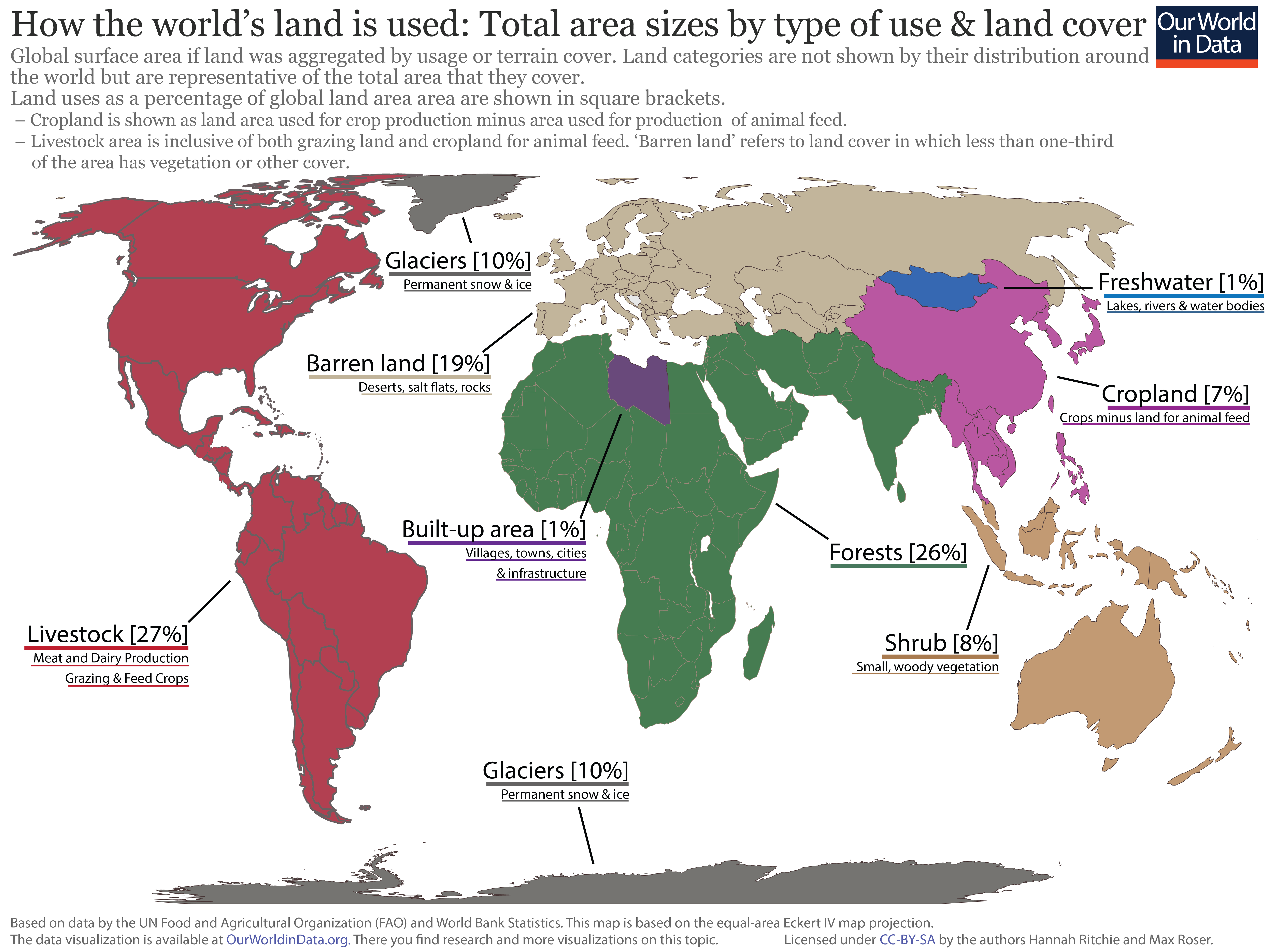
Animal agriculture takes up an area as large as both Americas, yet provides only 18% of calories and 37% of proteins.

https://ourworldindata.org/uploads/2013/10/World-Map-by-Land...

https://ourworldindata.org/land-use

If we were to reforest that area, we could sequester so much carbon that we would reverse the warming.

https://journals.plos.org/climate/article?id=10.1371/journal...

https://iopscience.iop.org/article/10.1088/1748-9326/10/8/08...

Feeding 10 billion people by 2050 within planetary limits may be achievable

A global shift towards healthy and more plant-based diets, halving food loss and waste, and improving farming practices and technologies are required to feed 10 billion people sustainably by 2050, a new study finds.

https://www.eurekalert.org/news-releases/917471