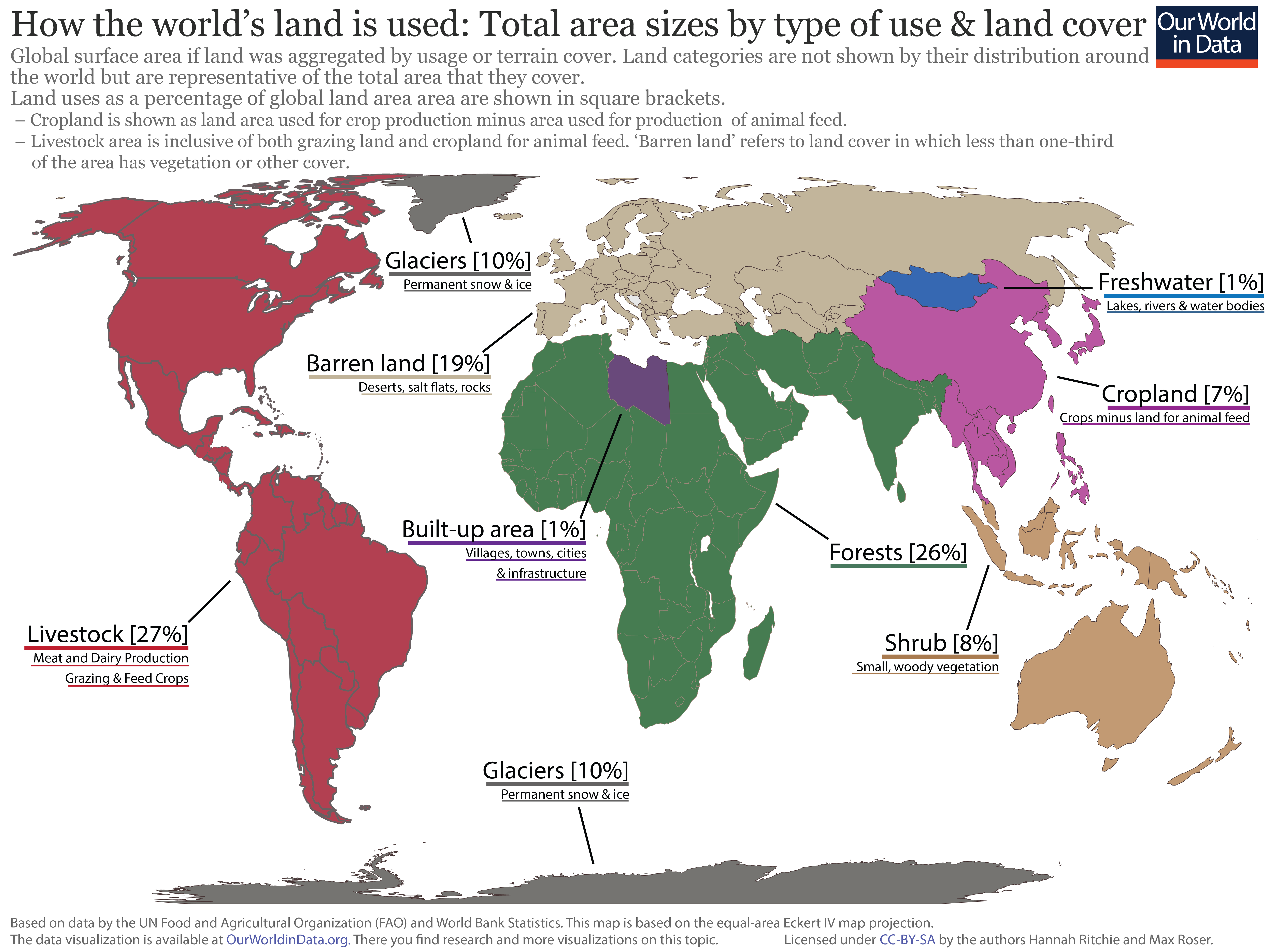
| > Well, when you say "our" you mean your own. Hardly. > it's impossible to raise grazing animals without being environmentally unfriendly. That is the part I dispute Animal farming became unsustainable due to its massive environmental footprint, including deforestation, habitat destruction, pollution, and excessive resource consumption, which collectively strain the Earth's capacity to support such practices. We cannot feed the population with the same version of American or European diets - we'd need 5+ Earths to do it. https://css.umich.edu/publications/factsheets/sustainability... Beef has an energy efficiency of about 2%. This means that for every 100 kilocalories you feed a cow, you only get 2 kilocalories of beef back. https://ourworldindata.org/land-use-diets We've deforested large swaths of habitable earth to make space for animal farming - it uses 80% of our agricultural lands. https://ourworldindata.org/land-use Deforestation is the leading driver of habitat loss ... and the leading driver of it is animal agriculture. https://ourworldindata.org/drivers-of-deforestation We've destroyed so many habitats and poisoned so much that we're driving almost a million species to extinction. https://www.nature.com/articles/d41586-019-01448-4 https://en.wikipedia.org/wiki/Holocene_extinction "A 2017 University of Oxford study titled Grazed and Confused accepted that managed grazing systems could sequester some carbon back into the soil. It added, however, that this was only around 20-60 percent of the emissions that the cattle produced in the first place. What’s more, after a few years soil reaches carbon equilibrium, meaning it cannot sequester any more." https://www.oxfordmartin.ox.ac.uk/publications/grazed-and-co... Animal agriculture takes up an area as large as both Americas, yet provides only 18% of calories and 37% of proteins. https://ourworldindata.org/uploads/2013/10/World-Map-by-Land... https://ourworldindata.org/land-use If we were to reforest that area, we could sequester so much carbon that we would reverse the warming. https://journals.plos.org/climate/article?id=10.1371/journal... https://iopscience.iop.org/article/10.1088/1748-9326/10/8/08... Feeding 10 billion people by 2050 within planetary limits may be achievable A global shift towards healthy and more plant-based diets, halving food loss and waste, and improving farming practices and technologies are required to feed 10 billion people sustainably by 2050, a new study finds. https://www.eurekalert.org/news-releases/917471 |