Hacker News new | ask | show | jobs
by anvandare 1267 days ago
For reference: this book is obviously a (praiseworthy) ambition to have a Greek counterpart to the Lingua Latina Per Se Illustrata[1] by Hans Ørberg.

Ørberg's way of teaching Latin is, in my view, excellent because it is based on a natural view of learning a language: show something, say what its name is, use its name in simple sentences, work up from there. Each time introducing new words surrounded by already-known ones and letting the pupil figure it out. All in the target language itself, exactly how we acquired our mother tongues. Vocabulary is acquired through repetition, grammar is acquired through "getting a feel for what sounds right". Using the brain's own mechanisms for deducing meaning and deriving rules.

The book is definitely going to need illustrations, just like in LLPSI[2]. Hard to understand what 'πόλις' means per se, but not if I take you up a mountain and point at [3] while saying "πόλις".

[1] https://en.wikipedia.org/wiki/Hans_%C3%98rberg

[2] https://blog.nina.coffee/img/lingua-latina.png

[3] https://i.pinimg.com/originals/f5/c3/10/f5c31074eeb418bc51e7...

3 comments

> Hard to understand what 'πόλις' means per se, but not if I take you up a mountain and point at [3] while saying "πόλις".

This works in theory, I guess, but in practice it's just absolutely awful. the Rosetta Stone courses work like this and I spent about 6 months maybe? working through the Korean class. I was only able to form my own sentences because I also bought some grammar books that taught me about particles and the "topic" of a sentence that you put -ga or -i after (depending if it ends in a vowel or consonant) and several other similar concepts.

But also, even pointing at an object or showing pictures didn't work. I remember at one point being shown two pictures and thinking I was being taught "behind" and a word that English doesn't have, for "far behind." Ah, how interesting I thought! Nope, not at all. It was "near" and "far." The only reason I learned this is because I started screenshotting every slide to an actual Korean friend I had and asking for translations of every word (I'm sure I drove him crazy). The reason I stopped doing the class in fact was that he wasn't always awake when I wanted to do the lessons (ironically since he was Korean-American and I was awake in the middle of the night usually lol - if he'd lived in Korea our schedules would've aligned better).

Anyway, after that experience I don't agree with this method at all. Maybe complete immersion does work, because people can correct your misconceptions, but learning from a book without any feedback is a horrible experience.

Complete immersion has good results, but this is pseudo-immersion at best. There are schools that teach following similar methods as Lingua ... per se illustrata, and while people do get the basics, I haven't heard from anybody that reached fluency through it. Language is pretty complex, and if you start out with the wrong idea about certain aspects, without feedback, you're likely to repeat the error for the rest of your life. Vocabulary is easily corrected, since native speakers know how to, but they rarely correct grammatical errors, and seldomly know the rules. Some languages have it easier than others in this respect, of course. E.g., English has small grammar and almost no morphology.

Good feedback is important, and if there's no teacher, you can correct yourself (to a certain extent) if the text book also explains the rules.

I learnt Latin with LLPSI 1. Though I must admit, LLPSI wasn't the only resource I used. I had to use latintutorial's* youtube videos (his videos are great btw) to explain certain bits of grammar that I couldn't understand on my own, like gerunds, gerundives and the subjunctive mood with `ut' and `cum' clauses is what I needed help with specifically, so you're right about people only getting the basics or at least the things they can make sense of on their own. I suppose LLPSI would be easier for someone who has already taught themselves an Indo-European language and is used to Indo-European grammar. Latin, for me, was the first language I learned, so I had jumped into the deep end. "Allen and Greenough's New Latin Grammar" is another book I used occasionally (it's the best Latin grammar book IMO). As for your comment on feedback, if I can understand what I'm reading then that's all I'm interested in. I'm only learning Latin to read ancient Latin literature. I don't want to compose or translate Latin. An example of feedback for me, would be to read a page of Caesar's The Gallic War in Latin then read the same page in English afterwards to see how close I was to understanding everything. So far I've been close on almost everything, so the feedback I'm getting is that I'm reading Latin the way it was written 2000 years ago.

Here's what I read in order:

LLPSI with Colloquia Personarum, Pugio Bruti (waste of time btw) and Fabulae Syrae. After that I read Epitome Historiae Sacrae, the Vulgate, Fabulae Faciles, Ad Alpes, Julius Caesar's Invasion of Britain and half of LLPSI 2. Currently I'm reading The Gallic War. I also started studying German at the start of this year using the book "German for Reading" by Karl Sandberg which is taking up 1 hour per day of my time so I can't spend 2 hours on Latin per day which is what I was doing from 2020 to early 2022. I wouldn't say I'm fluent at all, but on a good day I can comfortably read Caesar (with a dictionary).

My goal since the start (January 2020) has been to read Ovid's Metamorphoses, which hasn't worked out yet, but it's a work in progress.

* Big shoutout to LatinTutorial/Benjamin:

https://www.youtube.com/@latintutorial

One point for the discussion: learning to read is not the same as learning to speak. The latter is considerably more difficult.
100% agree. If `pure input' people, like Stephen Krashen and Steve Kaufmann, are to be believed then output (like speaking and writing) would eventually come after lots and lots and lots and lots of reading and listening, but I'm a bit skeptical.
Idk who they are, but have they ever learned a second language? It's probably just a gimmicky claim that got them a bit of fame (or infamy), and they stuck by it because of their career. I doubt they can present evidence.

And I don't mean: here's someone who was exposed to a large amount of English, and can now say a bunch of three word sentences. That's cheating. No, I want to see a large, representative group of people that haven't had any feedback on their speaking and writing during their learning reach almost error free, near-native fluency for a totally unfamiliar language (i.e., not an Englishman being exposed to French or a Mandarin speaker to Cantonese).

Edit: I looked up Krashen, but that looks like a hopeless case of academic hubris. E.g., this (http://www.sdkrashen.com/content/articles/why_dont_educators...) is just full of it. And he got influence on education with his absurd ideas.

oh yeah that was another thing with Rosetta Stone that drove me crazy - their speech recognition software was not good. I eventually started skipping the speech lessons altogether because it simply would not accept my input. Instead I practiced repeating after the example speaker during the other lessons, and speaking my own sentences out loud when I was "composing" them when working from grammar books. But, again, what I really needed was a teacher and a class.

On a different note, for the one language that I did learn and used to be relatively fluent in after 6 years of taking classes in school (Spanish), I can still somewhat converse in via writing, but I can't speak it at all anymore really. They're totally different skills.

You're describing a bad experience you had with a specific course (Rosetta Stone's Korean), and this data point is a useful warning, but generalizing from it to say that the method itself is “in practice it's just absolutely awful” and “a horrible experience” — when replying to a post about Lingua Latina Per Se Illustrata, which many people have tried and absolutely enjoyed, and indeed successfully learned Latin from.

All that this shows is that a course using this method can be either well-designed or not (possibly depending on the language and learner), and we don't know which one the current Greek one is.

That's fair, I'd appreciate hearing from someone who actually did the Latin curriculum and learned Latin from it if they managed to do it without additional resources to learn e.g. case endings from a text written in English.

Part of my reason for commenting is also that language-learning is something that a lot of people want to do but is extremely difficult to do & stick with outside of a structured environment/with a teacher. If you truly want to pursue it, I think finding an online class is going to help you considerably more than a self-guided curriculum like this; I probably should've mentioned that before. I wish I'd done that for Korean.

An interesting thing about LLPSI is that it does include abstract discussion of grammatical rules and concepts - in Latin, once readers have learned enough to permit following the discussion.

So it's not just learning from example and trying to pick up grammatical rules intuitively. Like when I took my German class, it was taught by immersion but included discussions, conducted in German, of how grammatical rules work. LLPSI is also attempting to do that kind of thing.

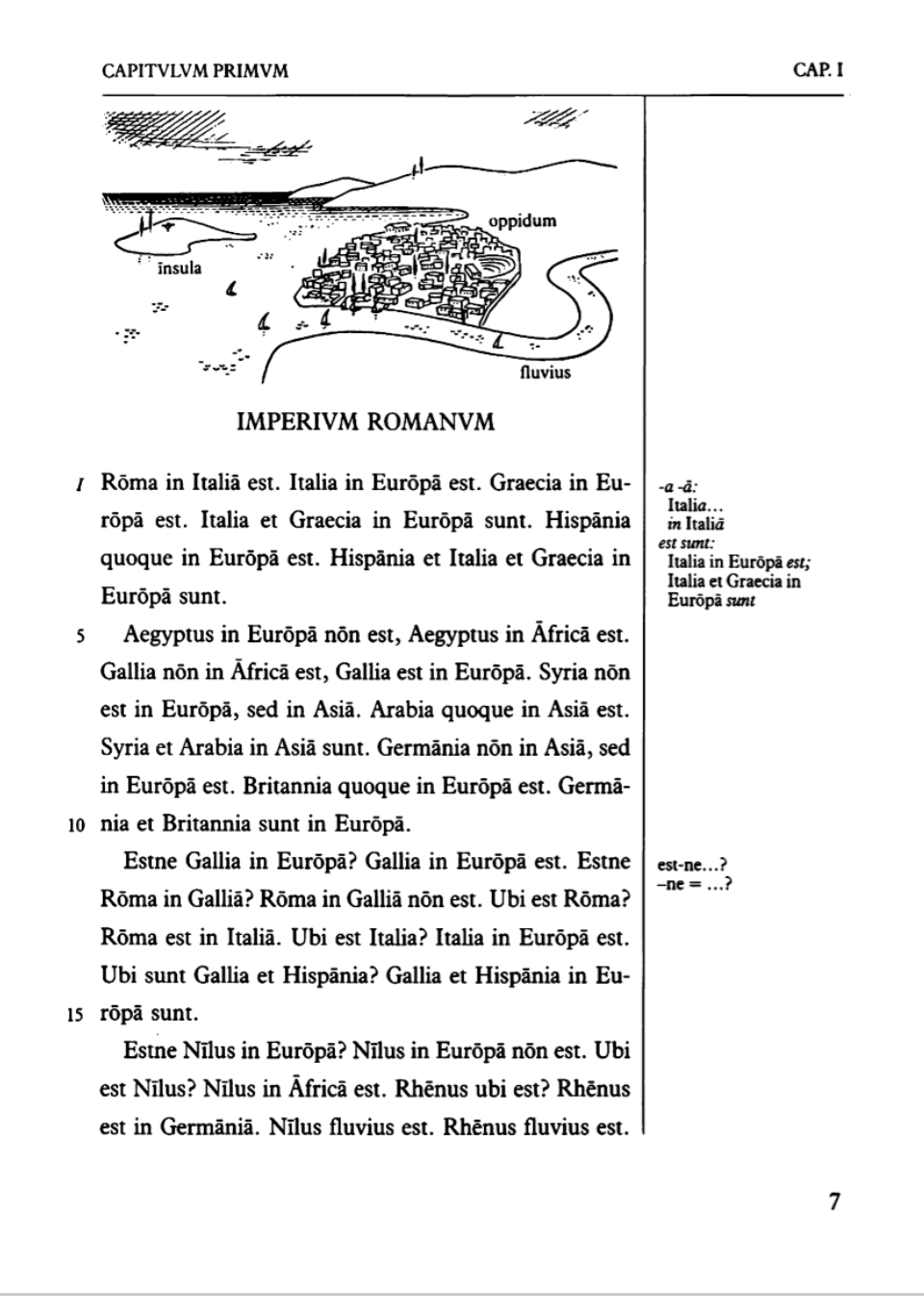
You are entirely correct in your criticism of Rosetta Stone, but LLPSI genuinely takes a very different approach. (I've done both, though for different languages.) LLPSI is carefully structured, precisely to teach things like declension and conjugation. As an example, this is very first line:

Rōma in Italiā est. Italia in Europā est. Graecia in Eurōpā est. Italia et Graecia in Eurōpā sunt.

This is not what most people mean by immersion. It's not a natural dialogue you're expected to understand by osmosis, it's an extremely carefully designed series of sentences aimed at manually bootstrapping your Latin. The book contains grammar explanations - wholly in Latin - from chapter 2 onwards. Every chapter has a grammatical concept it's designed to illustrate, and it manages to introduce fairly complex ideas - passive conjugations! ablative declensions! - in a deeply intuitive way, entirely in Latin. It's an incredibly satisfying course. If you have any interest in Latin at all, or are just looking for a New Year's Resolution, I would heartily recommend it.

That's interesting actually. It suggests that a major reason this works is because of its cognates with English that give you a starting point. So for example, a native Korean speaker would really struggle to learn from this curriculum, and the strategy wouldn't work very well to learn Korean. I wonder if it's possible at all to convey enough with pictures to design a curriculum like this when you don't have the help of cognates.
Cognates and illustrations definitely assist, and the book uses both freely. Chapter 1 begins with a map, for example. It’s a very clever strategy, one especially well suited for teaching Latin to people already speaking an Indo-European language.

I imagine it would be less useful to people who speak a language that doesn’t share the features of Latin. A map isn’t going to be of much use if one’s native language doesn’t have the concept of plurals, and one therefore struggles to comprehend the est / sunt distinction altogether. Then again, English doesn’t decline nouns or conjugate verbs (for the most part), and English speakers tend to be big fans of LLPSI. To its credit, it goes slow, and reinforces its lessons very well. The rest of chapter 1 is basically spent on variations of the above grammar point, introducing new nouns but reusing those two verb forms again and again in different variations, illustrating their use and how they contrast.

To your question, I also wonder how well this kind of bootstrapping approach could be achieved without relying on language similarity. The trick seems to be to tap into pre-existing adult skills or knowledge - e.g. logic, map reading. I think this is what sets LLPSI apart from “immersion” approaches like Rosetta Stone, which are based on the erroneous assumption that adults (do / should) learn language as toddlers do.

The book also includes a map of the places mentioned, at the time of Classical Latin that the narrative is set in. I’m only about half way through, but there really aren’t that many cognates. An aha! moment every so often, sure — like silēre -> silēns -> silentem -> silent — but it’s not like I read through and it only makes sense because of cognates.
Yes indeed a structured environment and teacher would be best… another reason is that self-guided learning also tends to run out of steam/motivation more easily. But it's not as if there's an abundance of classes (online or otherwise) for Latin.

Apart from what others have said about their experience learning Latin from LLPSI, a couple of other points:

• Using the book does not necessarily preclude looking up other resources now and then, it's probably ok.

• Consider your example of getting the wrong understanding of some items of vocabulary, like "behind" and "far behind" instead of "near" and "far". While this is not ideal, at the same time, in a well-designed course (which yours may not have been), you're at least getting a feel for how these terms are used in sentences. The understanding of words can get corrected/refined over time, based on seeing new contexts. What you're avoiding meanwhile is mapping the terms into your native language, in which you have a very clear understanding of words and their fine distinctions. This is a trade-off when one considers what this method aims for: eventually being able to think and compose naturally in the language, without always "decoding"/translating into/from another language. See this post shared by someone elsewhere in this discussion: https://blogicarian.blogspot.com/2019/03/argumentum-ad-ignor... — it describes the problem very well (and incidentally ends with a recommendation of Ørberg's LLPSI in its final paragraph).

Same here; a long while ago I tried to teach myself German via rosetta and it was not good. I remember the point where I gave up which was where 2 different words were used for food. Food for an animal, and for a person [1] I just wondered if there was a mistake, or what. A simple note saying 'yes there are different words for this unlike in English'[2] but no. I guess that was the final straw, I felt I was fighting something very poorly designed and basically not doing its job.

[1] Maybe it was 'to eat', I can't remember.

[2] In english there are actually different terms for human and animal edibles used in some contexts, these being 'food' and 'feed'

Probably "essen" (to eat, for a human) and "fressen" (to eat, for other animals).
That's was it, thanks!
There's a brand of snacks (nuts and dried fruits) that uses the name "Studentenfutter", which means "Student Feed".
I used a rosetta stone course as a supplement to several semesters of studying Spanish in school, and while I can't disagree with you about the necessity of other methods to learn certain concepts, I think it helped me considerably with getting enough fluency to do well in university courses. Granted, I had already taken some courses in Spanish already; I was not trying to pick up grammar rules from scratch.
Rosetta Stone only works well with romance languages. Anything with alien grammar isn't going to be picked up without some explanation.
Also worth pointing out that LLPSI is essentially Hans Ørberg's life's work. It's been adjusted and fine-tuned for decades, and it really shows.

While at a surface level it looks fairly simple, it is no small task to repeat the process with another language.

Giuseppi Peano tried to get people to learn an "unconjugated latin" by writing mathematics in it. eg https://archive.org/details/formulairedemat04peangoog/page/n... (mini rationale https://archive.org/details/formulairedemat04peangoog/page/n... )

Maybe set theory wasn't the best way of introducing a conlang, but I have to take my hat off for the weird flex.

I am writing one for Japanese (I was not aware of LLPSI when I started) and I use things that are common knowledge to a lot of people like set theory. I have used a few unusual things on the way.

I have recreated the UI of a fashion Ecommerce site such that the user is so familiar with the button labels ('buy', 'add to cart', 'recommended items') that they can easily guess their meanings.

I teach HTML using simple Japanese. I make use of the fact that "<span style="background-color: yellow;"> </span> " uses English words but is not English. That allows me to say things such as 'to change the background colour to yellow you can add this tag' without using English. It's definitely cheating but I have found that cheating is actually good practice when it comes to help people guess the meaning of words in a foreign language .

Funny, it's a bit like listening to Portugese when you've got a basic understanding of Latin. A lot of the pieces are there but they're all a bit off kilter.
Huh, surprisingly readable.
I think Ørberg is too extreme. His approach would work better with just a little bit of english thrown in to explain things. Reading his books, I often found myself looking things up anyway.
Hans Ørberg was Danish, so it might have been Danish rather than English if he had decided to include a modern language!

Even though it's often claimed to be appropriate for self-study, I think Ørberg thought that the commonest way it would be used was with a teacher, who would either teach by immersion (I've met people who used it that way) or by speaking a modern language to the students. I'm sure one thing he saw as a benefit to the Latin-only texts is that they could potentially be used by people all over the world, regardless of their native language, without having to be translated or localized for different audiences.

I used Jeanne Neumann’s companion text as a jumping off point into deeper stuff (and because at least a couple of times with just the original text, I spent several pages with the wrong idea for a word and felt embarrassed).