> The use of household carbon footprint calculators originated when oil producer BP hired Ogilvy to create an "effective propaganda" campaign to shift responsibility of climate change-causing pollution away from the corporations and institutions that created a society where carbon emissions are unavoidable and onto personal lifestyle choices. The term "carbon footprint" was also popularized by BP.
It literally doesn't matter who consumes it. As soon as the oil is out of the ground, we've already lost. That stored carbon is going into the atmosphere or into new a plastic / other petroleum product (which is often eventually burned and sent into the atmosphere).
Extraction taxes/bans are the only policy that matters. We need to leave the carbon that's already in the ground in the ground. Expensive new ways to re-sequester a fraction of the extracted carbon are just a shell game. Efficiency efforts will always be hindered by some variant of Jevon's paradox. [0].
Companies (like BP) that are heavily invested in extraction technology and capital - drilling rigs, pipelines, etc. - will try to convince you that we can extract as much as we want indefinitely, and figure out how to get the carbon out of the atmosphere later. It's a stupid, obviously wrong, bad-faith argument from an amoral, economically motivated set of actors.
Given the central place of energy in the economy, I don’t think taxes would work: they would merely increase prices provide incentives to develop technologies leading to more Javon’s paradox, as you said. The only solution I see is banning extraction. But banning something? Unthinkable!
I wonder why I still strive to limit my carbon footprint. Nobody’s impressed nor inspired by my behaviour.
>I don’t think taxes would work: they would merely increase prices provide incentives to develop technologies leading to more Javon’s paradox, as you said. The only solution I see is banning extraction.
1. Not all technological developments contribute the the Javon's paradox. I can see how more fuel efficient engines contributes to that, but electric cars (along with renewable energy generation) don't.
2. the point of taxes isn't solely to eliminate fossil fuels, it's also to provide compensation for the damage that fossil fuels create. If we determine that a tonne of carbon emitted causes $100 worth of damage, and we levy a $100 tax on carbon, that means governments can fully offset the damage. That makes for a far better state of affairs, even if we continue burning fossil fuels. I'll even go as far to say that it's a perfectly acceptable state of affairs.
>The only solution I see is banning extraction. But banning something? Unthinkable!
It's unthinkable for good reason. What do you do about critical industries that depend on fossil fuels? The whole point of carbon pricing is to use the market to force the least efficient/easiest to switch carbon users to stop emitting carbon, so that the costs of transitioning is as low as possible.
>I wonder why I still strive to limit my carbon footprint. Nobody’s impressed nor inspired by my behaviour.
Most of what you said applies to voting as well. Do you also wonder why you vote in elections?
If you tax extraction sufficiently, you can make it prohibitively expensive (regardless of technological improvements) to extract carbon-intensive fuels.
Take it to the extreme to verify this effect - a $1000/barrel tax on extracted oil is effectively a ban.
I understand that I'm advocating for the devil here but think about the semantics for a minute:
Big evil corp says something that's false for marketing. Nobody believes it. This is the most common by far, how often do you hear advertising that's way overblown? Probably trillions are sunk into this globally every year.
Alternatively, big evil corp might actually say something true and it's still in their favor so they spend money on spreading the word here, too.
People use this argument "it came from an evil corp" (usually phrased as propaganda, signaling you must be stupid to even listen) as a shortcut for "it must be false". I don't know whether it is in this case: we need to weigh it critically. Is it not possible that this corp saw an advantage and used it, regardless of whether the argument was true?
It seems like a shortcut that's easy to subscribe to and be able to move on with your day because you're not too blame. Maybe true, maybe not. I'm not sure, but this is not the way to find out.
If I see the behavior of rich individuals as well as companies (large and small, rich and poor), it does seem to me as though we need to work on both sides. Implying that personal responsibility is zero... we're eight billion people and about a billion of those are rich. That includes the vast majority of the people reading this (as well as myself—I'm writing this comment from a train which I chose over going by car today for environmental reasons). Can we really say that we are not to blame for any of this? We don't want capitalism with supply and demand, where we're creating the demand? What alternative is being proposed, that corporations just stop doing environmentally harmful things but we keep trying to get fuel at the pump/airport?
It doesn't add up. If all these consumers shift patterns, of course we'll have a major shift in business priorities. It also sets a good example for your peers if you make one choice per day for the environment, multiplying your individual impact. Either that or the government has to force the issue, so no one can have an unfair advantage by doing a bad thing.
To add to this, another 'green' idea - plastic recycling - is equally a marketing ploy by the industry. [0]
They always knew full well that it would never be feasible for the large majority of plastic types but to claim that it 'could' be recyclable somehow makes it seem like it is on you. When really we would have to live an ascetic live to avoid plastic as a consumer.
>corporations and institutions that created a society where carbon emissions are unavoidable and onto personal lifestyle choices
I mean, it's tempting to blame "corporations and institutions" for the lack of climate-friendly options, but how much of that is them being evil, and how much of that is due to aggregate consumer preferences? If say, 70% of consumers chooses the cheapest option available (disregarding climate impact), and the remaining 30% doesn't constitute a critical mass for a separate line of climate-friendly products, can you really blame "corporations and institutions" for following what the majority of consumers want?
What's the consumer preference re child labour? What's the consumer preference re slavery or conflict diamonds? What's the consumer preference re leaded gasoline? How about factories polluting rivers, as was common in the US not that long ago? Should we have told people to prefer undyed fabric because it would create less pollution?
Let's not limit society to just what "consumer preference" determines. We should be using our institutions (ie the government) to make things better.
Yes, because carbon isn't priced into the economy, and corporations lobby to maintain that status quo. Moreover, consumers can't choose between "cheap" and "environmentally friendly" because corporations don't publish information about the carbon footprint of their products (although they do lots of greenwashing--advertising "environmentally friendly" with no actual accountability).
The solution is pricing carbon emissions into the economy so the market will figure out how to use those emissions most efficiently. The function of "blame" here is to make it less advantageous for corporations to obstruct the path toward averting climate change.
Note also that corporations aren't the only ones who deserve blame: there are also the politicians in their pockets on both sides. Obviously the Republicans who deny climate change, but also those Democrats who preach it and then do next to nothing to stop it (throwing a few billion at the least-effective conceivable climate initiatives) or use it for cover for trillions of dollars of progressive social spending (via "climate justice").
>Yes, because carbon isn't priced into the economy, and corporations lobby to maintain that status quo.
I don't disagree that corporations are blameworthy by lobbying against climate change legislation. That said, you're changing the topic here. The entirety of that sentence was about the "lack of climate-friendly options" and the comment I was replying to was talking about "a society where carbon emissions are unavoidable".
>Moreover, consumers can't choose between "cheap" and "environmentally friendly" because corporations don't publish information about the carbon footprint of their products
Is this really an issue? Just assume anything that doesn't have strongly worded environmental claims is not environmentally friendly. Given that a supermajority of consumers care about the environment (at least in the abstract), if a product is actually environmentally friendly, it's probably going to be predominantly labeled.
> I don't disagree that corporations are blameworthy by lobbying against climate change legislation. That said, you're changing the topic here. The entirety of that sentence was about the "lack of climate-friendly options" and the comment I was replying to was talking about "a society where carbon emissions are unavoidable".
I don't see how I'm changing the topic. As you noted, the original topic was "corporations and institutions that created a society where carbon emissions are unavoidable and onto personal lifestyle choices". You seemed to be arguing that the landscape of goods and services is carbon intensive because consumers demand cheap products irrespective of climate concerns. I'm rebutting that with "consumers don't have the information to choose between climate and cost, they can only compare costs". Specifically, I noted (or rather implied) two ways to facilitate that information: require every product to publish information about its carbon footprint (with accountability mechanisms) or just price it into the cost of the item via carbon tax or similar.
> Is this really an issue? Just assume anything that doesn't have strongly worded environmental claims is not environmentally friendly. Given that a supermajority of consumers care about the environment (at least in the abstract), if a product is actually environmentally friendly, it's probably going to be predominantly labeled.
Yes, because "strongly worded environmental claims" is meaningless. There's no accountability that products making these claims outperform their competition at all, and even if they do outperform the competition, a consumer can't know by how much (am I paying 50% more for a product that emits half as much carbon, or only 1% less?). There's virtually no regulation here.
>I'm rebutting that with "consumers don't have the information to choose between climate and cost, they can only compare costs".
Fair point, I apologize for the accusation.
>Yes, because "strongly worded environmental claims" is meaningless. There's no accountability that products making these claims outperform their competition at all, and even if they do outperform the competition, a consumer can't know by how much (am I paying 50% more for a product that emits half as much carbon, or only 1% less?). There's virtually no regulation here.
But voluntary labeling seem to work fine with "organic"/"non-GMO" products? I agree that being able to compare two conventional products and choose the least bad option has value, but the lack of a pesticide content label didn't prevent the proliferation of organic products on supermarket shelves.
I could believe that carbon footprint was intended as a stalling tactic, but if that was the original intention, then it kind of backfired, because fossil fuel consumption must go down when citizens demand lower carbon footprint for the society.
To emit CO2, someone must be producing fossil fuels, and someone must be paying money to buy and burn it. IMO, everybody is responsible (some more than others), and if anyone starts arguing that it's the responsibility of (those different group of people), I get suspicious because that is a classical stalling tactic.
Tracking carbon emissions is the most inefficient, ineffective and impractical method ever devised for reducing CO2 emissions.
For example, my airline ticket has a line with how many tons of carbon are emitted by my share of the flight. What the heck is anyone going to do with that? But with the carbon tax on jet fuel, the price of the ticket is definitely going to affect behavior. And, of course, taxing fuel is FAR easier than trying to accurately measure the carbon in the jet blast at every stage of a flight.
An efficient, effective, and practical way to do it is to tax the carbon content of fuels, and let the market do its thing with prices.
Another crazy thing is requiring companies to document their "carbon footprint". Doing this will require an army of technicians and accountants, with every incentive to tilt the results into looking "green". And then what does one do with that number? Harangue the company about it?
Again, the simple, effective solution is just tax the carbon content in the fuel. If there's one thing the government does know how to do, it's tax things.
Yesterday I read some part of a report made for a national company about their carbon footprint. They got an auditing firm to produce nice charts. Then they hired a communication agency to present the result to their employees. They literally wrote: “Don’t show this chart, we don’t want employees to lose motivation.” What the graph shows is that the main source of emissions for this company is their investments.
> And, of course, taxing fuel is FAR easier than trying to accurately measure the carbon in the jet blast at every stage of a flight.
Right, but that's exactly why we're not doing it... Anything that's actually effective would eat into profits too much and upset the people that the lobbyists and lawmakers work for.
It's even a bit sadder than that. It would eat into profits mostly in the short term. In the longer term, we would get more efficient with our transportation and manufacturing practices: a whole host of decisions are made which assume certain energy prices--after a decade of gradually rising carbon prices, these assumptions would get revised and the whole system would be recalibrated to be more carbon efficient, thus keeping prices low for the consumer while also maintaining profitability for corporations. Moreover, we can start with an arbitrarily low carbon price so we don't break the economy (specifically the aforementioned profits), but the important bit is that we actually have a dial to turn to save the environment (which is presumably what investors fear).
That's true, both very good points... Higher-tech energy eventually gets us closer to "free" energy in the long-run. And yeah, we definitely should have faded it in.
Some people/corporations use those numbers to tax themselves. Microsoft does this I think as part of their commitment to carbon neutrality.
Better if it's done across society but not totally useless to be aware of that info even in the absence of a carbon tax.
Also, if they tax the fuel (which they certainly should) someone still needs to work out how to apportion that to the individual customers. Does the first person signing up pay the full wack, do you average it across all tickets, what if the plane flies half full, and so on. This is the kind of thing airlines do every day for the cost of fuel anyway.
Right. Every cost a company has is apportioned to the customers. This has to be done, otherwise a company cannot determine the price floor needed to stay in business.
Consider that so many thousands of companies are involved in the manufacture of the lowly pencil that there is no possible way to even determine the carbon footprint of it. Howinell can that work with a gigantic company like Microsoft? How can Microsoft's auditors come up with a remotely credible number? (They can't.)
But what makes it all work is the pricing mechanism of the free market, not some auditing system.
I think this is probably more of a marketing thing. Even though data centers consume a fair amount of electricity, software companies generate a lot more revenue per unit energy than most industries, so it's a lot cheaper for them to appear green than for, say, an air freight company who might be doing a lot more to reduce emission rates than Microsoft and yet doesn't sound as impressive as Microsoft's "we're [almost] carbon neutral".
> An appropriately high tax on jet fuel would price the airline industry out of business.
Why would it? Looking around it looks like fuel makes up 30% of airline's expenditures. Disregarding profits, that means $300 of a $1000 plane ticket is for fuel. The current world wide price for jet fuel is $3.76/gal, and burning a gallon of jet fuel produces 9.57kg of co2. One source says carbon needs to be priced at least $100/tonne[3], which is in line with current prices in the EU. With that price, the price of carbon is expected to add $0.96 per gallon, or a 26% increase in fuel costs. However, it would only raise overall expenditures by 7.7%. I doubt that's doubt that's going to bankrupt airlines. Consumers will probably fully absorb the cost.
Airline margins are already razor thin, about 10%, so increasing costs by that much would make them very close to not profitable. Not profitable industries die
Air travel will get more carbon efficient. The whole idea behind a carbon tax is that we start low and hike gradually, giving the market time to respond (rather than flipping a switch and raising ticket prices 7% overnight). Of course, the longer we wait the faster we have to hike prices (the timeline compresses), so it's hard to feel bad for industries that have resisted carbon taxes for the last decades. Moreover, if climate science is correct, the consequences of doing nothing far outweigh the loss of cheap air travel (of course, that's just a worst-case scenario; we absolutely don't have to choose between those two outcomes).
You realize that companies can raise prices? That's wha I meant by "Consumers will probably fully absorb the cost" last comment. Supermarket margins are even thinner than 10%, yet they aren't going broke during this inflation spree.
Economics 101: raising prices reduces demand. If airlines raise prices less people will fly — demand for flights is fairly elastic — further eating margins. Grocery stores sell food, the ultimate inelastic item.
Wouldn't regulating the industry put it out of business?
Taxing the fuel allows the industry to evolved towards an optimal solution. Regulating it does not.
Just look at how government regulation of the production, distribution, and price of infant formula resulted in mass shortages, as the manufacturers are unable to adapt.
Taxing carbon would impact airlines much less than you might think.
A carbon tax high enough to basically kill off all ICE cars and fossil fuel power plants would modestly impact airfare costs. Airlines are convenient and take very direct routes while getting extreme fuel efficiency per passenger.
Pandemic saw reduced passengers but it also saw vast reductions in flying down to as low as 9% of normal operations. So it had a smaller impact on averages than you might assume.
In normal operations they are about 100 passenger miles per gallon of fuel and that’s straight line paths with 80% full aircraft.
I'm from the future. In a few years time, the EU and other large governments will have instituted Carbon tracking apps directly linked to bank account information which have been combined with CBDC's to directly tax you for spending on carbon emission heavy products. It will also limit that spending.
I'm starting to see a trend for all these carbon footprint and environmental impact tabs integrated into apps and even bank interfaces. I never use them because it is obviously PR stuff that will never contain any useful, actionable advice. On top of that, won't all of this logging and extra computation actually increase carbon emissions?
Just wait until banks stop giving carbon offenders credit, interest or loans when monthly personal carbon footprint limits are exceeded. You'll see the usefulness then /s.
You're writing as if this is a bad thing, but this sound like something that climate activists would actually support? It's basically ESG investing, but in reverse. Rather than trying to affect change by boycotting companies with a bad climate track record, you're trying to affect change by boycotting people with a climate track record.
It's a convenient little responsibility two-step - us companies aren't responsible, it's you guys for choosing high carbon options! So rather than reducing the carbon emissions of all options as much as possible, they just call it out and claim it's on us.
Basically, the same as making packaging which mixes metal, plastic and paper, and then telling you there's two places in your city you can drop it off for "recycling", so they've done their bit.
> It's a convenient little responsibility two-step - us companies aren't responsible, it's you guys for choosing high carbon options! So rather than reducing the carbon emissions of all options as much as possible, they just call it out and claim it's on us.
This argument works in reverse as well:
>Us consumers aren't responsible, it's you corporations for choosing high carbon options! So rather than making lifestyle changes to reduce carbon emissions (not driving a SUV, not eating meat, not living in a McMansion in suburbia), we just call it out and claim it's on them.
You're absolutely right, when it comes to individuals. The whole concept of an individual "carbon footprint" is literally just corporate propaganda to deflect responsibility away from the actual offenders, who are primarily energy companies. The top 20 carbon-emitting corporations are responsible for ~35% of all emissions. [0]
Individuals have very little control over most carbon emissions. Outside of choosing to have fewer children, and transportation-related activities, there really is very little an individual can do here. [1]
Why not both? People choosing excessively large vehicles for aesthetics shouldn't get a pass because some giant company happens to produce the fuel it uses.
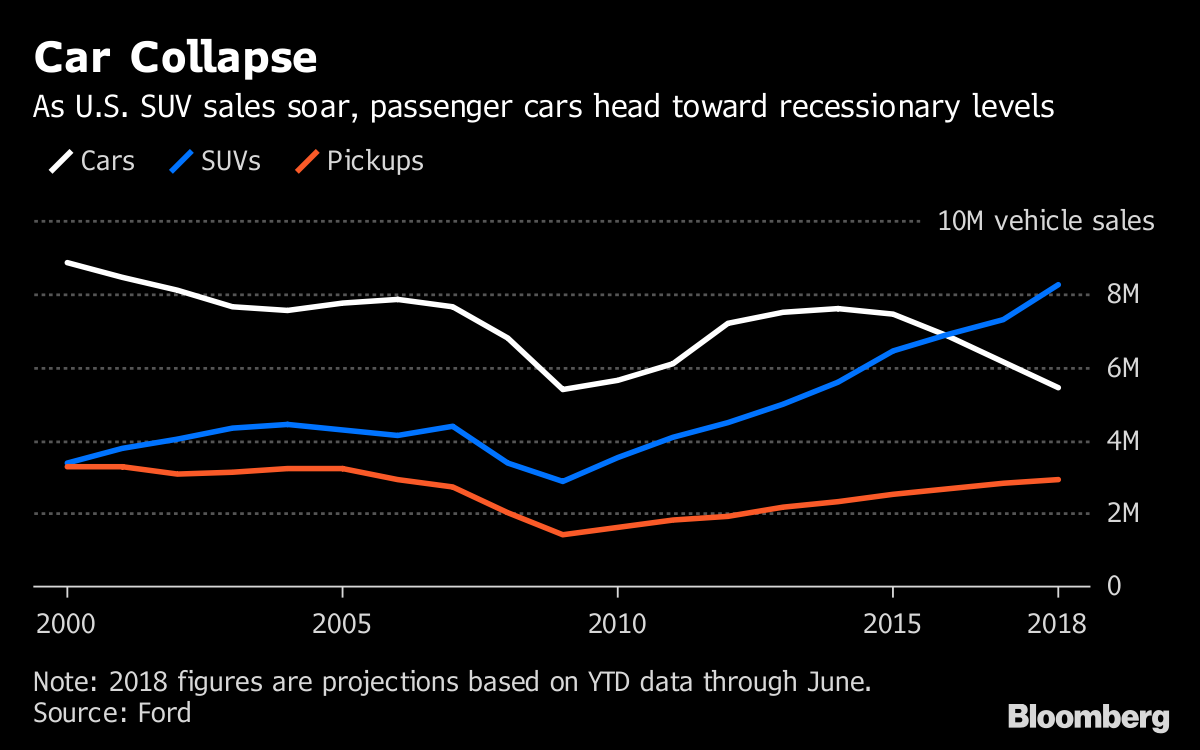
How about car companies deciding to sell more oversized vehicles because they don't want to put in the engineering effort to meet fuel efficiency standards? As actually happened. Advertising shifted to SUVs.
Blaming individuals may be interesting morally but it makes for terrible public policy. It doesn't produce anything actionable. Imagine trying to fix ozone depletion with a voluntary labelling scheme and "blaming" people who use CFCs.
> How about car companies deciding to sell more oversized vehicles because they don't want to put in the engineering effort to meet fuel efficiency standards? As actually happened. Advertising shifted to SUVs.
AFAIK SUV sales replacing sedan sales is a trend that has been going on for decades[1]. Blaming it on "[car companies] don't want to put in the engineering effort" doesn't make sense.
Well, when there are professionals applying science to create labels like "green, yellow or red", this is good natural science creating understable information for behavioural nudges... much more than PR
A Citizen’s Footprint: An analysis of the carbon footprint of consumption, investment, and political choices for the UK and Germany
> Voting for climate-friendly political parties in Germany & the UK could be the best way to minimize your carbon footprint
> 2DII’s analysis finds that voting for a climate-friendly party can reduce the carbon footprint of an individual’s voting choice by almost 7,000 kgs of CO2 per year. This compares to around 2,900 kgs of CO2 per year through a combination of going vegan, switching to a zero-carbon electricity provider, cutting out air travel, and switching from a petrol to an electric car. A typical UK citizen will reduce an additional 2,700 kgs of CO2 per year by switching to a low-carbon equity pension plan.
> A key driver of this outcome is the fact that changing consumption patterns will ‘only’ reduce your own footprint, while voting in elections can realize policies that change the footprint of an entire country – including for those voters that voted against climate policies.