Hacker News new | ask | show | jobs
by dsomers 1629 days ago
What an absolute joke. The United States has terrible class mobility compared to the Netherlands or Germany for example. You don’t have anything to support what you said other than a skewed perspective created by American centric media.

Edit: I guess the down voters here hate facts. The US scores lower on social mobility than the majority of European countries https://en.m.wikipedia.org/wiki/Global_Social_Mobility_Index

4 comments

Given my experience in NL, I would disagree. I see a very clear class divide here, which is just mostly ignored by the middle/upper classes and government.

Most of the population spend the majority of their income on rent, commuting, and essentials. Students also have lots of debt over the past decade (15k on average). Owning a car is expensive, but so is public transport (esp. for a family). Renting is expensive, but so is buying a house.

Income tax brackets range from ~40-50%, while corporate and dividend taxes are minimal - 15-20%. VAT is regressive and applies on almost all goods incl. groceries, ranging from 5-21%. There is no capital gains taxes, so this obviously benefits the economically active upper/elite classes who have assets/savings to invest - while middle class families do not own much at all.

Since the Mobility Index rankings focus on lower -> middle class mobility, it shows the Netherlands in a positive light. However, the income divide between the two classes is actually not as pronounced as the USA, while the gap between middle to upper is incredibly massive (like most of the world).

I guess what I'm trying to say is that despite the expected policy differences and rankings, NL is quite strongly divided economically. In my experience, the average Dutch don't mix with the poor, nor show off their riches, nor think too deeply about the elite classes. This mindset is essentially ignorance - neglecting poorness, brushing off government corruption, and assisting the funneling of taxes & wealth.

You forgot to mention you do have a wealth tax. For wealthy people, those tend to be one of the "worst" taxes, because it is payable regardless of whether your investments do well or bad.
You’re right, I missed commenting on the Wealth tax.

However, it’s equally ineffective - there are multitudes of ways to avoid paying it, as the wealthy here continuously do. Further, the percentage itself is quite small:

- 0.58% for 30k-100k

- 1.34% till ~1MM

- 1.68% afterwards.

It is hilarious to me, that 30k is considered “wealth”. This means saving for your children’s studying expenses (rent, food, etc), would require exceeding 30k and paying taxes.

The wealthy are wealthy. It doesn’t seem to affect them at all. Instead, people like you and I have to think about the arbitrary amount of money the gov wants to extricate from our small savings.

> Most of the population spend the majority of their income on rent, commuting, and essentials. Students also have lots of debt over the past decade (15k on average). Owning a car is expensive, but so is public transport (esp. for a family). Renting is expensive, but so is buying a house.

> Income tax brackets range from ~40-50%, while corporate and dividend taxes are minimal - 15-20%. VAT is regressive and applies on almost all goods incl. groceries, ranging from 5-21%. There is no capital gains taxes, so this obviously benefits the economically active upper/elite classes who have assets/savings to invest - while middle class families do not own much at all.

I hate to tell you, but the US practically invented all those issues. Average Americans pay a far larger percentage of their income in taxes than the wealthiest Americans or corporations do. You say VAT, we say "sales tax," and, yes, it's still just as regressive. Rent, student loans, etc.... yeah, that's all bad here, too.

https://smartasset.com/data-studies/income-needed-to-pay-ren...

https://www.theguardian.com/us-news/2021/dec/09/us-student-l...

https://www.cnbc.com/2021/09/23/americas-richest-400-familie...

> the US practically invented all these issues

I don’t believe that the Netherlands has inherited these ideas from the USA. In fact, NL invented capitalism and stock markets.

Every Dutchie I speak to about the inequality here, loves comparing themselves to the USA memes. It’s that whataboutism and the ignorance that bothers me.

> I don’t believe that the Netherlands has inherited these ideas from the USA. In fact, NL invented capitalism and stock markets.

Of course, I'm aware that NL invented stock markets and pioneered a lot of ideas behind modern capitalism. That wasn't where I was going with it.

Not to turn this into some weird anti-pissing contest of "my country is worse than yours," but, if you look at the numbers, the US fares worse than NL on:

Gini coefficient [0]: US 41.4 vs NL 28.1

Global social mobility index [1]: US 70.4 vs NL 82.4

Human development index [2]: US 0.92 vs NL 0.944

Now, I don't think capitalism is the best system for maximizing any of the above, but, if you look at the tables, it's pretty clear that the Nordic model of capitalism is basically as good as capitalism gets. When you look at some of the things that go into these indices, other than stuff like "GDP per capita," it's pretty clear why: having a strong safety net and other social programs for workers makes people better off.

If nothing else, reducing the consequences of failure from "total personal and financial ruin" to something more manageable is more likely to encourage people to take chances that may or may not pay off. That's what economic freedom really is. That's also the part of capitalism the US didn't pick up, so, that's what I was getting at when I was saying that the US invented those issues. Again, not to get into an anti-pissing contest, but, that's why the US recently got compared to Jurassic Park [3] on here. I don't see anybody comparing NL to a land where dinosaurs will eat you if you're not always vigilant.

> Every Dutchie I speak to about the inequality here, loves comparing themselves to the USA memes. It’s that whataboutism and the ignorance that bothers me.

I'm not sure what you mean here, but I'd like to know. Are you just saying that people you talk to are saying what I said, but without the facts and figures?

---

[0]: https://worldpopulationreview.com/country-rankings/gini-coef...

[1]: https://worldpopulationreview.com/country-rankings/social-mo...

[2]: https://worldpopulationreview.com/country-rankings/hdi-by-co...

[3]: https://news.ycombinator.com/item?id=29656668

> Not to turn this into some weird anti-pissing contest of "my country is worse than yours,"

Fair enough, though I wasn’t trying to imply that either.

> it's pretty clear that the Nordic model of capitalism is basically as good as capitalism gets

I can agree from the data and personal experience, that the QoL for the lower/middle classes in the EU is better than most of the world.

However, I don’t think that it’s as pronounced as the local EU politicians would have you believe, when they advocate for higher taxes every year.

That’s essentially the divide I’m talking about in my comments - the broken capitalist dystopia of it all. They set the benchmark somewhere in between the USA and the post-colonial world, and act like they’ve solved everything.

> reducing the consequences of failure from "total personal and financial ruin" to something more manageable is more likely to encourage people to take chances that may or may not pay off. That's what economic freedom really is.

Yes, I agree that this sounds intuitive. Unfortunately, the EU has one of the least risk-taking people I’ve ever seen. People don’t startup nor attempt businesses.

> Are you just saying that people you talk to are saying what I said, but without the facts and figures?

Not exactly, but rather, they are unaware of the situation outside their social bubble in NL. And see memes about the USA and think they’re doing great.

I loved living in NL (am Dutch), and would love to move back there, but financially it just doesn’t make sense.

Found it really hard to explain to my wife that:

Salary will decrease, cost of living will go up, income taxes will go up, VAT will also go up, QOL will stay roughly the same.

The only thing that I think is significantly better (and cheaper!) is the education.

Edit: And the beer.

QOL staying the same is quite attractive.

Out of curiosity, how many millions of dollars-equivalent does it cost to buy heath insurance in retirement?

Isn’t that more attractive than what you need in the states?

> QOL staying the same is quite attractive.

I can’t speak for the OP, but usually QoL refers to essential things like housing, food, education, etc. Outside of that, the average Dutchie has very little disposable income.

This means that the extra money they make in the USA, is still quite useful since you can spend it on all the other stuff that gives you joy in life.

Rising costs for housing, food and education is a huge problem in the US
What do Medicare supplements cost, like $100-$500/month? If health insurance is your primary reason to leave the US, it might make sense to spend years working in a job that offers health insurance after you retire, or moving to a lower COL area within the US (medical costs in rural Texas are drastically cheaper than San Francisco, for example)
Medicare 20 or more years from now? The eligibility age will be raised by 100 years before we know it.
I live in Japan, health insurance is quite good ;)
> Students also have lots of debt over the past decade (15k on average)

Those are amateur numbers. -USA

I know loads of students with more debt, but indeed, it’s less than the USA. Not an acceptable amount regardless.
Really? That seems something that could be paid off pretty easily. Not like US student debt which is the size of house in value.
The median income in NL is barely 30k, and savings are very low. An average loan of 15k is quite expensive for most.

I think the worst part is that most of the loan is used to pay rent - so it’s essentially tax-payer funded wealth transfer to real estate.

I don’t think that measurement of social mobility makes much sense in this context.

Sure, moving from lower working class to upper middle class is probably easier in Sweden than in many other countries. But the thing is: it doesn’t make much of a difference.

I have a sneaking suspicion that the Nordic welfare state kind of games the social mobility score in this way, by having such a compressed income distribution. If you go from $20k after taxes to $35k after taxes you’ve moved through more or less the whole income distribution, but your life is pretty much the same.

The thing is, there's only 1 situation where being a part of a certain socioeconomic group sucks. Being poor.

So any country that optimizes for improving that, kind of by definition, improves the average happiness of its citizens.

The report itself [0] notes many of the contradictions in the US:

> "Despite scoring high on the Work Opportunities (83.0) pillar—because of its low unemployment rate—as well as on the Technology Access pillar (90.2), it has the lowest score in the region on the Fair Wages pillar (43.8 against an average of 64.6 for the region). With an incidence of low pay (less than two-thirds of median wages) at 24.9, it has one of the shares of low-paid workers among OECD countries. The lack of effective social protection in the United States also translates into a low score on the Social Protection pillar (61.7). The minimum guaranteed income benefits for a family with two children (where one partner is out of work) is only 20% of median income. The United States could also improve on the Health pillar, where it performs quite poorly compared to peers in its region (75.8) due to a low healthy life expectancy at birth (66.6 years)."

When you average things down to a single number, you lose a lot of nuance.

For the US, the data the report collected generally supports something like 'You have the opportunity to succeed greatly, and be rewarded extremely well, but this requires financial resources at birth.' While also being true that 'If you are less successful, there are few and poor support nets for you, and serious pitfalls to avoid (f.ex. health care costs).'

[0] https://www3.weforum.org/docs/Global_Social_Mobility_Report....

> 'You have the opportunity to succeed greatly, and be rewarded extremely well, but this requires financial resources at birth

This is the opposite of financial mobility.

No, it is not. The opposite would be that it requires financial resources of the class you want to be part of to be part of a class.

Which wasn't what I (or the report) said: the idea is that it takes some level of financial resources as a prerequisite for a chance at top-level success.

Yes yes, class mobility but only for the already wealthy. Tell me more.
Which part of the report do you see as equating "financial resources" (my words) with "wealthy" (your words)?
> If you go from $20k after taxes to $35k after taxes you’ve moved through more or less the whole income distribution, but your life is pretty much the same.

100% agreed - my sibling comment about NL also implies the same.

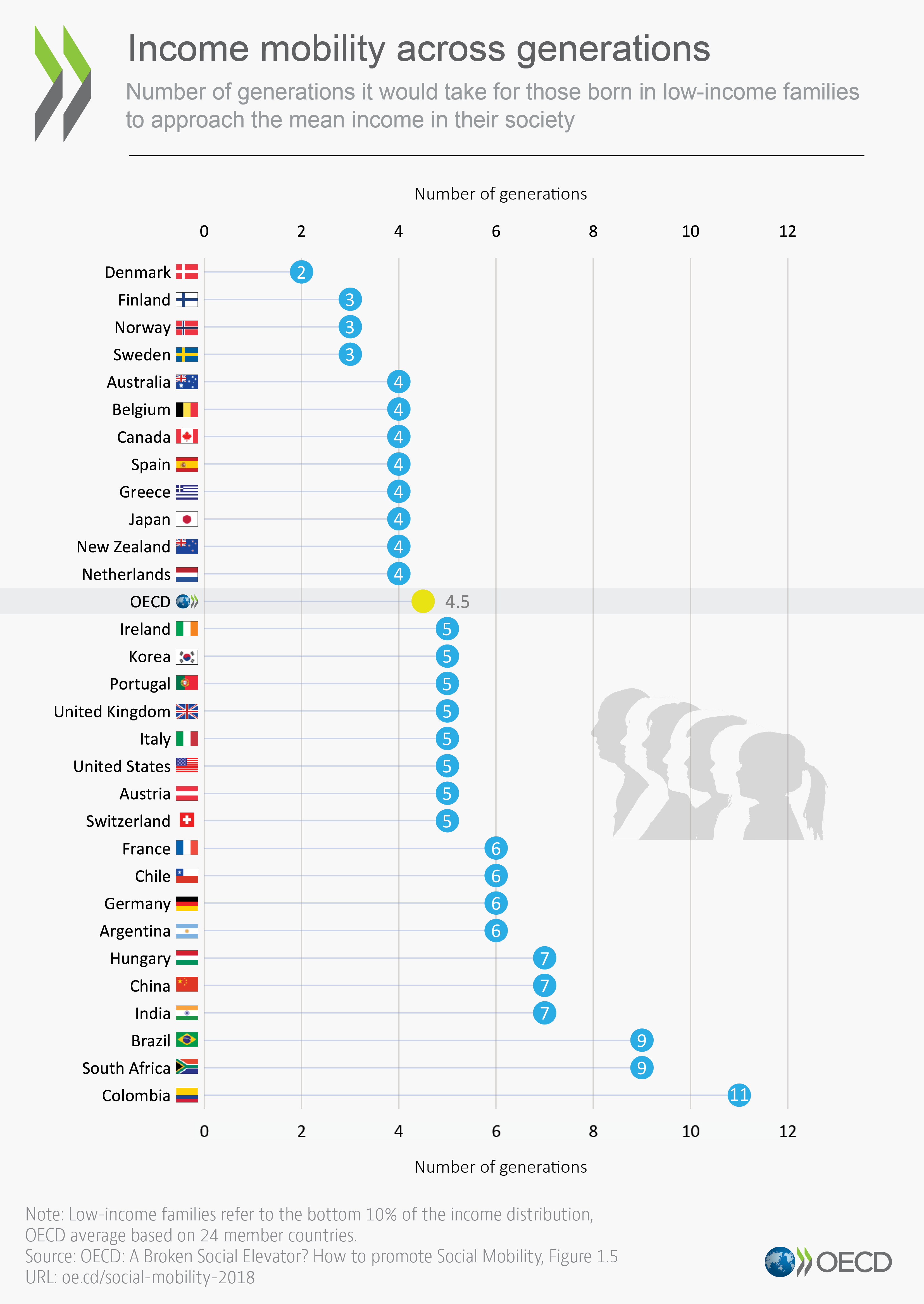
Using a different metric the Netherlands are slightly better than the US, but Germany is slightly worse.

https://www.oecd.org/els/soc/1-5%20generations.png

I’m kinda surprised by these numbers. My impression of the us is that many immigrants will be unskilled and have low incomes, but that their children will be much better off in comparison. So a few reasons these numbers could be this way:

1. My intuition is wrong

2. There are lots of people in low income groups where there is little i regeneration along mobility for structural reasons, or maybe immigrants children who often see the biggest improvements are excluded for some reason.

3. The chart talks about reaching mean income. Particularly in the US, mean income is higher than median income so even if achieving the latter is easier, achieving the former could be harder. To some extent the metric may disadvantage countries where the highest-earning few percent of the population earn a lot more than the median person.

That graph, and "social mobility" analysis in general, shows the movement from low income to average. This is good for a country overall, but it's irrelevant to the discussion that people are having in this thread. Most people here are more interested in the median to rich movement. Unfortunately this movement is practically impossible in countries like Sweden and NL (for an employee).

Let's take a typical profile that HN users would be interested in, a top10% engineer working for a big company. This person would never become rich in NL, but almost always become rich in the US.

>Most people here are more interested in the median to rich movement. Unfortunately this movement is practically impossible in countries like Sweden and NL (for an employee).

Same in Germany why I assumed the diagram would be appropriate. But you are 100% correct and I agree with

> This person would never become rich in NL, but almost always become rich in the US.

And the majority of Europe is still ahead of the US, so what’s your point?
I moved from Europe to the US, and so have a lot of other people who aim to become rich. In europe most rich people inherit everything, mobility to upper class is basically non existent. Here it’s Very much possible
My own experiences disagree.

I have friends who started out in middle-class families and sunk lower. I also have friends who started out middle-class and rose.

IMHO, the biggest factors seem to be raw intellingence, willingness to move & chase money, and some 'luck' factors. But I can't imagine a world where nobody could change fortunes given reasonably common circumstances.