Hacker News new | ask | show | jobs
by spodek 1662 days ago
Has anyone heard from the President a message to reduce consumption in the U.S.? We waste so much, there need be no hint of tightening belts or doing without things we like. Most Americans could drop our emissions and waste 50 percent just improving our lives. We live this huge lie that consumption correlates with quality of life, health, or happiness for most of us.

We could improve our lives by cutting out most of the useless, pointless junk instead of solving every problem by burning more fossil fuels.

13 comments

> Has anyone heard from the President a message to reduce consumption in the U.S.? We waste so much, there need be no hint of tightening belts or doing without things we like. Most Americans could drop our emissions and waste 50 percent just improving our lives. We live this huge lie that consumption correlates with quality of life, health, or happiness for most of us.

To be blunt, I wouldn't vote for a politician that told me I need to reduce my quality of life, nor would most people, which is why you never hear a politician say things like that. The average person does not want to hear that they need to tighten their belt so that someone else's belt now or in the future can be loosened. That's just not how people work.

> To be blunt, I wouldn't vote for a politician that told me I need to reduce my quality of life

Yeah, that is unfortunately a very common sentiment and a large part of why things continue to suck in the world and are unlikely to get better. It isn't just climate, people are far too selfish in pretty much every aspect of society and the whole is suffering because of it. I wish I could be optimistic about the future, but then I see comments like yours and am reminded that humanity has well earned it's pain. When the possibility of success approaches zero, giving up is a rational alternative to trying.

I feel you are being overly pessimistic. We can still accomplish substantive change, we just need to know how to market it. A message of collective sacrifice doesn't resonate with a society like ours because we don't view ourselves as part of a collective; we are individuals. You need to alter your messaging to fit the existing culture. Changing your messaging is far easier and effective than changing the existing culture.
Alright, so what is the message then? How do you get a selfish entitled status-obsessed overconsumption-promoting culture to do anything that will actually help?

I'm pretty convinced there is no such message. I think it is telling that you refer to such a concept without even suggesting what it's co tent might be. It is fairy dust.

The message is that many changes we will have to make for climate change will either make life better or will not negative affect people. Switching to electric vehicles will lower long term vehicle ownership costs and mean that you never have to go to the gas station, and oh yeah they are faster, more modern, and cooler; using efficient appliances lowers costs without lowering quality; switching away from beef will make you less likely to get fat, improve longevity, and save you money; switching to solar power makes you more resilient against the type of issues that happened in Texas; switching to high speed rail means less TSA bullshit and more comfort for less money; carrying a water bottle around instead of buying one time use plastic bottles means you will always have a cold beverage with you and you will never be thirsty; etc.

These aren't messages that will resonate with everyone, but they will resonate with more people than saying "life sucks deal with it". Look at how Ford is marketing their new electric pickup. Do you ever see the words "global warming", "climate change", or "sacrifice" appearing anywhere in their copy? No, because that messaging doesn't work so they focus on talking about capabilities, features, and QoL improvements instead.

> The average person does not want to hear that they need to tighten their belt so that someone else's belt now or in the future can be loosened. That's just not how people work.

People did it during WWII, not just by participating in combat but by donating their possessions to the war effort, and that was within living memory of people still alive today. Saying "that's just not how people work" assumes that it has always been so. I think something has changed since the 40s to make any kind of sacrifice for the community look like anathema to most.

(using the US as an example)

People "tightened their belt" during WWII because they had their sons conscripted by the government to go fight in the war. Some people never saw their fathers or sons ever again once they left the train/ship for Europe. Women were leaving the homemaking roles and working in wartime factories, offices, etc. because you had (theoretically) half of your population off in another country fighting for their lives.

You had _everybody_ on board since everyone knew somebody who was currently fighting, died/wounded in battle. It was a very real, persistent, visible issue. Climate change is not visible to everybody and doesn't affect everyone like the war effort did.

People see higher cost of living and they're living their daily lives just as they have been for the past decade. There's been no directly observable reason for the majority of people to start encouraging climate change action. It sucks, but that's the way it is right now because humans are humans.

Climate change is not that visible of a threat, (un)fortunately, depending on how you look at it. The majority of humans don't look farther than a couple years ahead, _if that_. They're too busy trying to survive with increased taxes, inflation on all goods and services, along with horrific monetary policy during a pandemic.

And this is why doing anything about climate change is such an uphill battle.
Correct, if we are serious about solving climate change, we need to come to grips with the fact that people will not lower their quality of life, and so we need to find impactful changes that either maintain the QoL status quo or improves it. For example, a Tesla or the new Ford Lightening pickup is something people can live with. Extremely good public transportation that saves people time and money is something people can live with. A bike is not something most people will live with.
I don't know what the actual answer is, but I think tax does a pretty good job of influencing behavior. Maybe there needs to be more of it.

You get a tax credit for buying EV's. Maybe there needs to be a bigger credit, or a bigger tax on fossil fueled cars. Don't ban stuff, just increase taxes on stuff and influence people's direction. The money raised can be used for making things better.

>we need to come to grips with the fact that people will not lower their quality of life

No problem, climate change will do it for them.

Yes, as the saying goes, when you find yourself in a hole keep digging until you find a better shovel.
Another popular saying: the definition of insanity is doing the same thing over and over and expecting a different result. Tell us again about all the awful things that will happen in the future and all the huge sacrifices we need to make today to prevent them so that people can shrug yet again and go back to ignoring you. We can either live in a fantasy or accept reality / human nature for what it is and actually start being productive.
> A bike is not something most people will live with.

Observations from cities that have actually made tangible improvements to their cycling infrastructure and seen a significant increase in cycling mode share suggest otherwise.

Doubly so when the people telling me to tighten my belt, are flying to climate conferences in private jets.
> That's just not how people work.

In 1973, when OPEC fully embargoed the Netherlands (among other countries), the Dutch government instituted "car-free Sundays" for three months in an attempt to curb oil use. It seems to have been fairly popular.

>To be blunt, I wouldn't vote for a politician that told me I need to reduce my quality of life

Interesting that you interpreted what @spodek said that way, they talked about improving quality of life and you read the complete opposite.

Fossil fuel will die only when the alternatives are better. Focusing positively there is where the effort should be.

So reduce environmental review for solar, massively reduce red tape for fission, invest in fusion, and invest in carbon capture technology are the main things here IMO.

We should strive for energy abundance, not austerity.

The thing is, consuming large amount more fossil fuels now is the opposite of energy abundance long term.
Alternatives delay the end of oil rather than bringing it about. If we use more oil now, we have to switch to alternatives sooner.

There’s currently ~42 years until the end of oil: https://www.worldometers.info/

A key problem is that environmental consequences of burning that oil will be catastrophic.

We'll run out eventually, but we've got to stop using it well before then.

Consumption does correlate with quality of life, health and happiness.

Keeping in mind that degrowth isn't going to happen (for good or bad), it probably isn't a great use of time to advocate for it.

> Consumption does correlate with quality of life, health and happiness.

At the current rate America consumes food, I'd bet that there's a _negative_ correlation between amount of food consumed and health.

If I go to Costco and look at the amount of meat you get per $, I am not sure if we aren't way beyond basic "quality of life, health and happiness."

I am saying this as someone who lived for years in the US and now lives again in Europe.

It really makes me sad when I go to Costco to buy food. I don't know how people will feed their kids right at these prices honestly.
Rice, beans, block American cheese, stew meat, whichever fruits and veggies are on sale, make your own baked goods. People found ways even when prices were much, much higher relative to incomes. Eat-whatever-you-like-whenever-you-like is not the historic norm for the working class.

Not saying this is a positive development, mind you, but there are whole cuisines designed around these kinds of needs, for good reason. Stretching out meats over multiple dishes, finding ways to use worse cuts, re-using fats, using all those parts most Americans won't eat anymore, but used to. Making stock from veggie scraps so they're not wasted (then using what's left for the garden, if you don't have chickens and/or pigs to recycle it into eggs and meat for you). Food waste should drop as prices go up, as it's largely a convenience thing. Assuming we remember how to really cook....

Reduce protein intake to the recommended amount. Rest of meals come from, carrots, onions, potatoes, rice, eggs, flour and beans.

Sticking with the above food is very affordable for the median income.

Europeans have half the ecological footprint of Americans, yet our quality of life is dramatically higher. It might have some correlation, but at a certain point that correlation stops and it just gets gratuitous.
> our quality of life is dramatically higher

(as a fellow European) By what metric ? Would love to know.

Life expectancy and infant mortality come to mind[1]. As does leisure time[2].

[1] https://www.theatlantic.com/ideas/archive/2021/09/america-li...

[2] https://www.nber.org/papers/w11278

According to numbeo local purchasing power in my city is the same or better than most US cities despite the fact that my wages are much lower over here in Germany.

Tax policy has massively dragged the absolute price level downwards while having almost no effect on the relative price level.

(Disposable) income != quality of life.
Correlation does not imply causation. Just purely saying “consume more and you will have a higher quality of life” seems off. Consuming the right things is important imo.
In my opinion governments should really pay attention to what the nation needs over the long term and spend money on that rather than count beans and get tricked by fiscal rules. That means no to boondoggles, yes to healthcare.
Degrowth will happen. Nature will force it's hand.
If degrowth happens on average, people with privilege will expect (and take steps to ensure) that it won't apply to them but only to others.
Well, that is exactly why there is growth dependence. Some people have extra things they don't really want, so others will have to repeat the same work just to get the same things that already exist.

It's like group homework. If one person does everything, others won't get to do it themselves. So they have to redo the homework on their own to learn instead of learning together.

It's also why the wage inflation spiral exists. Full employment may require busy work, as we do our work more efficiently we need an exponentially growing amount of busy work. If people simply worked less, without leaving individuals unemployed, you wouldn't have the damn spiral.

Nature has no say in Meta Worlds!

Long Growth.

> Has anyone heard from the President a message to reduce consumption in the U.S.? We waste so much

Who is 'we'? It's big companies and the military that are causing massive amounts of resource waste and overuse. Telling the working class to 'improve their lives' is quite ridiculous. This is a production problem at a systems level, not an individual consumption problem. That narrative of individual change is simply gaslighting by the propertied class.

>>>It's big companies and the military that are causing massive amounts of resource waste and overuse.

While often wasteful, the military is only 4% of US GDP,[1] and almost 40% of its expenditures is Pay & Benefits.[2] The rest, about $400 Billion, is <2% of the US's ~$21 Trillion economy (real 2019 GDP). It's...interesting...to single that sector of the economy out in particular.

[1] https://data.worldbank.org/indicator/MS.MIL.XPND.GD.ZS?locat...

[2] https://en.wikipedia.org/wiki/Military_budget_of_the_United_...

> It's big companies and the military that are causing massive amounts of resource waste and overuse.

oops i mixed up two different points in my original sentence. this is what i am talking about:

1) big companies are causing massive amounts of resource waste and overuse: https://www.theguardian.com/global-development-professionals...

2) the US military is the biggest contributor to CO2 emissions: https://www.theguardian.com/environment/2021/nov/11/worlds-m...

Big business is wasteful on our behalf. If I fly on plane, you'd blame American Airlines, but it was 100% my consumption. Are you going to blame me or Toyota for my V8 4Runner? I bought it.

You might think, "well, its American Airlines choice not to use carbon neutral biofuel!" But consumers always pick the lower priced flight. So if AA cost 15 bucks more than UA because of green fuel, 90% of the country would just fly UA.

You can blame certain companies for lying about global warming or polluting even when it wouldn't raise costs. But that doesn't absolve you from your role in consumption.

> Big business is wasteful on our behalf. If I fly on plane, you'd blame American Airlines, but it was 100% my consumption.

the problem is that the development of technology is not done democratically. there is an artificial scarcity in the solutions the working class can choose between due to the way our economic system bottlenecks/limits innovation by imposing an 'intellectual property' regime. those with privileged access to existing techno-scientific tools can expand their control of intellectual property, and the exorbitant economic rents the state empowers them to extract.

> You can blame certain companies for lying about global warming or polluting even when it wouldn't raise costs.

> But that doesn't absolve you from your role in consumption.

again, you are implying we live in a world where we make choices. we do not. decisions are made for us way before we buy the products/commodities we use and consume from supermarket shelves or car dealer showrooms or wherever.

an example to counter your flights example. instead it's take the option between train and air travel and consider the underdevelopment (terrible state) of railways in the US compared to many other countries. 'consumers' cannot choose train travel in the US because the state has not invested in the infrastructure (despite the proven reduced CO2 emissions).

add to all this the fact that all modern tech was developed using taxpayer money (an example of state innovation is SEMATECH - basically a 'socialist' programme which had US tech companies temporarily waive patent claims (at the cost of $100 million payout from the US govt.)) to try to out-innovate Japanese firms together, because the existing economic systems that are supposed to foster innovation, didn't.

when you look at it from this systemic perspective, blaming individuals is gaslighting by the propertied class.

https://magazine.scienceforthepeople.org/vol24-2-dont-be-evi...

https://en.m.wikipedia.org/wiki/SEMATECH

https://tribunemag.co.uk/2019/01/abolish-silicon-valley

https://jacobinmag.com/2015/03/socialism-innovation-capitali...

While I agree in general, I think as long as the rest of us persist in our mindset that we don't need to change we will resist all efforts to do so on a societal level as well.
Where have you been the last 2 years? People got pissed from being told to wear a mask to help slow the spread of a disease. I think it's safe to say telling people to tighten their belts when it comes to consumption would piss off members of all political parties.
Its kind of an interesting parallel

the politicians that are forcing mask use laws have been shown time and time again not wearing masks themselves.

the politicians forcing environmental laws have been shown time and time again leading extravagant environmentally damaging lifestyles.

You can't escape the feeling that these mandates are meant for the poor and not the rich and powerful political class

I can imagine a good portion of the population would not be inclined to take the advice of any President on self-moderation. The number of people struggling to keep their head above water is very high. The best chance we have is to make the environmentally friendly approaches profitable, especially if it creates local jobs and opportunity.
>The number of people struggling to keep their head above water is very high.

Yet American emissions per capita are among the highest in the world. Something doesn't add up.

Being poor is incredibly expensive.
In reality climate change is a problem caused by the rich, not the poor. Poor people can't afford to consume much, it's the rich who can afford big cars, large houses and flights to Bali.
I don't think consumers on the lower class strata could be blamed for climate change, but we have a series of massive industrial complexes and incentives which creates a lot of feedback.

Those without the means don't really have the leverage against this economic apparatus.

I think you're right, but we'll need to see a lot of empathy and humility exemplified in our societal power structures.

I don't like that we built those structures as pyramids, but I also don't think anyone likes the idea of the foundation collapsing.

This is like a cook at a restaurant burning dinner and then telling the patrons they needed to go on a diet anyway.
This is something that people will need to come to their own senses about. Politicians run to get elected/re-elected and economy is almost always the #1 driver for building a platform.

In the economic sense, if everyone reduced consumption then unemployment would go up, GDP down, recession, etc…

This is just my observation of how some dominoes might fall. There will always be upsides and downsides.

Yeah… that’s not how Americans work.

A significant portion of politicians would be parroting impeachment minutes after a statement like that.

that’s what jimmy carter did and it didn’t work out great for him whether or not it’s true. it’s the same reason politicians don’t tell americans to get exercise or eat healthy
Waste will not be a problem after Mars colonization. /s
Wouldn't make much of a difference. The MAGA crowd would just start using even more gas "to own the libs".
Improve our lives according to whom? You? Have you cut your consumption by 50% this year? Have you installed solar (if you own a house)? Have you started growing your own vegetables? Have you bought a house that is 50% smaller to reduce heating/cooling needs? Do you want someone telling you that you have to do all these things and more?
> Have you cut your consumption by 50% this year? Have you installed solar (if you own a house)? Have you started growing your own vegetables? Have you bought a house that is 50% smaller to reduce heating/cooling needs? Do you want someone telling you that you have to do all these things and more?

My consumption isn't very high to begin with, there wasn't much to cut. My house is shaded by large trees and solar wouldn't provide much benefit, so instead I've cut electrical use. I do have a garden, yes. I have a modestly sized house and 2 roomates.

Could I do more? Sure, not that it'd make much difference with the apparent sentiment being "fuck the future if it makes things inconvenient for me now". Especially for the incredibly well off portions of our society that consume ludicrously more resources than the median and then tell us all there's nothing we can do.

Sadly, I'm convinced that only an authoritarian dictatorship could actually pull this off, and I'm pretty sure I wouldn't like that either. I'd much prefer if people would just not throw up their hands because they're asked to be a little less comfortable for the sake our descendants' future.

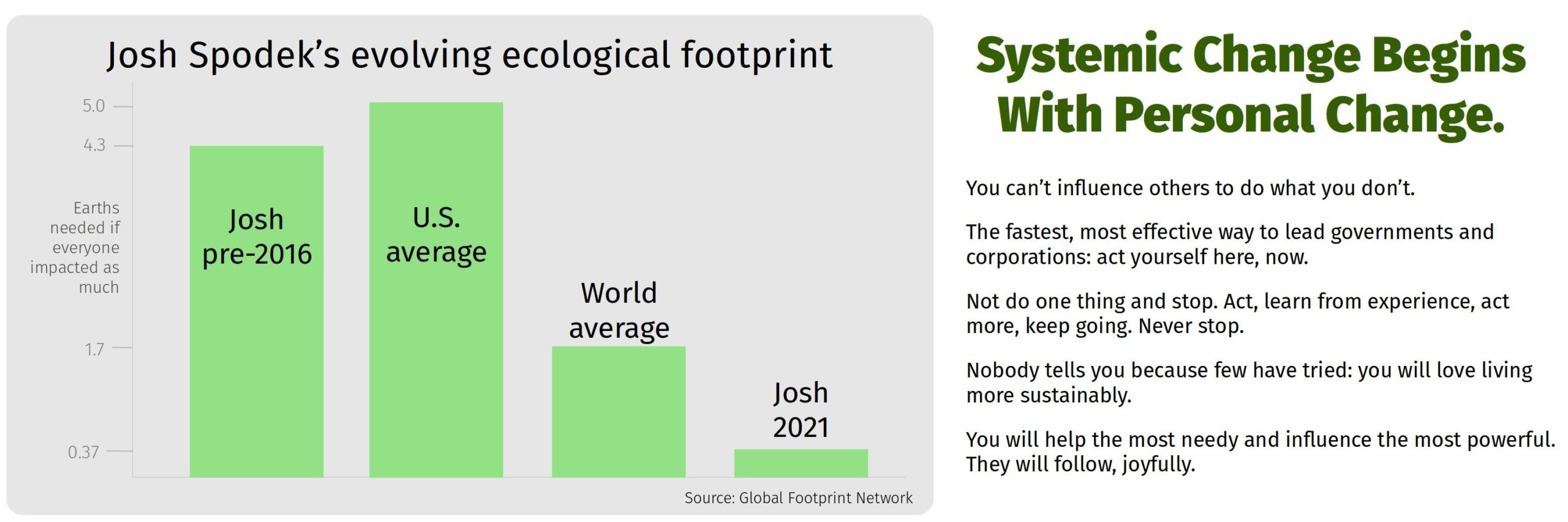
Since you ask, I've reduced over 90 percent, which I've shared publicly, anticipating I may be like a Roger Bannister to some. Will you join?

Here is a graph: https://joshuaspodek.com/wp-content/uploads/2021/11/ReduceFo...

On my blog https://www.joshuaspodek.com I post my electric bills, that I pick up litter daily, that I haven't flown since 2016, haven't filled a load of garbage since 2019, and more. Most importantly, that each of these changes improves my life. Or watch my TEDx talks on sustainability leadership: https://joshuaspodek.com/tedx.

Leadership, not individual action is the point. Yet more important and magnifying my effect, I lead workshops in food deserts, coach executives and politicians, and host a podcast helping change American and global culture from the attitude I read in your post, that sustainability and stewardship are burdens, deprivation, or sacrifice, to expecting it will improve their lives, help the most vulnerable, and create stability and abundance.