French generation is ~70% nuclear (10% wind/solar) and German is ~10% (~40% wind/solar). Yet their prices track each other closely. So I think this explanation is too simplistic.
Possibly there are large interconnects between the French and German grids levelling out wholesale prices, but my assumption is that they cannot carry enough power for this imagined scenario where nuclear makes a big difference.
There's no "French and German grids", most of EU is a single grid (see map https://en.wikipedia.org/wiki/Synchronous_grid_of_Continenta...) and there's no meaningful difference between "interconnects" linking France and Germany and power lines within France, though there are a bit fewer of them than internal lines.
There are some limited interconnects linking continental EU with UK and Scandinavia with some trade happening over them.
Calling it one grid is kind of misleading. There is nowhere near enough transmission if all power production in say Spain failed even if in theory there is enough excess capacity across the EU to provide power to Spain.
Limits on transmission result in individual countries generally having significantly different wholesale prices.
For very long distance power transmission, losses primarily depend on voltage and AC>DC>AC conversion efficiency which have both been increasing. China just completed a 3,300 km (2,100 mi) 1,100 kV line capable of sending 12 GW at the cost of 5.9 Billion dollars.
Over 1500km you can keep losses under 10%, but building infrastructure isn’t free. East to West links tend to work better because you can time shift demand and thus build fewer power plants.
That may be so but there is a tremendous difference in quality and capacity to absorb fluctuations between the various interconnected national grids. At the physical level they are still very much separate.
What everyone seems to be missing here is that in France alot of heating during winter is done with electricity which is not the case in germany.
So peak electricity usage in France during Winter is much higher and that is the time where it needs to import alot.
"Net exporter" doesn't really matter for the specific conversation at hand.
A better way to quantify grid health would be to identify periods of peak demand across northwestern/central Europe, and then tally who is selling power to whom at those inflated prices.
I have solar panels on my home, as do most of the homes in my neighborhood. However, we recently had to have a natural gas substation built adjacent to the community to deal with the demand surges coinciding with supply disruptions (every time it snows).
Just out of curiosity, assuming your internal batteries are charged to the max (e.g. after a sunny day), about how long can you go if it starts snowing or is very cloudy, before you need to start pumping in natural gas?
Maybe my understanding of how it all works using your own solar panel and the neighborhood's gas lines is too simplistic, though, to answer.
Like the vast majority of solar installations in suburban neighborhoods, none of the homes in my neighborhood have any battery paired with the solar panels.
The solar panels just feed power into the grid. This is the standard model used all over the Western US.
It will go down to 0% in Germany in several months. Germany is shutting down its last six nuclear power plants and no new ones can be built. Italy, Switzerland and Belgium also want to shut down their nuclear power plants. Shameful, unscientific public opinion in Western Europe despite more people realizing the danger of global warming.
I still remember the teacher in med school showing us how exclusively eating mushrooms and wild boars[1] while living in a poorly ventilated granite house (radon gas) in eastern France still wouldn’t reach the levels of exposure one would get from the soil in some western parts of France.
It was enlightening, to say the least.
But then, it isn’t really a risk worth taking in any case.
[1]: because one can’t just live on mushrooms, but boars do eat a lot of those
No, just as I meant it.
But I honestly don’t remember what the causes where; it was over 10 years ago and lessons were dense in information.
I can only recall a few tidbits here in there, including the specifications of a, as of now probably outdated, surgery probe meant to detect isotopes.
It was awesome! Swappable tips, a main unit on a wheeled stand giving it great mobility and awesome battery life! A great tool! Still don’t get the point of learning about it in first year though ¯\_(ツ)_/¯
Oh, and throwing dwarves in nightclubs is unethical, even with the dwarf's consent, because human dignity is inalienable.
Both Czechs and Slovaks are building new nuclear blocks (Temelin and Mochovce) but the progress is slow and riddled by corruption. So it's doubtful they will come online soon.
While I understand the fear of nuclear, especially in Europe where Chernobyl took place, I find it kind of silly that countries like Germany, Switzerland, Italy, Belgium, etc are shutting down THEIR nukes, while bordering France (and other countries) who aren't shutting them down.
Do they imagine that the radiation / fallout from their neighbor's catastrophe would respect national borders?
France is pretty much winding their industry down. The only one under construction is Flammanville 3 [0] which is currently projected to cost €19.1 billion compared to the initial budget of €3.3 billion. The current goal is 50% reduction to 2035 with no new plans being decided until Flammanville 3 is completed. [1]
I'm pro-nuclear but your argument is the same used by people saying "what's the point of my country reducing its CO2 emissions because it's only contributing to X% (X << 10) of global emissions?"
Some of France's neighbor are asking for the shutdown of some nuclear plants. It's much easier to ask this when you don't have any yourself
I'd say the co2 emissions example you quote makes more sense. That's simply "you're asking me sacrifice X in exchange for a benefit Y where Y is very small [because my country emissions are less than 1/30 of China's]".
Co2 emissions are also global and influence some areas of the world more than others; a nuclear fallout would hit primarily France, even though neighbours would be affected as well.
> but my assumption is that they cannot carry enough power
Right now (https://www.electricitymap.org/zone/DE), Germany is importing from France alone the equivalent of a bit under two French nuclear power plants at full power.
They are a net exporter because they have to sell their wind/solar power for cheap when they have too much of it, but are then forced to buy nuclear/hydro power from their neighbors when their coal power plants are not enough to compensate the ramp-up in demand and/or the lack of wind/sun.
France could be electrically self-sufficient, Germany couldn't -- whether they would depend on FR/BE/NL/... being irrelevant.
France exports a lot of nuclear power on nights and weekends while importing power during peak demand. Their actually further from self sufficiency.
It gets more complicated on a euro per kWh basis as Frances nuclear is much more expensive so economically their losing money even if it looks better in terms of cash flows.
That's right. Germany exports when the sun is shining and the prices are low to Switzerland and Austria who use it to pump water up the Alps. When there is no sun in Germany, they buy it back at a high price from Switzerland and Austria who convert the stored water to electricity.
The accounting gets tricky. France is generally paying more per kWh of nuclear than they generally get it from exporting it. However, the marginal costs per kWh is below what their receiving.
French nuclear power is such a bad deal for the country they try really hard to avoid showing the public how massive the subsidies are. Oddly enough this seems to have worked, and meanwhile they significantly reduced emissions which is a win for the environment.
The only bad deal is a crazily reactive interconnected market, which, when combined with solar/wind production, destroys long-term investments.
Solar/wind, when it products, crashes market prices. Nuclear is supposed to produce at those hours too, except that if it does, it sells at a loss; and if it doesn't, it blows its load factor which is supposed to be its strong point. In both cases, because of the destabilisation of the production equilibrium, caused by solar and wind, the balance of nuclear is endangered.
Yet nuclear is needed to deal with the very common lacks of solar/wind. Hence the global result: prices getting higher. The irony is that the State itself subsidies solar/wind, both directly, and indirectly by forcing the electrical company (which is mostly State-owned, and which also owns the nuclear plants) to buy solar/wind electricity at ridiculously high prices, which is killing its balance and forces it to raise consumer prices.
There was no such problem when there was not a market like the present one, and when there was no solar/wind. Production was OK, prices were low. All was going fine. The problem was introduced by a liberalisation dogma that "had" to be applied to everything and the kitchen sink + a pro-renewable/anti-nuclear dogma (renewable is not bad per se, but the consequences of its rushed development have been ignored, despite being very foreseeable).
1. That's not the point, the point being to illustrate how interconnected the EU grid is.
2. Regarding your comment, I personally don't see Germany importing 72 gCO2/MW power to export 399 gCO2/MW power as a good thing for anyone but coal companies, but whatever floats your boat.
"the point being to illustrate how interconnected the EU grid is."
Which is a good thing. Very few countries are self sufficient regarding cars for example, or Kiwis. So humanity invented trading and people trade things they don't have for things they have - so good interconnection is a good thing.
That’s the question I ask in the second paragraph. It only explains it if the interchange is sufficiently large. Another explanation could be that there is some EU mechanism to charge the same wholesale price even if there is not sufficient interchange capacity.
France is the the largest nuclear energy exporter, but it only exports about 12% of its nuclear energy, which might be enough to move the domestic price.
If that 12% is the annual average, also keep in mind that it's presumably ~25% sometimes and ~0% at other times.
Now suppose the domestic production is 100 GW, the domestic consumption is 90 GW and you're not exporting anything. Compare this to when the domestic production and consumption are still the same but you're exporting 20 GW. You go from having 10 GW to spare to being 10 GW short and having to bid for it against the foreign market.
And the prices aren't linear. In oversupply you could be paying barely anything. At 10% undersupply you could be paying twenty times as much if that's how much it takes to reduce demand by 10%.
During the intraday auctions, the left-over capacities are considered live, i.e. if there is 100MW of capacity left for France to Germany, you get the first 100MW of the French orderbook merged into the German one. If a trade happens, this capacity is updated. This is called SIDC (Single Intraday Coupling), https://www.emissions-euets.com/internal-electricity-market-..., used to be called XBID.
If by "track each other closely", you mean prices in Germany are reliably 50% higher than those in France[1], then yes, they "track each other" closely. German energy policy has been an unmitigated disaster, creating by far the most expensive electricity prices in the OECD and of course the highest in Europe, whereas prices in France are below the EU average.
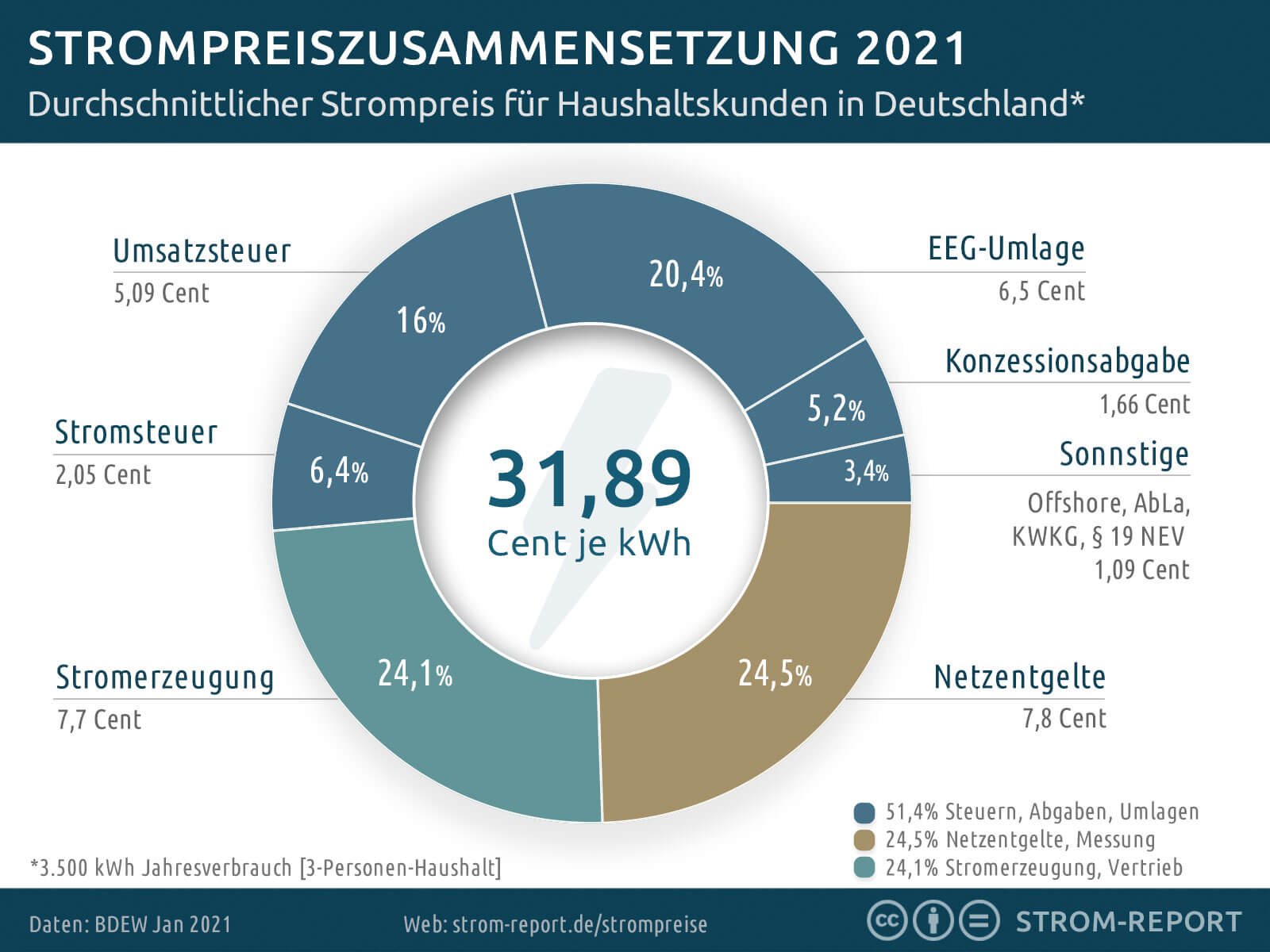
The source refers to retail electricity prices and thus doesn't apply here. The German electricity price is subject to lots of different taxes and fees; energy generation makes up less than a quarter of it [1]. These taxes do not need to exist and even the "EEG" which subsidizes renewables could be paid via the general budget. Like, for example, power plants could be paid for by the state. The comparison of household prices therefore makes little sense, as it implies the governments are in a race to offer the lowest rates to its population.
So according to your logic, taxes used to subsidize electricity production should not be included when calculating the cost of electricity, which can only give rise to a meaningless cost. Germany imposes such high taxes because they have such massive subsidies for producers. That is why electricity costs so much more in Germany — because it costs so much more to produce. But being fungible, the cost of wholesale electricity on the transnational exchanges will of course tend to the law of one price. It is the taxes that bring this in line with reality as to the fully loaded cost of generation, which in Germany is much higher.
>Germany imposes such high taxes because they have such massive subsidies for producers.
Even without the EEG, the electricity price would be among the highest in all of Europe. Also, given how much public money coal for example receives in Germany, I think it is a very reasonable argument that the EEG subsidy should not really be considered a fixed part of the electricity price that could not be moved elsewhere.
That's because market prices are what they are, they don't depend on whether it's "gas electricity" or "nuclear electricity".
Now, if you produce electricity by burning gas that you import and gas prices go through the roof then your production costs follow and your stuck.
In the meantime, production costs of nuclear plants have not moved at all. Which makes controlling consumer prices much more doable and less costly, for instance, you can sell that electricity with improved profit margins (and France does export a lot of electricity).
Electricity is only fungible on a second by second basis while ignoring transmission losses.
Local power production has a significant advantage. This gets offset when distant locations have significant geographic advantages like hydroelectric power or wind etc, or when peak production or demand varies between locations.
Large quantities of energy (e.g. from Nuclear) are bought in advance (between countries, and less often between companies), and with multiple years contracts. That's why you don't see a huge difference.
Or, if you want: Not building twice as many (wind/anything) was a major mistake.
Nuclear power plants fail sometimes, just like the wind fails. In 2016 almost a third of the plants in France were offline at the same time, some for planned maintenance, some unplanned, and the peak prices were higher than now.
All these things are fixable by overbuilding enough. There's nothing special or magic about nuclear.
Apart from the technology, safety profile and generally being the cleanest source of energy ever discovered. And being able to stockpile enormous amounts of energy in a small heap if necessary ^^.
And if we could just convince people to accept it only causing say, half as much damage as coal it would be ridiculously cheap too. These appallingly high safety standards are expensive.
^^ EDIT Which would really help if there was some sort of large, unexpected event which disrupted the world's logistic chains for a few years. Unlike natural gas. Longer term supply rather than short term spot markets, lots of room to recover from surprises.
Half as much damage as coal is a pretty low bar! Natural gas also meets it, for example.
Your broader point is strong though, and there's no reason 4th-gen nuclear power plants being designed now couldn't deliver a quarter (or less) the damage of coal while still being economical.
Could they really be economical though? There is potential for harm (including terrorism) that must be insured against, you also need to pay a premium for the land compared to solar/wind since few want to live nearby. The construction timelines are huge compared to solar/wind and you don't have the economies of scale that drive prices down.
Nuclear easily beats coal if we include the environmental costs but it's also up against solar, wind, geothermal, and tidal options which have seen huge efficiency gains in the last decade.
>Half as much damage as coal is a pretty low bar! Natural gas also meets it, for example.
Natural gas has advantages over coal, but if we are talking about effects on climate change, natural gas is unfortunately comparable to using coal. The CO2 emissions from a natural gas plant are much lower than a coal plant, but it isn't clear that if you account for methane releases during production/transporting/storage that it is better for climate change than coal.
>...Back in August, a NOAA-led study measured a stunning 6% to 12% methane leakage over one of the country’s largest gas fields — which would gut the climate benefits of switching from coal to gas. We’ve known for a long time that methane is a far more potent greenhouse gas than carbon dioxide (CO2), which is released when any hydrocarbon, like natural gas, is burned. But the IPCC’s latest report, released Monday (big PDF here), reports that methane is 34 times stronger a heat-trapping gas than CO2 over a 100-year time scale, so its global-warming potential (GWP) is 34. That is a nearly 40% increase from the IPCC’s previous estimate of 25. ...The IPCC reports that, over a 20-year time frame, methane has a global warming potential of 86 compared to CO2, up from its previous estimate of 72. Given that we are approaching real, irreversible tipping points in the climate system, climate studies should, at the very least, include analyses that use this 20-year time horizon. Finally, it bears repeating that natural gas from even the best fracked wells is still a climate-destroying fossil fuel. If we are to avoid catastrophic warming, our natural gas consumption has to peak sometime in the next 10 to 15 years, according to studies by both the Center for American Progress and the Union of Concerned Scientists.
As we use more and more natural gas, we can expect more and more methane disasters like the leak from Aliso Canyon in CA which was the largest methane leak in US history. This released over 100,000 tons of methane into the atmosphere and required 11,000 residents to be evacuated.
> ... appallingly high safety standards are expensive.
Not an expert on probability/statistics ... but wouldn't lower safety standards have meant, not 1 Tschernobyl and 1 Fukushima but most probably like say 10 such events in the last 30 years?
Yeah no, something tells me that having lower than "appallingly high safety standards" isn't a deal I'd want. Not at all.
Arguably the accident wasn't due to lax rules, but rather to lack of observance. The rules weren't followed. If that argument is correct, then the key isn't to make the rules stricter or looser, but rather to change the rules and/or environment to eliminate violations. Thus, IMO it's not a statistics problem, but rather a matter of how to design rules and the organisations to which the rules apply.
Germany, too, failed at designing rules for nuclear power: All of the nuclear operators disposed of contaminated waste without permission and without keeping records. How much? Probably not very much (or else it wouldn't have gone on for as long as it did), but there are no records.
Germany and Japan are good at rules. If those two failed, this task can't be a simple one.
The safety profile of nuclear is difficult to assess in face of changing climate patterns. In general long-tail events are hard to evaluate. Think Fukushima.
It's true, but when does it make sense to include plants that do not deliver reliable power?
Wind power makes a lot of sense as long as you are still using fossil fuels. Every watt generated by wind power means that you can reduce fossil fuel, and thus lower your CO2 emissions. But once you got rid of fossil fuels and you have a reliable source of power without CO2 emissions, you can get rid of the unreliable ones.
Batteries are so expensive that it is unclear whether they will ever solve the large scale storage problem: yes they're getting cheaper, but they have to continue to get cheaper for a long time before they're suitable, and it's unclear whether fundamental limits will be hit before that. If battery technology improves to the extent that it becomes viable for large scale storage, then wind and solar can become our main source of energy. Until then, nuclear is the only proven solution. Betting on batteries now amounts to gambling with the planet.
Batteries are not supposed to solve the large scale storage problem. They're best at solving the small scale storage problem. Recently they solved the problem of small scale storage on wheels.
> If battery technology improves to the extent that it becomes viable for large scale storage, then wind and solar can become our main source of energy.
Batteries are not the only way of storing electricity.
As far as I know, few people suggest (Lithium-)batteries for long term storage. Electrolysis, optionally followed by turning the Hydrogen into Methane, seems like a much more scalable solution. That works at scale today, it's just too expensive to make sense at this point. Then there are other types of batteries that might become much cheaper in the future, perhaps redox-flow batteries or something like that.
We are decades away from having enough storage to make wind and power a reliable power source. There is not even technology that would scale up enough to store a country's power for weeks or at least a few days.
China just has announced ambitious plans to install storage for 100 GWh by 2030. China's electric power generation capacity is 2200 GW (in 2020). That's not even enough to provide electricity for 5 minutes....
> There is not even technology that would scale up enough to store a country's power for weeks or at least a few days.
Don’t mistake a manufacturing limit for a tech scaling limit. While it may take decades to get there, batteries could do that; in the mean time, intercontinental HVDC connections could substitute for some of that storage (not all the storage all at once unless mining increases, but certainly plausible over the scale of a decade or so and we would need that timescale to build the renewables themselves anyway)[0], and the batteries are in addition to existing pumped hydro, and even in the current “low wind” scenario the UK is still getting 3.8 GW (~11%) from wind[1][2] rather than getting nothing.
We're also pretty far away from the kinds of renewable penetration where you actually need a lot of storage, so we have plenty of time left to build more batteries and electrolyzers.
>There is not even technology that would scale up enough to store a country's power for weeks or at least a few days.
My bet is that the Japanese will build some huge newfangled storage facility. There'll be a big earthquake. The storage will meltdown/burn/whatever somehow. It'll cause a great big semi-permanent problem. Everyone will declare victory and shout 'at least it wasn't nuclear'.
Not really. NPPs as backup to wind would be horribly expensive. Wind droughts don't happen often; even the current price during them would not make a NPP pay off.
What would make sense is larger local stores of hydrogen, to be burned in combustion turbines during the rare wind outages.
Are there any commercial operators of electric grid storage using hydrogen? I can only find prototype or demonstration projects.
Most of the time, people saying grid-scale storage is feasible point to technologies that exist in the prototyping phase. The reality is that we don't know whether these solutions will be feasible at scale, or if they'll hit bottlenecks or poor scalability that drives up cost when deployed at scale. Comparing a hypothetical cost of hydrogen, to actual historical cost is comparing apples to oranges.
Why should any exist yet, when natural gas has been so cheap? Tighten the screws enough to eliminate fossil fuel dispatchable sources and you'll start to see it (or something else that can solve the same problem better).
Many places are already seeing energy surpluses. California and Hawaii are consistently reaching excess daytime energy production. If we really can store electricity in hydrogen $1/KWh, then we should be seeing hydrogen storage being built to profit off these intervals of negative energy prices. But we aren't. Is it because people fail to see this market opportunity? Or, maybe, it's because writing a white paper claiming an extremely cheap cost is not remotely the same thing as actually building an energy storage facility at said cost.
I agree, we should tighten screws to eliminate fossil fuels. But hydroelectricity is the only scalable form of grid storage we currently have, and that's limited to the right geography. Expecting some unproven technology to be a silver bullet for storage is extremely wishful thinking. We need to be honest about technologies like hydrogen, compressed air, flywheels, etc: These are experimental technologies that might operate cheaply at scale, but we have no real-world experience to back up these claims. I could just say "storage is irrelevant because fusion will deliver energy at $1/MWh" and while nobody can technically disprove it, since they can't see into the future, it's also dishonest to claim this as fact for the same reason.
Hydrogen is relatively inconventient/difficult to handle except when transported via pipeline.
There appear to be no dense long range pipeline networks (for hydrogen) connecting multiple countries (yet).
Pipeline networks for natural gas aren't designed to safely transport pure (or high concentrations of) hydrogen, so over a certain concentration hydrogen would have to be converted into synthetic natural gas. The latter conversion appears to not yet be deployed at very large scales.
Seems to me that the reason why there is no large scale hydrogen generation yet (though there are medium-large/industrial scale projects now), is simply that until now large scale wasn't economically feasible. With hydrogen strategies and more pressure from a price on CO2 on their way we'll definitely see more of it soon.
For grid storage, hydrogen would not need to be transported at all (although the option to do so is there if it's favorable). It could be made above the storage caverns, pumped into them, then extracted and consumed there.
Absolutely. Hydrogen can be stored underground for maybe $1/kWh of storage capacity. There would also be power related costs, but those don't matter nearly as much for rare event backup.
Germany alone has the potential to store an estimated 9.6 PWh of hydrogen, enough to supply their average electric power demand for years, not weeks.
But if a country mitigates, e.g. by having many operators of different technologies, then consumers can hardly help noticing the price of nuclear. So the operators of nuclear plants end up having to explain ⓐ why they're expensive ⓑ that they are more reliable than the Japanese operators at Fukushima and c) why they still require public subsidy of their liability insurance.
When you say "why they're expensive" do you mean the plant itself, or the produced electricity?
In any case Fukushima is easily explained: They ignored the risk of tsunami despite two studies (and governmental bodies) warning of it. The real reason the Fukushima is so damaging, is that the Japanese are seen as generally "competent", so their mistakes/hubris are seen as reproducible anywhere i.e. "if the Japanese couldn't get it right".
Either, since the income should justify the investment: One wants nuclear plant operators to have plenty of income, so as not to be tempted to save on maintenance.
I agree entirely with the hubris argument. And it's a harsh one, because if an organisation claims to be more competent than the Japanese and and safety-minded too, why can't it persuade an insurer to sell it liability insurance on normal commercial terms, at a justifiable price? It's a difficult argument to make.
> if an organisation claims to be more competent than the Japanese and and safety-minded too, why can't it persuade an insurer to sell it liability insurance on normal commercial terms, at a justifiable price?
It's because nobody else buys that amount of insurance. A hundred billion dollar insurance policy has significant risks and costs to the insurer completely independent of the actual risk of a claim.
For one thing, the insurer is required to hold enough capital to pay out possible claims no matter how unlikely they are. So you're basically paying interest on that sum of money in the difference between the ordinary market rate of return and the lower return on the "safe" securities insurers are allowed to hold. That cost is completely independent of the risk of a claim; it's strictly based on the amount of insurance you want.
Then what happens if there is e.g. a major earthquake which causes a minor incident at a nuclear plant, so that 99% of the damage is caused by the earthquake but the insurer is a deep pocket and the judge is sympathetic to the earthquake victims? That's a risk an insurer has to account for, but it's not a risk you can address by improving the safety of the nuclear plant because the risk is rooted in politics.
When the risk of an incident is low enough, it's costs like that which dominate the premium for the policy. You can make the risk of a legitimate claim arbitrarily small and those costs would still be the same.
And it's an isolated demand for rigor. Nobody else is required to carry that amount of insurance. When a coal mine turns an entire town into a superfund site and kills thousands of people, they just file for bankruptcy. What would the alternatives cost if they had to carry the same insurance, or pay for their externalities?
By having other power sources as well. Starting with offshore wind, then of course, solar cells. Build up more storage (both biological gas and synthetic gas, water, batteries), strengthen the European networks. The chance is very good that on windless days in Germany, there will be quite a bit of wind in France. Same with solar.
A 1 GW DC line to Norway was put into operation just recently. And of course, we can keep all those gas power plants in reserve for those few days per year when nothing other is sufficient. The goal should first be, not requiring them to run on a day to day basis.
Yeah..
Lets base a large amount of our energy generation capacity on a resource that require a large amount of space and has a non zero chance of not producing anything, and lets back that up with excess power generation capacity which can mitigate this and does not exhibit this flaw.
Windmills are f.king stupid for anything other than local production.
Solar, Nuclear + Gas and grid storage seems like a way better approach.
Not to mention the fact that in wintertime windmills needs to be de-iced with the same chemicals they use on airplanes in colder climates.
Wind turbines that need to deal with ice typically have an internal de-icing system, with electrical heaters[1].
The meme about de-icing with chemicals was spread by oil and gas consultant Luke Legate. The picture he shared was actually showing a helicopter using plain hot water to de-ice a wind turbine in 2015[2]. This is sometimes used as a backup de-icing method.
It is stupid not to have windmills in the mix. In Germany they contribute more electricity than solar cells. Especially at night, in the winter. So one should have both solar and wind, the mix depending on the local conditions. In southern Germany there is more solar, in the north more wind, especially near the coast.
Wind power also doesn't require much space, you can farm or grow forests below them.
Whenever nuclear fails you can trace it directly to poor policymaking rather than any faults with the underlying technology, unlike something like coal which is flawed from the drawing board due to pollution.
> Whenever nuclear fails you can trace it directly to poor policymaking rather than any faults with the underlying technology (...)
This line of argument is pointless because policymaking is not something that you can remove from the equation or even ignore the risk that it fails. It's a kin to claiming that a machine mostly fails because of human error when human interaction is mandatory and a critical part of the process.
It's not pointless. It goes to show that there are good policies undertaken by certain groups in regards to managing nuclear power (such as the U.S. navy that has operated reactors longer than anyone without much incident), and bad ones (like Chernobyl).
On the other hand, for these other energy sources there are serious faults with the underlying technology that policy can't do anything about. Take a coal plant. The entire mechanics of that technology rely upon taking a block of solid carbon and converting it to a gas and expelling it into the atmosphere where it lowers air quality and increases the greenhouse gas effect. There is no way to policy your way out of that inherent fault with this underlying technology where you need to add more carbon into the air in order to produce any energy.
The capital costs mean the plants cost more to run than they would otherwise, but this wouldn't necessarily factor into the price. There's no reason to pay more for extra energy that costs more, so adding a plant that charges even more than the market price would not be able to sell any energy: the market already provides for demand at a lower price. What might actually raise the price is plants going offline, or existing plants raising their price. These things will probably happen, but they could happen anyway regardless of whether new plants come online.
To attempt an analogy, if I put up a sign that I'm selling iPhones at $6000 each, that won't actually raise the prices of iPhones. That's because customers can already get enough iPhones from Apple, even though they complain that Apple sells them for too high a price too. My offer is just never an alternative, not until Apple raises their prices much much higher (or goes out of business).
They are also enormously expensive to construct and don't scale down. You can build a single wind turbine for what, $100K? Even a basic nuclear power plant is now around $50B, which is a large chunk of change to take away from taxpayers leaving even less money to research more renewable/sustainable alternatives.
I do think that a better policy decision over the past 30 years would be to be more strict on building regulations to ensure good levels of insulation at construction time, which is much cheaper than retro-fitting. Also making sure it is done properly, I've seen plenty of builds where a few sections of insulation are missing because the builder ran out and no-one really checked.
> You can build a single wind turbine for what, $100K? Even a basic nuclear power plant is now around $50B
A modern wind turbine will typically feature a 20 years lifetime and cost a few million dollars to produce a handful of MWs.
On the other hand, we see nuclear power plants happily going over 50 years of service while producing power in the magnitude of a few GWs -- and they do not cost $50B to build, but somewhere in the ballpark of a few $B.
Taking the very very rough estimate of twice 1000 wind turbines vs. one nuclear power plant to produce a few GWs over half a century, we arrive at $2B for the wind turbines vs. e.g. $5B for the nuclear plants. Of course, this does not take into account the fact that the wind turbines must be supported by another power source for when there is no wind, that maintaining a nuclear plant is much more expensive than maintaining wind turbines, that 1000 WT require manifold more ground space than a NPP, etc.; but we are still very far away from $100K vs. $50B. And that is also without taking into account the commonly cited load factors of 0.25-0.4 for WTs vs. 0.85-0.95 for NPPs, which would require building at least twice as many WTs in locations complementary w.r.t. exposition to winds to be palliated.
Windmills can be very nifty ancillary power sources, but they do not hold a candle to NPPs in the context of a(n) (inter)national power grid.
> they do not cost $50B to build, but somewhere in the ballpark of a few $B
Which reactors are those? Hinkley Point C in the UK is £22.9 billion so far and is years away from completion. Likewise, Olkiluoto Unit 3 in Finland is up to €11 billion so far and also years from completion.
Those two examples are innovative sister projects (the EPRs) which are infamous in the nuclear community for having gone far overboard regarding both delays and over budget, and are much more representative of France fucking up its industrial know-how than anything else. Prices of more conventional designs (https://www.synapse-energy.com/sites/default/files/SynapsePa...) stand in the aforementioned mentioned ballpark.
Nuclear is just as bad in terms of following demand the capacity factor is at best 90% but involves weeks of downtime for refueling etc. Worse the economics only work out when production is kept close to 100% when available limiting adoption in a wider electric grid. France dealt with sub 70% capacity factors even with massive exports that’s roughly a 0.9/0.7 = 30% price hike per kWh.
You can use batteries to level our wind but you really need multiple nuclear power plants operating in concert which gets you back into the 10’s of billion dollar range for dependable nuclear power. However, even that few billion dollars is still massively excessive for a small island. The European grid is large enough that the unit cost isn’t a big deal, but the minimal scale of nuclear still results in various inefficiencies from transmission losses etc.
A much larger problem is simply the cost per GWh, building nuclear today means estimating it’s still going to be cost competitive in 40 years which really doesn’t seem to be the case. Even back in 2000 people where looking at various long term estimates and the required subsidies to make Nuclear cost competitive didn’t seem worth it.
>Also, nuclear power was never subsidized in Germany:
Haha, that's a good joke.
>Direct and indirect German government subsidies alone, including research grants and tax credits, since the mid-1950s have added up to €287bn, FÖS has calculated. Another €9bn were spent on other costs for the state, such as police operations during anti-nuclear protests, or follow-up costs from nuclear operations in former Eastern Germany.
“Great part of these costs never had been included in the electricity price, which is why atomic energy wrongly was considered as a cheap power source,”
Nuclear “Load following“ doesn’t reduce the number of workers needed, capital investment etc. It’s like turning off wind turbines you don’t really save money, it’s just useful to help balance the grid. In effect every time you do this with Nuclear, Wind, or Solar you end up increasing the cost per kWh produced.
In 1998 the Atomic Energy Act established the maximum insurance liability of nuclear insurer at about €2.5 billion; for damages above that cap the Federal Government is liable according to § 34 of the Atomic Energy Act. That’s a German nuclear subsidy, they have a few.
> Also, nuclear power was never subsidized in Germany
The German government took over responsibility for managing final storage of nuclear waste for something like 20bn EUR from the industry but is already projecting that it might cost more like 50bn EUR to actually find such a place.
Nuclear's price will still haunt tax payers long down the road.
If you have gigawatt-sized gaps to fill in non-fossil generation, then it doesn't matter that something doesn't scale down, it's a problem if something doesn't scale up. It doesn't matter how much a single wind turbine costs, it matters how much a gigawatt of wind turbines costs and where you will place all of them.
Factor in all the externalities that these other forms of energy bring in and nuclear is probably one of the cheapest. If you could put a figure on the economic damage from an entire city of millions breathing in fumes from pollutants every day on their lives, it would probably be astronomical.
> Factor in all the externalities that these other forms of energy bring in and nuclear is probably one of the cheapest.
There's a lot of handwaving in that personal assertion. The fact is that nuclear is by far more expensive than any alternative source of energy, baseless assertions on how with some imagination you can inflate cost of alternatives does nothing to change that.
Its not imagination, you can quantify these things. There have been thousands of studies showing the economic damage of something like a polluting coal plant and its not like we pass these costs on to the polluter ever, so of course the price of a coal plant looks low when you ignore the hospital bills and the loss of biodiversity. I'm not going to do your book report for you though.
> Its not imagination, you can quantify these things.
Please get back when you find any rational and serious quantification of these externalities, specially one which accounts for a few millennia worth of babysitting residues to validate a business that goes for a couple of decades.
Probably not, but the gas price is peaking for several, mostly temporal reasons. Especially if the overall gas usage drops due to more renewable electricity, the gas price will drop also.
But the real competition for nuclear energy shouldn't be gas (which is expensive even in better times), but renewables. We need much more of them.
When we talk about possible new nuclear plans, we are not talking about the next months but years. Short term not much can rectify the situation other than trying to buy more gas. Ironically, the much criticized north stream 2 pipeline has just become ready to put into operation.
Assuming that's true so what? Do we have any other choice? What other low carbon options do we have? Germany already has enough wind and solar that it's causing issues on bad weather days. Battery technology needs another decade or two the bare minimum to get close to being viable.
All depends on the cost and the timescale. You can do both of those things, and while neither could be built at a scale to be a complete substitute overnight, they’re probably both faster to build than modern nuclear plants.
(I’d go for these and nuclear myself, but nuclear isn’t generally popular and I don’t see that changing).
Even with HVDC I'm very sceptical that we'll soon see enough transmission capacity (electrical) from northern africa to europe or other regions in the world for that to become a relevant part of the eurafrican grid.
Assuming 10 kW each, with one such HVDC connection you could charge/discharge 800000 cars simultaneously. That is quite a lot less than the current number of cars and 10 kW is a lot less than the charging speeds which are currently being offered.
You need access to millions of gallons of water a year to run a huge solar plant like Ivanpah, not to mention there probably aren't a lot of great roads for bringing in materials for heavy construction in the sahara vs the American west where in a days drive you are in the container yards at the Port of Los Angeles, so its not as easy as just plopping solar panels in the middle of the desert all over the world.
Even without the water, the fact that you are practically on the moon out in the deserts of Africa makes any sort of operation difficult enough. It's probably much less of a headache to just open a nuclear power plant on the morrocan coast than to do anything that produces a similar amount of power out in the morrocan desert, where there might not be any roads let alone a grade separated freeway and a freight rail network connected to every port on the continent, as is the case even in some of the more desolate parts of the U.S..
A nuclear plant would let Morocco more dependent (expertise and combustible). Multiple intents to obtain uranium (either by mining it, as early as in the 1940's, or as a by-product of phosphate mining) aborted. Selling claims to foreign companies is less risky and is the path followed by Morocco.
A solar farm isn't a plant, there is no real permanent need for heavy-duty infrastructure: it needs few input (no energy nor raw matter, and most spare parts can be stored in the farm) and a set of power-line conveys its sole output, no need for freight trains/trucks.
Moreover Morocco's South is quite different from the average subsaharian desert. There are transport infrastructures, a very pertinent expressway (A3: Casablanca-Marrakesh-Agadir), ports (especially at Laâyoune), even airports (Dakhla can accommodate a Boeing 737). There are serious mining operations, see for example Phosboucraa. Some infra was created by French colons in order to exploit mines and is more-or-less maintained and extended.
Isn't offshoring power a major security risk? Terrorists cut the cables or the external nation prioritises power to themself or others in some time of crisis.
I'm all for global trade but as we saw with medical supplies in the early covid days, core services for society to function should to some base minimum be held and produced domestically. I'd think this includes power, medicine and food.
Sure nuclear is all good until something goes wrong and you need 30k years to inhabit the area again, but that can't ever happen...oh wait. You need to weigh cons as much as pros.
Although I'm generally pro more nuclear, this argument isn't massively compelling to me. The failed reactors of the past were considered safe when they were built.
The two large scale events involved a) known problematic design with a lot bad process (Chernobyl, the RBMK, and especially the condition into which the overall system was put before start of the event, would have failed a safety inspection under then-current Soviet rules) b) a plant where owners ignored multiple reports about dangers of tsunami capable of overcoming the defenses, and ultimately failed to contain due to loss of power to run the pumps (especially since all reactors scammed in the area). Again, failing requirements to keep running safely.
"The failed reactors of the past were considered safe when they were built."
Honestly, this is a terrible argument. It's like saying 'a few people died from eating bad apples, so we should ban oranges for fear that they are the same'. The technologies being discussed are fundamentally different. Not to mention that we don't apply this 'past performance as an indicator of future performance for different systems' paradigm to any other area of life.
The main difference is that they were not considered fundamentally safe. The newer, safer designs utilize the laws of physics for passive safety. The older ones relied on systems that had to function to prevent failure. It was an engineering design assumption that was wrong (that the systems would always function). That's a huge oversight to not run through emergency scenarios to see what would happen.
If you really want to look at historical data, then we can look the precursor to FAST that was tested for the past 60 years at Los Alamos and the numerous emergency scenario testing of the next gen FAST reactors.
A NPP is an order of magnitude more expensive than a combined cycle power plant of the same power output. So even if electricity prices are high now because of gas constraints, that doesn't mean a NPP would have been a good idea.
Europe should perhaps have diversified their gas suppliers, with more LNG.
> Europe should perhaps have diversified their gas suppliers, with more LNG.
If climate change is supposed to be an existential threat, we shouldn't be doing major investments into fossil infrastructure.
Anyway, if we spend all that money to build LNG infrastructure, like terminals, ships, and having contracts with suppliers etc. just for the few and far between situations where the price of LNG drops below Russian gas, the price/kWh is going to be pretty high as well due to all that capital sitting idle most of the time.
A bit like this, per se sensible, argument someone in this thread made that keeping a nuclear plant around just to balance wind/solar output is pretty expensive.
One of considerations for LNG is that it's not purely an economic concern as from a country perspective energy independence might be considered just as important as climate change (in the short term) and it's worth paying some premium to secure it. Just as Europe has farming subsidy policies that essentially result in Europe paying a premium for food over what would be a "global market price" (importing more food from e.g. Africa and exporting less food), mostly in order to ensure long-term food supply independence.
I fully agree. Energy, particularly gas, is certainly seen as geopolitics in the Kremlin.
That being said, I think the focus should be on (massively!) building out wind/solar/nuclear/transmission/storage, allowing Europe to tackle both climate change and dependency on a not-entirely friendly Russia at the same time.
And also because combustion turbines are a seriously nice technology. Heat exchangers are expensive. A NPP transmits heat across many fluid/solid interfaces: fuel rods to coolant, primary to second coolant heat exchanger, secondary loop to steam generators, and steam to cooling water in the condenser after the turbines. A simple cycle combustion turbine avoids all that. Even a combined cycle power plant puts much less heat through its steam bottoming cycle for a given power output.
Correction: I added an extra loop there. Silly -- the primary loop drives the steam generators. I may have been thinking of MSRs, which have a sterile salt loop between the steam generator and the fuel bearing salt.
Also worth noting that Boiling Water Reactors (about half the current fleet) eliminate the steam generators and secondary loop, at the cost of increased nuclear and mechanical complexity in the reactor.
Considering what the US and Australia did to France a few days ago, the EU might not want to depend on LNG from the US. With Russia they know with whom they are dealing.
France and Germany are the EU's most influential countries and the US is continuing to meddle in EU matters even after Trump left. From the EU point of view there is next to no change since Biden took office and now even France is questioning NATO.
LNG is a global market now, so one is not locked into LNG from just one supplier. It used to be that LNG required long term contracts, but there's enough sloshing around now that the market is more like oil.
Nuclear doesn’t need any backup plants or grid extension. The capital costs are high, but the electricity production is almost a 100% planable and reliable.
I mean, Germany’s electricity situation is basically proving you wrong. We have the highest electricity prices, worldwide.
At this point nuclear is the most expensive per mw. And the vast majority of that expense is upfront. So almost no one wants to invest in these things because they're incredibly risky.
Cost should always be a consideration, but when you see people conveniently ignore some costs and focus on others, it does a disservice to the goal of decarbonizing the grid and it isn't clear what they are really trying to accomplish.
The levelized cost for residential rooftop solar is about as high as nuclear, but that cost doesn't seem to matter to some advocates and they continue to strongly support subsidizing it.
The potential costs for renewables + storage is about the cost of nuclear, but that cost also doesn't matter to some advocates. (If grid storage was cheap, we would have built it decades ago.)
Some advocates recommend massively overbuilding solar or wind to deal with seasonal differences. This is obviously at least a direct cost multiplier but that doesn't seem to matter to some advocates.
Advocates also describe how we will rebuild the electrical grid to move vast amounts of solar or wind power across the USA. This will not be cheap, simple or easy to protect against terrorism. Even the relatively small proposed Tres Amigas super station hasn’t been completed yet. The potential costs here don't seem to matter to some advocates.
Some advocates for renewables seem happy with relying on natural gas peaker plants where necessary to get around the costs of building grid storage, but methane is a very potent GHG in the short term. (There are lots of atmospheric losses in the capture and distribution of natural gas.) No one concerned about climate change seriously thinks that burning natural gas is a long term answer.
Nuclear is risky?? I've heard the opposite, nuclear power plants tend to be extremely safe. You probably think it's risky because of 2 or 3 large scale accidents in the last 50 years or so. While those have a large impact, I don't think I would consider nuclear "extremely risky" just because of those.
I think they mean from the standpoint of it being a major financial investment with a non-negligible risk of project-failure subject to political whims and a high likelihood of significant cost overruns. I'd love to see some subsidies to address those issues though.
The biggest risk I've seen is that unanticipated events (including financial events) will completely shutter a unit, like San Onofre and Indian Point 2.
If your average cost overrun is around 100%, then it absolutely is financially risky. And selling years in advance is not just possible but necessary for nuclear plants - people would never agree on such prices 10-20 years from now so the have to be locked in even as the plant is being built.
Some real costs are hardly predictable: hot waste long-term management, decommission (see the UK case) and especially any boo-boo (Fukushima cleanup costs will be in the ~500bn USD range) do threaten the financial model.
By all means go to current financial markets and ask for huge loans in this low-interest-rate high-inflation market. It isn't even about risk (though risks caused by regulation/government oversight are manifold). It's about return, or the lack thereof.
...in 2012 value of GBP. Right now the inflation-adjusted value is something like 112 GBP per MWh or so. You'll have to do the math yourself for future inflation.
Also the spot price remaining like this for the next 35 years is obviously out of question. These levels of prices will attract investments in generator technologies that can be scaled up very quickly.
(Some) Advantages of nuclear power in comparison to 'renewables':
- EROI (energy return on energy invested)
- ratio of land required / energy produced
- much lower flow of materials (rare earth etc.)
- constant and very high power output (no storage needed)
IIRC nuclear is cheaper than the batteries, if that’s the limit, but land use of PV is a bit of a red herring: it can scale up or down, fit in spaces other things don’t. Rooftops, waste land, mounted on top of road noise barriers…
There’s no reason that I’m aware of not to cover the grounds of nuclear power plants in PV.
Some companies are buying up old farmland in California's central valley and turning them into solar farms. Seems like a great transition of land use, especially if water is going to be a continual problem over here.
>There’s no reason that I’m aware of not to cover the grounds of nuclear power plants in PV.
I'd be hesitant to impede access to various parts of the facility for safety reasons. Also, until a permanent storage solution is developed, reserving space for onsite storage is a very sensible thing to do.
The face that merely "thousands" of people are impacted by France's uranium mining isn't testament to a large ecological impact, but the opposite: Nuclear's ecological impact is far less than renewables. Hydroelectricity - by far the largest renewable energy source, more than wind and solar combined - has displaced hundreds of thousands of people. The Three Gorges Dam alone displaced 140,000 people [1]. Lithium and cobalt extraction will need to increase by orders of magnitude to provide the necessary storage for intermittent renewables.
The immense energy density of nuclear fuel means far less of it needs to be extracted to provide energy.
.png)
Possibly there are large interconnects between the French and German grids levelling out wholesale prices, but my assumption is that they cannot carry enough power for this imagined scenario where nuclear makes a big difference.