Hacker News new | ask | show | jobs
by dan-robertson 1738 days ago
French generation is ~70% nuclear (10% wind/solar) and German is ~10% (~40% wind/solar). Yet their prices track each other closely. So I think this explanation is too simplistic.

Possibly there are large interconnects between the French and German grids levelling out wholesale prices, but my assumption is that they cannot carry enough power for this imagined scenario where nuclear makes a big difference.

14 comments

There's no "French and German grids", most of EU is a single grid (see map https://en.wikipedia.org/wiki/Synchronous_grid_of_Continenta...) and there's no meaningful difference between "interconnects" linking France and Germany and power lines within France, though there are a bit fewer of them than internal lines.

There are some limited interconnects linking continental EU with UK and Scandinavia with some trade happening over them.

Calling it one grid is kind of misleading. There is nowhere near enough transmission if all power production in say Spain failed even if in theory there is enough excess capacity across the EU to provide power to Spain.

Limits on transmission result in individual countries generally having significantly different wholesale prices.

Isn't that the case with a grid of any size?

The British grid has a North - South imbalance, if I understand that correctly 20% of power would be lost with a 1500km transmission distance.

Replacing all the power of Spain would be very inefficient, even if the connections did exist.

https://en.wikipedia.org/wiki/National_Grid_(Great_Britain) (Power Flow section)

For very long distance power transmission, losses primarily depend on voltage and AC>DC>AC conversion efficiency which have both been increasing. China just completed a 3,300 km (2,100 mi) 1,100 kV line capable of sending 12 GW at the cost of 5.9 Billion dollars.

Over 1500km you can keep losses under 10%, but building infrastructure isn’t free. East to West links tend to work better because you can time shift demand and thus build fewer power plants.

Or see https://www.entsoe.eu/data/map/ for a map of the transmissions lines.
That may be so but there is a tremendous difference in quality and capacity to absorb fluctuations between the various interconnected national grids. At the physical level they are still very much separate.
France is supplying electricity to all of its neighbors and they’re trading in the same market.

Thus, if electricity is scarse and expensive across Europe, French wholesale prices rise as well.

FWIW, the French government forces EDF to sell the electricity to its national competitors at a fixed price of around 50 Euro/MWh, IIRC.

What everyone seems to be missing here is that in France alot of heating during winter is done with electricity which is not the case in germany. So peak electricity usage in France during Winter is much higher and that is the time where it needs to import alot.
"Net exporter" doesn't really matter for the specific conversation at hand.

A better way to quantify grid health would be to identify periods of peak demand across northwestern/central Europe, and then tally who is selling power to whom at those inflated prices.

I have solar panels on my home, as do most of the homes in my neighborhood. However, we recently had to have a natural gas substation built adjacent to the community to deal with the demand surges coinciding with supply disruptions (every time it snows).

Just out of curiosity, assuming your internal batteries are charged to the max (e.g. after a sunny day), about how long can you go if it starts snowing or is very cloudy, before you need to start pumping in natural gas?

Maybe my understanding of how it all works using your own solar panel and the neighborhood's gas lines is too simplistic, though, to answer.

Like the vast majority of solar installations in suburban neighborhoods, none of the homes in my neighborhood have any battery paired with the solar panels.

The solar panels just feed power into the grid. This is the standard model used all over the Western US.

I don't think the comment you replied to said anything about having batteries?
It will go down to 0% in Germany in several months. Germany is shutting down its last six nuclear power plants and no new ones can be built. Italy, Switzerland and Belgium also want to shut down their nuclear power plants. Shameful, unscientific public opinion in Western Europe despite more people realizing the danger of global warming.
The mistakes were made 30 years ago and once more after Fukushima. Germany should have gotten off coal first, then nuclear.

Or it should have built modern reactors 20 years ago. Now it's too late, too long and too expensive.

Not being able to eat certain mushrooms or animals for decades in whole regions because of radioactive rain does that to a population yeah.
I still remember the teacher in med school showing us how exclusively eating mushrooms and wild boars[1] while living in a poorly ventilated granite house (radon gas) in eastern France still wouldn’t reach the levels of exposure one would get from the soil in some western parts of France.

It was enlightening, to say the least.

But then, it isn’t really a risk worth taking in any case.

[1]: because one can’t just live on mushrooms, but boars do eat a lot of those

Do you mean the other way around?

This map suggests that western France is fine:

https://www.wsl.ch/en/2020/07/new-map-for-radioactive-soil-c...

No, just as I meant it. But I honestly don’t remember what the causes where; it was over 10 years ago and lessons were dense in information.

I can only recall a few tidbits here in there, including the specifications of a, as of now probably outdated, surgery probe meant to detect isotopes.

It was awesome! Swappable tips, a main unit on a wheeled stand giving it great mobility and awesome battery life! A great tool! Still don’t get the point of learning about it in first year though ¯\_(ツ)_/¯

Oh, and throwing dwarves in nightclubs is unethical, even with the dwarf's consent, because human dignity is inalienable.

This appears to be a map of just cesium, not all radionuclides.
There are no nuclear plants in Italy producing commercially available electricity AFAIK.
A referendum after Chernobyl forced the Italian government to shut down all nuclear power plants in Italy before the 90s
Eastern will happily pick up the slack on new nuclear power plants and sell that electricity to balance the trade.
Both Czechs and Slovaks are building new nuclear blocks (Temelin and Mochovce) but the progress is slow and riddled by corruption. So it's doubtful they will come online soon.
What's the purpose in shutting them down?
They're mostly old and EOL.
Italy doesn't have nuclear plants.
While I understand the fear of nuclear, especially in Europe where Chernobyl took place, I find it kind of silly that countries like Germany, Switzerland, Italy, Belgium, etc are shutting down THEIR nukes, while bordering France (and other countries) who aren't shutting them down.

Do they imagine that the radiation / fallout from their neighbor's catastrophe would respect national borders?

France is pretty much winding their industry down. The only one under construction is Flammanville 3 [0] which is currently projected to cost €19.1 billion compared to the initial budget of €3.3 billion. The current goal is 50% reduction to 2035 with no new plans being decided until Flammanville 3 is completed. [1]

[0]: https://en.wikipedia.org/wiki/EPR_(nuclear_reactor)#Flamanvi...

[1]: https://en.wikipedia.org/wiki/Nuclear_power_in_France#Recent...

I'm pro-nuclear but your argument is the same used by people saying "what's the point of my country reducing its CO2 emissions because it's only contributing to X% (X << 10) of global emissions?"

Some of France's neighbor are asking for the shutdown of some nuclear plants. It's much easier to ask this when you don't have any yourself

I'd say the co2 emissions example you quote makes more sense. That's simply "you're asking me sacrifice X in exchange for a benefit Y where Y is very small [because my country emissions are less than 1/30 of China's]".

Co2 emissions are also global and influence some areas of the world more than others; a nuclear fallout would hit primarily France, even though neighbours would be affected as well.

It was and is idiotic populism.
> but my assumption is that they cannot carry enough power

Right now (https://www.electricitymap.org/zone/DE), Germany is importing from France alone the equivalent of a bit under two French nuclear power plants at full power.

Germany is a net exporter of electricity to France 13.7TWh in 2017. But they trade a lot of power back and forth. https://www.agora-energiewende.de/fileadmin/Projekte/2018/Ja...
They are a net exporter because they have to sell their wind/solar power for cheap when they have too much of it, but are then forced to buy nuclear/hydro power from their neighbors when their coal power plants are not enough to compensate the ramp-up in demand and/or the lack of wind/sun.

France could be electrically self-sufficient, Germany couldn't -- whether they would depend on FR/BE/NL/... being irrelevant.

France exports a lot of nuclear power on nights and weekends while importing power during peak demand. Their actually further from self sufficiency.

It gets more complicated on a euro per kWh basis as Frances nuclear is much more expensive so economically their losing money even if it looks better in terms of cash flows.

France is now close to its daily subpeak (https://www.rte-france.com/en/eco2mix/electricity-consumptio...) and exports (https://www.electricitymap.org/zone/FR) 11.5GW while importing 1GW, i.e. a surplus of >10GW, with over 50GW to spare in hydro and nuclear alone. The worst peak being at around 80GW during the winter, they should do good should they be independent at some point for whatever reason.
Self sufficiency is really about the delta between demand and available supply. It’s the worse case not average that’s the issue so you normally need to look at the coldest and hottest days not September which is when a lot of production is taken offline because demand is so low. Even that’s not the full picture individual power plants may be taken offline for a wide range of reasons.

That said, self sufficiency is expensive and generally not worth the costs involved.

> France could be electrically self-sufficient, Germany couldn't

According to what arbitrary criterion?

Buy high and sell low is not a strategy that's improved buy scaling it up.
Yes, _net_ exporter. But we are often exporting at low or even negative prices.
That's right. Germany exports when the sun is shining and the prices are low to Switzerland and Austria who use it to pump water up the Alps. When there is no sun in Germany, they buy it back at a high price from Switzerland and Austria who convert the stored water to electricity.
Or, in other words, they hire some battery services?
The accounting gets tricky. France is generally paying more per kWh of nuclear than they generally get it from exporting it. However, the marginal costs per kWh is below what their receiving.

French nuclear power is such a bad deal for the country they try really hard to avoid showing the public how massive the subsidies are. Oddly enough this seems to have worked, and meanwhile they significantly reduced emissions which is a win for the environment.

The only bad deal is a crazily reactive interconnected market, which, when combined with solar/wind production, destroys long-term investments.

Solar/wind, when it products, crashes market prices. Nuclear is supposed to produce at those hours too, except that if it does, it sells at a loss; and if it doesn't, it blows its load factor which is supposed to be its strong point. In both cases, because of the destabilisation of the production equilibrium, caused by solar and wind, the balance of nuclear is endangered.

Yet nuclear is needed to deal with the very common lacks of solar/wind. Hence the global result: prices getting higher. The irony is that the State itself subsidies solar/wind, both directly, and indirectly by forcing the electrical company (which is mostly State-owned, and which also owns the nuclear plants) to buy solar/wind electricity at ridiculously high prices, which is killing its balance and forces it to raise consumer prices.

There was no such problem when there was not a market like the present one, and when there was no solar/wind. Production was OK, prices were low. All was going fine. The problem was introduced by a liberalisation dogma that "had" to be applied to everything and the kitchen sink + a pro-renewable/anti-nuclear dogma (renewable is not bad per se, but the consequences of its rushed development have been ignored, despite being very foreseeable).

The wholesale inflation adjusted price of electric has been falling in the US over the last 40 years. https://www.usinflationcalculator.com/inflation/electricity-... Prices are spiking vs 2020, but are still down inflation adjusted from 2019.

Which is in part an outgrowth of bringing cheaper wind and solar electricity sources online combined with inexpensive natural gas. The headline ultra low wind and solar prices hide the fact they are still profitable to bring online meaning it’s selling enough energy at positive prices to add more. It is also profitable to add batteries to the electric grid in California which should offset other peaking sources like natural gas. The question of what becomes of nuclear may simply be it’s largely phased out with some being kept around as a combination of energy source and useful isotope generator.

Might be, but in total Germany is a net exporter of electricity.
1. That's not the point, the point being to illustrate how interconnected the EU grid is.

2. Regarding your comment, I personally don't see Germany importing 72 gCO2/MW power to export 399 gCO2/MW power as a good thing for anyone but coal companies, but whatever floats your boat.

"the point being to illustrate how interconnected the EU grid is."

Which is a good thing. Very few countries are self sufficient regarding cars for example, or Kiwis. So humanity invented trading and people trade things they don't have for things they have - so good interconnection is a good thing.

> Which is a good thing

Absolutely.

That’s irrelevant since Germany is often exporting electricity at cheap or even negative prices.

The net value also doesn’t buy you anything if you have to import electricity due to lack of local production.

France can self-supply itself with electricity.

But it can't self supply with Kiwis. Whereas Isreal is self suffient on Kiwis but not on cars.
Do these countries trade energy in the same markets? If so, that would explain it, wouldn’t it?
That’s the question I ask in the second paragraph. It only explains it if the interchange is sufficiently large. Another explanation could be that there is some EU mechanism to charge the same wholesale price even if there is not sufficient interchange capacity.
France is the the largest nuclear energy exporter, but it only exports about 12% of its nuclear energy, which might be enough to move the domestic price.
If that 12% is the annual average, also keep in mind that it's presumably ~25% sometimes and ~0% at other times.

Now suppose the domestic production is 100 GW, the domestic consumption is 90 GW and you're not exporting anything. Compare this to when the domestic production and consumption are still the same but you're exporting 20 GW. You go from having 10 GW to spare to being 10 GW short and having to bid for it against the foreign market.

And the prices aren't linear. In oversupply you could be paying barely anything. At 10% undersupply you could be paying twenty times as much if that's how much it takes to reduce demand by 10%.

All relevant mechanisms (day-ahead auction and intraday continuous auction) take the interconnector capacities into account.

The dayahead mechanism is described at length here: https://www.nordpoolgroup.com/globalassets/download-center/s...

During the intraday auctions, the left-over capacities are considered live, i.e. if there is 100MW of capacity left for France to Germany, you get the first 100MW of the French orderbook merged into the German one. If a trade happens, this capacity is updated. This is called SIDC (Single Intraday Coupling), https://www.emissions-euets.com/internal-electricity-market-..., used to be called XBID.

And when the wind stops blowing, Spain has to buy nuclear energy at a premium price from France.
> Yet their prices track each other closely.

If by "track each other closely", you mean prices in Germany are reliably 50% higher than those in France[1], then yes, they "track each other" closely. German energy policy has been an unmitigated disaster, creating by far the most expensive electricity prices in the OECD and of course the highest in Europe, whereas prices in France are below the EU average.

https://ec.europa.eu/eurostat/statistics-explained/index.php...

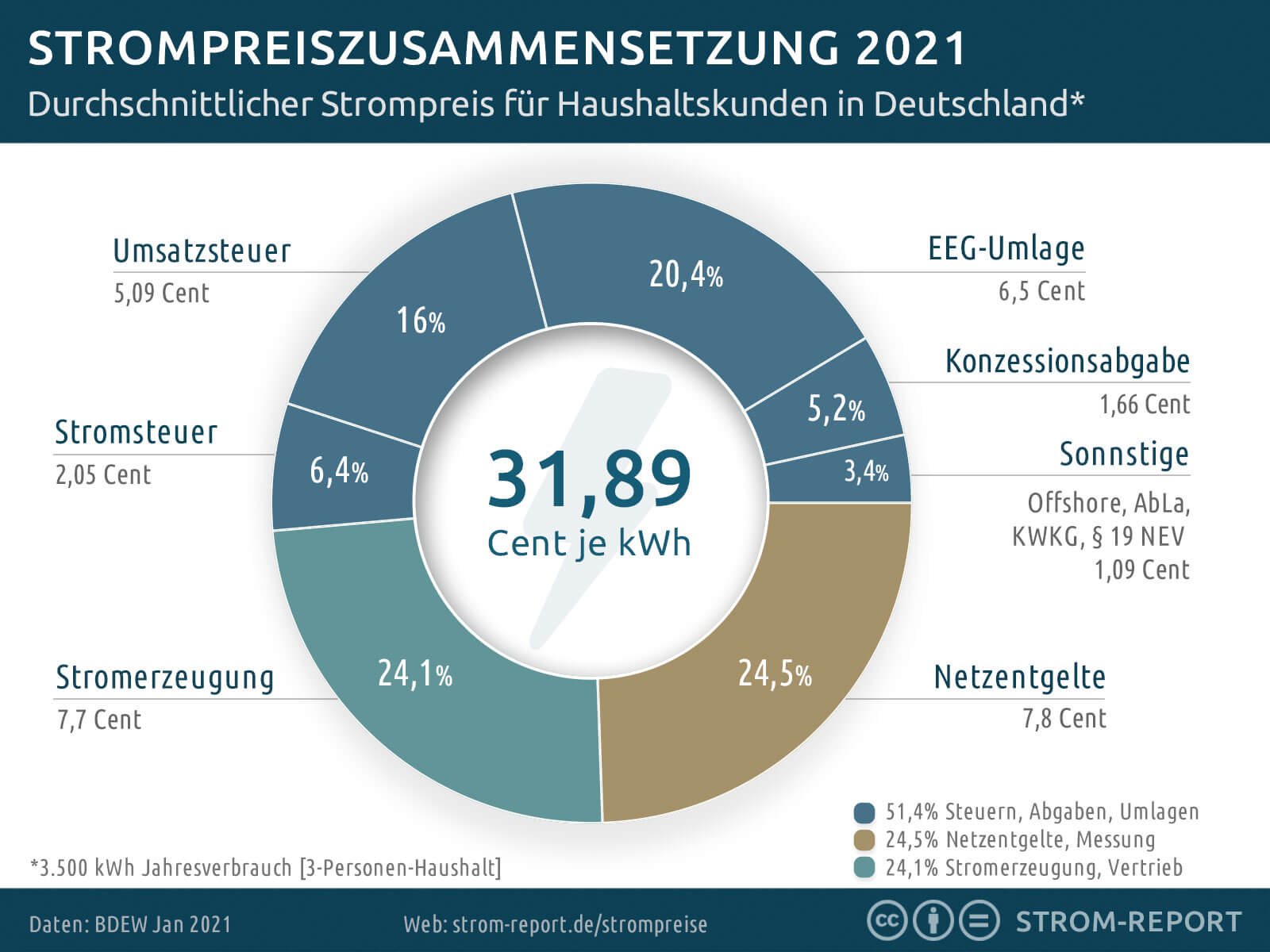
The source refers to retail electricity prices and thus doesn't apply here. The German electricity price is subject to lots of different taxes and fees; energy generation makes up less than a quarter of it [1]. These taxes do not need to exist and even the "EEG" which subsidizes renewables could be paid via the general budget. Like, for example, power plants could be paid for by the state. The comparison of household prices therefore makes little sense, as it implies the governments are in a race to offer the lowest rates to its population.

[1]: https://strom-report.de/medien/strompreis-deutschland-2021.j...

So according to your logic, taxes used to subsidize electricity production should not be included when calculating the cost of electricity, which can only give rise to a meaningless cost. Germany imposes such high taxes because they have such massive subsidies for producers. That is why electricity costs so much more in Germany — because it costs so much more to produce. But being fungible, the cost of wholesale electricity on the transnational exchanges will of course tend to the law of one price. It is the taxes that bring this in line with reality as to the fully loaded cost of generation, which in Germany is much higher.
>Germany imposes such high taxes because they have such massive subsidies for producers.

Even without the EEG, the electricity price would be among the highest in all of Europe. Also, given how much public money coal for example receives in Germany, I think it is a very reasonable argument that the EEG subsidy should not really be considered a fixed part of the electricity price that could not be moved elsewhere.

That's because market prices are what they are, they don't depend on whether it's "gas electricity" or "nuclear electricity".

Now, if you produce electricity by burning gas that you import and gas prices go through the roof then your production costs follow and your stuck.

In the meantime, production costs of nuclear plants have not moved at all. Which makes controlling consumer prices much more doable and less costly, for instance, you can sell that electricity with improved profit margins (and France does export a lot of electricity).

+ This map shows these statistics https://www.electricitymap.org/map
Actually it appears that this is how it works, though in this case it’s more purchases from Czech than France.
If you have interconnects, energy is fungible - just like oil or other commodities.
Electricity is only fungible on a second by second basis while ignoring transmission losses.

Local power production has a significant advantage. This gets offset when distant locations have significant geographic advantages like hydroelectric power or wind etc, or when peak production or demand varies between locations.

Large quantities of energy (e.g. from Nuclear) are bought in advance (between countries, and less often between companies), and with multiple years contracts. That's why you don't see a huge difference.