Hacker News new | ask | show | jobs
by neonnoodle 1795 days ago
Ten years on, and it's chilling to consider how much more widespread Brevik's ideology has become worldwide. Ethnonationalism has elbowed its way to a seat at the table, demanding "toleration" for itself that it would never reciprocate for pluralism.
9 comments

The fascist that inspired Breivik is still in parliament in NL, and has since then been joined by many (worse) examples.

"Breivik's subtitle is lifted from a 2007 essay by fellow Norwegian blogger "Fjordman". Extensive citations - often plagiarised - also refer to other anti-Muslim ideologues and groups, from the Dutch politician Geert Wilders and Steven Yaxley-Lennon's English Defence League to the likes of Jihadwatch and Stop the Islamisation of Nations (SION). "

From: https://www.bbc.com/news/world-europe-19366000

Do I misunderstand these terms, or hasn't ethnonationalism been the norm historically and pluralism quite rare?
No, the existence of ethnicities is old but the concept of tying them to national borders is very young (modern era, and mostly 19th century and beyond) and the specific interpretation of ethonationalism here (ethno exclusionism within a set of borders) is even younger.

I have to work right now so can't work through all the examples listed by another poster below, but will try to come to this thread later. But if you look at e.g. historical Europe or Rome you will rarely find borders defined by ethnicity, and you will rarely even find people defining themselves by a singular ethnicity. Look at the e.g. Franks, the Germanic political entity that ended up defining modern France (and Holland and Germany and Belgium, etc.) A Germanic-speaking tribe that took over a Celtic (Gaulic) and Latin speaking territory, went to war with other "Germans", switched to speaking Latin in some places, but not all, and on the territory where they once ruled you now have a shattered mirror of dozens of ethnicities ("German", "Dutch", "Walloon", "French", "Alsatian", etc) in a nested fractal pattern depending on what lense you use, none of which correspond to any exact political border and which are fluid and changing from decade to decade.

My take: Ethnicity exists, is fluid, etc. Ethnonationalism is a tool, an ideological tool, mobilizing ethnicity for its own ends, using a specifically modern era mechanism ("nations", which are only ~200-300 years old) for the purposes of whoever is wielding it. E.g. the ambitions of an e.g. Milosevic type personality.

My ancestors are from both Alsace and Germany, so I take an interest in this topic.

I'm still a bit confused, but I think the takeaway is that I was conflating "any ethnic persecution" with "ethnonationalism". It sounds like the latter is much more specific ("we don't want Jews in our country" versus "this country belongs to Germans"?)?
I think it's normal to be confused, because the terms and history all have different interpretations and meanings.

What is German? What is Jew? What is "country"? And what is nation?

The answer to all those questions changes. Which is one of the reasons why I think it's important to be incredibly suspicious of any person who claims to have the answer, and to be able to state with certainty that this country belongs to Germany or this is the homeland of the Jews.

What are they really trying to accomplish?

Also, I'm super suspicious of anybody who says about any topic "it's always been this way" or "it's just common sense"... because a) they're usually wrong b) that's usually just obscuring a proposition or action they don't want to justify or defend using arguments so they appeal to nature/God/common-sense/natural-rightness instead.

> What is German? What is Jew? What is "country"? And what is nation?

I agree about ethnicities being mercurial; I'm not espousing "ethnicity" as a good way of organizing the world, but it's an established convention. WRT "country", here I mean it in a political/territorial sense--i.e., a territory under control of a sovereign government.

> Also, I'm super suspicious of anybody who says about any topic "it's always been this way" or "it's just common sense"

I'm not asserting anything. Ethnicity seems much too mercurial for me to understand well, and it seems like it's easy for people on either side of an argument to flex the definition to suit their ideological ends.

So it's very reasonable to point out that there's rarely such thing as 'pure ethnicity' and especially the 'lensing' issue of scale is insightful, and of course that some eras there's more evolution than that others ...

... but none of this upsets the fact that ethnicity is the 'primary weight' in the ultimate definition of borders, other than the borders which are artificial (i.e. political) which is why those tend to collapse.

i.e. " historical Europe or Rome you will rarely find borders defined by ethnicity" <- this is just not true.

Borders very clearly, 'mostly' ethnic, with huge caveats obviously, but those caveats don't change the underlying gravity of ethnicity.

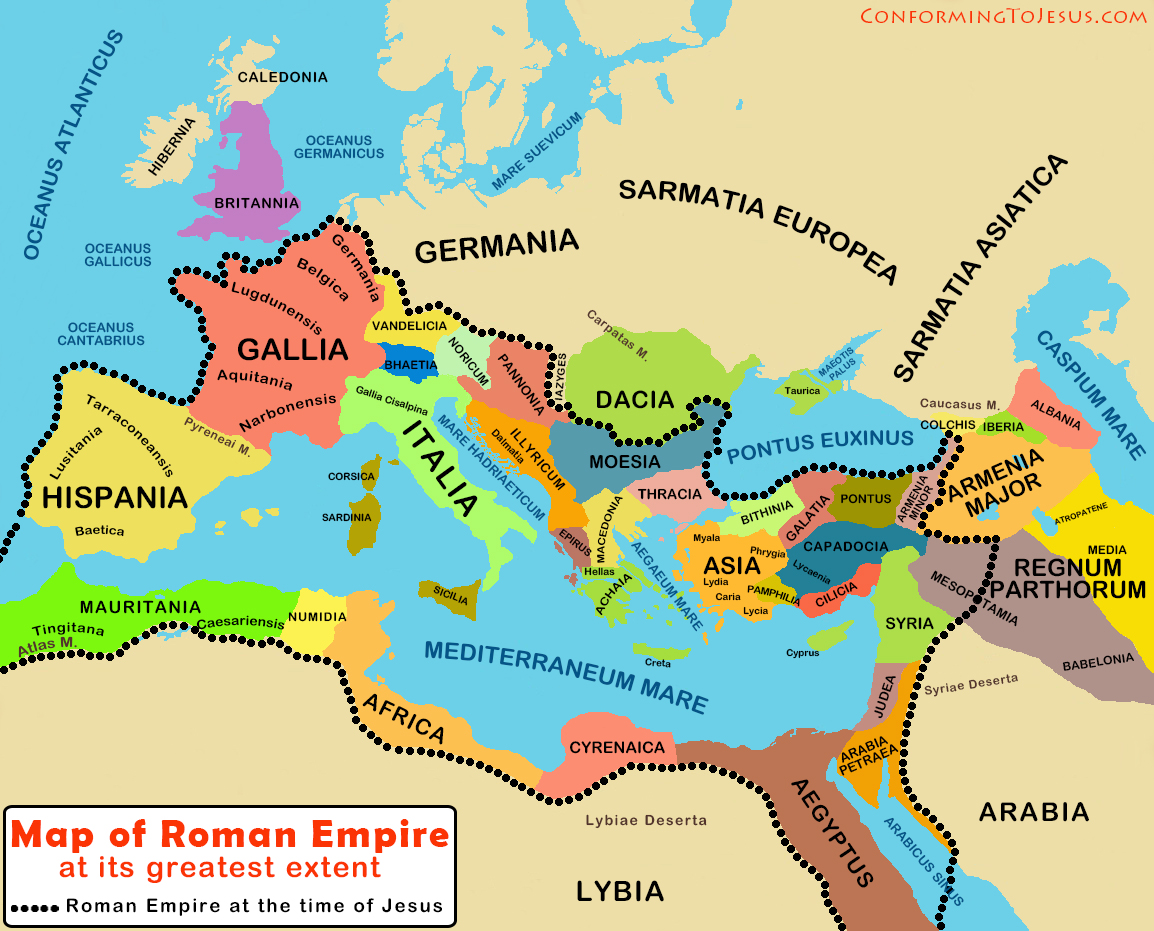
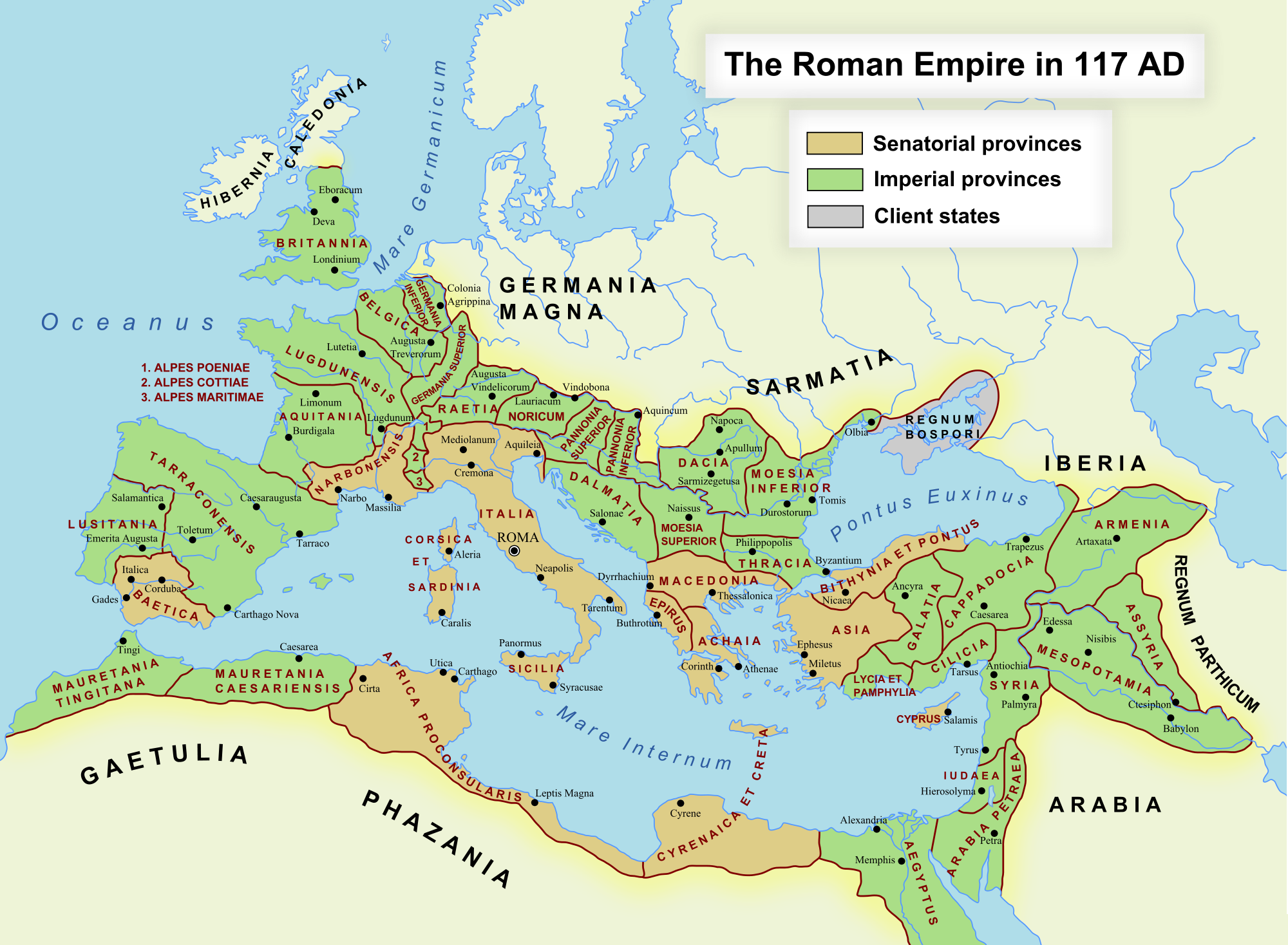
Both a map of Europe today (though it's national) and even a map of the Roman Empire at any given time fairly strongly highlight this.

Roman borders don't help your point - they speak against it.

For a visual refresher here's a bunch of them [1].

Those are mostly ethnic divisions - some of which exist even today.

The fact that Greece has been 'occupied' for ~2200 years, by a whole variety of external powers, and still 'moslty' remains 'Greece' is evidence of this.

Despite your well meaning highlights of the Germanic invasion of Latin Gaul ... there is still a major delineating border between 'Gallia' and 'Germania' today [2].

Same for 'Hispania', 'Britannia', and 'Caledonia' (i.e. Scotland) and 'Hibernia' (i.e. Ireland).

It's an incredibly similar map 2000 years later.

Maybe one factor you could consider in your line of reasoning is the difference between political and ethnic boundaries.

When one group 'invades' another - that's a political change, not necessarily an ethnic one.

It becomes 'ethnic' when the invaders bring along with them considerable cultural power and especially 'bodies' i.e. if there's a lot of migration.

The official language of France in 2021 (and there are many) is French, which is Romantic, despite Frankish invasion.

Charlemagne was more or less a political phenomenon, less so cultural one.

[1] https://www.google.com/search?q=map+of+roman+empire&client=f...

[2] https://www.conformingtojesus.com/images/webpages/map_roman_...

You’re begging the question of why ethnicity implies borders. Borders are purely political objects. Without states, there are no borders. Labeling geographic areas as being primarily inhabited by descendants of a certain ethnicity does not at all imply that there is a well-defined point at which one ethnicity becomes another ethnicity in those areas. You can’t just ignore the existence of the nation-state in discussing borders. It’s the whole substance of the question.

I will note too that your argument here completely falls apart for America.

I think you're missing a lot of information here.

"Without states, there are no borders"

Well, the 'Nation State' is a modern concept, so no.

But if you were to say 'borders imply an administrative region of some kind' - then maybe.

But even without official, stated administrative organization, 'borders' still exist as the demarcation point between groups.

"You can’t just ignore the existence of the nation-state in discussing borders."

I absolutely did not, and I have no idea what you are referring to here.

"your argument here completely falls apart for America. "

No, it doesn't.

Start with the point that most 'states' (or administrative regions) in history, have been ethnocentric. From Egypt through Minoan, Greek, Roman etc..

Some more so than others. The US, no, Sweden, mostly.

> Well, the 'Nation State' is a modern concept, so no.

The nation state is. The state is not. The state is ancient.

> But even without official, stated administrative organization, 'borders' still exist as the demarcation point between groups.

But they’re not borders as such. Without administration, they shift constantly, and frequently are not clear at the edges.

> Start with the point that most 'states' (or administrative regions) in history, have been ethnocentric. From Egypt through Minoan, Greek, Roman etc..

Sure, but the phenomenon of the nation state is the part that you’re missing here. You can argue that historically, humans have grouped themselves ethnically. What you can’t argue is that this somehow makes ethnocentrism in the political environment of a nation state “natural,” as the concept of the nation and the state have been aligned for hundreds of years now.

> Some more so than others. The US, no, Sweden, mostly.

But this distinction basically proves this is not intrinsic to how humans function. The existence of variation is a pretty good argument against historical determinism.

The concept of a territory been defended by tribe against other tribes is as old as mammals.
Even if that's the case, that's not close to the same as a "nation" or even an "ethnicity."

Example: Germanic tribes that migrated out of the north in the 1st-5th centuries AD all spoke similar languages and had similar customs but were fluidly at war with each other and rarely if at all recognized any wider "German" identity. Some allied with the Romans, some joined confederations with the Huns, some groups seemed to be mixtures of Gauls and German despite different languages, etc. etc. This didn't befuddled the Romans at all. In the same era, Greeks (Hellenes) called themselves Romani, Goths ruled over formerly Roman territories and adopted Roman practices, while having Latin speaking subjects.

Stretch that out to the modern far right in Europe, on what basis is "European" any kind of "tribe?" What exactly are us "cultural Marxists" trying to impose on this poor persecuted "European identity"?

It does not stand up to critical inspection so it has to appeal to stuff like you just said "oh it's always been this way" -- who says? Define your terms, show me how they're the same, and prove it. Because appealing to that past and then conflating with the present with it to justify some action or policy has really serious consequences for humans

No. Consider France -- until Napoleon forged modern France, it contained dozens of languages and ethnicities. Then the modern world steam-rolled them into Frenchmen.
I don't think "the modern world" can be faulted. The French explicitly had a top-down campaign to forge a French national identity/ethnicity. But I take the broader point, I thought "ethnonationalism" was any kind of persecution of ethnic minorities.
What could be more modern than a top-down, homogenous education campaign?
Recent history, 19th and 20th century, yes. Older than that, no. Correct me if I am wrong, but wasn't French a minority language in France until the government decided to pursue a policy of francisation?
I think so. IMO, tolerance is a result of education, easily unlearned under pressure.
I think we could make a distinction between 'ethnocentrism' as identification with culture and being 'historically normative' at least somewhat, and 'ethnonationalism' which is the addition of the nation state, where it can possibly get more extremist under an operationally effective entity and codified/organized ideology aka Nazism. That's just my view.
Yup, an he was an early (in this cycle) example of the importance of the Paradox of Tolerance.

"A concept advanced by the philosopher Karl Popper which claims that unlimited tolerance necessarily results in the destruction of the tolerant by the intolerant, resulting in a society in which tolerance is no longer possible. Therefore, while paradoxical to the concept of free speech, it is necessary to be intolerant of intolerance. "[1]

In short, in a society of unlimited tolerance, the intolerant will drive out tolerance and take over. In This murderer's example, by simply eliminating those whose views he doesn't like.

[1] https://rationalwiki.org/wiki/Paradox_of_tolerance

Seems the point is being missed here - the point is that tolerant societies must nevertheless be vigilant to contain serious intolerance or it will take over.

It is easy to have an absolutist rule "oh just let anyone say and do anything". Seems like the simple freedom, but the paradox points out that this WILL be hacked and destroyed by some intolerant group.

It is much harder to implement a few constraints that are actually required to keep things free. But it is necessary (and that murderous rampage to literally eliminate a class of future leaders is an example of why it is necessary).

Two things I would do to stop this:

1. stop calling it right wing extremism. These guys are mad nationalists, not Ayn Rand (not that I am a fan of Ayn Rand either.)

By calling it by its real name it won't come across as just a variant of conservative or liberal. Because we absolutely detest them and I guess I speak for most of us when I say we don't even want them to vote for us.

2. Encourage serious debate. Dare to meet people.

I wrote about this the other day in the context of climate change:

Climate change believers are awfully fast to reach for the branding iron whenever someone asks an innocent questions.

Meanwhile climate change deniers will patiently smooth talk people and dig out "study" after "study" carefully picked to prove their point.

Same goes for this: the only place you can safely discuss immigration without risking someone sneaking up on you with a red hot "racist" iron is - you probably guessed it - with the racists.

Now why don't we fix this?

Probably because we'd have to admit that there are some serious problems with the way immigration has been practiced.

From his wikipedia entry:

> The Jerusalem Post describes his support for Israel as a "far-right Zionism". He calls all "nationalists" to join in the struggle against "cultural Marxists/multiculturalists" [1]

Now fear of "cultural Marxists" destroying Europe/US/Christianity etc is mainstream talk in right of center politics.

[1] http://www.jpost.com/International/Norway-attack-suspect-had...

It's the paradox of tolerance in action. Tolerate intolerant ideals and there will be a sudden jerk to intolerance.
For context Karl Popper's quote on the paradox of tolerance:

"Unlimited tolerance must lead to the disappearance of tolerance. If we extend unlimited tolerance even to those who are intolerant, if we are not prepared to defend a tolerant society against the onslaught of the intolerant, then the tolerant will be destroyed, and tolerance with them.—In this formulation, I do not imply, for instance, that we should always suppress the utterance of intolerant philosophies; as long as we can counter them by rational argument and keep them in check by public opinion, suppression would certainly be most unwise. But we should claim the right to suppress them if necessary even by force; for it may easily turn out that they are not prepared to meet us on the level of rational argument, but begin by denouncing all argument; they may forbid their followers to listen to rational argument, because it is deceptive, and teach them to answer arguments by the use of their fists or pistols. We should therefore claim, in the name of tolerance, the right not to tolerate the intolerant." [0]

[0] K. Popper (1945) 'The Open Society and Its Enemies'

> and teach them to answer arguments by the use of their fists or pistols.

It would be great if that condition was used to distinguish between individuals that are intolerant and those that simply are dissenting.

A dissenter might disagree with the rationality of the arguments being presented. They might be in minority in term of public opinion. Suppression would still certainly be most unwise.

You can’t perfectly distinguish between intolerance and dissent from first principles because the distinction is inherently political, and intolerance could also be characterized as dissent in a society that practices tolerance. In most cases though I think intolerance is pretty clear: when you start denying people’s status as full citizens of a nation, you are being intolerant.
Amazing that he anticipated "So much for the tolerant left" about 70 years before it became a widespread complaint
It's the paradox of intolerance because it's a paradox, i.e. a logical contradiction. If you are tolerant to intolerant views, they will gain power and censor your tolerant speech. But on the other hand, if you are intolerant towards intolerant views and censor them, then it's ok for someone else to censor YOU for being intolerant.

You can go a step farther and say that "tolerance towards intolerance leads to intolerance, therefore we should be intolerant towards tolerance in the first place!" It's a paradox for a reason, and no high-minded solutions of "intolerance in the name of tolerance" are able to sidestep its implications.

There are two conclusions that I personally draw from it. The first is that intolerance/tolerance is not a binary, is not easily definable, and therefore there is no clear standard for what speech is right to censor and which is not. i.e. the paradox is unsolvable. The second is that "tolerance" and "intolerance" are not great words to describe the dynamics at play, they carry extra nuance that is not helpful.

(if you can't tell, I'm not a fan of the paradox of tolerance)

It reminds me of game theory and how difficult it is to create cooperator strategies that prevent the invasion of defectors in e.g. the prisoners' dilemma.
The outcome should be, tolerance for others to express their intolerance, and you to express your intolerance of their intolerance, but no one gets to shut anyone's expression's down.

You can ignore them, don't have to amplify them or give them a platform, but you don't shout them down and you don't allow them to shout others down or stop them from building their own platform.

The Communists in America have been marginalized for a long time in America, but even the most totalitarian/Stalinist believing of them aren't muzzled. Whatever one's extreme belief, a truly robust society has the tools to survive their ability to talk about them.

The paradox disappears when you treat tolerance as a peace treaty rather than a universal moral obligation.
Unfortunately the paradox of tolerance is trivially abused. If someone concludes that Islam is intolerant, that person feels that the PoT gives them moral license to behave in tolerantly toward Muslims. I think we also see this in American culture war where the definition of “intolerance” is contorted such that it matches one’s ideological opponents. Perhaps we need a firmer test for what constitutes tolerance or intolerance, although even then the semantic contortionists would probably just redefine the terms that constitute the test.
What's left is to determine who is tolerant and who isn't.
Yeah and it's a bit tricky. Best to leave it to someone who knows what they're doing. I vote for me.
The paradox of Tolerance says to actually tolerate intolerance unless it’s violent.
No, it does not.
Ethnonationalism (or at least ethnocentrism) is as old as time, and probably the 'default' mindset. Lack of any other force, especially when combined with the 'nation' part i.e. organized nation state, it might get out of hand, which is why it can come to be a problem, but nominally, it's not. It's probably a defining feature of how we organize ourselves.

So the very existence of most of our nations, is a form of 'Tolerance' of it.

If you look at the borders of Europe and how they flop around over time, it becomes clear that the 'delineating' factor is mostly ethnicity, at least crudely. Sometimes, a political dynasty can force those lines (i.e. Habsburg) but those don't last. What were the chances that Netherlands, Spain, Austria, Hungary, Romania and Slovenia etc. were going to stay organized under one House?

Even highly authoritarian ideological secular organizations i.e. USSR failed. Napoleon failed outside his borders whereas within France, it might have just worked for him.

Religious Empires aka Arabic conquest, have some lasting impact but that didn't change borders in any lasting way mostly (although maybe in SE Europe).

Despite a degree of 'multi-culture' in China, the CCP authoritarianism hinges on Han ethnocentricism without which it probably would not hold together.

Where those 'ethnic lines' are drawn poorly, we see trouble.

Belgium is almost a 'failed political state' (literally 100's of days in a row without a government) and the 'division' is 100% because of Flemish/Walloon divide.

Canada has the 'Quebec' factor which has really fundamentally affected things and has a profound effect.

The 'Long Straight Lines in the Desert' in the Middle East were arguably drawn poorly after the fall of the Ottoman Empire, and a lot of people tend to point at that as an existential source of instability and why we see problems to this day. Iraq is not a functional state as the Kurds have de-facto independence, and the primary source of instability is the Shia/Sunni divide, unfortunately inflamed by neighbouring parties for their own gain.

The 'New World' aka US, Canada, Australia, Brazil represent something different surely, but even there, it's hard to ignore strong ethnic foundations of the colonizing powers.

Greece is still Greece today after 2500 years, the borders are similar. Also note their 'primary antagonists' i.e. 'Persians' are also something very roughly resembling a state today.

Of course for every 'long lived state' there are 10 that don't exist anymore, but there seems to be resiliency in culture more than anything else.

So I think it's a matter of keeping 'true extremists' (aka not vast government spying and overreach) under wraps as individuals, not so much thinking about specific kinds of movements.

I also believe that these kinds of people would just as easy fall under some other cultural/religious/ideological/extremist umbrella.

I don't think there's much difference between 'XXX extremist' and 'YYY extremist' even if they are ostensibly opposed to one another.

Ok, so you take belgium "as a failed state", and the "Quebec factor", while ignoring, let's say... Switzerland?

> If you look at the borders of Europe and how they flop around over time, it becomes clear that the 'delineating' factor is mostly ethnicity, at least crudely.

No. I don't know why you would think that. Brittany was Gallo-Breton, and the two ethnicity almost cut the duchy in two. Two very, very different languages and ethnicity. I would know, i was born on the lingual border. Occitan was closer to Ligurian than to Paris' French, Normand was closer to London's, I would like to think that Liege was always speaking alsacian rather than French, and that Burgundy was speaking more French than the Armagnac Duchy was. The Basque ethnicity was always separated between two crowns (at least)

You know what defined the national borders during the nationnalism epidemic of the 19th century? Natural borders. And when none exist, you create artificial ones, not a all following ethnicity. Ukraine? Lithuania? Poland even? No natural borders => the borders cut with forests or swampsm not "ethnical divide" (or else eastern Europe would NOT look like this).

> Napoleon failed outside his borders whereas within France, it might have just worked for him.

Yes, and what was France looking like when he took power? How yeah, Savoy, Piedmont, Liguria are really French. As are the netherlands... It worked for him until he started to meddle into other kingdom's/Empire internal affairs.

> Greece is still Greece today after 2500 years, the borders are similar.

Yeah, no. The old Greece western borders stopped before that (linguistically at least), the northern border reached higher, as were the eastern borders. I know that Iran fancy themselve as persia successor, but let's be honest, their border follow more natural borders than the old Persian Empire.

If ethnocentrism were "as old as time", what about the Mughals? What about the Romans? What about the "King of Franc" ruling over a lot of non-Franc (a majority of non-Franc even)? And the Holy Roman empire? What about the Commonwealth of Poland? The truth is, ethnicity is a lot like language, and follow the same rules language used to do.

Just want to say thank you, you made all the points that I wanted to make (but could not summon the energy to) in a reply to this comment.

Should add re: Greece that there was few points at which the Greeks ever even considered themselves any kind of "ethnic "nation"; in pre-Roman times they recognized the existence of "Hellenes" but were constantly at war with each other. In Roman times (which went on much longer there than in the west) they came to consider themselves Romans. And in post-Roman Ottoman times they were one of ethnicity of many in what is now Greece and Asia-Minor and identified more around religion. Until the great ethnonationalist catastrophe of the forced population relocation of Greeks and Turks in the last century in which all sorts of people who didn't fit the "right" categories were mixed up (Christian Turks? Muslim Greeks? etc)

This line of reasoning of 'finding examples where ethnicity fails to provide the boundary distinction' doesn't make your case.

I know about 'Switzlerand', thanks. Which is why I brought up USA/Australia/Brazil etc..

Nobody is going to argue that there are many factors that drive boundaries (aka natural boundaries) merely highlighting some counter examples doesn't deconstruct the fact that ethnicity is the primary marker.

"No. I don't know why you would think that. "

Well I don't know what to say because to me, it's 'very obvious' that ethnic boundaries are strong - I don't know how anyone could think otherwise.

In fact, if there is 'nuance' it's probably the things that you are stating that are 'less obvious'.

Here is a map of Rome in the year 0 [0]

Here is a map of Europe today [1]

They are incredibly similar.

By pointing out 'that there are differences' doesn't deny that fact.

Again: "Yeah, no. The old Greece western borders stopped before that (linguistically at least), the northern border reached higher, as were the eastern borders."

That borders have shifted materially, doesn't change the underlying fact that 'Greece is strongly related to Greece'.

I think that's the clearest example of where your argument does not cross the threshold you think it does. You say 'the borders have changed' - fine - I say 'it's still pretty much Greece', which it is.

The Duchy of Savoy was mostly a political organization, not an ethnic one, and guess what? It doesn't exist.

The fragmented borders have mostly collapsed - along the lines of ethnicity, crudely. And of course, within those borders, it's fragments like a fractal (great analogy by the commenter above).

And finally, yes, 'natural borders' are obviously a framing reference, because they keep people apart, which allows groups to develop, we agree there.

[0] https://www.conformingtojesus.com/images/webpages/map_roman_...

[1] https://geology.com/world/europe-satellite-image.shtml

It's a bit precious to point to the Greek borders and say "look, there's Greece" when you're pointing to a territory in which a half million people were forcibly expelled based on ethnonationalist politics and ideology, only 100 years ago.

Likewise to "French ethnicity", a place where government policy is still actively engaged in destroying minority languages (and their cultures) and has been since Napoleon.

These "ethnic" borders you're pointing to are as much a product of political maneuverings using ethnicity as a platform, as they are any kind of "natural" product of ethnicity.

Again, dismissing my points. What about Britanny (breton and Gallo, see my previous post)? What about the Basque country? What about Alsace? What about Savoy then, if it was "mostly a political organization" (that created modern Italy by the way)? What about Occitanie? and Catalonia (Roussillon mostly)? Aquitaine? Do we talk about northern France then, since we saw pretty much All the south is NOT French? Is Normandy French? Culturally? When the original normand had so many word from the danes, and even the name tell us where they come from (NOR-mand)? Picardia (from Baie de Somme to liege basically), do you consider it French? Because i'm pretty sure, it use to be way closer to the lowlands than France, culturally (when the Duchy of Artois existed, at least).

I only know one contry well, mine, and a bit of northern Italy (i'm a 1750-1911 history nerd).

So now i'm gonna dissect northern Italy: you can count Liguria (closer to Occitan than Rome), as well as Piedmont ethnicity (but since the Duchy of Savoy is mostly political, i guess it doesn't exist... Ho, wait, did this duchy not inherit Sardinia from the pope and the Hasburg and form the kingdom of Sardinia-Piedmont? I guess it was based on ethnicity then.) Do you think Venitians where closer to Roman (or i guess Piedmont) than they were to Dalmatians before the 18th century? I am sure it wasn't the case.

You map of Rome is funny. Here is what i found [0]. This is obviously not following ethnic divisions. Unless the basques moved during the time period, but i'm certain they did not.

[0]https://www.worldhistory.org/uploads/images/266.png?v=162592...

I'm not dismissing your points - I accept there's a lot of ambiguity.

Given the level of fragmentation you want to get into by highlighting tiny, short-lived political entities that had small populations and exited only for a blip in history ... well, you'll find many of them.

But you're missing the forest through the trees: the borders are unambiguously ethnic, to the point where it's not really even an argument.

'So What about Basque Country'?

Yes - thanks proving my point!

The 'Basque' fit so poorly within the constraints of Spanish borders that there is literally 'terrorism' and a systematic malaise: separatists groups and violence!

It might very well bode better if there was a separate nation state, or some degree of sovereignty there. I don't know, that's besides the point.

And what about Occitane, Catalonia, Alscace? They are, for the most part, ethnic subdivisions that fit more or less within the bigger systems they are in. Some better than others, but almost all of them to some reasonable degree.

But you're arguing against reality to insist that the line between Poland and Germany isn't relatively clear at some point, even if it's not perfect. It fuzzes over a few leagues, but by the time you hit Warsaw or Berlin it's clearly 'a different culture'. Again that there are strong subdivisions in Germany doesn't change the fact because the subdivisions are 'mostly' Germanic.

The Swedes and Finns have very distinct ethnostates, even if they have pockets of Swedes (historically, not just expats) in Finland, and even with distinct 'aboriginal' groups within both.

Again, in the big picture - hard ethnic delineation.

The map of the Roman Empire you provided only reinfornces my case: many of regions form the basis for many nation states today.

The more developed the system, the more likely it would be to have continued existence.

The demarcation point between the old Roman Empire and the Germanic states today is stark - written in politics, language, culture.

Europe didn't end up with a bunch of Switzerland - it ended up mostly with a bunch of Germanys, i.e. the sub-fragmentation is mostly related in some way and the external boundaries forming a kind of ethnic delineation.

There is 'malaise' in Basque country because of the ethno-nationalist/ethnostate nature of France and Spain, not because of some nonsense essentialism that a country with ethnicities in its boundaries naturally tends towards chaos and malaise. The lack of actual multiculturalism in both those states is what gives Euskadi (and Catalonian) nationalism its grounding.

Same in my country, Canada. Quebecois nationalism exist/existed in large part due to the experience of British colonialism and the awful way that the Quebecois and their language were treated and the dumbass way many English Canadians still talk about them.

You're reversing the causes and effect here. The basque did not have any issue being divided between 3 kingdoms for a thousand years. Breton did not mind being ruled by Gallo for at least as much time. Somehow, they started revolting when the state, the nation rather, started imposing their own languages and forbidding them to keep their cultural identity. Everybody talk about the Armenian genocide, but this is only the last of a long history, the 19th century is riddled by ethnic displacement to make the nice looking european border match the ethnicity. Italy did exactly the same, Austro-Hungary too. The Balkan crisis is caused by an ethnonationalism the did not exist before.

You know that have multiple culture in your kingdom was a sign of strength until the end of the 18th century, right? Despite the Villers-Coteret directive, nothing could please a King of France more than listening the his multilingual, multicultural country. It is really obvious than the cultural area we have no were forced. I know there is a lot of fear behind the sinicization, but France did the same in less than 50 years, although at a smaller scale, with a modicum of violence and some small concessions.

Aragon was probably one of the most multicultural, multilingual kingdom of old, but since the concept of nation did not exist, and that ethnicity was just another word for language 95% of the time, it did not cause any issue, and certainly not ethnic tensions.

A recent study concluded that Breivik’s influence on right wing terrorism is close to none. But yes, the 22 july attacks is certainly a critical chapter in the overall rise of nationalist movements in the last decade.

Link to study: https://www.universiteitleiden.nl/binaries/content/assets/cu...

Unsure about the downvotes, but needless to say, the results of the study are, well, positive:

https://www.nrk.no/trondelag/ny-studie_-anders-behring-breiv...

On the contrary, I don't see any widespread nazi ideology. I see people open disagree with the left and some of its goals but that is, and I hope you agree, not the same thing.
> I don't see any widespread nazi ideology

Perhaps they have played too much Wolfenstein VR to come to that conclusion of seeing Nazis everywhere or some sort of hidden agenda of a secret Nazi invasion from space.

SlateStarCodex (A HN favourite) put it more accurately about the media (and social media) during the recent events in 2017 and still to this day:

"I also think events proved me right in saying that the media was going crazy in a particular way where they would read racism into anything..."

"...At some point you just have to admit everyone went crazy for a few years and seeing started seeing Nazis in trees and rocks and grilled cheese sandwiches and Trump was an especially tempting target."

[0] https://astralcodexten.substack.com/p/mantic-monday-grading-...

Speech obesity is an inherent need of attention economy: the heavier the words the better they sink.