Hacker News new | ask | show | jobs
by jollybean 1794 days ago
So it's very reasonable to point out that there's rarely such thing as 'pure ethnicity' and especially the 'lensing' issue of scale is insightful, and of course that some eras there's more evolution than that others ...

... but none of this upsets the fact that ethnicity is the 'primary weight' in the ultimate definition of borders, other than the borders which are artificial (i.e. political) which is why those tend to collapse.

i.e. " historical Europe or Rome you will rarely find borders defined by ethnicity" <- this is just not true.

Borders very clearly, 'mostly' ethnic, with huge caveats obviously, but those caveats don't change the underlying gravity of ethnicity.

Both a map of Europe today (though it's national) and even a map of the Roman Empire at any given time fairly strongly highlight this.

Roman borders don't help your point - they speak against it.

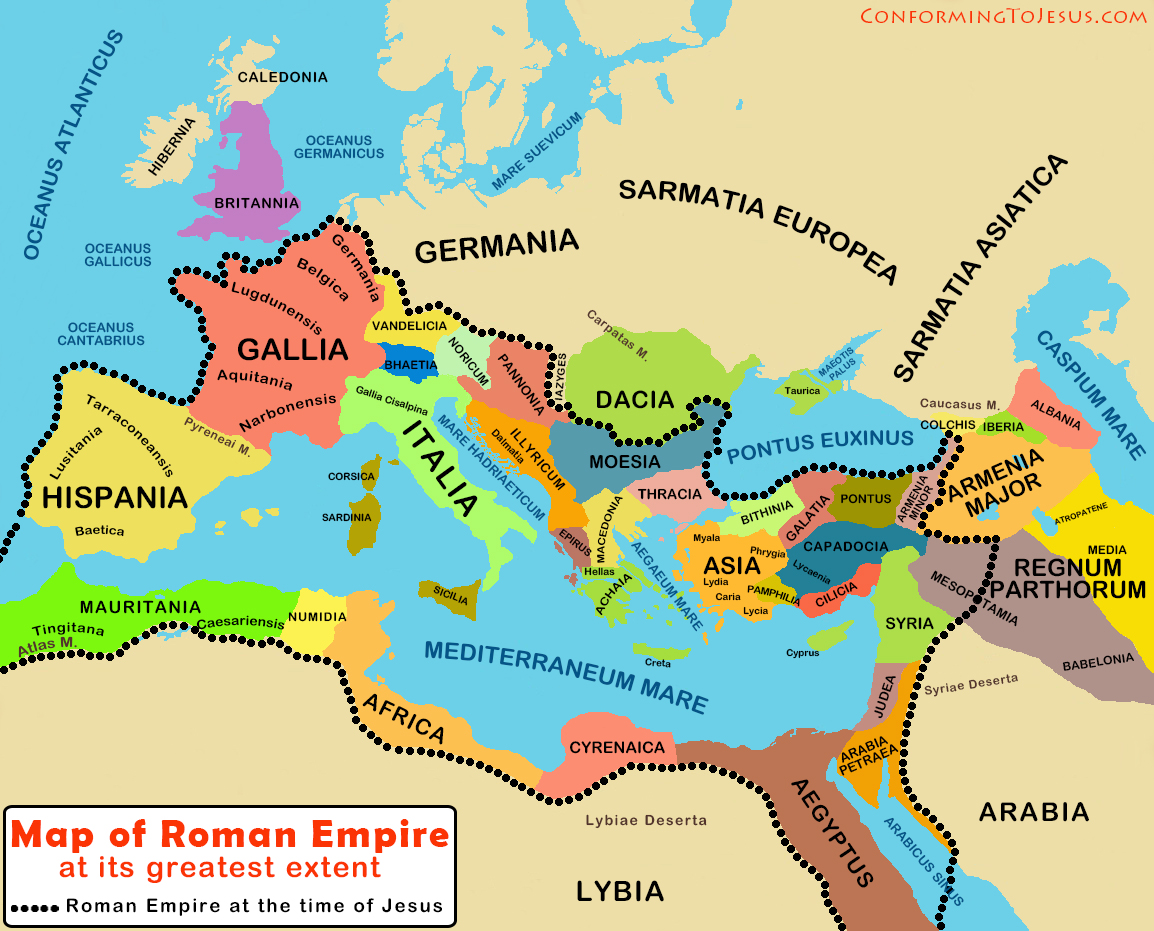
For a visual refresher here's a bunch of them [1].

Those are mostly ethnic divisions - some of which exist even today.

The fact that Greece has been 'occupied' for ~2200 years, by a whole variety of external powers, and still 'moslty' remains 'Greece' is evidence of this.

Despite your well meaning highlights of the Germanic invasion of Latin Gaul ... there is still a major delineating border between 'Gallia' and 'Germania' today [2].

Same for 'Hispania', 'Britannia', and 'Caledonia' (i.e. Scotland) and 'Hibernia' (i.e. Ireland).

It's an incredibly similar map 2000 years later.

Maybe one factor you could consider in your line of reasoning is the difference between political and ethnic boundaries.

When one group 'invades' another - that's a political change, not necessarily an ethnic one.

It becomes 'ethnic' when the invaders bring along with them considerable cultural power and especially 'bodies' i.e. if there's a lot of migration.

The official language of France in 2021 (and there are many) is French, which is Romantic, despite Frankish invasion.

Charlemagne was more or less a political phenomenon, less so cultural one.

[1] https://www.google.com/search?q=map+of+roman+empire&client=f...

[2] https://www.conformingtojesus.com/images/webpages/map_roman_...

1 comments

You’re begging the question of why ethnicity implies borders. Borders are purely political objects. Without states, there are no borders. Labeling geographic areas as being primarily inhabited by descendants of a certain ethnicity does not at all imply that there is a well-defined point at which one ethnicity becomes another ethnicity in those areas. You can’t just ignore the existence of the nation-state in discussing borders. It’s the whole substance of the question.

I will note too that your argument here completely falls apart for America.

I think you're missing a lot of information here.

"Without states, there are no borders"

Well, the 'Nation State' is a modern concept, so no.

But if you were to say 'borders imply an administrative region of some kind' - then maybe.

But even without official, stated administrative organization, 'borders' still exist as the demarcation point between groups.

"You can’t just ignore the existence of the nation-state in discussing borders."

I absolutely did not, and I have no idea what you are referring to here.

"your argument here completely falls apart for America. "

No, it doesn't.

Start with the point that most 'states' (or administrative regions) in history, have been ethnocentric. From Egypt through Minoan, Greek, Roman etc..

Some more so than others. The US, no, Sweden, mostly.

> Well, the 'Nation State' is a modern concept, so no.

The nation state is. The state is not. The state is ancient.

> But even without official, stated administrative organization, 'borders' still exist as the demarcation point between groups.

But they’re not borders as such. Without administration, they shift constantly, and frequently are not clear at the edges.

> Start with the point that most 'states' (or administrative regions) in history, have been ethnocentric. From Egypt through Minoan, Greek, Roman etc..

Sure, but the phenomenon of the nation state is the part that you’re missing here. You can argue that historically, humans have grouped themselves ethnically. What you can’t argue is that this somehow makes ethnocentrism in the political environment of a nation state “natural,” as the concept of the nation and the state have been aligned for hundreds of years now.

> Some more so than others. The US, no, Sweden, mostly.

But this distinction basically proves this is not intrinsic to how humans function. The existence of variation is a pretty good argument against historical determinism.

" What you can’t argue is that this somehow makes ethnocentrism in the political environment of a nation state “natural,” as the concept of the nation and the state have been aligned for hundreds of years now."

??? Yes, I'm making that argument and it's really obvious.

The 'modern nation state' is not fundamentally different from historical 'states' in this regard.

'Gaul' was an administrative state, part of the Roman Empire, roughly ethnocentric. 'France' is now.

Borders bounce around, but they mostly fit between ethnic groups. It doesn't really matter whether we are dealing with the modern notion of state or not.

"Some more so than others. The US, no, Sweden, mostly.

But this distinction basically proves this is not intrinsic to how humans function."

It really doesn't.

That 'some nation states' do not form along ethnic boundaries in not way 'proves' that ethnicity is not a natural vector for state formation.

Even if 'most' nation states formed along some other means, it still wouldn't prove that ethnicity is not a vector of formation.

The fact a number of ethnocentric states exists proves that it's a vector of formation.

The fact that 'most states' are roughly ethnocentric proves my point.

It's fairly obvious and not very controversial.

I think it's just one of those issues that triggers some people who hate the fact that ethnicity is a fairly important part of our identity, and then they step out of their ability to apply rhetoric in a reasonable way i.e. a kind of bad faith argumentation. It's the only explanation I can fathom for why people would argue with something so obvious. Vietnam has Vietnamese and Korea has Koreans. Obviously it's more complicated than that, but unless there are literal Nazis running around, and there generally are not, then who cares. It's really not a problem in most places in the world.