|
|
|
|
|
|
by orwin
1794 days ago
|
|
|
Again, dismissing my points. What about Britanny (breton and Gallo, see my previous post)? What about the Basque country? What about Alsace? What about Savoy then, if it was "mostly a political organization" (that created modern Italy by the way)? What about Occitanie? and Catalonia (Roussillon mostly)? Aquitaine? Do we talk about northern France then, since we saw pretty much All the south is NOT French? Is Normandy French? Culturally? When the original normand had so many word from the danes, and even the name tell us where they come from (NOR-mand)? Picardia (from Baie de Somme to liege basically), do you consider it French? Because i'm pretty sure, it use to be way closer to the lowlands than France, culturally (when the Duchy of Artois existed, at least). I only know one contry well, mine, and a bit of northern Italy (i'm a 1750-1911 history nerd). So now i'm gonna dissect northern Italy: you can count Liguria (closer to Occitan than Rome), as well as Piedmont ethnicity (but since the Duchy of Savoy is mostly political, i guess it doesn't exist... Ho, wait, did this duchy not inherit Sardinia from the pope and the Hasburg and form the kingdom of Sardinia-Piedmont? I guess it was based on ethnicity then.) Do you think Venitians where closer to Roman (or i guess Piedmont) than they were to Dalmatians before the 18th century? I am sure it wasn't the case. You map of Rome is funny. Here is what i found [0]. This is obviously not following ethnic divisions. Unless the basques moved during the time period, but i'm certain they did not. [0]https://www.worldhistory.org/uploads/images/266.png?v=162592... |
|
|
Given the level of fragmentation you want to get into by highlighting tiny, short-lived political entities that had small populations and exited only for a blip in history ... well, you'll find many of them.
But you're missing the forest through the trees: the borders are unambiguously ethnic, to the point where it's not really even an argument.
'So What about Basque Country'?
Yes - thanks proving my point!
The 'Basque' fit so poorly within the constraints of Spanish borders that there is literally 'terrorism' and a systematic malaise: separatists groups and violence!
It might very well bode better if there was a separate nation state, or some degree of sovereignty there. I don't know, that's besides the point.
And what about Occitane, Catalonia, Alscace? They are, for the most part, ethnic subdivisions that fit more or less within the bigger systems they are in. Some better than others, but almost all of them to some reasonable degree.
But you're arguing against reality to insist that the line between Poland and Germany isn't relatively clear at some point, even if it's not perfect. It fuzzes over a few leagues, but by the time you hit Warsaw or Berlin it's clearly 'a different culture'. Again that there are strong subdivisions in Germany doesn't change the fact because the subdivisions are 'mostly' Germanic.
The Swedes and Finns have very distinct ethnostates, even if they have pockets of Swedes (historically, not just expats) in Finland, and even with distinct 'aboriginal' groups within both.
Again, in the big picture - hard ethnic delineation.
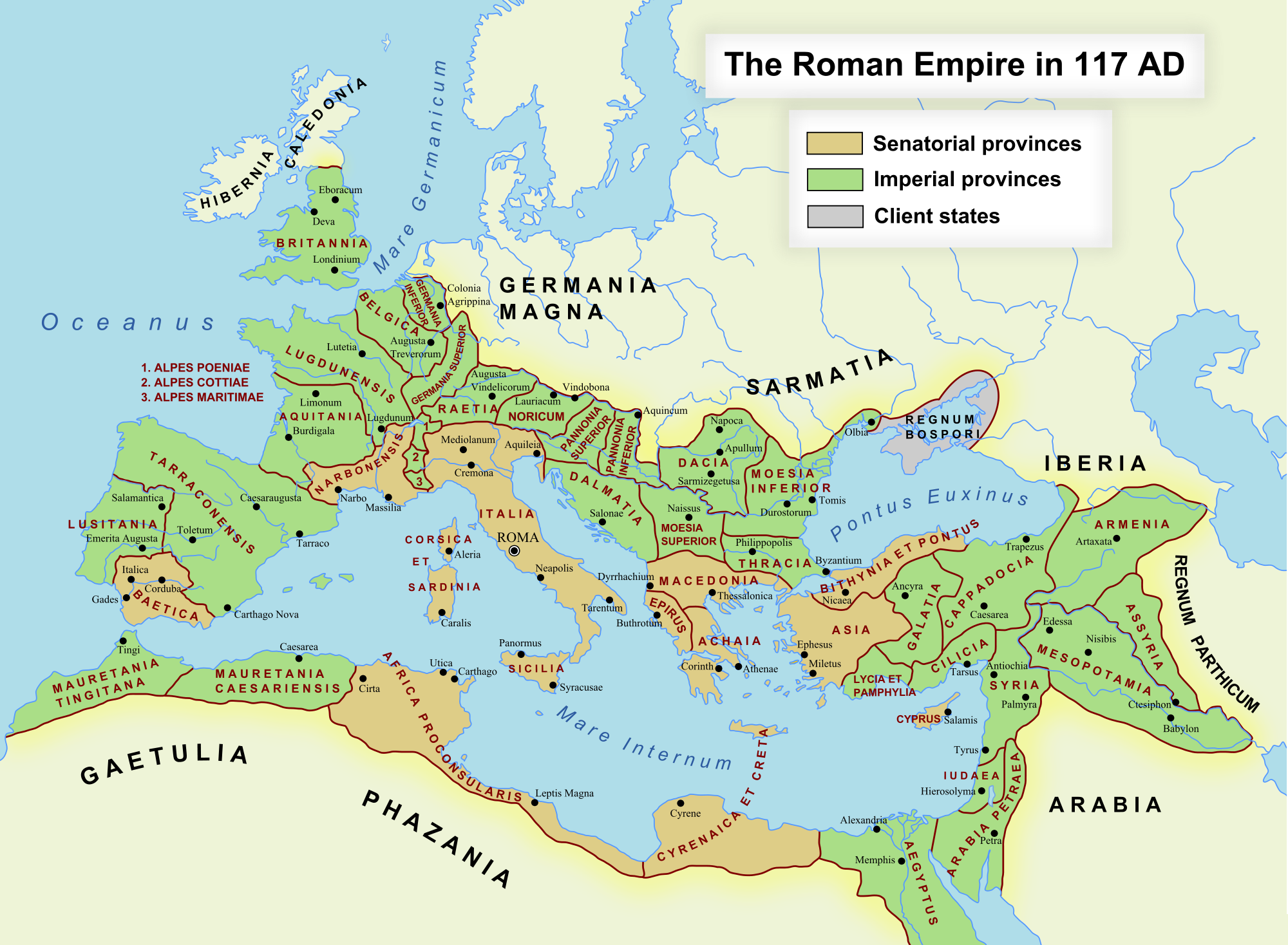
The map of the Roman Empire you provided only reinfornces my case: many of regions form the basis for many nation states today.
The more developed the system, the more likely it would be to have continued existence.
The demarcation point between the old Roman Empire and the Germanic states today is stark - written in politics, language, culture.
Europe didn't end up with a bunch of Switzerland - it ended up mostly with a bunch of Germanys, i.e. the sub-fragmentation is mostly related in some way and the external boundaries forming a kind of ethnic delineation.