Hacker News new | ask | show | jobs
by jollybean 1795 days ago
Ethnonationalism (or at least ethnocentrism) is as old as time, and probably the 'default' mindset. Lack of any other force, especially when combined with the 'nation' part i.e. organized nation state, it might get out of hand, which is why it can come to be a problem, but nominally, it's not. It's probably a defining feature of how we organize ourselves.

So the very existence of most of our nations, is a form of 'Tolerance' of it.

If you look at the borders of Europe and how they flop around over time, it becomes clear that the 'delineating' factor is mostly ethnicity, at least crudely. Sometimes, a political dynasty can force those lines (i.e. Habsburg) but those don't last. What were the chances that Netherlands, Spain, Austria, Hungary, Romania and Slovenia etc. were going to stay organized under one House?

Even highly authoritarian ideological secular organizations i.e. USSR failed. Napoleon failed outside his borders whereas within France, it might have just worked for him.

Religious Empires aka Arabic conquest, have some lasting impact but that didn't change borders in any lasting way mostly (although maybe in SE Europe).

Despite a degree of 'multi-culture' in China, the CCP authoritarianism hinges on Han ethnocentricism without which it probably would not hold together.

Where those 'ethnic lines' are drawn poorly, we see trouble.

Belgium is almost a 'failed political state' (literally 100's of days in a row without a government) and the 'division' is 100% because of Flemish/Walloon divide.

Canada has the 'Quebec' factor which has really fundamentally affected things and has a profound effect.

The 'Long Straight Lines in the Desert' in the Middle East were arguably drawn poorly after the fall of the Ottoman Empire, and a lot of people tend to point at that as an existential source of instability and why we see problems to this day. Iraq is not a functional state as the Kurds have de-facto independence, and the primary source of instability is the Shia/Sunni divide, unfortunately inflamed by neighbouring parties for their own gain.

The 'New World' aka US, Canada, Australia, Brazil represent something different surely, but even there, it's hard to ignore strong ethnic foundations of the colonizing powers.

Greece is still Greece today after 2500 years, the borders are similar. Also note their 'primary antagonists' i.e. 'Persians' are also something very roughly resembling a state today.

Of course for every 'long lived state' there are 10 that don't exist anymore, but there seems to be resiliency in culture more than anything else.

So I think it's a matter of keeping 'true extremists' (aka not vast government spying and overreach) under wraps as individuals, not so much thinking about specific kinds of movements.

I also believe that these kinds of people would just as easy fall under some other cultural/religious/ideological/extremist umbrella.

I don't think there's much difference between 'XXX extremist' and 'YYY extremist' even if they are ostensibly opposed to one another.

1 comments

Ok, so you take belgium "as a failed state", and the "Quebec factor", while ignoring, let's say... Switzerland?

> If you look at the borders of Europe and how they flop around over time, it becomes clear that the 'delineating' factor is mostly ethnicity, at least crudely.

No. I don't know why you would think that. Brittany was Gallo-Breton, and the two ethnicity almost cut the duchy in two. Two very, very different languages and ethnicity. I would know, i was born on the lingual border. Occitan was closer to Ligurian than to Paris' French, Normand was closer to London's, I would like to think that Liege was always speaking alsacian rather than French, and that Burgundy was speaking more French than the Armagnac Duchy was. The Basque ethnicity was always separated between two crowns (at least)

You know what defined the national borders during the nationnalism epidemic of the 19th century? Natural borders. And when none exist, you create artificial ones, not a all following ethnicity. Ukraine? Lithuania? Poland even? No natural borders => the borders cut with forests or swampsm not "ethnical divide" (or else eastern Europe would NOT look like this).

> Napoleon failed outside his borders whereas within France, it might have just worked for him.

Yes, and what was France looking like when he took power? How yeah, Savoy, Piedmont, Liguria are really French. As are the netherlands... It worked for him until he started to meddle into other kingdom's/Empire internal affairs.

> Greece is still Greece today after 2500 years, the borders are similar.

Yeah, no. The old Greece western borders stopped before that (linguistically at least), the northern border reached higher, as were the eastern borders. I know that Iran fancy themselve as persia successor, but let's be honest, their border follow more natural borders than the old Persian Empire.

If ethnocentrism were "as old as time", what about the Mughals? What about the Romans? What about the "King of Franc" ruling over a lot of non-Franc (a majority of non-Franc even)? And the Holy Roman empire? What about the Commonwealth of Poland? The truth is, ethnicity is a lot like language, and follow the same rules language used to do.

Just want to say thank you, you made all the points that I wanted to make (but could not summon the energy to) in a reply to this comment.

Should add re: Greece that there was few points at which the Greeks ever even considered themselves any kind of "ethnic "nation"; in pre-Roman times they recognized the existence of "Hellenes" but were constantly at war with each other. In Roman times (which went on much longer there than in the west) they came to consider themselves Romans. And in post-Roman Ottoman times they were one of ethnicity of many in what is now Greece and Asia-Minor and identified more around religion. Until the great ethnonationalist catastrophe of the forced population relocation of Greeks and Turks in the last century in which all sorts of people who didn't fit the "right" categories were mixed up (Christian Turks? Muslim Greeks? etc)

This line of reasoning of 'finding examples where ethnicity fails to provide the boundary distinction' doesn't make your case.

I know about 'Switzlerand', thanks. Which is why I brought up USA/Australia/Brazil etc..

Nobody is going to argue that there are many factors that drive boundaries (aka natural boundaries) merely highlighting some counter examples doesn't deconstruct the fact that ethnicity is the primary marker.

"No. I don't know why you would think that. "

Well I don't know what to say because to me, it's 'very obvious' that ethnic boundaries are strong - I don't know how anyone could think otherwise.

In fact, if there is 'nuance' it's probably the things that you are stating that are 'less obvious'.

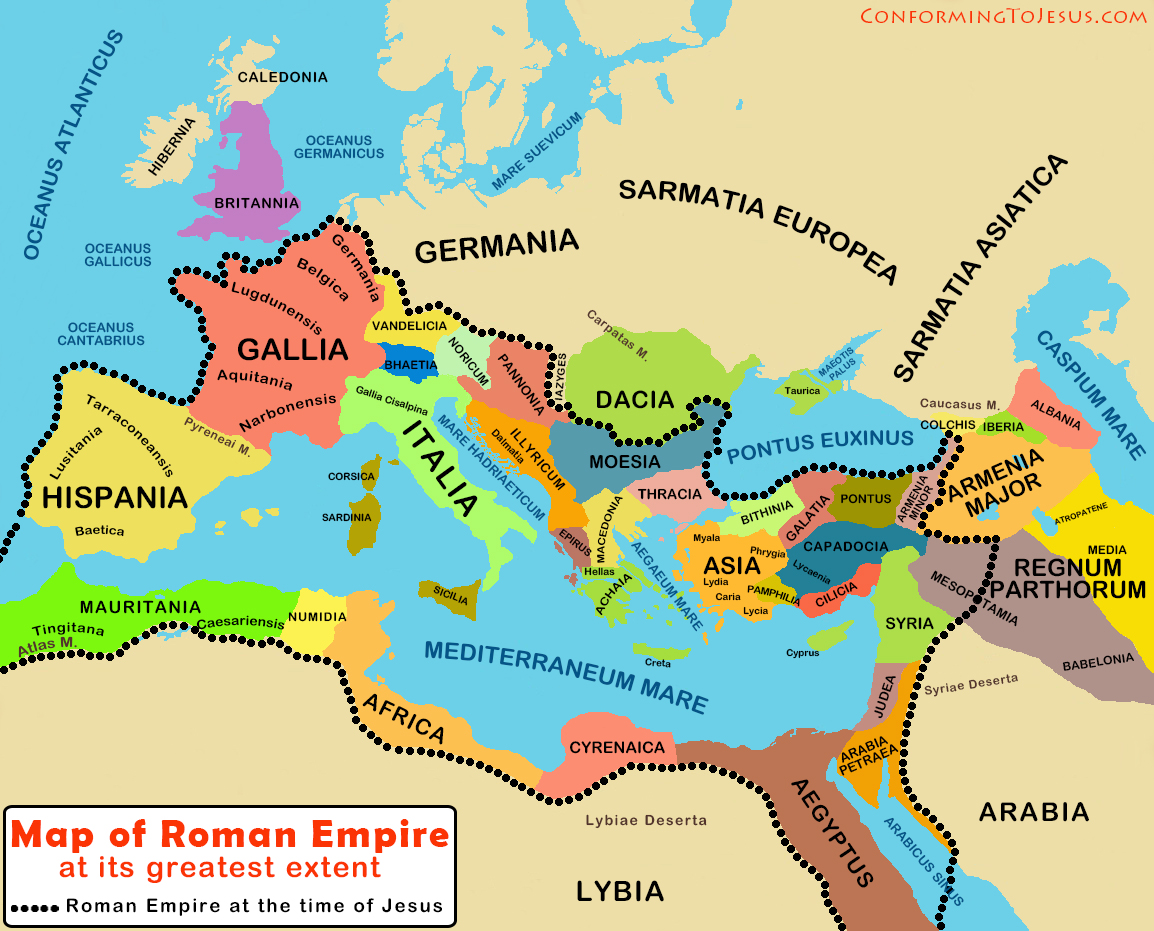
Here is a map of Rome in the year 0 [0]

Here is a map of Europe today [1]

They are incredibly similar.

By pointing out 'that there are differences' doesn't deny that fact.

Again: "Yeah, no. The old Greece western borders stopped before that (linguistically at least), the northern border reached higher, as were the eastern borders."

That borders have shifted materially, doesn't change the underlying fact that 'Greece is strongly related to Greece'.

I think that's the clearest example of where your argument does not cross the threshold you think it does. You say 'the borders have changed' - fine - I say 'it's still pretty much Greece', which it is.

The Duchy of Savoy was mostly a political organization, not an ethnic one, and guess what? It doesn't exist.

The fragmented borders have mostly collapsed - along the lines of ethnicity, crudely. And of course, within those borders, it's fragments like a fractal (great analogy by the commenter above).

And finally, yes, 'natural borders' are obviously a framing reference, because they keep people apart, which allows groups to develop, we agree there.

[0] https://www.conformingtojesus.com/images/webpages/map_roman_...

[1] https://geology.com/world/europe-satellite-image.shtml

It's a bit precious to point to the Greek borders and say "look, there's Greece" when you're pointing to a territory in which a half million people were forcibly expelled based on ethnonationalist politics and ideology, only 100 years ago.

Likewise to "French ethnicity", a place where government policy is still actively engaged in destroying minority languages (and their cultures) and has been since Napoleon.

These "ethnic" borders you're pointing to are as much a product of political maneuverings using ethnicity as a platform, as they are any kind of "natural" product of ethnicity.

Again, dismissing my points. What about Britanny (breton and Gallo, see my previous post)? What about the Basque country? What about Alsace? What about Savoy then, if it was "mostly a political organization" (that created modern Italy by the way)? What about Occitanie? and Catalonia (Roussillon mostly)? Aquitaine? Do we talk about northern France then, since we saw pretty much All the south is NOT French? Is Normandy French? Culturally? When the original normand had so many word from the danes, and even the name tell us where they come from (NOR-mand)? Picardia (from Baie de Somme to liege basically), do you consider it French? Because i'm pretty sure, it use to be way closer to the lowlands than France, culturally (when the Duchy of Artois existed, at least).

I only know one contry well, mine, and a bit of northern Italy (i'm a 1750-1911 history nerd).

So now i'm gonna dissect northern Italy: you can count Liguria (closer to Occitan than Rome), as well as Piedmont ethnicity (but since the Duchy of Savoy is mostly political, i guess it doesn't exist... Ho, wait, did this duchy not inherit Sardinia from the pope and the Hasburg and form the kingdom of Sardinia-Piedmont? I guess it was based on ethnicity then.) Do you think Venitians where closer to Roman (or i guess Piedmont) than they were to Dalmatians before the 18th century? I am sure it wasn't the case.

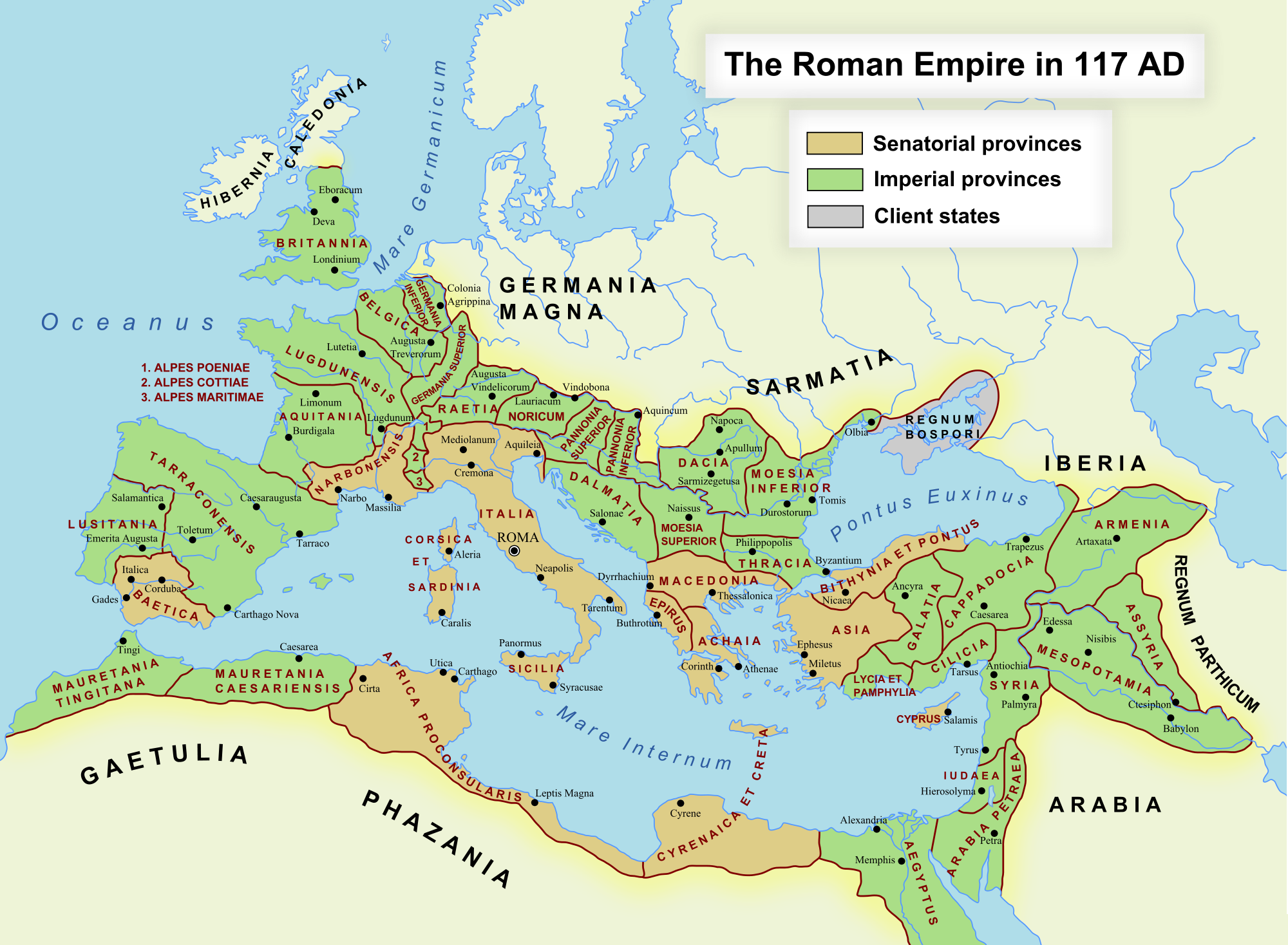
You map of Rome is funny. Here is what i found [0]. This is obviously not following ethnic divisions. Unless the basques moved during the time period, but i'm certain they did not.

[0]https://www.worldhistory.org/uploads/images/266.png?v=162592...

I'm not dismissing your points - I accept there's a lot of ambiguity.

Given the level of fragmentation you want to get into by highlighting tiny, short-lived political entities that had small populations and exited only for a blip in history ... well, you'll find many of them.

But you're missing the forest through the trees: the borders are unambiguously ethnic, to the point where it's not really even an argument.

'So What about Basque Country'?

Yes - thanks proving my point!

The 'Basque' fit so poorly within the constraints of Spanish borders that there is literally 'terrorism' and a systematic malaise: separatists groups and violence!

It might very well bode better if there was a separate nation state, or some degree of sovereignty there. I don't know, that's besides the point.

And what about Occitane, Catalonia, Alscace? They are, for the most part, ethnic subdivisions that fit more or less within the bigger systems they are in. Some better than others, but almost all of them to some reasonable degree.

But you're arguing against reality to insist that the line between Poland and Germany isn't relatively clear at some point, even if it's not perfect. It fuzzes over a few leagues, but by the time you hit Warsaw or Berlin it's clearly 'a different culture'. Again that there are strong subdivisions in Germany doesn't change the fact because the subdivisions are 'mostly' Germanic.

The Swedes and Finns have very distinct ethnostates, even if they have pockets of Swedes (historically, not just expats) in Finland, and even with distinct 'aboriginal' groups within both.

Again, in the big picture - hard ethnic delineation.

The map of the Roman Empire you provided only reinfornces my case: many of regions form the basis for many nation states today.

The more developed the system, the more likely it would be to have continued existence.

The demarcation point between the old Roman Empire and the Germanic states today is stark - written in politics, language, culture.

Europe didn't end up with a bunch of Switzerland - it ended up mostly with a bunch of Germanys, i.e. the sub-fragmentation is mostly related in some way and the external boundaries forming a kind of ethnic delineation.

There is 'malaise' in Basque country because of the ethno-nationalist/ethnostate nature of France and Spain, not because of some nonsense essentialism that a country with ethnicities in its boundaries naturally tends towards chaos and malaise. The lack of actual multiculturalism in both those states is what gives Euskadi (and Catalonian) nationalism its grounding.

Same in my country, Canada. Quebecois nationalism exist/existed in large part due to the experience of British colonialism and the awful way that the Quebecois and their language were treated and the dumbass way many English Canadians still talk about them.

You're reversing the causes and effect here. The basque did not have any issue being divided between 3 kingdoms for a thousand years. Breton did not mind being ruled by Gallo for at least as much time. Somehow, they started revolting when the state, the nation rather, started imposing their own languages and forbidding them to keep their cultural identity. Everybody talk about the Armenian genocide, but this is only the last of a long history, the 19th century is riddled by ethnic displacement to make the nice looking european border match the ethnicity. Italy did exactly the same, Austro-Hungary too. The Balkan crisis is caused by an ethnonationalism the did not exist before.

You know that have multiple culture in your kingdom was a sign of strength until the end of the 18th century, right? Despite the Villers-Coteret directive, nothing could please a King of France more than listening the his multilingual, multicultural country. It is really obvious than the cultural area we have no were forced. I know there is a lot of fear behind the sinicization, but France did the same in less than 50 years, although at a smaller scale, with a modicum of violence and some small concessions.

Aragon was probably one of the most multicultural, multilingual kingdom of old, but since the concept of nation did not exist, and that ethnicity was just another word for language 95% of the time, it did not cause any issue, and certainly not ethnic tensions.