The be honest, American companies never had a monopoly in any of the parts needed to build a commercially viable phone. Unlike say in the PC world, where the dominant OS/Software stack has an almost impenetrable reliance on x86, phones were mostly ARM based (in an attempt to prevent Intel's chokehold). And communication standards require FRAND patent grants allowing anyone to build for the spec.
That said, even as recently as a decade back, China was routinely written off as a cheap imitation of US/Japan/Korea in the electronics industry, Huawei & friends have proven otherwise. Their flagships are on par with the Apples and Samsungs, and even lead them on velocity of feature releases, especially hardware
> Unlike say in the PC world, where the dominant OS/Software stack has an almost impenetrable reliance on x86
Huawei also makes its own x86 chips, GPUs, and even FPGAs (e.g. TPU-like systems), and while Huawei Cloud still runs other vendors hardware, it's becoming more and more "Huawei-hardware only" each quarter.
I think the US has not realized yet how good it had it, and how much it has screwed things up. The EU, Russia, India, Japan, and China are all super-dependent on Intel, AMD, and NVIDIA's products, and therefore, the US, on many critical sectors. By showing China/Huawei [0] how much this dependence can hurt, the US has forced China to become technologically independent, and if China succeeds, then all other super powers will have a real and viable alternative to US products.
Right now, e.g., the EU is on the "let's ban all Huawei products, China spies on us!" boat, but the wind can change very quickly to "let's ball all US products, the NSA spies on us!" any time - it doesn't matter that the actual truth is that, no matter who you buy from, they are going to spy on you.
I personally think that it's good for another global player to enter the sector. I don't think it will disrupt it in any major way, but it is already affecting prices, e.g., in the cloud sector, where we are finding out how much are customers willing to pay to "avoid" a Chinese cloud, and it isn't that much.
> 'Right now, e.g., the EU is on the "let's ban all Huawei products, China spies on us!" boat'
Really? Citation please.
Mike Pompeo's been going around Europe threatening dire consequences for any country which uses Huawei tech ("We won't work with allies that use Huawei equipment in their 5G networks", etc.), but I haven't heard of any calls for a ban at EU level...
Can you show me some proof that the EU wants to ban Huawei products?
and many more. This is enough to nudge public opinion in one particular direction (Huawei == evil), and politicians sometimes do what voters want over here.
This is obviously a quite brittle status quo, and one or two impactful articles here and there about how the US / NSA "collect data" on EU citizens might be enough to turn the wind the other way.
The real news behind all of these articles is that China is now perfectly able to compete with the US technology companies at this particular level. That's interesting because for many countries, depending on the US for most of their electronics is a big risk worth minimizing, so I expect a shift from a US dominated industry to a balance between US and Chinese technologies being integrated in these countries. Nobody wants to exclusively depend on China either.
Exactly. There is no EU call to ban Huawei infrastructure, so I'm mystified as to why you claimed 'the EU is on the "let's ban all Huawei products, China spies on us!" boat'.
The links you posted show that government departments in a couple of EU countries refuse to use Huawei, nothing more...
I'm not sure I follow you. My claim means that there is the opinion in the EU that Huawei should be banned. For some reason you understand that as "The EU banned Huawei". That's not what I claimed, and I have no idea how you get from one to the other.
Do you think China wasn't aware of how well the US had it? They had no intention of letting it stay that way. The US did not force them into it, they wanted to do this all along. Recent political action may have sped things up, but this has all been in the works for a long time.
I fully agree, but I don't think that getting Huawei "banned" (IP use rights blocked, etc.) was some sort of chess master grand move by the Chinese government. The US literally served them the excuse to accelerate this dramatically in a silver platter.
The US had its reasons, but other countries have been able to handle Huawei much better. E.g. the UK allegedly [0] found "backdoors" in Huawei hardware for the government, they let Huawei know, Huawei said "sorry about that", and they fixed it.
[0]: Huawei argued that the "backdoor" was actually debugging software, and the software was verified to only use Telnet..
This development is a boon for users worldwide. At the beginning they might just influence pricing, but I bet after a decade or two they will start competing on features.
Google and Apple are just milking it. Smart phones were introduced a decade ago. Flagship phones costed then around $500, now we got to the point that they costing $1,000+ like if mass producing wouldn't cut the cost down. On top of that making a battery be non removable and constantly over-volting the batteries to reduce their life. Ultimately phones become useless after 2 years, unless you replace batteries yourself or pay someone to do it for you.
A few years ago, I got annoyed with a Google phone (Nexus something I think) that broke, given how expensive it was, and replaced it with a Motorola Android phone that was well under $100. I didn't really sacrifice the basic necessities - sure, the screen was small and side by side with a high end phone obviously less bright and lower resolution, but providing you didn't care about processor intensive apps/games, it served the same purpose.
Edit:
Of course, I am assuming there wasn't a substantial subsidy from somewhere, but from my point of view, it didn't have a contract attached.
Another way of looking at things: Today’s phones are quite a bit more capable than the first generation of smartphones, and they only cost twice as much.
10x faster and more capable at what? The tech in phones might be progressing but the use cases aren't. What most people do on their phones now is the same as they did 10 years ago. Eventually people will realise they don't need more speed, and the focus will switch to things like power effeciency and weight. Just like laptops.
>Smart phones were introduced a decade ago. Flagship phones costed then around $500, now we got to the point that they costing $1,000+ like if mass producing wouldn't cut the cost down.
If making smartphones is really as easy as you make it out to be, and smartphone prices are rising, then why isn't that being captured in the global profit share? Considering that Androids are vastly more popular than iOS phones, there would be no reason why Apple's getting 62% of global profits.
Xiaomi is even more impressive. A friend of mine from China showed me a video (2017 or 2018) of a man who ordered from a Xiaomi store. The video was of the man receiving the item he ordered 5 minutes after he ordered it! It was around midnight not sure of the day but 5 minutes to his door step from ordering it!
I asked my friend how is that possible so he showed me an image of a map of Xiaomi warehouses. I can't recall if he said there were dozens or hundreds per city.
>The video was of the man receiving the item he ordered 5 minutes after he ordered it! It was around midnight not sure of the day but 5 minutes to his door step from ordering it!
Feels like a viral marketing stunt to me. There's zero reason why anyone would want a phone within 5 minutes (or even same day). In the off chance that they do, they could simply walk into a physical store and buy it there. There's no need to set up a real time delivery network for that one guy who needs a phone delivered the same day and can't walk into a store.
>I asked my friend how is that possible so he showed me an image of a map of Xiaomi warehouses. I can't recall if he said there were dozens or hundreds per city.
I have a feeling they're closer to "stores" than warehouses.
Their computers are also matched with Microsoft's for the tallest screen (3:2) you can get, while also being pretty high quality. If you don't want 16:9, the only other options I'm aware of are the newest Dell XPS convertible and Apple (both 16:10). I would get a Huawei Matebook except that it would really rock the boat at my work, and that's not something I want to do.
   I would get a Huawei Matebook except that it would
   really rock the boat at my work, and that's not
   something I want to do.
Is this really a thing in American (I'm assuming here) workplaces?
Are all Huawei products persona non grata or just some ? I thought it was just the P30 Pro phone and some enterprise stuff that were explicitly barred.
Could you elaborate on where things stand as of this writing, and if they are ever likely to improve, post-trade war?
IME, workplaces are all HP or Dell. Nobody in America uses Huawei anything - I was a little surprised when I went to Europe and saw signs for Huawei phone accessories.
Americans who have even a vague understanding of technology typically assume everything is backdoored by at least one government. So the Intel Management Engine is a fed backdoor, Yandex forwards all your mail to the KGB, Huawei spies on you for the Chicoms, and so on. And the Chinese have a reputation for industrial espionage, so nobody would use Huawei at work.
I have no idea, but everywhere I've been in the US, both public and private sector, seems to have Dell products, very occasionally HP. I'd expect them to be made in China too, I dunno.
I’ve no dog in this race but I feel the selective outrage to Huawei and other chines tech companies hypocritical while America consumes more and more goods produced in China without batting an eye.
US market has been open, so when a Chinese state-owned entity dumps products American consumers buy said products as they only see a product at a cheaper price. How is that hypocritical? The only thing that has been hypocritical was the Chinese blocking of market access via tariffs and nontraditional market barriers in order to favor local entities while demanding market access to others.
Could someone actually vote with their wallet here and buy an American made — not assembled — phone? (I'm under the impression that the best case is that the parts are fabricated in China and assembled in the US, e.g., Apple phones.)
You have it backward, the parts themselves are usually created in Fab's outside of China while they are assembled (most labor-intensive process) in China. The whole article is about how Huawei is extremely dependent on components outside of China but has shifted from mostly US chips to EU, Taiwanese, Japanese, and South Korean Chips.
The problem also, is that tech companies in Russia and in China have no choice but to cooperate with the state and be part of espionage. This is not just about open and fair markets, yada yada. This is only "clean" in theory.
Huawei is special in that beyond even requiring to cooperate with the state, it has a corporate structure that is seen in State-Owned Entities and could be thought of as a CCP entity.
I know a few Natives on Twitter who say similar things about the US -- only talking about real property, not intellectual property -- and who would like their land back.
People are free to say stupid things. Native Americans aren't a monolith -it was never 'their' land - there were hundreds of native nations who were variously at peace or at war with each other over the years.
I wonder how those Natives you know on twitter would carve up the land once they got it back - do Apaches need to go back to Canada, since they invaded the southwest only in the ~16th century and pushed out the Pueblo people?
They're saying that your comment is irrelevant because you're comparing current issues between the USA and China with issues between the USA and Native Americans in a completely different time period. Today's morals aren't the same as they were hundreds of years ago, so it doesn't make sense to excuse current IP theft in China by pointing out historical theft of land by the USA.
I fail to see how this anecdote about a Twitter comment is relevant to a comment about IP theft.
GP is correct - any older Cisco employee can count off a laundry list of things Huawei directly stole from them, and the Chinese state absolutely subsidizes them. GP is making the point that it isn't fair to compare Huawei prices to Apple prices given the amount of engineering Huawei stole from other companies and their government subsidies.
It's not an anecdote about a Twitter comment. It's a nutshell version of American history.
China also has lower labor costs generally. Lots of things cost less in other countries for the same reason.
It's rare for anyone to come up with something genuinely original. We depend on education and culture and many things to develop anything. Then we argue about things like intellectual property rights because such conventions are an attempt to sort out how to make society work given that ideas are easily "stolen" and if we don't allow for some means for originators of new things to profit, we actively discourage our best and brightest from contributing to forward progress.
But this forum skews American. Most people will argue "for" the American side and "against" the Chinese for that reason alone.
I'm only pointing out the hypocrisy and silliness of arguing this as if America has some absolute moral high ground.
I follow Natives on Twitter because, according to oral family tradition, I'm a small part Cherokee. I'm pretty sure most full-blooded Natives would happily ship me back to Europe along with the rest of the whites.
I don't know the right answer going forward. I just believe that you need actual facts to find it.
The implicit assumption that China is The Bad Guy and America is The Good Guy is unlikely to yield a real solution when there is so much low hanging fruit for saying "The two nations aren't all that different."
But it seems my thoughts are likely wholly unwelcome here, as is so often the case.
> I checked out a Huawei store - they're the same asthetic as an apple store with a ton more useful tech then an ipod, macbook and imac.
If you cannot tell the difference between the design aesthetic of an Apple store and a Huawei one I will heavily discount your taste as a guide to my I own. I’ve only been to Huawei stores in China, perhaps it’s different elsewhere. The tables are plastic fake wood. The stores smell bad when new, like cheap plastic or putting your nose right next to the benches in a just opened McDonald’s. I assume the same kind of care for aesthetics and design goes into their products so if you want a bad cheap copy of the surface level of good design go with Huawei.
> I assume the same kind of care for aesthetics and design goes into their products so if you want a bad cheap copy of the surface level of good design go with Huawei.
If you've been to Huawei stores then you should be familiar with the build quality of Huawei products, otherwise your opinion is incredibly hard to square. And the insinuation that current crop of Huawei devices are copy cat designs is out of touch. The exception being the MateBook line, which if anything, has superior derivative design given Apples poor track record in notebooks these last few years.
If the floors are tile rather than vinyl and all the furniture is solid wood rather than veneered chipboard they almost the only outgasing will be from the products sold in store. Even in a new Apple store outgasing should generally be minimal. If you’ve been in a new store that stinks of formaldehyde I bow to your experience.
This is really impressive for Huawei. I do not mean to say that the trade war between China and the US is the same as the Cold War from before, but I have a fun tidbit to share.
One of the more interesting theories I heard for why the US won the Cold War is because Russia struggled to develop IC technology. The Russians were masters of espionage, and I would even give them the edge in mechanical engineering, but the United States' ability to master electrical engineering proved more important. They just couldn't build computers like the US, and computers proved to be wildly important for technological breakthroughs.
Now that Huawei has figured out how to do it without us, it's really become autonomous. This is great news for China, and will help them enormously in the ongoing trade war. And obviously it's not so great for the US.
There's a lot of confusion, I think, about how you "win" a trade war; as far as I can tell, autarchy is pretty bad for all involved; trade wars seem like a thing where everyone loses and the 'win' comes from winding down the trade war and trading again.
You mean autarky, full economic self-sufficiency.
China is certainly big enough to operate as an autarky. The US used to, up to about 1980 or so.
This is a current goal of the government of China. It's called "Made in China 2025", and was announced in 2015.. "The goals of Made in China 2025 include increasing the Chinese-domestic content of core materials to 40 percent by 2020 and 70 percent by 2025.[5] The plan focuses on high-tech fields including the pharmaceutical industry, automotive industry, aerospace industry, semiconductors, IT and robotics etc, which are presently the purview of foreign companies." There's been some backing off on this from the government of China for PR purposes, but the big goals seem to be on track. Key items include a leading position in semiconductors and in aircraft. Semiconductors seem to be coming along well. In aircraft, the COMAC 929 is a medium-sized airliner with five prototypes flying. The engine is still imported, but an engine to replace it has been developed to the prototype level.
China already has the world's largest auto industry, so that's covered. Also the largest robot industry. Don't know about pharma.
>You mean autarky, full economic self-sufficiency. China is certainly big enough to operate as an autarky. The US used to, up to about 1980 or so.
You think the US is less industrially capable than in 1980? that... seems unlikely. Sure, we import and export a lot more of our stuff now than we did then, but that's because we live a lot better when we trade (and because the technology of trade has improved vastly.)
I mean, certainly, both the US and China could survive without trade. hell, there are a bunch of people who could pull it off just by themselves. But... in all cases, all involved would be a lot poorer; they'd work a lot harder for a lot less.
You think the US is less industrially capable than in 1980? that... seems unlikely. Sure, we import and export a lot more of our stuff now than we did then, but that's because we live a lot better when we trade (and because the technology of trade has improved vastly.)
Once you lose a capability it’s gone forever. That is why countries cling desperately to domestic steel, shipbuilding, arms and other industries. Once the institutional knowledge is gone and the infrastructure is gone it’s never coming back. And other countries whose interests may not align with your own have you over a barrel.
This is... not my impression, from working around Engineers all my life. My impression is that cutting edge manufacturing techniques from the '80s are now available, cheaply, to hobbyists. Stuff these guys put in the basement and work on then they are sick of javascript. (FDM aside, I could walk to several CnC lathes and... three large laser cutters from where I am right now, all dedicated to hobby usage, all of which see pretty regular use)
My impression is that if you paid your professional engineers as much to design automated widget factories as you pay them to design advertising systems, they'd make something serviceable. And sure, rev 1 isn't going to be as good as rev 2, it never is, The institutional knowledge effect is big... I'm just saying it's not insurmountable, and the US is a rich country. If we cared, we'd spend money and solve the problem.
I personally think the big capability we are putting in danger right now is the capability the US has always had to hoover the best minds from all over the world, to persuade them to come and set down roots and work in the US. That's the long term problem I see with the way we're going.
I think the second big capability we are putting in danger is that culturally, my impression is that the US is valuing education less than it used to. As a side effect, we're not paying to educate our people (and, I would argue, my compatriots are becoming harder to educate as a result.)
The long term advantage China has over the US is not really institutional knowledge; the long term advantage is that they are putting a lot more effort into education than we are, (and we are not scooping up those educated minds the way we used to.)
Re-training an Engineer from one field to another is a lot easier than bringing someone up to speed who isn't educated; I've watched both happen, and... one is definitely less effort than the other.
> Once you lose a capability it’s gone forever. That is why countries cling desperately to domestic steel, shipbuilding, arms and other industries. Once the institutional knowledge is gone and the infrastructure is gone it’s never coming back. And other countries whose interests may not align with your own have you over a barrel.
Not exactly: that's only true if you let neoliberal economists set your economic policy.
Countries like China recently gained those industrial capabilities, and the reason for that is not just because they have access to cheaper labor. More importantly, they have industrial policy that prioritizes the development of domestic industry.
Nothing fundamental prevents Western democracies (perhaps collectively) from implementing industrial policies that prioritize industrial development rather than stuff like finance in its ever more byzantine forms [1].
[1] I read somewhere that financial development is only really beneficial up to a point. Past that point, it actually does more harm than good.
Well, you can bring it back with a major expenses. The problem is competition against vertical semi-integration which is present in China. (Multiple companies but same place - cheap transport and high availability plus widespread knowledge.)
The remaining industries are also integrated or partially integrated.
There was a trade war between US and Japan. What happened to Japan? The same will happen to China but it will take longer because China is more powerful than Japan at the time. All the hatred on China is similar (but stronger) to the one we had on Japan.
One of my goto's when economists/commentators love to harp on about Japan and it's lost decades. For all this horrible economic data they still years later have the longest lifespans, the top standings in innovation (many paradigms of which have been now copied worldwide) and on the whole a far safer society than virtually every other Western country.
Perhaps the widespread belief that economic growth equals wellbeing is the real problem here.
Plenty of places on Earth with 7% gdp growth that you need to pay me to live in.
There's a lot of great things about Japan, but I think most people on Hacker News would not envy Japanese work culture. It's common for men to work 100+ hour weeks with 20+ hours of commuting (much more common than in the US). Working women have it even worse, because it's customary for them to do all of the house work as well (even moreso than in the US).
Combine that with the fact that after working all those hours, senior poverty rates are also much higher than in the US, and it doesn't exactly seem like a laborer's paradise.
Health and safety are great, but like GDP and money, they're not the only things that matter.
The trade war with Japan started in the mid 80ies and finished by the mid 90ies. The quality of life in Japan (as well as their GDP per capita) didn't improve since then. However, the quality of life in Japan was pretty good even before the 80ies.
Well, according to (1) life expectancy is up ~6 years, (2) infant mortality rate is down by ~2.5x, (3) homicides are down and (4) unemployment is down; all in the period of time that you mention.
It was heavily weighted in favor of the US which is why the US became the richest country in the world and benefited the most from international trade.
Classic example are the complaints about Apple products being manufactured in China. However, as study after study has shown, a $600 iphone probably leads to economic activity of about $40-$50 in China at most, with a further $50 or so in the rest of the world, and the remaining $500 being generated in the US.
The US had a massive problem which is that this tremendous wealth that was generated was thanks to a variety of reasons concentrated amongst a few people right at the top, and unlike in decades in the past the benefits stopped trickling down to the rest of the country. But the real problem was an internal distribution one, which the current administration only served to exacerbate.
>It's seems uncommon for people to consider if our trade with China before this "war" was fair.
So, I'm not an expert, but... my understanding is that China is accused of subsidizing domestic manufacturing. Analogous to the sort of dumping that uber and lyft do, really; Much like how Softbank subsidizes my ride to work in the hope that they can jack up prices once I get really used to it, the Chinese government is subsidizing my consumer goods purchases, with the hope that manufacturing will decline elsewhere to the point where they can some day jack up prices to market-clearing levels.
I mean, is that fair? no. Is this something the market does on the regular, even without government having a hand in it? yes. Is this bad for the USA? If we lose manufacturing ability, probably... but this has been going on for a generation now. How long would it take us to re-gain or move the manufacturing of our consumer goods? (we already keep manufacturing of defense goods in the USA, for exactly this reason. My own guess is that if there was economic reason to move more high-touch human labor intensive manufacturing in-house, we'd make like BMW and build plants in South Carolina and similar places with fewer unions, and we already do a bunch of automated manufacturing here.) - the implication here is that just like Uber and softbank, I am not sure this is a long-term profitable thing for China to do, and I have the (controversial) opinion that the market in the USA is healthy enough that if we needed to build more manufacturing here, we could do it pretty quickly)
(I mean, the other side of this, the complex part that I personally don't entirely understand is that the USA subsidizes a lot of domestic industry, too... most famously the agriculture sector. As a us citizen, I totally support my tax dollars being used to make sure that we overproduce food. That seems like an extremely reasonable thing to do. (it does get more complex when that food is sold elsewhere, but I am not an expert) - My understanding is that the US also subsidizes a lot of US manufacturing... I mean, my feelings on that are more mixed... but I personally don't see subsidies as inherently evil or incompatible with doing lots of trade with another country.)
>It seems like most people just parrot: "War. Bad."
We're talking about a trade war here, which is a different sort of animal.
Please understand that I'm saying "Trade: good" - a subtle difference. And I do think that trade is usually good, even trade with someone who is subsidizing their goods.
(I have... very different feelings about trade sanctions, about restrictions on trade as a way to get a country, say, to respect human rights. But I don't think that's what the trade war with China is about; the trade war with China, as I understand it, is about tariffs and subsidies)
I would say that the "winner" is the one who got hurt less and can recover faster/better but it is all relative. While 2 sides are busy killing each other the third one might get the benefits
I'm just saying, from where I stand (and I'm first to recognize I'm not an expert here) it sure looks like my country is trying to make things harder for China, and is paying the price of making things harder for workers in my own country. Even if the Chinese worker is hurt more than the American worker, the American worker is still being hurt, and as far as I can tell, all involved would be better off if we traded in a more free way.
>> it sure looks like my country is trying to make things harder for China, and is paying the price of making things harder for workers in my own country.
Not sure if you've noticed, but manufacturing is starting to come back in the US. Industrial automation and skilled trades jobs are starting to be a thing again. These are solid middle class jobs that often dont require a degree. Its coming at the expense of some pain in other areas, but it might be an overall positive.
The path we were on was not sustainable. The US lost a LOT of capability over the last 20 years. Getting that back is critical and will not be painless.
>Not sure if you've noticed, but manufacturing is starting to come back in the US. Industrial automation and skilled trades jobs are starting to be a thing again. These are solid middle class jobs that often dont require a degree. Its coming at the expense of some pain in other areas, but it might be an overall positive.
My understanding is that most of the really good paying manufacturing jobs aren't coming back; the manufacturing that is coming back is non-union and pays worse than a union job (and much worse, say, than the better IT jobs that don't require a degree.)
I personally think it's super weird that people (especially in the USA) seem to think that manufacturing jobs are inherently better than other jobs, when my impression is that most of the pay advantages are simply that it is a class of jobs that unionized while it was in high demand, preserving some of the benefits of being a high demand job through a time when demand had fallen.
> The US lost a LOT of capability over the last 20 years.
but in return, the US gained a lot of cheap goods. Cheap goods which then increased profits for businesses.
Unfortunately, the lower working class is unable to reap this reward.
If manufacturing and industry returned, it may mean that cost of goods would become more expensive, and it can slow the economic expansion of the US. Whether you see this as a good outcome or not depends on your personal ideals however.
Is it really free when China had much greater tariffs on US goods than Chinese goods had come into the US? Is it really free when Chinese entities get to enjoy massive subsidies to dump products while foreign companies face nonmarket barriers?
Fundamentally it's time to wake to the fact that the CCP views the very existence of Liberal Democracies as a threat to itself [1]. It will work to undermind or extinguish then where ever it can. Facing the Soviet Union had a cost. Facing Nazi Germany had a cost. And facing the CCP will have a cost.
>Is it really free when China had much greater tariffs on US goods than Chinese goods had come into the US? Is it really free when Chinese entities get to enjoy massive subsidies to dump products while foreign companies face nonmarket barriers?
so you are saying that a trade war is successful if there are fewer barriers at the end than at the beginning? That's a reasonable definition, but that would benefit both parties, so it still doesn't really show a "winner"
> And facing the CCP will have a cost.
But if you define a successful trade war as one where there are fewer barriers to trade at the end than at the beginning, that will benefit both parties.
I mean, one could argue that free trade (well, more trade) is going to make your society more free in general, is going to introduce more ideas and things like that, I suppose, and you could also argue that trading more with a country makes it less likely you will go to war with them, but these things aren't really about crushing your competitor.
Document 9 is for domestic policy, CPC recognizing Western Liberal values is a threat to Chinese system does not mean CPC is attempting to undermine those values elsewhere. Unlike USSR, CPC hasn't been exporting or competing on ideology.
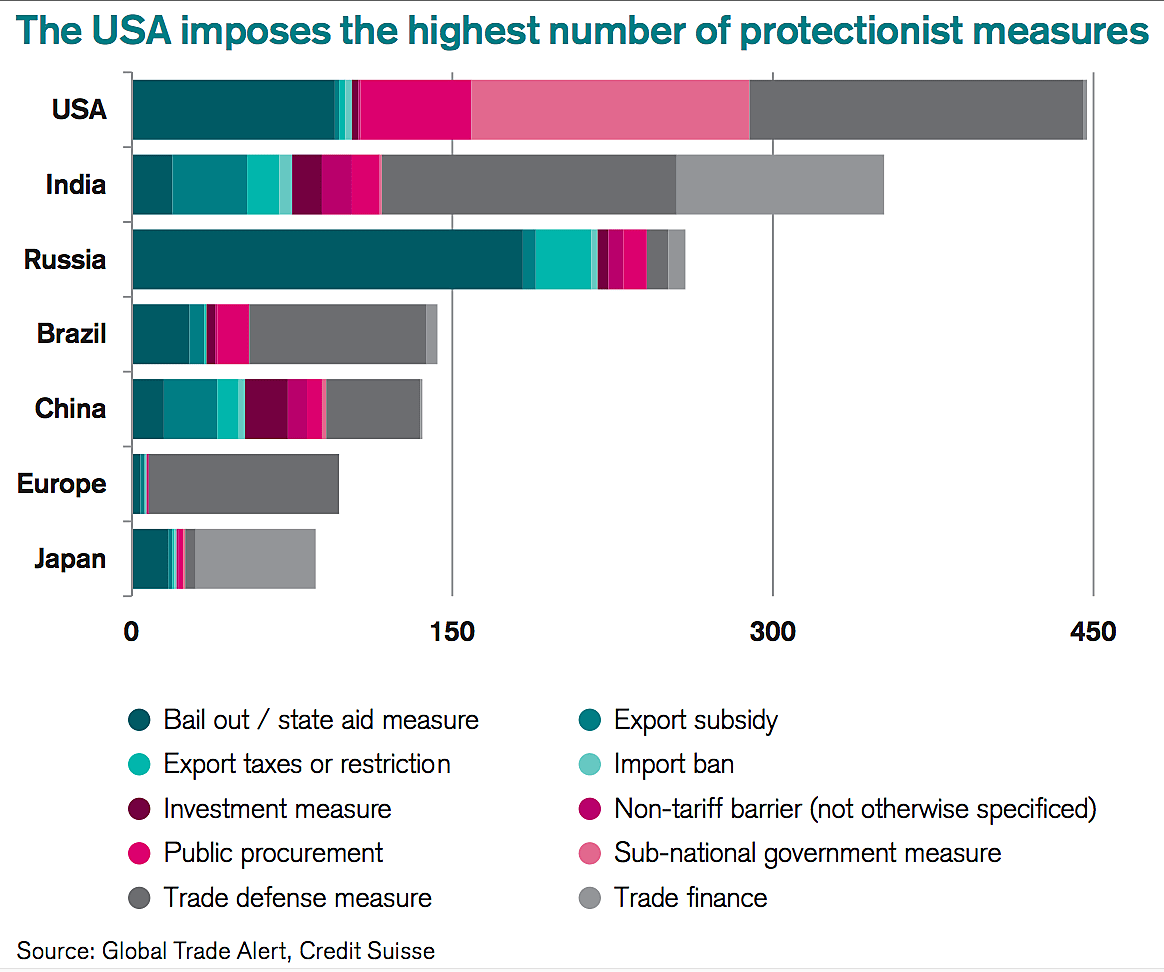
As for the free trade question, China has a higher mean tariff rate ~2% more, which is comparable to other developing countries. But viewing "free trade" in tariff lens doesn't present the whole picture. In terms of trade barriers US has more protectionist measures than China [1]. Go look up a list of WTO complaints to see who the largest free trade abuser is, a good visualizer [2]:
>China was involved in 63 disputes with 9 Economies from the time it acceded to the WTO in 2001 through 2018. China has been the complainant 20 times and the respondent 43 times.
VS
>United States was involved in 275 disputes with 42 Economies from the time it acceded to the WTO in 1995 through 2018. The United States has been the complainant 123 times and the respondent 152 times.
Or look up some US Chamber of Commerce surveys, Latest U.S. China Business Council's (USCBC) survey tldr was basically US companies overwhelmingly convinced Chinese companies receive (alleged) unfair state subsidies but they don't care because even with the tradewar, 97% of respondents said their China operations were profitable which is UP from 85% in 2015. Overall, business in China is good, select industries face more barriers than others (some technology, many financial services), industries with the loudest lobbying groups that skew the narrative.
I think OP refers to "winning" in an economic sense, trade war or no trade war. The key goal is "my country will have more global influence than yours in 100 years".
Taxes, tariffs, import/export bans of goods or technology, etc. are all just tools in the arsenal of both sides they will use when it seems to give them an edge over the competition.
The winner is decided in the details. It’s not obvious at 30,000 feet, but changing tariffs before and after a war can make a clear winner in these situations. At the extreme end involving actual fighting, the opium wars where actually about trade with China.
This seems more like an issue with people being out of touch with the theoretical side of war. War, as a concept, has been treated as simply being another means of compelling cooperation since as far back as Sun Tzu. Although western war philosophy has been equally influenced by more recent figures like Carl Von Clausewitz. The US military even acknowledges similar thinking through modern concepts like the DIME model that are oriented towards forming a theory of war that acknowledges itself as part of a larger political environment. From this perspective, where war is just a tool for compelling cooperation, a trade war is simply a trade and economy based conflict which seeks to compel cooperation towards some particular goal like not putting people in concentration camps or buying more USA made rice.
I... think that in the modern era, "real war" is a different sort of thing from "trade war" - a difference in kind, not degree, in a way that just wasn't so when Tzu wrote.
The fact of the matter is that both the US and China could survive (albeit with a lower standard of living) without external trade entirely. I don't think the same could be said for an all-out war.
An all-out war between the two countries would likely kill most of us and put the standard of living of the few survivors below what you and I would call 'civilization' - one side might lose harder than the other, sure, but the consequences would be essentially unthinkable for both.
We should not limit our analysis to nations anymore. There are transnational forces that are becoming historical agents. The Cold War might have ended in terms of nations with the collapse of the USSR but it didn't in terms of political struggle of the movements that gave birth to states like USSR or current China.
I think that electronics/computers by itself do not have much to do with with the fall of soviet union. USSR fell because:
1. its economic model was dysfunctional and a failure
2. Its moderate leaders (aka Gorbachev and his allies), decided to dismantle it, as they realized the model was a failure, and their only other option was to become extremely repressive, roll out tanks and kill people. (north korea is an example that given enough repression, even an extremely poor economy is not enough to dismantle a bad government.)
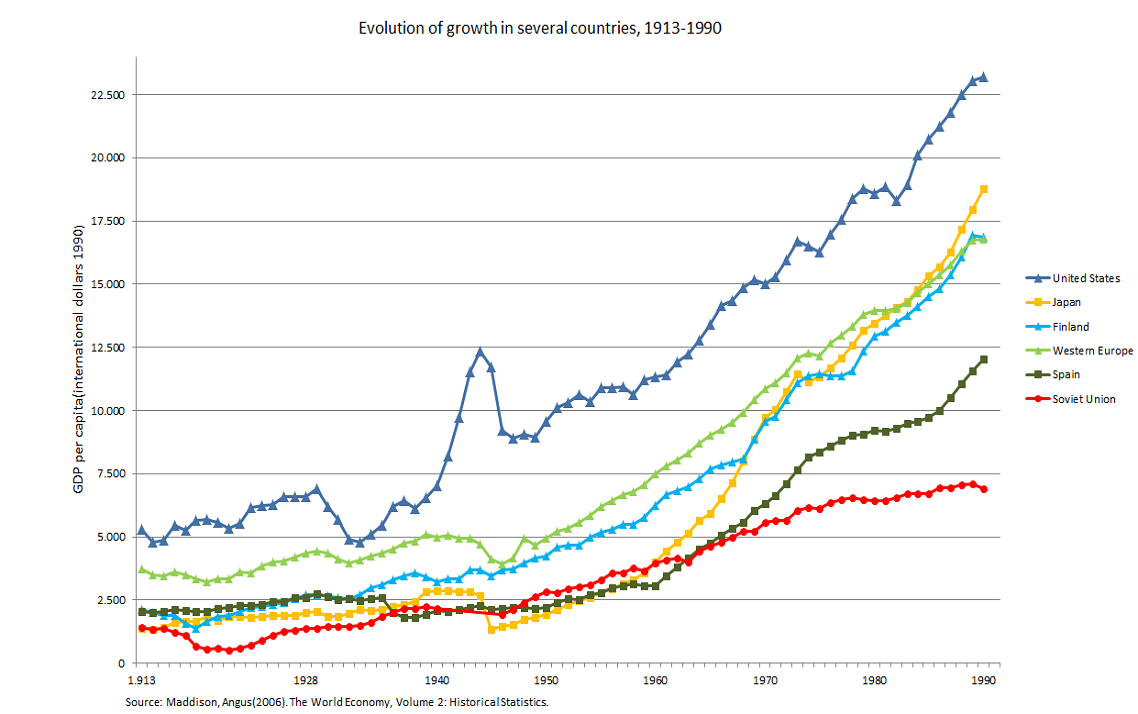
The soviet union was away behind the US (gdp per capita) in the 50s and early 60s, where computers were less developed and less important (to the general economy at least).
The soviet union failed, because centralized, collectivism, and having all the output owned by the state is a failure as a model.... as it goes against basic human nature.
Look at Spain's economy, how it is transformed after Franco died and the fascist regime is removed and the country opens up, gets less centralized.
Another analogy is Argentina. Where there was too much central planing, and state dictated economy. Compare it against Canada, (open and capitalistic), and you see that the system is the main culprit, and not necessary computers.
> Look at Spain's economy, how it is transformed after Franco died and the fascist regime is removed and the country opens up, gets less centralized.
The graph shoots up in 1960 and slows down in 1975. Franco died in 1975, so your assumption that fascism and central planning hurt the economy is contradicted by the data.
If Wikipedia is to be believed, the actual cause was that the old central planners were replaced by new ones who were actually competent and made policies to support industrialization: https://en.wikipedia.org/wiki/Spanish_miracle
It’s amazing to me, and deeply concerning, that you’re being downvoted for this. Those of us who work in tech are so firmly ensconced in that bubble that we actually think microchips defeated the USSR.
My point was that the microchip industry is a critical part for the developing economy. Today the Bay Area (not California) has 1/2 the GDP of all of Russia! I realize there are lots of industries in the Bay Area besides hardware and software engineering, but that's a pretty stark contrast.
Obviously there were lots of reasons the Soviet Union collapsed (Chernobyl, for instance). But ignoring the importance of the computer industry in the information era seems like a big oversight.
You never lived in a communist state, have you? Do you even realize that even basic things were fucked up beyond belief/comprehension to the average american. (perhaps not, to the average foreigner that have lived in failed states).
Again, I was comparing data from the 50s and early 60s, where computers were just not that wide use yet and the computer industry was not even a blip on the overall economy.
You also can claim: Today's US entertainment output, equals half of USSR's GDP. Then US won the cold war because it's move industry.
Than you can do the same comparison for medical, agriculture, etc... etc..
then you see the trend that due to its failed system, the USSR was behind the US in every field, and tech was just one of them.
> You never lived in a communist state, have you? Do you even realize that even basic things were fucked up beyond belief/comprehension to the average american. (perhaps not, to the average foreigner that have lived in failed states).
I haven't, but why does it matter? I'm not saying communism is better than democracy, nor did I imply it. Things have been way more fucked up in North Korea longer than the Soviet Union survived, so just being fucked up is not enough for a government to fail (not that I'm optimistic about North Korea's future).
> Again, I was comparing data from the 50s and early 60s, where computers were just not that wide use yet and the computer industry was not even a blip on the overall economy.
I think most people on HN are familiar with the story of how computers won WWII, where Von Neumann used them to decipher German and Japanese encrypted communications. Also the Apollo missions were all controlled by circuits. Computers have been massively important (and expensive - the modern equivalent of ~100 billion USD was spent putting a man on the moon, and some of that includes developing IC technology) for a while.
> You also can claim: Today's US entertainment output, equals half of USSR's GDP. Then US won the cold war because it's move industry. Than you can do the same comparison for medical, agriculture, etc... etc.. then you see the trend that due to its failed system, the USSR was behind the US in every field, and tech was just one of them.
Except the Soviets weren't trying to replicate the movie industry because it wasn't particularly useful for them. But they immediately understood the value of computers, and put significant efforts into developing their technologies.
And the Soviets weren't behind in everything. Contrary to popular belief, the Soviets were ahead in the Space Race until Korolev died. If you want an example of petty politics ruining a nation's future - Korolev's death is my all time favorite. That man made Von Braun look ordinary. It's weird to think how history might have turned out differently had the Soviet Union not sent one of the most brilliant men in history to the gulags.
Ironically the US did something similarly stupid by refusing to allow Qian Xuesen to stay in the United States, effectively creating the Chinese space program.
Agreed. While HN is a great forum for discussing tech, the technological obsession can really warp the world view of some when it comes to history. However, its the presence of level-headed folks (like you) who point out these things that somewhat makes up for it.
ICs and computers may have been a huge part of the downfall, especially if you consider how important they are in warfare.
"1. its economic model was dysfunctional and a failure"
The USSR had a good economy for some time. During Stalins brutal industrialization, growth rates may have even outclassed Chinas. E.g. 13% p.a. over 12 years, the numbers are controversial. I have a paper about it. Fact is, in WW1 and WW2 Germany faced a very different country.
The later decline may also correlate with declining oil production. The USSR sold a lot of Oil and Gas to the west.
"The soviet union failed, because centralized, collectivism, and having all the output owned by the state is a failure as a model...."
This is also true fro China and the last word, if the system is sustainable or not, is not spoken in this regards.
I tell you a secret: The western market oriented, capitalistic system is also bound to fail.
1. Due to the inherent feature to use debt to prefinance production, the economy has always to keep growing. It is not possible to use our current capitalistic system in a steady state economy.
2. Since wealth and economic growth are interlinked and energy is more or less limited, the system has to come to a stop sooner or later.
Central planned economy didn't work traditionally because it is so difficult to get all the information to make plans. It was too slow to adapt. I think with the age of AI and IoT, it may actually is the time for central planning to shine.
When there was a referendum asking the people in all reoublics whether to keep the Soviet Union or dismantle it, the overwhelming majority, 70+ percent, voted to keep it. The leadership dismantled it anyway. When asking why, it usually is useful to ask cui bono.
We're apparently just far enough away from the Berlin wall falling that now people want to re-litigate that the Soviet Union was bad and it was a good thing it collapsed.
I have seen people who dislike the democratic party in the US on both the left and the right adopt this stance in the context of the Trump-Russia question.
The argument goes that all the former Soviet, but current NATO/EU states (and states with factions who might want to join, like Ukraine) never wanted to leave Russian control.
I disagree with this, but I would note that it's too simple to say something is simply good/bad here. The Soviet Union despite its problems did have some notable accomplishments.
> The argument goes that all the former Soviet, but current NATO/EU states (and states with factions who might want to join, like Ukraine) never wanted to leave Russian control.
You mean "conspiracy theory".
I know you're pointing it out as a dubious argument, but stuff like this is what impressionable minds latch onto on the internet.
Those who were for keeping USSR - were they mostly from Russia or from Republics? Because it might look like metropoly citizens voting for keeping colonies.
Yeah thats all good and well until your realise they are a surveillance distopia, which the west dont care about, at least until they decide to start invading the world via military means rather than just lending countries into crippling debt.
The United States is still better at technology, and Russia is better at espionage. Never underestimate the underdog.
There was a massive article on the modern KGB under Putin in 2017(?), I think in the Atlantic. They basically managed to hack into some offline Pentagon systems by distributing infected USB drives around that location, through different outlets, in the hopes that an unsuspecting target will use a USB drive on a secure system, and then insert it on a wired machine. Boom. It worked.
I think you may be thinking of Stuxnet, which was created by the US and Israel and targeted Iranian nuclear reactors.
If you were trying to steal data this way, how would you get it back out of the infected machine? Stuxnet didn't have this problem, because its goal was purely to sabotage.
Is the article you are talking about "What Putin Really Wants" by Julia Ioffe[0]? It was published in January 2018. It doesn't have the USB key story you're talking about though.
Even if those chips are completely devoid of American-origin IP cores, they almost certainly were designed with American-origin EDA software.
I am not sure if such chips would be covered by existing export bans or if EDA software licensing agreements prohibit export of produced design files to countries subject to US export bans.
If neither is the case, I expect either or both to change soon.
I really doubt that the EDA software is really that much of an investment these days. It's the lithography tech that's the real crown jewel, and it is being protected.
> I really doubt that the EDA software is really that much of an investment these days
If EDA tools were so simple, why don't the big IC design companies -- e.g., Intel, Apple, Samsung -- just build their own in-house tools instead of paying millions in license fees?
> It's the lithography tech that's the real crown jewel, and it is being protected.
Sure, but lithography tech is useless unless you have access to solid tooling for design verification. In IC design, no one can afford to debug issues after the chip is fabricated. EDA toolchains include complex simulation software that, when combined with fab-provided models, allow you to simulate circuit behavior down to the lowest level.
Millions is not that much. TCO of six engineers for a year gets you into millions. If it's a solved problem, it's probably worth just buying off the street.
I hope someone can correct me in this thread, but I recall hearing that a single-seat license can cost ~$50k per year. I would imagine that any company with a large number of ASIC engineers would love to reduce that overhead.
Regardless, none of what you said disagrees with the point that EDA tools are complex and should therefore be protected from Chinese influence.
The two are quite linked. You can't make a good open EDA package without knowing current design rules and the like, and if you want design rules that aren't old enough to drink you'll be bound by NDAs, as fabs strive to 'protect' every bit of knowledge about their 'crown jewels'.
Sure, the implication though is that if you've got the fab design rules it's not that hard to make the EDA tools. It's not 1982 anymore where the DoD is spending obscene amounts of money to run this on a 10Mhz mainframe.
It's worth noting that Chinese smartphones without any US components have been available for a long time, based around SoCs from Mediatek and Spreadtrum/RDA.
I think we are in this awkward time where China is shifting from playing catch up to the US to taking more of a lead in some areas that are meaningful. This type of transition is awkward for all involved, but it was going to happen and these sanctions moved it forward a bit.
I am still surprised that the sanctions didn't have that much of a financial effect on China or at least us in the west didn't notice it very much.
That's a two way street, there are plenty of American companies switching to Philippine or Vietnamese manufacturers that won't ever go back to sourcing from China
Yup. So the US has created a new competitor and didn’t gain anything in the bargain other than paying for the transition.
It would be one thing if this was done after, say, the TPP that ensured that Phillipines and Vietnam created an IP a regime that protected US company interests before they started manufacturing there, but that’s not what happened.
Don't worry. Huawei barely gets to manage the fund itself from Chinese banks. And the moment that US DOJ launches secondary boycott on Huawei and its financial affiliates & financiers, believe me -- it won't last months.
The most important thing is the financial power. The current wrestle between China and the US (entailing Huawei and Chinese trade deals) is all about the US wanting to forcefully open up Chinese financial markets -- which China will never do.
It would be exciting to see how the new trade deals would unfold.
Yes? Surveillance is common worldwide and Huawei is a popular brand in the region.
I'm guessing you're curious if the Chinese government is using some hidden backdoor in Huawei products to spy on Hong Kong residents who would otherwise be acting privately.
Backdoors in the phones seems highly unlikely. Considering that the government can simply listen in at the cell towers and data centers there is no reason to risk the reputation and thus influence and reach of a Chinese company like that.
Huawei had to license synopsys/cadence/mentor to design their chip(which is using ARM core), if US really wants to play hardball Huawei's IC design can be killed nearly instantly once those CAD design software is forbidden. In the meantime I heard Huawei etc bought a few years' license right before the trade war, they're actually well prepared.
Another way is to restrict chip manufacturing, Taiwan pretty much owns the best technology for that(TSMC), Intel/Samsung has some, Huawei has none.
And you have Android to some degree, without Android there is no Smartphone dominance from China as of now. Open source in general helped China to catch up and overtake the west extremely efficiently, you don't need any business spies anymore, just download/modify/profit.
At the moment USA still has the possibility to contain IC ecosystem if it really wants to do that. In 10~20 years it will be a different story though, by then USA might not have much leverage if anything at all left.
I am not sure about large companies, essentially every small to mid-sized PCB design/manf company in China uses pirated EDA software, primarily Altium Designer, OrCAD and Mentor Graphics. In fact, piracy of sofware is encouraged by the CCP - I won't name the websites, but in order to get a download link you need a WeChat or Baidu account which is ultimately linked to Citizen ID or Passport through phone number (OTP). Yes, I setup a Windows VM to get access to these sites where you need to install a Baidu download manager in your operating system.
There is also specific Chinese forum lingo that is used to thank people who post pirated software ("1st floor", "2nd floor", etc.)
>At the moment USA still has the possibility to contain IC ecosystem if it really wants to do that
It's been doing that nonstop since before Trump, Trump is merely broadcasting the actions publicly. Apart from Fujian Jinhua last year, CFUIUS / DOD / USTrade has blocked many Chinese IC acquisition attempts (including EU owned), last month US pressured TMSC to stop dealing with Huawei, ASML held back EUV delivery shortly after. The way things are escalating, the hypothetical shooting war over Taiwan might be triggered by TSMC drama instead of independence.
I think the US is making a big mistake by falling back to isolationism and confrontation in a sort of last-ditch attempt to reign Chinese progress in.
The prevailing quite chauvinistic attitude among many people outside of Asia is that because of their lack of political liberalism China or other Asian countries will always be stuck with copying or being the manufacturing bench. I think this will turn out to be a grave miscalculation and that the trade wars will only accelerate the decoupling and strengthen the Chinese regime's narrative to develop at all costs.
I think many people in the West really are not aware how deeply the resentment goes in Chinese society to not be bullied around ever again, the mentality really is 'better-broken jade than intact tile', and it's hard to compete with that.
I agree, many have underestimated China resolve to be number one. Many also don't understand China's history because they've gone through much more suffering than a trade war in the last 50 years.
I have a Huawei P30 Lite which I use for work purposes. Build quality is better than Samsung. I prefer using it over my iPhone. It is nowhere near inferior. Did I mention that it is supposed to be a cheap phone but its performance is impressive?
Articles whose content contradict their headlines are rather quite frustrating. The title is "Huawei Manages to Make Smartphones Without American Chips"
But the article itself states: "While Huawei hasn’t stopped using American chips entirely, it has reduced its reliance on U.S. suppliers or eliminated U.S. chips in phones launched since May"
And it's graph shows significant usage of US chips.
I'm sure Huawei is trying it's best to reduce its dependence on US chips, and thanks to access to chips from the EU, Taiwan, JP, it likely will succeed. But I can't help but be annoyed at the thought that Taiwan and Japan are relying on the US to protect them from the same CCP they're short sightedly profiting from.
There is no contradiction. The title, "Huawei Manages to Make Smartphones Without American Chips", is confirmed by the content of the article, including a quote by an analyst: “When Huawei came out with this high-end phone—and this is its flagship—with no U.S. content, that made a pretty big statement.”
The title didn't claim that Huawei, for all of its phones, had not used any American chip. It claimed that some of its new phones don't use any.
Your claim that "it's (sic) graph shows significant usage of US chips" is wrong. The table shows that for every component that was built by an American firm, they have a non-American alternative. Sometimes American providers are still listed, but the table is not quantitative, so the American chips part still used may be lower than 5%, for all we know after reading this.
The headline doesn't say they've made every single one of their smartphones without US parts.
You are reading something into the headline that it doesn't claim.
It doesn't contradict that story.....
Headline:
Huawei Manages to Make Smartphones Without American Chips
The second sentence from the story:
Huawei’s latest phone, which it unveiled in September—the Mate 30 with a curved display and wide-angle cameras that competes with Apple Inc.’s iPhone 11—contained no U.S. parts, according to an analysis by UBS and Fomalhaut Techno Solutions, a Japanese technology lab that took the device apart to inspect its insides.
I think that if you frame it in the context of “class war”, it all makes sense. E.g. there is the Taiwan as corporate interests and Taiwan the people.
The corporate interests don’t give a rat’s ass about who has ultimate sovereignty, or democracy, or human rights. They can’t. It’s systematic and by-design. Corporations only care about profit. As long as there is profit to be made, they wouldn’t care if Taiwan gets annexed by Mainland China.
The people, however, may have different ideas.
So we’re not really talking about “short-sightedness” here. We’re talking about different entities of vastly different wealth and power, within the same country, having different perspectives on the same “problem”. The rich and powerful have liberty; they probably have wealth hidden away and companies set up in multiple countries. They can have plan Bs, lots of them. The rest of the population, however, is stuck.
That doesn't seem like a contradiction. The newer phones do not have American chips, which matches the headline that says they have managed to make phones without these chips.
The US basically started a slow-motion kidnapping of Meng Wanzhou in December 2018. The ban on US shipments to Huawei might have sped the process up, but I imagine they already saw this as personal.
How likely it is that Huawei got access to the technology behind Samsung's Exynos[1] to speed up the development of their own ARM chips? At least that's what happened with Samsung's foldable screen technology[2].
> CNEX, a microchip company backed by Microsoft and Dell, has filed new allegations in a Texas lawsuit accusing Chinese tech giant Huawei and one of its executives of stealing trade secrets.
> It's the latest filing in a suit set to go to trial June 3. CNEX claims that Huawei spent years trying to steal its data storage secrets.
And also[2]:
> "We expect other nations will want to become self-sufficient in critical technologies. That's what we'd expect of a responsible government," he said. "The issue isn't that China has set out to do that. It's that part of their industrial policy, part of the way they try to accomplish that, is state-sponsored theft or creating an environment that rewards or turns a blind eye to it."
> He pointed to evidence of such behavior allegedly linked to the "Made in China 2025" strategic plan. The Chinese government introduced the plan in 2015, designed to reduce dependence on imported technology in 10 priority industries including robotics, IT, aviation, railway transport and biopharma. "We've charged cases, I believe, in eight of those 10 sectors, IP theft cases," Hickey said.
That said, even as recently as a decade back, China was routinely written off as a cheap imitation of US/Japan/Korea in the electronics industry, Huawei & friends have proven otherwise. Their flagships are on par with the Apples and Samsungs, and even lead them on velocity of feature releases, especially hardware