Hacker News new | ask | show | jobs
by lsc 2397 days ago
>And obviously it's not so great for the US.

There's a lot of confusion, I think, about how you "win" a trade war; as far as I can tell, autarchy is pretty bad for all involved; trade wars seem like a thing where everyone loses and the 'win' comes from winding down the trade war and trading again.

7 comments

You mean autarky, full economic self-sufficiency. China is certainly big enough to operate as an autarky. The US used to, up to about 1980 or so.

This is a current goal of the government of China. It's called "Made in China 2025", and was announced in 2015.. "The goals of Made in China 2025 include increasing the Chinese-domestic content of core materials to 40 percent by 2020 and 70 percent by 2025.[5] The plan focuses on high-tech fields including the pharmaceutical industry, automotive industry, aerospace industry, semiconductors, IT and robotics etc, which are presently the purview of foreign companies." There's been some backing off on this from the government of China for PR purposes, but the big goals seem to be on track. Key items include a leading position in semiconductors and in aircraft. Semiconductors seem to be coming along well. In aircraft, the COMAC 929 is a medium-sized airliner with five prototypes flying. The engine is still imported, but an engine to replace it has been developed to the prototype level.

China already has the world's largest auto industry, so that's covered. Also the largest robot industry. Don't know about pharma.

>You mean autarky, full economic self-sufficiency. China is certainly big enough to operate as an autarky. The US used to, up to about 1980 or so.

You think the US is less industrially capable than in 1980? that... seems unlikely. Sure, we import and export a lot more of our stuff now than we did then, but that's because we live a lot better when we trade (and because the technology of trade has improved vastly.)

I mean, certainly, both the US and China could survive without trade. hell, there are a bunch of people who could pull it off just by themselves. But... in all cases, all involved would be a lot poorer; they'd work a lot harder for a lot less.

You think the US is less industrially capable than in 1980? that... seems unlikely. Sure, we import and export a lot more of our stuff now than we did then, but that's because we live a lot better when we trade (and because the technology of trade has improved vastly.)

Once you lose a capability it’s gone forever. That is why countries cling desperately to domestic steel, shipbuilding, arms and other industries. Once the institutional knowledge is gone and the infrastructure is gone it’s never coming back. And other countries whose interests may not align with your own have you over a barrel.

>Once you lose a capability it’s gone forever

This is... not my impression, from working around Engineers all my life. My impression is that cutting edge manufacturing techniques from the '80s are now available, cheaply, to hobbyists. Stuff these guys put in the basement and work on then they are sick of javascript. (FDM aside, I could walk to several CnC lathes and... three large laser cutters from where I am right now, all dedicated to hobby usage, all of which see pretty regular use)

My impression is that if you paid your professional engineers as much to design automated widget factories as you pay them to design advertising systems, they'd make something serviceable. And sure, rev 1 isn't going to be as good as rev 2, it never is, The institutional knowledge effect is big... I'm just saying it's not insurmountable, and the US is a rich country. If we cared, we'd spend money and solve the problem.

I personally think the big capability we are putting in danger right now is the capability the US has always had to hoover the best minds from all over the world, to persuade them to come and set down roots and work in the US. That's the long term problem I see with the way we're going.

I think the second big capability we are putting in danger is that culturally, my impression is that the US is valuing education less than it used to. As a side effect, we're not paying to educate our people (and, I would argue, my compatriots are becoming harder to educate as a result.)

The long term advantage China has over the US is not really institutional knowledge; the long term advantage is that they are putting a lot more effort into education than we are, (and we are not scooping up those educated minds the way we used to.)

Re-training an Engineer from one field to another is a lot easier than bringing someone up to speed who isn't educated; I've watched both happen, and... one is definitely less effort than the other.

> Once you lose a capability it’s gone forever. That is why countries cling desperately to domestic steel, shipbuilding, arms and other industries. Once the institutional knowledge is gone and the infrastructure is gone it’s never coming back. And other countries whose interests may not align with your own have you over a barrel.

Not exactly: that's only true if you let neoliberal economists set your economic policy.

Countries like China recently gained those industrial capabilities, and the reason for that is not just because they have access to cheaper labor. More importantly, they have industrial policy that prioritizes the development of domestic industry.

Nothing fundamental prevents Western democracies (perhaps collectively) from implementing industrial policies that prioritize industrial development rather than stuff like finance in its ever more byzantine forms [1].

[1] I read somewhere that financial development is only really beneficial up to a point. Past that point, it actually does more harm than good.

Countries like China recently gained those industrial capabilities, and the reason for that is not just because they have access to cheaper labor.

Don’t forget the psychological side. If an industry is booming then ambitious, motivated people flock to it, colleges teach courses in it, people look to build long-term careers in it. The West had that from the Industrial Revolution up until the 80s maybe. China has it now. There are still a few steelworkers and shipwrights and even miners in the UK but those industries are winding down. If we ever need a lot of warships in a hurry - which has happened not that long ago - we would struggle. The expertise is lost.

Well, you can bring it back with a major expenses. The problem is competition against vertical semi-integration which is present in China. (Multiple companies but same place - cheap transport and high availability plus widespread knowledge.)

The remaining industries are also integrated or partially integrated.

Say you have a century-old widget factory that closes (a common story here in Wales). The widget making machinery gets sold off, even if for scrap. The factory site gets demolished and redeveloped. The widget makers retire or retrain and they tell their kids “don’t go into the widget business, it’s a dead end”. All the colleges cancel their widget courses, no demand.

A decade or two passes and rebooting your widget industry will be an order of magnitude harder than it was to start in the first place.

>A decade or two passes and rebooting your widget industry will be an order of magnitude harder than it was to start in the first place.

Eh, you don't want any of the old equipment anyhow, you want new computer controlled stuff. I mean, sure, the people making that equipment need to have some experienced machinists, but... not so many of them; you mostly want Engineers for this job.

I think the problem America has is not with losing existing factories, but in how little value we place, culturally, on education.

Maybe not any more? You can hire internationally now, its never been easier to research widgets. New technologies and manufacturing techniques make it a whole different widget ballgame anyway - you probably wouldn't do it the same anyway.

In fact, many industries reinvent themselves periodically just to stay current. Restarting a factory can't be much different.

There was a trade war between US and Japan. What happened to Japan? The same will happen to China but it will take longer because China is more powerful than Japan at the time. All the hatred on China is similar (but stronger) to the one we had on Japan.
Are you saying China can look forward to one of the highest qualities of life?
One of my goto's when economists/commentators love to harp on about Japan and it's lost decades. For all this horrible economic data they still years later have the longest lifespans, the top standings in innovation (many paradigms of which have been now copied worldwide) and on the whole a far safer society than virtually every other Western country.

Perhaps the widespread belief that economic growth equals wellbeing is the real problem here. Plenty of places on Earth with 7% gdp growth that you need to pay me to live in.

There's a lot of great things about Japan, but I think most people on Hacker News would not envy Japanese work culture. It's common for men to work 100+ hour weeks with 20+ hours of commuting (much more common than in the US). Working women have it even worse, because it's customary for them to do all of the house work as well (even moreso than in the US).

Combine that with the fact that after working all those hours, senior poverty rates are also much higher than in the US, and it doesn't exactly seem like a laborer's paradise.

Health and safety are great, but like GDP and money, they're not the only things that matter.

Were it not late I would respond with Japanese land area, natural resources, almost entire dependency on imports, natural disasters, current account deficit and an entire country ravaged after being the losers in the last global war, including the only place on Earth to be ever attacked with nuclear weapons. I'm not of the opinion that many poorer countries would also be capable of fighting for worker pay were it adjusted for what is clearly national potential.

And while not addressing your clearly correct comment, I'd far prefer to be a remote worker in Osaka or Tokyo than virtually all cities in the US despite language/cultural difficulties.

The trade war with Japan started in the mid 80ies and finished by the mid 90ies. The quality of life in Japan (as well as their GDP per capita) didn't improve since then. However, the quality of life in Japan was pretty good even before the 80ies.
Well, according to (1) life expectancy is up ~6 years, (2) infant mortality rate is down by ~2.5x, (3) homicides are down and (4) unemployment is down; all in the period of time that you mention.

Seems like objective improvements.

(1) https://data.worldbank.org/indicator/SP.DYN.LE00.IN?location...

(2) https://data.worldbank.org/indicator/SP.DYN.IMRT.IN?end=2018...

(3) https://data.worldbank.org/indicator/VC.IHR.PSRC.P5?location...

(4) https://tradingeconomics.com/japan/unemployment-rate

From wiki:

"With 15.7 percent of people in poverty, Japan was above the average percent of 11 among the OECD member states." "Japan has some of the highest rates of child poverty in the developed world, according to a Unicef report."

It's seems uncommon for people to consider if our trade with China before this "war" was fair.

It seems like most people just parrot: "War. Bad."

I'm not saying this administration is doing everything right on trade, or that it's even doing anything right on trade.

It just seems like people think that what was before "the trade war" was the default, and that the default was fair.

You’re right. It wasn’t fair.

It was heavily weighted in favor of the US which is why the US became the richest country in the world and benefited the most from international trade.

Classic example are the complaints about Apple products being manufactured in China. However, as study after study has shown, a $600 iphone probably leads to economic activity of about $40-$50 in China at most, with a further $50 or so in the rest of the world, and the remaining $500 being generated in the US.

The US had a massive problem which is that this tremendous wealth that was generated was thanks to a variety of reasons concentrated amongst a few people right at the top, and unlike in decades in the past the benefits stopped trickling down to the rest of the country. But the real problem was an internal distribution one, which the current administration only served to exacerbate.

>It's seems uncommon for people to consider if our trade with China before this "war" was fair.

So, I'm not an expert, but... my understanding is that China is accused of subsidizing domestic manufacturing. Analogous to the sort of dumping that uber and lyft do, really; Much like how Softbank subsidizes my ride to work in the hope that they can jack up prices once I get really used to it, the Chinese government is subsidizing my consumer goods purchases, with the hope that manufacturing will decline elsewhere to the point where they can some day jack up prices to market-clearing levels.

I mean, is that fair? no. Is this something the market does on the regular, even without government having a hand in it? yes. Is this bad for the USA? If we lose manufacturing ability, probably... but this has been going on for a generation now. How long would it take us to re-gain or move the manufacturing of our consumer goods? (we already keep manufacturing of defense goods in the USA, for exactly this reason. My own guess is that if there was economic reason to move more high-touch human labor intensive manufacturing in-house, we'd make like BMW and build plants in South Carolina and similar places with fewer unions, and we already do a bunch of automated manufacturing here.) - the implication here is that just like Uber and softbank, I am not sure this is a long-term profitable thing for China to do, and I have the (controversial) opinion that the market in the USA is healthy enough that if we needed to build more manufacturing here, we could do it pretty quickly)

(I mean, the other side of this, the complex part that I personally don't entirely understand is that the USA subsidizes a lot of domestic industry, too... most famously the agriculture sector. As a us citizen, I totally support my tax dollars being used to make sure that we overproduce food. That seems like an extremely reasonable thing to do. (it does get more complex when that food is sold elsewhere, but I am not an expert) - My understanding is that the US also subsidizes a lot of US manufacturing... I mean, my feelings on that are more mixed... but I personally don't see subsidies as inherently evil or incompatible with doing lots of trade with another country.)

>It seems like most people just parrot: "War. Bad."

We're talking about a trade war here, which is a different sort of animal.

Please understand that I'm saying "Trade: good" - a subtle difference. And I do think that trade is usually good, even trade with someone who is subsidizing their goods.

(I have... very different feelings about trade sanctions, about restrictions on trade as a way to get a country, say, to respect human rights. But I don't think that's what the trade war with China is about; the trade war with China, as I understand it, is about tariffs and subsidies)

I would say that the "winner" is the one who got hurt less and can recover faster/better but it is all relative. While 2 sides are busy killing each other the third one might get the benefits
I'm just saying, from where I stand (and I'm first to recognize I'm not an expert here) it sure looks like my country is trying to make things harder for China, and is paying the price of making things harder for workers in my own country. Even if the Chinese worker is hurt more than the American worker, the American worker is still being hurt, and as far as I can tell, all involved would be better off if we traded in a more free way.
>> it sure looks like my country is trying to make things harder for China, and is paying the price of making things harder for workers in my own country.

Not sure if you've noticed, but manufacturing is starting to come back in the US. Industrial automation and skilled trades jobs are starting to be a thing again. These are solid middle class jobs that often dont require a degree. Its coming at the expense of some pain in other areas, but it might be an overall positive.

The path we were on was not sustainable. The US lost a LOT of capability over the last 20 years. Getting that back is critical and will not be painless.

>Not sure if you've noticed, but manufacturing is starting to come back in the US. Industrial automation and skilled trades jobs are starting to be a thing again. These are solid middle class jobs that often dont require a degree. Its coming at the expense of some pain in other areas, but it might be an overall positive.

My understanding is that most of the really good paying manufacturing jobs aren't coming back; the manufacturing that is coming back is non-union and pays worse than a union job (and much worse, say, than the better IT jobs that don't require a degree.)

I personally think it's super weird that people (especially in the USA) seem to think that manufacturing jobs are inherently better than other jobs, when my impression is that most of the pay advantages are simply that it is a class of jobs that unionized while it was in high demand, preserving some of the benefits of being a high demand job through a time when demand had fallen.

I said automation and skilled trades jobs. The people who build, program, and maintain the automation for manufacturing. Some of them are union and some are not, but they all pay decent. I didnt mean the basic assembly line jobs, but those are needed too.
> people (especially in the USA) seem to think that manufacturing jobs are inherently better than other jobs

I don’t think they’re inherently better, but I do think the person who invents the next big thing will necessarily be a person who knows how to manufacture the current big thing, so the more people we have who know how to do that, the more likely we are to lead the next wave.

> The US lost a LOT of capability over the last 20 years.

but in return, the US gained a lot of cheap goods. Cheap goods which then increased profits for businesses.

Unfortunately, the lower working class is unable to reap this reward.

If manufacturing and industry returned, it may mean that cost of goods would become more expensive, and it can slow the economic expansion of the US. Whether you see this as a good outcome or not depends on your personal ideals however.

>The US lost a LOT of capability over the last 20 years

citation needed...

My understanding was that US manufacturing output has been steadily growing (even if employment has been falling) for all of that time.

We lost the ability to make CRTs and subsequently never gained LCD and Oled manufacturing. We lost the leading edge in IC manufacturing. We lost the ability to put people in orbit. Were in danger of not being able to make passenger planes.

Sure, all of that can be turned around, but the trend is toward losing capability to do advanced things.

I think I have read that that manufacturing employment has been falling in China and the world as a whole, too.
Is it really free when China had much greater tariffs on US goods than Chinese goods had come into the US? Is it really free when Chinese entities get to enjoy massive subsidies to dump products while foreign companies face nonmarket barriers?

Fundamentally it's time to wake to the fact that the CCP views the very existence of Liberal Democracies as a threat to itself [1]. It will work to undermind or extinguish then where ever it can. Facing the Soviet Union had a cost. Facing Nazi Germany had a cost. And facing the CCP will have a cost.

[1]: https://en.wikipedia.org/wiki/Document_Number_Nine

>Is it really free when China had much greater tariffs on US goods than Chinese goods had come into the US? Is it really free when Chinese entities get to enjoy massive subsidies to dump products while foreign companies face nonmarket barriers?

so you are saying that a trade war is successful if there are fewer barriers at the end than at the beginning? That's a reasonable definition, but that would benefit both parties, so it still doesn't really show a "winner"

> And facing the CCP will have a cost.

But if you define a successful trade war as one where there are fewer barriers to trade at the end than at the beginning, that will benefit both parties.

I mean, one could argue that free trade (well, more trade) is going to make your society more free in general, is going to introduce more ideas and things like that, I suppose, and you could also argue that trading more with a country makes it less likely you will go to war with them, but these things aren't really about crushing your competitor.

>I mean, one could argue that free trade (well, more trade) is going to make your society more free in general, is going to introduce more ideas and things like that, I suppose, and you could also argue that trading more with a country makes it less likely you will go to war with them, but these things aren't really about crushing your competitor.

One who would argue something like that in the face of the decidedly not free CCP run society that is modern China is fooling themselves. And their mode of operation is most certainly about crushing competitors.

I freely admit that I don't know a whole lot about China, and even less about the government of China. But I do know a fair number of people who are or were Chinese citizens who either now work here or do a lot of business with the US.

That's what I mean by trade spreading ideas. These people clearly have learned a lot from American culture (and I have learned a lot from them) - I personally think that when trying to get things done, the more people you have from different backgrounds, the more different ideas you have, and the more likely you are to come up with a good solution.

(And further, this trade war, as I understand it, isn't about talking the CCP into treating it's citizens better, it's about tariffs and subsidies, matters with far less moral force.)

Document 9 is for domestic policy, CPC recognizing Western Liberal values is a threat to Chinese system does not mean CPC is attempting to undermine those values elsewhere. Unlike USSR, CPC hasn't been exporting or competing on ideology.

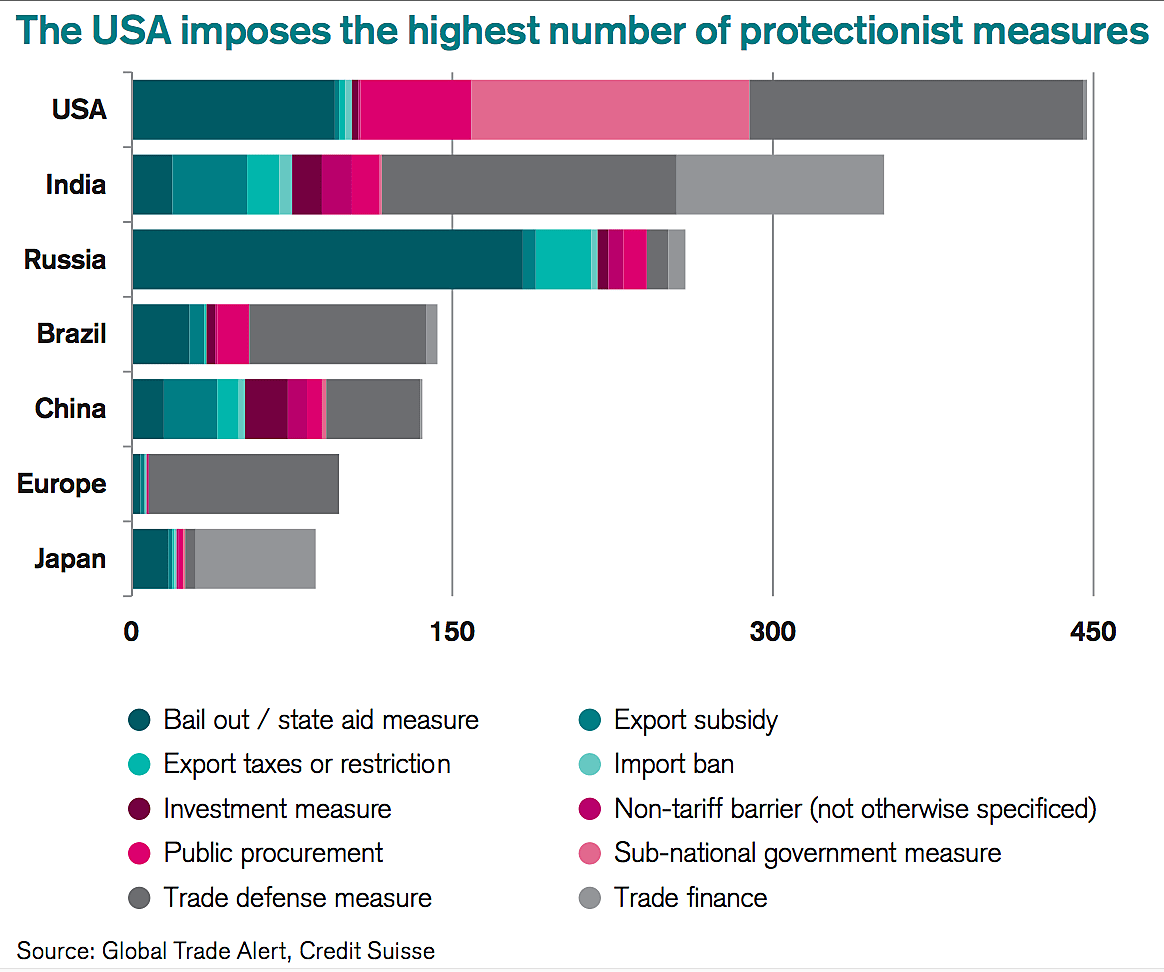
As for the free trade question, China has a higher mean tariff rate ~2% more, which is comparable to other developing countries. But viewing "free trade" in tariff lens doesn't present the whole picture. In terms of trade barriers US has more protectionist measures than China [1]. Go look up a list of WTO complaints to see who the largest free trade abuser is, a good visualizer [2]:

>China was involved in 63 disputes with 9 Economies from the time it acceded to the WTO in 2001 through 2018. China has been the complainant 20 times and the respondent 43 times.

VS

>United States was involved in 275 disputes with 42 Economies from the time it acceded to the WTO in 1995 through 2018. The United States has been the complainant 123 times and the respondent 152 times.

Or look up some US Chamber of Commerce surveys, Latest U.S. China Business Council's (USCBC) survey tldr was basically US companies overwhelmingly convinced Chinese companies receive (alleged) unfair state subsidies but they don't care because even with the tradewar, 97% of respondents said their China operations were profitable which is UP from 85% in 2015. Overall, business in China is good, select industries face more barriers than others (some technology, many financial services), industries with the loudest lobbying groups that skew the narrative.

[1] https://www.cato.org/sites/cato.org/files/styles/pubs_2x/pub...

[2] https://chinapower.csis.org/china-world-trade-organization-w...

[3] https://www.forbes.com/sites/kenrapoza/2019/08/30/us-compani...

What's the point of comparing the number of disputes without at least normalizing for the size of the economy and the length of time being discussed? It looks unserious.
Because multiple indicators conform to reveal the flimsy narrative behind China being some supreme violator of free trade. Controlling for time, China should have received 112 claims since it's accession, almost 3x more. You can examine the cases more closely here and judge magnitude for yourself, but the basic pattern is that the US is the biggest exploiter of free trade and the institution that supports it, by magnitudes, including among developed G20 nations. Not to mention their current efforts to block WTO judges reappointment, an actual attack on values via institutional sabotage.

https://www.wto.org/english/tratop_e/dispu_e/dispu_maps_e.ht...

https://www.wto.org/english/tratop_e/dispu_e/dispu_maps_e.ht...

That's not to say Chinese markets aren't protectionist, every country is, with the harshest measures reserved for strategically important industries, typically with extremely well funded and loud lobbying groups. A handful of large companies complain about tech transfer, but relative to all sectors their concerns are marginal - latest American Chamber of Commerce in Shanghai poll of US companies on top priorities for current trade talks and 0.4% of respondents thinks force tech transfer is an important issue. But those 0.4% of companies encompass strategic industries with disproportionate geopolitical ramifications, so their concerns are magnified for IR theater to distort the narrative. There's a reason the pivot to Asia and the narrative against Chinese development started when Made in China 2025 was announced to supplant western dominance in key high tech fields. It's unserious to rationalize US actions against China to preserving free trade - it's more geopolitical maneuvering to protect US industries, as others have mentioned it's the same story behind Japan with Plaza Accord that also targeted West Germany.

A pyrrhic victory if you will.
I think OP refers to "winning" in an economic sense, trade war or no trade war. The key goal is "my country will have more global influence than yours in 100 years".

Taxes, tariffs, import/export bans of goods or technology, etc. are all just tools in the arsenal of both sides they will use when it seems to give them an edge over the competition.

The winner is decided in the details. It’s not obvious at 30,000 feet, but changing tariffs before and after a war can make a clear winner in these situations. At the extreme end involving actual fighting, the opium wars where actually about trade with China.
This seems more like an issue with people being out of touch with the theoretical side of war. War, as a concept, has been treated as simply being another means of compelling cooperation since as far back as Sun Tzu. Although western war philosophy has been equally influenced by more recent figures like Carl Von Clausewitz. The US military even acknowledges similar thinking through modern concepts like the DIME model that are oriented towards forming a theory of war that acknowledges itself as part of a larger political environment. From this perspective, where war is just a tool for compelling cooperation, a trade war is simply a trade and economy based conflict which seeks to compel cooperation towards some particular goal like not putting people in concentration camps or buying more USA made rice.
I... think that in the modern era, "real war" is a different sort of thing from "trade war" - a difference in kind, not degree, in a way that just wasn't so when Tzu wrote.

The fact of the matter is that both the US and China could survive (albeit with a lower standard of living) without external trade entirely. I don't think the same could be said for an all-out war.

An all-out war between the two countries would likely kill most of us and put the standard of living of the few survivors below what you and I would call 'civilization' - one side might lose harder than the other, sure, but the consequences would be essentially unthinkable for both.