| I think that electronics/computers by itself do not have much to do with with the fall of soviet union. USSR fell because: 1. its economic model was dysfunctional and a failure 2. Its moderate leaders (aka Gorbachev and his allies), decided to dismantle it, as they realized the model was a failure, and their only other option was to become extremely repressive, roll out tanks and kill people. (north korea is an example that given enough repression, even an extremely poor economy is not enough to dismantle a bad government.) The soviet union was away behind the US (gdp per capita) in the 50s and early 60s, where computers were less developed and less important (to the general economy at least). The soviet union failed, because centralized, collectivism, and having all the output owned by the state is a failure as a model.... as it goes against basic human nature. https://upload.wikimedia.org/wikipedia/commons/c/cc/Soviet_U... Look at Spain's economy, how it is transformed after Franco died and the fascist regime is removed and the country opens up, gets less centralized. Another analogy is Argentina. Where there was too much central planing, and state dictated economy. Compare it against Canada, (open and capitalistic), and you see that the system is the main culprit, and not necessary computers. |
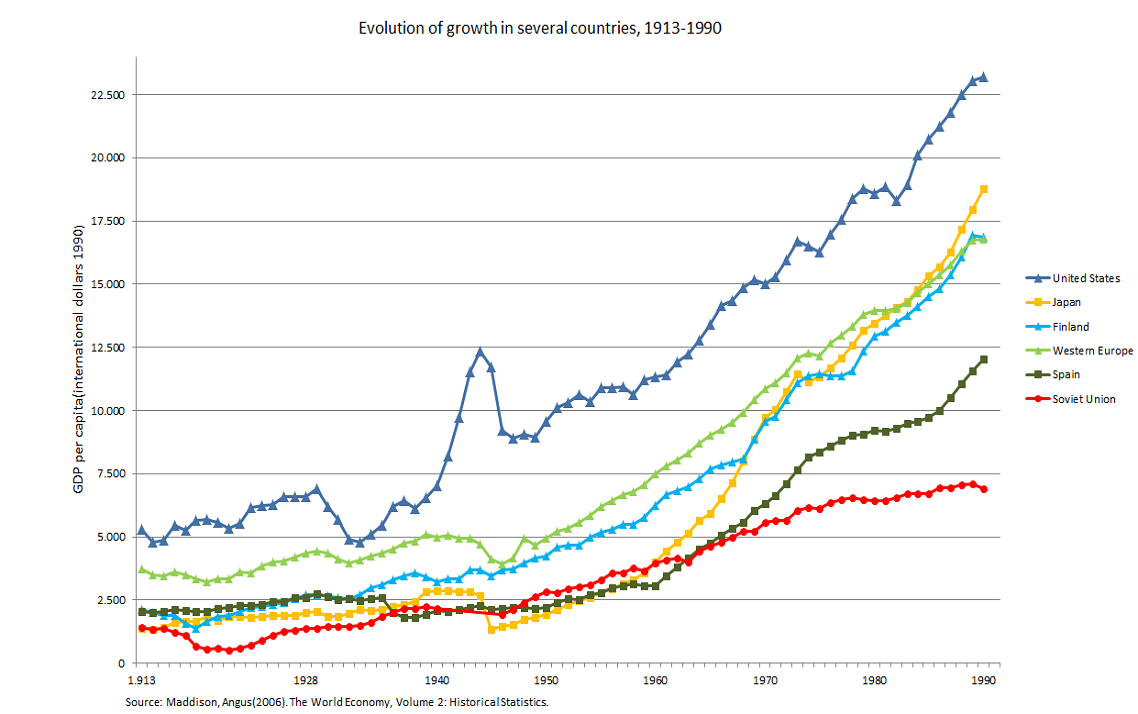
The graph shoots up in 1960 and slows down in 1975. Franco died in 1975, so your assumption that fascism and central planning hurt the economy is contradicted by the data.
If Wikipedia is to be believed, the actual cause was that the old central planners were replaced by new ones who were actually competent and made policies to support industrialization: https://en.wikipedia.org/wiki/Spanish_miracle