Hacker News new | ask | show | jobs
by dirtyid 2397 days ago
Document 9 is for domestic policy, CPC recognizing Western Liberal values is a threat to Chinese system does not mean CPC is attempting to undermine those values elsewhere. Unlike USSR, CPC hasn't been exporting or competing on ideology.

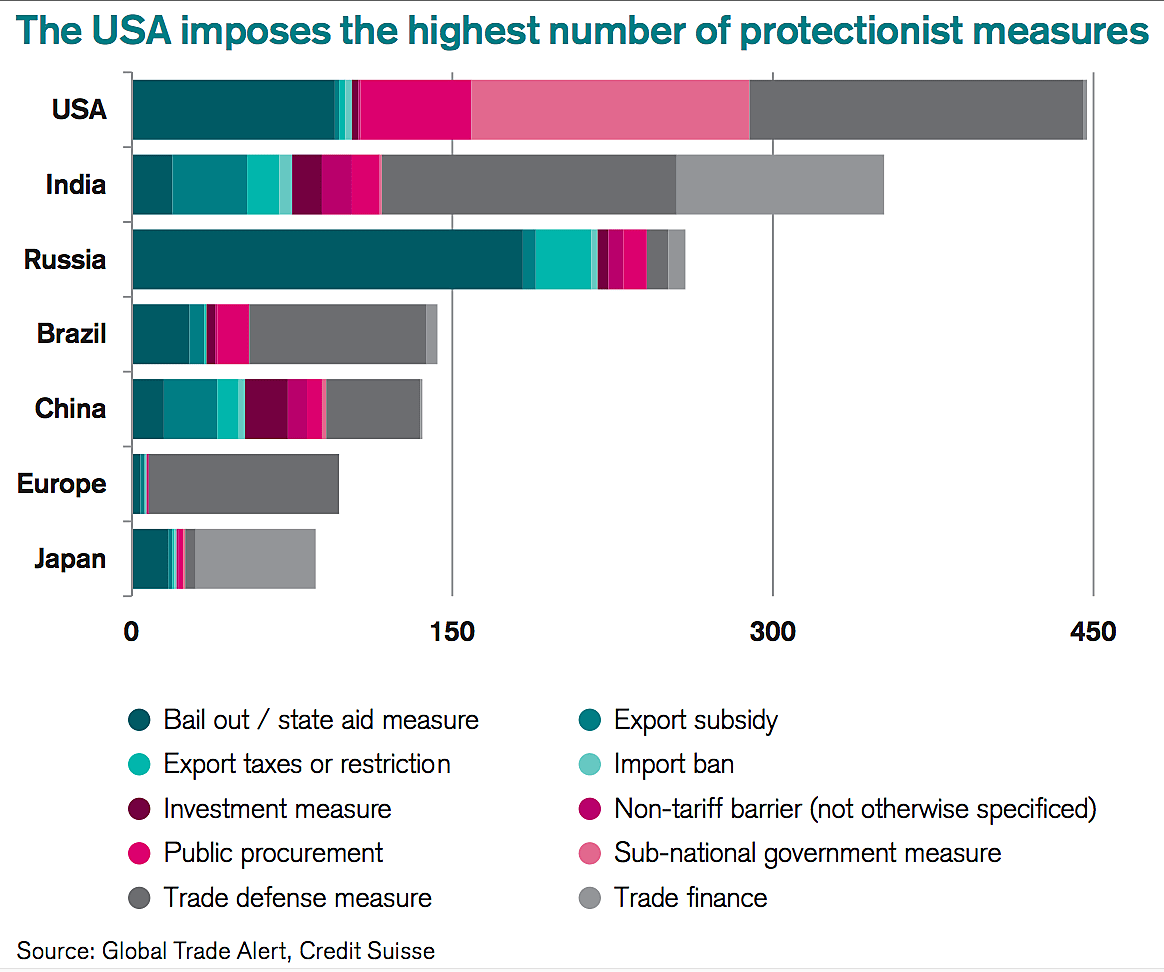
As for the free trade question, China has a higher mean tariff rate ~2% more, which is comparable to other developing countries. But viewing "free trade" in tariff lens doesn't present the whole picture. In terms of trade barriers US has more protectionist measures than China [1]. Go look up a list of WTO complaints to see who the largest free trade abuser is, a good visualizer [2]:

>China was involved in 63 disputes with 9 Economies from the time it acceded to the WTO in 2001 through 2018. China has been the complainant 20 times and the respondent 43 times.

VS

>United States was involved in 275 disputes with 42 Economies from the time it acceded to the WTO in 1995 through 2018. The United States has been the complainant 123 times and the respondent 152 times.

Or look up some US Chamber of Commerce surveys, Latest U.S. China Business Council's (USCBC) survey tldr was basically US companies overwhelmingly convinced Chinese companies receive (alleged) unfair state subsidies but they don't care because even with the tradewar, 97% of respondents said their China operations were profitable which is UP from 85% in 2015. Overall, business in China is good, select industries face more barriers than others (some technology, many financial services), industries with the loudest lobbying groups that skew the narrative.

[1] https://www.cato.org/sites/cato.org/files/styles/pubs_2x/pub...

[2] https://chinapower.csis.org/china-world-trade-organization-w...

[3] https://www.forbes.com/sites/kenrapoza/2019/08/30/us-compani...

1 comments

What's the point of comparing the number of disputes without at least normalizing for the size of the economy and the length of time being discussed? It looks unserious.
Because multiple indicators conform to reveal the flimsy narrative behind China being some supreme violator of free trade. Controlling for time, China should have received 112 claims since it's accession, almost 3x more. You can examine the cases more closely here and judge magnitude for yourself, but the basic pattern is that the US is the biggest exploiter of free trade and the institution that supports it, by magnitudes, including among developed G20 nations. Not to mention their current efforts to block WTO judges reappointment, an actual attack on values via institutional sabotage.

https://www.wto.org/english/tratop_e/dispu_e/dispu_maps_e.ht...

https://www.wto.org/english/tratop_e/dispu_e/dispu_maps_e.ht...

That's not to say Chinese markets aren't protectionist, every country is, with the harshest measures reserved for strategically important industries, typically with extremely well funded and loud lobbying groups. A handful of large companies complain about tech transfer, but relative to all sectors their concerns are marginal - latest American Chamber of Commerce in Shanghai poll of US companies on top priorities for current trade talks and 0.4% of respondents thinks force tech transfer is an important issue. But those 0.4% of companies encompass strategic industries with disproportionate geopolitical ramifications, so their concerns are magnified for IR theater to distort the narrative. There's a reason the pivot to Asia and the narrative against Chinese development started when Made in China 2025 was announced to supplant western dominance in key high tech fields. It's unserious to rationalize US actions against China to preserving free trade - it's more geopolitical maneuvering to protect US industries, as others have mentioned it's the same story behind Japan with Plaza Accord that also targeted West Germany.

"Controlling for time, China should have received 112 claims since it's accession, almost 3x more"

In 2005, in roughly the middle of the timeframe, the US economy was almost 6 times the size of China's.

Maybe you could expand on why you don't think claims should scale with the size of the economy, since you seemed to ignore the suggestion of normalizing for that.

Then compare EU with US. They have comparable GDP throughout the years, with EU being generally slightly ahead, yet they've been involved in less disputes. Around 1/2 as much as respondents, i.e. abusers.

>The EU was involved in 184 disputes with 27 Economies from the time it acceded to the WTO in 1995 through 2018. The European Union has been the complainant 99 times and the respondent 85 times.

VS

>United States was involved in 275 disputes with 42 Economies from the time it acceded to the WTO in 1995 through 2018. The United States has been the complainant 123 times and the respondent 152 times.

If you want to consider the scale of economy, then also factor in that US is one of the least trade-dependent developed economies in the world, i.e. trade-GDP is very low. Comparison of OECD countries including EU [1], US trades (low end estimate) half as much as EU, which makes the number of US disputes even more disproportional relative to unit of trade. Or the fact that US as a country somehow lodged more complaints than all EU members with their wildly disparate interests.

[1] https://data.oecd.org/trade/trade-in-goods-and-services.htm