Hacker News new | ask | show | jobs
AMA: NY AG Schneiderman on net neutrality and protecting our voice in government
1126 points by AGSchneiderman 3123 days ago
Hey everyone, New York AG Eric Schneiderman here.

For the last 6 months, my office has been investigating a flood of fake comments that corrupted the FCC’s net neutrality comment process. Approximately 1 million of those comments may have been submitted using real people’s stolen identities--including those of as many as 50K New Yorkers, such as a dead person and a 13 year old child. This is akin to identity theft on a massive scale, and it undermines the public’s right to be heard at the most basic level of our government’s rulemaking.

Yesterday, FCC Commissioner Jessica Rosenworcel and I held a press conference to update on my office’s investigation and called on the FCC to delay its net neutrality vote until we can get to the bottom of it. In an era where foreign governments have indisputably tried to use the internet and social media to influence our elections, federal & state governments should be working together to ensure that malevolent actors cannot subvert our administrative agencies’ decision-making processes. You can watch our full press conference here: https://youtu.be/TtZEC21QN-c.

I’ll be back this afternoon to take your questions!

In the meantime, a few things you can do to help in this fight:

1. My office requested help in our investigation from the FCC at least 9 times, but the FCC’s Chairman and his staff responded by stonewalling (yesterday, the FCC’s IG finally indicated they may assist with our investigation). So we’ve gone to the public. My office has set up a website for you to check whether your name was used to submit fake comments, & file a report if it was: https://ag.ny.gov/fakecomments.

2. While FCC Chairman Pai has declared his intention to roll back net neutrality, we can still beat this effort back in Congress. If you haven't already spoken to your representatives, please do it today. You can contact your Senators and Congresspeople through the Capitol switchboard at (202) 224-3121.

Thanks all. Keep speaking out.

77 comments

If net neutrality fails, would it makes sense aggressively pursue a legal effort to break up "big cable"? Back in the long distance/DSL days, the local telcos were forced into allowing alternate vendors to sell long distance & Internet service over the copper wire running to one's house. Can we bust up Comcast's strangehold on the Internet service available to my apartment by forcing them to allow any vendor to sell Internet over that single Comcast-owned coax line? They lobbied against neutrality, so take away their monopoly!
This is exactly the way it was until W's FCC changed it removing wholesale line sharing regulations by declaring ISPs information services.

https://arstechnica.com/tech-policy/2007/10/appeals-court-up...

> If net neutrality fails, would it makes sense aggressively pursue a legal effort to break up "big cable"?

It already makes sense.

If there were a competitive free market, then there would be a rational argument against net neutrality rules, but that simply isn't the case unless you live in North Dakota.

It's ironic that Ajit Pai acts like he can back up his argument against net neutrality with nothing but a short-sighted libertarian stance, yet he is so clearly helping support the current oligopoly, rather than fighting for a competitive free market.

Ajit Pai knows exactly what he's doing.
The legal authority to regulate the telcos is partly based on their common carrier status, which is the exactly the regulatory category that Ajit Pai wants to remove from ISPs.
We don’t even need to bust up telcos. All that needs to happen is the FCC needs to switch from huge, infrequent bandwidth sales to frequent regional bandwidth auctions. This will basically solve any last-mile oligopoly woes.
You appear to be mixing up cellphones and last-mile access.
Dear Attorney General,

I am beyond thrilled to see you on our forum. You're a gem to our country and make me proud to be a New Yorker and an American.

In your review of this forum's discussions on net neutrality, what do we consistently miss, exaggerate or get sidetracked by? Are there technical projects we can contribute to or technical problems take on that would help you defend net neutrality?

Thank you again, from all of us.

Wow – I’m honored! The volcano of bad ideas coming out of this administration has kept me busy on a lot of fronts, so I haven’t had as much time as I’d like to keep myself up to date on the boards here. But I can say that my staff – especially in my Bureau of Internet & Technology – does try to keep up on the news in tech and any potential problems we need to address. My understanding from them is that the tech community has been incredibly active on net neutrality, and incredibly helpful and supportive of our efforts on the issue. I thank you all for that. If you have a specific proposal for how to help our office's investigation, I encourage you to get in touch and my team will get back to you as soon as they can.

https://ag.ny.gov/contact-attorney-general

> Bureau of Internet & Technology

BIT, I see. How refreshing to see a non-strained and more importantly, non-Orwellian acronym come from the US/a State government.

Hey, everyone, this is AG Schneiderman, I'm here and ready to take your questions. Just a reminder that you can check to see if your identity was misused during the NN comment process by clicking here: https://ag.ny.gov/fakecomments.
Hi Mr. Schneiderman:

As a constituent, thank you for your work. I can't help but notice that your office is the only state AG vocally supporting net neutrality. Has your office attempted to coordinate with/gain support of other state's AGs?

Fortunately, it's not just my office that’s publicly supported net neutrality. (My office did submit its own public comment in support of net neutrality because we had an issue we wanted to address that was unique to our experience.) Several other state AGs submitted a comment in support of net neutrality as well (available here: https://ecfsapi.fcc.gov/file/10717283141719/2017.07.17%20Att...)

You are right that a broad bipartisan coalition could make a big difference. Some other state AGs have reached out to us for more information about the problem and about my office’s investigation, and we’re providing information to any of them that want to investigate and act on behalf of their own states’ constituents whose identities were misused.

For those like me wondering which states (pulled out of the pdf above):

Illinois, California, Connecticut, District of Columbia, Hawaii, Iowa, Maine, Maryland, Massachusetts, Mississippi, Oregon, Vermont, Washington

I found one comment that is likely fake, although it is for someone in Nevada, rather than where I live. This person happens to share my name, which is why I found it.

I’ve called both the NY and NV Attorney General. I hope NV is ready to cooperate to investigate this serious identity theft issue.

Thank you for your response.
For those of us who have used the internet 1989 to present, and who are dubious anytime we are told government is taking broad sweeping actions to "protect" us. Please explain the need for this regulation to exist.

1. Please define "network neutrality" - if possible do so without using hand-waving nonsense words, but technical definitions. What strictly defines a "neutrality infraction"?

2. If the internet existed for ~20 years without the need for regulation, why now?

3. Please explain how is the very same government who allows the communication monopolies to exist, supposed to also ensure that they are "neutral"? It seems awfully convenient that the solutions to problems that government creates is to have more government.

4. Wouldn't more competition be a better course to ensuring a freer net?

I’m glad you asked – this is a very important question. In short, the regulation is needed to protect against ISPs prioritizing their profits over their consumers, which is something we have seen in the past where regulations were lacking.

As a preliminary matter, it’s important to recognize that net neutrality principles and protections in different forms have actually been around since 2005 and even earlier. So the flourishing of the internet and everything relying on it during that time occurred under the protections. A few years ago, however, the courts struck down one form of net neutrality protections (those that had relied on Title I of the Communications Act), so then in 2015 the FCC put net neutrality protections back in place under Title II instead (they also expanded the earlier protections, e.g., to include protections against abuses related to interconnection, which had not been the subject of net neutrality protections before 2015). Now, in 2017, the FCC under Chairman Ajit Pai is proposing to repeal net neutrality protections altogether (and the courts’ earlier decisions effectively foreclose a return to net neutrality protections under Title I). So that would be entirely new territory for the internet.

Why do we think that’s bad? Well, as I explained in my own public comment in the current proceeding (https://ecfsapi.fcc.gov/file/10717583023587/FINAL%20RIF%20Co...), we’ve seen how companies behave in the absence of net neutrality protections, specifically in the area of interconnection before it was regulated in 2015, and their unregulated conduct harmed consumers. In essence, they made a deliberate business decision to let the quality of internet access degrade, knowing that it hurt consumers, to try to squeeze revenue out of edge providers like Netflix and backbone providers like Cogent and Level 3. Plus, we know that many consumers have few ISPs to choose from, so competition isn’t as effective a check as in other markets. So I believe strong net neutrality regulations are needed to avoid harms to consumers.

Could you please reference what it was the courts struck down related to Title I enforcement? This is news to me and I'm very interested in a more complete view of things.
In 2014 the court struck down net neutrality rules that prevented blocking and discrimination, which the FCC had issued under Title I of the 1934 Communications Act. But in 2016 the court upheld net neutrality rules that prevented blocking and discrimination, which the FCC had issued under Title II.

Going back to the early 2000s, the FCC has espoused broadband neutrality principles that prevented discrimination against certain types of traffic. In 2005, the FCC articulated these principles in what became known as the “four freedoms” and used them to stop network providers from discriminating against traffic that competed with their own services, for example: in 2005 the FCC stopped phone company Madison River’s blocking of Vonage VoIP calls that competed with Madison’s call service; and in 2008 the FCC stopped Comcast’s blocking of online video services that competed with its on-demand cable offering.

Comcast sued, and in 2010 a federal appellate court ruled that Title I didn’t authorize the FCC to make Comcast comply with the FCC’s net neutrality policies. So the FCC then issued a new regulation in 2010 that, among other things, banned blocking and other “unreasonable discrimination.” Verizon then sued, and in 2014 the same court ruled that anti-blocking and anti-discrimination rules couldn’t be imposed under Title I. The court suggested, however, that the FCC could issue such rules if it reclassified broadband internet in a way that put them under Title II. In 2015, the FCC issued neutrality rules under Title II, and when ISPs again sued, the court this time upheld the rules and they are currently in effect.

Chairman Pai’s FCC wants to repeal those rules, even though the court held that they were valid in 2016, and even though the courts orders from 2010 and 2014 essentially preclude the FCC from issuing neutrality rules under Title I.

If you want to take a really deep dive into the history of neutrality, which goes back 50 years, I recommend reading this: https://www.wired.com/story/how-the-fccs-net-neutrality-plan...

"In short, the regulation is needed to protect against ISPs prioritizing their profits over their consumers"

It's not encouraging to see that your broad, summary statement is nonsensical.

A for-profit business firm prioritizes their profits over their consumers by definition.

I am sympathetic to the cause of net neutrality but surely you can do better than this ...

Internet is a utility, and it is controlled predominantly by 6 companies.

There is simply not enough competition to rely on the free market to keep net neutrality as a fiscal priority.

Until the oligopoly is broken up, and everyone has competitive access to the internet, we need some way to ensure that net neutrality happens.

Without net neutrality, businesses using the internet itself , and even free nonprofit services will be unable to compete with large corporations like Facebook, Google, etc. because they won't be able to afford to pay ISPs for the right to reach customers without unreasonable bandwidth constraints.

"There is simply not enough competition to rely on the free market to keep net neutrality as a fiscal priority."

You're answering a question I didn't pose.

I wasn't even specifically speaking about net neutrality - something I am sympathetic to.

I was lamenting the fact that the level of discourse is lower than I'd hope it to be. Knee jerk "that guys not on my team" responses aren't helping to encourage me.

> You're answering a question I didn't pose.

I am clearing up some points you seem to have misunderstood or glossed over.

> > > "In short, the regulation is needed to protect against ISPs prioritizing their profits over their consumers"

> > It's not encouraging to see that your broad, summary statement is nonsensical.

> > A for-profit business firm prioritizes their profits over their consumers by definition.

Since, as you pointed out, a business prioritizes profits over customers, there needs to be an incentive for these businesses to prioritize their customers. That incentive is either competition or regulation.

The first choice is not currently workable, since competition between ISPs is impractical.

This is the same problem that net neutrality exists to prevent, just in a different problem space: Without a free market, competition is unfeasible.

> Knee jerk "that guys not on my team" responses aren't helping to encourage me.

Could you elaborate on what you see as a "knee jerk response"? I am not seeing any here.

Business prioritizes profit over people. Regulations exist to rule out profit-seeking behavior that is ultimately detrimental to society
It's part of the bargain: we recognize that these sorts of companies form monopolies[0], and in exchange for those monopolies, we impose regulation to keep them from engaging in the negative, anti-consumer practices often associated with running a monopoly.

We expect that if there were a competitive landscape, the companies that succeed would find a balance between profit and providing the services and quality that customers demand, but we don't have a competitive landscape, so we need to ensure that happens by other means.

[0] My take on why this is ok, and why we don't really want the proliferation of these sorts of companies: https://news.ycombinator.com/item?id=15858078

It's not nonsensical, but it does imply some assumptions about a free market and the social contract.

Governments exist to benefit their citzens. A free market is a great benefit thanks to competition forcing out businesses that don't prioritize their consumers.

This assumes perfect competition though and it assumes a lot of things that are not realistic such as there being no barriers to entering a market. Clearly there are massive barriers to becoming a new ISPs so some non-zero amount of regulation is reasonable.

tl;dr: It's reasonable for a captialist government to intervene when the free market fails to incentivize businesses to benefit citizens.

> a free market and the social contract

you have to pick one!

I am not speaking about the rest of your points (just don't have time right now), but I did want to note that the "the Internet existed w/o net neutrality" argument really frustrates me.

The Internet of today isn't the Internet of a year ago, let alone the "~20 year" time frame you mention. Yes-- the Internet of 20 years ago didn't need regulation because the profit potential was minimal. It only makes sense, with more and more commerce moving to the Internet, that the entrenched telecommunication interests would move more aggressively to "tax" the use of the Internet.

I'd love to have more competition in the Internet access space, but I don't see that happening anytime soon. The existing telecom interests have lots of regulation and lobbying power at their disposal to exclude competitors. I'd argue the existing interests need to kept in check until the regulatory climate changes to allow more competition in the ISP space.

I agree with you. Many ISPs would be quite good for the internet as a whole, but the problem with that is that just idealistic thinking in this case because the internet is a shared medium and infrastructure is build not only by companies but also by the tax payers.

In many cases the market can be left to its own devices to regulate themselves, but in some cases especially concerning infrastructure, interfaces, shared resources and basic human needs and rights we need regulation by the society that is not oriented to maximize profit in one business year but to create lasting and preservable goods.

Back to the net neutrality: I don't know if it that great for the market own regulation if you make it more difficult for consumer to objectively compare the offers of the different ISPs because you don't force them to release this information in a standardized format anymore.

(edit: not AGSchneiderman, but just what I understand about the topic)

1. Net neutrality is to not treat differently (to not change speed/latency/access) of a packet depending on source, destination or content/protocol. A "neutrality infraction" is e.g. throttling some streaming services and not others, or blocking access.

Note that this is NOT the same thing as prioritizing packets depending on behavior (amount and size to same destination, etc) and other parameters (like DSCP); this is called Quality of Service (QoS), which can be done without violating Net Neutrality.

2. There has been some of those "not neutral" behaviors (we need a word to define this!) in the last 10-15 years, but much more in the last few, as economies change and ISPs realize they can be nasty. The regulation was needed because these violations started to occur more. You only hear the cases of the US, but you don't hear of other countries. (e.g. Youtube and Movistar/Imagenio in Spain)

3. The problem of ISP monopolies is a different issue, and Net Neutrality doesn't change it a bit. If anything it helps. Since Net Neutrality is the _default_ state of computer networks, you wouldn't need to do anything special to comply. But if other companies are playing nasty, new ISPs would probably be forced to do a similar thing, as most people would want the cheap/free "internet".

4. That's the broken window fallacy. Let's create a problem so there can be more companies offering a solution. Also it wouldn't guarantee that there is at least one ISP everywhere offering unrestricted internet access at a reasonable price, which would stifle innovation and free market in web services.

edit:

Source in English about Telefonica Movistar throttling https://www.ft.com/content/f07c61d4-ea24-11e2-913c-00144feab... (I can't find much but I did suffer the problem and could confirm with a VPN)

Nice table I've just found (not about NN in general, but rather about the bittorrent protocol) https://wiki.vuze.com/w/Bad_ISPs

To piggyback here, the key point in #1 is about prioritizing/throttling based on vendor, not service type. Prioritizing video over email is fine, prioritizing Netflix (who paid you) over Hulu (who didn't) is not.
> Please explain how is the very same government who allows the communication monopolies to exist, supposed to also ensure that they are "neutral"? It seems awfully convenient that the solutions to problems that government creates is to have more government.

AG Schneiderman didn't address this point, but my take on it is this:

We allow these monopolies to exist because the infrastructure they require to operate by necessity must make use of public land and resources. In the case of wireless companies, radio spectrum is limited, so not just anyone can set up a wireless company. In the case of land-line/cable companies, we really do not want to allow just anyone to dig up our land or set up utility poles in order to run cable and fiber.

So we compromise: we only allow a select few to operate on the airwaves and to lay cable, but we regulate them in order to try to disallow them from engaging in the anti-consumer activity that you can only engage in when you have little or no competition.

There are perhaps other options, such as disallowing the people who build the infrastructure to also operate it as an ISP, and instead lease access to ISP companies at non-discriminatory rates. That brings other problems, too, though it might overall be better. At the end of the day, we have the system we have, and we need to make the best of it. If we could come up with a better system where net neutrality regulation wouldn't be necessary, that would be great, but we still need that sort of protection in place while we work to change our current system into something else.

They should treat the internet like they treat electricity. It doesn't matter if you're using it for a hair dryer or a work light or to charge your phone- you get it the same as everyone else for the same price.

Why aren't we de-regulating power companies too?

Do you also extend this to allow for pay-for-what-you-use? I don't disagree with charging people more for how much they use, but a lot of net neutrality proponents lose their minds at the suggestion that somebody who uses 5 GB a month should pay less than the kid streaming 10 TB of torrents every month.
I think the overlap between those is muddled for a few reasons:

1. Zero rating. Wikipedia+facebook is free, everything else counts towards the cap. This was a subject of major debate in India.

2. First party zero rating - YouTube and Vonage count towards the cap, your ISP's streaming video or VOIP service does not.

3. Negotiated zero rating. "binge on" and similar, which is basically vendor neutral but limits the type of content excluded from the cap.

4. Extremely small caps. If YouTube counts toward the cap and TV doesn't, you won't cancel your cable package. This gives cable+ISPs a big incentive to keep caps low.

I view #1 and #2 to be clear violations of NN, and #3 as borderline. #4 is just a consequence of ISP monopoly - but it's not NN.

Good thoughts. That does get muddy. I wonder how long though until AWS Included service comes around that allows data in and out on partner networks to be uncounted for any AWS customers of business using that service? That's a hypothetical of course, but I could see it.
I agree with your comment, and propose the following test, which will yield the same conclusions.

Given a scenario, ask the following:

"If enforced, will this give the users a financial incentive to pick one information source on the Net over another to get the same content?"

If the answer is YES, then the scenario is a violation of net neutrality principles.

So for the 4 scenarios you listed, the answers would be YES, YES, LIKELY NOT, and NO*

(*only because we restrict the test to sources on the Net).

For #3 that's not strictly true - while the policy doesn't discriminate by vendor, it does discriminate by content type and by packet sniffing capabilities. For example, unlimited video uses the same bandwidth as a VPN downloading at the same speed as the video's bitrate, and are equal from a network management perspective - but they get vastly different treatment towards your data cap.
Why is #2 a violation of NN, but #4 is not? Does it really matter if the video is transferred using IP on top of "internet" frequencies, or IP on top of "video" frequencies, or QAM on "video" frequencies?
In #2 the service is delivered over IP and the same last mile wires as other internet traffic. It's not "the internet", but it competes directly with the internet for last mile bandwidth, just like a Netflix or YouTube cache installed on the ISP's network.

https://arstechnica.com/information-technology/2015/11/comca...

It's because we see TV and Internet as different media entirely, even if they deliver the "same" content. That is outside of the scope of NN discussion currently. In the same manner, newspapers and TV are subject to different regulation even if both deliver the "same" news. It's hard to come up with rules which would apply for all media - even maxims like the 1st amendment aren't simple to implement.

In theory, the problem you refer to should be addressed by anti-monopoly laws (NN is a tool to address a different problem).

I think the difference is that customers pay for TV separately already, regardless of the transmission medium.
The problem with data caps is that it makes people afraid to use any new service that requires a significant amount of data, especially when they can't easily count the data that service will use, which is usually the case.

The other problem with data caps is that they aren't a good description of bandwidth use. Bandwidth isn't a bucket of water that runs out after a certain amount has been poured. Bandwidth is the maximum flow rate of pipes connected to an infinite reservoir. Capping transfer speeds makes sense, because there is only so much that can be delivered during the same period. Capping transfer amounts doesn't make sense, because that kid streaming 10TB of torrents can push most of her bandwidth usage to off hours like 3am on a Wednesday, rather than getting it all during peak hours like 8pm on a Friday.

Do you mean net neutral pay-for-what-you-use?

I.e.

You can buy 5GB volume. Everything you do counts against it.

Or do you mean selective pay-for-what-you-use-and-your-ISP-doesn't-prefer?

I.e.

You can buy 5GB, the ISP chooses what does and doesn't count against that.

From NN point of view: The former is fine. The latter isn't. (The whole king-maker problems)

I suggest you look into how power is regulated in most states, its not that cut and dry. Its pretty wacky TBH.
(Not the AG speaking)

The Internet did not exist for 20 years without regulation. Title II was the reason you had a choice among various dialup ISPs in the 90s; line-sharing requirements gave you a choice among numerous DSL services until 2005 when the Bush administration deregulated those services.

In fact, almost immediately after DSL line-sharing requirements were dropped, and with cable line-sharing never implemented, the abuses started and the FCC began regulating ISPs more directly. That was a decade ago, and the 2015 rules were a response to a court ruling that only Title II regulations could be used to impose net neutrality.

Personally, I would favor a reinstatement of the line-sharing rules or a hybrid approach in which an ISP can either be subject to net neutrality regulation or to line-sharing rules. That would give us the best of both worlds. Unfortunately, Ajit Pai's plan is just deregulation, without any proposal or effort to set up a competitive market. At best most Americans have either no choice or a choice between DSL and cable; in a competitive market we would have multiple DSL, cable, and fiber services to choose from, so that if we need the technical characteristics of one type of service we can still benefit from some level of competition.

> Please explain how is the very same government who allows the communication monopolies to exist, supposed to also ensure that they are "neutral"? It seems awfully convenient that the solutions to problems that government creates is to have more government.

The government "allowing" monopolies to exist is an example of the government NOT doing something. Besides the matter of conflating federal anti-trust, state governments & the FCC as being essentially the same thing, if government intervention is defined to include non-intervention then conveniently literally everything is the government's fault. The government "allowing" the lack of net neutrality is also "more government" by this definition.

>The government "allowing" monopolies to exist is an example of the government NOT doing something.

The FCC strictly controls who can use wireless spectrum for the purposes of protecting the monopoly status of those who pay big bucks to buy spectrum from their auctions.

Further, you do know that ATT was once a national / quasi-govt run monopoly?

Lastly, its not just the Feds, CLEC / ILEC classifications at the local level virtually ensure only the big players can ever call themselves a "phone company".

No, what he means is, in NY for instance, cable operators must agree to state, city franchise agreement to do business there and that's how we end up with the communication monopolies/oligarchy locally. It's an artificial barrier erected by gov't that ultimately inhibits competition -- all in the name of public interest.
So you're cool if I dig up your street very few months? I want to offer service to your neighbor.

The government doesn't create local communication monopolies. Anyone who suggests otherwise is either lying or hasn't thought very hard about the subject.

yes in fact i would be ok. I would prefer slight inconvenience every few months and actually having a decently competitive ISP market.

side note: given constant need to dig up the streets to lay cable, wouldn't the local government opt to install a large conduit.

I didn't say I wanted to offer you service, just your neighbor. He's more profitable. You don't get to benefit personally from all the interruption, but in order to have anything approaching a free/competitive market, you'd have to tolerate it.
I disagree that the it was inaction by government that allowed monopolies. The regulation the government put in in the first place have at a minimum contributed heavily to creating high barriers to entry.
My understanding is that the technical implementation of net neutrality is a ban of traffic policing (dropping prior to complete congestion to signal senders to slow down) for purposes other than "reasonable network management"

So Comcast shaping Netflix when Cogent won't pay their share to upgrade their peering point is probably still legal, but they would probably have to go to court to prove that it was "reasonable network management" and depending on the technical prowess of the court, could easily go the other way. The outcome is that telcos lose a lot of negotiating power to content providers.

More last mile providers probably wouldn't solve this problem, because people pay money for what they actually want (streaming video) rather than what they say they want ("free speech") and an ISP that protected freedom of speech would be protecting nazis, white supremacists, fake news, etc.

>My understanding is that the technical implementation of net neutrality is a ban of traffic policing (dropping prior to complete congestion to signal senders to slow down) for purposes other than "reasonable network management"

Thanks for the points. A few further thoughts.

1. There are two sides to every connection. Couldn't Netflix itself traffic shape?

2. Can I pay for QoS from an ISP for elevated service (for instance say I also have VOIP service for my office and want low-latency to trunk)? Doesn't my elevated status neccessitate shaping of others packets (for mine to arrive with lowest latency, others must be delayed)?

3. Lastly, given that all communications (everything from postal mail, to TV, cellphone, etc) relies on oversubscription, QoS traffic shaping is baked into the pie, there is no network access without shaping. Literally every single packet is shaped constantly along the way. Given this fact, QoS is the not optional. It is in fact the entire business process. Thereby, how could an ISP ever be shown to not be engaging in "reasonable network management"?

NOTE: I'm asking these questions somewhat rhetorically. My point always when NN discussions arise is to try to engage in actual technical discussion about the matter for the purposes of illustrating to others that its largely an undefined, impossible to enforce concept. In fact, the idea is impossible. To my repeated disappointment, few people - even on technical places like HN - bother to think about the technical aspects. To me this shows that NN is like a mind virus. Its the 2015 version of "won't someone think of the children" from the 80's. It is a crafty bit of wordsmith that makes it impossible for people not to support. Who could be for a "non-neutral" net? All of this is crafted for the politicians benefit, since they gain the power (and their monopoly lobbyist).

Shaping is not a problem at all. The problem is how you decide that shaping. If you're client of a network and you pay more for more priority inside that network they can do that, but as soon as the packet leaves it, it should have the same priority as anything else. And in practice you should never need such a service, as long as there's enough capacity. QoS can prioritize VoIP traffic without having to look to the source, destination or content. There's many clues for that which don't rely on having a list of source/destination tables or content matching.
ISPs charge their customers for access. They should not be able to then restrict that access based on their business needs. Just because Netflix competes with Comcast (NBC) doesn't mean Comcast should be able to ignore their customers' desire to consume Netflix content. Because that's what it is.

It's not like Netflix is generating petabytes of unsolicited traffic. They're providing the traffic Comcast's (or verizon's, ATT's, or whose-ever) customers are requesting. Net Neutrality is Wheaton's Law, writ large:

Don't be a dick. (To your customers, or the content-providers who produce what your customers want.)

There used to be a time when content companies needed to carefully select their network transit partners in order to make sure the bits their customers were paying them for had the best chance of reaching them (see: the existence of the CDN industry). It seems that those times are over, and the internet will be legislated to be 100% reliable and capacious..
I don't think the internet should be any less-regulated than the power industry.

Westinghouse (e.g.) can't charge me more for power to run GE (e.g.) appliances. Comcast (e.g.) shouldn't be able to extort customers for access to (e.g.) Netflix.

CDNs are definitely still a thing. Not so much because of "chance of reaching", but because you can't change the speed of light, and having the content closer to the clients is both faster and cheaper.
CDNs are a neccesity for latency and distribution, little of it has to do with your origin provider's quality. There are still some pretty terrible providers out there, some of them are HUGE and have hundreds of thousands of satisfied customers.
> actual technical discussion about the matter for the purposes of illustrating to others that its largely an undefined, impossible to enforce concept. In fact, the idea is impossible

NN means an ISP cannot place artificial speed limits on packets that I send or receive, based on the contents of the packets; e.g. the protocol, the port, or the destination address.

NN rules have already existed for several years, for the full specification see http://transition.fcc.gov/Daily_Releases/Daily_Business/2015... . This is a widely accepted concept so if you want to support your argument that net neutrality is "impossible" you'd need to rebut what this actually says.

This is illustrative of the main problem I've run into discussing NN. Everybody has a different definition of what it is, and many are not even close yet they both get the mental satisfaction of "being on the team for a free net"

To be clear, I don't disagree with your post. I just chose it as an outlet to vent my frustration that language and words are so hard.

By hijacking a thread that's about taking action to argue technicalities, you are kind of contributing to the problem by decreasing SNR. If you are just here to argue, you are wasting the time and brainpower of people who could actually be contributing to solutions.

At the very least, instead of saying "see, I told you it wasn't easy," why don't you summarize the responses you have received and formulate a set of rules that would satisfy as many as possible?

"The outcome is that telcos lose a lot of negotiating power to content providers."

The percentage of content providers that deliver to telcos directly is almost zero. Netflix is one of the biggest notable ones, but even they don't always do it.

That's true. Content providers usually pay a (usually many) intermediary (usually a tier 1 or tier 2 backbone provider) to deliver the traffic to the ISP. In order to deliver the traffic from one network to the other, both companies need to have short and long haul cables, routers with high speed interfaces, and employees to manage and maintain those things. So there are costs of this traffic borne by both companies. They are both getting paid by their customers to deliver the traffic, but the "peering agreement" between them governs the cost sharing responsibility of that link between the two of them. If the intermediary fails to fulfill their obligations according to the peering agreement, it is opaque to the customer who is not living up to their end of the contract (and always blamed on the end-user's ISP)
Its rarely opaque TBH. Its usually pretty obvious who's failing to hold up to their end of the bargain. Gamers figure this out on their own all the time.
I've seen a lot of cases where people think they figured it out but are wrong. Traceroutes are hard to interpret. Did you know that most paths on the Internet are asymmetric, and traceroute doesn't tell you what the reverse path is?
4. Perhaps more competition would be a better option, but as the failure of Google Fiber has shown, competition is not allowed to exist. The ISPs own the infrastructure, and they will do everything in their power to prevent outsiders from threatening their regional duopolies.

Personally, I think our bits and bytes should be treated as our other methods of private communication are (theoretically, anyway)--allowed to pass back and forth between two parties, unimpeded, without having been tampered with or spied upon. But that requires regulation.

All they can do with their power is what the government allows them to do through manipulation of federal, state, and local laws, as well as zoning, ordinances, codes, etc.

Unless they own the land itself, they can't prevent others without the use of government as their tool.

"The government" in this case is responsive to the 99% of people that do not care one bit about ISP monopolies, but do care greatly about road construction in their neighborhoods. This regulation exists for a reason that isn't just pure mustache twirling corruption.
Not AGSchneiderman, but I'll try my hand at some of these.

2. Because the "gentleman's agreement" behind peering has broken down, and the last-mile telecoms realized they can demand money from both sides.

3. Because any entity the size of the govt has many parts. The NY AG is not working at the FCC, nor do they work at federal antitrust organizations.

4. It certainly would, but the incredible infrastructure investment needed to bring meaningful competition to an area ensures that most companies and investors don't want to commit to such a low ROI.

Your points on 2+4 are not based in fact and are extremely general statements.

On point 2 - All of these agreements work, sometimes the agreements where more money is at stake take longer to sort out but they do get sorted out. The biggest fact involved is that when the agreements are slow to get sorted out, the parties involve lose customers and revenue.

On point 4 - in areas where competition for the last mile is able to exist, it does in fact exist. If you want to address the last mile there are a lot of other things that can be done aside from hamstringing ISPs.

#2 I have no doubt they will get "sorted out", just to the benefit of the telecoms, and the detriment of everyone else. Also, I have no idea why you think Verizon/Spectrum/Comcast would "lose customers and revenue" in a protracted negotiation in any monopoly county. If there's only one broadband provider, you have no meaningful alternative, and they

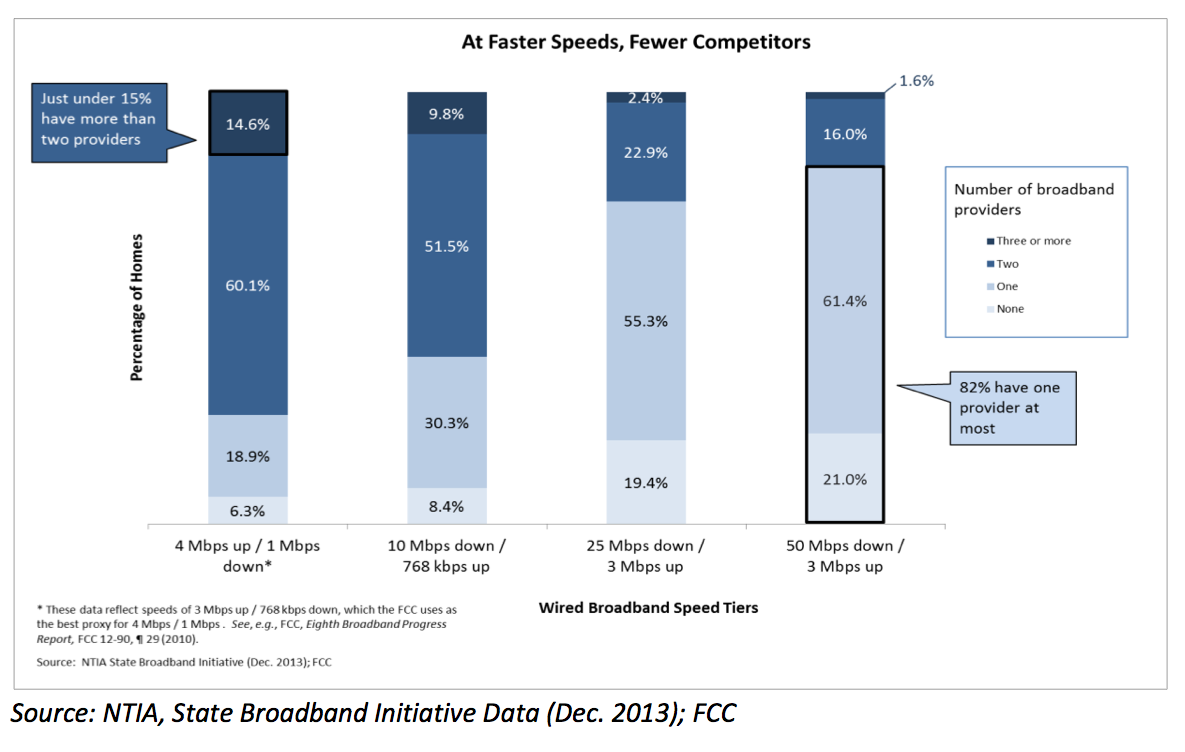
#4 If you check the Broadband Initiative Data for 2013 (last year of available data) at https://cdn.arstechnica.net/wp-content/uploads/2014/09/fcc-b..., you can see for the fastest speeds of 50Mbps down, there's at most one provider for 82% of America.

I'm not suggesting hamstringing ISPs at all, but bringing them to heel since they won't willingly do so. E.g., here in NYC, Verizon is being sued for being unwilling to keep its contract to make FiOS available to every residence (https://www.nytimes.com/2017/03/13/nyregion/ny-sues-verizon-...)

What actions can state and local governments take to support net neutrality? Is New York going to consider revoking cable franchise agreements for companies that do not support net neutrality, or require it (maybe nationwide?) for bidders on franchise agreements?
Great question. State and local governments should do definitely take action to support net neutrality, because the overwhelming majority of their citizens – regardless of politics or ideology -- favor net neutrality. That’s been proven again and again in every survey and study to measure public sentiment.

Right now, the most effective thing state and local government officials can do is to join the chorus of citizens calling on their state’s Senators and Representatives in DC, demanding that they oppose Chairman Pai’s proposed rollback of the existing Title II protections. If enough folks in Congress--from both parties--feel pressure to stand up and demand that the FCC preserve net neutrality, it'll be much harder for the FCC to disregard the will of the public.

This might be related so I wanted to tack on a question: Does the FCC, especially Pai consider one of the only options for providers of broadband in the North East considered a competitive market?
Dear AG Schneiderman:

Thanks for all the work you do on behalf of New Yorkers and consumers in other states.

1. Are there any federal statutes under which states could sue providers to effectively maintain net neutrality? (analogous to the UDAAP authority granted to states by Dodd-Frank)

2. What obligations does the FCC have under the APA (or other statute) to ensure the integrity of the comment process, rather than merely evaluating them and remaining "open minded"?

Can you briefly expand on what congress is capable of doing to delay or stop this?

I would like to be able to convey specific actions I want to see from my representatives, but I currently only feel comfortable asking "please do something!"

Are we to demand that they require the FCC delay the vote until your investigation has concluded? Do they have that authority?

I was under the impression that the telecom lobby was using the FCC as an end run around congress. What does a delay gain for us if those involved in the vote are beholden to lobbies, not citizens?

Thank you for taking the time to come here today, and for your involvement.

On Congress: Many members of Congress have already spoken up and called on the FCC to halt the process until the problems with public comments can be investigated. I hope more of our elected officials in Washington take up that call. If enough members of Congress support net neutrality, especially if it is a bipartisan group, then I believe the FCC is less likely to repeal the strong Title II net neutrality protections that we know the overwhelming majority of Americans support.

On what you can do: I’ve called on the FCC to delay its vote. So has FCC Commissioner Jessica Rosenworcel, one of the leading champions of net neutrality. And so have at least 28 U.S. Senators. Americans absolutely have the right to make their preferences known to their elected representatives in Washington, and I encourage you to do so, especially if those officials haven’t already spoken publicly about net neutrality. If members of Congress – speaking on behalf of their constituents – speak out on any issue, their statements matter.

My interest in a pause in the process is to get to the bottom of the fake comments and misuse of New Yorkers’ identities, and to make sure real Americans are given the right to have their voices heard. At heart, what we're talking about aren't the merits of net neutrality -- it's the integrity of the democratic policymaking process and the rule of law. In that way, I believe such a delay would be very beneficial to any ultimate result.

So it's not a matter of demanding my representatives create new legislation, so much as it is trying to convince them to make my voice (our voices) heard on the national stage. That makes sense.
The AG is glossing over the roles of the different institutions here. Put simply, the FCC isn't delaying the vote because it doesn't take a democratic approach to rule-making. (There are also unknown ramifications of allowing DDoS attacks on comments to delay/"de-legitimize" policy decisions). Like many other agencies in the Executive branch, its leaders have broad powers to enact policies. The AG, like any clever politician, is scoring political points by yelling "think of the children!" instead of explaining how the process actually works and how constituents can actually impact the situation. This will not delay the vote, just like the Senate phone systems going down wouldn't delay a Senate vote.

If you value Net Neutrality, don't waste time with the FCC - it's simply not set up for constituent influence. Instead, focus your efforts on Congress. Congressional legislation would overrule the FCC, just as it was intended to. Congresspeople are far more likely to consider voter opinions too.

AG Schneiderman,

While not from the US, as a jurist I feel compelled to do my part to prevent abuse of process and misrepresentations from occurring in the public sphere.

Is there any role available for American or Canadian jurists to help with your office's efforts in this matter? Tim Wu's assertion that this battle will ultimately be won or lost in the courts comes to mind: https://www.nytimes.com/2017/11/22/opinion/courts-net-neutra...

Would developing a case against Mr. Pai directly be an option you are considering? The revolving door/regulatory capture issue which is often raised in tandem with critiques of the FCC's current and past behavior is clearly contemplated at 47 U.S.C. § 154, (b) (2) & (b) (3).

-=-=-=-

I feel as if this situation is our creation as jurists.

The Anglo-American legal tradition has a strong current against recognizing a general theory of abuse of rights/abus de droit which is often foundational in civilian legal traditions, instead relying heavily upon balance of rights analysis.

Mr. Pai's argumentation relies heavily upon the balance of rights analysis, which discounts the importance of the purpose of the commission, his office and the rules in place in favour of a crude and arbitrary weighing of benefits and harms to stakeholders.

In this case: If the benefit to incumbent ISPs is large enough, the balance of rights analysis would handily justify harm to consumers - even if it would conflict with the purpose listed in the FCC's enabling legislation. See: 47 U.S.C. § 151.

Do you need help? This is one of the best communities in the world to ask to write free analysis software to help you determine which entries were likely to have been automated.
If you have ideas for how to help my office's investigation, we welcome them. You can get in touch at https://ag.ny.gov/contact-attorney-general.

Generally speaking, I encourage anyone who wants to get involved in the fight to protect net neutrality to reach out to organizations they support that have been active and vocal here, and offer their support. Nonprofits and advocacy organizations are always in need of committed, talented people who are willing to help organize, including people with technical talent. Don’t be afraid to reach out.

I am one, of I am sure many, here who have written automated fraud prevention software.

Post a dataset somewhere that we can run our algorithms against, and a way of getting our findings back to you.

https://patents.google.com/patent/US20130138427A1

Hello Mr. Schneiderman,

Thank you for doing this AMA, for your investigation, and for your well spoken remarks at yesterday's press conference.

Will you also pursue whether the FCC legitimately experienced a distributed denial-of-service (DDoS) attack?

Personally, I think that one of these two scenarios is likely:

1. The signs of the reported DDoS are natural artifacts of heavy traffic load on the FCC's web application. Large groups may have submitted through mechanisms unintended by the FCC, and users may have created malformed requests. When large groups of people use your system, it can be in ways you didn't anticipate when the system was designed. If this is the case, the FCC falsely claimed there was a DDoS -- this could be due to incompetence (poorly written application) or malevolence (willfully ignoring authentic human input that overwhelmingly supported net neutrality). Either of these outcomes are contrary to the FCCs mission.

2. There was legitimate DDoS activity. In this case, we must find out who committed this DDoS. Furthermore, we need to analyze whether there is any correlation between the faked identities and the DDoS activity. For example, let's say there is a clever ISP against net neutrality. They conduct this DDoS against the FCCs commenting system to drown out the voices of real US citizens. However, they know the DDoS might be analyzed, so they conduct the DDoS with pro net neutrality comments -- the content of the comments doesn't matter to them, so much as the ability to point the finger elsewhere while knowingly suppressing authentic comments. If there is extreme overlap between IP addresses used for such a scheme and other anti net neutrality comments, the true intention is revealed. Again, this is just an example. For your investigation, you would likely be interested in this angle in order to rule out whether the entity that conducted the DDoS was also responsible for the massive case of identity theft you are pursuing.

Either way, if the state of New York could compel the FCC to release anonymized logs, our entire country would benefit.

Thank you! Remain steadfast.

Is there anything that states can do to promote municipal broadband or maximize competition for ISPs? If Ajit Pai is ultimately successful in rolling back net neutrality in spite of evidence of foul play and the pleadings of agencies such as yours, is it possible to fight against consolidation and to encourage consumers to vote for net neutrality with their wallets? Thank you.
Hi Mr. Schneiderman,

NY resident here. Thank you very much for your work. I'm proud to have you as our State AG.

In your view, do the fake comments delegitimize FCC's rule-making process, if the FCC does not delay the vote until after the investigation is over? And can the FCC's Net Neutrality decision (regardless of whether or not they vote to repeal NN) be challenged in the court, on the grounds that the integrity of its rule-making process has been seriously compromised?

Thanks!

AG Schneiderman: Thank you for doing this and setting up this website. I actually hadn't checked until now, and found a false comment - it isn't from me though, it's from my biological mom, who's been dead for almost 20 years now. Is there a way for me to file a report for this? My representatives are already for net neutrality, but I will see what else I can do to support this cause. Thank you for fighting for our freedoms and to uncover the fraud that occurred during this comments process.
That's awful and I'm sorry to hear it. You can report the fake comment to my office at https://ag.ny.gov/fakecomments.
Do know of any resources that explain Net Neutrality in a non-partisan, clear, concise manner?

My dad is under the impression that Net Neutrality is bad because "the government has no business with the Internet." I'd like to provide him with some good information to try to sway his mind, but most simple explanations I can find are comedic in nature (John Oliver, The Oatmeal webcomic), or are from a "liberal source." Any help on swaying someone for this issue would be greatly appreciated.

You and I seem have the same general problem: family members influenced by "right-wing" media that have been convinced to hate anything to do with "liberals", without actually defining who or what a "liberal" is.

On top of that, both of my parents have been conditioned to reject anything remotely vulgar, so friendly comedy like John Oliver simply promotes their biases rather than breaking the ice.

It's a frustrating problem, and I have no idea how to approach it.

Net Neutrality generally means ISPs must treat all packets they deliver the same.

In other words, a cat photo is treated just as important as a military document being transferred to a general.

That's it.

There's Net Neutrality regulation, which varies in complexity, but Net Neutrality itself is a fairly simple concept.

Here's a good explanation but it probably doesn't speak to your dad. It's hard to find a non-partisan resource because literally EVERYONE is in favor of an open, free, "neutral" internet: https://www.youtube.com/watch?v=yVLiw7ZvzDI&t=12m20s
I think the simplest way to explain the need for net neutrality is to point out these two things:

1. ISPs are currently an oligopoly that would be the only beneficiaries to a non-neutral internet. Customers can't choose between ISPs, so we need to make sure that the ISPs don't hurt their customers.

2. The internet is an economy, and a non-neutral internet would directly prevent competition.

Net Neutrality is like preventing the US Post office from providing express delivery as the extra speed comes at the expense of regular delivery and there is a risk that only big companies would be able to pay for the service.
Net Neutrality is like preventing the Post Office from limiting the amount of packages a business can deliver, or limiting the priority of that business's deliveries unless that business pays the Post Office a premium.

The problem with that behavior is that there are some very large, wealthy businesses like Amazon who need to deliver a high volume of packages on time, so those businesses would be willing to pay a very high premium.

Since the Post Office would be making such deals with everyone, so that they don't look like they are being unfair, the big deals they make with Amazon would set the bar for every business who wants their packages delivered by the Post Office.

That bar would naturally be too high for small businesses and nonprofits, who would quickly go out of business, or be unable to start in the first place.

There is absolutely no difference between what you and I said. The Post Office does limit the priority of a business delivery unless that business pays a premium (express delivery).

The reason this doesn't goes terribly is that there is business competition between the Post Office and FedEx, DHL, etc.

The problem with the internet is not the lack of neutrality, it's the lack of competition between ISP.

And you assume that small businesses will be kept out. I see the exact opposite happening in Europe where net neutrality is more lax. Small startups are making agreements with ISPs to provide services that need a level of QoS that wouldn't be possible with net neutrality in place.

Don't forget that this is a metaphor.

You are right that the problem is a lack of competition.

The biggest problem with internet companies right now is that there are services like Facebook that people use so prolifically that they are very difficult to compete with. If ISPs began prioritizing Facebook, as they have tried to do before, it will be even more difficult to compete.

The other problem is that ISPs aren't the only ones fighting competition between internet services. There is a long history with media corporations using copyright to fight competition. Most innovative music streaming services have been considered illegal (turntable.fm, Grooveshark, What.CD), unless their business can pay rightsholders (Spotify, ). and adding features to existing services like Netflix involves breaking DRM, which is also illegal.

All of these issues are related in some way, especially since many of the biggest media corporations are the same businesses as the biggest ISPs. These corporations have accrued so much capital that no one can compete with them or their lobbying.

I think ultimately all attempts at analogy end up failing, so I'd try to avoid them when talking to your dad.

First off, the government already has "business with the internet". Cable, DSL, wireless, etc. companies are all already regulated in general, and always have been. We don't just allow anyone to come along and dig up our streets or put up utility poles so they can run cable or fiber. We also don't allow any random company to start broadcasting on whatever radio frequency band they want. These are all scarce public resources, and restricting access to them makes sense. So the number of companies that can become ISPs in any given area is limited (by the government), and IMO that's actually the right thing to do.

If you can get your dad to agree with that, or at least understand where that sort of thinking comes from, then move on to:

The best way to ensure that companies in a particular industry don't engage in anti-consumer behavior is to ensure that there's a good competitive landscape. If you can do that, there will eventually be a natural equilibrium between a company's profit motives and the quality of service it provides to customers, because customers will be able to vote with their wallets and only patronize companies that give them what they want, for a price they think is fair.

Hopefully that's not controversial. In fact, it's very "free market" and "no gov't interference", so I think it's something your dad would agree with. But:

If we don't and can't have a competitive landscape, the next best thing is to regulate what these monopolies can do. Net neutrality regulation ensures that ISPs won't try to charge you more if you want to stream high quality video rather than just crappy video, for example. It keeps them from "bundling" websites in differently-priced plans to cause you to have to pay more to see more of the internet. And on the other side of the equation, it keeps ISPs from charging certain content providers a premium to send their bits over the ISP's network.

You might also want to add, but isn't strictly necessary:

These things may sound theoretical, but they're not. ISPs have constantly been in a tug of war with the FCC to determine what they're allowed to do. The FCC, for its part, had tacitly agreed not to regulate them under Title II as long as they maintained the neutrality of the internet. In 2014-15, Verizon decided they didn't want to play ball anymore, and thought they had the political clout to avoid Title II classification, so they sued the FCC, claiming the FCC didn't have the right to enforce net neutrality under Title I rules. The court ruled that Verizon was correct, but Verizon overplayed its hand: the FCC ended up classifying them under Title II anyway. So we've always had some form of net neutrality, even though up until 2015 it was more of a "gentlemen's agreement" between the FCC and the ISPs than actual regulation. Once the ISPs got too big for their britches, the FCC smacked them down, and hard.

(my weak attempt follows)

The FCC's mission is (among other things) to "make available [..] communication services with adequate facilities at reasonable charges". They are also supposed to promote competition, neutrality, affordability, innovation, etc.

The only way to do that is with regulation. The only thing the FCC does is regulate. It regulates to stop monopolies and unfair business practices, which harm consumers and businesses.

In theory, we shouldn't need so much regulation of the internet. But the internet is an interwoven, complicated beast, and one single company can have a huge impact on lots of businesses and consumers - even ones that have nothing to do with them directly.

Net Neutrality is just a term to refer to a "common carrier" - a person or thing that carries goods or services for other people, and is responsible for them along the way.

Think of UPS, carrying your Christmas packages from you to your loved ones. Imagine if UPS was allowed to unpack your Christmas present and replace it with a cheap, shoddy replacement - and then demand more money to deliver the real thing!!! On top of this, UPS is the only carrier that will deliver from your area. This has already happened multiple times on the internet, and the FCC has been the only thing that has stopped it.

If internet companies aren't required to treat everyone fairly, they can make life miserable for businesses, and for you. You could end up with different access than other people, depending on who you pay, or how much you pay, or where you live. You could be forced to make choices you don't want to make, simply because someone has unfair power over your internet.

Companies have no incentive to protect your right to an affordable, competitive, neutral, innovative, free internet. And that's why we need the government to meddle in it. Because in this case, nobody else is going to.

But right now, the FCC Chairman doesn't care about ensuring your access to a fair, neutral internet - he cares more about the interests of a few rich companies, who stand to make a lot of money by walling off parts of the internet from you, and from competing businesses, so they can then turn around and charge you double for what you were already paying for.

Does this sound fair to you? No? Then you're a supporter of Net Neutrality. Now, how the government enforces Net Neutrality will be debated, and there isn't one set way to do it. But they will have to use regulation to enforce it, one way or another. And what they're doing now is the opposite of that.

So if you want your internet to be fair, tell your representatives that. Tell them you support Net Neutrality, and that you demand equal and fair access to the internet for everyone. Let them figure out the details. But know that what you're supporting is for you, as much as everyone else.

How do you feel about Ajit Pai's decision to not postpone the upcoming Net Neutrality vote as many across the nation have called upon him to do?
I think it's the wrong decision. We live in a democracy, and our country has clear laws requiring federal agencies to honor every citizen’s right to have his or her voice heard on any policy, like net neutrality, that impacts all of us. Our investigation has already shown that the legally required public comment process was deeply corrupted by bad actors. Until we are able to investigate who did this and why, and determine with greater certainty which comments are legitimate and which are bogus, our citizens’ voices are not being heard.

Chairman Pai has not disputed that the fake comments we identify exist – both supporting and opposing net neutrality -- or that Americans’ identities were illegally misused. Instead, his office has tried to paint the issue as a partisan attack. As I’ve repeatedly made clear, this is not about the merits of net neutrality. It’s about the integrity of the process by which a hugely important policy decision is made, and that’s a matter everyone has a stake in, regardless of their view on a particular issue.

Mr Schneiderman,

How can you enforce Net Neutrality today? I'm an ATT & Comcast user. It's clear to me that these companies are already throttling my service based on which websites I visit, which I understand is illegal. I have deduced this by switching to a VPN whenever a website does not immediately come online. In over a hundred trials in the last two years I have confirmed that over 80% of the time a website will immediately appear once it is masked to my phone ISP or to my home internet ISP. This is despite the increased distance the traffic must take to route through the VPN server. It seems to me Net Neutrality is a fight we are already losing because we cannot enforce it.

Nitpick: You just described a way to enforce it. For privacy reasons I would go that route anyways.
Yes I can do it. But privacy and net neutrality needs to be in place for the general public who are not so tech savvy. Otherwise data gatherers will use information to destroy competition and sustain monopolies. If I make a new site that competes with some service that ATT sells, perhaps they knock on the door offering some crummy buy out deal. If I don’t accept they can just choke off the service. More likely though, they sell a choke off service to big spenders. Let’s say it’s the 90s. A scrappy website called Backrub, created by two Stanford grads, introduces a new internet search that is vastly superior to a Microsoft owned MSN Search. Microsoft pays ATT to throttle Backrub users. Fast forward back to 2017 and the world is forced to use Bing because Google doesn’t exist. I’m sorry if I created a horrific mental image for you but we need to make net neutrality the default for Joe Public otherwise this capitalist enterprise system will run itself into the ground.
Mr. Schneiderman,

Beyond efforts such as your lawsuit, what are some actions that local and state governments can undertake to ensure that net neutrality remains in-place within their jurisdiction, without the risk of being preempted by the FCC?

Another commenter here suggests municipal broadband as a possible response to the weakening or elimination of net neutrality. Do you see any legal constraints that may be imposed by federal law and/or FCC regulation on the efforts of states and local governments to foster "network neutral" internet utilities that can compete with carriers known to discriminate within their networks?

AG, I didn't find anything under my name, but interestingly the two results that popped up for my (uncommon) family name all happen to be for individuals who show up in court cases and arrests when I do a cursory Google search. These comments object to the Title II classification.

It's not proof of anything whatsoever, but I wonder if "people who are in jail" might be another category the fake comments used along with deceased individuals and youths. Not to mention, court dockets and the news is a good source for the identities of real individuals.

This may be completely off the mark, but it's worth asking;

If the FCC repeals net neutrality, and if the FCC blocks state level net neutrality laws, and if a state / municipality has a de facto monopoly contract with one ISP, and finally, if that ISP engages in filtering / blocking / throttling content...

Then wouldn't that imply a first amendment violation, in that the state sanctions (via contract) treating protected speech in violation of the first amendment rights?

Because the people involved are trying to engage in protected speech which is hindered by state laws?

If there had not been identity theft, would a law have been broken by foreign nationals submitting comments to the FCC? Under what conditions is it illegal for foreign nationals to buy political ads on US-based websites or TV?

Net neutrality within the US is likely to affect the content available to people around the world, so it's reasonable for them to have an opinion. How should foreign nationals legally advocate for their positions in such a debate?

Can states implement their own net neutrality rules?

Will the Trump administration be able to sensor online content like Putin does in Russia?

Pai has specifically said he wants (and has the power) to Federally pre-empt state-level NN initiatives.
Could you give us an impression to what degree a trustworthy comment period matters legally in the agency decision-making process?

I believe many people consider the comment period a PR gimmick with no relevance, but I got the impression that it is legally required to some degree. If so, is this a substantive requirement with actual protective powers against agencies deciding arbitrarily, or just a veneer of rationality and transparent easily neutered?

The law in our country requires federal agencies to provide every citizen with the right to notice and the opportunity to have his or her voice heard in policymaking. We now know from my office’s investigation and other reports of major flaws in the current proceeding that our citizens have not been given the opportunity to be truly heard, because the real voices are being drowned out, negated, or undermined by fake comments, stolen identities, and other irregularities.

I disagree with those people who call the comment period a mere “PR gimmick.” For approximately 70 years America has had laws requiring federal agencies to provide citizens with notice of certain policy changes and an opportunity to make their voices heard. The last time net neutrality was up for consideration, the FCC received an outpouring from the public in favor of Title II net neutrality protections, and the FCC ultimately adopted those rules.

* What do you think are the prospects of passing strong Net Neutrality law in the Congress? One of the main concerns isn't just FCC removing the rules, but the Congress passing a weak law which would solidify dysfunctional rules, making fixing them many times harder.

* Why do you think, existing anti-trust law is not working to prevent abuse by ISP monopolists like using data caps and zero rating to disadvantage video competitors?

Do you personally believe that this was enabled either passively or actively by the FCC to cloud the public discourse surrounding the net neutrality vote?
As a follow up, if it was intentionally done, can/will there be any legal consequences?
Thanks, AGSchneiderman and staff, for fighting for this issue!

Here's a clickable link to the fake comments tool: https://ag.ny.gov/fakecomments

Hmm, I just found a comment using my same name (rare, but not unique) but an address for what looks to be an abandoned house in the next town over from where I grew up...
FYI, there are some folks at http://datafordemocracy.org / http://www.startuppolicylab.org/ coordinating a study of this, including Jeff Kao, whose work on this was cited in https://www.washingtonpost.com/news/the-switch/wp/2017/11/24...

If you want to help analyze the data and see what happened, it could be worth checking that out (I’m not involved, but it seems like valuable work).”

Mr. Schneiderman, what power does the NY AGs office actually have to halt or slow this egregious deriliction of duty on the part of the FCC and it's chairman, and under what specific laws?

More generally, it seems that petition and protest do very little to change congress's stance on subjects of importantance to it's real constituencies, the people, as shown by multiple studies and events. Does this potentially violate any laws and which, and if so why has prosecutorial discretion been exercised so frequently with the rich and powerful (cabinet members, congress, bankers etc) while minorities and the poor are almost never afforded it?

Finally, if the repeal of net neutrality is passed, what recourse is there for the people, your office, or any other relevant office?

Would you mind commenting on these findings? They seem to have found that both sides have been stuffing the ballot box: http://www.emprata.com/reports/fcc-restoring-internet-freedo...

Also, can you work on net neutrality for all bits? That is Google, Facebook, Twitter, as the main gateways to public discourse treat all comments equally without promoting one viewpoint over another that does not enjoy elite sanction?

What good is NN as it stands if edge providers can treat bits differently?

Basically NN says all bits _allowed_ to get to you by edge providers shall be treated the same, but it does not say edge providers have to allow all bits on their systems.

Thanks.

I’m glad you asked – this report is really telling. It’s been reported that this study was paid for by Broadband for America, which counts many big ISPs as members. Yet even this study found massive flaws in the comments, including about 8 million comments using made-up identities. Also revealing, is its findings about the approximately 1.5 million comments that were personalized, meaning someone felt so strongly about the issue they went to the extra trouble to write a unique comment themselves (versus, say, signing a petition – which is certainly valid but less labor-intensive). Of those 1.5 million personalized comments, 98.5% were pro-neutrality.
Thank you for responding.

I think those numbers point to their study attempting to be open about their findings, despite being commissioned by ISPs. However concerning is they found quite a few faked email addresses with foreign domains --people who even if real should have little to say how we govern our telecoms.

Nonetheless my question remains concerning the virtual triumvirate controlling what is acceptable and non acceptable public opinion, given they are the new voice of the hoi polloi. We have to find a way to ensure people's right to voice an opinion isn't virtually infringed by having a de facto triumvirate establishing what is and isn't accepted as public discourse, given they have very specific corporate agenda which could run counter to public opinion.

both paragraphs are whataboutism. The first talks about comment content which the AG did not reference. The second talks about an entirely irrelevant issue and tries to shift the definition of a term to something broader that clouds discussion.
I would disagree. The first says that there is a concern both sides engaged in ballot stuffing while AG seems concerned by a single sides PoV.

The other more importantly is concerned with guaranteeing a triumvirate of gatekeepers doesn't guide discourse in one direction or the other.

Your link says a lot of form letters were submitted. That's not the issue. There's nothing wrong with submitting a form letter with your name attached to it.

The issue is using someone elses name and information to submit a comment -- ie: identity theft.

Form letters and identity theft are not equivalent. One is an easy way to submit a comment. The other is illegal.

While troubling, i think this is more aptly described as impersonation. Theft implies direct benefit to the thief.
Anecdotally, my name and an old (albeit valid) address was used in two comments supporting repeal that I did not submit. That is to say, comments that the Emprata analysis would view as "valid" but most definitely were not.
Net Neutrality has a specific meaning, and is supposed to protect against one specific mechanism that would undercut the internet's openness.

The fear of Non-Net-Neutrality goes far beyond the usual "there's only two ISPs where I life and they both offer the same deals".

It's something in completely its own category of nefariousness because they could be as anticompetitive as they want, and the market could not solve it.

That's because the injured party isn't their customers, who could take their business elsewhere, or at least loudly complain on the internet (if they have any).

It's someone not part to the ISP<->customer contract, namely that unknown video startup in Nantucket, or the e2e-encrpyted messenger app your friend Lauren is working on. They're going to be forced into paying ISPs if they ever want to reach the ISPs' customers. And there's no risk to the ISP, because nobody is going to change ISPs for some startup they've never heard about.

The result could be ISPs capturing almost every cent of value created by new startups. We will also have a fractured internet, because small companies will have to negotiate contracts with every single ISP. Also want to reach those 500,000 people in eastern Montana? That'll cost you $2,000 per week.

Anyone not living on the US coasts, and people in other countries, will constantly run into "HTTP Error 469: go suck a bag of.."

>They seem to have found that both sides have been stuffing the ballot box

That's not entirely clear from that source. And even if it were, that's reason to try something different to solicit public feedback, not to go ahead with whatever the telcos say to do.

> That is Google, Facebook, Twitter, as the main gateways to public discourse treat all comments equally without promoting one viewpoint over another that does not enjoy elite sanction?

This has nothing to do with net neutrality. NN is about your right to transmit information over the internet, not your right to have someone else transmit it for you. If you want to talk about regulations on big content providers, fine, but it's totally irrelevant to the discussion at hand.

>What good is NN as it stands if edge providers can treat bits differently?

NN is not about edge providers. It's about not allowing middlemen to use their natural-monopoly power to censor edge providers.

It seems that the internet is being flooded with accounts that use real people's stolen identities and this is yet another example.

Which, if any, laws did the creators of these accounts break by posting these comments to the FCC under other people's identities?

It may violate a number of laws, including laws against impersonation or misuse of identity and falsification or forgery. Depending on facts we uncover, it could also be a form of a deceptive business practice. Some of that conduct is criminal under NY law, and some of it also constitutes a civil violation.
AG Schneiderman: Thank you for doing this and setting up this website! My representatives are already for net neutrality - but I will see what else I can do to support this cause. Thank you for fighting for our freedoms and to uncover the fraud that occurred during this comments process.

(I thought there was a comment using my mother's name/etc. but it appears that there's somebody else with the same name living in New York? Maybe? My last name's really rare [on the order of 50 people in the US?], so I wasn't expecting this at all, but they do appear to exist as a different person.)

Hi AG Schneiderman,

I have an unusual last name. I searched it on your FCC comment site. Someone with my last name as their first name was the only result. Their comment was against net neutrality. Due to our unusual last name, it seemed odd it was someones first name so I decided to do my own research. By searching google, I came across a variety of social media accounts all of them were inactive with little to no followers or in some instances they were spamming links to other sites.

I have little reason to believe this "persons" anti-net neutrality response was genuine.

Is there any way to report this sort of expected fraud?

AG published a form for reporting fake comments: https://ag.ny.gov/fakecomments-form
I don't know, that seems like it's for comments made by you that you didn't actually do.

I have little reason to believe the person who left this comment is real or rather if the person is real, I doubt they actually left the response. However I don't think I should file it on their behalf in case I'm wrong.

I guess if they want the information, I'd pass it onto his staff and let him and his staff do the research to determine it's authenticity although that seems like a lot of work to authenticate one person.

What's the possibility of using the RICO statutes against these companies? I'm thinking of Comcast in particular. Recently they made a "mistake" by adding services to my cable bill that I had not ordered. They very quickly erased the charges when I complained, but if their excuse for why they were there in the first place was valid, they should have fought to keep the money if they were in the right. I believe this was done to keep anyone from complaining too vociferously. I believe this behavior is consistent and intentional.

Their behavior and attitude towards employees (anecdotal, I'll admit) seems very much like that of Bank of America concerning their recent accounts fraud scandal. I believe that Comcast either intentionally puts these charges on customers bills hoping they will not notice, especially on autopayment enabled accounts, or they pressure their employees so greatly that the employees are doing this themselves, like Bank of American claimed their employees did.

I think this type of pressure put on employees is known to Comcast executives to cause fraudulent charges and is the desired result of said pressure. The executives can then claim they knew nothing of said behavior and deny any wrongdoing. I understand such a case would be difficult to make, but I think many companies behave in this way and we need to start using bigger hammers to bring them back within the law.

I think RICO should also be applied to banks that repeatedly break the law, but that's perhaps another story.

Thoughts?

I think the link would be more useful if it weren't done in an explain-like-i'm-five manner. Some of it does seem to apply, especially if you look at the things on the list:

https://www.law.cornell.edu/uscode/text/18/1961

section 1343 (relating to wire fraud)

section 1028 (relating to fraud and related activity in connection with identification documents)

...and I could go on but meh. I believe that the link started out with "complicated conspiracy" law to describe what RICO is...isn't that exactly what I was accusing Comcast of?

I understand that RICO is an extremely difficult case to make, and it probably should be so, so that the law isn't used flippantly. But I also think we need much more powerful tools to control these corrupt monopolies that control large parts of this country's infrastructure, especially as they seem hell bent on controlling even more of it. IF Verizon is found to have controlled a massive identity theft racket to bombard the FCC with fake comments, it seems to me that RICO is the exact tool to use.

If one discovers one's name has been used in fake comments, what can/should one do about it?
My office put up a web page where you can easily check if your identity was misused and, if so, report the abuse to us: ag.ny.gov/fakecomments. In just a few days we’ve received thousands of comments, not just from New Yorkers but from all over the country. My team is reviewing those submissions for further evidence and leads in our investigation. Those submissions help us learn more about the attributes of different fake comments. We've also been sharing information from these submissions with the Attorneys General in other states who have reached out to us for more information about their own constituents’ identities being illegally misused.
Can you require Apartments to have more than one ISP. Charter is the worst and that's all that's available while my neighbors have FIOS available to them and RCN
Dear Attorney General,

If the vote proceeds will you sue this repeal, to protect New Yorkers?

Thanks for this question. We think there's still time to stop repeal, so we're hoping everyone with a stake in this issue--especially the tech community--will mobilize to force the Chairman to reconsider his proposal. You can be sure that we'll scrutinize the final rule very closely and seriously consider possible next steps at that point.
Guys Isn't it about time we refer to some other countries in the world for some reference point especially when our nation's media is polluted by Fake News, Fake Comments and #FakeWhatNot?

For example in INDIA. India's TRAI is trying really hard to ensure Freedom is maintained on the "Service" of Internet itself.

Referring to this Wiki Article https://en.wikipedia.org/wiki/Net_neutrality_in_India

Section "2016"

TRAI rules in favor of Net Neutrality[edit] The TRAI on 8 February 2016 barred telecom service providers from charging differential rates for data services, thus prohibiting Facebook’s Free Basics and Airtel Zero platform by Airtel in their present form. (Airtel was the largest Tel. Provider in 2016.)[62]

In their latest ruling,[9] they have stipulated that:

1. No service provider can offer or charge discriminatory tariffs for data services on the basis of content. 2. No service provider shall enter into any arrangement, agreement or contract, by whatever name called, with any person, natural or legal, that the effect of discriminatory tariffs for data services being offered or charged by the service provider for the purpose of evading the prohibition in this regulation. 3. Reduced tariff for accessing or providing emergency services, or at times of public emergency has been permitted. 4. Financial disincentives for contravention of the regulation have also been specified.

@AG Schneiderman on net neutrality and protecting our voice in government, can we use some of these points to our favor?

Capitalism is "Great"! but the powers vouching for "it" need to know that it CAN NOT go against the Constitution of the United States of America and the rights of Americans.

Is this the same FCC Commenting System that sent API keys to anyone who asked?

https://arstechnica.com/information-technology/2017/08/fccs-...

What actions are you going to take to make sure big players like Comcast don't just split the internet up into packages?
Dear AG,

I am wondering if net neutrality should not be enforced by international trade agreements, such as TAFTA and others.

Net neutrality means that European ISPs cannot slow down the internet from American Companies and vice versa.

What Pai is proposing will give frightening ideas to foreign ISPs. Ask Facebook a cut of its ads or slow down its traffic. Ask Apple a cut of app purchases, or slow down downloads from the app store. Ask a cut of the streaming of any Hollywood movie, otherwise the streaming quality will be inferior to local European movies.

My intuition is that moving away from net neutrality is dangerous for healthy trade between countries and should be enforced at the international level.

I am wondering if current trade agreements already have implicit net neutrality rules. If it's not the case, we should promote such measures for the next generation of international trade agreements.

Net neutrality only concerns edge providers, which do not deal with international data transfer.

Net neutrality rules prevent ISPs from changing their customer's traffic, and their customers are not international.

It's so easy to identify those fake comments by just looking at few. I figure this is one of the comments that seems fake. Why is it taking long to identify there are lot of fake comments in it?

'The unprecedented regulatory power the Obama Administration imposed on the internet is smothering innovation, damaging the American economy and obstructing job creation. I urge the Federal Communications Commission to end the bureaucratic regulatory overreach of the internet known as Title II and restore the bipartisan light-touch regulatory consensus that enabled the internet to flourish for more than 20 years. The plan currently under consideration at the FCC to repeal Obama's Title II power grab is a positive step forward and will help to promote a truly free and open internet for everyone.'

You’re right that it can be easy to spot comments that may be fake, but to have confidence that certain comments are fake requires further analysis. One reason is that the mere use of identical text in multiple comments (even large numbers of comments) isn’t necessarily evidence of misconduct – many public interest groups use web forms with pre-prepared comment text that people can fill out, or they circulate petitions for people to sign to provide consent to having the same “form letter” comment submitted on their behalf. So we look to other attributes that are shared across certain comments to help us determine if they’re likely fake. While we’ve already gathered enough evidence to conclude that a million comments are likely fake, we’re still analyzing others. And of course, it would be much easier and quicker to identify which comments are likely fake if we could analyze FCC records showing the source(s) of comments (which we would keep confidential given the possible identifying information), but the FCC refused to respond to our repeated requests over many months.
I would say that this comment is "real" - in the sense that it was actually wordsmithed for the position it supports, but that it is likely that the purported person's name and address are fake/misattributed to the comment.

This wordsmithed position likely came from some partisan political action web site gathering automated signatories; you go to it, fill out your info, and it posts to the FCC input form/api or whatever.

Similar ones exist as well for the opposite view ("for net-neutrality rules").

At that point, it's a matter of generating the information and pasting and sending (the actual text is usually pre-filled on the form, sometimes with allowances to allow a real user to edit the form).

For instance, I looked up my name on the AG's site - it found several hits. Most of them were "against net neutrality" - essentially with the text you posted - but the addresses didn't match my address.

But a couple were posted "for the current net neutrality rules" urging the FCC not to change anything; even so, I didn't post them, and the addresses didn't match.

Curiously, one of those two comments had a small sentence tacked onto the end, reading "Don't fuck this up!" - which is something I would never put into a public comment to a govt agency or request. So even though I agreed with the position, it still appalled me to see that vulgarity applied to the comment.

All comments though were fake - I never sent any of them in to the FCC.

> All comments though were fake - I never sent any of them in to the FCC.

Or your name isn't that uncommon. Have you ever tried being the first google result for your name, as an SEO experiment? It is hard!

I say this as someone who shares a name with a minor league baseball player, numerous facebook/linkedin/etc profiles and a baby whose life/death was covered by the BBC.

I don't go around accusing all of these people of being fake.

Hi Eric! It's always great to interact with our politicians, so thanks for doing this AMA. Now onto my question.

About a week ago Republican FCC member Brendan Carr posted this https://www.washingtonpost.com/amphtml/opinions/no-the-fcc-i... opinion piece to the Washington Post. It gives his view on why repealing title II is good and makes some interesting points. I was wondering if you could share your thoughts on it.

Hello, NY resident from Orange County here. Does the investigation have a good likelyhood of suing the FCC for the current situation? Also how do the possible ramifications of a Net Nutrality repeal affect the Spectrum litigation?
Can a state AG not subpoena a federal agency?
The assistance we’ve requested should not require a subpoena. State and federal agencies cooperate all the time, especially when they are engaged in law enforcement investigations into illegal conduct. The FCC has worked with my office in the past under such circumstances, and there is no good reason for them not to work with us here. Regardless of any legal constraints that may exist on a state law enforcement office’s ability to compel a federal agency to cooperate in an investigation, cooperation always should be -- and usually is -- provided voluntarily.
Correct, because of federal supremacy. The state and federal governments are “separate sovereignties”, but not co-equal ones.
What does your actions mean for residents in other states who have fake comments posted in their name? Should they still report them to you and are those fake comments actionable in any other way?
We've received and we welcome submissions from people across the country. As New York's Attorney General, my responsibility is to the people of New York. But what happened in the NN comment process affects all of us. I think that's why we've had AGs from other states reach out to us for information along these lines. So if your identity was misused, I encourage you to notify your state officials as well.
Additionally, have you been working with any other state AGs regarding this issue?
Dear Mr. Schneiderman:

There are many places where I can get faster internet from my cell phone than I can from DSL or independent ISPs. How do we get ISPs to invest in faster internet (such as gigabit FTTH)?

If Congress and Pai are seemingly bought and paid for without any regard for the wishes of the actual majority of their constituents, what recourse do the rest of us have?

Speaking with our representatives seems to be completely ineffective (see the monstrosity of tax reform working its way through now behind closed doors).

Can you open an investigation into Pai himself with regards to any compensation or future compensation he may receive as a result of this? What other creative options do we realistically have?

Thank you for your leadership in many areas and especially this one!

on a side note, I live far out east on Long Island and only have one viable option for an ISP that enables me to work, others (like satellite) are not viable for me to vpn to different clients, is there anything I can do to help increase competition out here so myself and neighbors have alternatives to "Optimum online"?

Thank you again I am very happy to see you on this forum!

You’re not alone. Many Americans – especially those far from major cities -- have only a single ISP available, others have only two ISPs. That’s why competition is more limited in the market for broadband than in other markets (because consumers can’t “vote with their feet” by switching to a competitor), and that’s a major reason I believe the existing net neutrality regulation under Title II is needed.
In an era of increased government surveilance and personal intrusion, why should Americans be ok with more oversight from a broken organization like the FCC?
The FCC is only broken in the sense that its leaders are dismantling it.

The most recent successful dismantling was getting rid of ISP customer privacy protections. ISPs are now allowed to collect data from customers without even notifying them, and sell that data.

Without a strong FCC, ISPs are quickly becoming a new "Big Brother", with similar abilities to diminish individual privacy and trust by collecting and profiting from their customer's data, and stifling competition between internet services.

I checked a lot of my family and friends names. I found my friend on the list. Without letting him know, I asked if he was for or against it. He said he's never made a comment, and there are 2 comments with his name and current address. I believed the fake comments were happening, but this is actual proof for me that it did happen. He is submitting a report on AG Schneiderman's website now.
Hi Eric, we've seen a lot of back and forth on net neutrality issues between administrations. How do we solidify the ground so it's not tied to one party or another? And if this goes through (as it looks like it will), are there legal recourses that you're prepared to use? This feels like it's going to be a consumer issue as much as a communications issue.
> Approximately 1 million of those comments may have been submitted using real people’s stolen identities--including those of as many as 50K New Yorkers, such as a dead person and a 13 year old child.

I'm not familiar with the story about the 13 year old child. Has anyone gotten in touch with them to see if they submitted it? Maybe they're the next Aaron Swartz.

This comment was submitted under the name and address of someone we will call Jill, in Rochester, New York.

As it turns out, Jill’s father wasn’t very happy about that submission because the real Jill is only 13 years old and never submitted any comment.

We also saw a woman in Albany who supposedly submitted a comment in July of 2017. Sadly, her son reached out to us to say that was impossible because she had died in June.

Even right here in my office, my assistant press secretary had a phony comment submitted under her name using the address of her childhood home.

These are just a few of the thousands of comments that have been reported to my office.

Hi AG Schneiderman, I'm a resident of Westchester County, NY and support your investigation into the FCC's process. If you are successful, or even if you are unsuccessful, do you think your efforts will embolden other state AGs to investigate the federal government, and do you think that is a good or a bad precedent to set?
Hello and thank you for taking the time to do this. My question:

Do you see net neutrality as the end-all solution to this, or would further regulation/deregulation be required beyond simply creating these rules? Also, is there a place for deregulation of ISPs and infrastructure to allow for more free-market competition?

There’s a long history of neutrality regulation for networks – going back even before the internet – even though the requirements have taken different forms over the years. And when those regulations were enforced they ended practices that hurt consumers and companies that wanted to provide services over those networks. Here’s a great summary of the history: https://www.wired.com/story/how-the-fccs-net-neutrality-plan.... The current net neutrality regulations under Title II are strong and address the many forms of discriminatory (i.e., anti-neutrality) conduct we’ve seen in the past.

I have to respectfully disagree with a premise in your second question, that deregulation is what would allow for more market competition. The history clearly shows that when neutrality regulation was in place and enforced, it increased competition, for example: in 2005 it protected VoIP against discrimination by a phone company with a competing service; in 2008 it protected online video against discrimination by a cable company offering cable video on-demand. Moreover, ISPs invested in broadband infrastructure over the years because net neutrality was protecting edge providers, which led to huge innovations like online video, which in turn helped drive ever greater consumer demand for broadband that justified further infrastructure investment.

Well, I found someone with my same name, but they had a comment that very much aligned with my opinion!

https://www.fcc.gov/ecfs/filing/10510804518262

> Preserve net neutrality ! Go fcc yourself.

Hello Mr. Schneiderman,

I hope that by "AMA" you really do mean, anything :)

What is your take on the outdated gravity knife law?

Mr. Schneiderman, it seems to me that what you’re proposing, holding up the regulatory process because some people faked comments, would create a highly perverse incentive for those opposed to a particular action to submit fake comments appearing to support that action.
Dear Mr. Schneiderman:

If a video steaming service (such as Netflix or YouTube) installs a "appliance" or "cache" to provide faster video to a certain ISP's customers, do you believe that violates net neutrality, and if so, why?

That doesn't really matter in the context of a discussion about fake comment submission, does it? Spamming fake comments for or against net neutrality, either way, is a problem.
Hi Mr. Schneiderman:

There are some great questions on here. I'm afraid the time window for this AMA is just too short to do them justice! Any chance you could pop back on here again over the next few days answer a few more of the best questions?

Not finished yet -- I'll be in and out today to answer your questions. Thanks to all for taking the time to join me.
Hi Mr. Schneiderman:

If the FCC publishes rules intended to repeal NN and Title-II regulations, as is expected, will your office petition Congress to invoke is powers via the Congressional Review Act, to consider overturning said rules? Thank you.

How do we know that if the government decides how access is governed that the same government won't abuse by deciding what we can do with said access, what sites we use, what protocols we use, what apps we use, in our use.
Hm, my comment doesn't show up in the FCC tool provided. Strange.
Searching my last name "worm" will give you a great example of the slightly modified text used by the NN scammers that AG Eric described in a previous communication. Lolz
I wanted to thank you for your efforts here. Would you have legal authority to stop the FCC from making this ruling? Would a judge actually be able to delay the vote?
Why isn't 'mandatory, complete, full disclosure of all network management policies' not an option vs Title II?
Un-related to the FCC nightmare, how do you, as AG, feel about bitcoin and crypto currencies?
How do you overcome the argument from some that the cables/infrastructure/etc are owned by the Telcos who should therefore be able to control what data flows through them? The argument is that if they take that right too far, the market will attempt to react to fix the problem, without government oversight.
My name is so common that this search feature is useless without a zipcode.
Thank you for meeting us here!
Timing update here: I'll be on to answer some questions between 3 PM and 4 PM ET. Thanks all!
FCC allows written comments as well as electronic submissions.

Written comments require submission of four copies and must include a contact address. All must have original signatures.

Should the FCC give more weight to written submissions than to electronically-submitted comments?

Will the FCC contact the submitters for permission to use their comments in the decision-making process?

I know that e.g. in some smaller democratic governments, legislatures accepting written submissions from the public will contact the submitters to obtain permission to use the comments, regardless of whether the legislative committees use them or not.

This could function to some extent as a verification of identity.

Can we challenge the FCC's electronic comments submission system as fundamentally flawed?

Due to numerous data breaches, there is significant, known availability of personally identifiable information on US citizens available to anyone, anywhere in the world with an internet connection.

Can FCC ignore this and provide a comment submission system that performs no meaningful checks on identity of commenters?

If they pass net neutrality, can we legally build our own internet/ISP/distributed network?
You can, it'll just be a lot more expensive AFAIK.
Why?
Regulatory and compliance costs are regressive - they target small businesses because they're aimed at large businesses but tend to adversely affect smaller ones at a greater rate.
Are we talking about net neutrality here? Because I don't think NN can be costly. Net Neutrality is the _natural_ state of computer networks, you don't have to do anything special.
NN regulation is not at all the "natural" state, which is why I think its a bad idea.
I just wanted to thank you for your efforts here. Would you have legal authority to stop the FCC from making this ruling? Would a judge actually be able to delay the vote?
I understand the motivations behind net neutrality. What I don't understand is why do we not extend this to all kinds of communication monopolies. Some examples:

1. Reddit is the monopoly in online newsboards. As long as it is there, nothing else can prop up and gain traction. However, I cannot exercise my right to free speech on the website without risking getting blocked by a moderator or even admins. Net neutrality should force reddit to carry my opinions and preserve my comments as I typed them. Also, they shouldn't be allowed to display ads. That results in a "fast lane" for people who pay them.

2. Facebook is the monopoly in social networks. As long as facebook exists, nobody can become relevant. Sure there is stuff like instagram and snapchat, but my Facebook profile is my de facto online phone number. Facebook should not be allowed to block my profile, flag my posts. They must carry my posts and content like anybody else's. Again, no ads can be allowed in a neutral net.

3. Youtube is the monopoly in user created video. They should not be able to block my account or pay me less money if their advertisers don't like my content. All content must be treated equally. Everyone should get access.

All of these areas are natural monopolies, just like last mile broadband/fiber. At any time, there can only be one "Youtube". It can be replaced by something else, but there will always be one highly dominant video website, which people will inevitably visit to see the latest movie trailer or music video. Why does net neutrality exclude all these?

I wouldn't be so quick to conflate market share with a monopoly. We're one a message board other than reddit, and I could name hundreds with 10K+ users. Is reddit popular? No doubt. But it's far from a monopoly. A monopoly is generally defined as having a high barrier to entry, combined with price discrimination.

You can certainly argue that the userbase/content of reddit/facebook/youtube constitutes a high barrier to entry. However, the userbase/content of facebook/reddit/yt is a feature, and not fundamental to the service itself (you can have a video sharing site with just a few videos). This is why these three are not natural monopolies. In contrast, serving packets is all an ISP can do. It either serves them (at some speed), or it doesn't. I would emphasize the barrier to entry is the real capital costs that are integral to the (sole) function of the service. It's simply not possible for every New Yorker to dig up the sidewalk to lay fiber. That is what constitutes a natural monopoly.

As to the price discrimination point, Facebook/YT/reddit do not, as far as I'm aware, solid control of ad pricing, although I'm sure they would love to. Your ISP, however, exercises significant pricing controls, especially if they are the only game in town.

> It's simply not possible for every New Yorker to dig up the sidewalk to lay fiber. That is what constitutes a natural monopoly.

It's simply not possible for every reddit user to code up their own reddit. Why is this not a natural monopoly?

It’s very possible — the full source to an older version is on github.

That aside, it might be a poor example and explanation on my part. Other than technical competency, there is nothing inherently stopping everyone from having a shitty one man version of reddit, independent of everyone else’s shitty one man reddit.

For the New Yorker example, everyone must work together — if I cut my neighbors line putting mine in, there’s crosstalk etc, the whole thing falls apart.

The point I am trying to make is that the ISP does one thing only and that thing requires cooperation. Reddit does lots of things, but cooperation is not integral to those things. Granted, it wouldn’t be worth a whole lot, but that’s not the issue.

This is an amendment to the first clause of the original comment. My point about pricing pressure still stands.

> It’s very possible — the full source to an older version is on github.

What makes reddit "reddit" is the millions of users, not the code (which is open and very basic).

> there is nothing inherently stopping everyone from having a shitty one man version of reddit, independent of everyone else’s shitty one man reddit.

There is: usage. My one-person reddit is useless if you and 100 million other do not use it actively.

> For the New Yorker example, everyone must work together — if I cut my neighbors line putting mine in, there’s crosstalk etc, the whole thing falls apart.

Exactly, everyone must converge on a single reddit. There can be a very long tail of similar sites but none of those will come close to within an order of magnitude of reddit. They "fall apart" if everyone doesn't "work together".

> The point I am trying to make is that the ISP does one thing only

What would that thing be? To me it looks like they do several things. Digging up the neighborhood, installing fiber, installing routers and switches, operating the network, connecting to the internet via bgp, etc. And what has the number of things you do got to do with the issue of nn?

> Reddit does lots of things, but cooperation is not integral to those things. Granted, it wouldn’t be worth a whole lot, but that’s not the issue.

It's exactly the issue. It is technically possible for me and my neighbor to dig up our street and make a private network among ourselves. Is it in any way a substitute for internet? It isn't. Just like a shitty one-man reddit.

Of course this is applicable to facebook, youtube and other such service, not just reddit.

> As to the price discrimination point, Facebook/YT/reddit do not, as far as I'm aware, solid control of ad pricing, although I'm sure they would love to. Your ISP, however, exercises significant pricing controls, especially if they are the only game in town.

I didn't understand your point that's why didn't respond to it earlier. Care to explain again?

Dunno if you're still interested, but here's my clarifications.

What makes reddit great is the millions of users. Millions of user are instrumental to its success and popularity. However, reddit can still exist if no one used it. It wouldn't be very successful or popular, but it can still exist. I fully agree a one person reddit is useless, but useless != impossible to exist.

In the network case, you make a good point. However, I think there is still a distinction to be made between an entity that lives on the internet vs an entity that supplies the internet, which I think goes back to the original barrier to entry argument.

If you decided reddit was awful, you could conceivably run your own with fairly little cost. On the other hand, digging up your street, putting up poles, buying switches etc is far more capital intensive, and that's just a network for two people! Even if both groups are shitty, one is clearly prohibitively more costly than the other. This distinction warrants a difference in treatment, where the ISP is subject to NN but reddit is not.

To put it another way, it's totally reasonable to create a parallel reddit, so much so that several exist. It may be popular, but it's reasonably possible. Creating parallel internet infrastructure is downright inconceivable. No one in their right mind would think laying fiber optic cable across the pacific for a parallel network is a workable idea because local_ISP is awful.

A monopoly isn't just defined by being popular and having a large market share. It needs to have several other features, one of the ones I think is especially important is price control. Google/Apple/reddit do not have price control, the ISP does.

Wikipedia has an excellent article on monopolies.

These are higher abstractions than the internet itself.

Net neutrality does not exclude these.

What happens if Comcast decides to dramatically slow down Reddit/Facebook/YouTube in favour of another service? Your point no longer stands.

> Net neutrality does not exclude these.

It does if my reddit blocks my account for posting in /r/fatpeoplehate. It does if facebook shows an advertisement post to more people than my status.

> What happens if Comcast decides to dramatically slow down Reddit/Facebook/YouTube in favour of another service? Your point no longer stands.

My point becomes stronger. This is exactly why we need net neutrality for youtube, reddit, and amazon. What happens if amazon blocks the sale of chromecast on their website? What happens if Youtube blocks me when I'm using an Aamazon stick? These things are happening and they are as wrong as Comcast slowing down Netflix.

1. Is Reddit the only online newsboard you can access locally? If the answer is "no", I don't see how it's a monopoly. Aren't you...here? Posting?
As I noted in my comment, it doesn't matter if I can access voat. Because reddit is much better and I simply won't get relevant news from voat. Just because you can access a 3G GSM network at home doesn't mean Comcast doesn't have monopoly.
Thanks Schneiderman.

Thneiderman.

How do these comments harm real people? Definitely seems shady but I don't really see how using fake names actually hurt anyone.
This is a question I've gotten a lot in recent days -- and I totally get it. When it comes to this issue, I ask people to keep something important in mind: the law protects more than just our physical safety – it protects important intangibles, such as our property interests, our civil rights, our control of our identities, and even our dignity. Fake comments hurt Americans in several ways. First, they deprive those who wish to make their voice heard the ability to do so, by drowning them out or negating their actual view (especially when a fake comment in their name is misused with a comment expressing the opposite view of the one they really hold – we’ve see lots of these). Second, fake comments lead to worse policy outcomes for everyone, because policymakers are acting on incorrect information. Third, fake comments can erode public faith in their government’s legitimacy, which is indispensable in a democracy. Fourth, they are an offense to dignity for many of those whose identities are misused. On the web form my office put up for people to check if their identity was misused and report it, we included a comment form. What we’ve seen is very telling: many New Yorkers, and Americans in other states, are deeply insulted that their identities were misused.
I feel the harm is caused by appropriating a process that's supposed to be a way for citizens to voice their opinion and rendering it useless, regardless of which names are signed to the content for or against. It seems like another attack on citizens' trust for government process.
There were hundreds of thousands of real comments. There's no way they were going to make a difference anyway, it's not like the vast majority of them were informed.
> How do these comments harm real people?

When they are used to justify policies that harm real people. That question is so silly I first thought it was rhetorical.

Do you really think regulatory decisions are made based on which side gets more public comments? And that that is so obvious anyone who disagrees is silly?
Regulatory decisions are supposed to be made with public input. We're all aware that the agencies often ignore input. That doesn't mean it's ok to make fake input. The FCC will use these fake comments to create the illusion that the public has given them a mandate. That's unacceptable.
The FCC actually said they threw out all comments that didn't have actual legal arguments, quite the opposite of what you're suggesting.
That sounds like a roundabout way of agreeing that it doesn't harm any real people, it just shouldn't be done and should be prosecuted
Deceiving the public with a fake narrative of popular support harms society.
Why would you prosecute something that doesn't harm anyone?