Hacker News new | ask | show | jobs
by _red 3123 days ago
For those of us who have used the internet 1989 to present, and who are dubious anytime we are told government is taking broad sweeping actions to "protect" us. Please explain the need for this regulation to exist.

1. Please define "network neutrality" - if possible do so without using hand-waving nonsense words, but technical definitions. What strictly defines a "neutrality infraction"?

2. If the internet existed for ~20 years without the need for regulation, why now?

3. Please explain how is the very same government who allows the communication monopolies to exist, supposed to also ensure that they are "neutral"? It seems awfully convenient that the solutions to problems that government creates is to have more government.

4. Wouldn't more competition be a better course to ensuring a freer net?

10 comments

I’m glad you asked – this is a very important question. In short, the regulation is needed to protect against ISPs prioritizing their profits over their consumers, which is something we have seen in the past where regulations were lacking.

As a preliminary matter, it’s important to recognize that net neutrality principles and protections in different forms have actually been around since 2005 and even earlier. So the flourishing of the internet and everything relying on it during that time occurred under the protections. A few years ago, however, the courts struck down one form of net neutrality protections (those that had relied on Title I of the Communications Act), so then in 2015 the FCC put net neutrality protections back in place under Title II instead (they also expanded the earlier protections, e.g., to include protections against abuses related to interconnection, which had not been the subject of net neutrality protections before 2015). Now, in 2017, the FCC under Chairman Ajit Pai is proposing to repeal net neutrality protections altogether (and the courts’ earlier decisions effectively foreclose a return to net neutrality protections under Title I). So that would be entirely new territory for the internet.

Why do we think that’s bad? Well, as I explained in my own public comment in the current proceeding (https://ecfsapi.fcc.gov/file/10717583023587/FINAL%20RIF%20Co...), we’ve seen how companies behave in the absence of net neutrality protections, specifically in the area of interconnection before it was regulated in 2015, and their unregulated conduct harmed consumers. In essence, they made a deliberate business decision to let the quality of internet access degrade, knowing that it hurt consumers, to try to squeeze revenue out of edge providers like Netflix and backbone providers like Cogent and Level 3. Plus, we know that many consumers have few ISPs to choose from, so competition isn’t as effective a check as in other markets. So I believe strong net neutrality regulations are needed to avoid harms to consumers.

Could you please reference what it was the courts struck down related to Title I enforcement? This is news to me and I'm very interested in a more complete view of things.
In 2014 the court struck down net neutrality rules that prevented blocking and discrimination, which the FCC had issued under Title I of the 1934 Communications Act. But in 2016 the court upheld net neutrality rules that prevented blocking and discrimination, which the FCC had issued under Title II.

Going back to the early 2000s, the FCC has espoused broadband neutrality principles that prevented discrimination against certain types of traffic. In 2005, the FCC articulated these principles in what became known as the “four freedoms” and used them to stop network providers from discriminating against traffic that competed with their own services, for example: in 2005 the FCC stopped phone company Madison River’s blocking of Vonage VoIP calls that competed with Madison’s call service; and in 2008 the FCC stopped Comcast’s blocking of online video services that competed with its on-demand cable offering.

Comcast sued, and in 2010 a federal appellate court ruled that Title I didn’t authorize the FCC to make Comcast comply with the FCC’s net neutrality policies. So the FCC then issued a new regulation in 2010 that, among other things, banned blocking and other “unreasonable discrimination.” Verizon then sued, and in 2014 the same court ruled that anti-blocking and anti-discrimination rules couldn’t be imposed under Title I. The court suggested, however, that the FCC could issue such rules if it reclassified broadband internet in a way that put them under Title II. In 2015, the FCC issued neutrality rules under Title II, and when ISPs again sued, the court this time upheld the rules and they are currently in effect.

Chairman Pai’s FCC wants to repeal those rules, even though the court held that they were valid in 2016, and even though the courts orders from 2010 and 2014 essentially preclude the FCC from issuing neutrality rules under Title I.

If you want to take a really deep dive into the history of neutrality, which goes back 50 years, I recommend reading this: https://www.wired.com/story/how-the-fccs-net-neutrality-plan...

"In short, the regulation is needed to protect against ISPs prioritizing their profits over their consumers"

It's not encouraging to see that your broad, summary statement is nonsensical.

A for-profit business firm prioritizes their profits over their consumers by definition.

I am sympathetic to the cause of net neutrality but surely you can do better than this ...

Internet is a utility, and it is controlled predominantly by 6 companies.

There is simply not enough competition to rely on the free market to keep net neutrality as a fiscal priority.

Until the oligopoly is broken up, and everyone has competitive access to the internet, we need some way to ensure that net neutrality happens.

Without net neutrality, businesses using the internet itself , and even free nonprofit services will be unable to compete with large corporations like Facebook, Google, etc. because they won't be able to afford to pay ISPs for the right to reach customers without unreasonable bandwidth constraints.

"There is simply not enough competition to rely on the free market to keep net neutrality as a fiscal priority."

You're answering a question I didn't pose.

I wasn't even specifically speaking about net neutrality - something I am sympathetic to.

I was lamenting the fact that the level of discourse is lower than I'd hope it to be. Knee jerk "that guys not on my team" responses aren't helping to encourage me.

> You're answering a question I didn't pose.

I am clearing up some points you seem to have misunderstood or glossed over.

> > > "In short, the regulation is needed to protect against ISPs prioritizing their profits over their consumers"

> > It's not encouraging to see that your broad, summary statement is nonsensical.

> > A for-profit business firm prioritizes their profits over their consumers by definition.

Since, as you pointed out, a business prioritizes profits over customers, there needs to be an incentive for these businesses to prioritize their customers. That incentive is either competition or regulation.

The first choice is not currently workable, since competition between ISPs is impractical.

This is the same problem that net neutrality exists to prevent, just in a different problem space: Without a free market, competition is unfeasible.

> Knee jerk "that guys not on my team" responses aren't helping to encourage me.

Could you elaborate on what you see as a "knee jerk response"? I am not seeing any here.

> The first choice is not currently workable, since competition between ISPs is impractical.

Could you explain why that is?

Business prioritizes profit over people. Regulations exist to rule out profit-seeking behavior that is ultimately detrimental to society
It's part of the bargain: we recognize that these sorts of companies form monopolies[0], and in exchange for those monopolies, we impose regulation to keep them from engaging in the negative, anti-consumer practices often associated with running a monopoly.

We expect that if there were a competitive landscape, the companies that succeed would find a balance between profit and providing the services and quality that customers demand, but we don't have a competitive landscape, so we need to ensure that happens by other means.

[0] My take on why this is ok, and why we don't really want the proliferation of these sorts of companies: https://news.ycombinator.com/item?id=15858078

It's not nonsensical, but it does imply some assumptions about a free market and the social contract.

Governments exist to benefit their citzens. A free market is a great benefit thanks to competition forcing out businesses that don't prioritize their consumers.

This assumes perfect competition though and it assumes a lot of things that are not realistic such as there being no barriers to entering a market. Clearly there are massive barriers to becoming a new ISPs so some non-zero amount of regulation is reasonable.

tl;dr: It's reasonable for a captialist government to intervene when the free market fails to incentivize businesses to benefit citizens.

> a free market and the social contract

you have to pick one!

I am not speaking about the rest of your points (just don't have time right now), but I did want to note that the "the Internet existed w/o net neutrality" argument really frustrates me.

The Internet of today isn't the Internet of a year ago, let alone the "~20 year" time frame you mention. Yes-- the Internet of 20 years ago didn't need regulation because the profit potential was minimal. It only makes sense, with more and more commerce moving to the Internet, that the entrenched telecommunication interests would move more aggressively to "tax" the use of the Internet.

I'd love to have more competition in the Internet access space, but I don't see that happening anytime soon. The existing telecom interests have lots of regulation and lobbying power at their disposal to exclude competitors. I'd argue the existing interests need to kept in check until the regulatory climate changes to allow more competition in the ISP space.

I agree with you. Many ISPs would be quite good for the internet as a whole, but the problem with that is that just idealistic thinking in this case because the internet is a shared medium and infrastructure is build not only by companies but also by the tax payers.

In many cases the market can be left to its own devices to regulate themselves, but in some cases especially concerning infrastructure, interfaces, shared resources and basic human needs and rights we need regulation by the society that is not oriented to maximize profit in one business year but to create lasting and preservable goods.

Back to the net neutrality: I don't know if it that great for the market own regulation if you make it more difficult for consumer to objectively compare the offers of the different ISPs because you don't force them to release this information in a standardized format anymore.

(edit: not AGSchneiderman, but just what I understand about the topic)

1. Net neutrality is to not treat differently (to not change speed/latency/access) of a packet depending on source, destination or content/protocol. A "neutrality infraction" is e.g. throttling some streaming services and not others, or blocking access.

Note that this is NOT the same thing as prioritizing packets depending on behavior (amount and size to same destination, etc) and other parameters (like DSCP); this is called Quality of Service (QoS), which can be done without violating Net Neutrality.

2. There has been some of those "not neutral" behaviors (we need a word to define this!) in the last 10-15 years, but much more in the last few, as economies change and ISPs realize they can be nasty. The regulation was needed because these violations started to occur more. You only hear the cases of the US, but you don't hear of other countries. (e.g. Youtube and Movistar/Imagenio in Spain)

3. The problem of ISP monopolies is a different issue, and Net Neutrality doesn't change it a bit. If anything it helps. Since Net Neutrality is the _default_ state of computer networks, you wouldn't need to do anything special to comply. But if other companies are playing nasty, new ISPs would probably be forced to do a similar thing, as most people would want the cheap/free "internet".

4. That's the broken window fallacy. Let's create a problem so there can be more companies offering a solution. Also it wouldn't guarantee that there is at least one ISP everywhere offering unrestricted internet access at a reasonable price, which would stifle innovation and free market in web services.

edit:

Source in English about Telefonica Movistar throttling https://www.ft.com/content/f07c61d4-ea24-11e2-913c-00144feab... (I can't find much but I did suffer the problem and could confirm with a VPN)

Nice table I've just found (not about NN in general, but rather about the bittorrent protocol) https://wiki.vuze.com/w/Bad_ISPs

To piggyback here, the key point in #1 is about prioritizing/throttling based on vendor, not service type. Prioritizing video over email is fine, prioritizing Netflix (who paid you) over Hulu (who didn't) is not.
> Please explain how is the very same government who allows the communication monopolies to exist, supposed to also ensure that they are "neutral"? It seems awfully convenient that the solutions to problems that government creates is to have more government.

AG Schneiderman didn't address this point, but my take on it is this:

We allow these monopolies to exist because the infrastructure they require to operate by necessity must make use of public land and resources. In the case of wireless companies, radio spectrum is limited, so not just anyone can set up a wireless company. In the case of land-line/cable companies, we really do not want to allow just anyone to dig up our land or set up utility poles in order to run cable and fiber.

So we compromise: we only allow a select few to operate on the airwaves and to lay cable, but we regulate them in order to try to disallow them from engaging in the anti-consumer activity that you can only engage in when you have little or no competition.

There are perhaps other options, such as disallowing the people who build the infrastructure to also operate it as an ISP, and instead lease access to ISP companies at non-discriminatory rates. That brings other problems, too, though it might overall be better. At the end of the day, we have the system we have, and we need to make the best of it. If we could come up with a better system where net neutrality regulation wouldn't be necessary, that would be great, but we still need that sort of protection in place while we work to change our current system into something else.

They should treat the internet like they treat electricity. It doesn't matter if you're using it for a hair dryer or a work light or to charge your phone- you get it the same as everyone else for the same price.

Why aren't we de-regulating power companies too?

Do you also extend this to allow for pay-for-what-you-use? I don't disagree with charging people more for how much they use, but a lot of net neutrality proponents lose their minds at the suggestion that somebody who uses 5 GB a month should pay less than the kid streaming 10 TB of torrents every month.
I think the overlap between those is muddled for a few reasons:

1. Zero rating. Wikipedia+facebook is free, everything else counts towards the cap. This was a subject of major debate in India.

2. First party zero rating - YouTube and Vonage count towards the cap, your ISP's streaming video or VOIP service does not.

3. Negotiated zero rating. "binge on" and similar, which is basically vendor neutral but limits the type of content excluded from the cap.

4. Extremely small caps. If YouTube counts toward the cap and TV doesn't, you won't cancel your cable package. This gives cable+ISPs a big incentive to keep caps low.

I view #1 and #2 to be clear violations of NN, and #3 as borderline. #4 is just a consequence of ISP monopoly - but it's not NN.

Good thoughts. That does get muddy. I wonder how long though until AWS Included service comes around that allows data in and out on partner networks to be uncounted for any AWS customers of business using that service? That's a hypothetical of course, but I could see it.
I agree with your comment, and propose the following test, which will yield the same conclusions.

Given a scenario, ask the following:

"If enforced, will this give the users a financial incentive to pick one information source on the Net over another to get the same content?"

If the answer is YES, then the scenario is a violation of net neutrality principles.

So for the 4 scenarios you listed, the answers would be YES, YES, LIKELY NOT, and NO*

(*only because we restrict the test to sources on the Net).

For #3 that's not strictly true - while the policy doesn't discriminate by vendor, it does discriminate by content type and by packet sniffing capabilities. For example, unlimited video uses the same bandwidth as a VPN downloading at the same speed as the video's bitrate, and are equal from a network management perspective - but they get vastly different treatment towards your data cap.
Why is #2 a violation of NN, but #4 is not? Does it really matter if the video is transferred using IP on top of "internet" frequencies, or IP on top of "video" frequencies, or QAM on "video" frequencies?
In #2 the service is delivered over IP and the same last mile wires as other internet traffic. It's not "the internet", but it competes directly with the internet for last mile bandwidth, just like a Netflix or YouTube cache installed on the ISP's network.

https://arstechnica.com/information-technology/2015/11/comca...

It directly competes for last mile bandwidth regardless--the frequencies on the coax can either be used for internet or a dedicated video service but not both.

Would you really require cable ISPs provide you an internet bandwidth of X and video bandwidth of Y instead of internet bandwidth of X+Y?

It's because we see TV and Internet as different media entirely, even if they deliver the "same" content. That is outside of the scope of NN discussion currently. In the same manner, newspapers and TV are subject to different regulation even if both deliver the "same" news. It's hard to come up with rules which would apply for all media - even maxims like the 1st amendment aren't simple to implement.

In theory, the problem you refer to should be addressed by anti-monopoly laws (NN is a tool to address a different problem).

I think the difference is that customers pay for TV separately already, regardless of the transmission medium.
The problem with data caps is that it makes people afraid to use any new service that requires a significant amount of data, especially when they can't easily count the data that service will use, which is usually the case.

The other problem with data caps is that they aren't a good description of bandwidth use. Bandwidth isn't a bucket of water that runs out after a certain amount has been poured. Bandwidth is the maximum flow rate of pipes connected to an infinite reservoir. Capping transfer speeds makes sense, because there is only so much that can be delivered during the same period. Capping transfer amounts doesn't make sense, because that kid streaming 10TB of torrents can push most of her bandwidth usage to off hours like 3am on a Wednesday, rather than getting it all during peak hours like 8pm on a Friday.

Do you mean net neutral pay-for-what-you-use?

I.e.

You can buy 5GB volume. Everything you do counts against it.

Or do you mean selective pay-for-what-you-use-and-your-ISP-doesn't-prefer?

I.e.

You can buy 5GB, the ISP chooses what does and doesn't count against that.

From NN point of view: The former is fine. The latter isn't. (The whole king-maker problems)

I suggest you look into how power is regulated in most states, its not that cut and dry. Its pretty wacky TBH.
(Not the AG speaking)

The Internet did not exist for 20 years without regulation. Title II was the reason you had a choice among various dialup ISPs in the 90s; line-sharing requirements gave you a choice among numerous DSL services until 2005 when the Bush administration deregulated those services.

In fact, almost immediately after DSL line-sharing requirements were dropped, and with cable line-sharing never implemented, the abuses started and the FCC began regulating ISPs more directly. That was a decade ago, and the 2015 rules were a response to a court ruling that only Title II regulations could be used to impose net neutrality.

Personally, I would favor a reinstatement of the line-sharing rules or a hybrid approach in which an ISP can either be subject to net neutrality regulation or to line-sharing rules. That would give us the best of both worlds. Unfortunately, Ajit Pai's plan is just deregulation, without any proposal or effort to set up a competitive market. At best most Americans have either no choice or a choice between DSL and cable; in a competitive market we would have multiple DSL, cable, and fiber services to choose from, so that if we need the technical characteristics of one type of service we can still benefit from some level of competition.

> Please explain how is the very same government who allows the communication monopolies to exist, supposed to also ensure that they are "neutral"? It seems awfully convenient that the solutions to problems that government creates is to have more government.

The government "allowing" monopolies to exist is an example of the government NOT doing something. Besides the matter of conflating federal anti-trust, state governments & the FCC as being essentially the same thing, if government intervention is defined to include non-intervention then conveniently literally everything is the government's fault. The government "allowing" the lack of net neutrality is also "more government" by this definition.

>The government "allowing" monopolies to exist is an example of the government NOT doing something.

The FCC strictly controls who can use wireless spectrum for the purposes of protecting the monopoly status of those who pay big bucks to buy spectrum from their auctions.

Further, you do know that ATT was once a national / quasi-govt run monopoly?

Lastly, its not just the Feds, CLEC / ILEC classifications at the local level virtually ensure only the big players can ever call themselves a "phone company".

No, what he means is, in NY for instance, cable operators must agree to state, city franchise agreement to do business there and that's how we end up with the communication monopolies/oligarchy locally. It's an artificial barrier erected by gov't that ultimately inhibits competition -- all in the name of public interest.
So you're cool if I dig up your street very few months? I want to offer service to your neighbor.

The government doesn't create local communication monopolies. Anyone who suggests otherwise is either lying or hasn't thought very hard about the subject.

yes in fact i would be ok. I would prefer slight inconvenience every few months and actually having a decently competitive ISP market.

side note: given constant need to dig up the streets to lay cable, wouldn't the local government opt to install a large conduit.

I didn't say I wanted to offer you service, just your neighbor. He's more profitable. You don't get to benefit personally from all the interruption, but in order to have anything approaching a free/competitive market, you'd have to tolerate it.
In NYC, there's weekly subway, road service disruption & delay every weekend due to maintenance. In Brooklyn, where my parents used to live, there is no weekend service for a good part of the year.

On the other hand, most Verizon maintenances I've noticed are almost always done at night. It's a good guess that most telecomm providers are not as inconsiderate as public work performed, owned and run by gov't. I likewise won't mind them digging and patching up streets every now and then.

I disagree that the it was inaction by government that allowed monopolies. The regulation the government put in in the first place have at a minimum contributed heavily to creating high barriers to entry.
My understanding is that the technical implementation of net neutrality is a ban of traffic policing (dropping prior to complete congestion to signal senders to slow down) for purposes other than "reasonable network management"

So Comcast shaping Netflix when Cogent won't pay their share to upgrade their peering point is probably still legal, but they would probably have to go to court to prove that it was "reasonable network management" and depending on the technical prowess of the court, could easily go the other way. The outcome is that telcos lose a lot of negotiating power to content providers.

More last mile providers probably wouldn't solve this problem, because people pay money for what they actually want (streaming video) rather than what they say they want ("free speech") and an ISP that protected freedom of speech would be protecting nazis, white supremacists, fake news, etc.

>My understanding is that the technical implementation of net neutrality is a ban of traffic policing (dropping prior to complete congestion to signal senders to slow down) for purposes other than "reasonable network management"

Thanks for the points. A few further thoughts.

1. There are two sides to every connection. Couldn't Netflix itself traffic shape?

2. Can I pay for QoS from an ISP for elevated service (for instance say I also have VOIP service for my office and want low-latency to trunk)? Doesn't my elevated status neccessitate shaping of others packets (for mine to arrive with lowest latency, others must be delayed)?

3. Lastly, given that all communications (everything from postal mail, to TV, cellphone, etc) relies on oversubscription, QoS traffic shaping is baked into the pie, there is no network access without shaping. Literally every single packet is shaped constantly along the way. Given this fact, QoS is the not optional. It is in fact the entire business process. Thereby, how could an ISP ever be shown to not be engaging in "reasonable network management"?

NOTE: I'm asking these questions somewhat rhetorically. My point always when NN discussions arise is to try to engage in actual technical discussion about the matter for the purposes of illustrating to others that its largely an undefined, impossible to enforce concept. In fact, the idea is impossible. To my repeated disappointment, few people - even on technical places like HN - bother to think about the technical aspects. To me this shows that NN is like a mind virus. Its the 2015 version of "won't someone think of the children" from the 80's. It is a crafty bit of wordsmith that makes it impossible for people not to support. Who could be for a "non-neutral" net? All of this is crafted for the politicians benefit, since they gain the power (and their monopoly lobbyist).

Shaping is not a problem at all. The problem is how you decide that shaping. If you're client of a network and you pay more for more priority inside that network they can do that, but as soon as the packet leaves it, it should have the same priority as anything else. And in practice you should never need such a service, as long as there's enough capacity. QoS can prioritize VoIP traffic without having to look to the source, destination or content. There's many clues for that which don't rely on having a list of source/destination tables or content matching.
ISPs charge their customers for access. They should not be able to then restrict that access based on their business needs. Just because Netflix competes with Comcast (NBC) doesn't mean Comcast should be able to ignore their customers' desire to consume Netflix content. Because that's what it is.

It's not like Netflix is generating petabytes of unsolicited traffic. They're providing the traffic Comcast's (or verizon's, ATT's, or whose-ever) customers are requesting. Net Neutrality is Wheaton's Law, writ large:

Don't be a dick. (To your customers, or the content-providers who produce what your customers want.)

There used to be a time when content companies needed to carefully select their network transit partners in order to make sure the bits their customers were paying them for had the best chance of reaching them (see: the existence of the CDN industry). It seems that those times are over, and the internet will be legislated to be 100% reliable and capacious..
I don't think the internet should be any less-regulated than the power industry.

Westinghouse (e.g.) can't charge me more for power to run GE (e.g.) appliances. Comcast (e.g.) shouldn't be able to extort customers for access to (e.g.) Netflix.

False analogy. Westinghouse can either make their own power or buy it as a fungible commodity from anyone else who does. Comcast can't make Netflix packets.
CDNs are definitely still a thing. Not so much because of "chance of reaching", but because you can't change the speed of light, and having the content closer to the clients is both faster and cheaper.
Given perfect reliability, faster (lower latency) doesn’t matter for streaming video because all of the traffic is pipelined (even for live, encoding lag would dominate the few hundred ms maximum delay from light speed). And the user already paid their ISP for the bandwidth, so why would distance factor into the cost?
CDNs are a neccesity for latency and distribution, little of it has to do with your origin provider's quality. There are still some pretty terrible providers out there, some of them are HUGE and have hundreds of thousands of satisfied customers.
> actual technical discussion about the matter for the purposes of illustrating to others that its largely an undefined, impossible to enforce concept. In fact, the idea is impossible

NN means an ISP cannot place artificial speed limits on packets that I send or receive, based on the contents of the packets; e.g. the protocol, the port, or the destination address.

NN rules have already existed for several years, for the full specification see http://transition.fcc.gov/Daily_Releases/Daily_Business/2015... . This is a widely accepted concept so if you want to support your argument that net neutrality is "impossible" you'd need to rebut what this actually says.

This is illustrative of the main problem I've run into discussing NN. Everybody has a different definition of what it is, and many are not even close yet they both get the mental satisfaction of "being on the team for a free net"

To be clear, I don't disagree with your post. I just chose it as an outlet to vent my frustration that language and words are so hard.

By hijacking a thread that's about taking action to argue technicalities, you are kind of contributing to the problem by decreasing SNR. If you are just here to argue, you are wasting the time and brainpower of people who could actually be contributing to solutions.

At the very least, instead of saying "see, I told you it wasn't easy," why don't you summarize the responses you have received and formulate a set of rules that would satisfy as many as possible?

"The outcome is that telcos lose a lot of negotiating power to content providers."

The percentage of content providers that deliver to telcos directly is almost zero. Netflix is one of the biggest notable ones, but even they don't always do it.

That's true. Content providers usually pay a (usually many) intermediary (usually a tier 1 or tier 2 backbone provider) to deliver the traffic to the ISP. In order to deliver the traffic from one network to the other, both companies need to have short and long haul cables, routers with high speed interfaces, and employees to manage and maintain those things. So there are costs of this traffic borne by both companies. They are both getting paid by their customers to deliver the traffic, but the "peering agreement" between them governs the cost sharing responsibility of that link between the two of them. If the intermediary fails to fulfill their obligations according to the peering agreement, it is opaque to the customer who is not living up to their end of the contract (and always blamed on the end-user's ISP)
Its rarely opaque TBH. Its usually pretty obvious who's failing to hold up to their end of the bargain. Gamers figure this out on their own all the time.
I've seen a lot of cases where people think they figured it out but are wrong. Traceroutes are hard to interpret. Did you know that most paths on the Internet are asymmetric, and traceroute doesn't tell you what the reverse path is?
Yes, I've actually run part of the internet for around 16 years.
4. Perhaps more competition would be a better option, but as the failure of Google Fiber has shown, competition is not allowed to exist. The ISPs own the infrastructure, and they will do everything in their power to prevent outsiders from threatening their regional duopolies.

Personally, I think our bits and bytes should be treated as our other methods of private communication are (theoretically, anyway)--allowed to pass back and forth between two parties, unimpeded, without having been tampered with or spied upon. But that requires regulation.

All they can do with their power is what the government allows them to do through manipulation of federal, state, and local laws, as well as zoning, ordinances, codes, etc.

Unless they own the land itself, they can't prevent others without the use of government as their tool.

"The government" in this case is responsive to the 99% of people that do not care one bit about ISP monopolies, but do care greatly about road construction in their neighborhoods. This regulation exists for a reason that isn't just pure mustache twirling corruption.
Not AGSchneiderman, but I'll try my hand at some of these.

2. Because the "gentleman's agreement" behind peering has broken down, and the last-mile telecoms realized they can demand money from both sides.

3. Because any entity the size of the govt has many parts. The NY AG is not working at the FCC, nor do they work at federal antitrust organizations.

4. It certainly would, but the incredible infrastructure investment needed to bring meaningful competition to an area ensures that most companies and investors don't want to commit to such a low ROI.

Your points on 2+4 are not based in fact and are extremely general statements.

On point 2 - All of these agreements work, sometimes the agreements where more money is at stake take longer to sort out but they do get sorted out. The biggest fact involved is that when the agreements are slow to get sorted out, the parties involve lose customers and revenue.

On point 4 - in areas where competition for the last mile is able to exist, it does in fact exist. If you want to address the last mile there are a lot of other things that can be done aside from hamstringing ISPs.

#2 I have no doubt they will get "sorted out", just to the benefit of the telecoms, and the detriment of everyone else. Also, I have no idea why you think Verizon/Spectrum/Comcast would "lose customers and revenue" in a protracted negotiation in any monopoly county. If there's only one broadband provider, you have no meaningful alternative, and they

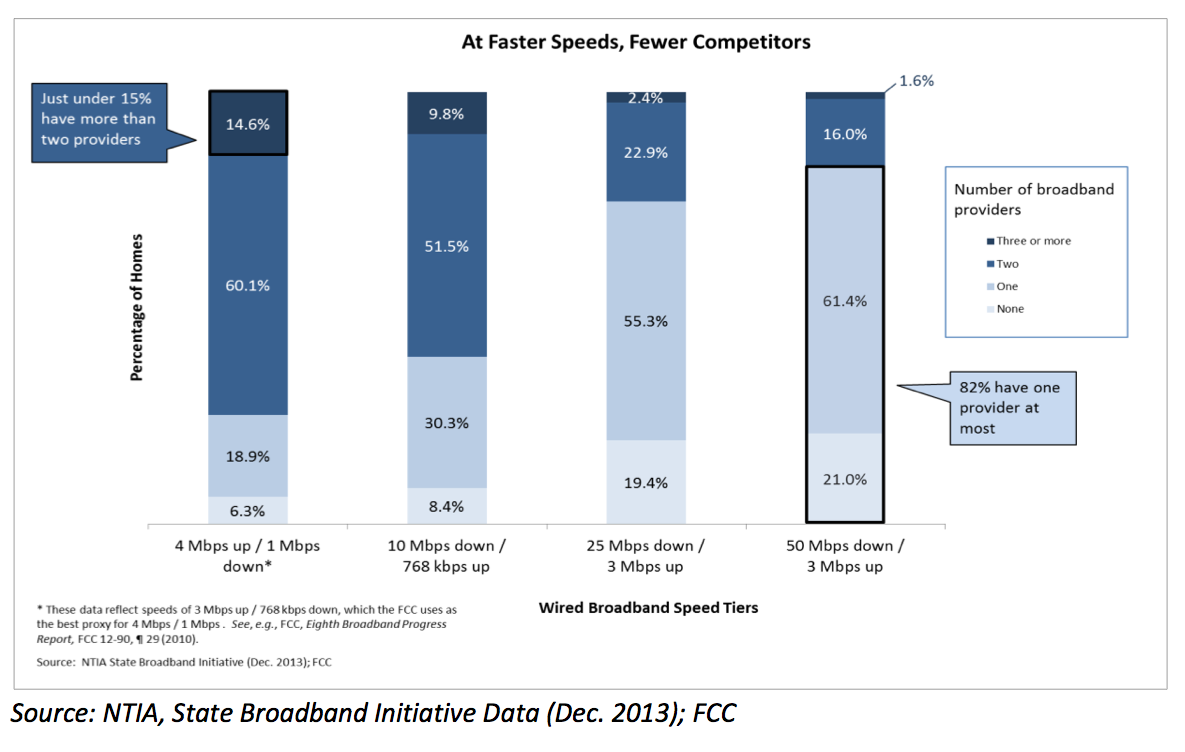
#4 If you check the Broadband Initiative Data for 2013 (last year of available data) at https://cdn.arstechnica.net/wp-content/uploads/2014/09/fcc-b..., you can see for the fastest speeds of 50Mbps down, there's at most one provider for 82% of America.

I'm not suggesting hamstringing ISPs at all, but bringing them to heel since they won't willingly do so. E.g., here in NYC, Verizon is being sued for being unwilling to keep its contract to make FiOS available to every residence (https://www.nytimes.com/2017/03/13/nyregion/ny-sues-verizon-...)