Hacker News new | ask | show | jobs
by tzamora 3244 days ago
I guess you are talking processed, adultered meat. If you have normal organic meat there is no problem at all. Likely we have been eating meat from the beginning of our existance. The problem is that the anti meat lobby like peta or sugar-bread industry want us to buy more of their products. Keto is a really good healthy diet its just that requires that you educate yourself and also is really hard to mantain because we are really very addicted to bread, flour and sugar.
4 comments

> If you have normal organic meat there is no problem at all

Source?

Because all of this seems to show otherwise:

https://www.ncbi.nlm.nih.gov/pubmed/23306319

http://www.bmj.com/content/357/bmj.j1957

http://ajcn.nutrition.org/content/85/2/518.full

http://cancerpreventionresearch.aacrjournals.org/content/can...

> Likely we have been eating meat from the beginning of our existance

Just because we have evolved eating meat, doesn't necessarily mean it is the most optimal. Appeal to Nature.

> The problem is that the anti meat lobby like peta or sugar-bread industry want us to buy more of their products

What "products" is PETA selling??? I have a lot of qualms with PETA, but I have never seen them vindicated in this way...

> Keto is a really good healthy diet its just that requires that you educate yourself

You seem to be really invested in the diet. Maybe you have some bias?

Look, you can be on a ketogenic diet and not eat meat at all. I eat a few ounces a day. I could easily not eat any at all and still maintain a high fat ketogenic diet, but I enjoy the flavor.

I also have read plenty of studies that contradict the ones above. I'm not saying they are necessarily wrong. But I find medical statistical studies very hard to interpret because they don't control for all the factors and the data is not super reliable. Often the conclusions seem excessive given the data that is actually there.

> Look, you can be on a ketogenic diet and not eat meat at all.

For sure, but I doubt most people doing Keto are eating very little to no meat.

> I find medical statistical studies very hard to interpret because they don't control for all the factors and the data is not super reliable

Ok so you are suggesting we throw out all studies because they may or may not control for all the variables? That seems like a zero sum proposition that is a bit overkill. Of course there are some studies that are less rigorously controlled than others, but to conclude that no studies can be trusted because "medical statistical studies very hard to interpret" and "the data is not super reliable" just seems like an excuse to ignore what is very compelling evidence.

Of course I don't want to throw the studies out. I'm suggesting the conclusions are too strong and not necessarily justified.
https://www.ncbi.nlm.nih.gov/pmc/articles/PMC4944490/?report...

Also please read China Study critiques. They are good at dismantling "red meat is bad" point of view.

1. The study you referenced included 28 participants and utilized food frequency questionnaires. Maybe you have something more substantial? Because that is pretty weak on multiple levels.

2. Nobody is referencing the China Study here. It is also 12 years old. Not sure what critiques you are referring to (as you didn't reference any), but I highly doubt they would discredit the information I referenced just because they have to do with "dismantling" the "red meat is bad point of view."

Here is yet another huge meta analysis of the correlation between red meat and Type 2 Diabetes published just 2 years ago:

https://www.researchgate.net/profile/Yoona_Kim5/publication/...

I really hate this argument. On one hand Keto advocates cry about the grain and sugar lobby, on the other they don't even consider the massive outreach the livestock lobby has and their interest in pushing this diet.

Even organic meat and animal products don't come without health risks and it comes at substantial cost to our environment.

You don't have to eat a lot of meat on this diet. I've been on the diet for years, have read a lot of information on it (fortunately it's been used for medical purposes for over 100 years so there is plenty of material). I personally eat a few ounces a day because I enjoy it. But it could easily be left out, I'd just have to get my protein elsewhere.
Why would organic meat be better? Link to science?
In the case of Beef, grass fed beef has substantially better fat/cholesterol profile, and more micro-nutrients/antioxidants

https://nutritionj.biomedcentral.com/articles/10.1186/1475-2... http://www.mayoclinic.org/diseases-conditions/heart-disease/...

Granted that's a relative judgement. Too much meat, even organic meat, can be unhealthy depending on a number of factors.

Even organic meat and fish has a lot of downsides. Animal fat and protein is not good for us. Check the videos at nutritionfacts.org for details.
nurtitionfacts.org is run by Michael Greger who is a vegan animal welfare crusader. Many of the articles have a factual basis but there is cherry picking to promote animal free diets so it is not an unbiased source.
Yeah this website is definitely to be taken with a grain of salt (even though Greger wouldn't be happy about the sodium intake), but at least he thoroughly cites his sources.

Websites advocating for a Ketogenic diet feel just as biased and most of the time don't have half the research backing it.

This is an ad hominem and quite unfair. Michael Greger states himself that he does not like the term veganism, and he also writes that it was the health benefits of a plant based diet that led him to promote that diet. To call him a "vegan animal welfare crusader" is a bit hyperbolic to say the least.

From Greger's book How Not to Die he writes in the Introduction to Part 2:

> From a nutrition standpoint, the reason I don’t like the terms vegetarian and vegan is that they are only defined by what you don’t eat. When I used to speak on college campuses, I would meet vegans who appeared to be living off french fries and beer. Vegan, technically, but not exactly health promoting. That’s why I prefer the term whole-food, plant-based nutrition. As far as I can discern, the best available balance of evidence suggests that the healthiest diet is one centered on unprocessed plant foods. On a day-today basis, the more whole plant foods and the fewer processed and animal products, the better.

And from the Preface of How Not to Die he writes:

> True, I have biases of my own to rein in. Although my original motivation was health, over the years, I’ve grown into quite the animal lover. Three cats and a dog run our household, and I’ve spent much of my professional life proudly serving the Humane Society of the United States as the charity’s public health director. So, like many people, I care about the welfare of the animals we eat, but first and foremost, I am a physician. My primary duty has always been to care for my patients, to accurately provide the best available balance of evidence.

He backs up all his claims with extensive citations from recent, peer reviewed studies. The link between meat and heart disease, diabetes, and even cancer is very well established now.

Anecdotally, keto diet did absolutely nothing for me except make me feel even worse, whereas I’ve noticed dramatic improvements in mood and health after three weeks of a purely plant based diet.

The site is very good at sourcing articles and it is an excellent resource as long as you realise he is probably ethically inclined not to promote any study which might increase the suffering of animals.

I don't think that makes him a bad person or the website valueless but it is hard to argue it does not have a strong ethical vegan bias.

At the moment I would claim that overconsumption of highly processed, mostly plant based foods is the real nutritional disaster. Meat consumption is falling in many places but obesity and related diseases are still getting worse.

If you don't have ethical concerns I think low to moderate consumption of animal protein as part of a balance diet is still probably sensible. You probably want to avoid processed meats and charring. But we are all going to die from something and statistically it probably isn't going to be from eating an occasional steak.

> Meat consumption is falling in many places but obesity and related diseases are still getting worse.

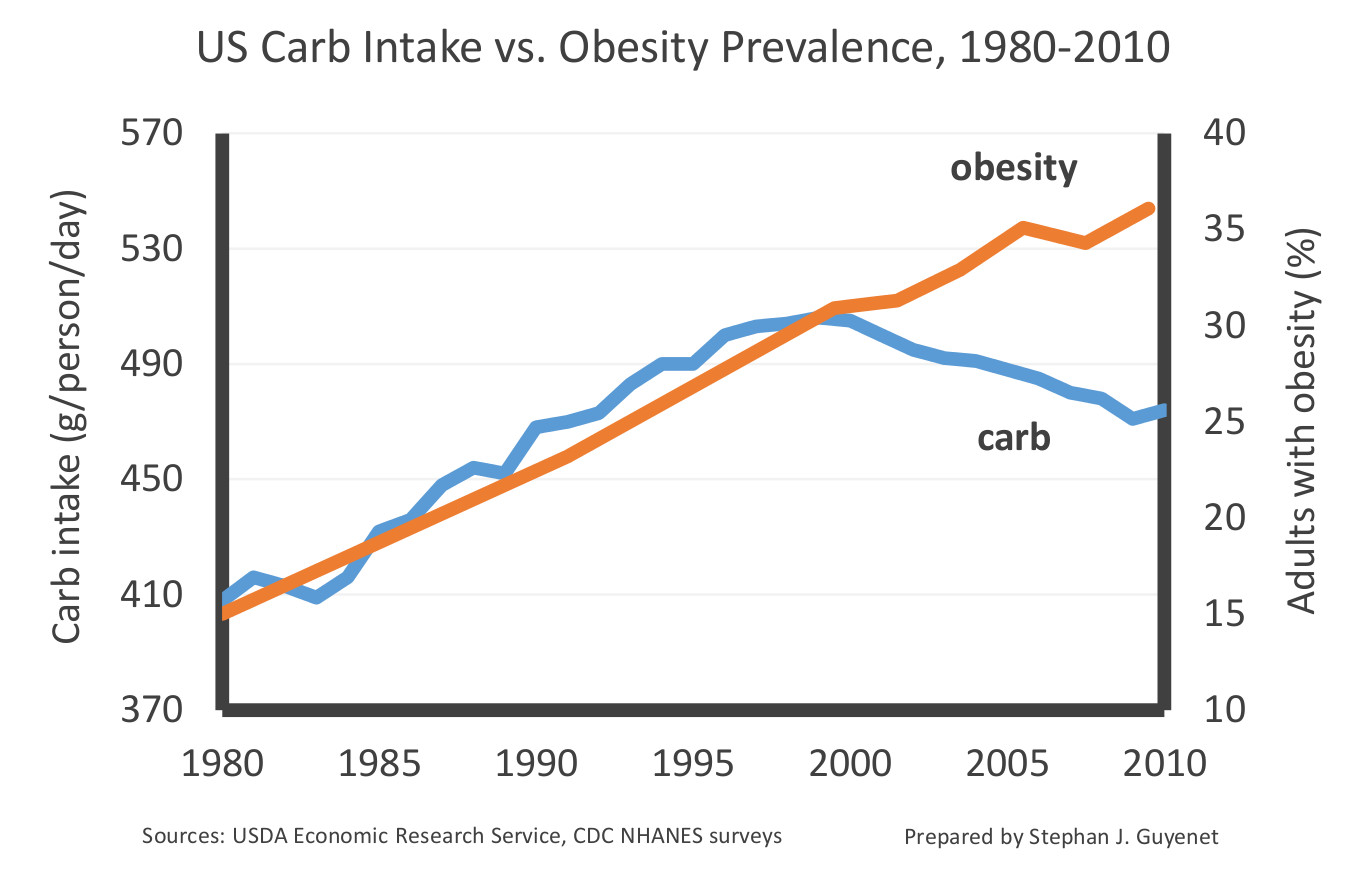
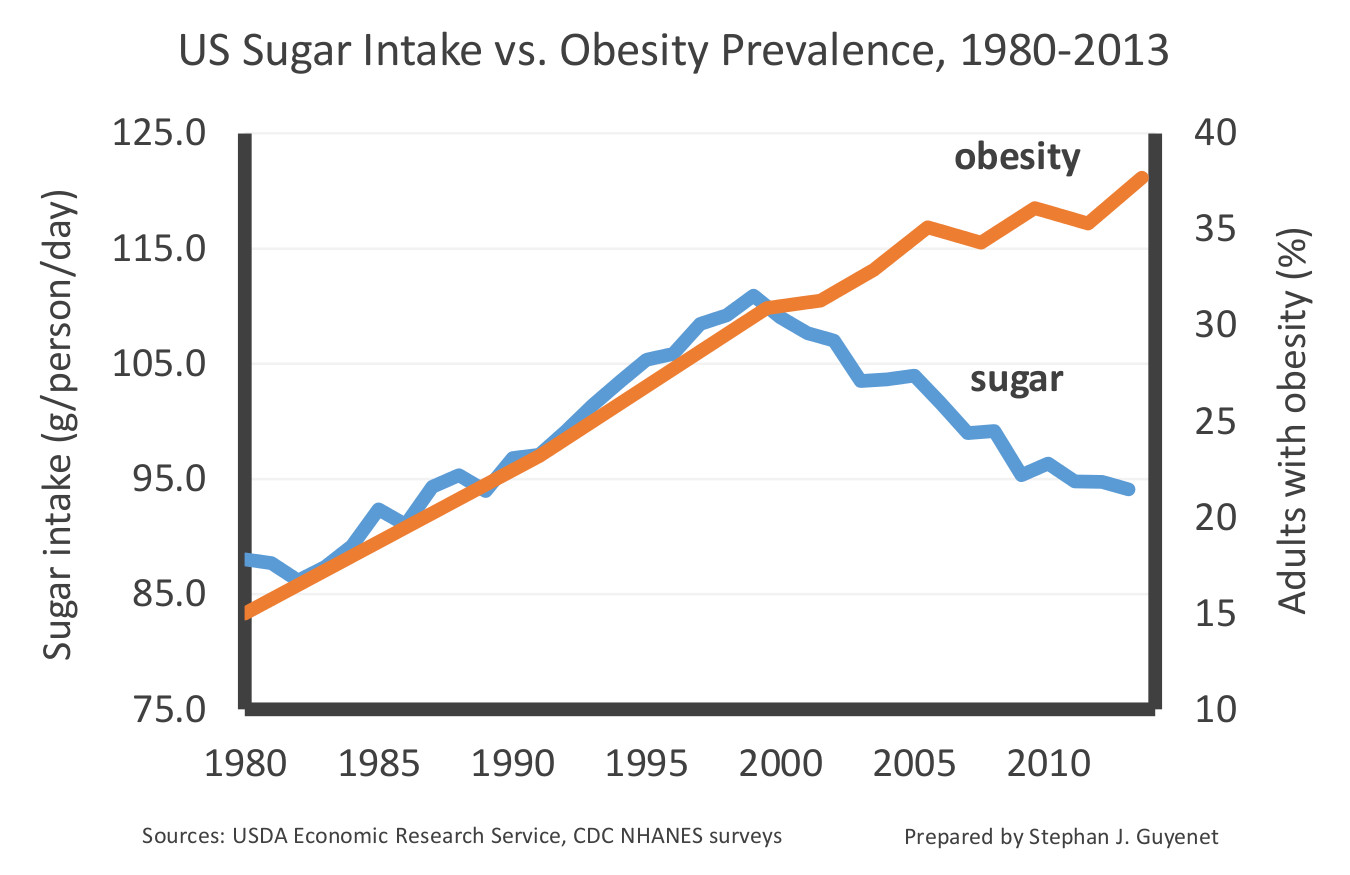
I can use that same logic to say that sugar and carbohydrate consumption has gone down while obesity has continued rising:

http://2.bp.blogspot.com/-0OuoFyJtZuI/VkofY-qgeOI/AAAAAAAAbb...

http://3.bp.blogspot.com/-fUv755XU-3g/Vkof8Eln2WI/AAAAAAAAbb...

The main problem is still OVERCONSUMPTION of highly processed and hormone filled foods

I always thought that heart disease was something I might one day have to worry about but could ignore in the meantime while I enjoy eating what I want. But I'm only 46 now and over the last year I've been experiencing increasing tightness and discomfort in my chest and strong heart arrhythmia. That's what motivated me to take a closer look at my diet. After only three weeks of eliminating animal products from my diet those symptoms have disappeared.

As for growing obesity, there is a lot of evidence that points to toxins in our food as an important factor:

https://www.youtube.com/watch?v=ieQBdS9cN0I

Most of these toxins are concentrated in animal products.

People are also eating a lot more cheese which contributes to obesity:

https://www.theatlantic.com/health/archive/2013/09/now-is-th...

Of course refined carbohydrates and sugars are also a big problem and they should be scrupulously avoided.

> The link between meat and...diabetes...is very well established now.

There is a group of Type 2 diabetics in remission who are doing just fine on meat-based and keto-based diets, with no medication. If meat was a causal contributing factor to diabetes, I wouldn't expect to see that. We do eat a lot of leafy greens, it isn't like all-meat-all-the-time. But fresh meat, simply prepared, eaten to the protein macros appropriate for your body, does nothing to exacerbate these already-diagnosed Type 2 patients from going back into Type 2.

A contributing factor to diabetes is surplus calories creating excess body fat. You can do that with meat, vegetables, fruit, and breads. Harder to do with vegetables if you eat the veggies raw; if you eat only leafy greens for vegetables, I'd say it is nearly impossible.

There are vegan/vegetarian Type 2 patients, but I have yet to run across one in remission on no medication, for two years or longer, so they might be rare. It is much harder to get your proteins while carb restricted to manage blood sugar levels, eating only vegetables; I'm sure there are vegetarian Type 2's in remission out there, likely using soy-based products and protein powder to get their protein, it's just not as popular a method of going into remission.

Personally, I switched to preparing meals using as unprocessed as possible foods. If I could eat raw beef (like a tartare), I would; I don't because it is too time-consuming to prepare. This rules out tofu and other soy-based products, and protein powders as well, for me personally. I can manage to build muscle and keep my blood sugar markers in a normal non-diabetic range as long as I keep my daily net carbohydrate intake to 20g or less. If you are familiar with vegetarian diets and can suggest a way for me to switch to a vegetarian approach that observes that, supports about 2500 calories per day, and is made from unprocessed ingredients, then please let me know, thanks.

> There is a group of Type 2 diabetics in remission who are doing just fine on meat-based and keto-based diets

But how are their arteries looking?

> but I have yet to run across [a vegetarian/vegan] in remission on no medication, for two years or longer, so they might be rare

How many have you run into? How strictly were they following a whole-food plant-based diet? What is your sample size?

Scientifically speaking, the movie "What The Health" summarizes the facts succinctly:

Low Fat, Plant-Based Diet is More than Twice as Powerful at Controlling and/or Reversing Diabetes, than the ADA Diet Recommending Meat and Dairy

See http://www.whatthehealthfilm.com/facts/ for a list of citations supporting that statement.

Avoiding processed foods, both animal and plant, is a good idea.

But the links between diabetes and animal products are pretty well established:

https://nutritionfacts.org/video/why-is-meat-a-risk-factor-f...

https://nutritionfacts.org/video/diabetes-as-a-disease-of-fa...

You might want to have a look at this book too:

https://www.amazon.com/Neal-Barnards-Program-Reversing-Diabe...

> But the links between diabetes and animal products are pretty well established

How was the link determined? I'd like to see the number of studies that studied people with low carb diets. Carbs is in pretty much everything nowadays, and it's really difficult to find people that consumes <5% that are not doing some low carb diet on purpose.

Or people that eat only once a day.

Very related: https://news.ycombinator.com/item?id=14831224

Does your plant-based diet include bread/carbs, and did you stick with the keto diet for more than a few days?

Usually when people feel like crap (initially) on keto it's their bodies switching over from primarily burning sugar to primarily burning fat, but it subsides after a few hours/days depending on the person/diet (look up "keto flu").

Note that keto does not necessarily include meat. You'd get the same effect eating nothing but raw vegetables for a week.

I eat complex carbs like brown rice. I avoid refined carbs. I did keto for two weeks and finally had to stop because I felt worse and hated what I was eating. To be clear I was eating the kind of keto diet I usually see people endorse which is very heavy in animal fat and protein.

In contrast I’ve been purely plant based for three weeks now and I’ve noticed dramatic improvements in my mood and energy levels. I’ve lost a bit of weight and I really enjoy what I’m eating. The numbness and swelling I’ve struggled with for over a year as a result of surgery for a broken leg has also massively improved, which I didn’t expect.

Yeah that would be the difference. I'm not really technically "keto" at this point given my cheat days, right now I'm doing a 16/8 daily fast, but my typical diet is about 2/3 fruits and vegetables 1/3 meat, and I've never felt better. By contrast I once tried eating something like 90% meat for weeks and also felt like crap (although I did lose weight). The lack of fiber was particularly palpable. :P

My personal theory is a lot of prescribed keto diets have lax regulations on meat, so everyone who goes for them immediately maxes out the tastiest item available. The meat, assuming it's high quality/minimally processed isn't a problem directly, but eating more meat means you're eating fewer vegetables/fruit/nuts to balance things out.

I'd still say meat is more than a luxury in moderate doses. Zinc/B-Vitamins/Omega-3s and a lot of other good stuff is very hard to find naturally in non-meat form, and given the lack of regulation in the supplement industry I'd rather get such things through food.

I've switched to a diet that is mostly plant based with small portions of meat occasionally and low carb intake. I don't agree that "plant based" is the reason you feel better but I do think not eating huge quantities of meat and carbohydrates/sugar causes your body to be a little more accommodating.