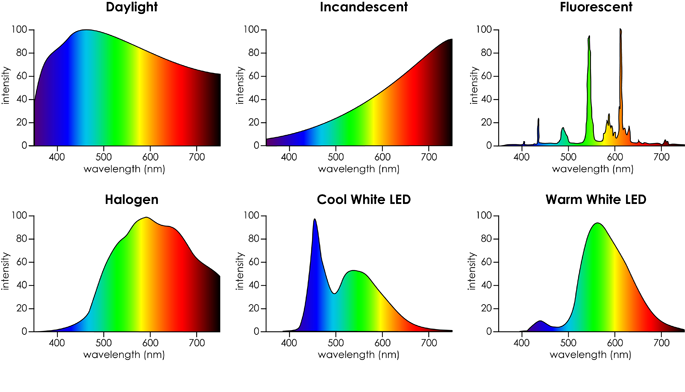
They emit more blue light than incandescent bulbs [1]. If people light their households with LED lights at night, it might shift their circadian rhythms [2]. Screwed up circadian rhythms can have all sorts of negative health/productivity effects.
I'll be trying my hand at some LED strip / arduino programming to build a dawn alarm that goes from dim red to bright white progressively. I have a Philips halogen dawn alarm which naturally goes from orange -> red as it ramps up, but unfortunately doesn't get quite as bright as I would like for that "wake up at the cabin" experience.
I'd love to see more applications of LEDs providing the right color temperature and intensity for the time of day, as well as more applications that avoid the bulb form factor. I'd love for my ceiling to emit light like the sky...
Those look like a very polished product! In my case, I'm looking to take advantage of the availability of $15 for a 300 RGB LED strip, as well as for the challenge writing my own control logic with an arduino. The SAD wake-up alarm is more of a side-benefit.
I'd been considering a project like this recently. I'd like some way of bringing the amount/timing/frequency of light I experience indoors closer to what I would experience were I in the outdoors, under the assumption that it would be better for my sleep/wake cycle and possibly other things.
That thought occurred to me as well. Circadian phase delay already seems to be a problem re: the increasing brightness of our computing devices, almost all using LEDs.
New phones, tablets, TV's, etc. should come with a warning to keep them "dimmed down" in the evening, or better, keep use to a minimum late in the day. Sure, I know, the odds are about zilch people would actually heed such advice, but it ought to be out there anyway.
Another thing is the the relatively low CRI. For many purposes (industrial, medical, artistic) the spectral output of bright LEDs is far less than ideal. LEDs will probably get closer to "full-spectrum" over time, and no doubt will easily beat the discontinuous spectrum of fluorescent lamps.
LEDs now just need to get cheap enough, and really need to work with existing dimmer controllers.
what is the relevance of that blue spike? Incandescent spectrum looks much more linear (http://housecraft.ca/wp-content/uploads/2012/09/spectral_res...), but appears to maybe emit more (just judging by eye) aggregate blue energy than the warm white LED.
Then again intensity towards blue-green still seems much higher in the LED, and maybe that matters more?
I haven't managed to find an LED warm/soft bulb that actually has a spectrum like in the chart you linked.
The spectrum I linked above is from http://www.designingwithleds.com/measuring-light-quality-phi... -- it's for a Cree Soft White bulb. There's a bunch more area under the curve over the range that seems to matter for that bulb than for the incandescent one (although incandescent bulbs might not be great at night either...)
Green light does alter circadian rhythms as well, although not as strongly as blue (peak responsivity seems to be ~460-480nm). The actual circadian-wavelength-responsivity curve doesn't seem to be well mapped out, as far as I can tell.
I would suppose that intensity is as or more important than exact wavelength (within the violet-to-green range), given the increasing intensity of the rising sun is the origin of our circadian-rhythm adaptation.
I'd pay good money for a TV with integrated F.lux (i.e. blue gradually degrades with the movement of the sun).
I started using F.lux too many years ago now to count, and honestly it really seemed to help. However getting similar kind of functionality on all of your other devices (e.g. Tablets, Phones, TV, etc) is near impossible right now.
As far as I know the "blue light ruins sleep" research is fairly decent, so hopefully it isn't a placebo.
For Android I use something called "Twilight". It is a good stand in for F.lux, and even has a few extras. For time control, it has the standard sunrise/sunset coordinate system that F.lux uses, as well as Alarm control to set custom bedtime/wakeup.
Interesting link. The contrarian in me says it only looks at a couple bulbs, and in my (limited) experience with a variety of new low-end LED bulbs the light quality varies greatly and has also been improving, so maybe this won't end up being much of an issue on circadian rhythms at all. But it's an interesting factor I hadn't been considering (how do LED's compare in this to the CFL's that have already replaced incandescents for many, I wonder?)

I'd love to see more applications of LEDs providing the right color temperature and intensity for the time of day, as well as more applications that avoid the bulb form factor. I'd love for my ceiling to emit light like the sky...