Hacker News new | ask | show | jobs
by jp555 4277 days ago
Almost all the LEDs in my house are ~2700K, about the same an incandescent lights.

Regarding circadian rhythm, light from near-sleep-time television watching is much more of a concern, but that's been a problem for at least 30 years.

2 comments

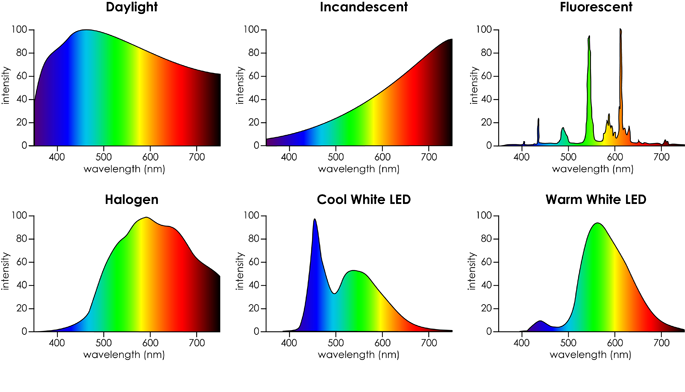
2700K can still have a spike of blue in the wrong spot. this is a 2700K bulb: http://www.designingwithleds.com/wp-content/uploads/2014/01/...
what is the relevance of that blue spike? Incandescent spectrum looks much more linear (http://housecraft.ca/wp-content/uploads/2012/09/spectral_res...), but appears to maybe emit more (just judging by eye) aggregate blue energy than the warm white LED.

Then again intensity towards blue-green still seems much higher in the LED, and maybe that matters more?

I haven't managed to find an LED warm/soft bulb that actually has a spectrum like in the chart you linked.

The spectrum I linked above is from http://www.designingwithleds.com/measuring-light-quality-phi... -- it's for a Cree Soft White bulb. There's a bunch more area under the curve over the range that seems to matter for that bulb than for the incandescent one (although incandescent bulbs might not be great at night either...)

Green light does alter circadian rhythms as well, although not as strongly as blue (peak responsivity seems to be ~460-480nm). The actual circadian-wavelength-responsivity curve doesn't seem to be well mapped out, as far as I can tell.

I would suppose that intensity is as or more important than exact wavelength (within the violet-to-green range), given the increasing intensity of the rising sun is the origin of our circadian-rhythm adaptation.
I'd pay good money for a TV with integrated F.lux (i.e. blue gradually degrades with the movement of the sun).

I started using F.lux too many years ago now to count, and honestly it really seemed to help. However getting similar kind of functionality on all of your other devices (e.g. Tablets, Phones, TV, etc) is near impossible right now.

As far as I know the "blue light ruins sleep" research is fairly decent, so hopefully it isn't a placebo.

For Android I use something called "Twilight". It is a good stand in for F.lux, and even has a few extras. For time control, it has the standard sunrise/sunset coordinate system that F.lux uses, as well as Alarm control to set custom bedtime/wakeup.