I came to post the same thing... I had NeXT cube serial number 32 on my desk at Los Alamos as an intern back in '88 running NextStep 0.8 and clearly remember how amazing the machine was. We got the first 50 of the line (I think) because a guy in the Laboratory was a friend of Jobs, and Jobs wanted to promote the box as the perfect research tool thanks to Mathematica and the like.
Windows 95 looks quite similar to NeXTSTEP, with very similar gray window decorations and beveled (might be the wrong word) borders and buttons. It could be a design of times kind of thing, but to me it looks very "inspired".
For what it's worth, I remember thinking that Windows95 was 'inspired' by NeXTStep when it was new. The NeXTStep machines themselves were pretty amazing for their late-80's origin. They had (and effectively used) 4-level 1-megapixel displays at a time when PC's were largely stuck at 640x480 or worse.
High screen resolutions were certainly possible on DOS PCs of the era, but since PCs were an open platform, developers would often target their software at the lowest common denominator of hardware, so outside of specific niche markets, they didn't typically produce DOS applications intended for high-resolution displays.
On top of that, the DOS market in that era always preferred to make the tradeoff in favor of higher color depths rather than higher resolutions. At 640x480, a VGA display contemporary to NeXTStep could display 16 colors, and at 320x200, 256 colors.
> On top of that, the DOS market in that era always preferred to make the tradeoff in favor of higher color depths rather than higher resolutions.
I think I'd characterize it a little differently: I remember games favoring 256-color modes (320x200, ModeX, etc.) and productivity applications favoring higher resolution. At the time, having both high bit depths and high resolution at the same time was asking too much of the hardware.
To put it in perspective, for a while, my desktop PC was an older generation 486/33. When I say 'older generation', what I mainly mean is that it was one of the last machines that lacked a local bus of any kind. This put the video board behind an ISA-bus, which was lucky to sustain 8MB/sec shared across all peripherals. Just looking at the bus, it couldn't update a full 1024x768 desktop at more than 10Hz. (320x200 was well over 100Hz).
I actually had a 486 DX50 in the early '90s, probably around the same time as you had your 486. It had an EISA bus - a 32-bit extended version of ISA - which was roughly contemporary with NeXTStep, and that supported about 20 MB/sec of usable bandwidth. I had a Diamond Speedstar video card which allowed Windows 3.1 to run very smoothly at 1024x768, 256 colors. It could, IIRC, work very well at 1280x1024 in 16 color mode, which would definitely have been comparable to anything NeXTStep had to offer, at least in the graphics department.
But when it came to productivity applications, they were probably more conservative than anything else on the PC platform. Even though I had this great video card and could run Windows 3.1 at high resolutions, I still exited to DOS to run WordPerfect in 80x25 text mode.
I actually recently came across a box of floppies that I used in middle school. Schoolwork that I did in 7th grade, in 1992, was all saved in WordPerfect 5.1 format. Stuff from 8th grade, 1993, was in Ami Pro format. So I'm fairly certain that I didn't start using any productivity software in Windows until about 1993.
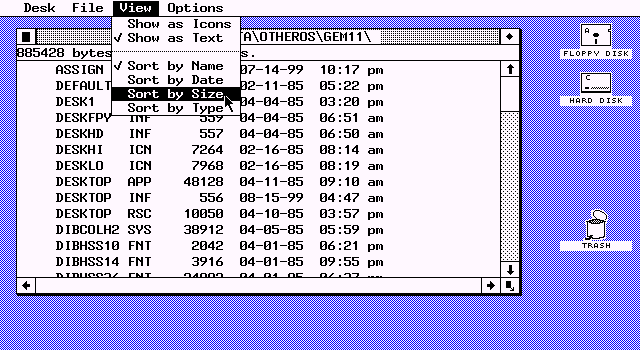
The only graphical productivity application I remember using prior to that, under DOS, was Ventura Publisher, which, IIRC, actually used a custom version of the GEM GUI. But I ran that on my 8088 XT-clone in EGA mode.
There was a store in the basement of my college dorm that sold Intel-based NeXTStep machines. As befitting the OS and the time, they were all very high end machines: 486DX2/66, EISA/VLB, SCSI Disk, 32+MB, and all priced well over $5K. I remember drooling over the machines, but never had the cash to actually buy one. In 1995, I ultimately skipped from the ISA 486DX/33 to a PCI-based P5/100. The P5 was in a completely different league, of course.
Regarding software, my family and I went straight over to Windows productivity software with the release of Windows 3.0. The back story behind that was that our first printer (ca. 1986-7) was a Toshiba P321. This was a relatively new, 24-pin printer that was almost completely unsupported by the DOS software that we had. Windows 3.0 solved the support problem by giving us a single, good printer driver that worked for anything that could print through the Windows API. Between that, the protected mode memory manager, and support for 16 color 800x600, Windows was a compelling enough package that we immediately switched over almost entirely in 1990.
The NextStep was way ahead on the curve for it's time (which is one of the reasons it failed).
I read an awesome piece a while back (and for the life of me I can't remember where) that said if you want to design for the future, estimate what computing power will be available in 10-15 years then buy that for your developers.
In that project I think they spent 186,000 per machine per user on average but they where designing software light years ahead of its time.
The NextStep didn't work out for a bunch of reasons cost been one of the major ones.
The other project wasn't trying to create a product they where trying to capture a sense of what hardware would be on every desk in 10 years and design for that, in effect skating to where the puck will be rather than where it is.


Those were fun times!